Weekend Update

Weekend Update

Photo by Dane Deaner on Unsplash

The U.S. House of Representative both will be engaged in committee work through Wednesday this week until Yom Kippur begins on Wednesday evening. The Senate also will be engaged in floor voting for the same period. Committee work principally will focus on the details of the $3.5 trillion budget reconciliation bill and a related Plan B measures including a stopgap extension of federal funding past September 30 and addressing the debt ceiling.

On the Delta variant front

The Wall Street Journal explains that epidemiologists no long think that COVID-19 can be eradicated. We have a good shot at the virus becoming endemic / a routine treatable illness.

When or even whether Covid-19 settles into that status depends on how many more people get vaccinated and how soon, said Adolfo Garcia-Sastre, director of the Global Health and Emerging Pathogens Institute at the Icahn School of Medicine at Mount Sinai in New York.

For Covid-19 to become mild, most people will need some immunity, which studies have shown reduces the severity of the disease. Infections provide some immunity, but at risk of severe illness, death and further spread of the virus, compared with vaccines. People could become vulnerable to SARS-CoV-2 if that immunity erodes or is weak, or if the virus mutates.

“The more people who are vaccinated, the less problems there are going to be,” Dr. Garcia-Sastre said.

The Journal’s Numbers columnist explains why COVID-19 vaccination boosters will be necessary.

“We’re fortunate with tetanus, diphtheria, measles and vaccinia,” Dr. [Mark] Slifka [from the Oregon Health & Science University] said. “We have identified what the threshold of protection is. You track antibody decline over time, and if you know the threshold of protection, you can calculate durability of protection. With Covid, we don’t know.”

Complicating things further, viruses and bacteria that mutate to escape the body’s immune response are harder to control.

Measles, mumps, rubella and chickenpox hardly mutate at all, but at least eight variants of SARS-CoV-2, the virus that causes Covid-19, have been found, according to the British Medical Journal.  

“It does make it more complicated for the vaccine to work,” Dr. Slifka said. “You’re chasing multiple targets over time. Flu also mutates. With flu, we’ve adjusted by making a new flu vaccine each year that as closely as possible matches the new strain of flu.”

The FDA’s Vaccines Advisory Committee meets on the topic of COVID-19 boosters this Friday September 17. The CDC’s Advisory Committee on Immunization Practices has scheduled a complementary meeting for September 29.

The FEHBlog ran across this interesting WebMD article titled “Monoclonal Antibodies vs. Vaccines vs. COVID-19: What to Know.” “‘As hospitalizations go up nationwide, we have a therapy here that can mitigate that,’ says William Fales, MD, medical director of the Michigan Department of Health and Human Services Division of EMS and Trauma. Getting monoclonal antibodies is one of ‘the best things you can do once you’re positive.’” However, the vaccine’s protection against COVID-19 has a much longer duration than this treatment. “There are two authorized uses for monoclonal antibodies: To treat or stop COVID-19’s progression in a high-risk person who tests positive, and to prevent COVID-19 in a high-risk person who’s been exposed.” The treatment is administered while hospitalized or while outpatient at an infusion center.

In RX news, Managed Healthcare Executive reports

The FDA has approved 30 biosimilars and 21 have been launched. But it won’t be till biosimilars for some of the more widely prescribed biologics are on the market before biosimilars really start to have a major impact on American healthcare and its cost, according to a top-ranking executive at OptumRx.

“We’re still a few years away from the point at which the most widely-utilized … products in the U.S. today will be available as biosimilars,” Savitha Vivian, senior vice president of clinical and formulary Services for OptumRx, said in an interview with Managed Healthcare Executive®. “And that’s really what we’re looking for, because that’s going to enable a more sizable and impactful bottom-line savings.”

Ms. Vivian expects Humira to hit the bio-similar market in 2023.

“Another significant biosimilar launch that is still two to three years away from one for Novo Nordisk’s insulin aspart injection (Novolog), a “highly utilized medication, especially in the outpatient setting,” noted Vivian.Biosimilars for Genentech’s Actemra (tocilizumab), a medication for rheumatoid arthritis and other forms of arthritis, and Stelara (ustekinumab), Janssen’s immunosuppressive drug for plaque psoriasis and psoriatic arthritis, are also two or three years away.”

Patient and provider comfort with biosimilars is still a “critical barrier” to the adoption of biosimilars, she said.

Switching therapies in patients who are stable on the biosimilar’s reference product to the biosimilar is not typically recommended, according to Vivian. “So from a clinical perspective, we need to be cautious in implementing strategies that force these types of switching.”Instead, she said, “what we really need is data showing that there’s really no additional risk from switching therapies in these hard-to-treat or hard-to-control chronic diseases. That’s going to really increase the confidence for prescribers to start using biosimilars in … those stable patients.”

Another barrier is a lack of interchangeability in biosimilars, with notable exception of Semglee (insulin glargine-yfgn), which was FDA-approved as biosimilar to, and interchangeable with Lantus (insulin glargine) this summer. In order to demonstrate interchangeability, studies must show there is no additional risk or reduced efficacy if a patient switches back and forth between the interchangeable biosimilar and the reference product.


Tuesday’s Tidbits

Photo by Patrick Fore on Unsplash

On the Delta variant front and acccording to the CDC’s COVID Data Tracker, the United States reached two data points today — the number of COVID cases now exceeds 40 million and the percentage of Americans aged 18 and over who have received at least one dose of a COVID-19 vaccine reached 75%.

At the end of 2020, the number of cases according to the CDC stood at 20 million. In his blog, National Institutes of Health Director Francis Collins discusses a recent Nature study estimating that “the true number of [COVID] infections by the end of 2020 at more than 100 million [1]. That’s equal to just under a third of the U.S. population of 328 million. This revised number shows just how rapidly this novel coronavirus spread through the country last year. It also brings home just how timely the vaccines have been—and continue to be in 2021—to protect our nation’s health in this time of pandemic.” It also suggests to the FEHBlog that we may to closer to effective herd immunity in some areas of the U.S. than generally thought.

Also David Leonhardt in today’s New York Times tells us about another way to look at the situation.

The C.D.C. reported a terrifying fact in July: Vaccinated people with the Delta variant of the Covid virus carried roughly the same viral load in their noses and throats as unvaccinated people.

The news seemed to suggest that even the vaccinated were highly vulnerable to getting infected and passing the virus to others. Sure enough, stories about vaccinated people getting Covid — so-called breakthrough infections — were all around this summer: at a party in Provincetown, Mass.; among the Chicago Cubs; on Capitol Hill. Delta seemed as if it might be changing everything.

In recent weeks, however, more data has become available, and it suggests that the true picture is less alarming. Yes, Delta has increased the chances of getting Covid for almost everyone. But if you’re vaccinated, a Covid infection is still uncommon, and those high viral loads are not as worrisome as they initially sounded.

How small are the chances of the average vaccinated American contracting Covid? Probably about one in 5,000 per day, and even lower for people who take precautions or live in a highly vaccinated community. * * *

I will confess to one bit of hesitation about walking you through the data on breakthrough infections: It’s not clear how much we should be worrying about them. For the vaccinated, Covid resembles the flu and usually a mild one. Society does not grind to a halt over the flu.

In Britain, many people have become comfortable with the current Covid risks. The vaccines make serious illness rare in adults, and the risks to young children are so low that Britain may never recommend that most receive the vaccine. Letting the virus continue to dominate life, on the other hand, has large costs.

“There’s a feeling that finally we can breathe; we can start trying to get back what we’ve lost,” Devi Sridhar, the head of the global public health program at the University of Edinburgh, told The Times.

Well put, Mr. Leonhardt, as usual.

From the federal employee benefits front, OPM posted on the Federal Register website today a notice of changes to Federal Group Life Insurance premium rates for “Employee Basic Insurance, Option A (most age bands), Option B (most age bands), Option C (most age bands), and Post-Retirement Basic Insurance. These rates will be effective the first pay period beginning on or after October 1, 2021.”

From the tidbits department

  • Federal News Network reports that “The White House is proposing billions of dollars in supplemental funding for disaster relief and other programs, which it’s asking Congress to attach to a short-term continuing resolution that will be critical toward avoiding a government shutdown at the end of the month. ‘With the end of the fiscal year rapidly approaching, it’s clear that Congress will need to pass a short term continuing resolution to provide more time for the fiscal 2022 process to unfold,’ Shalanda Young, the Office of Management and Budget’s acting director, said Tuesday in a blog post.” 
  • Fierce Healthcare informs us that “The American Medical Association [“AMA”] released updates to its medical codes for 2022 with many tied to new technology services and the administration of COVID-19 vaccines. The AMA made 405 changes in the 2022 Current Procedural Terminology code set, including 249 new codes, 63 deletions and 93 revisions. The changes will take effect Jan. 1. ” The CPT is recognized as a HIPAA electronic transaction code set.
  • AP News reports that “Four companies in the drug industry said Saturday that enough states had agreed to a settlement of lawsuits over the opioid crisis for them to move ahead with the $26 billion deal. An announcement from the three largest U.S. drug distribution companies and a confirmation from drugmaker Johnson & Johnson, which had previously announced that it would move ahead, came Saturday. That was the deadline for the companies to decide whether there was enough buy-in to continue the settlement plan. * * * Together, the settlements are likely to represent the biggest piece of a string of settlements between companies in the drug industry and state and local governments over the addiction and overdose epidemic in the U.S.”
  • Healthcare Dive tells us that “The use of telehealth for patient visits seems to have leveled off at 20% or fewer of all appointments, more than a year and a half after COVID-19 first spurred an unprecedented jump in utilization, according to a new survey from KLAS Research and the Center for Connected Medicine.”
  • The AMA discusses “what doctors wish patients knew about a prediabetes diagnosis,” which of course is a fairly common diagnosis in our country.
  • The Wall Street Journal continues its series on the Future of Everything in healthcare with an article about sensor studded smart clothes. “From a prescription bra that signals cardiac arrest to a mosquito-proof textile, startups and scientists are developing garments for healthier living.”

Tuesday Tidbits

Photo by Patrick Fore on Unsplash

From the Delta variant front —

Medscape reports on yesterday’s CDC Advisory Committee on Immunization Practices meeting:

“Vaccines remain effective in preventing hospitalization and severe disease but might be less effective in preventing infection or milder symptomatic illness,” Sara Oliver, MD, the CDC scientist who presented the information [about the mRNA vaccines], told the committee.

In a new data analysis released by the CDC on Sunday, unvaccinated adults were 17 times more likely to be hospitalized than vaccinated adults. Hospitalization rates were higher for unvaccinated people in all age groups.

Among the fully vaccinated, people who were hospitalized were much older, more likely to be nursing home residents and more likely to have three or more underlying medical conditions. Nearly a third had immunosuppressive conditions.

Healthcare Dive tells us that

The U.S. government will resume distribution of Eli Lilly’s COVID-19 antibody drug combination in a number of states, HHS said Friday, as cases and hospitalizations in the U.S. are driven higher by the spread of the delta variant.The decision comes roughly two months after administration of Lilly’s therapy was halted by U.S. officials due to concerns of reduced efficacy against coronavirus infections stemming from the beta and gamma variants. Those are now much less prevalent compared with delta, which laboratory testing has shown remains susceptible to treatment with the dual-antibody therapy, HHS said.

Fierce Pharma reports that

Last week’s FDA approval of Pfizer’s Comirnaty vaccine boosted consumer confidence among both vaccinated and unvaccinated people.

A Harris Poll survey over the weekend found that 80% of Americans who were aware of the approval now have more confidence in it. Even more encouraging? Almost half (49%) of unvaccinated people who heard about the approval said they will “probably” or “definitely” get vaccinated.

Overall awareness of the Pfizer approval was high—79% of those surveyed by The Harris Poll were aware of the FDA thumbs-up.

From the telehealth front, Kaiser Health News discusses re-emerging state law barriers to telehealth. “’The whole challenge is to ensure maximum access to health while assuring quality,’said Barak Richman, a Duke University law professor, who said laws and policies haven’t been updated to reflect new technological realities partly because state boards want to hang onto their authority.” The article provides an overview of options available to doctors and state boards.

From the miscellany front

  • Beckers Hospital Review unveils six big ideas in health innovation. For example, Jason Joseph. Senior Vice President and Chief Digital and Information Officer at Spectrum Health (Grand Rapids, Mich.). As we innovate, we are forcing hidden barriers into the light via experimentation. We saw so many of these barriers uncovered within health care, such as lack of connectivity, digital competency, and the need for comprehensive managed workflow. We have shined a spotlight on how much of healthcare relies on people and inconsistent manual processes to get through the system. That needs to change, and that also requires changing a leader’s traditional mindset.
  • The Agency for Healthcare Quality and Research is offering a toolkit to help healthcare providers and possible health plans get patients and members engaged with the diagnosis process.

The toolkit contains two strategies, Be The Expert On You and 60 Seconds To Improve Diagnostic Safety. When paired together, these strategies enhance communication and information sharing within the patient-provider encounter to improve diagnostic safety. Each strategy contains practical materials to support adoption of the strategy within office-based practices.

Be The Expert On You is a patient-facing strategy that prepares patients and their families to tell their personal health stories in a clear, concise way. Research suggests that 79 percent of diagnostic errors are related to the patient-clinician encounter and up to 56 percent of these errors are related to miscommunication during the encounter. Environmental scan findings show that inviting patients to share their entire health story, uninterrupted, and in a way that gives clinicians the information they need can reduce diagnostic errors.

60 Seconds To Improve Diagnostic Safety prepares providers to practice deep and reflective listening for one minute at the start of a patient-encounter. Research suggests that patients are interrupted by their providers in the first 11 to 18 seconds of telling their diagnostic story. Diagnostic safety can be improved when a provider allows a patient to tell his or her health story without interruption for one minute, and then asks questions to deepen understanding.

  • Not every innovative idea makes sense to implement though. The President and Democrat leadership in Congress want the Centers for Medicare Services to “negotiate” drug prices for Medicare Part D plans. Regulatory Focus informs us that “A new drug development model released by the Congressional Budget Office (CBO) estimates a Medicare drug pricing bill like the one proposed by Democrats in the US House of Representatives could result in between 21 and 59 fewer drugs brought to market over the next three decades.”

Tuesday’s Tidbits

Photo by Michele Orallo on Unsplash

From Capitol Hill, Roll Call reports that the House Speaker Nancy Pelosi negotiated a Democrat legislative victory when the House narrowly approved a rule adopting the $3.5 trillion budget blueprint and agreeing to hold a floor vote on the Senate’s bipartisan, $1 trillion infrastructure bill no later than September 27, 2021.

Leadership is hoping to have the reconciliation package, which committees have a Sept. 15 deadline to assemble, ready for floor action around the same time as the infrastructure bill with the goal of passing both by the end of September, House Majority Leader Steny H. Hoyer told reporters on a press call Tuesday afternoon.

How soon the reconciliation package is ready “will dictate to some degree the flow of legislation,” the Maryland Democrat said. “We have not got a hard view on sequencing.”

Federal News Network informs us about three items for federal employees to watch in the bipartisan infrastructure bill.

From the Delta variant front, the American Hospital Association tells us

The Centers for Disease Control and Prevention today released research highlighting two important trends emerging from the COVID-19 pandemic regarding vaccines’ current effectiveness. The first, which looked at breakthrough infections among fully vaccinated front-line health care workers, found that, following the emergence of the SARS-CoV-2 delta variant, there has been a moderate reduction in the effectiveness of COVID-19 vaccines in preventing infection in this group. However, the authors note that “this trend should be interpreted with caution because [vaccine efficacy] might also be declining as time since vaccination increases and because of poor precision in estimates due to limited number of weeks of observation and few infections among participants.” Additionally, the CDC notes that even a sustained two-thirds reduction in infection risk underscores COVID-19 vaccinations’ continued importance and benefits in preventing deaths, hospitalizations and the virus’ spread. 

The second study reviewed SARS-CoV-2 infections in Los Angeles County over the course of nearly three months, starting in May 2021. Researchers found that approximately three out of four cases were among unvaccinated individuals. Additionally, infection and hospitalization rates among unvaccinated persons were 4.9 and 29.2 times more likely, respectively, than those in fully vaccinated persons, with little change when the delta variant took root as the nation’s dominant virus strain.

The Society for Human Resource Management discusses what the FDA’s full approval for the Pfizer vaccine means for employer COVID-19 policies.

The Wall Street Journal informs us that

Johnson & Johnson said [over Tuesday night] that a second dose of its [one dose] Covid-19 vaccine was found in a study to generate a strong immune response, justifying a booster shot after eight months. * * * J&J said researchers found antibody levels increased ninefold among people who received a second dose of its vaccine, compared with one month after they received a first dose. * * *

“We look forward to discussing with public health officials a potential strategy for our Johnson & Johnson Covid-19 vaccine, boosting eight months or longer after the primary single-dose vaccination,” [said] Dr. Mathai Mammen, global head of R&D at Janssen Pharmaceutical Cos. of Johnson & Johnson.

The Biden administration said last week that people ages 18 and older who got the Covid-19 vaccines from Pfizer Inc. or Moderna Inc. should get an extra dose eight months later, reflecting heightened concern over the highly contagious Delta variant and data showing initial immunity to Covid-19 diminishes over time. J&J’s suggested timeline would be in sync with that broader strategy.

Currently boosters are only authorized for immunocompromised people who received two-dose messenger-RNA vaccines. The Food and Drug Administration must authorize extra doses before they can be offered more broadly as recommended by the Biden administration to those 18 and older who received two-dose messenger-RNA vaccines, and it is expected to do so before Sept. 20, when health authorities said messenger-RNA boosters would become available

The CDC’s expert advisory panel on vaccines will meet next week to discuss the Biden administration’s plans for booster shots.

According to the CDC’s website, this virtual ACIP meeting will be held on August 30 and 31.

Finally STAT News reports that

The age at which adults who are overweight or obese should be screened for type 2 diabetes is going down while the prevalence of both forms of the disease is going up among children and adolescents — two developments reported Tuesday that signal a growing burden of these chronic health conditions among Americans.

The U.S. Preventive Services Task Force lowered its recommended age to 35 — down from 40 in its 2015 guidance — to test people with above-normal BMIs for elevated glucose levels that could mean prediabetes or diabetes itself. The new evidence review and recommendations, published in the Journal of the American Medical Association, would make more than 40% of adults eligible for screening, and an estimated one-third will likely meet USPSTF criteria to undertake preventive steps.

Monday Roundup

Photo by Sven Read on Unsplash

From Capitol Hill, Roll Call reports that

Speaker Nancy Pelosi floated a compromise to moderate holdouts Monday that would advance the budget resolution needed to unlock a $3.5 trillion package of aid to families, students and clean energy subsidies in exchange for a guaranteed vote on a separate, $550 billion infrastructure package.

The plan would “deem” the fiscal 2022 budget resolution adopted when the chamber adopts the combined rule for floor debate on the Senate-passed infrastructure bill and voting rights legislation. Pelosi, D-Calif., also committed to a floor vote on the infrastructure bill before Oct. 1, when current surface transportation program authorizations lapse.

The House of Representatives convened at 5 pm ET this evening and went into a recess at 5:30 pm ET for a Democrat member caucus. The House resumed its session with routine business at 6 pm ET and the House recessed again at 8 pm likely for another Democrat member caucus. [Follow-up — Early Tuesday morning the Wall Street Journal reports that “Plans to hold that vote Monday night were [later] abandoned, though, and Mrs. Pelosi said the chamber would vote on the measure on Tuesday as she left the Capitol after midnight.”

From the Delta variant front, Mondays have tended to be a good day for COVID-19 vaccine news. This morning the Food and Drug Administration “approved [for marketing] the first COVID-19 vaccine. The vaccine has been known as the Pfizer-BioNTech COVID-19 Vaccine, and will now be marketed as Comirnaty (koe-mir’-na-tee), for the prevention of COVID-19 disease in individuals 16 years of age and older. The vaccine also continues to be available under emergency use authorization (EUA), including for individuals 12 through 15 years of age and for the administration of a third dose in certain immunocompromised individuals.” This action occurred two weeks before the Labor Day.

The Wall Street Journal reports that

The Food and Drug Administration’s approval was seen by public health officials as a key step to convince hesitant individuals to get the shot and to encourage employers to mandate it. 

“Today I’m calling on more companies in the private sector to step up with vaccine requirements that will reach millions more people,” President Biden said. “I call on you to do that—require it.” * * *

The vaccine is now eligible for off-label prescriptions—or use beyond the approved populations. That could include booster doses, according to the FDA. Prescribing the vaccine off label for children wouldn’t be appropriate as there is no data on proper dosing or safety in youth, said acting FDA Commissioner Janet Woodcock. * * *

Pfizer * * * is now permitted to market the vaccine to doctors, healthcare providers and the general public as it does with other approved products. Pfizer declined to share its marketing and advertising plans but said it seeks to take a thoughtful approach with such communications in hopes of increasing vaccine confidence. 

Pfizer made its FDA marketing approval application last May and Moderna, which produces the other mRNA vaccine, applied for FDA marketing approval in June so Moderna now moves from the on deck circle to at bat.

Federal News Network informs us that “The Pentagon said Monday that it will require service members to receive the COVID-19 vaccine now that the Pfizer vaccine has received full approval. Pentagon spokesman John Kirby said Defense Secretary Lloyd Austin is making good on his vow earlier this month to require the shots once the Food and Drug Administration approved the vaccine. He said guidance is being developed and a timeline will be provided in the coming days.”

Govexec tells us that

During the White House’s daily press briefing, Press Secretary Jen Psaki said that some agencies may roll out requirements that subsets of the federal workforce must be vaccinated, similar to those announced for health care workers at the Veterans Affairs and Health and Human Services departments. Across the federal government, agencies are working to implement President Biden’s requirement that all federal workers and contractors either attest that they have been vaccinated against COVID-19 or submit to a stringent regimen of wearing masks and being tested regularly for the virus.

“I expect there will be more . . . we certainly expect there will be more mandates for factions of federal employees,” Psaki said. “I think you’re looking more at agency-to-agency, or different factions of the government at this point, but expect there will be more on that front.”

In the meantime, federal employee unions have already begun engaging with management at various agencies to negotiate how the Biden administration’s vaccine mandate will be implemented. Matt Biggs, president of the International Federation of Professional and Technical Employees, said that although his union publicly announced its support for the vaccine mandate, it is working to ensure workers’ rights are protected, regardless of whether they elect to be vaccinated.

In other vaccine news, the UPI reports

Most teens and young adults want to get vaccinated against COVID-19, a survey published Friday by JAMA Health Forum found.

About 75% of people ages 14 to 24 years in the United States who responded to the survey, conducted by the University of Michigan’s Institute for Healthcare Policy and Innovation, said they would get the shot, the data showed.

Most agreed with the statement that vaccination was important to “help stop the spread [of the virus], as well as get back to normal as soon as possible,” the researchers said.

Still, about 42% of respondents said they were concerned about COVID-19 vaccine side effects and 12% indicated they worried about the shot’s effectiveness, according to the researchers.

From the health savings account front, Benefits Pro informs us that

“Devenir has given another peek into the current state of HSAs with its demographic survey. Among its key findings:

  • As of December 31, 2020, the study estimates there were over 30 million HSAs covering 63 million people in the United States.
  • Nearly 1 in 5 Americans in their 30s had a health savings account by the end of the year.
  • HSAs are just as popular with older Americans: Account holders over 50 years of age held more than $44 billion in their accounts, with an average balance of just over $4300.

The study also found that HSAs are being used in every state in the country, with some states reporting nearly 77% of the privately insured populations being covered by an HSA. See our slideshow above for the states with the highest and lowest numbers of people covered by HSAs, and click here for the full study.” Here’s a link to another interesting Benefits Pro article on HSAs.

From the telehealth front, mHealth Intelligence reports that

The pandemic has proven the value of telehealth to parents, according to a recent survey by Nemours Children’s Health. But it has also highlighted the need to continue emphasizing the value of virtual visits to overcome barriers to care and improve health and wellness.

A survey of more than 2,000 adults conducted earlier this year in conjunction with Amwell found that while 35 percent of parents used telehealth prior to the COVID-19 crisis (based on a 2017 survey), that percentage jumped to 77 percent during the pandemic. In addition, almost 80 percent have accessed pediatric telehealth services, compared to 35 percent before the pandemic.

Overall, the survey reports, more than 60 percent of parents want to continue using connected health services after the pandemic – including almost 30 percent of parents who hadn’t used any telehealth in the past.

“While one might expect that factors such as income or access to technology are barriers to telehealth, this survey underscores how telehealth proved to be a viable solution to expanding access and reducing disparities in providing timely care during COVID-19,” R. Lawrence Moss, MD, president and CEO of Nemours Children’s Health System, said in a press release. “Regulations that were eased during the pandemic need to become permanent to support telehealth access for the long-term. Telehealth can be part of building health equity among people experiencing social, economic and family challenges.”

From the research front, the National Institutes of Health announced the results of a study of pregnant women:

Drinking alcohol and smoking tobacco cigarettes throughout the first trimester of pregnancy is associated with nearly three times the risk of late stillbirth (at 28 or more weeks), compared to women who neither drink or smoke during pregnancy or quit both before the end of the first trimester, according to a study funded by the National Institutes of Health. Although prenatal smoking is known to increase stillbirth risk, the researchers conducted the study to examine how smoking combined with alcohol use might influence the risk. The researchers also confirmed the higher stillbirth risk from alcohol alone, which has been suggested by earlier, less comprehensive studies.

In healthcare business news, Healthcare Dive tells us that

  • “Google is dissolving its health division, Google Health, after three years as the head of the unit, David Feinberg, departs to become CEO of health IT vendor Cerner.
  • “Google is splitting its health projects and teams across several other divisions of the company, according to an Aug. 19 internal memo to employees from Jeff Dean, the head of Google’s research division, obtained by Insider.
  • Alphabet’s Google created the Google Health division in 2018 to bring its health initiatives under a single umbrella. The Mountain View, California-based company remains committed to healthcare and will continue to invest in the space, but the goal of the reshuffling is to put its teams in the areas that make the most sense for its projects, a​ Google spokesperson told Healthcare Dive.”

Finally, the American Medical Association President Gerald E. Harmon, MD, opines on the actions that the medical community needs to take into order for American life expectancy to resume its upward track:

The AMA is committed to vigorous advocacy and broad-based collaboration to help people everywhere live longer, healthier lives. Our longstanding efforts targeting heart disease and type 2 diabetes—two of our country’s most common and most devastating chronic diseases—bring physicians in multiple practice settings and specialties together with patients, community groups, and both public- and private-sector organizations to better treat those struggling with these conditions, and also to prevent at-risk individuals from developing them.

The AMA Opioid Task Force and our Pain Care Task Force work with lawmakers and policymakers to guide their decision-making, to shift the perspective from responding to overdoses to preventing them, and to develop clinical best practices to reverse and eventually end the epidemic of fatal overdoses that worsened once the pandemic began.

Additional AMA efforts target: (1) behavioral health integration and suicide prevention;(2)firearm safety; (3) reducing maternal mortality; (4) eliminating racial and ethnic disparities in health care; (5) ensuring that digital health technology improves patient care and health outcomes, and (6) transforming medical education to ensure physicians are prepared to meet patient needs today and tomorrow.

Tuesday’s Tidbits

Photo by Josh Mills on Unsplash

From Capitol Hill, the Wall Street Journal reports that “Top House Democrats said the chamber would move forward with voting on the budget blueprint for a $3.5 trillion healthcare, education and climate package next week, rebuffing demands from a group of centrist Democrats to first vote on a $1 trillion infrastructure bill and urging their caucus to stay unified around President Biden’s agenda” According to the article the centrist Democrats opposed the Speaker’s compromise approach discussed in Sunday’s Post and the much larger Democrat progressive causus pushed hard for this outcome. Speaker Pelosi can only afford to lose three of the nine Democrat centrists as the Republicans are expected to unanimously oppose the budget blueprint.

From the Delta variant front

  • Bloomberg reports that the Southern states continue to experience robust vaccination rates one month after the mid-July low point.
  • The Wall Street Journal informs us that “The Delta variant of the Covid-19 virus appears to be breaking through the protection vaccines provide at a higher rate than previous strains, a Wall Street Journal analysis found, though infections among the fully inoculated remain a tiny fraction of overall cases, and symptoms tend to be milder.”
  • Most significantly the New York Times reports tonight that

The Biden administration has decided that most Americans should get a coronavirus booster vaccination eight months after they received their second shot, and could begin offering third shots as early as the third week of September, according to administration officials familiar with the discussions.

Officials are planning to announce the decision on Wednesday at the White House. Their goal is to let Americans who received the Pfizer-BioNTech or Moderna vaccines know now that they will need additional protection against the Delta variant, which is causing caseloads to surge across much of the nation. But the new policy will depend on the Food and Drug Administration authorizing additional shots.

Recipients of the Johnson & Johnson vaccine, which was authorized as a one-dose regimen, will also most likely require an additional dose, the officials said. But they are waiting for results, expected this month, from a clinical trial that provided participants with two doses. So far, only about 14 million people in the United States have gotten the Johnson & Johnson shot, which the government began offering in March. The first Pfizer and Moderna vaccines were given in December.

The first boosters would probably go to nursing home residents, health care workers and emergency workers, who were the first to be vaccinated last winter. They would likely be followed by other older people, then by the general population. Officials envision giving people the same vaccine they originally received.

On the federal employment front, Federal News Network tells us that OPM is promulgating an interim final rule that will allow agencies to “hire [bachelors degree or graduate] students to a temporary appointment of a year or a term appointment of one-to-four years. Students will work for their agency at the General Schedule 11 level or below while in school. Students who finish their degrees and meet a series of other requirements are eligible for a permanent position at the same agency, OPM said.”

From the federal guidance front

  • The National Law Review informs us that “OSHA’s Revised COVID-19 Guidance [released August 13] Adopts CDC’s Latest Recommendation on Masks for Vaccinated Employees, Advocates for Vaccination, and Suggests Periodic Testing for Unvaccinated Employees.” “Although OSHA disclaims that its recommendations are legally binding on employers, the agency also includes language that signals that failure to adhere to the recommendations could be legally significant for the employer.  Specifically, OSHA prefaces its guidance by stating: “The recommendations are advisory in nature and informational in content and are intended to assist employers in providing a safe and healthful workplace free from recognized hazards that are causing or likely to cause death or serious physical harm.”
  • The tri-agencies issued Affordable Care Act FAQ 48 informing interested parties that in response to litigation they are working on an amending the “2018 final regulations that expanded exemptions for entities with religious or moral objections to the contraceptive coverage requirement to which their health plans would otherwise be subject.” That rulemaking of course will lead to more litigation and so on.

On the drug news front, STAT News reports that

A new study found that the number of adults who used two widely prescribed stimulants nearly doubled in recent years, raising concerns about a potential wave of abuse since both medicines can be highly addictive.

Specifically, an estimated 4.1 million adults reported using amphetamines and methylphenidate in 2018, an increase of nearly 80% from 2013. Measured by total prescriptions, the use of amphetamines rose 119% during that time, while the use of methylphenidate grew about 39%, according to the study, which was published in BMJ Open.

The article warns that this surge could turn into another epidemic.

On the healthcare utilization front, Fierce Healthcare reports that

Hospitals did not experience a major rebound in deferred care in the first part of 2021, foretelling that such care may not be coming back, a new analysis finds.

The analysis from Kaiser Family Foundation and the Epic Health Research Network, released Tuesday, found hospital spending was 4.1% below expected levels in June. It is the latest evidence of how the lingering impact of the pandemic could affect hospital finances, especially as the highly transmissible delta variant is causing new surges in most states.

“Several factors may be contributing to the lower-than-expected number of hospital admissions in early 2021,” the analysis said. “For example, the economic effects of the pandemic may depress the number of people seeking services.”

Researchers explored data from 250 hospitals across 47 states and 112 million patients through April 9, 2021.

Hospital admission rates were nearly 90% of what were expected if the pandemic did not happen, the analysis found.

From the tidbits department

  • Health Day tells us that “A small, new study suggests that getting out of your chair every half hour may help improve your blood sugar levels and your overall health.”
  • Fierce Healthcare informs us that “New York City-based Unite Us announced this morning [August 17] the acquisition of Carrot Health, a consumer data and predictive analytics platform offering engagement insights to payer and provider customers. With its new purchase, the social determinants of health software platform said it will be better positioned to help healthcare organizations identify patients with unmet social needs and connect them to community resources across all 50 states. Unite Us did not disclose the terms of the deal, which has already closed.”
  • In this week’s NIH Director’s blog, Dr. Francis Collins discusses how advanced brain scanning can help guide neurosurgeons.
  • Last but certainly not least the HHS Agency for Healthcare Quality and Research issued a call to action on achieving health equity.

Weekend update

Photo by Dane Deaner on Unsplash

The House of Representatives and the Senate remain on District / State work breaks this week. Of course the Congressional staff never rests. The Wall Street Journal reports that “House Speaker Nancy Pelosi (D., Calif.) on Sunday asked a top committee [the House Rules Committee] to look at moving forward on a $1 trillion bipartisan infrastructure bill along with the $3.5 trillion budget framework in an effort to balance the demands of her party’s ideological factions.” Fierce Healthcare identifies three major healthcare policy areas in the budget framework which healthcare lobbyists are watching carefully.

On the Delta variant front

  • The Wall Street Journal informs us that “Hospitalizations of Covid-19 patients in their 30s have hit a new record, U.S. government data show, a sign of the toll that the highly contagious Delta variant is taking among the unvaccinated.”
  • The message about the inportance of being vaccinated appears to be breaking through to the reluctant. Bloomberg tells us that “The U.S. reported almost 1 million Covid-19 vaccine doses on Saturday, the most for a single day since early July, reflecting a faster pace of inoculation as the delta variant spreads.” Nearly 60% of the vaccine eligible U.S. population (at least 12 years old) is fully vaccinated.

On the healthcare business front, Fierce Healthcare tells us that

UnitedHealth Group and Change Healthcare have entered into a timing agreement with the Department of Justice for their planned $8 billion merger.

In late March, DOJ made a second request for additional details and documentary information related to the merger. Under the timing agreement, which was reached on Aug. 7, UnitedHealth and Change agree to not “consummate” their merger before 120 days have passed since the two certified their compliance with the agency’s request.

The exception is if they receive written confirmation from DOJ that it has completed its investigation in that window, according to a Securities and Exchange Commission filing from Change Healthcare.

As we all know, timing is everything.

On the federal retirement front, Federal News Network reports

Federal retirements in July saw a big jump compared to last year, but the average processing time has swelled to nearly three months.

OPM received 8,922 retirement claims last month, compared to 6,819 claims in July 2020 — a 30.8% increase. Processed claims, meanwhile, only saw a 4.5% increase from 6,620 in July 2020 to 6,920 last month.

The latest numbers show that 2021 is generally seeing far more federal retirements than in 2020, when the pandemic reached its height. With the exception of January and February, every month this year has had year-over-year increases ranging from 10.8% to 47.2%.

Most notably, the 22% increase in federal retirements from June to July has led to a growing claims backlog. The inventory of claims ballooned from 24,999 in June to 27,001 in July, reversing the backlog’s downward trend after its peak in March.

Congress created two extremely complicated federal retirement programs. In the FEHBlog’s view, it’s up to those busy Congressional staffers to streamline the programs in order to facilitate automated claims processing.

Friday Stats and More

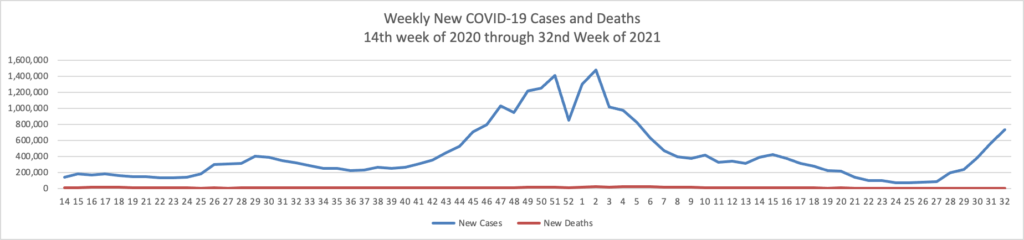
Based on the Centers for Disease Control’s COVID-19 Data Tracker website, here is the FEHBlog’s chart of new weekly COVID-19 cases and deaths over the 14th week of 2020 through 32nd week of this year (beginning April 2, 2020, and ending August 11, 2021); using Thursday as the first day of the week in order to facilitate this weekly update):

and here is the CDC’s latest overall weekly hospitalization rate chart for COVID-19:

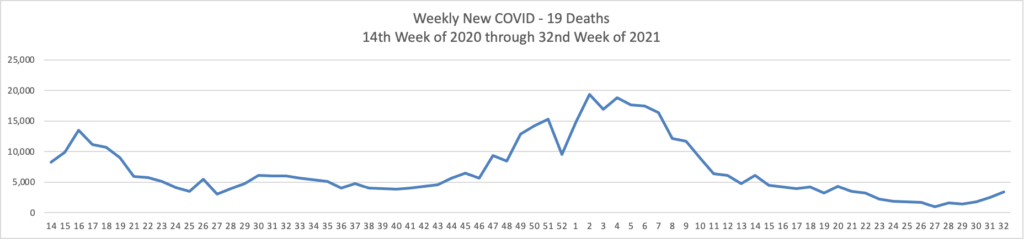
The FEHBlog has noticed that the new cases and deaths chart shows a flat line for new weekly deaths  because new cases significantly exceed new deaths. Accordingly here is a chart of new COVID-19 deaths over the same period (April 2, 2020, through August 11, 2021):

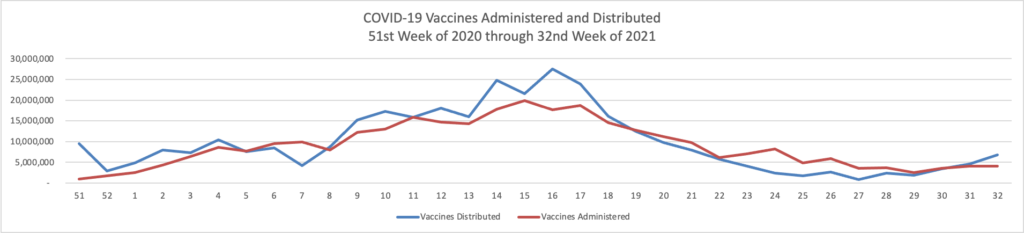
Finally here is a COVID-19 vaccinations chart over the period December 17, 2020, through August 11, 2021, which also uses Thursday as the first day of the week:

Here is a link to the Centers for Disease Control’s (“CDC”) latest weekly review for the COVID data tracker upon which the FEHBlog relies. The review is aptly titled: “Put on Your Masks and Thinking Caps.”

The American Hospital Association has released on You Tube a two minute long presentation on the value of COVID-19 vaccines. It’s called Eight Things to Know About the COVID-19 Vaccine. Its message should be widely distributed.

The Federal Times reports that Kaiser Permanente which is the third largest carrier in the FEHB Program announced a COVID-19 vaccine incentive for its FEHB plan membership today.

The CDC also issued 2021-22 Flu Season FAQs today. Among thing the FEHBlog learned that “All flu vaccines will be quadrivalent (four component), meaning designed to protect against four different flu viruses. For more information: Quadrivalent Influenza Vaccine | CDC.”

In an ironic twist, check out this quote from Fierce Healthcare

“The recent emergence of the delta variant has introduced some uncertainty to our second half visits outlook,” said Ido Schoenberg, M.D., chairman and CEO of Amwell, during the call.

“With mask mandates quickly returning and also acknowledging other trends we are observing within visit mix and volumes, we need to account for these other dynamics and a likely weaker cold and flu season due to these variant-related protective measures,” he said, also noting the company does not expect extra COVID-related demand.

“Consequently, we are adjusting down our visit forecast for the remainder of the year to account for these factors,” he said.

As the French say, “quelle domage”.

But seriously folks, Revcycle Intelligence informs us that

The percentage of telehealth claim lines has stabilized at about 5 percent of medical claim lines, indicating a new balance of virtual and in-person care.

The analysis conducted by FAIR Health as part of its Monthly Telehealth Regional Tracker included data representing the privately insured population, including Medicare Advantage, and excluded Medicare fee-for-service and Medicaid claims data.

The data revealed that the percentage telehealth claim lines increased slightly to 5 percent in May 2021, from 4.9 percent the previous month. The slight increase suggests a stabilization of telehealth utilization since telehealth claim lines had declined each month from February to April of this year.

And what’s more —

  • Healthcare Dive has a helpful wrap up article on the HIMSS conference. Take a look.
  • Federal News Network reports that the General Services Administration released federal employee travel per diems for the fiscal year beginning October 1, 2021. The combined per diems provide a cap of the federal contractor travel expenses that can be charged against an experience rated FEHB contract.
  • From Capitol Hill, Roll Call reports that nine centrist House Democrats have told Speaker Pelosi in writing that “We will not consider voting for a budget resolution until the bipartisan Infrastructure Investment and Jobs Act passes the House and is signed into law.” Roll Call adds that “Together, they’ve got more than enough support to stall the budget in the narrowly divided House where Democrats can lose no more than three members on party-line votes. No Republicans are expected to vote for the budget resolution, which is needed to begin the process on a $3.5 trillion reconciliation package chock full of Democratic priorities.”

Midweek Update

Photo by Josh Mills on Unsplash

The American Hospital Association informs us that

The Senate early this morning approved on a party line vote a $3.5 trillion budget resolution, which included reconciliation instructions which will provide the majority party with the means to pass a comprehensive reconciliation package with just 51 votes in the Senate, rather than the usual 60-vote hurdle. The House will reconvene on Aug. 23 to consider the budget resolution. Once the resolution has passed both chambers, the House and Senate majorities can proceed with the reconciliation process, a resolution to which is expected in the fall. 

Bloomberg adds

Translating the budget framework into law will require Biden and Democratic congressional leaders keeping their party’s moderate and progressive wings marching together.

Just hours after passage of the budget blueprint, Senator Joe Manchin, a Democrat from West Virginia, said he couldn’t support a social spending bill with a $3.5 trillion price tag. Senator Kyrsten Sinema, an Arizona Democrat, has said the same. One Democratic objection is all it would take to scuttle the package in the Senate.

Time will tell but we are talking about $3.5 trillion on top of the $1 trillion infrastructure bill and multi-trillion COVID-19 relief bills that Congress has passed in the last 18 months. It appears that Congress is trying to disprove the adage that money can’t solve all problems.

One of the initiatives in the budget reconciliation package is to add dental, vision, and hearing coverage to Medicare. Kaiser Health News discusses the issue here.

From the Delta variant front

  • The Centers for Disease Control’s Advisory Committee on Immunization Practice released a helpful report on COVID-19 adverse side effects which it summarized as follows

What is already known about this topic?

Rare serious adverse events have been reported after COVID-19 vaccination, including Guillain-Barré syndrome (GBS) and thrombosis with thrombocytopenia syndrome (TTS) after Janssen COVID-19 vaccination and myocarditis after mRNA (Pfizer-BioNTech and Moderna) COVID-19 vaccination.

What is added by this report?

On July 22, 2021, the Advisory Committee on Immunization Practices reviewed updated benefit-risk analyses after Janssen and mRNA COVID-19 vaccination and concluded that the benefits outweigh the risks for rare serious adverse events after COVID-19 vaccination.

What are the implications for public health practice?

Continued COVID-19 vaccination will prevent COVID-19 morbidity and mortality far exceeding GBS, TTS, and myocarditis cases expected. Information about rare adverse events should be disseminated to providers, vaccine recipients, and the public.

  • Forbes tells us that today “The Centers for Disease Control and Prevention encouraged anyone pregnant and breastfeeding to get vaccinated against coronavirus Wednesday, pointing to a growing amount of evidence that vaccines are safe and effective as new cases and hospitalizations linked to the virus surge across the country.” The Washington Post adds “Just 23 percent of pregnant women have received at least one shot of vaccine.”
  • Also from Forbes as schools begin to reopen “Vaccine rates among teenagers have remained lower than the U.S. population overall, with only 43% of 12- to 15-year-olds and 52.8% of 16- and 17-year-olds receiving at least a first dose as compared with 58.9% of the total population and 71.2% of adults.”
  • The Boston Globe discusses this teenage hesitancy issue — “The top reservation among parents of unvaccinated teens was the lack of information about the long-term effects of the shot, followed by concerns about side effects and fertility — despite conclusive evidence that the vaccine has no negative impacts on reproduction. Dr. Jill Kasper, a pediatrician at Cambridge Health Alliance, said she typically encounters ‘very little hesitancy’ from parents about routine adolescent vaccinations. That hasn’t been the case with COVID-19.”

The HHS Agency for Healthcare Quality and Research issued two noteworthy studies today. Here are the topline findings

  • #1 Overuse or low-value procedures may result in patient physical, psychological, or emotional harm. This study explored the association between eight low-value care procedures and length of stay (LOS) and cost. All eight procedures were associated with increased LOS and cost, particularly spinal fusion. Patients receiving low-value care may be exposed to increased risk of adverse events and hospital-acquired conditions.
  • #2 Medication administration errors made by parent or caregivers can result in medication errors at home. This systematic review found that 30% to 80% of pediatric patients experience a medication error at home, and that the risk increases based on characteristics of the caregiver and if a prescription contains more than two drugs.

Healthcare Dive informs us that

  • CVS Health said its Aetna unit will offer virtual primary care to self-funded employers nationwide in a move that underscores the growing popularity of telehealth services fueled by the COVID-19 public health emergency.
  • Using Teladoc Health’s physician-led care team model, the Aetna Virtual Primary Care service is intended to help strengthen the patient-doctor relationship and improve access to care, the vertically integrated company announced Tuesday. Members can receive health services remotely and in person.

Such support for primary care should be applauded.

In other healthcare news

  • STAT News reports that The Department of Veterans Affairs has decided not to cover a new Alzheimer’s drug from Biogen [Adulhelm], citing insufficient evidence of “a robust and meaningful clinical benefit” and concerns about safety. In a notice issued by the agency, the VA said it will make exceptions for “highly selected patients” and listed several hurdles that must be cleared before the medicine will be covered, such as requiring it to be prescribed by providers who specialize in treating dementia and ensuring patients had recently received MRI brain scans. * * * ‘Its bad news for Biogen,’ said Ira Loss of Washington Analysis, which tracks legislative and regulatory issues affecting the pharmaceutical industry for investors, who noted several private insurers have either declined or delayed coverage for the drug. ‘The VA is a big buyer of medicines. And you don’t like this kind of publicity, that’s for sure.’”
  • Fierce Healthcare continues to report from the HIMSS conference in Las Vegas. “Health IT giant Epic launched a new customer story-sharing website that lets Epic users share insights, tips and creative ideas around using health IT to improve their organizations and patient care. The site, EpicShare.org, combines insights from industry leaders, quick tips on improving outcomes and performance, in-depth case studies as well as a “Hey Judy” column from Epic founder and CEO Judy Faulkner.”

Tuesday’s Tidbits

Photo by Patrick Fore on Unsplash

The Wall Street Journal reports

The Senate passed a roughly $1 trillion infrastructure package with broad bipartisan support Tuesday, advancing a central piece of President Biden’s economic agenda that would amount to one of the most substantial federal investments in roads, bridges and rail in decades.

With 19 Republicans including Senate Minority Leader Mitch McConnell (R., Ky.) joining all 50 Democrats to pass the bill 69 to 30, the legislation sailed through the Senate. The bill will face a more complicated path in the House, where Democrats have yoked the fate of the infrastructure effort to the passage of a broad $3.5 trillion antipoverty and climate effort. 

Professor Katie Keith in the Health Affairs blog discusses the Administration’s health policy objectives in the budget reconciliation bill that the Senate is now taking up. “Vice President Harris emphasized the need for Congress to build on these [Affordable Care Act special enrollment period] coverage gains by 1) extending the American Rescue Plan Act subsidy enhancements; 2) closing the Medicaid coverage gap; 3) expanding Medicare to include dental, vision, and hearing coverage; and 4) lowering prescription drug costs.”

Becker’s Hospital review tells us how COVID-19 vaccination rates have changed in the states for the week ended August 9. The rates in 40 states lead by Mississippi (and the District of Columbia) are up and only 10 states are down.

STAT News informs us that

As the world amasses experience with Covid-19 vaccines, something we should have known from the start is coming into sharp focus.

Vaccines that are injected into arm muscles aren’t likely to be able to protect our nasal passages from marauding SARS-CoV-2 viruses for very long, even if they are doing a terrific job protecting lungs from the virus. If we want vaccines that protect our upper respiratory tracts, we may need products that are administered in the nose — intranasal vaccines.

Can they be made? Probably. Will they do what we want them to do, if they are made? Possibly. Is there still room for this type of next-generation product, given the record number of Covid vaccines that have already been put into use? Potentially. Will it be difficult to get them through development? Likely.

In this regard the National Institutes of Health reports on a successful animal study of a COVID-19 intranasal vaccine based on the Oxford / Astra Zeneca model. What’s more, “[a] clinical trial at the University of Oxford is now testing intranasal vaccination in human volunteers.”

Fierce Healthcare is running a daily HIMSS21 roundup from the conference being held in Las Vegas this week.

Reg Jones writes in FedWeek about FEHB coverage for adult children of federal employees and annuitants who are incapable of self support. This is a rather unique feature of the Program.

Finally the Wall Street Journal reports that

The U.S. Postal Service plans to charge more for packages shipped during the holidays, including those sent by individuals, to offset the rising cost of deliveries at the busiest time of the year.

The agency on Tuesday proposed adding surcharges on most packages shipped domestically between Oct. 3 and Dec. 26, saying the fees would apply to both commercial and retail customers. That means it won’t just be Amazon.com Inc.,Target Corp. TGT 0.63% and other big holiday shippers paying higher-than-normal rates; it will also cost more to ship a box of cookies to grandma.

The agency said the added fees, ranging from 25 cents for smaller packages to $5 for heavier items traveling longer distances, are in line with broader industry practices to charge more during the holiday season.