Midweek Update

Midweek Update

Tomorrow morning the House Oversight and Reform Committee will mark up its bipartisan Postal Reform Act (H.R. 3076) and the Postal Improvement Act (HR 3077). H.R. 3076 would eliminate the Postal Service’s unique obligation to pre-fund the cost of FEHB coverage for its annuitants. It also would create a subprogram with the FEHB for postal service employees and annuitants that would be fully integrated with Medicare Parts A (hospital), B (professional services) and D (prescription drugs) for annuitants over age 65.

Existing FEHB plans largely receive the financial benefit of Medicare Parts A and B integration, but OPM does not permit FEHB plans to offer Medicare Part D integration known as EGWPs. The FEHBlog expects H.R. 3076’s mandatory use of Part D EGWPs in the subprogram will unleash a gusher of new benefit savings for subprogram plans. Fingers crossed that successful adoption of Part D EGWPs in this subprogram leads OPM to allow carriers to add them in existing FEHB too. However, as currently drafted, the subprogram would launch on January 1, 2023, which is aggressive timing in the FEHBlog’s view.

Today according to the Wall Street Journal

The Centers for Disease Control and Prevention recommended that 12- to 15-year-olds receive the Covid-19 vaccine from Pfizer Inc. and BioNTech SE, expanding the nation’s vaccination campaign. 

The CDC took the step after its vaccination advisory panel voted to recommend the shot at a meeting Wednesday after reviewing clinical trial data and other relevant information. The vote by the Advisory Committee on Immunization Practices, or ACIP, was 14-0, with one voting member recusing. * * *

Covid-19 cases are rising in adolescents, and as older Americans have gotten vaccinated, adolescents make up an increasing proportion of the overall U.S. case count, Sara Oliver, a CDC medical officer, said. Adolescents accounted for 9% of reported cases in April, a larger proportion than cases involving people 65 years and older as more adults have been vaccinated, she said.

According to the CARES Act of 2020, health plans, including FEHB plans, must begin to cover the Pfizer vaccine without member cost sharing for this age group no later than fifteen days from today, May 27, 2021. According to the Journal, “Pfizer anticipates asking the FDA in September to authorize its vaccine’s use in children 2 to 11 years old should ongoing studies prove positive. The company said It plans to make a similar request for children 6 months to 2 years of age in the fourth quarter.”

In Biden Administration news, the American Hospital Association reports that

Health and Human Services Secretary Xavier Becerra today swore in Andrea Palm as deputy secretary. Confirmed by the Senate yesterday, Palm previously served as secretary-designee of Wisconsin’s Department of Health Services and in several leadership roles at HHS during the Obama-Biden administration.  
“My focus will be on improving the lives and livelihoods of the American people: tackling the COVID-19 pandemic, efficiently and equitably distributing vaccines, expanding access to affordable health care, addressing the epidemic of substance use disorders, and improving mental health care,” she said. 
Biden’s nominee to serve as Centers for Medicare and Medicaid Services administrator, Chiquita Brooks-LaSure, today moved one-step closer to confirmation with the Senate voting 51-48 to discharge the nomination. The Senate could hold a final vote on her confirmation next week.  

STAT News informs us

  • “Telehealth companies, flush with cash after the Covid-19 pandemic spiked both demand and investment, are now embarking on massive lobbying efforts to secure their interests on Capitol Hill. The goal is clear: Lawmakers are weighing whether to permanently loosen regulations that were temporarily eased during the pandemic. Among other changes, providers have been allowed to practice in states where they are not licensed, and Medicare has been permitted to pay providers the same for virtual visits as in-person ones. Lobbyists for the rapidly growing industry are determined to keep those changes intact.” Watch for this result the big infrastructure bill.
  • Amazon’s objectives for its nascent pharmacy business are straightforward: “better selection, better convenience, and better prices,” according to TJ Parker, the vice president of pharmacy at the company.“ It really is the Amazon playbook,” he said during a Wednesday panel at STAT’s Health Tech Summit. * * * “Customers really want more Amazon and less pharmacy and so our work from here is to make pharmacy truly as seamless to us as amazon.com [is] for other categories,” Parker said. Among Amazon’s latest offerings: a new price-comparison tool for medications, which launched Tuesday. Now, when someone searches for a prescription drug on Amazon, Amazon Pharmacy’s price for a drug is listed alongside the cost for Prime members at other pharmacies like CVS, Walgreens, Walmart, and Costco.” Watch out GoodRx.

On a related note, the Drug Channels blog assesses how Cigna’s growing pharmacy platform expands its channel power.

Last week, Cigna released its earnings for the first quarter of 2021. I was struck by how quickly Cigna’s Express Scripts PBM business has increased revenues and prescriptions from its retail pharmacy network. Our second chart below highlights this growth. The businesses in Cigna’s Evernorth segment—especially Express Scripts, Ascent Health Services, and InsideRx—are already providing rebate negotiation, network management, and/or a sourcing platform for Prime Therapeutics, Kroger, Humana, GoodRx, and Amazon.”


Tuesday’s Tidbits

Photo by Patrick Fore on Unsplash

The FEHBlog had been wondering what was going on with the Postal Reform bill that includes a new Postal Service Health Benefits Program. It turns out that the House Oversight and Reform Committee plans to mark up the latest draft of that bill on Thursday morning. The FEHBlog plans to tune in for this meeting.

In health equity developments —

  • The Wall Street Journal reports that “Ride-sharing companies Uber Technologies Inc. and Lyft Inc. will make all rides to and from vaccination sites free until July 4 under a new partnership with the White House. * * * While the companies were already providing free or discounted rides in some circumstances, the rides will now be free to anyone in the U.S. who is going to a vaccination site to get the shot, and Lyft and Uber will promote the rides to and from tens of thousands of vaccination sites through their apps. The feature will launch in the next two weeks and run until July 4.”
  • Health Leaders Media informs us about Horizon Blue Cross’s ongoing efforts to advance health equity in New Jersey in cooperation with healthcare and community organizations as well as solid data.
  • The American Medical Association released a “strategic plan to embed racial justice and advance health equity.” “With the input of many both inside and outside of AMA, this strategic plan serves as a three-year roadmap to plant the initial seeds for action and accountability to embed racial justice and advance health equity for years to come.”

In regulatory developments –

  • Professor Katie Keith in the Health Affairs blog provides background on yesterday HHS decision to “interpret Section 1557 and Title IX, which prohibit discrimination on the basis of sex, to include discrimination on the basis of sexual orientation and gender identity.”
  • Fierce Healthcare reports that “The Centers for Medicare & Medicaid Services has sent its first wave of warning letters out to hospitals breaking federal rules requiring them to disclose payer-negotiated prices, a spokesperson for the agency confirmed.”
  • Healthcare Dives discusses healthcare organization comments to HHS’s Office for Civil Rights on its proposed rule that would make generally helpful adjustments to the HIPAA Privacy Rule, in the FEHBlog’s opinion.

Miscellaneous tidbits —

  • Reg Jones discusses the Federal Employees Group Life Insurance Program in FedWeek.
  • The Society for Human Resources Management writes about “Supporting Mental Health in the Post-Pandemic Workplace.”
  • Health Payer Intelligence discusses Blue Cross of North Carolina’s successful effort to consolidate member experience data from across the company to boost member satisfaction.

Weekend update

Photo by Michele Orallo on Unsplash

Happy Mothers’ Day.

Congress will be engaged in Committee business and floor votes for the next two weeks. The Hill reports on what we can expect from Congress in the near term.

From the COVID-19 front, Bloomberg informs us that

The share of U.S. hospital beds occupied by Covid-19 patients fell to 5.37%, the lowest since Oct. 5, according to the U.S. Department of Health & Human Services. Michigan had the biggest percentage of beds occupied by Covid patients at 13.3% followed by Maryland at 10.8%, according to the latest HHS data, which reflect the situation on Thursday. Florida had 3,504 hospitalized Covid patients, the most of any state, followed by Texas with 3,080.

The U.S. added fewer than 35,000 cases on Saturday, sending the seven-day rolling average of new infections to the lowest since the end of September. While reporting often lags on weekends, the data collected by Johns Hopkins University and Bloomberg is the latest sign that the pandemic in America is easing.

Another 625 people nationwide died of Covid-19, bringing the toll to more than 581,000 since the outbreak began. Detroit and New York City had the most deaths per capita among major metro areas in the week through Wednesday, according to a Centers for Disease Control and Prevention report dated May 6.

According to the CDC’s website, nearly 7.5 million doses of COVID-19 vaccine were administered over the past three days. Approximately 43% of the U.S. population over age 18 and 71% of that population over age 65 is fully vaccinated against COVID-19. All of these facts are clearly related.

Govexec reports on the Postal Service’s first quarter 2021 financial results.

USPS lost just $82 million in the second quarter of fiscal 2021, a marked improvement over the same quarter the previous year. When excluding inflationary adjustments to the agency’s workers’ compensation liabilities that are outside of management’s control, however, the agency experienced $1.7 billion in losses from January through March compared to $1.9 billion in that period of fiscal 2020. 

Total revenue jumped 6% over the same period last year, led by a 34% spike in package business. The shift from regular mail—where plummeting volume persisted—to packages continued to add costs to the postal system, as packages entail additional personnel and transportation costs. * * *

The Postal Service’s costs jumped by 4% in the most recent quarter, which management attributed to package delivery and paid leave related to the pandemic. The agency’s total net loss of $82 million was down from $4.5 billion in the same period last year. 

Joe Corbett, the USPS chief financial officer, speculated the agency would break even by fiscal 2023 or fiscal 2024, provided DeJoy’s plan is implemented. USPS is relying in large part on Congress to pass reforms that would remove much of its liabilities for retiree health care costs from its balance sheets.  

Fredric Rolando, president of the National Association of Letters Carriers, said the postal revenue increases demonstrate those retiree health care reforms are the primary change needed.  The uptick in business drives home “how much the American people and their businesses rely on the essential work of the Postal Service,” Rolando said

If the the Postal Service’s healthcare reforms would save money and the Medicare Part D integration would create a gusher of savings, why not just apply those reforms across the entire FEHB which would avoid the additional administrative cost of creating a new Postal Service Health Benefits Program within the FEHB Program?

Weekend Update

Photo by Michele Orallo on Unsplash

This coming week, the House of Representatives is engaged in Committee business and the Senate is on a State work break.

From the COVID front, Bloomberg reports on a UK study finding that taking only one dose of the Pfizer OK may be sufficient for a person who has survived a COVID-19 infection but not for others.

The study appears to contrast with other research that has suggested the first dose of Pfizer’s shot provides a strong level of protection against Covid, including some variants. That’s in part because it examined the level of people’s immune responses, rather than real-world infection levels.

Still, the findings offer a warning for countries like the U.K., where the majority of vaccinated people have had only a single dose of inoculations like Pfizer’s that require two shots to offer full protection.

In other vaccination news, Precision Vaccinations explains that

The HPV vaccine was designed to prevent reproductive warts and cancers caused by the most common sexually transmitted infection in the United States. The FDA approved the vaccine for women in 2006 and expanded it to men in 2009.

Preventing cervical cancer was the primary focus at that time, so girls and women were more likely to hear about it from their pediatricians or OBGYNs. 

Yet oropharyngeal cancer, which occurs in the throat, tonsils, and back of the tongue, has now surpassed cervical cancer as the leading cancer caused by HPV.

Data indicates 80% of those diagnosed with oropharyngeal cancer are men.

“I don’t think that a lot of people, providers, and patients, are aware that this vaccine is a cancer-prevention vaccine for men as well as women,” Chen says. “But HPV-associated oropharyngeal cancer can impact anyone.”

“And there’s no good screening for it, which makes vaccination even more important.”

With respect to general preventive services, Fierce Healthcare informs us that

CVS Health is expanding its program to offer no-cost, community-based screenings to 14 more markets.

Project Health, which is now in its sixteenth year, offers a slew of free biometric screenings at CVS Pharmacy locations, including blood pressure, glucose levels and cholesterol. Patients can then meet with a nurse practitioner, who can provide additional guidance and referrals for treatment if needed.

New markets include Birmingham, Alabama; Phoenix; Jacksonville, Orlando and Tallahassee, Florida; Baton Rouge and New Orleans, Louisiana; Jackson, Mississippi; Charlotte, North Carolina; Cleveland, Ohio; Charleston and Columbia, South Carolina; and Knoxville and Memphis, Tennessee, CVS said in announcement provided first to Fierce Healthcare.

The program is also launching four new mobile units, CVS said, and anticipates providing 1,700 screening events across its 32 markets by the end of the year.

From the relevant history front, the Wall Street Journal’s Saturday Essay compares the 1957-58 flu pandemic with our current COVID-19 pandemic. In both cases, a rapidly developed vaccine was made available to the public.

From 1948 to 1957, Maurice Hilleman—born in Miles City, Mont., in 1919—was chief of the Department of Respiratory Diseases at the Army Medical Center (now the Walter Reed Army Institute of Research).

Early in his career, Hilleman had discovered the genetic changes that occur when the influenza virus mutates, known as “shift and drift.” It was this work that enabled him to recognize, when reading reports in the press of “glassy-eyed children” in Hong Kong, that the outbreak had the potential to become a disastrous pandemic. He and a colleague worked nine 14-hour days to confirm that this was a new and potentially deadly strain of flu.

Speed was of the essence, as in 2020. Hilleman was able to work directly with vaccine manufacturers, bypassing “the bureaucratic red tape,” as he put it. The Public Health Service released the first cultures of the Asian influenza virus to manufacturers even before Hilleman had finished his analysis. By the late summer, six companies were producing his vaccine.

It has become commonplace to describe the speed with which vaccines were devised for Covid-19 as unprecedented. But it was not. The first New York Times report of the outbreak in Hong Kong—three paragraphs on page 3—was on April 17, 1957. By July 26, little more than three months later, doctors at Fort Ord, Calif., began to inoculate recruits to the military.

Wait there’s more, according to his 2005 obituary, Dr. Hilleman invented vaccines for measles, mumps, rubella, Hepatitis A, Hepatitis B and pneumonia.

In closing here is an interesting Bloomberg interview with Shahid Jameel, director, Trivedi School of Biosciences, Ashoka University, which is located in the state of Haryana, India. The interview concerns the COVID-19 crisis in that country.

BG: What’s the biggest challenge now?

SJ: To bring things under control, you want to vaccinate more people on a daily basis than the number of new infections. Remember that a person who gets the first shot today will get the second shot in four to six weeks, and will need two more weeks to develop full immunity. So somebody who starts vaccination today will take two months to develop protective immunity.

This means the vaccination drive has to be sustained over months, many more doses daily than cases. Only then can we reverse the surge.

BG: Is the supply of vaccines sufficient to maintain that pace?

SJ: One of the critical errors we made was in vaccine procurement. In January, the government ordered only 11 million doses [from Serum Institute located in India]. Between Serum Institute and Bharat Biotech, we can currently produce roughly 90-100 million doses in a month. But they also have exports commitments, especially to the WHO’s COVAX program. 

Meanwhile, India has begun to accept vaccine registration from anyone aged 18 or older. In total, we’re talking about 800 million people, or 1.6 billion doses. It’s going to be a struggle.

The BBC offers more background on the Indian crisis. Needless to say, the world needs to help India.

Midweek Update

Photo by Mark Tegethoff on Unsplash

Govexec reports that at the Senate Homeland Security and Governmental Affairs Committee’s business meeting today, the Committee advanced to the Senate floor the nominations of Kiran Ahuja to be OPM Director along party lines and the three nominations of Postal Service Governors with bipartisan margins. The FEHBlog expects these nominations to be brought to the Senate floor next month.

From the COVID-19 front:

  • The Wall Street Journal informs us that “Vaccines appear to be starting to curb new Covid-19 infections in the U.S., a breakthrough that could help people return to more normal activities as infection worries fade, public-health officials say. By Tuesday, 37.3% of U.S. adults were fully vaccinated against Covid-19, with about 2.7 million shots each day. * * * With the U.S. recently averaging at least 50,000 new daily cases, the pandemic is far from over. But the U.S. is nearing a nationwide benchmark of having 40% of adults fully vaccinated, which many public-health experts call an important threshold where vaccinations gain an upper hand over the coronavirus, based on the experience from further-along nations such as Israel.”
  • Today the Centers for Disease Control released a report on the mRNA vaccines. Here are the highlights which support the Journal’s report particularly as over 2/3s of Americans over age 65 are fully vaccinated.

Clinical trials suggest high efficacy for COVID-19 vaccines, but evaluation of vaccine effectiveness against severe outcomes in real-world settings and in populations at high risk, including older adults, is needed.

What is added by this report?

In a multistate network of U.S. hospitals during January–March 2021, receipt of Pfizer-BioNTech or Moderna COVID-19 vaccines was 94% effective against COVID-19 hospitalization among fully vaccinated adults and 64% effective among partially vaccinated adults aged ≥65 years.

What are the implications for public health practice?

SARS-CoV-2 vaccines significantly reduce the risk for COVID-19–associated hospitalization in older adults and, in turn, might lead to commensurate reductions in post-COVID conditions and deaths.

  • The Wall Street Journal also reports that “Covid-19 tests for people to use to get quick results at home are finally becoming available to buy at pharmacies and retailers. Yet an obstacle might stand in the way of regular use: cost. * * * The U.S. Food and Drug Administration recently cleared over-the-counter sales of two of these rapid at-home screening tests, one from Abbott Laboratories and another from Quidel Corp. 

Major pharmacies recently said they plan to sell a two-pack of Abbott’s test for nearly $24, while Walmart says it will charge just under $20. The price for Quidel’s test hasn’t been released, though Quidel has indicated it will be less than $30 for a pair.

“Twenty-five dollars for a Covid test, I think most people would pay that once. But would they pay it every week or every two weeks?” says Zoe McLaren, a health economist and an associate professor in the School of Public Policy at the University of Maryland, Baltimore County. “It’s not designed to be a one-time cost.”

Dr. McLaren and medical-testing experts expressed hope that prices would drop if more companies get clearance to sell paper-strip tests. * * * Public-health authorities say they are glad to see the tests in stores, and the tests will be valuable tools for checking symptoms or for specific occasions, such as traveling or visiting relatives.

From the Medicare front

  • The Centers for Medicare and Medicaid Services released yesterday a proposed fiscal year 2022 Medicare Part A inpatient prospective payment system rule. “The proposed increase in operating payment rates for general acute care hospitals paid under the IPPS that successfully participate in the Hospital Inpatient Quality Reporting (IQR) Program and are meaningful electronic health record (EHR) users is approximately 2.8 percent. This reflects the projected hospital market basket update of 2.5 percent reduced by a 0.2 percentage point productivity adjustment and increased by a 0.5 percentage point adjustment required by legislation.”
  • Healthcare Dive provides its perspective on the proposal which evidently was well received by the hospital industry. “[T]he American Hospital Association applaud[ed] the provision that removes the requirement that hospitals report privately negotiated rates with Medicare Advantage payers on Medicare cost reports and another that repeals market-based weight methodology for determining payments.”

On the FEHB front

  • FedSmith advises that “Federal employees facing a future with children aging out of TRICARE should consider enrolling in an FEHB policy. This is because FEHB plans provide coverage for children in the family option up to age 26. Additionally, the family FEHB premium for the employee, spouse, and children may be less than the cost of the TYA option for one individual. FEHB employees who are eligible for TRICARE and interested in having their children covered in an FEHB plan have to enroll during Open Season. Federal employees with TRICARE also need to enroll in a plan at least a year ahead of retirement for the FEHB plan to be continue in retirement.” Interesting.

On the artificial intelligence front, Forbes lists its top 50 AI companies to watch. Enjoy.

Weekend update

Photo by Thought Catalog on Unsplash

Both of Houses of Congress are engaged in Committee business this week. The Senate Homeland Security and Governmental Affairs Committee will meet Wednesday morning to consider moving Kiran Ahuja’s OPM Director nomination to the Senate floor. The Senate will be engaged in floor business this week. Among other business items, the Senate will consider confirming Jason Miller to be OMB Deputy Director for Management. The President will address a joint session of Congress on Wednesday night.

From the COVID-19 front —

According to the CDC, over 1/3 of Americans over age 18 and over 2/3s of Americans over 65 are fully vaccinated against COVID-19. Bloomberg reports that “in the next few weeks, what the vaccine campaign is going to look like is going to change dramatically. The Biden administration is pursuing a strategy of abundance, which the White House has referred to as an “overwhelm the problem” approach. That means that there will likely still be widespread shipping of vaccines to pharmacies and health centers, inoculation clinics and mobile vaccine resources. But what’s likely to disappear are lines and scarcity.”

The FEHBlog has been looking for news that Pfizer and Moderna have applied for full Food and Drug Administration marketing approval for their vaccines. A San Diego television station reports on the implications of full marketing approval for these vaccines.

Companies want full approval for several reasons. Once the pandemic is no longer officially designated as an emergency, only fully approved products can remain on the market. And the stamp of approval from the FDA carries valuable credibility, [Dr. Sidney] Wolfe [co-founder of Public Citizen’s Health Research Group] said. “Aside from what benefit for marketing it does in this country, it will clearly have an international benefit,” he said.

The FEHBlog also understands that full marketing approval would allows the companies to distribute the vaccines directly to physicians’ offices.

Typically it takes the FDA about six months to review a licensure application for a high-priority drug. Pfizer said it expects to apply in the first half of 2021, and it expects a decision from the FDA in the second half of the year.

Another news source indicates that Moderna recently filed its licensure application with the FDA.

Good Housekeeping offers a timeline for when children will receive COVID-19 vaccines. Pfizer has applied to extend its COVID-19 vaccine’s emergency use authorization to people aged 12 to 15. However, the FEHBlog sees no FDA advisory committee scheduled to consider this request as yet.

From the artificial intelligence and telehealth fronts, the Wall Street Journal reports that

  • A journalist writes on her experience with telehealth over the past year.

For me, both in-person conversations and remote conversations have their unique advantages and disadvantages. Sometimes, eye contact or hands-on care is just what I need to feel confident in my doctor’s diagnosis or advice. But other times, there’s nothing like leveling the playing field with video or phone chat to make everything feel a bit more intimate and safer. One of the lessons we’ve learned from a year of remote everything is that in-person interactions have strengths that virtual conversations can’t quite match, and vice versa. Healthcare may be one more area where the future is hybrid.

It’s a reminder that health plans should focus their telehealth efforts on mental health services because people are comfortable with it and it extends the plan’s network.

  • In the other article three experts weigh in on whether artificial intelligence can replace human mental health therapists. Of course, the answer to that question is no. Nevertheless the experts’ responses on exciting uses of artificial intelligence in the mental health field is interesting, e.g., “In the near term, I am most excited about using AI to augment or guide therapists, such as giving feedback after the session or even providing tools to support self-reflection.” and

We can generate a vast amount of data about the brain from genetics, neuroimaging, cognitive assessments and now even smartphone signals. We can utilize AI to find patterns that may help us unlock why people develop mental illness, who responds best to certain treatments and who may need help immediately. Using new data combined with AI will likely help us unlock the potential of creating new personalized and even preventive treatments.

Encouraging.

From the federal employment front, the Federal Times informs us that “Even during the worst global pandemic of the century, increased demands on public jobs and a radical shift to predominantly remote work, federal employees are confident in their agencies’ ability to keep them safe and recognize their hard work, according to results of the [OPM] 2020 Federal Employee Viewpoint Survey.” Bravo.

Friday Stats and More

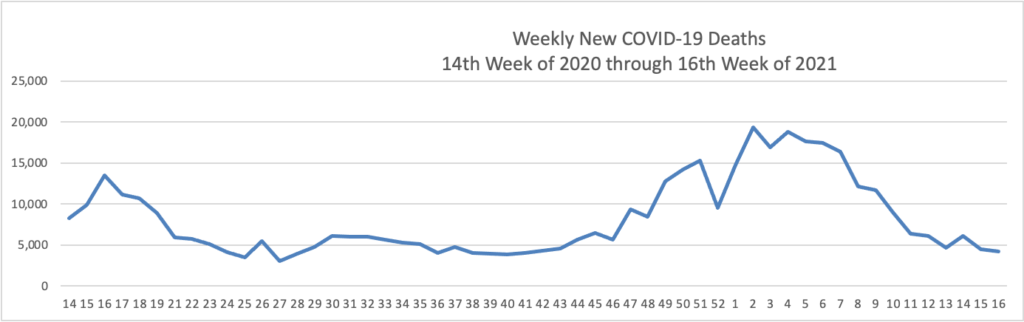
Based on the Centers for Disease Control’s COVID-19 Data Tracker website, here is the FEHBlog’s chart of new weekly COVID-19 cases and deaths over the 14th week of 2020 through 16th week of this year (beginning April 2, 2020, and ending April 21, 2021; using Thursday as the first day of the week in order to facilitate this weekly update):

and here is the CDC’s latest overall weekly hospitalization rate chart for COVID-19:

The FEHBlog has noticed that the new cases and deaths chart shows a flat line for new weekly deaths  because new cases greatly exceed new deaths. Accordingly here is a chart of new COVID-19 deaths over the period (April 2, 2020, through April 21, 2021):

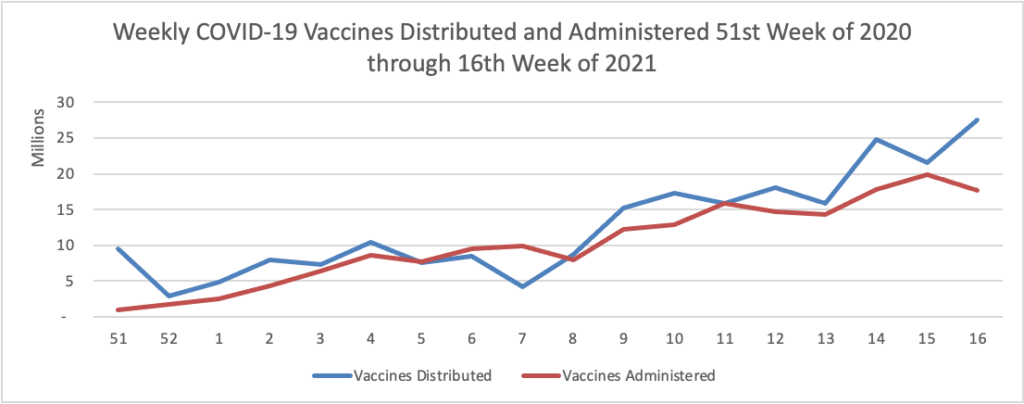
Finally here is a COVID-19 vaccinations chart over the period December 17, 2020, through April 21, 2021 which also uses Thursday as the first day of the week:

The Hill reports this evening that

Johnson & Johnson coronavirus vaccinations should resume immediately, federal regulators said Friday.

The approval follows a recommendation from a federal advisory panel that the shot’s benefits outweigh its risks. 

States could start administering the shots in hours, if not days. There are about 9.5 million doses of the vaccine sitting on shelves across the country that could be deployed immediately.

The Food and Drug Administration (FDA) and Centers for Disease Control and Prevention (CDC), which had jointly recommended a nationwide pause 10 days ago, accepted the recommendation from CDC’s Advisory Committee on Immunization Practices.

The panel wants the FDA to add a warning label intended to make providers aware of the risk of a rare complication involving blood clots in women under the age of 50. 

Johnson & Johnson has already negotiated warning label language with FDA, a company official told the panel.

Medscape adds that “The recommended pause on April 13 in the rollout of the Janssen/Johnson and Johnson vaccine has not substantially deflated confidence in COVID-19 immunization, a new poll reveals.” Let’s go.

From Capitol Hill, Healthcare Dive reports that “The Senate Finance Committee split upon party lines in a Thursday vote on the nomination of Chiquita Brooks-LaSure, President Joe Biden’s pick to head the powerful agency overseeing Medicare and Medicaid, voting 14-14 to move to a full Senate vote without a recommendation for confirmation.” The FEHBlog expects that Ms. Brooks-LaSure will be confirmed next week.

Speaking of health equity, Econtalk currently features a fascinating discussion between host Russ Roberts, who recently became President of Jerusalem’s Shalem College, and Washington University Sociology Professor Mark Rank  “on the nature of poverty and the challenge of ending or reducing it.”

Fierce Healthcare offers interviews with healthcare experts on telehealth regulation and health equity.

Beckers points out how UnitedHealthcare plans to make Optum a $100 billion business and how Anthem’s IngenioRx PBM business keeps growing.

Tuesday Tidbits

Photo by Patrick Fore on Unsplash

Fedweek reports that

A Senate [Homeland Security and Governmental Affairs] Committee hearing is set for Thursday April 22 [at 10:15 am] on Kiran Ahuja’s nomination to become OPM director, potentially setting the stage for her confirmation in the near future.

No opposition has emerged to Ahuja, who was OPM’s chief of staff for part of the Obama administration and who most recently led the Biden transition team for the agency. She also has experience as a Justice Department attorney and with the White House Initiative on Asian Americans and Pacific Islanders under Obama, among other roles.

The FEHB Carrier Conference’s keynote speaker today was Dr. Garth Graham who spoke on social determinants of health issues. Dr. Graham who is Director and Global Head of Healthcare and Public Health at Google/YouTube published a 2018 study finding that

In this cohort study of 6402 patients from 2 acute myocardial infarction registries, self-identified black patients and white patients differed in several clinical and socioeconomic characteristics. The higher the prevalence of characteristics associated with being a black patient, the higher the 5-year mortality rate, but no differences were observed between black patients and white patients with similar characteristics.

These findings illustrate social determinants of health concerns in a nutshell. MedCity News discusses how healthcare providers and payers are addressing these concerns.

Another speaker Dr. Mark Fendrick from the University of Michigan discussed value based insurance design which focuses on paying more for high value care by identifying and excluding low value care.

The alignment of clinically nuanced, provider- facing and consumer engagement initiatives is a necessary and critical step to improve quality of care, enhance patient experience, and contain cost growth.

That’s easier said than done, but you have to start somewhere as OPM points out in its 2022 call letter.

In COVID-19 tidbits

  • ABC News reports that as of yesterday, “All adults in the United States are eligible for COVID-19 vaccines starting Monday, with all 50 states and Washington, D.C., meeting the April 19 deadline President Joe Biden had set for opening eligibility.” The minimum age for the Pfizer vaccine is 16 years old. The minimum age for the Moderna and currently paused Johnson and Johnson vaccine is 18 years old.
  • STAT News informs us about the “many key questions about SARS-2 and the disease it causes, Covid-19, [that] continue to bedevil scientists.” “There was surprising diversity in the questions, though many cluster around certain themes, such as the nature of immunity or the impact of viral variants. Knowing what scientists still want to learn shows us how far we’ve come — and how far we have left to go to solve the mysteries of SARS-2 and Covid-19.”

In telehealth tidbits:

  • More news comes out of last week’s United Healthcare first quarter 2021 earnings report. Becker’s Hospital News reports that “UnitedHealth Group subsidiary Optum has deployed a new telehealth product across all 50 states, company leaders said April 15. The new virtual care product, dubbed Optum Virtual Care, is now live in all 50 states, said OptumHealth CEO Wyatt Decker during UnitedHealth Group’s Q1 2021 earnings call transcript, which was transcribed by the Motley Fool. With the new offering, Optum aims to integrate physical care, virtual care, home care and behavioral care. Optum Virtual Care offers virtual health services but also, if necessary, can connect patients to a bricks-and-mortar facility for more complex care or identifying and triaging both physical and behavioral healthcare needs, Mr. Decker said.
  • Fierce Healthcare reports that “Cigna’s Evernorth has completed its acquisition of virtual care provider MDLive. Cigna first announced the deal in late February, with the expectation it would close in the second quarter. The deal, the insurer said, will enhance the Evernorth subsidiary’s efforts to lower healthcare costs.
  • The upshot of the FEHB Carrier Conference’s discussion of telehealth today was that health plan payments for virtual care should reflect the quality and efficacy of care relative to in-person care. For example, the Insurance Journal reports that

Published in the April issue of Health Affairs, the [University of Michigan] study finds that patients who had an on-demand virtual care visit for an upper respiratory infection in the three years before the pandemic began were slightly more likely to receive additional follow-up care than similar patients who had their first visit in person.

The study compared data from more than 28,700 virtual visits with data from more than 57,400 in-person visits for acute respiratory infections in 2016 through 2019. Those visits, and any follow-up care, were all covered by a large insurer. All the virtual visits were done through a direct-to-consumer telehealth company with which the insurer had partnered.

The authors say it’s important to note that the vast majority of the patients did not require any further care for their infections, which included ear infections, bronchitis, laryngitis, sore throat and pneumonia.

But 10.3% of the patients first seen through a direct-to-consumer telehealth visit ended up having an in-person visit in the next week, compared with 5.9% of those who had their first visit in person. This includes second telemedicine visits or visits to clinics, urgent care centers and emergency rooms.

In other tidbits, Healthcare Dive discusses what to watch as public traded providers and payers report their first quarter 2021 results and CVS Health announced a new joint CVS Health / Aetna benefit design.

Weekend update

Photo by Tomasz Filipek on Unsplash

Both Houses of Congress are working on floor and committee business this week. Here are links to the House floor schedule, the Senate floor schedule and the Committee business schedule. Nothing particularly interesting from an FEHBP standpoint.

In contrast, this week from Tuesday through Thursday, the U.S. Office of Personnel Management and America’s Health Insurance Plans will hold the annual FEHB carrier conference. This will be the longest conference in the FEHBlog’s memory.

In that regard, “The Alliance for Fertility Preservation (AFP) commends the U.S. Office of Personnel Management (OPM) for including coverage for fertility preservation in its annual call for benefit and rate proposals from Federal Employee Health Benefit (FEHB) Program carriers. This coverage would allow for fertility preservation services related to infertility caused by medical treatment (iatrogenic infertility).”

The AFP estimates that in the United States, approximately 160,000 people between ages 0-44 are diagnosed with cancer each year. Most of these patients will face treatments including chemotherapy, radiation, and/or surgery that can damage reproductive cells (eggs and sperm), reproductive organs, or impact the ability to carry a pregnancy. Because this damage treatment-based, it can affect patients with any type of cancer. Patients with other conditions requiring similar therapies are also at risk.

Fertility preservation is now considered part of the standard of care for age-eligible patients. Guidelines supporting fertility preservation have been issued by the relevant medical associations, including the American Society of Clinical Oncology (ASCO), the American Society for Reproductive Medicine (ASRM), and the American Medical Association (AMA).

This new benefit for 2022 is a carrier conference topic on Tuesday.

From the COVID-19 front, the FEHBlog and his wife attended the socially distanced and fan-masked Washington Nationals game this afternoon. Walking from the parking lot to Nationals Park, we walked by a CVS pharmacy which had a sign reading COVID-19 vaccinations available here. We went into the pharmacy, and the FEHBlog noticed a staff member at a table waiting to sign up people for the vaccine. The FEHBlog was so happy.

Health Payer Intelligence discusses how the Blue Cross Blue Shield plans are “aiming to be a community resource to ensure shots are administered. Reed Melton, vice president of clinical operations at the Blue Cross Blue Shield Association (BCBSA), told Fierce Healthcare that the group’s member plans are partnering with regional and community organizations to tackle vaccine hesitancy and support administration efforts. “We have a full-court press from Honolulu to San Juan,” Melton said.  At the national level, BCBSA has partnered with Feeding America to offer educational materials on COVID-19 vaccines to people at 200 food banks, which can reach 40 million Americans.”

Last week the Centers for Disease Control reported to providers of care about so-called vaccine breakthrough cases of COVID-19.

Vaccine breakthrough cases occur in only a small percentage of vaccinated persons. To date, no unexpected patterns have been identified in the case demographics or vaccine characteristics among people with reported vaccine breakthrough infections.COVID-19 vaccines are effective. CDC recommends that all eligible people get a COVID-19 vaccine as soon as one is available to them.

The Wall Street Journal reports today that

President Biden’s chief medical adviser said he expects Johnson & Johnson’s Covid-19 vaccine to return to use in the U.S. by Friday, after a pause because of concerns about blood clots in several patients. “I would be very surprised…if we don’t have a resumption in some form by Friday,” Dr. Anthony Fauci told CBS’s “Face the Nation,” echoing remarks he made on other networks Sunday.

The American Medical Association has shared information about what physicians should know about this blood clot issue.

Thursday Miscellany

Photo by Juliane Liebermann on Unsplash

From Capitol Hill, Govexec reports that yesterday, “a Senate panel advanced President Biden’s pick [Jason Miller] to be deputy director for management for the Office of Management and Budget to the full chamber. Today, Fierce Healthcare reports Chiquita Brooks-LaSure’s confirmation hearing to be Centers for Medicare Service administrator before the Senate Finance Committee. “The hearing didn’t highlight any major opposition from Republicans to her nomination, likely signaling her confirmation as the head of CMS.”

From the Johnson & Johnson vaccine pause front, Healthcare Dive discusses “What Happens Next, A call by regulators to stop J&J vaccinations won’t dramatically disrupt U.S. supply. But changes in labeling are possible, as is a renewed debate over vaccine hesitancy.” The Wall Street Journal adds that

A study by the University of Oxford found the risk of rare but sometimes-deadly blood clotting is roughly eight to 10 times greater in Covid-19 sufferers than among people who have received any of the first three Western-developed vaccines widely available. The study, involving vaccinations from Pfizer Inc. and BioNTech SE, another from Moderna Inc. and one from AstraZeneca PLC, adds to competing evidence related to blood clotting that regulators and governments may need to take into account as they weigh continued deployment of vaccines. 

While the Johnson & Johnson vaccine was not included in this study, the Astra-Zeneca vaccine uses the same adenovirus technology as the Johnson & Johnson vaccine.

In other COVID-19 vaccine news, the HHS Office of Inspector General issued a warning that provider must not charge patients for the COVID-19 vaccine.


OIG is aware of complaints by patients about charges by providers when getting their COVID-19 vaccines. Providers that charge impermissible fees must refund them and ensure that individuals are not charged fees for the COVID-19 vaccine or vaccine administration in the future. Consistent with the CDC Vaccination Program, providers are permitted to bill third-party payers (such as Medicare, Medicaid, the HRSA COVID-19 Uninsured Program, or a private insurer) for an administration fee, in accordance with the payer’s applicable billing rules.

In FEHB news, today the Office of Personnel Management issued a benefit administration letter to employing agencies and a letter to FEHB carriers instructing them to tighten up on the process of adding family members to an FEHBP enrollment. For the employing offices —

An employing office must require proof of family member eligibility for coverage through the FEHB Program for: 

• new employees during their initial opportunity to enroll (IOE) 

• employees requesting FEHB changes due to all other QLEs2 

Due to the large volume of transactions during the annual Federal Benefits Open Season, employing offices may, but are not required to, verify family member eligibility. 

When reviewing a new family member’s eligibility, employing offices may take this opportunity to verify the eligibility of family members currently enrolled who have not previously been verified. 

For the carriers — “Before adding a family member to an existing Self and Family enrollment, an FEHB Carrier must require that the enrollee provide proof of that family member’s eligibility for coverage through the FEHB Program.” In the middle of the last decade, OPM considered but never implemented an audit of family member eligibility records.

From the Centers for Disease Control reports front

  • Health Day informs us that “Emergency department visits were lower during December 2020 to January 2021 compared with prepandemic levels one year earlier, according to research published in the April 16 issue of the U.S. Centers for Disease Control and Prevention Morbidity and Mortality Weekly Report. * * * The researchers found that after an initial decrease during March to April 2020, there was an increase in emergency department visits through July 2020, but at levels below those during 2019; during December 2020 to January 2021, there was a decrease of 25 percent in visits compared with prepandemic levels.”
  • The New York Times reports that

More than 87,000 Americans died of drug overdoses over the 12-month period that ended in September, according to preliminary federal data, eclipsing the toll from any year since the opioid epidemic began in the 1990s.

The surge represents an increasingly urgent public health crisis, one that has drawn less attention and fewer resources while the nation has battled the coronavirus pandemic. Deaths from overdoses started rising again in the months leading up to the coronavirus pandemic — after dropping slightly in 2018 for the first time in decades — and it is hard to gauge just how closely the two phenomena are linked. But the pandemic unquestionably exacerbated the trend, which grew much worse last spring: The biggest jump in overdose deaths took place in April and May, when fear and stress were rampant, job losses were multiplying and the strictest lockdown measures were in effect

That’s quite sad.

In other news —

  • Becker’s Hospital Review informs us that “UnitedHealth Group posted nearly $5 billion in profit for the first quarter of 2021 as its UnitedHealthcare and Optum businesses continue to grow.”
  • STAT News offers an interesting report on the burgeoning market for increasingly inexpensive continuous glucose monitors for folks with Diabetes I.

Glucose monitors are becoming the backbone of a new movement in consumer tech — one that so far is outpacing the evidence. “You kind of have this dichotomy with the perceived value of CGM,” said Susan Schembre, a researcher at the University of Arizona who has studied the use of CGMs in healthy people. “We have the consumers really driving the market on one end, and then the science kind of resisting it on the other.”

Eventually, the devices and the evidence will converge. Already, clinical CGMs have expanded from their initial patient population: Doctors regularly prescribe them to people who manage their type 2 diabetes with insulin, and sometimes to help type 2 patients tweak their habits and avoid going on medication. Manufacturers are planning for a future in which patients use the devices to both treat and prevent metabolic issues — dramatically increasing their market share. Consumer tech companies are looking for their slice of the pie.