Midweek update

Midweek update

Photo by Manasvita S on Unsplash

From Capitol Hill, STAT News reports that Senate leaders have reached an agreement to extend a Medicare pay bump for health care providers through 2021, a major lobbying win for hospitals.”

The Wall Street Journal reports two Senate confirmations in healthcare positions:

The Senate [today] confirmed Dr. Rachel Levine as assistant health secretary, making her the first openly transgender federal official approved by the Senate.

The vote was 52 to 48, largely along party lines, with GOP Sens. Lisa Murkowski of Alaska and Susan Collins of Maine joining all 50 Democrats.

The pediatrician and former Pennsylvania secretary of health helped steer the state’s response to Covid-19. She has also worked to increase awareness of equity issues that the LGBT community faces and is a professor of pediatrics and psychiatry at Penn State College of Medicine. 

and

Yesterday, the Senate approved Vivek Murthy, President Biden’s pick for surgeon general, by a 57-to-43 vote, marking his second stint in the post, which he held from 2014 through 2017. Dr. Murthy, who was co-chairman of Mr. Biden’s Covid-19 advisory board, has said he would use his position to provide science-based guidelines for ending the coronavirus pandemic.

From the COVID vaccine front, Medscape informs us that

White House officials said at a briefing Wednesday they are still anticipating updated vaccine data from AstraZeneca, after federal officials called Tuesday’s release of interim phase 3 data from the company “outdated information.”

“Right now, AstraZeneca is getting back with the Data and Safety Monitoring Board and will likely come out with an updated statement,” said Anthony Fauci, MD, a top COVID-19 official and chief of the National Institute of Allergy and Infectious Diseases, the agency that complained to the pharmaceutical company that their current information was “incomplete.”

Andy Slavitt, senior White House adviser for COVID-19 response, added: “Our takeaway is the importance of transparency and trust…. I would urge us not to focus on the process of the last couple days, but instead to focus on what really matters, which is what happens when these applications for these candidates are submitted to the FDA.”

FLASH — The Washington Post reported at 10:30 pm Wednesday night that

An updated company analysis of the coronavirus vaccine developed by AstraZeneca and the University of Oxford showed that the two-shot regimen was robustly effective — 76 percent at preventing symptomatic illness — according to a news release from the drugmaker late Wednesday.

The finding, only slightly lower than results announced days earlier, underscores that the vaccine being widely used by many countries appears to be a powerful tool to help end the pandemic. No severe cases of illness were reported in study volunteers who received the vaccine. Among people 65 and older, the vaccine was 85 percent effective, the company reported.

Yesterday, the FEHBlog watched a Wall Street Journal interview with Mr. Slavitt as part of the WSJ’s Health Forum. The FEHBlog really enjoyed this WSJ video featuring reporter Joanna Stern with a COVID vaccine hunter from New Jersey. It’s certainly worth five and half minutes of your day.

HR Dive reports that

Employers should offer paid sick leave to employees with “signs and symptoms” following COVID-19 vaccination, according to guidance updated March 16 by the Centers for Disease Control and Prevention.

Employers should consider on-site vaccination programs if they have a large workforce with predictable schedules and enough space to run a clinic that meets social distancing requirements, CDC said. Employers that choose to offer vaccinations should record each offer and employees’ decisions. Employers should consider off-site vaccination if they are a small- or medium-sized organization lacking the resources to host a vaccination clinic, it said.

The agency also said that whether an employer may require COVID-19 vaccinations is a matter of state or other applicable law but noted that exemptions may apply: Medical exemptions for people who are at risk for an adverse reaction because of an allergy to one of the components used in the vaccine or a medical condition; and religious exemptions for people who reject being vaccinated because of their religious beliefs.

In healthcare business news, Fierce Healthcare lets us know that

Uber is ramping up its prescription delivery business by teaming up with software company ScriptDrop. The ride-share giant will be the default delivery service for ScriptDrop pharmacies in 37 states and will eventually expand to others.

ScriptDrop works with some of the top grocery chains, pharmacy chains and health systems in the U.S., including Albertsons, Jewel-Osco, Safeway and Vons. Through the tie-up with Uber, those pharmacies will be able to leverage the company’s technology to deliver more prescriptions to more customers.

From the report front, the FEHBlog noticed

Finally March 22 to 28, 2021, is National Drug and Alcohol Facts Week. “Held since 2010, NDAFW brings teens and scientific experts together to discuss the scientific facts about drugs, as well as their potential health effects on teen bodies and brains. ”

Tuesday Tidbits

Photo by Patrick Fore on Unsplash

Fortune offers an insightful story about CVS Health’s CEO Karen Lynch.

Smart Brief discusses news from last week’s AHIP National Policy Conference.

The Society for Human Resource Management offers a helpful list of American Rescue Plan Act provisions impacting employers.

Medscape encouragingly reports that

Vaccination of about 88% of Americans who received the first dose of Pfizer/BioNTech or Moderna’s COVID-19 vaccines was complete, a study of over 12 million people by the U.S. Centers for Disease Control and Prevention (CDC) showed. * * * According to the analysis, about 3% of people in the United States who received the first dose of either vaccine did not get the second dose needed to complete vaccination. The agency said 8.6% had not received the second dose, but were still within the allowable interval to receive it.

As of today, 64.6% of the U.S. population over age 65 has received at least one dose of the COVID-19 vaccine and 36.6% of that group (including the FEHBlog) are fully vaccinated.

Healthcare Dive informs us that “Independent primary care docs more financially stable, but fed up with vaccine exclusion.” The FEHBlog heard today that vaccine distribution will open to more sites of care, including physician offices, once the Food and Drug Administration gives full marketing approval to the COVID-19 vaccines. The FEHBlog, however, could not find a projected date for that action, but he will keep looking.

Healthcare Dive also reports that “Virtual care company Doctor on Demand and clinical navigator Grand Rounds have announced plans to merge, creating a multibillion-dollar digital health firm.” The companies’ joint press release explains

The new company will combine Grand Rounds’ data-driven clinical navigation platform and patient advocacy tools with Doctor On Demand’s preeminent virtual care offering to provide an unparalleled member experience. It will accelerate the adoption of virtual care in key areas including primary care, specialty care, chronic condition management, and behavioral health. Owen Tripp, CEO of Grand Rounds, will serve as the CEO of the expanded business. Both companies will continue to operate under their existing brands for the time being.

“No one has done this before, combining navigation and virtual care delivery. We think it’s the future,” said Owen Tripp, co-founder and CEO of Grand Rounds. “People make unguided healthcare decisions every day, often with higher costs and worse outcomes. Now, with Doctor On Demand, we’ll offer them coordinated support on all fronts—physical, behavioral, financial, administrative—and we’ll do it for everything from acute issues to life-long health. This is truly complete care, and it’s what we all need.”

“We’re building a next-generation virtual care company with a nationwide practice of diverse, dedicated providers and a multidisciplinary care team,” said Hill Ferguson, CEO of Doctor On Demand. “By fully integrating medical and behavioral healthcare with clinical navigation, we’re impacting healthcare where it actually happens—between a patient and their provider—and ensuring that experience is seamless, personalized, and can follow the patient wherever they go.”

In continuing recognition of Patient Safety Awareness Week, here are links to the Agency for Healthcare Research and Quality’s blog post on accelerating progress in patient safety and an AHRQ article on the importance of good communication skills to achieving patient safety.

Thursday Miscellany

Photo by Juliane Liebermann on Unsplash

The President signed the American Rescue Plan (H.R. 1319) into law today.

Mercer provides a useful overview of the provisions of the law affecting employers. The COBRA subsidy discussed in the article does not apply to the temporary continuation coverage applicable to federal and postal employees. The COBRA subsidy in any event is only available to employees who lost health coverage due to involuntary termination of employment or reduction in hours.

On the bright side, the new law “increases the income exclusion for employer-provided dependent care assistance programs — for example, employee pretax contributions to dependent care FSAs — from $5,000 to $10,500 (and from $2,500 to $5,250 for a married individual filing a separate return) for 2021.” The FEHBlog expects that OPM will adopt this FSA change because the dependent care FSA is fully funded by the employee with no insurance risk to the employer.

Katie Keith in Health Affairs digs into the law’s financial support for the Affordable Care Act marketplace and its beneficiaries.

From the COVID front —

  • The White House has announced that the Biden administration will seek to “make every adult in the U.S. eligible for vaccination no later than May 1.” This fact sheet explains that steps that will be taken to make good on that plan.  The FEHBlog believes that this is an achievable goal.
  • David Leonhardt in the New York Times offers an interesting take on herd immunity from COVID-19. He explains that

Herd immunity is more like a light dimmer. The more people develop immunity — either from having been infected or from being vaccinated — the less easily the virus will spread.

Nearly 30 percent of Americans have now had the virus, according to Youyang Gu, a data scientist. (That includes many people who have never taken a Covid test.) About 18 percent have received at least one vaccine shot. There is some overlap between these two groups, which means that about 40 percent of Americans now have some protection from Covid.

Had these people been exposed to the virus a year ago, they could have become infected — and then spread Covid to others. Today, many are protected.

What’s more Mr. Leonhardt’s first dose of vaccination figure (18%) reflects the total U.S. population. However the vaccines generally are available only to people over 18 years of age. The Centers for Disease Control reports today that 25.1% of that population has received at least one dose of a COVID-19 vaccine. The FEHBlog nearly fell off his share today when he noticed a new statistic on the CDC site showing that 62.4% of the U.S. population over age 65 has received at least one dose of a COVID-19 vaccine. That’s great news.

In legislative / regulatory news —

  • Healthcare Dive reports that Xavier Becerra will soon receive a Senate floor vote on his nomination to serve as Secretary of Health and Human Services.
  • Govexec reports that “Postmaster General Louis DeJoy will soon request a $40 billion investment into the cash-strapped U.S. Postal Service for organizational and workforce improvements, saying the money will help address longstanding challenges the mailing agency faces.  The funds would go toward infrastructure updates such as larger facilities and new package sortation equipment, DeJoy told a panel of the House Appropriations Committee on Thursday [March 11], and reducing turnover in the USPS workforce.”
  • Healthcare Dive also discusses hospital pricing information that has been gleaned from the online reports required by the federal government’s hospital pricing transparency rule. It’s not pretty.

Thursday Miscellany

Photo by Juliane Liebermann on Unsplash

Roll Call reports that the Senate continues to move forward its modified version of the American Rescue Plan which the House of Representatives passed last week. Here’s a link to the Congressional Budget Office’s report on the Senate bill.

The Senate Homeland Security and Governmental Affairs Committee held a confirmation hearing today on the President’s nominations of Shalanda D. Young to be Deputy Director, Office of Management and Budget, and Jason S. Miller to be Deputy Director for Management, Office of Management and Budget. Federal News Network sums up the hearing as follows: “President Joe Biden’s picks to serve in top positions at the Office of Management and Budget vowed on Thursday to remove hurdles from federal hiring, improve employee morale and help agencies keep their workforces safe during the pandemic.”

David Leonhardt of the New York Times does a great job putting the three current COVID-19 vaccines in perspective:

It’s the latest case of vaccine alarmism.

Many Americans are worried that Johnson & Johnson’s Covid-19 vaccine is an inferior product that may not be worth getting. Gov. Doug Burgum of North Dakota recently told The Washington Postthat he was now seeing not only “vaccine hesitancy” but also “the potential for brand hesitancy.”

The perception stems from the headline rates of effectiveness of the three vaccines: 72 percent for Johnson & Johnson, compared with 94 percent for Moderna and 95 percent for Pfizer. But those headline rates can be misleading in a few ways.

The most important measure — whether the vaccine prevents serious illness — shows the Johnson & Johnson vaccine to be equally effective as the other two. All work for nearly 100 percent of people. The picture is murkier for mild cases, but they are not particularly worrisome.

In promising news, STAT News reports that

Eli Lilly said Thursday that a study showed its experimental diabetes drug, tirzepatide, reduced patients’ blood sugar and body weight more than a rival medicine, Novo Nordisk’s Ozempic. The study compared three doses of tirzepatide — 5 mg, 10 mg, and 15 mg — to a 1 mg dose of Ozempic. Both drugs were given as injections. Tirzepatide reduced A1C, a measure of blood sugar levels, by 2.09% at the 5-mg dose, 2.37% at the 10-mg dose, and 2.46% at the 15-mg dose. For Ozempic, there was a 1.86% reduction. Patients were followed for 40 weeks.

Patients who received tirzepatide also saw their body weight decline by more than those who received Ozempic. They lost an average of 7.8 kilograms, or 8.5% of their body weight at the lowest dose, 10.3 kg, an 11% decrease, on the middle dose, and 12.4 kg, a 13.1% decrease, on the highest dose. For patients on semaglutide, the decrease in body weight was 6.2 kilograms, or 6.7%.

The differences were all statistically significant.

Lilly plans to virtually present the full trial results at the American Diabetes Association’s annual scientific conference in late June 2021.

In concerning news, the Centers for Disease Control informs us that “a new paper from CDC, in partnership with the University of Utah, estimates that the national healthcare costs associated with infections from six multidrug-resistant pathogens can be substantial at more than $4.6 billion annually.   This is one of the largest studies to estimate the cost associated with high-priority antibiotic-resistant pathogens. Issues highlighted in the study align with data and threats in CDC’s 2019 Antibiotic Resistance (AR) Threats Report. This includes the impact of resistant infections in the community, which can put more people at risk, make spread more difficult to identify and contain, and threaten the progress made to protect patients in healthcare.”  

Finally, Fierce Healthcare lets us know that

Greater liquidity, a stable payer mix and higher-acuity patients helped major hospital chains end 2020 with massive profits despite a financial roller coaster caused by the pandemic.

The latest earnings reports from several for-profit and not-for-profit hospital chains come as patient volumes continue to drift below pre-pandemic levels and as major hospital groups have raised the alarm about financial hardship faced by many hospitals around the country. 

And while plenty of health systems around the country are struggling, experts say many of the largest health systems around the nation have remained profitable.

[However] Rural and more independent and smaller facilities already operate on narrower profit margins which have been exacerbated by the pandemic. These financial headwinds could cause more consolidation among such facilities.

Thursday Miscellany

Photo by Juliane Liebermann on Unsplash

In a welcome spurt of cautious optimism, Bloomberg reports this evening

The U.S. vaccine supply is poised to double in the coming weeks and months, according to an analysis by Bloomberg, allowing a broad expansion of doses administered across the country. * * * A review of drugmakers’ public statements and their supply deals suggests that the number of vaccines delivered should rise to almost 20 million a week in March, more than 25 million a week in April and May, and over 30 million a week June. By summer, it would be enough to give 4.5 million shots a day.  * * * The analysis assumes drugmakers will meet their new delivery targets — not a guarantee in a year-old pandemic where much has gone wrong.

The FEHBlog’s bet, for what it’s worth, is that Bloomberg’s analysis proves correct.

The urgency of rapid COVID-19 vaccine distribution is reinforced by the Centers for Disease Control’s report today that U.S. life expectancy dropped by one year during the first six months of last year.

For perspective, take a look at the American Medical Association’s interview of John Barry, the author of the Great Influenza. To wit –

In 1918, people didn’t buy the government’s take on the pandemic. They saw what was happening. The disease was much more virulent, killing between 50 million and 100 million people. That would be between 225–450 million people today after adjusting for population. In Philadelphia, Barry said, priests would drive horse-drawn carts down the street calling for people to bring out their dead.

Mr. Barry urges truth telling by all parties holding public trust. By the way, the Great Influenza is fascinating reading.

In regulatory news —

  • Fierce Healthcare informs us that “President Joe Biden has chosen Chiquita Brooks-LaSure to lead the Centers for Medicare & Medicaid Services (CMS), according to a report in The Washington Post.” This post requires Senate confirmation.
  • The National Law Journal reports that “The U.S. Equal Employment Opportunity Commission (EEOC) announced last Friday that it was withdrawing two proposed rules regarding the incentives employers can provide their employees as part of a wellness program without violating the Americans with Disabilities Act (ADA) or Genetic Information Nondiscrimination Act (GINA). Originally, the proposed rules had stated that, for the most part, employers could offer only “de minimis” incentives for employees participating in a wellness program—incentives that potentially could apply to employees receiving a coronavirus (COVID-19) vaccine. With the withdrawal of those rules, employers have little guidance in terms of what incentives, if any, they may offer employees”
  • The Health and Human Services Inspector General announced a court ordered delay in effective date of the Trump Administrations’ rule banning prescription drug rebates in Medicare Part D (but not the FEHBP) to January 1, 2023.
  • The Internal Revenue Service issued guidance implementing the following cafeteria plan changes created by the Consolidated Appropriations Act, 2021. The new law

Provides flexibility with respect to carryovers of unused amounts from the 2020 and 2021 plan years;

Extends the permissible period for incurring claims for plan years ending in 2020 and 2021;

Provides a special rule regarding post-termination reimbursements from health FSAs during plan years 2020 and 2021;

Provides a special claims period and carryover rule for dependent care assistance programs when a dependent “ages out” during the COVID-19 public health emergency; and

Allows certain mid-year election changes for health FSAs and dependent care assistance programs for plan years ending in 2021.

This notice also provides additional relief with respect to mid-year elections for plan years ending in 2021. 

Weekend update

Photo by JOSHUA COLEMAN on Unsplash

Happy Valentines Day.

In the coming week, the Senate is on a State work period and the House of Representatives remains engaged in committee work. Fierce Healthcare reports that last Thursday

The House Ways and Means Committee voted 24-18 along party lines Thursday to approve a section of a $1.9 trillion COVID-19 relief package that includes the [two year long Affordable Care Act] subsidy boost. * * * [Also [t]he House Energy and Commerce Committee released legislation aimed at expanding Medicaid coverage and eligibility. * * * The legislation now moves to the House Budget Committee, which will roll it into the final package and send to the House floor [later this month].

On the COVID-19 vaccination front —

Students as young as first grade [age 6] might be able to get vaccinated against COVID-19 by September, White House chief medical adviser Dr. Anthony Fauci predicted in an interview published by ProPublica on Thursday.

Fauci cited clinical trials now underway in the U.S. from vaccine developers Pfizer and Moderna to test the safety and efficacy of the doses in children. He had said previously that the Food and Drug Administration might allow for vaccinations in American children “by the time we get to the late spring and early summer.” 

  • The Wall Street Journal reports that

Walmart Inc., the U.S.’s largest retailer and private employer, is set to become one of the biggest distributors of the Covid-19 vaccine as the federal government enlists retail pharmacies to accelerate what has been a choppy rollout.

Last week, 21 retail chains and pharmacy networks started administering those doses, including CVS, Walgreens, Kroger and grocers in all 50 states. The government initially plans to give around a million doses a week directly to pharmacies. Around 200,000 of those are going to Walmart, a spokeswoman said.

That is in part because out of the roughly 5,000 U.S. stores under the company’s Walmart and Sam’s Club banners, about 4,000 are located in what the federal government defines as medically underserved areas.

  • The Washington Post informs us about volunteer COVID-19 vaccine hunter who are helping the elderly get their protection. Bravo.
  • According to the CDC’s COVID-19 vaccine tracker, over six million doses COVID-19 vaccines were administered from February 11 through February 13. 38,292,270 Americans have receive their first dose and another 14,077,440 have received both doses of either the Pfizer or the Moderna vaccine. We are likely only two weeks away from the single dose Johnson & Johnson vaccine joining this portfolio.

Friday Stats and More

Image result for abraham lincoln birthday

Happy Lincoln’s Birthday.

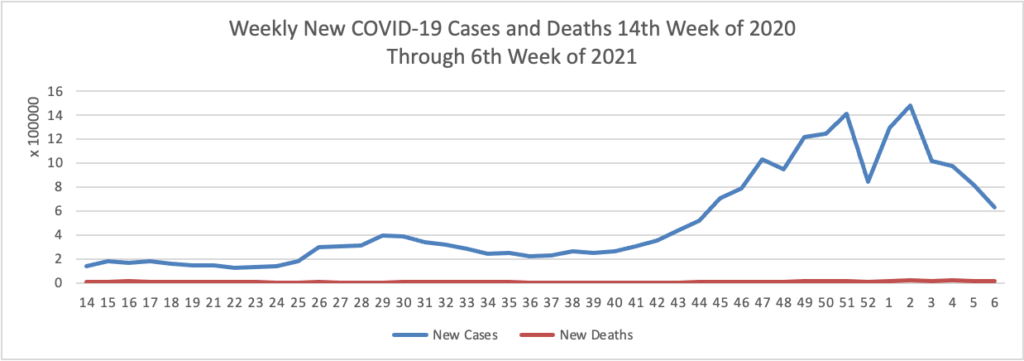
Based on the Centers for Disease Control’s COVID-19 Case Tracker website, here is the FEHBlog’s chart of new weekly COVID-19 cases and deaths over the 14th week of 2020 through the 6th week of this year (beginning April 2, 2021, and ending February 10, 2021; using Thursday as the first day of the week in order to facilitate this weekly update):

and here is the CDC’s latest overall weekly hospitalization rate chart for COVID-19:

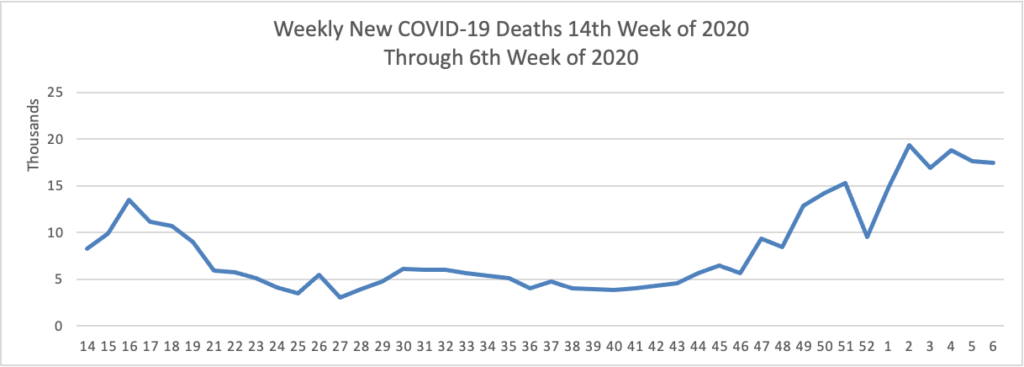
The FEHBlog has noticed that the new cases and deaths chart shows a flat line for new weekly deaths because new cases greatly exceed new deaths. Accordingly here is a chart of new weekly COVID-19 deaths over the period April 2, 2020, through February 10, 2021):

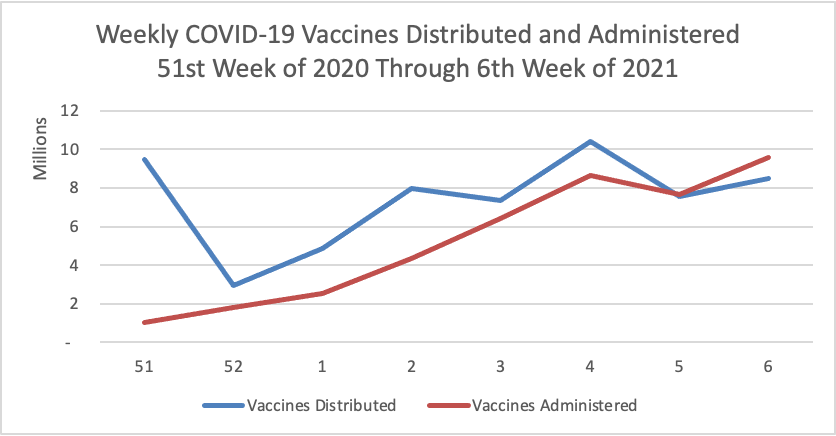
Finally here is a COVID-19 vaccinations chart from December 17, 2020, through February 10, 2021, which also uses Thursday as the first day of the week:

The Wall Street Journal sums it up well for this week :

U.S. Covid-19 deaths [a lagging indicator] appear to finally be slowing, following a broad and steep decline in both newly reported cases and hospitalizations in recent weeks.

While daily deaths remain near record highs, the average number of coronavirus-related fatalities has broadly fallen in recent days, dropping from a seven-day average of 3,172 on Feb. 1 to 2,765 on Wednesday, according to a Wall Street Journal analysis of Johns Hopkins University data.

Vaccinations, meanwhile, appear to be increasing, with about two million shots administered Thursday, according to a Wall Street Journal analysis of data from the Centers for Disease Control and Prevention.

In other vaccination news —

  • Medpage Today informs us about CDC changes to its adult and children vaccination recommendations which were released yesterday.
  • HR Dive reports that

The Society for Human Resource Management and 41 other business groups including the U.S. Chamber of Commerce have asked the U.S. Equal Employment Opportunity Commission (EEOC) to clarify “the extent to which employers may offer employees incentives to vaccinate.”

In a Feb. 1 letter to EEOC Chair Charlotte Burrows HR Dive obtained from the HR Policy Association, a signee, the groups wrote that incentives may aid in coronavirus vaccine distribution. But many employers are concerned about the liability they could create in offering such incentives, the letter said.

The signees asked EEOC to clarify how they might offer vaccination incentives without infringing upon the boundaries established by the Americans with Disabilities Act and other laws enforced by the agency. Specifically, the groups requested that the agency issue guidance that defines “what qualifies as a permissible incentive as broadly as possible.” An EEOC spokesperson said the agency appreciates “input from all stakeholders and will review the letter carefully.”

From the seeking public comment front —

  • The National Committee for Quality Assurance is seeking “feedback on proposed new measures, changes to existing measures and proposed measures for retirement. Public comment is now open for HEDIS® Measurement Year 2022.” The public comment deadline is March 11, 2021.
  • HHS’s Agency for Healthcare Research and Quality “encourage [interested parties] to review the draft report [titled “Strategies to Improve Patient Safety: Draft Report to Congress for Public Comment and Review by the National Academy of Medicine”] and send comments to PSQIA.RC@ahrq.hhs.gov no later than Feb. 16. We’ll review feedback in developing a final report for Congress later this year.” That’s not much time as the notice was posted today.

Weekend Update

Image result for super bowl

Happy Super Sunday LV!

The House of Representatives is engaged in committee work. The Senate is engaged in floor and committee work. The Wall Street Journal reports that

Senate Democrats said they expect a short impeachment trial starting this week for former President Donald Trump as they also seek to push ahead with the Biden administration’s proposed $1.9-trillion economic-relief bill.

The two events, combined with continuing hearings and votes on President Biden’s cabinet nominees, presage competing priorities as the new Democratic majority—which is reliant on Vice President Kamala Harris to break tied votes—is still figuring out key details on the trial process and on what provisions to include in the bill.

The Senate Homeland Security and Governmental Affairs is holding a confirmation hearing for Office and Management and Budget Director nominee Neera Tanden on Tuesday morning. The Senate Health Education Labor and Pension Committee is holding a confirmation hearing for the President’s Education Secretary and Labor Secretary nominees on Thursday morning.

On the COVID-19 front

  • The Wall Street Journal’s lead article this afternoon reports that

Vaccination drives hold out the promise of curbing Covid-19, but governments and businesses are increasingly accepting what epidemiologists have long warned: The pathogen will circulate for years, or even decades, leaving society to coexist with Covid-19 much as it does with other endemic diseases like flu, measles, and HIV. The ease with which the coronavirus spreads, the emergence of new strains and poor access to vaccines in large parts of the world mean Covid-19 could shift from a pandemic disease to an endemic one, implying lasting modifications to personal and societal behavior, epidemiologists say.

That’s not a shocker in the FEHBlog’s book. An endemic status would be a vast improvement over what we have faced for the past year.

  • Speaking of which, NPR Shots offers the latest advice on upgrading your COVID-19 masks.

“A cloth mask might be 50% effective at blocking viruses and aerosols,” says Linsey Marr, a researcher at Virginia Tech who studies airborne virus transmission. “We’re at the point now … that we need better than 50%.” When you’re outdoors, where fresh air can quickly disperse virus droplets and smaller particles, a cloth mask is still fine, Marr says. But infectious particles can accumulate indoors, and that’s when you want a better mask. “I am now wearing my best mask to the grocery store. I wasn’t before,” Marr says.

The article explains what Ms. Marr means.

Scientists probing the origins of the coronavirus are wrapping up a lengthy investigation in China and have found “important clues” about a Wuhan seafood market’s role in the outbreak. Peter Daszak, a New York-based zoologist assisting the World Health Organization-sponsored mission, said he anticipates the main findings will be released before his planned [Wednesday] Feb. 10 departure.  * * * “It’s the beginning of hopefully a really deep understanding of what happened so we can stop the next one,” he said over Zoom late Friday. “That’s what this is all about — trying to understand why these things emerge so we don’t continually have global economic crashes and horrific mortality while we wait for vaccines. It’s just not a tenable future.”

In miscellaneous healthcare news —

As every financial professional worth their salt knows, HSAs are a unicorn in the tax world. The accounts are funded with pretax income, grow tax-free and are not taxed when used for eligible expenses — the “triple tax” benefits for which they are so renowned. They represent one of the most efficient ways to squirrel away money for retirement. But they are also kneecapped by their pairing with high-deductible health plans, which are not always optimal for people who regularly anticipate big medical bills.

And while more people have opened HSAs, largely as more employers have opted for high-deductible plans, they are used more like checking accounts than as the long-term saving and investing vehicles they were designed to be.

The pandemic also appears to be having some consequences for HSA use, with those affected by job loss depleting their accounts and those who have remained employed being able to save more than ever, financial advisers say.

The FEHBlog believes that health plans should educate members about getting the most out of their HSA arrangements.

  • A friend of the FEHBlog pointed out that on February 5, the Food and Drug Administration “authorized marketing of a new prescription only device [know as eXciteOSA] intended to reduce snoring and mild obstructive sleep apnea. Unlike devices used while patients sleep, this is the first device used while awake that is intended to improve tongue muscle function, which in time can help prevent the tongue from collapsing backwards and obstructing the airway during sleep.”

Weekend Update

Photo by Clarisse Meyer on Unsplash

Congress continues it floor and committee work this coming week. Committees are in engaged in organizational meetings on both sides of Congress. Senate Committees principally will be engaged in holding hearings on Presidential cabinet nomination.

The House Oversight and Reform Committee, whose jurisdiction includes the FEHBP, holds its organizational meeting tomorrow at 2 pm. The Chair will continue to be Rep. Carolyn Maloney (D NY) and the Ranking Member will be Rep. James Comer (R KY). The party ratio will be 25 Democrats and 20 Republicans.

Meanwhile, Bloomberg reports that

Joe Biden’s presidency began at a choreographed sprint, with a series of executive actions to erase Donald Trump’s legacy and reset the nation’s course. But as his first full week in office came to a close, the new president was discovering the limits of his power.

His administration’s efforts to bolster vaccine production ran into the same hurdles that plagued the Trump administration — bottlenecks both at factories and in clinics — and Biden’s advisers had to clean up after the president said any American would be able to get inoculated by the spring. * * *

[FEHBlog note — Per the CDC’s Vaccinations site, on average 1.3 million doses of COVID-19 vaccine were administered on Friday and Saturday.]

He’s meanwhile encountering familiar roadblocks in Congress, where just four of his cabinet nominees have been confirmed 12 days into his presidency, and he’s found no traction among congressional Republicans for another big stimulus bill. * * *

Ten GOP senators wrote to Biden on Sunday with an alternative proposal for a slimmed-down stimulus bill. The White House says it will review the offer. A smaller plan that passed with bipartisan support would leave Democrats free to pursue more contentious elements using a partisan budget tool.

The Wall Street Journal adds

The offer is the first Republicans have forwarded since Mr. Biden proposed the $1.9 trillion plan, which Republicans have said is too costly and includes unneeded initiatives, and tests whether the Biden administration and Democrats in Congress will seek compromise or try to pass the relief package themselves. Democratic leaders have said they plan to begin a legislative process that would bypass the need for Republican support this week, with the first step coming as soon as Monday.

FEHBlog Public Service Announcement: The Centers for Disease Control on Saturday implemented one of the President’s executive orders by requiring

the wearing of masks by all travelers into, within, or out of the United States, e.g., on airplanes, ships, ferries, trains, subways, buses, taxis, and ride-shares. The mask requirement also applies to travelers in U.S. transportation hubs such as airports and seaports; train, bus, and subway stations; and any other areas that provide transportation.  Transportation operators must require all persons onboard to wear masks when boarding, disembarking, and for the duration of travel. Operators of transportation hubs must require all persons to wear a mask when entering or on the premises of a transportation hub.

This order will be effective on February 2, 2021. For more information on the Order or to view frequently asked questions, visit: https://www.cdc.gov/quarantine/masks/mask-travel-guidance.html

Thursday Miscellany

Photo by Juliane Liebermann on Unsplash

As the FEHBlog mentioned on Sunday, today was healthcare day at the White House. Here are links to the President’s executive order intended to strengthen Medicaid and the Affordable Care Act and the related fact sheet. Health Payer Intelligence explains that

In response to the executive order, the Department of Health and Human Services (HHS) will open a special enrollment period on the federal health insurance marketplace platform. The special enrollment period will last from February 15, 2021 through May 15, 2021.

This move will give the uninsured or underinsured individuals more time to enroll on the Affordable Care Act marketplace. Not only will it open up the federally-facilitated marketplace, but this executive order will also allow state-based marketplaces on the federal platform to have a special enrollment period.

“The President will also direct federal agencies to reconsider rules and other policies that limit Americans’ access to health care, and consider actions that will protect and strengthen that access,” said the fact sheet.

The Wall Street Journal adds “Mr. Biden’s sweeping call to review decisions that could limit access to health care marks the start of a tougher battle that is likely to spur political conflict between his administration and Republicans.”

The FEHBlog did watch the Washington Post’s online Prognosis 2021 today. Dr. Vivek Murthy, the President’s nominee for Surgeon General, commented that the President’s goal of 100,000,000 doses of COVID-19 vaccine in his first 100 days in office / April 30, 2021 is a floor not a ceiling. The ultimate goal of achieving herd immunity “goes beyond” April 30. On January 26 and 27, over 2.65 million doses were administered according to the CDC. Progress is being made.

Prognosis 2021 also featured BCBSA CEO Kim Keck, who discussed the Affordable Care Act. She accurately quipped that the Affordable Care Act should be known as the Access to Care Act as we are still waiting for a law that would reduce healthcare costs.

Prognosis 2021 also included an interview with U.S. Senator and Doctor Bill Cassidy (R La.). He touted the recently enacted No Surprises Act intended to protect patients against out of network surprise billing in emergency care, air ambulance and ancillary care at in-network hospital situations. While this law will be a heavy lift to implement, the FEHBlog does expect it to be effective. Video highlights of Prognosis 2021 are available here.

Speaking of healthcare costs Healthcare Dive reports that “U.S. hospitals lost more than $20 billion from suspending elective surgeries over three months at the beginning of the COVID-19 pandemic’s onset in this country, according to an article published recently in the Annals of Surgery.” Holy smoke.

Patient safety advocate the Leapfrog Group announced

Recognizing Excellence in Diagnosis, a new national initiative to publicly report and recognize hospitals for preventing patient harm due to diagnostic errors. Developed in collaboration with The Society to Improve Diagnosis in Medicine (SIDM) and key experts, the project is funded with a two-year grant of $1.2 million by the Gordon and Betty Moore Foundation. * * *

Joining Leapfrog in leading this effort is SIDM, a nationally recognized organization focused on catalyzing efforts to improve diagnostic quality and safety, as well as convener of the Coalition to Improve Diagnosis, of which Leapfrog is a member. SIDM will develop resources to guide health systems and clinicians on improving diagnostic safety. * * *

Recognizing Excellence in Diagnosis will be conducted over two years. As a first step, the initiative will convene an advisory group of Leapfrog and SIDM representatives, patient and payor stakeholders, and experts in diagnosis and performance analysis. With guidance from the advisory group, the project will identify best practices in diagnosis and put together a roadmap for hospitals and health systems to achieve excellence. SIDM will facilitate the development of training and educational materials to support hospitals and health systems in their adoption of the best practices. In year two, Leapfrog will pilot test a national survey, similar to the annual Leapfrog Hospital Survey, to collect data from up to 100 hospitals and health systems on their adoption of identified best practices. A national report will be issued on the current status of diagnostic safety, best practices for achieving excellence, and strategies for payors and patients to incentivize improvement.

Good luck with this initiative.