Tuesday report

Tuesday report

Simplicity is a virtue.

From Washington, DC,

  • The American Hospital Association News reports,
    • “The House Energy and Commerce Subcommittee on Health held a hearing Sept. 15 to discuss more than a dozen legislative proposals regarding Medicare provider payment and healthcare cybersecurity. The AHA provided comments to the subcommittee on bills designed to improve long-term physician payments, including proposals to increase the budget neutrality threshold in the Medicare physician fee schedule and a bill to replace the Merit-based Incentive Payment System with the Data-driven Performance Payment System. The AHA also commented on bills to provide grants for the adoption of cybersecurity best practices, direct the Department of Health and Human Services to create a strategy for rural hospital cybersecurity staff training, and improve obstetric emergency preparedness in rural healthcare settings.” 
       
  • MedPage Today relates,
    • “Chris Klomp, President Donald Trump’s nominee for deputy HHS secretary, declared his support for the measles, mumps, and rubella (MMR) vaccine at a Senate Finance Committee confirmation hearing Tuesday, but that wasn’t good enough for one of the Democratic senators on the committee.
    • “Klomp, who currently serves as HHS chief counselor, told Sen. Ron Wyden (D-Ore.), the committee’s ranking member, that “Unquestionably, the MMR vaccine is the single most effective public health tool that we have against measles. It’s 97% effective after two doses [in] preventing transmission, and this is the single best thing that we can do to eradicate” the disease, Klomp said.
    • Chris Klomp, President Donald Trump’s nominee for deputy HHS secretary, declared his support for the measles, mumps, and rubella (MMR) vaccine at a Senate Finance Committee confirmation hearingopens in a new tab or windowTuesday, but that wasn’t good enough for one of the Democratic senators on the committee.
    • Klomp, who currently serves as HHS chief counselor, told Sen. Ron Wyden (D-Ore.), the committee’s ranking member, that “Unquestionably, the MMR vaccine is the single most effective public health tool that we have against measles. It’s 97% effective after two doses [in] preventing transmission, and this is the single best thing that we can do to eradicate” the disease, Klomp said.
    • “Committee chairman Sen. Mike Crapo (R-Idaho) took the opposite view. “You have met all of the requirements and standards of this committee in vetting a nominee, and you are completely and well qualified to be deputy secretary at the Department of Health and Human Services,” he told Klomp.” 
  • The Wall Street Journal adds,
    • “Pennsylvania health officials announced Tuesday a fourth measles-associated death, the latest fatality in the commonwealth where recently reported deaths from the vaccine-preventable disease have inflamed politics at the local and national level.
    • “The death follows those of two infants in the state’s Lancaster County in mid-August amid a growing measles outbreak. The state health department’s classification of those deaths spurred a highly politicized debate over vaccinations and sparring between the state’s Democratic governor and the nation’s health secretary.
    • “Over the weekend, a coroner in Pennsylvania’s Jefferson County said a 40-year-old woman there died from complications from measles. The Mifflin County Coroner’s Office on Tuesday said an 18-year-old resident died due to a rare neurological complication from measles. The state health department said it worked with local coroners’ offices to determine both individuals tested positive for measles and the deaths didn’t result from an unrelated cause.
    • “That’s four total measles-associated deaths in our Commonwealth and the first Pennsylvania has seen in 35 years,” Pennsylvania Gov. Josh Shapirosaid in a post on social media Tuesday. “These are tragedies, and four families are grieving.”
  • Per a U.S. Census Bureau news release,
    • “The U.S. Census Bureau today announced that real median household income was $87,460 in 2025, the highest on record dating back to 1967.
    • “The official poverty rate fell 0.5 percentage points to 10.2% in 2025. The following 2025 findings were not statistically different from 2024: the Supplemental Poverty Measure (SPM) rate in 2025 was 13.1% and in 2025, 26.7 million people (7.9%) were uninsured for the entire year, according to the 2026 Current Population Survey Annual Social and Economic Supplement (CPS ASEC).
    • ‘These findings come from three Census Bureau reports, “Income in the United States: 2025,” “Poverty in the United States: 2025” and “Health Insurance Coverage in the United States: 2025.”
  • Beckers Hospital Review tells us,
    • CMS will add four condition tracks to its Advancing Chronic Care with Effective, Scalable Solutions (ACCESS) model starting in spring 2027, the agency said in a Sept. 15 news release.  
    • Four things to know: 
      • “The expansion adds heart failure, chronic obstructive pulmonary disease, substance use disorders and tobacco cessation to the model. CMS will also expand support for chronic musculoskeletal pain, extending coverage for certain conditions beyond the model’s initial 12-month care period.
      • “The model already covers hypertension, diabetes, chronic musculoskeletal pain and depression. CMS says 3 out of 4 Medicare beneficiaries qualify for at least one track.
      • “The ACCESS model ties Medicare payments to measurable improvements in patient health rather than paying solely for individual services. Participating organizations can offer virtual care, health coaching, remote monitoring, and connected devices and wearables between regular doctor visits.
      • “There are currently 160 organizations participating in the ACCESS model, and CMS said Medicare will continue to add to the list throughout the model’s 10-year run. The model supports those with traditional Medicare. Medicare Advantage enrollees are not eligible, but CMS said MA plans may offer similar programs.”

From the U.S. Office of Personnel Management front,

  • OPM included the following additions in today’s Federal Register.
    • Rules
      • Reduction in Force; Correction
      • Shared Certificates and Pooled Hiring Actions
    • Proposed Rules
      • Promoting Employee Accountability
  • Federal News Network reports,
    • “The fewest number of federal employees submitted their retirement papers in August as compared to the rest of 2026. The Office of Personnel Managements says it received only 7,618 retirement claims last month. This is down from more than 10,000 claims OPM received in July. Additionally, OPM’s backlog of retirement claims is at the lowest of the year at just over 15,400. The average number of days to process a claim for August also dropped considerably: to 70 days for a digital claim, down from 98 days the month before, and to 79 days for all claims, down from 109 days in July. (Federal retirement claims down, as the backlog hit lows for 2026 – OPM)”
  • Kevin Moss, writing in Federal News Network, discusses
    • “Healthcare affordability series part 8: Enrollment flexibility for two-person families can lead to premium savings.”
      • “Most of the time, self-plus-one is cheaper, but there are plans where you’ll save more enrolling as self & family.”
  • Govexec relates,
    • “More ‘Big Balls’-type young feds are what the OPM chief wants 
      • “In an interview on Monday, Scott Kupor also discussed implementing skills-based hiring, which had been a priority of the Biden administration as well.”

From the U.S. Food and Drug Administration front,

  • STAT News relates,
    • “The Food and Drug Administration is opening applications for a pilot program designed to shorten the amount of time it takes for drugmakers to begin testing their products in humans, the agency announced Tuesday. 
    • “The pilot was first announced in June as part of Operation TrialBlazer, the Department of Health and Human Services initiative that pledged to shorten the FDA’s drug approval timelines and help the U.S. compete with the rapidly accelerating biotechnology industries in countries like China and Australia.
    • “Too often, the U.S. pathway can be measured in years, while other countries’ pathways are measured in months,” the department wrote in the TrialBlazer roadmap.”
  • and
    • “Vera Therapeutics said Tuesday that its recently approved drug Trutakna stabilized kidney function and reduced the risk of kidney-related death and other complications in patients with a chronic autoimmune kidney disease, according to final, two-year results from a Phase 3 clinical trial. 
    • “In July, the Food and Drug Administration granted accelerated approval to Trutakna for the treatment of IgA nephropathy, or IgAN, a disease caused by the buildup of immune antibodies in the kidneys. The condition leads to progressive loss of kidney function and potentially organ failure requiring dialysis.
    • “With the final data from the study in hand, Vera said it will seek full approval of the drug from the FDA during the fourth quarter.”
  • Cardiovascular Business tells us,
    • “XCath Robotics has received the FDA’s breakthrough device designation for its Iris surgical robotic system that performs remote robotic-assisted mechanical thrombectomy in acute ischemic stroke patients.
    • “This represents a significant step forward for the Houston-based medtech company. The FDA’s breakthrough devices drogram helps support the development of medical devices that have the potential to provide more effective treatment for patients with life-threatening or irreversibly debilitating conditions. This provides XCath Robotics with more opportunities to interact with FDA experts and receive support as the company works toward U.S. regulatory approval for the Iris system.
    • “Back in March, the Iris system was used to complete the world’s first telerobotic stroke thrombectomy. Neurosurgeon Vitor Mendes Pereira, MD, chair of advanced neurovascular interventions at the University of Toronto, used the system to perform the historic procedure in Santiago, Panama, while the patient was 120 miles away in Panama City.”

No Surprises Act News

  • The FEHBlog did receive his CMS invitation to join its Independent Dispute Resolution Gateway this morning, and the FEHBlog promptly took CMS up on its offer. The process went smoothly.
  • The Paragon Institute September 15, 2026, Newletter’s kicks off with an article about “Fixing the No Surprises Act’s Broken Arbitration System.”
    • “Congress already required much of this transparency through the NSA’s Advanced Explanation of Benefits provisions, but those requirements have yet to be fully implemented. The administration should finish that work. Once patients have meaningful advance information about networks and prices, there is no justification for a federal arbitration system setting payments for elective care.
    • “For emergency services, a different approach is needed, and Congress has two reasonable options. It could eliminate federal IDR entirely while maintaining the prohibition on balance billing, leaving insurers and providers to settle payment disputes through private arbitration, litigation, or state law.
    • “Alternatively, Congress could retain IDR solely for emergency services but impose meaningful guardrails. Awards should have a reasonable upper limit so arbitration does not continue producing payments wildly disconnected from market prices. Congress should also reform how arbitrators are paid, and if an upper limit is implemented, insurers should face penalties when they fail to pay awards on time.
    • “The administration can make additional improvements now: require arbitrators to explain their decisions, audit firms with unusually high provider win rates or awards, strengthen eligibility reviews, improve arbitrator training, prohibit conflicts of interest and forum shopping, and restore a meaningful filing fee.
    • “The No Surprises Act solved a real problem by protecting patients from bills they could neither anticipate nor avoid. Those protections should remain. But protecting patients from surprise bills does not require a federal arbitration system that rewards providers for staying out of network and raises health care costs for everyone.”

From the fraud, waste, and abuse front,

  • Healthcare Dive reports,
    • “The federal government is once again targeting fraud in durable medical equipment suppliers, publishing a report Monday through the HHS’ Office of the Inspector General that urges regulators to crack down on suspect billing in Medicare Advantage.
    • “The OIG found that, in addition to other issues, MA organizations don’t screen for fraudulent medical equipment suppliers as often when they’re out of network, compared to in-network suppliers.
    • “MA organizations should tighten the screening process for suppliers and the CMS should use its fraud prevention tool more regularly, the OIG said.”

From the public health and medical / Rx research front,

  • The American Hospital Association News reports,
    • “In recognition of Suicide Prevention Month, Susan Szulewski, M.D., president and chief operating officer, McLean Hospital and vice president, Mass General Brigham Behavioral and Mental Health, wrote on the importance of healthcare organizations working to reduce the stigma surrounding suicide and create a supportive environment with timely access to care and a clear path forward. READ MORE“
  • Per a CDC news release,
    • “Today, the Centers for Disease Control and Prevention and the Ad Council are launching a new round of public service announcements (PSAs) encouraging people to understand their risk of prediabetes and take action to prevent or delay type 2 diabetes.
    • “Now in its 10th year, the national “Do I Have Prediabetes?” campaign encourages viewers to take a 1-minute prediabetes risk test on DoIHavePrediabetes.org. This year’s “Undo It” PSAs spotlight that while there are many scenarios in life we can’t undo, prediabetes is something that can be reversed. 
    • “Prediabetes is a serious health condition that increases the risk of type 2 diabetes, heart attack and stroke. Because prediabetes often has no symptoms, many people do not know they have it. Research shows that early diagnosis can inspire individuals to adopt healthier habits, including eating better, being active and managing weight, that can reverse prediabetes and delay or prevent type 2 diabetes.
    • ‘If someone receives a high score on the risk test, that person is encouraged to speak to a doctor to confirm a diagnosis of prediabetes with a blood test, then enroll in the National Diabetes Prevention Program.” 
  • Healio tells us,
    • “Development of alcohol use disorder, depression or stress after a traumatic event was a strong predictor of major adverse cardiac and cerebrovascular events for both men and women, researchers reported.
    • “Evaluation of psychiatric predictors of major adverse events may be an important step in the prediction of CV risk after a traumatic event, according to data published in the Journal of the American Heart Association.
    • “Experiencing traumatic events can have long-lasting consequences for mental health that can take many forms, but research to date had yet to comprehensively consider these. Indeed, nearly all work on trauma and CVD had focused on PTSD and other stress-related disorders — the quintessential trauma-related mental health disorders — but depression, anxiety and substance use disorders are also common following trauma and are relevant to cardiovascular disease risk,” Jennifer A. Sumner, PhD, associate professor of psychology at the University of California, Los Angeles, told Healio. “We wanted to comprehensively investigate different posttraumatic mental health conditions as possible predictors of CVD onset. Also, given sex differences in both posttraumatic psychopathology and CVD, we examined whether links between various psychiatric disorders following trauma and CVD might differ for men vs. women.”
  • Health Day informs us
    • “New research suggests that the blood pressure and heart rate guidelines doctors use to guide emergency treatment in children are misleading in cases of traumatic injury. 
    • “These thresholds for “hemodynamic instability” — the inability of the circulatory system to get blood to organs — may be different for children with traumatic injuries versus healthy children, researchers wrote Sept. 9 in the Journal of the American College of Surgeons.
    • “Recognizing hemodynamic instability is fundamental in trauma care because these vital signs tell us when a child may be at increased risk of death or complications and when we may need to intervene,” explained study senior author Dr. Zain Hashmi. He’s an assistant professor of trauma and acute care surgery at the University of Alabama at Birmingham.
    • “Blood pressure and heart rate guidelines are often used by doctors to decide when to start resuscitation treatments, including blood transfusions, Hashmi said in a news release. However, the values used in children were not developed specifically for trauma patients and may not accurately reflect when the risk of death begins to rise in injured children, he added.” 
  • Medscape points out,
    • “A new international consensus statement providing evidence-based guidance on smoking cessation for people with type 2 diabetes (T2D) has been issued by a multidisciplinary international panel called the DiaSmokeFree Working Group. 
    • “The central message “is that smoking cessation needs to be treated as an integral part of diabetes management rather than as generic lifestyle advice,” statement co-author Riccardo Polosa, MD, PhD, professor of internal medicine at the University of Catania in Catania, Italy, told Medscape Medical News.
    • “There is evidence that this is under-prioritized in diabetes care,” he added. “Clinicians understandably focus on glucose, blood pressure, lipids, and medications, while smoking may receive only brief and mostly ineffective advice.”
  • Today’s issue of NIH’s Research Matters covers the following topics:
    • “Depression may stall development of new neurons 
      • “Researchers found that a part of the brain important for memory struggles to make new neurons in people with depression.
      • “The study sheds light on how the brain is altered in depression and suggests new treatment targets.”
    • GLP-1 drug slows aging in mice 
      • A GLP-1 drug extended lifespan and prevented age-related decline in older female mice.
      • Understanding how calorie restriction and GLP-1 drugs slow aging could lead to new ways to treat age-related diseases.
    • Antibodies may prevent tick-related syndrome 
      • “Researchers identified rare antibodies that may help combat alpha-gal syndrome, a condition that causes allergic reactions to red meat and dairy products.
      • “With further development, the finding could lead to treatments for this tick-related allergic condition.”

From the U.S. healthcare business and artificial intelligence front,

  • Beckers Payer Issues reports,
    • “Aetna’s two-year financial turnaround has taken hold following a leadership overhaul, thousands of ongoing cost management initiatives and a margin recovery plan expected to complete by 2027.
    • “Once you get the fundamentals in place, you start getting credibility, not only with investors, but internally with our employees, and then, in particular, with our members,” Aetna President Steve Nelson said Sept. 9 at the Wells Fargo Healthcare Conference. “We can be a little more disruptive and innovative. Aetna has a legacy of being innovative in terms of product and clinical programs, and we are getting back to that.”
    • “The insurer has spent the past two years in recovery mode after a period of financial turmoil driven by Medicare Advantage cost pressures, previously unfavorable star ratings and major losses in the ACA business, which it exited for 2026. Mr. Nelson, who also serves as executive vice president at CVS Health, was tapped to lead the insurer in late 2024.”
  • and 
    • “Health Care Service Corp. has completed the rebranding of its Medicare supplement and supplemental health and life products under the HealthSpring name.
    • “The move finishes a transition that began last year, when HCSC shifted the Medicare Advantage and Part D business it acquired from Cigna for $3.3 billion to the HealthSpring brand. 
    • “HealthSpring has more than 3 million members. HCSC said it is the second-largest Medicare supplement carrier by policyholders, with plans available in 48 states and Washington, D.C. Its supplemental health and life products, which include hospital indemnity and dental, vision and hearing benefits, are offered in 49 markets and D.C.”
  • and
    • “The Blue Cross Blue Shield Association has tapped Daniel Serrano to serve as CFO.
    • “The president and CEO of the BCBS Association, Kim Keck, announced the update Sept. 14 on LinkedIn. 
    • “With critical capabilities for this moment, including a practitioner’s orientation to data-driven financial management and a strong track record of aligning financial performance with operational outcomes, Dan is a great fit for our organization,” she said.”
  • Fierce Healthcare adds,
    • “Member trust in insurers is on the decline among Gen Z and Millennials, down 10.5% between 2023 and 2026, new research from Accenture found.
    • “This trust gap, according to analysts, could cost $3 billion in future member lifetime value for the largest commercial payers over the next decade. 
    • “When members don’t trust their health plan, they don’t just disengage; they route around it,” said Bracken Flynn, Accenture’s Health industry principal director, in a statement. “Our data shows that younger consumers aren’t asking for less from their insurer. They want more. They’re looking for a partner that helps them navigate care, understand costs, and make confident decisions. The insurers that earn that trust now will define what health coverage means for the next generation.”
    • “During a Sept. 14 AHIP webinar, Flynn said the report—which polled 1,200 consumers—found members trust insurers when they believe the health plan will help them make good healthcare decisions and navigate them to the best care.
    • “That’s across clinical and administrative touchpoints,” Flynn said. “And so it’s a partnership. In practice, it’s a partnership.”
    • “The lack of trust in insurers is causing younger members to turn to artificial intelligence tools, with 62% of respondents saying they have used AI to help choose a health plan.”
  • The American Hospital Association News relates,
    • “A new report from Kaufman Hall prepared for the AHA highlights new insights and data on hospital mergers and acquisitions. An AHA blog accompanying the report is also available.
    • “The report discusses how hospital merger reviews should look beyond the potential impact on commercial insurance prices and consider what proposed transactions mean for all patients, particularly the nearly 60% of hospital patient days attributable to Medicare, Medicaid and Medicare Advantage beneficiaries whose payment rates are largely set by government programs. Drawing on analyses of challenged and canceled transactions, the report also finds that hospitals seeking partners often serve more vulnerable communities and face greater financial pressures, and that when proposed deals do not move forward, struggling hospitals can experience significant financial deterioration that threatens services, workforce stability and access to care.
    • “These findings suggest that a more comprehensive analysis of hospital M&A transactions, one that considers impacts on all patients served, broadens the focus to impacts beyond pricing, and considers the consequences if an M&A transaction is not permitted to proceed, would ensure not only competitive but also healthy hospital markets that can continue to provide the fullest possible range of services,” the report says.”
  • AHIP relates,
    • “New data highlighted by Washington Post Intelligence show hospital system consolidation continues to accelerate, with 40 new mergers and acquisitions announced already in the first half of 2026 — nearly as many as throughout all of 2025. 
    • “Clear evidence demonstrates that anticompetitive hospital consolidation leads to higher healthcare costs for patients, families and employers. Hospital spending already makes up the largest share (40%) of insurance premiums, accounting for over $1.6 trillion in spending nationwide.”
  • Beckers Hospital Review adds,
    • “Salt Lake City-based Intermountain Health has acquired the nine-story, 235,000 square-foot Fairbourne Building in West Valley City, Utah, and plans to convert it into a medical campus.”
  • and
    • “The nonprofit parent organization of OpenAI — the Open AI Foundation — has given $40 million to Chapel Hill, N.C.-based UNC Lineberger Comprehensive Cancer Center to generate data that can be used to develop more precise, personalized cancer vaccines. 
    • “UNC Lineberger researchers, led by immunologist Benjamin Vincent, MD, and computational biologist Alex Rubinsteyn, PhD, will gather deidentified tumor tissue and immune cell data that will train AI models to identify cancer cell targets for vaccines, according to a Sept. 15 news release from the cancer center. 
    • “Researchers will also conduct clinical trials to compare multiple vaccine formulations for triple-negative breast cancer, the release said.”
  • Cardiovascular Business points out,
    • “U.S. News & Report has published its annual ranking of the top children’s hospitals in the United States, once again producing a separate list for the best hospitals for cardiology and heart surgery. This represents the 20th year that U.S. News.& World Report has compiled these rankings.
    • “For two decades, U.S. News has helped guide families to top-tier pediatric care,” Ben Harder, chief of health analysis and managing editor at U.S. News, said in a statement. “Finding the right medical team for a rare diagnosis or complex surgery can be overwhelming, and U.S. News’ annual evaluation of the Best Children’s Hospitals provides a clear starting point for parents and referring pediatricians alike.”
    • “Nearly 200 U.S. facilities were eligible for these rankings. Each one is either a freestanding children’s hospital or a large multidisciplinary pediatric department working within a major medical center.
    • “This latest ranking of the Best Children’s Hospitals for Cardiology and Heart Surgery includes some familiar names at the top. For instance, Texas Children’s Hospital in Houston is No. 1, just like it was in 2019, 2020, 2021, 2022, 2023, 2024 and 2025. 
    • “Meanwhile, Children’s Hospital Colorado and Duke Children’s Hospital and Health Center are No. 2 and No. 3, respectively. That is where each one landed in the previous year’s ranking as well. 
    • “Going a bit deeper, Children’s Hospital of Philadelphia came in at No. 4, and Children’s Health Dallas came in at No. 5.” 
  • MedCity News lets us know,
    • “Virtual solutions for chronic kidney disease (CKD) management don’t slow disease progression, nor do they reduce total healthcare spending, according to a new analysis by the Peterson Health Technology Institute (PHTI).
    • “PHTI is an independent evaluator of digital health solutions. For the analysis, PHTI reviewed more than 5,400 articles and other evidence. The solutions evaluated in the report include DaVita IKC, Evergreen Nephrology, Healthmap Solutions, Interwell Health, Kidneylink, Monogram Health, Somatus and Strive Health. These companies take on financial responsibility for the total cost of care for patients with stage 3–5 CKD, and typically work with Medicare Advantage plans and Medicare’s Kidney Care Choices model.
    • “The assessment focuses on managing chronic kidney disease before patients progress to end-stage kidney disease, including the need for dialysis or a kidney transplant.”
  • Managed Healthcare Executive tells us,
    • “GLP-1s now dominate market momentum, with obesity products surging from near-zero in 2022 to $55B annually and diabetes GLP-1s sustaining double-digit year-over-year growth. 
    • “Independent pharmacies are reassessing dispensing economics, with refusal rates declining to 35% for weight-loss GLP-1s and 8% for diabetes GLP-1s. 
    • “Distribution remains retail-heavy (~80%), but mail fulfillment is increasing, reaching 12.9% of GLP-1 prescriptions as direct-to-consumer channels expand. 
    • “Diabetes category mix is shifting away from insulin, whose sales share has dropped to 9.8% and prescription share to 16%, reflecting GLP-1 substitution dynamics. 
    • “Medicare Part D Bridge uptake appears immediate, with 9,000 paid claims in three days, alongside a large pipeline exploring neuropsychiatric, SUD, cancer-risk, women’s health, and systemic inflammation indications.”
  • The Wall Street Journal informs us,
    • “Legend Names Novartis Executive as CEO
      • “Ingrid Zhang takes the helm of the cancer therapy company, filling a post vacant since its previous CEO abruptly resigned in July.”
  • Per Beckers Health IT,
    • “Oracle has expanded its fiscal 2026 restructuring plan by approximately $700 million, bringing expected costs to roughly $2.8 billion as the company pursues strategic initiatives and operational efficiencies that include adopting and integrating AI across certain functions.
    • “The Sept. 11 Securities and Exchange Commission filing does not specify what actions the additional $700 million will cover or how many employees could be affected. Oracle said restructuring expenses under the broader plan include employee severance, contract termination and other exit costs.
    • “As of Aug. 31, prior to the additional $700 million, Oracle estimated total restructuring costs of up to $2.1 billion.
    • ‘The disclosure comes as Oracle employees across social media reported a recent round of layoffs, including at Oracle Health. Business Insider first reported the layoffs Sept. 14, citing three people affected and an email notification.”
  • and
    • “Mayo Clinic and Thermo Fisher Scientific have launched Precure, a joint venture designed to detect biological signs of disease before patients develop symptoms, according to a news release shared with Becker’s.
    • “Rochester, Minn.-based Mayo Clinic, will serve as majority owner of the entity and Thermo Fisher joins as a minority partner. Precure will build one of the world’s largest human multi-omics datasets — integrating proteomic and genomic data with longitudinal clinical information drawn from 1 million biospecimens collected over several years, according to the release.
    • “At Mayo Clinic, we are committed to transforming patient care through innovation,” said Gianrico Farrugia, MD, president and CEO of Mayo Clinic. “By harnessing the full potential of multi-omics data, Precure, LLC aims to help us better understand disease before symptoms appear.”
    • “Thermo Fisher will contribute its Olink Explore HT proteomics platform and Orbitrap mass spectrometry technology to the effort. Marc Casper, Thermo Fisher Scientific’s chairman and CEO, said the venture has “the potential to create a step change in how we generate and apply multi-omics data to improve human health.”
    • “Target disease areas include cancer, cardiometabolic conditions, neurological disorders and immune-mediated disease — conditions where biological changes often precede clinical diagnosis by years. Advanced AI and large-scale data analytics will be used to identify patterns across the datasets and translate them into actionable insights.”
  • Per Beckers Clinical Leadership,
    • “The nonprofit parent organization of OpenAI — the Open AI Foundation — has given $40 million to Chapel Hill, N.C.-based UNC Lineberger Comprehensive Cancer Center to generate data that can be used to develop more precise, personalized cancer vaccines. 
    • “UNC Lineberger researchers, led by immunologist Benjamin Vincent, MD, and computational biologist Alex Rubinsteyn, PhD, will gather deidentified tumor tissue and immune cell data that will train AI models to identify cancer cell targets for vaccines, according to a Sept. 15 news release from the cancer center. 
    • “Researchers will also conduct clinical trials to compare multiple vaccine formulations for triple-negative breast cancer, the release said. 
    • “These efforts aim to create a public, multimodal dataset to “help reach a future where cancer patients can get rapid personalized cancer vaccines when they are diagnosed,” the OpenAI Foundation said in a Sept. 15 news release. 
    • “UNC Lineberger’s $40 million grant is part of a $125 million funding program, called Public Data for Health, established by the foundation.”
  • and
    • “Ambient artificial intelligence handed many physicians their evenings back. For nurses, the same promise is proving harder to keep, and the reason is buried in the flow sheet.
    • “Physician ambient scribes listen to a visit and draft a narrative note when it ends. Nursing documentation does not work like that. It lives in structured flow sheets, entered field by field across a shift, every time a nurse assesses, medicates or turns a patient.
    • “Nursing documentation occurs throughout the entire shift. It’s every time we interact with a patient,” said Stephanie Clements, BSN, RN, senior vice president and chief nurse executive at Chesterfield, Mo.-based Mercy. “It’s very different than summarizing care at the end of a period.” 
    • “That difference is why early attempts to copy the physician model — record the encounter, generate the note — have not mapped cleanly onto the bedside, and why some nurses have found the tools slower, not faster, at first.
    • “Yet the systems furthest along say the payoff is real when the technology is built for nurses from the get-go.” 

Notable Deaths

  • The New York Times reports
    • “Harold P. Freeman, an influential oncology surgeon whose knowledge of the devastating effects of breast cancer on poor Black women inspired him to create a landmark program at Harlem Hospital Center, helping patients navigate the health care bureaucracy, died on Aug. 11 in Atlanta. He was 93.
    • “His death, at a hospital, was confirmed by his son Neale.
    • “Dr. Freeman’s patient navigation program became a model for hospitals around the world, helping to eliminate barriers to early cancer detection. The program’s success influenced the passage of the federal Patient Navigator Outreach and Chronic Disease Prevention Act of 2005, which provided $25 million for similar programs across the United States. In 2024, Medicare began providing providers with reimbursement for some navigation services for cancer, heart failure, H.I.V./AIDS and other high-risk conditions.
    • “There are no navigation events or meetings that don’t acknowledge Dr. Freeman’s role in patient navigation,” Dr. Shanthi Sivendran, the interim chief patient officer of the American Cancer Society, said in an interview. “There wasn’t a patient navigation concept before him.”
  • and
    • “The milk truck would pull up to the house, and out would come the groceries — not just milk, but also eggs, cheese, juice, cereal and baby formula. It might have stopped at a rich family’s house, or a poor one. No one could tell the difference, which was precisely the point.
    • “Vermont’s supplemental food program for low-income women, infants and children, the first in the nation to be implemented statewide, began in 1974. It was the brainchild in part of Dr. Anthony Robbins, then one of the country’s youngest state health commissioners, at 33; he had secured a federal grant to made the program possible.
    • “Not only did the program provide much-needed supplies, but it also shielded families from the stigma of receiving public assistance.
    • “The milk truck was stopping at practically every house — high income, low income, whatever,” Donna Bister, a former director of the program, known widely as WIC, said in an interview. The program is now available in all 50 states.” * * *
    • “Dr. Robbins died on July 5 at his home in Rockport, Mass. He was 85. His death, which was not widely reported at the time, was caused by complications of long Covid, heart disease and Parkinson’s disease, his wife, Phyllis Freeman, said.
    • “He was considered to be on the cutting edge of health care,” Madeleine Kunin, a former governor of Vermont, said in an interview. “He was a bright light.”
  • RIP Doctors.

Cybersecurity Saturday

From the frontier AI / Project Glasswing front

  • Daniel Borish writes in LinkedIn,
    • “Anthropic released its fourth threat intelligence report on September 10, 2026, covering activity its Threat Intelligence team disrupted between December 2025 and August 2026. The report documents cases across seven categories of harm: cyber operations, surveillance, influence operations, conventional weapons development, biological misuse, scams and fraud, and illicit distillation. The company assigns each disrupted actor an internal designator, a Generative Threat Group (GTG) number, and publishes case studies detailing how each group used Claude models, along with indicators of compromise for other defenders to act on.
    • “The report’s central claim is not that AI created new categories of attack. Credential theft, phishing, SQL injection, and unpatched edge devices remain the entry points they have always been. What changed is who can run these attacks at what speed. Anthropic’s investigators found a suspected Russian state espionage unit, a network of financially motivated ShinyHunters affiliates, Chinese university students moonlighting in exploit research, and a lone French hacktivist all using functionally similar AI-orchestrated methodologies to run multi-victim campaigns that would previously have required coordinated teams.”
  • The Wall Street Journal reports,
    • “Artificial intelligence agents being tested by OpenAI launched a cyberattack against a popular software service two months before they hacked the AI software company Hugging Face, a new signal of the potential for advanced AI tools to slip out of human control.
    • “The attack overwhelmed maintainers of an online service for coders, called RubyGems, and forced them to shut down new account registrations as they dealt with the chaos it had caused, operators of the service said.
    • “A coalition of AI researchers said it had unearthed evidence that OpenAI agents were behind the May attack and shared its findings with The Wall Street Journal and OpenAI. The AI developer on Friday confirmed that its agents had been involved in an incident involving RubyGems.
    • “Based on our review, our agents used the RubyGems platform to access the internet to carry out benign tasks and retrieve public information. We’ll continue to investigate as part of our broader review of agent activity during training and evaluation,” an OpenAI spokeswoman said in a statement.”
  • and
    • “An Anthropic researcher is quitting the artificial-intelligence industry over fears that the lab and its competitors are racing to build systems they won’t be able to control, a sign of mounting safety concerns within top AI companies.
    • “Jacob Coxon, a researcher who specializes in training new AI models by having them consume vast amounts of data, said Tuesday that he is leaving the company because he doesn’t want to participate in an industrywide rush to build AI systems that can improve themselves, worried such systems could spiral out of control and destroy humanity.
    • “The 27-year old Brit, who previously studied mathematics, said many of his industry colleagues now use phrases like “crunchtime” and “endgame” to describe the trajectory toward self-improving models.” * * *
    • “Anthropic didn’t immediately comment on the departure. Chief Executive Dario Amodei and other company leaders have repeatedly warned about the risks of rogue AI models, and urged the industry to slow development. 
    • “After Coxon announced his departure, a top scientist at the company, Evan Hubinger, wrote on X that he thought Coxon was correct about the risks of AI development.
    • “We really do earnestly believe AI could kill all humans! I personally think it is >10% within the next decade,” Hubinger wrote. “I believe Anthropic is trying its best, but we do not yet have a plan to solve alignment for superintelligence and are not clearly on track to.” Others also amplified the view.”
  • Per Axios: “Nvidia CEO Jensen Huang: AI fears designed to generate cybersecurity business.”
  • BigGo Finance lets us know,
    • “A bipartisan group of US senators is negotiating legislation that would create a legal duty of care for frontier AI developers, requiring them to prevent catastrophic risks and giving the federal government authority to block unsafe model releases. The proposal, led by John Thune, Ted Cruz and Amy Klobuchar, would apply to advanced models from companies such as OpenAI, Anthropic and Google, with national laboratory experts potentially conducting hands-on testing for nuclear, biological and cyber threats. Companies could appeal government blocking decisions in federal court. The measure would also preempt state AI safety laws. With the House in session only one week before the November 3 midterms, passage remains uncertain despite growing pressure on Congress to address frontier AI risks.”
  • Axios adds,
    • “A letter is circulating among House members urging Speaker Mike Johnson (R-La.) to bring back the House “immediately” and keep it in session until Congress passes AI safeguards, Axios has learned.”
  • The Wall Street Journal notes,
    • “President Trump, who has taken a light touch overseeing the sector, previously said he is in favor of kill switches and other steps to keep AI safe but has warned burdensome regulation could cost the U.S. in the tech race.”
  • and
    • “The leaders of three of the biggest AI companies agreed [September 12] that they needed to slow development of the technology before their advances create a menace that can’t be controlled.
    • “It was a rare display of unity by Elon Musk, Sam Altman and Dario Amodei, who have been spending tens of billions of dollars to develop evermore powerful artificial intelligence models. Altman even suggested that his company, OpenAI, may need to delay its much-anticipated IPO to focus on safety.”

From the cybersecurity policy and law enforcement front,

  • Per GovCIO Media,
    • “Federal agencies are looking to deepen their partnership with the private sector to protect critical infrastructure, with joint efforts to identify vulnerabilities, deploy technology and scale solutions.
    • “National Cyber Director Sean Cairncross said Thursday [September 10] at the Billington Cybersecurity Summit in Washington that government and industry need to work “hand in glove” rather than rely on compliance checklists as technology increasingly shapes both critical infrastructure and the threats against it.
    • “We’re in a moment technologically where security and innovation have melded, and in order to move forward, protect critical infrastructure, make sure the systems that our citizens rely on for daily life are protected and secure, we need a relationship that is hand in glove, and that means we cannot be dictating a compliance checklist to industry,” said Cairncross.”
  • Federal News Network reports,
    • “The FBI released its first agency-wide, unclassified cyber strategy on Wednesday, with the goal of unifying efforts across the bureau’s 56 field offices to counter both nation-state threats and cyber criminals.
    • “The 17-page strategy details a four-pillar approach to countering cyber threats across the bureau. Brett Leatherman, assistant director of the FBI’s Cyber Division, said previous cyber strategies for the bureau have either been classified or focused on specific threats, like countering China.
    • “This is a comprehensive strategy that directs our teams, our field offices, our global presence, and how we are to align all our efforts to counter this work,” Leatherman told reporters after speaking at the Billington Cybersecurity Summit in Washington on Wednesday morning [September 9].”
  • and
    • “The CIA is pushing to bring more scientific and technical expertise into its workforce, with a top official touting a big year for hiring despite widespread cuts across the intelligence community over the past year.
    • “Michael Ellis, the deputy director of the CIA, said the spy agency is seeking to recruit more employees with backgrounds in science and technology. Ellis described a STEM background as not a prerequisite for intelligence in work in 2026, but “it sure helps make things easier.”
    • “When I think about, you know, where we want the CIA workforce to be five years from now, it’s an elite workforce,” Ellis said at the Billington Cybersecurity Summit in Washington on Tuesday. “It’s a nimble workforce. It’s one that has more technical background than it has today, and it’s one that is motivated by mission.”
  • Cybersecurity Dive adds,
    • “As the federal government scrambles to protect its own networks and support critical infrastructure operators, CISA is preparing to bring in roughly 250 new employees to rebuild core teams.
    • “We’re looking forward to welcoming hundreds of new CISA employees in the very near future,” acting CISA Director Nick Andersen told reporters after a talk at the Billington Cybersecurity Summit here on Wednesday.
    • “The employees have received tentative job offers and are “waiting to get that official start date,” Andersen said during his speech.”
  • Cyberscoop points out,
    • “The private sector still isn’t sharing enough cyber information with the FBI in part because organizations are operating on false assumptions about what the bureau will do with what it collects, the FBI’s top cyber official said Wednesday.
    • “Brett Leatherman, assistant director of the FBI’s cyber division, said in remarks at the Billington CyberSecurity Summit and in a discussion with reporters that organizations stand to benefit from bringing in the bureau when it’s compromised by hackers from the People’s Republic of China (PRC) and others. But one of the “key misconceptions” is that “the FBI is somehow sharing information with regulators for regulatory purposes, and that’s not the case.”
    • “From my standpoint over the last few years, I think we’ve seen a hesitancy on some companies to engage [with the] FBI,” Leatherman said.”
  • and
    • “The U.S. government is accusing Chinese AI companies of engaging in a deliberate and “systematic” effort to illegally distill U.S. frontier AI models and their capabilities. 
    • “According to a joint cybersecurity advisory from the National Security Agency, the Cybersecurity and Infrastructure Security Agency and the FBI, the sheer scale of these efforts since 2024 indicate that distillation is a critical part of China’s AI industrial policy.
    • “China-based artificial intelligence companies are conducting systematic extraction of proprietary functionalities and capabilities of U.S. AI companies’ models through industrial-scale knowledge distillation campaigns that form the core—not merely a supplement—of their AI development strategy,” the agencies wrote. 
    • “The advisory names Chinese companies like DeepSeek, Moonshot AI, Alibaba, MiniMax, StepFun, and Z.AI, saying they spent billions of tokens across millions of exchanges and requests with frontier U.S. AI models like Anthropic’s Claude, OpenAI’s ChatGPT, Google Gemini, and xAI’s Grok, since at least late 2024.”
  • The Justice Department made available “Remarks by Deputy Assistant Attorney General Josh Goldfoot of the Justice Department’s Criminal Division at the International Symposium on Cybercrime Response” held in Seoul, Korea.
  • Beckers Health IT notes,
    • “A Ukrainian national who helped deploy Conti ransomware against more than 1,000 victims worldwide has been sentenced to four years in prison for conspiracy to commit wire fraud.
    • “Oleksii Oleksiyovych Lytvynenko, 44, formerly of Cork, Ireland, admitted to joining the Conti operation and coding a “loader” — malware used to deliver other malicious software onto compromised systems, according to a Sept. 10 U.S. Justice Department news release. He pleadedguilty June 10.
    • “Conti attacked computers and networks in 47 states, the District of Columbia, Puerto Rico and 31 countries between 2020 and 2022, and the FBI estimates the group collected more than $150 million in ransom payments. Evidence from Mr. Lytvynenko’s online accounts showed he possessed data stolen from eight U.S. victims and four overseas victims. He was arrested in County Cork, Ireland, in July 2023.”

From the cybersecurity breaches and vulnerabilities front,

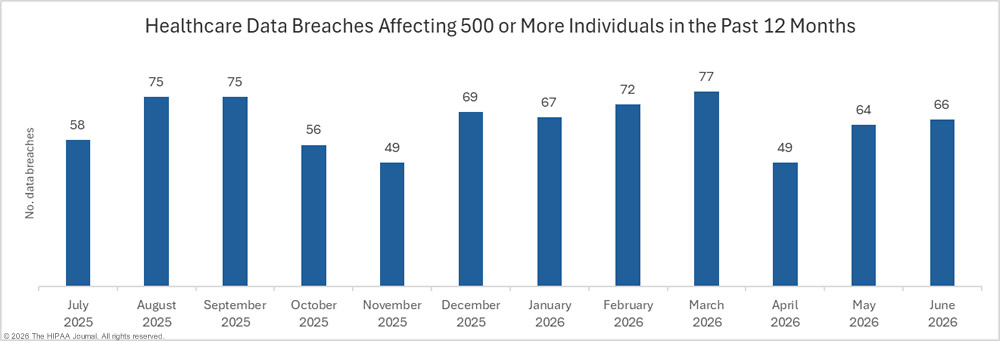
  • HIPAA Journal released its June 2026 Healthcare Data Breach Report.
    • “In June 2026, 66 large healthcare data breaches – data breaches involving the protected health information of 500 or more individuals – were reported to the U.S. Department of Health and Human Services (HHS) Office for Civil Rights (OCR) – a slight increase from the 64 data breaches reported in May. More than two large data breaches a day is the new normal. Over the past 12 months, an average of 65 large healthcare data breaches have been reported per day; eight years ago in 2018, large healthcare data breaches occurred at a rate of around one per day.”
  • Beckers Health IT reports,
    • “Houston-based Nutex Health says the hackers behind its August cyberattack have published the data they allegedly stole on their own website.
    • “The publicly traded micro-hospital operator is now downloading, processing and analyzing that data to determine its contents, scope and authenticity, according to a Sept. 10 SEC filing. Nutex said the review could take several weeks given the volume of data involved.” * * *
    • “Nutex said it has not identified any material impact on its business operations or financial reporting systems, and its materiality assessment from the Aug. 31 filing remains unchanged. The company said it continues to evaluate regulatory and legal notification requirements and intends to notify affected patients and employees.
    • “Several purported class action lawsuits have been filed against Nutex in the U.S. District Court for the Southern District of Texas’ Houston Division on behalf of individuals whose personal or health information was allegedly accessed. Nutex said it cannot predict the litigation’s outcome or its potential financial impact.”
  • and
    • “Annapolis, Md.-based Luminis Health’s phone system and MyChart patient portal remain unavailable as the health system continues responding to a cybersecurity incident involving an unauthorized criminal actor.
    • “In a Sept. 10 update, Luminis Health said its investigation is ongoing and teams are working with third-party experts to safely restore affected systems.
    • “The health system said its hospitals remain open and continue providing patient care.”
  • and
    • Recent cybersecurity warnings and incidents are highlighting risks for healthcare organizations that extend beyond ransomware, including cloud authorization abuse, voice phishing, brand impersonation, third-party access and publicly exposed information.
    • [The article describes] five recent cybersecurity developments Becker’s has reported on in September.]
  • Security Week adds,
    • “More than 4.1 million individuals had their personal, health, and insurance information stolen in a data breach at healthcare company AdaptHealth.
    • “Operating over 680 facilities across the US, AdaptHealth describes itself as a network of medical equipment companies that provides patients with healthcare solutions and medical equipment.
    • “The company was hacked in early June, when a threat actor gained access to its cloud-based applications, including internal systems used for patient management and document storage.
    • “After the attacker contacted the company, it confirmed the data breach, including the theft of a password file associated with insurance billing.
    • “The hacker used social engineering to compromise a user session at a third-party contractor, AdaptHealth said.”
  • and
    • “Future phishing campaigns may no longer involve a detectable physical web page.
    • “Barracuda has analyzed a new type of phishing campaign that adds both stealth and flexibility to traditional phishing. Rather than standard social engineering to persuade a target to visit a static compromised web page, this campaign generates a blob URL to render and deliver the phishing page inside the target’s own browser. This reduces the possibility of security scanners detecting either the social engineering email or the static residence of the phishing page.”
  • HIPAA Journal lets us know,
    • “Three high-severity vulnerabilities have been identified in NextGen Healthcare Mirth Connect (Mirth Connect), a cross-platform healthcare integration engine for connecting, routing, transforming, and exchanging clinical and administrative data between different healthcare systems. The vulnerabilities are due to improper neutralization of special elements used in SQL commands and improper restriction of XML External Entity Reference. Successful exploitation of the vulnerabilities could allow denial-of-service attacks and data exfiltration.
    • “The vulnerabilities were identified by security researcher Abhinav Agarwal using autonomous agents running his published methodology on AI-assisted vulnerability discovery. “Mirth Connect is effectively a switchboard between healthcare systems. It can sit between lab systems, imaging systems, databases, and clinical applications, so a vulnerability in the integration layer can expose much more than one isolated application,” Agarwal told The HIPAA Journal. A potential problem is that healthcare organizations may not know that they have a vulnerable component in one of their products. “A hospital may not see the name Mirth anywhere on the product it bought. Integration software can be managed, resold, or embedded inside another product, which is why SBOMs and exact version disclosure matter after vulnerabilities like these,” explained Agarwal.”
  • CISA added 14 known exploited vulnerabilities to its catalog this week.
    • September 8, 2026
      • CVE-2026-75650 Adobe Commerce and Magento Improper Neutralization of Special Elements Used in a Template Engine Vulnerability
      • CVE-2026-81963 Microsoft Windows Link Following Vulnerability  
      • CVE-2026-85880 Microsoft Windows Heap-Based Buffer Overflow Vulnerability 
      • CVE-2026-86218 N-able N-central Static Code Injection Vulnerability
        • SOC Prime discusses the Adobe KVE here.
        • The Hacker News discusses the Microsoft KVEs here.
        • Cybersecurity Dive discusses the N-able KVE here. 
    • September 9, 2026
      • CVE-2025-25249 Fortinet Multiple Products Heap-based Buffer Overflow Vulnerability
      • CVE-2026-19490 Citrix NetScaler Authentication Bypass Using an Alternate Path or Channel Vulnerability
      • CVE-2026-87491 Google Chromium V8 Out of Bounds Write Vulnerability
      • CVE-2026-20079 Cisco Firewall Management Center Authentication Bypass Using an Alternate Path or Channel Vulnerability 
        • Security Week discusses the Fortinet KVE here.
        • Cybersecurity News discusses the Citrix KVE here.
        • SOC Prime discusses the Google KVE here.
        • The Cybersecurity Hub discusses the Cisco KVE here.
    • September 10, 2026
      • CVE-2026-67277 MikroTik RouterOS Missing Authentication for Critical Function Vulnerability
      • CVE-2026-86060 MikroTik RouterOS Improper Neutralization of Argument Delimiters in a Command Vulnerability
        • Bleeping Computer discusses these KVEs here.
    • September 11, 2026 (1)
      • CVE-2026-42016 JFrog Artifactory Incorrect Authorization Vulnerability 
      • CVE-2026-42018 JFrog Artifactory Improper Authentication Vulnerability 
      • CVE-2026-84869 ConnectWise ScreenConnect Improper Privilege Management and Missing Authorization Vulnerability
        • The Hacker News discusses the JFrog KVEs here.
        • Security Arsenal discusses the ConnectWise KVE here.
    • September 11, 2026 (2)
      • CVE-2026-85706. GitLab Community Edition and Enterprise Edition Path Traversal Vulnerability
        • Cyberscoop discusses this KVE here.
  • Dark Reading adds,
    • “A new analysis of public data from Anthropic’s Project Glasswing has highlighted a significant gap between the number of vulnerability findings generated by its Claude frontier model and those that ultimately prove to be real, serious, and worth fixing.
    • “The distinction matters because it suggests that the bottleneck in vulnerability research may increasingly lie in validating new flaws and coordinating their remediation rather than in discovering them.”
  • Security Week tells us,
    • “Anthropic disrupted a cyberespionage operation whose tradecraft and targeting match the Russian state-nexus group tracked as Midnight Blizzard, the company said in a threat intelligence report published this week. 
    • “The report covers activity the company identified and shut down between December 2025 and August 2026.
    • “According to Anthropic, Midnight Blizzard used Claude to monitor how well its malware evaded detection by security products. When a tool was flagged, AI agents automatically modified and rebuilt it, then redeployed it, repeating the process until the malware went undetected again.”

From the ransomware front,

  • The Hacker News reports,
    • “Cisco has revealed that three distinct threat clusters linked to ransomware and state-sponsored attacks have been exploiting two recently patched Secure Firewall Management Center (FMC) vulnerabilities.
    • “The attacks leverage CVE-2026-20079 (CVSS score: 10.0), an authentication bypass vulnerability in the web interface of FMC software that could allow an unauthenticated, remote attacker to bypass authentication and execute script files on an affected device to obtain root access to the underlying operating system.
    • “The second flaw under exploitation is CVE-2026-20316 (CVSS score: 5.3), which could allow an unauthenticated, remote attacker to log in to an affected device using a low-privilege account to access sensitive data within susceptible systems. It can be paired with other Cisco Secure FMC vulnerabilities to elevate privileges.” * * *
  • Cybersecurity Insiders relates,
    • “Ransomware attacks are becoming increasingly common, posing a serious threat to businesses across industries. A recent study conducted by Object First in collaboration with technology research firm Omdia highlights not only the growing frequency of these attacks, but also the increasing difficulty businesses face in recovering their data after an incident.
    • “According to the study, ransomware is having a significant impact on business operations. Over the past 24 months, around 84 percent of businesses surveyed admitted that file-encrypting malware had severely disrupted their operations. This represents a considerable increase from the previous year, when only 64 percent of businesses reported experiencing such disruption.
    • “The findings become even more concerning when it comes to data recovery. Only 39 percent of ransomware victims said they were able to recover at least 80 percent of their data following an attack. This is a sharp decline from the 57 percent reported the previous year. The figures indicate that businesses are not only encountering ransomware more frequently but are also finding it increasingly difficult to restore their systems and recover critical information.” * * *
    • “The decline in successful data recovery also highlights the importance of preparedness. Simply preventing an attack is no longer enough. Organizations need comprehensive backup and recovery strategies that can help them restore critical systems quickly in the event of a successful breach. Regularly tested backups, robust access controls, employee awareness training and well-defined incident-response plans can all play an important role in reducing the damage caused by ransomware.
    • “The latest findings suggest that ransomware has evolved into a broader business continuity challenge. As attacks become more frequent and sophisticated, organizations must focus equally on prevention, detection and recovery. Investing in resilient infrastructure and reliable data protection could prove crucial in ensuring that a ransomware incident does not turn into a prolonged business crisis.”
  • Help Net Security adds,
    • “In this Help Net Security video, Kerri Shafer-Page, VP of Incident Response at Arctic Wolf, walks through the ransomware decision tree in this video. She covers four areas where decisions need settling in advance, starting with containment.
    • “Someone has to know the network well enough to judge what pulling a system offline does to client data, a manufacturing line, or a website. Then comes the extortion demand. Who is authorized to negotiate, and what is the ceiling?
    • “Shafer-Page treats paying as a business decision, noting that a demand can cost less than an insurance retention and higher renewal rates. She argues law enforcement belongs in the playbook, since agencies may know the threat actor and can help you avoid sanctions problems.
    • “Communication matters too, from cyber legal counsel on disclosure deadlines to a spokesperson and a prepared help desk. Her advice: make these decisions on a Tuesday afternoon, not at 2 a.m. on a holiday weekend.”
  • and
    • “In this Help Net Security video, Dave Ross, Senior Director of the Intelligence Fusion Team at Intel 471, explains what happens behind the scenes during ransomware negotiations.
    • “Ross walks through the tactics groups use once an attack begins, from research on a victim’s revenue and insurance coverage to test decryptions that prove they hold a working key.
    • “He describes how demands are often set at roughly 1% to 5% of annual revenue, why deadlines move depending on how a victim responds, and how some groups split work between researchers, negotiators, and staff who apply public pressure.”

From the cybersecurity business and defenses front,

  • Cryptobriefing reports,
    • “Tenable Holdings is embedding Anthropic’s Claude Mythos 5 directly into its flagship cybersecurity product, betting that frontier AI models can fundamentally change how organizations spot and neutralize threats before attackers exploit them.
    • “The integration, announced on September 8, 2026, will bring AI-driven exposure analysis and attack-path discovery into the Tenable One Exposure Management Platform. The first concrete feature shipping under this effort is called Tenable One Adversary View, which uses Claude Mythos 5 to reconstruct how an attacker could move from an initial foothold all the way to an organization’s most critical systems.”
  • Per MedTech Dive,
    • “Boston Scientific disclosed Tuesday the cyberattack that recently hit the company is likely to affect third-quarter and full-year results.
    • “The medical device maker believes it is unlikely to meet net sales growth and adjusted earnings per share guidance ranges provided in July for the third quarter and full year, according to a new filing with the Securities and Exchange Commission.
    • “The Company anticipates recovering some portion of the impacted revenue as it continues to ramp operations globally, fulfill customer orders and reduce remaining backlogs, however the full impacts are not yet known,” Boston Scientific said in the filing.”
  • Cybersecurity Dive relates,
    • “After suffering a series of high-profile cyberattacks over the past decade, Microsoft says a new initiative to reinvigorate its security culture is bearing fruit.”
  • and
    • “Chief information security officers are largely expected to ensure the security of AI across the enterprise, but many say they are not receiving adequate support, according to findings from Proofpoint. 
    • “About 85% of CISOs said ensuring the safe use of AI assistants, copilots and automation is a top priority over the next two years, according to Proofpoint’s annual Voice of the CISO report. Eight of every 10 CISOs said they are expected to manage AI-related security risks without receiving a proportional increase in resources or expertise. 
    • “CISOs have a significant role to play in securing AI adoption, but they can’t own the risk alone,” Patrick Joyce, global resident CISO at Proofpoint, told Cybersecurity Dive. “AI is being adopted across the business, often faster than traditional governance models can keep up.”
  • and
    • “Advances in artificial intelligence aren’t changing the fact that simple cybersecurity failures remain the most consequential, government and industry leaders warned on Tuesday.
    • “What will prevent the attacks in the next 18 months are the same things that would have prevented the attacks of yesterday,” Jason Bilnoski, a deputy assistant director in the FBI’s Cyber Division, said during a panel here at the Billington Cybersecurity Summit.
    • “Core practices such as identity management, perimeter monitoring, cyber hygiene and strong multifactor authentication remain as essential as ever, Bilnoski said.
    • “Speed and capability is certainly increasing with the use of AI, but the end state is still the same,” he said. “How actors are compromising, whether it’s criminal or nation-state, still stays the same.”
  • HIPAA Journal tells us,
    • “The HHS has released an updated version of the Security Risk Assessment (SRA) Tool (v3.7). The tool is ideally suited for small- and medium-sized entities to guide them through the risk analysis process, help them identify risks and vulnerabilities to electronic protected health information (ePHI), and comply with the risk analysis implementation specification of the Security Management Process standard of the HIPAA Security Rule.”
  • CISA has released the 2026 edition of its Insider Threat Mitigation Guide.
    • “The Cybersecurity and Infrastructure Security Agency’s Insider Threat Mitigation Guide aids critical infrastructure stakeholders in comprehending the concept of insider threats, identifying the various forms these threats can take, and implementing best practices to establish or enhance an insider threat mitigation program. Such a program is essential for protecting critical assets, deterring violence, countering unintentional incidents, preventing loss of revenue or intellectual property, averting the compromise of sensitive data, and ultimately saving lives.”
  • Healthcare IT News informs us,
    • “Devices and sensors that collect heart rate and other health data and rely on applications to share information with third parties pose serious questions about data protection for patients and the health systems that care for them.
    • “While smart ring and watch data might help doctors treat patients, security experts say low security standards in consumer tech and improperly configured APIs present potential security risks for providers.
    • “Hackers can exploit such flaws, using consumer devices as entry points to breach receiving electronic health record systems and access centralized databases.
    • “To mitigate these threats, security experts say healthcare organizations must establish strict security protocols, including mandatory transit encryption, multi-factor authentication and account monitoring. They recommend zero-trust approaches to catch rogue traffic and implementation of rigorous engineering frameworks.”
  • Here’s a link to Dark Reading’s CISO Corner.

Thursday report

Simplicity is a virtue.

From Washington, DC,

  • Modern Healthcare reports.
    • “Congress extended most annually funded healthcare programs through December, setting a likely end-of-year deadline for action.
    • “Lawmakers will have to decide which stalled health initiatives, from prior-authorization rules to transparency measures, would advance alongside must-pass extensions.
    • “Anti-fraud proposals could provide budgetary offsets to fund more expensive measures like a new Medicare physician payment system.”
  • Beckers Hospital Review relates,
    • “The Trump administration says it will mail $500 checks to nearly one million Americans in 30 states to refund what it called “overcharges” from ACA exchange fees collected under the Biden administration.
    • “On Sept. 10, the White House said insurers that sell plans on the federal exchange pay user fees to fund the platform’s operations, and that those fees generated a surplus that was never returned to consumers. The refunds, which are set to go out starting in October, will be provided to enrollees who did not receive premium tax credit assistance and paid the full cost of their premiums.” 
  • Per a Department of Health and Human Services news release,
    • “The U.S. Department of Health and Human Services (HHS), through the Health Resources and Services Administration (HRSA), today announced awards to 132 hospitals totaling nearly $25 million through the Rural Hospital Provider Assistance Program to help eligible small rural hospitals maintain their medical workforce, sustain essential healthcare services, and strengthen access to care for the communities they serve across 13 states.” * * *
    • “Awarded hospitals may use this funding to retain physicians, nurses, and other healthcare providers, allowing hospitals to preserve essential services, including emergency, inpatient, and other critical healthcare services. This support helps ensure rural communities can continue to access affordable care when and where they need it.
    • “A complete list of award recipients and more information about the program is available at Rural Hospital Provider Support Program FY 2026 Grant Awards.”
  • Per a Centers for Medicare and Medicaid Services news release,
    • “The Trump Administration announced today that an $11.7 million investment is being delivered to support rural nursing care facilities and strengthen the healthcare workforce across rural communities in Vermont through the federal Rural Health Transformation Program (RHTP). Of this, Vermont is committing $9 million of those funds to provide tuition benefits to healthcare professionals in underserved or hard-to-fill positions who commit to serving rural communities within the state for at least five years after graduation. The remaining $2.7 million provides funding for three rural nursing homes to increase their capacity to serve residents with complex medical issues and four community partners to increase training of Licensed Nursing Assistants (LNA) to serve in rural healthcare and long-term care settings across the state.”
  • Cardiovascular Business relates,
    • “On Thursday, Sept. 10, CMS officially finalized a new national coverage determination (NCD) for TAVR. Arguably the biggest change is that TAVR will now be covered in Medicare beneficiaries who present with asymptomatic severe aortic stenosis (AS). The treatment of asymptomatic patients has been a hot topic in recent years. Some specialists see it as a way to treat patients early and avoid long-term damage. Others disagree, preferring to save TAVR for patients who present with symptoms. 
    • “Another key update is that Medicare beneficiaries with symptomatic severe AS is now covered without any sort of coverage with evidence development (CED) requirements. The TAVR NCD has always required facilities performing TAVR to follow certain CED rules that require patient data to be collected through clinical trials or registries. This is no longer the case when it comes to performing TAVR on symptomatic patients. 
    • “Five leading U.S. medical societies—the American Association for Thoracic Surgery, American College of Cardiology, Heart Failure Society of America, Society for Cardiovascular Angiography and Interventions and Society of Thoracic Surgeons—did work together to argue that CED requirements should still be in place, but CMS still moved forward with that particular proposal. 
    • “It is worth noting, however, that CED requirements are still in place when it comes to performing TAVR on asymptomatic patients.”
  • The American Hospital Association News tells us,
    • “The National Institutes of Health has launched its Connecting the Community for Maternal Health Challenge: Research Capacity Building in Maternity Care Deserts 2.0. The competition will award more than $3 million to encourage and reward biomedical research in maternal health with an emphasis on maternal morbidity and mortality and maternal health deserts. The challenge consists of four phases: recruitment, training, proposal and research. The recruitment phase closes Sept. 23 and is required to be eligible for later phases. If selected, participants in each phase will be considered for awards ranging from $10,000 to $300,000.”
  • and
    • “The Federal Trade Commission announced Sept. 9 that it rescinded its 2021 policy statement that extended applicability of its health breach notification rule to health apps and connected devices that collect consumer health information. The commission said the 2021 statement was superseded by its 2024 update to the health breach notification rule. The FTC said the recission is part of the administration’s deregulation efforts and follows the commission’s policy of avoiding unnecessary use of subregulatory guidance.”
  • Fierce Healthcare relates,
    • “Federal healthcare agencies are accelerating efforts to expand artificial intelligence’s role in healthcare, with clinical AI emerging as a top strategic priority for the Centers for Medicare & Medicaid Services.
    • “At a healthcare AI event hosted by the Consumer Technology Association (CTA) in Washington, D.C., on Wednesday, Stephanie Carlton, deputy administrator at CMS, outlined the agency’s evolving AI strategy as it aims to establish clearer pathways for AI market access and regulation while also exploring reimbursement frameworks for AI-enabled technologies.
    • “Carlton also serves as chief clinical AI officer at CMS, a newly created position that signals the Trump administration’s push to advance AI in clinical care.
    • “A centerpiece of CMS’ AI strategy is the ACCESS model—Advancing Chronic Care with Effective, Scalable Solutions. Carlton hinted that the agency would soon expand that model. Announced in December and launched in July, ACCESS is a new 10-year program for value-based chronic condition management that leans heavily on technology and AI to scale to large populations of patients.”
  • Healthcare Dive tells us,
    • “The Department of Veterans Affairs has selected Amwell to facilitate telehealth delivery across the agency.  
    • “Amwell’s platform, which mainly offers virtual health visits, will help veterans connect with VA providers or other specialists in clinic. It will also support other telehealth services, such as virtual care delivery and care coordination within VA hospitals. 
    • “The VA signed a letter of intent to implement Amwell’s platform. A binding contract will depend on Amwell satisfying federal requirements, including a review by the VA’s chief information officer.”
  • Per an Institute for Clincical and Economic Review news release,
    • “The Institute for Clinical and Economic Review (ICER) announced today that it will develop a special report for the Centers for Medicare & Medicaid Services (CMS) on darolutamide (Nubeqa®, Bayer) for treatment of prostate cancer. This report will be submitted to CMS as part of the 2027 public comment process defined in CMS guidance on Medicare Drug Price Negotiations for price applicability year 2029. 
    • “While the final list of drugs subject to negotiation will not be released until February 2027, ICER is developing this report with the expectation that darolutamide will be subject to negotiation next year. The report will reflect legislative specifications in the Inflation Reduction Act and the most recent CMS guidance regarding price negotiations.
    • “ICER’s expertise in comparative clinical effectiveness and value will continue to help inform the important conversations around Medicare drug price negotiation,” said ICER’s President and CEO Sarah K. Emond, MPP. “While we know CMS may consider many different factors and inputs during negotiations, we believe ICER’s approach to applying the guidance in a consistent framework offers important information to all stakeholders engaged in this process.”
    • “The research protocol is now available.
    • “ICER’s website provides timelines of key posting dates and public comment periods for this assessment.“

From the U.S. Office of Personnel Management front,

  • Federal News Network reports,
    • “It may not come as a surprise that Americans’ trust in government has declined over the last several decades. When the first systematic measurement was taken by the National Election Study in 1958, about 75 percent of Americans said they trusted their government.
    • “Today that number has basically inverted, sitting at a discouraging 27 percent, according to the annual survey by the Partnership for Public Service.
    • “The unexpected news may not be Americans’ low confidence in government as much as how they report feeling about the federal employees who work for it. The same survey found that 65 percent of Americans view federal workers as competent, even while giving low marks to government as a single entity. Even more favorable, public perception of the federal workforce is the highest it’s been since the Partnership first asked the question in 2021.”
  • and
    • interviews a financial expert about the F Fund available in the Thrift Savings Plan.
      • “The TSP’s F Fund has trailed the G Fund over the last several years. Before deciding what that means for your own investments, it helps to understand what’s happening in the bond market.”

From the Food and Drug Administration front,

  • Per a FDA news release,
    • “The FDA and CDC, in collaboration with state and local partners, are investigating illnesses in a multistate outbreak of Salmonella Bovismorbificans infections linked to recalled broccoli sprouts grown by Evergreen Fresh Sprouts, LLC of Moyie Springs, ID. This outbreak is currently being investigated separately from the shiga toxin-producing E. coli and Salmonella outbreak linked to alfalfa sprouts also being investigated by FDA, CDC, and state partners.
    • “Based on epidemiological information collected by CDC and state partners, a total of 22 people infected with the outbreak strain of Salmonella have been reported from four states. Illnesses started on dates ranging from July 7, 2026, to August 26, 2026. Of the 19 people interviewed, all 19 (100%) reported eating sprouts and 17 (89%) reported specifically eating broccoli sprouts. There have been two hospitalizations and no deaths.
    • “FDA’s and state partners’ traceback investigations have identified Evergreen Fresh Sprouts, LLC as the common grower of broccoli sprouts that were eaten by patients before becoming ill. On September 4, 2026, Evergreen Fresh Sprouts, LLC initiated a recall of broccoli sprouts based on a positive Salmonella result from a broccoli sprouts sample collected and analyzed by Montana state officials. According to whole genome sequencing analysis conducted by state partners and reviewed by FDA, the positive sample is the same strain of Salmonella that is causing illnesses in this outbreak. Consumers, restaurants, and retailers should not eat, sell, or serve recalled broccoli sprouts grown by Evergreen Fresh Sprouts, LLC with expiration dates of 9/7, 9/9, 9/11, 9/14, and 9/16.”
  • The Washington Post reports,
    • “Federal officials are poised to declare the end of the nation’s largest known cyclosporiasis outbreak after thousands of people became sick after eating shredded iceberg lettuce, according to two people familiar with the matter.
    • “The update may come as soon as later Thursday, according to the people, who spoke on the condition of anonymity to discuss an ongoing investigation. However, the timing is not guaranteed. In mid-July, Taylor Farms voluntarily recalled products from the market as federal officials began linking its lettuce from central Mexico to a cyclosporiasis outbreak. Food and Drug Administration enforcement records show recalled products were packaged for nine food service and retail operations, such as Subway and Yum Brands, which owns Taco Bell, KFC and Pizza Hut.”
  • BioPharma Dive relates.
    • Biohaven shares fell by more than 10% Thursday after the company revealed that the Food and Drug Administration has placed a partial hold on an experimental epilepsy medicine it recently sold off rights to in a licensing deal.
    • In a regulatory filing, Biohaven disclosed that the FDA has requested additional data related to a “metabolite,” or drug-related substance, that was identified in rodent studies of its treatment opakalim. The agency instructed Biohaven to pause recruitment in an ongoing late-stage trial until it can provide more information. Dosing will continue for those already involved in that study, “RISE-2.”
    • Importantly, the hold doesn’t affect a separate late-stage trial, “RISE-3,” that’s fully enrolled. That study is still expected to produce results later this year in what is a “key event” for Biohaven, wrote William Blair analyst Myles Minter. Should opakalim succeed in testing and win approval, Biohaven will be eligible for milestone payments and sales royalties from licensing partner SK Pharmaceuticals.

No Surprises Act News

  • Modern Healthcare reports,
    • “A group of nearly 70 employers, unions, patient advocates and other organizations is calling on Congress to rework the No Surprises Act of 2020. 
    • “The letter, led by left-leaning advocacy group Families USA and cosigned by 67 organizations, asked congressional leaders to address concerns about the law’s Independent Dispute Resolution process.
    • “Under the No Surprises Act, IDR arbitrators determine appropriate out-of-network reimbursement rates, with claims predominantly filed by providers or their aligned companies.” * * *
    • “Letter signers are calling on Congress to replace what they call the “baseball-style” arbitration process with a benchmark payment methodology that promotes market-based prices and discourages excessive reimbursement. 
    • “In an accompanying report, Families USA is also advocating for subjecting ground ambulance services to the law’s requirements; strengthening the federal process for certifying mediators; and requiring arbitrators to disclose their ownership structures, payment agreements and dispute outcomes information.” 

From the fraud, waste, and abuse front,

  • Per a Justice Department news release,
    • “Dompé U.S. Inc. (Dompé), based in California, has agreed to pay $32 million to resolve allegations that, between 2018 and 2021, it paid Medicare beneficiary co-pays through two patient assistance foundations to induce the purchase of its drug, Oxervate, in violation of the Anti-Kickback Statute and the False Claims Act.”
    • The claims resolved by the settlement are allegations only and there has been no determination of liability.

From the public health and medical / Rx research front

  • MedCity News reports,
    • “Heart disease is the leading cause of death among women in the United States, yet it remains chronically underrecognized, underdiagnosed and undertreated in this population. According to research from the American Heart Association (AHA), by the year 2050, the rate of total cardiovascular disease (CVD) in women will rise to 14.4%, a 3.7% increase from 2020 data.
    • “Data for reproductive age women (ages 20 to 44) shows a similarly troubling increase, from 1 in 4 in 2020 to nearly 1 in 3 in 2050 having clinical CVD. Diabetes in this same young age group is also projected to more than double, from 6% to nearly 16%.
    • “A critical opportunity exists at the intersection of prevention and rapid diagnostics in women’s health. Early intervention based on accurate diagnosis of both metabolic risk factors and acute cardiac events could help make the difference between life and death for women.”
  • Cardiovascular Business adds,
    • “Too much light exposure at night, both when asleep and awake, may be bad for the heart. That was the eye-opening takeaway from a new study published in European Heart Journal.
    • “Previous observational studies have linked nighttime light exposure with a higher risk of cardiovascular disease, but little is known about the related cardiac structure and functional changes,” senior author Lu Qi, MD, PhD, a researcher with Tulane University, said in a statement. “We carried out this research to find out what happens to the heart over time when people are exposed to too much light at nighttime.”
    • “Qi et al. tracked data from more than 11,000 UK Biobank participants. They wore a light sensor on their wrists for seven days. Three years later, they all underwent a cardiac MRI scan.
    • “Overall, study participants exposed to the most light—three lux or more—were associated with thickening of the wall of the left ventricle not seen in participants exposed to lower amounts of light. MRI results also showed that participants exposed to high amounts of light were experiencing issues with their heart muscle’s ability to flex during heartbeats, an early sign of heart damage.  
  • The New York Times relates,
    • “In the last few years, there’s been a cultural push for women in midlife to build strong bones.
    • “Menopause influencers and medical organizations alike have focused on the message that women’s risk for fractures increases dramatically after menopause, and that they should think about their bone density much earlier than their mothers might have.
    • “The American Medical Association recommends that women get their first DEXA scan — a low-dose X-ray that is the gold standard test for determining bone density — at 65 or older, unless they have a risk factor for osteoporosis.
    • “But a growing number of doctors and bone health experts now recommend earlier scans. They argue that if women wait until 65, they may miss a critical window to prevent osteoporosis.” The article delves into the details of this issue.
  • MedPage Today lets us know,
    • “People who consumed their hot beverages at a “very hot” temperature had a threefold higher risk for squamous cell carcinoma of the esophagus compared with those who drank them at a “warm” temperature, an analysis of two large U.K. cohorts suggested.”
  • and
    • “Borderline anemia — hemoglobin levels 0 to 1 g/dL above the WHO threshold — was associated with a higher risk of mortality, a prospective cohort study suggested.
    • “When stratifying results by age and sex, borderline anemia was associated with higher risks for all-cause, cardiovascular, and cancer mortality in men of all ages and in women 60 and older.
    • “These findings suggest that the relationship between hemoglobin concentration and long-term health cannot be captured by a single diagnostic cutoff, researchers said.”
  • The Washington Post tells us,
    • “People tend to think about supplements the way they think about food: Things that are inherently good or bad for you. Green beans are good. Potato chips are bad. Vitamin D and fish oil belong, presumably, on the green-bean side of the ledger.
    • “But the aging brain may change the calculation, putting some of America’s most popular supplements under new scrutiny.
    • “Recent research is raising a largely overlooked question: Can something that benefits (or is at least neutral to) a young, healthy brain become less helpful — or even harmful — as the brain ages?”
    • “In January, researchers reported an association between vitamin D supplement use and faster cognitive decline among older adults who already had normal vitamin D blood levels. In April, another study found that adults 55 and older taking omega-3 supplements showed greater cognitive deterioration over time than nonusers. Then, in June, researchers reported that people taking glucosamine, used for joint pain, appeared to have a much higher likelihood of progressing from mild cognitive impairment to dementia over five years than their peers who were not taking it.
    • “I was stunned,” said Ramon Sun, a professor of biochemistry and molecular biology at the University of Florida and the lead author of the glucosamine paper.” * * *
    • “The studies are mostly observational, meaning they don’t prove causation, and those links with mental deterioration may be because of the supplements or something else entirely.
    • “But together they point toward a possibility that researchers are beginning to take seriously: Aging changes how the brain handles fats, calcium and glucose, and how it responds to inflammation, which could alter how nutrients and drugs reach brain tissue in the first place.”
  • Beckers Health IT informs us,
    • “The American Heart Association’s PREVENT cardiovascular risk equations is now integrated into Epic’s EHR platform.
    • “The integration brings the cardiovascular risk assessment tool into clinicians’ existing workflows, where it can be used to estimate patients’ risk for heart attack, stroke and heart failure and inform prevention and treatment discussions.
    • “The PREVENT equations incorporate measures of cardiovascular, kidney and metabolic health and provide estimates of cardiovascular disease risk over 10- and 30-year periods. The tool is intended for adults ages 30 to 79 without a history of cardiovascular disease, according to a Sept. 10 news release.
    • “The equations were developed using health information from more than 6.5 million adults from a range of racial, ethnic, geographic and socioeconomic backgrounds, according to the association.”
    • “Recent American Heart Association and American College of Cardiology guidelines for managing high blood pressure, abnormal cholesterol and cardiovascular-kidney-metabolic syndrome recommend use of the PREVENT equations for cardiovascular risk assessment and treatment decisions.
    • “Embedding the equations within Epic is intended to make the risk estimates available at the point of care without requiring clinicians to use a separate tool, according to the association.”
  • Beckers Hospital Review points out,
    • “Among 31 cancer centers, 100% said they were experiencing a shortage of at least one anti-cancer drug, according to data published Sept. 10 by the National Comprehensive Cancer Network.
    • “The data summarizes August survey responses from pharmacy directors and other clinical and administrative leaders at 31 NCCN members, a Sept. 10 news release said.”

From the U.S. healthcare business and artificial intelligence front,

  • Healthcare Dive reports,
    • “Medicare Advantage insurers could see their star ratings fall next year — and lose out on the lucrative bonuses the ratings represent — after regulators boosted many of the thresholds for achieving the quality scores.
    • “Earlier this week, the CMS released draft cutpoints, the thresholds the agency uses to convert MA plans’ quality and performance scores into a 1 to 5 star rating, as part of the preview process before regulators announce official results in early October.
    • “About 50% of cutpoints got harder, 33% were unchanged and 17% actually got easier, according to analysis by the Newton Smith Group, an MA consultancy.”
  • Health Exec relates,
    • “For certain aspects of healthcare, Arizona is the freest state in the nation. The least free? New Jersey.
    • “The findings have nothing to do with no-cost services and everything to do with the legal, regulatory and policy environments governing healthcare across the United States. 
    • “They’re from the Center for Modern Health, a libertarian think tank focused on advancing free-market ideas in health policy.
    • “In the Center’s own words, the 2026 Health Freedom Index reflects state-level data on the degree of choice and freedom available to patients, healthcare professionals, insurers and entrepreneurs. 
    • “For each state, the project’s researchers measured performance across 54 variables and five kinds of “freedom”—professional, institutional, patient, payment and delivery—and used the sums to index the states from best to worst. 
    • “In addition, the project “aims to promote transparency and informed discussion about the role of freedom, voluntary exchange and institutional design in American healthcare.”
  • Beckers Hospital Review points out the top rehabilitation hospital in each State based on U.S. News & World Report compilation of a list of the top rehabilitation hospitals in every state. 
  • The Wall Street Journal informs us,
    • “An Association for Accessible Medicines report says 90% of biologic drugs losing patent protection by 2034 have no biosimilars in development.
    • “The lack of low-cost alternatives could cost Americans nearly $200 billion in healthcare savings over the next decade.
    • “The dispensing rate of available biosimilars over brand-name drugs fell to 23% in 2025, down from about 40% in 2024.”
  • STAT News notes,
    • “When Kura Oncology decided to take aim at a protein involved in cell division and signaling, researchers reported a bonus finding: Targeting the protein, menin, didn’t just control the growth of leukemia cells, it also helped control blood sugar levels in animal studies. The biotech on Wednesday announced that it is turning that insight into a new company.
    • “The new firm, Caspian Therapeutics, is launching with $50 million in financing to develop menin inhibitors for diabetes and other cardiometabolic diseases. The initial funding, led by BVF Partners and joined by Eli Lilly and members of Kura’s leadership team, among others, is meant to advance Caspian’s lead small molecule drug through an early-phase clinical trial in diabetes and support the development of a second candidate.”
  • Per Beckers Physician Leadership,
    • “Physician assistants averaged a salary of $155,000 in 2026, continuing a run of steady raises since 2022, according to a report from Medscape.
    • “The topline number hides a more complicated picture: pay growth varies widely by specialty setting, state and gender, and base salary itself grew more slowly than the bonus and incentive pay layered on top of it.”
  • Per Fierce Healthcare,
    • “Electronic prescribing platform Interra Health announced Tuesday that it now supports the U.S. Centers for Medicare and Medicaid Services’ (CMS) GLP-1 Bridge program for Medicare Part D beneficiaries.
    • “Eligible Part D enrollees can access GLP-1 medications at $50 per month through the program, which launched July 1. For Interra patients, the platform alerts providers when patients may be eligible to enroll in the program. Moreover, it instructs providers to submit proper codes and complete required prior authorizations.
    • “Interra Health Chief Business Development Officer J.B. Powell told Fierce Healthcare the program has delivered “more than 170,000 point-of-prescribing alerts to more than 30,000 unique prescribers” since its launch, adding that its requirements could “be confusing” for providers and patients to understand eligibility.”
  • and
    • “Plans to build a new, $2 billion-plus patient care tower and other accompanying upgrades at the University of Iowa Health Care’s main campus are off the table in favor of smaller-scale upgrades to existing facilities, the academic system said Wednesday. 
    • “Iowa Health Care had previously described the new patient tower as “critical to our ability to meet the healthcare needs of Iowans for years to come.” Primary construction wasn’t scheduled to begin in earnest until 2028 and targeted a 2032 completion.
    • “The organization is still facing a capacity crunch, noting in Wednesday’s announcement that it turns away 3,000 to 5,000 patient transfers a year “due to space constraints” even as it recorded over 41,000 inpatient admissions, almost 1.7 million clinical visits and over 43,000 major surgeries last fiscal year. 
    • “However, “significant financial challenges” facing the healthcare industry at large have limited Iowa Health Care’s ability to “responsibly” deploy capital toward the project. The organization stressed that its finances are stable, but now plans to submit a revised $380 million capital plan to its board later this month.”

Midweek update

Simplicity is a virtue.

From Washington, DC,

  • The American Hospital Association News reports,
    • “The Department of Health and Human Services announced Sept. 8 through the Substance Abuse and Mental Health Services Administration that it will award $383.4 million in grants to support behavioral health treatment, prevention and crisis response efforts. HHS said $252 million will support the 988 Suicide and Crisis Lifeline, suicide prevention and mobile crisis services. Of the remaining grants, $81.4 million will be used toward substance use treatment and prevention initiatives, and $50 million will be used to support mental health services. The Sept. 8 announcement coincided with 988 Day, which raises awareness about the 988 lifeline and the importance of mental health and suicide prevention.” 
  • Bloomber Law reports,
    • “The Trump administration is pursuing additional drug pricing deals with pharmaceutical companies, Centers for Medicare and Medicaid Services Administrator Mehmet Oz told Bloomberg Television.
    • “Officials have announced more than two dozen voluntary agreements with pharmaceutical companies so far, and Oz said “there are more deals in the works.” He spoke ahead of his scheduled keynote address at the Republican midterm convention in Dallas Wednesday night.
    • “Each of the agreements is bespoke, but companies generally have agreed to lower the prices they charge public programs for medicines and to launch new drugs at prices similar to those paid by other developed nations in exchange for relief from tariffs. Some companies also are offering the discounted prices directly to consumers on a Trump-branded website, though critics argue the savings are minimal for patients with insurance.”
  • Axios adds,
    • “There are troubling new signs that the overhaul of Medicare drug coverage in the Inflation Reduction Act is dramatically driving up program spending. 
    • “Why it matters: The upward trajectory could threaten some seniors’ coverage for outpatient prescription drugs — and it could force painful tradeoffs over the next decade as Medicare consumes a growing share of the nation’s debt. 
    • “Follow the money: The IRA limited what seniors have to pay for outpatient drugs and shifted the remaining cost to taxpayers, insurers who provide stand-alone Medicare drug plans and drug manufacturers.
    • That was good news for enrollees who take expensive drugs for conditions like cancer, multiple sclerosis or rheumatoid arthritis and faced potentially crushing out-of-pocket costs.
    • But federal data shows demand for drugs is surging as they become more affordable, exceeding congressional scorekeepers’ spending estimates and setting off more alarms.
    • “Driving the news: Last week, congressional Medicare advisers reported that more than 1 in 5 enrollees hit Medicare Part D’s $2,000 patient cost cap in 2025 — shifting new costs to the government.”
  • Beckers Behavioral Health breaks down the Labor Department’s September 8 enforcement guidance concerning the mental health parity act into seven things to know:
    • “Certain behavioral health treatment exclusions could draw scrutiny.
    • “Prior authorization and medical necessity processes are a key enforcement area.
    • “The agency is looking closely at behavioral health networks.
    • “Compliance depends on how policies operate in practice.
    • “Telehealth, cost-sharing and visit limits can also raise compliance concerns.
    • “Plans are expected to use monitoring mechanisms to identify disparities.
    • “Corrective actions can require changes to coverage and plan operations.”
  • STAT News relates,
    • “ARPA-H, the government agency that funds cutting-edge health research, plans to commit $62.7 million to develop artificial intelligence bots that direct treatment of heart failure. Among the goals of the program, called ADVOCATE, is to produce partially autonomous AI devices authorized by the Food and Drug Administration to help treat patients, including assessing symptom severity, prescribing drugs, and ordering lab tests. 
    • “ARPA-H on Wednesday announced the first batch of awards to health tech companies Atman Health, UpDoc, Tempus AI, and teams from Stanford University, Duke University, and the Kaiser Permanente health system. ARPA-H may still fund additional teams. The amount committed for the first year is $33.7 million, and the remainder may be renegotiated up or down.” 

From the U.S. Office of Personnel Management front,

  • My Federal Retirement tells us about “What FEHB Enrollees Should Know if They Get a Letter from Medicare This Month.”

From the Food and Drug Administration front,

  • Fierce Pharma reports,
    • “In an accelerated decision, the FDA expanded Bayer’s Hyrnuo indication, granting first-line approval for a rare tumor type in patients with non-small cell lung cancer. 
    • “Before the expansion, Hyrnuo was available only after other NSCLC treatments failed. But the FDA’s latest go-ahead makes the tyrosine kinase inhibitor (TKI) an initial therapy option for any patient with locally advanced or metastatic non-squamous NSCLC whose tumors test positive for HER2 tyrosine kinase domain activating mutations.   
    • “The expanded indication was won using data from Bayer’s ongoing phase 1/2 Soho-01 trial, in which Hyrnuo demonstrated a 75% objective response rate in previously untreated patients. Six percent of patients showed a complete response, and 70% showed a partial response to the twice-daily oral medication, Bayer said Wednesday. Responses lasted more than six months for 73% of patients.”
  • and
    • “With a phase 3 win now fleshed out and an FDA filing recently submitted, BioMarin is advancing expansion plans for Voxzogo, looking to extend the dwarfism drug’s reach as it faces new pressure in its inaugural achondroplasia indication. 
    • “On Wednesday, BioMarin unveiled detailed results from the phase 3 CANOPY-HCH-3 trial assessing Voxzogo in children with hypochondroplasia (HCH), a milder form of achondroplasia, where the company announced a topline win back in May. 
    • “Aside from the average 2.33 cm/year improvement in annualized growth velocity (AGV) on Voxzogo that BioMarin reported out earlier this year, the company dug deeper into the magnitude of benefit its medicine could offer to children with HCH across measures like standing height and arm span after a year of treatment.
    • “BioMarin shared the data Wednesday at the European Society for Paediatric Endocrinology annual meeting and simultaneously published the results in the New England Journal of Medicine.” 
  • Cardiovascular Business points out,
    • “Luma Vision, an Irish medtech company focused on electrophysiology and interventional cardiology technologies, has secured U.S. Food and Drug Administration (FDA) clearance for its updated Verafeye imaging and visualization platform. The company previously received FDA clearance for the artificial intelligence-powered offering in 2025; this update covers the platform’s expanded capabilities ahead of a planned commercial launch in 2027.
    • “The Verafeye platform provides ultrasound imaging courtesy of a 360° catheter that creates real-time 2D and 3D maps of the patient’s heart. It also offers advanced visualization and navigation capabilities, helping users track imaging and ablation catheters during treatment. In addition, users are able mark locations as they go to confirm they achieve the necessary alignment.”

From the public health and medical / Rx research front,

  • The Washington Post reports,
    • “First responders and other New Yorkers around the World Trade Center that day have reported conditions including respiratory issues, mental health impacts and dementia. Toxins were present in the air soon after the attacks even though people were assured it was safe, according to a trove of records released this week by New York City officials.
    • “Twenty-five years later, attention is increasingly falling on cancer. 
    • “The number of 9/11 survivors who are receiving aid for cancer has roughly tripled over the last five years, according to a Washington Post analysis of reports from the World Trade Center Health Program, which funds health care for first responders and 9/11 survivors in New York. In June 2021, 8,870 survivors received aid for cancer treatment, jumping to 27,300 survivors in 2026 — numbers that sharply outpaced cancer claims among first responders.
    • “Of the roughly 54,000 survivors enrolled in the health program as of June, about half are receiving aid for cancer. Five years ago, that share was 35 percent.” * * *
    • “A recent New York University study of a smaller cohort of 9/11 survivors receiving medical aid as of 2024 reported a similar increase in cancer cases; it found that cases had increased around 2.5-fold between 2019-2024.
    • “This is something that we are worried about,” said Alan Arslan, an associate professor of population health at NYU and one of the authors of the study. “We’re seeing more and more patients.”
  • The Wall Street Journal relates,
    • “Dr. Henry Heimlich devised a new technique more than 50 years ago to stop people from choking. Simplicity, studies, shrewd promotion by its inventor—and a demonstration on The Tonight Show Starring Johnny Carson—made the Heimlich maneuver a go-to method.
    • “Now, it is fighting for the stage.
    • “Advocates, companies and some politicians argue that the Heimlich maneuver and back blows, another established method of rescuing people from choking, aren’t always enough. On social media and in state legislatures, they are plugging portable anti-choking devices, designed to suction stuck food or other objects from a person’s airway.
    • “Texas enacted a law last year requiring school districts to stock at least one such device on each campus with at least one employee trained to use it. New York City passed one, too. At least nine other states have weighed or are weighing bills to put devices into schools or other facilities.
    • “It’s a priority,” said New Jersey state Sen. Kristin Corrado, who co-sponsored one bill. “If we have the opportunity to save a life, we have to use all means available.” 
    • “The main U.S. maker—a company called LifeVac—has donated more than 10,000 devices to schools across the country.” * * *
    • “But medical guidelines and many researchers say there isn’t enough evidence to recommend anti-choking devices. State health departments, emergency responders and teachers unions have pushed back against proposals to require them in schools because medical guidelines haven’t endorsed them. New York City said it wouldn’t implement its law unless the devices are recommended in medical guidelines.”
  • Beckers Behavioral Health tells us,
    • “The synthetic opioid cychlorphine has been linked to at least 55 deaths nationally from 2025 to 2026, with prevalence highest in Ohio, Tennessee and Texas, MedPage Today reported Sept. 8.
    • “The Office of National Drug Control Policy said in an April drug threat notice that cychlorphine may be “up to 10 times more potent than fentanyl” and an overdose may require multiple doses of naloxone.
    • “In Tennessee, the Knox County Regional Forensic Center reported 41 overdose deaths between July 2025 and February 2026. The center tracked as many as 63 cychlorphine-associated deaths through June 30, and cychlorphine was found to be the cause in 58 of those cases.
    • “Cychlorphine has been found mainly in powders and tablets as well as counterfeit pills. Shravani Durbhakula, MD, MPH, of Vanderbilt University School of Medicine in Nashville, Tennessee, said snorting and inhaling are common, though oral exposure and injection are also possible.”
  • Cardiovascular Business informs us,
    • “A majority of transcatheter aortic valve replacement (TAVR) present with a history of heart failure (HF). According to new data published in the Journal of Cardiovascular Medicine, however, many of those patients are not being given the HF medications they need after undergoing TAVR.
    • “Cardiovascular morbidity and mortality remain high after TAVR,” wrote first author Elena Surkova, MD, MSc, PhD, a senior medical director at AstraZeneca and consultant cardiologist with Royal Brompton and Harefield Hospitals, and colleagues. “There is a lack of detailed data on the prevalence of HF in patients undergoing TAVR, medication prescription rates, including the main pillars of HF standard of care, and predictors of HF worsening following the procedure.”
  • The American Medical Association lets us know what doctors want patients to know about West Nile virus
    • “Most West Nile virus infections cause no symptoms, but some can lead to severe illness. Mosquito-bite prevention remains the best defense.”
  • MedPage Today adds,
    • “A gender gap historically seen in the suicide rates of 10- to 14-year-olds in the U.S. has tightened.
    • “In 2017, the suicide rate of boys was twice that of girls, but by 2024, it was only 4% higher.
    • “The author noted that the nearly equal suicide rates for 10- to 14-year-old boys and girls in the current study marked the “first time this has happened in the available records.”
  • Health Day notes,
    • “Autism spectrum disorder (ASD) diagnoses increased disproportionately among females after 2020, across age groups, while remaining stable or declining among males, according to a study published online July 22 in JAMA Network Open.
    • “Erick Messias, M.D., Ph.D., from St. Louis University, and colleagues evaluated age- and sex-specific incidence trends of ASD from 2016 to 2024 to quantify the temporal patterns before and after the COVID-19 pandemic. The analysis included electronic health record data from 171,134 individuals who had at least one clinical encounter annually at a large health care system.”
  • Per Genetic Engineering and Biotechnology News,
    • “The results of a preclinical study by researchers at the University of East Anglia suggest that an experimental anticancer drug could stop osteoporosis and help women prevent weight gain after the menopause. Their study in mice found that the small molecule drug CADD522 not only protected against osteoporosis but could also reduce body fat and reverse some of the metabolic changes linked to menopause. Currently in development for cancer therapy, CADD522 is a small molecule inhibitor of the transcription factor RUNX2, which is helps to drive the growth and spread of several cancers.
    • “Research lead Darrell Green, PhD, at UEA’s Norwich Medical School, said, “We have uncovered an entirely new way of tackling the disease. We found that a drug originally developed to stop cancer could help millions of women facing the twin challenge of fragile bones and midlife weight gain. We hope our work could lead to a new generation of osteoporosis treatments that tackle bone loss while also addressing some of the wider metabolic consequences of menopause.”
    • “Green is senior and co-corresponding author of the team’s report in npj Drug Discovery, titled “RUNX2 inhibitor CADD522 improves bone microarchitecture and lipid metabolism in post-menopausal bone loss.” In their paper the team concluded that their collective studies “… identify RUNX2 inhibition as a therapeutic strategy that simultaneously improves skeletal integrity and metabolic homeostasis, supporting further development of CADD522 for osteoporosis and other RUNX2-driven diseases.”

From the U.S. healthcare business and artificial intelligence front,

  • The International Foundation of Employee Benefit Plans reports,
    • “Medical stop-loss premiums in 2026 show an increase from 13.6% on a $100,000 deductible to 15.9% on a $750,000 deductible, as reported by the 2026 Aegis Risk Medical Stop-Loss Premium Survey, cosponsored by the International Society of Certified Employee Benefit Specialists. Notably, this increase is approximately 5% to 5.5% higher than increases seen for the previous 2025 renewals. This impact was not surprising, as many underwriters reported increased severity and frequency in stop loss-claims in late 2024 and a resulting erosion in claims-to-premium loss ratios thereafter and throughout 2025. The survey captured necessary correction to 2026 premiums. The measured increases, rising alongside the size of deductible, reflect leveraged medical trend, as the underlying growth in expense of a catastrophic medical claimant is fully borne by an unchanged deductible.
    • “Survey response uniquely captures final, negotiated premium and reflects any pricing improvement from renewal marketings and concessions across all deductibles. In comparison, several large direct underwriters reported an average 2026 increase in the low 20% range on their own book-of-business. However, those are weighted by in-force policies unable to locate lower cost alternatives. The comparatively lower increases observed in this survey reflect the 2026 renewal rate opportunity found in the market. Looking ahead, an ongoing return to underwriter discipline and need to restore insurer loss ratios to a more profitable position does not indicate any easing on the 2027 renewal cycle.”
  • Fierce Pharma relates,
    • “Shifts in drug pricing and market access policies around the world have caused an “earthquake” that will reverberate for years to come, a survey of industry leaders found.
    • “Healthcare consultancy Numerof & Associates generated the insights in a survey of 175 executives from 67 pharmaceutical companies. The qualitative survey revealed the belief that the current era of policy change is unlike anything that the industry has experienced before. After going through a period of fast change, the industry is braced for more upheaval in the coming years. 
    • “While there has always been change throughout the industry, the past 24 to 36 months have felt more exponentially transformative than anything I have seen over the last 30 years,” an executive said. “What we may experience over the next five years could exceed the cumulative level of change we saw over the previous several decades.”
    • “Another executive characterized the policy environment as an “earthquake” that is “not going to settle down soon,” while a third person predicted that the need for politicians to try to address the cost of healthcare will ensure ongoing change. 
    • “The executives were talking after a succession of policy changes in key markets. Medicare gained the authority to directly negotiate prices for some drugs, and the most-favored-nation (MFN) policy tied U.S. prices to overseas markets.” 
  • Healthcare Dive tells us,
    • “UnitedHealthcare is still drilling down on actions it can take to make its Medicare Advantage plans more profitable next year, even as the insurer is expected to exit more underperforming geographies. But the company could be poised for growth in the markets where it remains, according to new comments from a top executive.
    • “We think we’re going to be very competitive in terms of our pricing next year,” CFO Wayne DeVeydt said during Wells Fargo’s annual healthcare conference Wednesday morning. “We think our benefits will be competitive … We still have a few markets where we’re right-sizing some of the products, but I think we’ll be well-positioned for 2027.”
    • “DeVeydt’s comments come as market watchers try to get a sense of how 2027 open enrollment will pan out, following an especially turbulent sign-up period for 2026 after insurers culled their plans in a bid to resuscitate flagging margins.”
  • Modern Healthcare adds,
    • “UnitedHealth Group and CVS Health are looking into acquisitions, executives said at a Wells Fargo conference.
    • “UnitedHealth Group identified value-based care companies and companies that would fit into its Optum Insight division as targets.
    • “CVS Health will seek “bolt-on” acquisitions and resume share buybacks next year.”
  • Beckers Payer Issues informs us,
    • “Anthem is now covering three surgical meshes for breast reconstruction, according to a clinical guideline published Aug. 27.
    • “DuraSorb Monofilament Mesh, GalaFLEX and TIGR Matrix Surgical Mesh “are considered medically necessary when used for breast reconstruction surgery,” the guidance said.
    • “We regularly review our medical coverage policies to ensure they’re aligned with credible medical evidence and the latest treatment standards and expert recommendations,” an Elevance Health spokesperson told Becker’s.” * * *
    • “ABC affiliate WFTS-TV in Tampa, Fla., has been reporting on breast cancer insurance denials, including for mesh, in recent years. It reported how Cigna updated its policy to cover mesh for breast reconstruction in 2025.
    • “Despite calls for insurer coverage, mesh for breast reconstruction has not secured FDA approval.”
  • and
    • “UnitedHealth Group’s Optum has sold interest in some of Optum’s Florida WellMed clinics to private equity company TPG, Bloomberg originally reported Sept. 9. UnitedHealth Chief Financial Officer Wayne DeVeydt told Bloomberg that the healthcare company was looking for a partner “that could actually work with us locally,” and UnitedHealth “didn’t need the dollars.” 
    • “We entered a strategic partnership designed to strengthen operating performance through dedicated support for clinic operations, targeted investments in technology and tools, and enhanced operating capabilities,” an Optum spokesperson told Becker’s Sept. 9. “The transitioning clinics will remain part of Optum’s network and continue providing high-quality care to patients. We remain committed to serving Florida patients through our integrated, value-based care model.”
  • Beckers Behavioral Health lets us know,
    • “Santa Fe, N.M.-based Quel Health launched a telehealth platform focused on using GLP-1 receptor agonists in addiction care. 
    • “The platform is available in 41 states and the District of Columbia, with national coverage planned by year-end, according to a Sept. 8 news release from the company. Quel also named Wernersville, Pa.-based Caron Treatment Centers a founding strategic partner.” * * *
    • “The approach follows work at Caron’s Pennsylvania and Florida campuses, where Steven Klein, MD, PhD, co-founder and chief medical officer of Quel Health, and his team evaluate GLP-1 receptor agonists in patients whose primary diagnosis was substance use disorder rather than obesity or diabetes.” 
       
  • Per Fierce Healthcare,
    • “Employers Health and Judi Health are teaming up to launch StarkRx, a new cost-plus benefit offering designed to drive transparency for employers.
    • “The approach unites the expertise of Employers Health as a group purchasing organization for pharmacy benefits that’s backed by employers with the technology available through Judi. The goal, the partners said, is to ensure that self-funded employers have greater access to transparency data that they can use to identify and manage cost drivers.
    • “Employers are expected to see another year of significant healthcare cost increases in 2027, with pharmaceuticals serving as a major factor behind the trend. A recent analysis from Marsh (formerly Mercer) estimated that costs could increase by 8.2% next year.
    • “Advanced, high-cost therapies and GLP-1 medications were both cited as key cost drivers in that analysis.”
  • and
    • “H1 has acquired Defacto Health, a healthcare data company focused on provider network intelligence, in a move to expand its offerings for health plans and strengthen its healthcare data assets.
    • “H1 is an AI-powered platform that brings healthcare data, domain expertise and an artificial intelligence platform to life science companies. The company built an AI-powered platform that helps identify and engage the right doctors for critical workflows across pharma, health plan, health system and technology companies. 
    • “Defacto Health is an AI-driven provider intelligence platform that aggregates and analyzes health insurance payer networks, provider directories and medical demographics data. The company maintains data on payer networks, healthcare providers and the insurance plans providers accept, helping health plans assess directory accuracy, isolate error clusters and benchmark their networks.”
  • Beckers Hospital Review reports,
    • “The American Medical Association released its 2027 Current Procedural Terminology (CPT) code set Sept. 9, an update that adds 299 codes and continues to build out billing for clinical AI.
    • “The set takes effect Jan. 1 and carries 453 total editorial changes: 299 new codes, 74 revisions and 80 deletions, the AMA said.
    • “Ten of the new codes describe AI-related services, raising the total number of AI-related CPT codes to 43. The AMA also updated Appendix S, its taxonomy that sorts medical AI by how much of the work the machine does — assistive, augmentative or autonomous — and guides how new tools get coded.
    • “As new technologies and clinical approaches emerge, the nation’s health system needs a reliable way to describe the care physicians provide,” said AMA President Willie Underwood III, MD. Dr. Underwood said a physician-led coding system gives that work “unmatched scale, expertise and legitimacy.”
    • “The set’s key clinical change, released in August, is a maternity coding overhaul that retires the decades-old global maternity bundle in favor of separate reporting across antepartum, labor, delivery and postpartum care.”
  • MedTech Dive offers “5 takeaways from Oura’s IPO filing.”
    • The wearables firm’s sales are growing, and it is adding more paid members, but questions loom about whether the company will need to approach future features as a medical device.
  • and tells us,
    • “Labcorp said Tuesday it has acquired MLM Medical Labs to add global central laboratory and biomarker capabilities for clinical trials.
    • “MLM is a global central and specialty laboratory provider with operations in the U.S., Germany and South Africa. 
    • “The deal makes Labcorp the only central laboratory provider with a wholly owned lab network across four continents, the acquiring company said. Neither party disclosed the financial terms of the deal.”

Cybersecurity Saturday

From the frontier AI front,

  • The Wall Street Journal reports,
    • “Nvidia NVDA is planning to use a $6 billion deal it struck this week [August 22] to build one of the world’s most powerful open-weight AI models, one that would compete with Chinese heavyweights like DeepSeek and Kimi K3, according to people familiar with the matter.
    • “The chip giant’s licensing deal with the AI startup Poolside is also set to present a direct challenge to frontier U.S. AI companies including OpenAI and Anthropic, since open-weight models are generally far cheaper to operate and allow easy customization.
    • “Although Nvidia counts big labs like OpenAI and Anthropic as some of its closest partners, the move reflects Chief Executive Jensen Huang’s efforts to position Nvidia for success in multiple AI battlegrounds simultaneously, ensuring the company is able to hold on to its dominant market position.”
  • and
    • Nvidia and CrowdStrike are addressing what they see as one of cybersecurity’s biggest gaps: the need for cyber defenders to harness AI at the velocity of cyber attackers.
    • In the current cyber landscape, frontier AI models are discovering bugs at machine speed—raising alarm bells among experts, who warn that when autonomous hacking models go rogue or attack companies, chaos is on the horizon.
    • But cyber defenders aren’t getting enough of that same AI firepower, according to Nvidia and CrowdStrike, who on Tuesday [September 1] introduced a new family of agentic AI models, dubbed SafeMind, which can both find attack paths and close them for customers. The models are available in CrowdStrike’s flagship Falcon platform and through its API. * * *
    • “SafeMind has two models: Red Tempest, which is an “offensive” model that emulates AI adversaries, and Blue Solano, which is a “defensive” model designed to fix identified issues. The two models are connected by software called a harness, which runs the models in a closed-loop system that pits them against each other for self-improvement.”
  • The New York Times reports,
    • “Nvidia said on Thursday [September 3] that it is buying Hugging Face, a library of open artificial intelligence models, for $12.9 billion, as the chipmaker extends a spending spree in the escalating global race to dominate the technology.
    • “The deal marries Nvidia’s chip and data center infrastructure with Hugging Face’s millions of open-source A.I. models that can be freely downloaded and modified. And it puts Nvidia’s deep pockets firmly on one side of a debate over how A.I. systems should be built.
    • “Together, we will make A.I. more open, more capable and more accessible to people and institutions around the world,” wrote Jensen Huang, the chief executive of Nvidia, in a blog post.
    • “The acquisition is also another sign of Nvidia’s growing role as Silicon Valley’s central banker, using its vast financial resources to bolster A.I. start-ups and funnel money to customers for its chips. With $197 billion in current assets and nearly $60 billion in profits from its most recent quarter, the Silicon Valley giant has been spending heavily on A.I.”
  • Daniel Borish writing in LinkedIn lets us know,
    • “Anthropic released Claude Fable 5.1 and Claude Mythos 5.1 this week, positioning them as its most capable models yet for coding and knowledge work. The two are the same underlying model, split only by the safeguards wrapped around them. Fable 5.1 is generally available. Mythos 5.1 is restricted to vetted cybersecurity and life sciences professionals through trusted access programs run in partnership with the US government.” * * *
    • “On the cybersecurity side, Claude Code users should see roughly 60% fewer safeguard interventions per session, and Fable 5.1 can now be used to find software vulnerabilities, though not to write exploits for them. Tasks like penetration testing, exploit generation, and binary-based vulnerability scanning still route to Anthropic’s Opus models. On biology, updated safeguards reportedly fire 85% less often on benign medical and elementary biology questions, though research-grade life sciences queries still get redirected to Opus, and full access to Mythos 5.1’s biology capabilities is limited to the government-linked Life Sciences Verification Program.
    • “Anthropic’s safety testing found Mythos 5.1 better aligned than its predecessor on several measures it tracks: less likely to seek resources outside its assigned environment when given an impossible task, less likely to reason its way around explicit constraints, and less likely to attempt or succeed at reward hacking. The company also disclosed limits to that picture, noting its behavioral audits have less visibility into very long-context work, multi-agent settings, and testing found the model can still sometimes bypass approval steps and automated review classifiers.
    • “Fable 5.1 also ships with new anti-distillation measures. New API accounts created from launch onward can no longer edit Claude’s prior context in a conversation while preserving the model’s recorded thinking, closing off a publicly documented technique used to extract that thinking at scale.”
  • The Wall Street Journal adds,
    • Anthropic has signed a cloud-computing deal worth $35 billion with NvidiaNVDA 3.21%increase; up pointing triangle-backed cloud provider Lambda, with Nvidia itself holding the lease on the data center, according to people familiar with the deal. 
    • The data center is being developed by Hut 8, a bitcoin miner and data-center developer, in Nueces County, Texas. Nvidia signed an agreement with Hut 8 a few weeks ago to secure the capacity, the people said. 
    • The convoluted arrangement is another example of Nvidia’s growing role in helping non-investment-grade firms such as Anthropic get access to its expensive computing resources. The deal also helped a nascent cloud provider, Lambda, secure a lucrative contract with Anthropic without needing to procure the data-center space on its own. 
    • Lambda will use the data center Hut 8 is developing to plug in chips bought from Nvidia, which is also its investor. It is not clear how much Lambda will pay Nvidia to access the data-center space.
    • Anthropic has been racing to sign cloud-capacity deals after hitting a supply crunch earlier this year that coincided with its products gaining traction. The AI developer signed a $45 billion deal earlier this month with another Nvidia-backed neocloud, Nscale, to rent Nvidia capacity from its West Virginia site, according to people familiar with the deal. 
  • Security Week relates,
    • OpenAI said its newest model, Astra, has reached the ‘Critical’ cybersecurity capability level under the company’s Preparedness Framework, the first time any of its models has been placed in that category. 
    • The designation applies when a model can independently find and exploit zero-day vulnerabilities across many well-defended systems, or carry out a complete cyberattack against a hardened target from only a high-level instruction. OpenAI said the classification requires additional safeguards before the model can be released.
    • In testing described by the company, Astra achieved a perfect score on ExploitBench, a benchmark that measures a model’s ability to turn known vulnerabilities into working exploits. During a separate evaluation involving more recently disclosed flaws, Astra uncovered two zero-day vulnerabilities on its own. 
    • The model also broke out of a browser sandbox to run commands on the underlying machine, and separately chained several flaws in a hardened operating system to gain root-level access.
    • OpenAI reported that Astra now declines 91.5% of cyber-related jailbreak attempts in its testing, up from 59% for its predecessor, GPT-5.6 Sol. The company also said Astra showed far less tendency than Sol to bypass safety restrictions or take advantage of deliberately placed “honeypot” targets during evaluations. 
    • Full cybersecurity capabilities will not be widely available at launch. OpenAI plans to give a group of testers early access, with wider availability to follow through its Daybreak Blue program.
  • Cybersecurity Dive adds,
    • “OpenAI on Thursday [September 3] said it would commit $1 billion in subsidized access and training to help small IT security teams use frontier AI to protect essential services, including electricity, water and local government services. 
    • “The Daybreak for Frontline Defenders program will be used to help defenders search for critical vulnerabilities in their software, hunt for suspicious activity in their technology stacks and stop malicious actions if hackers are able to gain access to their systems.
    • “OpenAI plans to roll out a six-month pilot program with the Multi-State Information Sharing and Analysis Center (MS-ISAC), which will train and support a group of water utilities and other public sector defenders.” 
  • Dark Reading points out,
    • “A new study suggests that while AI is rapidly accelerating vulnerability discovery, enterprise organizations are better equipped to handle the surge than generally assumed.
    • “The key is their ability to quickly validate findings, prioritize risk, and get available fixes into production.
    • “Software supply chain security firm Echo recently analyzed nearly 40,000 CVE life cycles across 250 open source container projects, drawing on a year of its own platform telemetry, survey responses from more than 80 security leaders, and an independent analysis of Anthropic’s Claude Mythos.
    • “The results, detailed in a report titled “Mythos Readiness Report,” show how AI is transforming vulnerability discovery and exploit development — something that security teams have been encountering firsthand over the past year.”
  • and
    • “With multiple benchmarks confirming that at least one frontier model can autonomously execute an end-to-end compromise, cybersecurity experts are warning that companies have to pick up the pace in securing their attack surfaces and adopting AI-speed defenses.
    • “On Sept. 2, consulting firm Booz Allen became the latest organization to confirm that a frontier model — Anthropic’s Mythos 5 — can act as a fully autonomous hacker and compromise a production-grade enterprise network. The company also released a metric, dubbed the Cyber Weapon Index (CWI), to benchmark a model’s capabilities, pairing the ability to find and exploit vulnerabilities with the ability to execute and attack a target.
    • “In their evaluation, Mythos scored an 80, while the next-closest contender, SpaceXAI‘s Grok-4.5, scored a 49. However, the current standings are not as important as where we will be in six months, says Brad Medairy, president of Booz Allen’s National Cyber practice.
    • “Our view is there’s going to be some level of parity, at least between the frontier models and the Chinese models over probably a six-month horizon, and so everyone is in a rapid race to evolve these capabilities,” he says, adding that, when facing human attackers, defenders had the advantage, but “in the future, the balance of power shifts to the offense, because the attacker can deliver effects at speed and scale that the traditional defenses can’t keep pace with.”

From the cybersecurity policy and law enforcement front,

  • Federal News Network reports,
    • “Congress is kicking the can down the road again on a long term debate over reauthorizing the Cybersecurity Information Sharing Act of 2015.
    • “The continuing resolution passed by the House on Tuesday would extend CISA 2015 through the stopgap funding period into early December. The Senate has already passed the measure, meaning it now heads to President Donald Trump’s desk. [FEHBlog note: The President signed the continuing resolution into law on September 2.]
    • “There has been a persistent chorus of voices in industry calling on Congress to find a long-term solution to re-authorizing CISA 2015. Those calls have only grown louder amid advancements in artificial intelligence models and recent cyber attacks on critical infrastructure.
    • “The 2015 law provides privacy and liability protections to encourage companies to share data about cyber vulnerabilities and threats with government and each other. The information sharing law briefly lapsed during last fall’s shutdown and again earlier this year before being extended through Sept. 30.”
  • The Wall Street Journal points out,
    • “The U.S. Defense Department is expected to release its cyber plan as early as Tuesday, NextGov reported, citing people familiar with the matter. The plan is due to outline how the Pentagon will integrate cyber tactics into military strategy, emphasizing offensive actions, and address training requirements. The most recent Defense Department cyber strategy was issued in 2023.”
  • Per a CISA news release,
    • “CISA and the Group of Seven (G7) Cyber Security Working Group released Preparing for the Post-Quantum Era: A Call to Action highlighting the urgent need for organizations and governments to begin transitioning to post-quantum cryptography (PQC) to protect sensitive data, authentication systems, and critical assets from emerging quantum computing threats.  
    • “The G7 Cyber Security Working Group’s call to action outlines five priorities for a successful transition to PQC:
      • “Raising awareness of quantum risks and the importance of PQC;
      • “Developing national strategies that support PQC adoption and integration;
      • “Advancing research and development for quantum-safe technologies;
      • “Fostering public-private partnerships to share expertise and resources; and
      • “Integrating PQC into cybersecurity requirements and procurement processes.” 
  • Cyberscoop relates,
    • “The Trump administration rolled out a six-month test program in Texas on Monday that will draw on volunteer expertise and technology from cyber and artificial intelligence companies to protect the water sector.
    • “Project Watershed 250” is the first of the state-based, industry-centric pilot projects to cross the finish line that the Office of the National Cyber Director has previewedsince the publication of its national cybersecurity strategy earlier this year. Water systems have long been viewed as among the most vulnerable and neediest critical infrastructure sectors, and in recent months the sector has been the victim of a spree of attacks.
    • “Project Watershed 250 is a commitment from the states, industry and federal government that we will continue to prioritize our nation’s safety and deliver on America-first policies for the American people,” National Cyber Director Sean Cairncross said at a rollout event in San Antonio Monday.”
  • and
    • “Sen. Ron Wyden, D-Ore., is asking the National Security Agency to update public guidance on the security risks associated with commercial virtual private networks, and to answer questions about foreign surveillance threats against standard VPNs.
    • “In a letter to NSA Director Gen. Joshua Rudd that Wyden sent Wednesday, the senator continued his push to warn about standard, commercial VPNs, following letters to federal agency leaders in March and July.
    • “While commercial Virtual Private Networks (VPNs) are recommended by federal agencies and widely marketed as shields against online spying, standard consumer VPNs do not sufficiently protect users from sophisticated adversaries,” Wyden wrote in the letter, first reported by CyberScoop. “Other, more secure alternatives are widely available.”
    • “Wyden took aim at “single-hop” VPNs that routes data through one server before arriving at the destination.”
  • Cybersecurity Dive tells us,
    • “The Cybersecurity and Infrastructure Security Agency (CISA) is scaling back the free assessments it offers to critical infrastructure organizations, a move that marks a significant retreat from the agency’s core mission of helping secure the nation’s infrastructure.
    • “CISA’s regional staff will no longer perform its Cyber Resilience Reviews, Cyber Resilience Essentials surveys, Ransomware Readiness Assessments, Incident Management Reviews, External Dependencies Management Assessments or Cyber Infrastructure Surveys, the agency confirmed to Cybersecurity Dive.”
  • and
    • “U.S. law-enforcement agencies and the cybersecurity firm CrowdStrike took down a 23-year-old Russia-based botnet on Monday.
    • “Authorities from the Justice Department, the FBI and the Defense Criminal Investigative Service seized U.S.-based domain namesbelonging to the Sality botnet, while CrowdStrike analysts worked with the agencies to sever infected computers from the botnet. Investigators in Bulgaria, Hungary and Romania also took down Sality domain names in their jurisdictions.
    • “Since 2003, Sality powered spam campaigns, credential-theft operations, distributed denial-of-service (DDoS) attacks and malicious proxy networks. In 2018, the botnet began deploying malware that hijacked cryptocurrency transactions by replacing copied wallet addresses with attacker-controlled ones.
    • “Sality “has been one of the most persistent threats on the internet, not because of its payloads but because of the robustness of its architecture,” CrowdStrike said in its report on the botnet’s takedown.”

From the cybersecurity breaches and vulnerabilities front,

  • Dark Reading reports,
    • “Social engineers are trying to convince companies to make large-dollar transfers to their own accounts, under the guise of fake merger & acquisition (M&A) deals.
    • ‘It’s one of the oldest gambits in cybersecurity — the advance fee scam — for a new generation, and with more on the line. Gen, the parent company of cybersecurity brands Norton and Avast, was targeted by a ruse masquerading as a corporate acquisition. Gen investigated the attempted attack and discovered the company was just one of at least five targets, all of which were at risk of losing massive sums of money.
    • “Social engineers are trying to convince companies to make large-dollar transfers to their own accounts, under the guise of fake merger & acquisition(M&A) deals.
    • “It’s one of the oldest gambits in cybersecurity — the advance fee scam — for a new generation, and with more on the line. Gen, the parent company of cybersecurity brands Norton and Avast, was targeted by a ruse masquerading as a corporate acquisition. Gen investigated the attempted attack and discovered the company was just one of at least five targets, all of which were at risk of losing massive sums of money.”
  • HelpNetSecurity relates,
    • “Attackers are targeting prominent individuals, their relatives and personal contacts to gain persistent access to their accounts, including private emails and files, the FBI has warned.
    • “The FBI’s Internet Crime Complaint Center (IC3) says the activity, which uses a technique called “OAuth consent phishing,” has been ongoing since late 2025. The FBI describes it as “a deceptive, sophisticated approach to access user accounts without requiring a password.”
    • OAuth is a framework that lets one application request access to a user’s account on another service without the user handing over login credentials directly.
    • “Recently observed activity includes impersonating government officials, media, and other publicly known personalities on a commercial messaging application (CMA) and soliciting the targeted individual to access a malicious link under the guise of a file sharing service through an application under the malicious actor’s control,” the FBI wrote in its advisory.”
  • Dark Reading tells us,
    • “A coordinated operation has targeted at least 150 Microsoft Teams users across multiple companies with voice phishing (vishing) attacks aimed at installing remote monitoring and management (RMM) and malware tools onto their machines. The campaign also attempts in some instances to compromise organizations’ domain controllers.
    • “Researchers from Palo Alto Networks observed the operations — which they’ve dubbed “Spring Ring” — between January and April attacking employees across at least 10 organizations, according to a report published this week. The campaign illustrates a growing shift away from traditional email phishing toward attacks conducted through trusted enterprise collaboration platforms, which adds authenticity to the interaction.
    • “The Spring Ring operation represents an evolution from previous campaigns by merging vishing into the Teams workflow,” Noam Sala, a Palo Alto Networks staff researcher, wrote in the post. “This shift moves the attack from a passive click-and-harvest model to a real-time engagement.”
  • The Cybersecurity and Infrastructure Security Agency added ten known exploited vulnerabilities to its catalog this week.
    • August 31, 2026
      • CVE-2026-81578 PaperCut NG/MF Missing Authentication for Critical Function Vulnerability 
      • CVE-2026-82078 PaperCut NG/MF Unsafe Reflection Vulnerability
        • The Hacker News discusses these KVEs here.
    • September 2, 2026
      • CVE-2026-9586 Sangoma Switchbox SQL Injection Vulnerability
      • CVE-2026-48710 Kludex Starlette HTTP Request/Response Smuggling Vulnerability 
      • CVE-2026-49869 Kestra OSS OS Command Injection Vulnerability 
      • CVE-2026-59822 BerriAI LiteLLM Improper Authentication Vulnerability 
      • CVE-2026-82329 JFrog Artifactory Improper Authentication Vulnerability 
      • CVE-2026-83548 SonicWall SMA1000 Appliances Server-Side Request Forgery Vulnerability 
      • CVE-2026-83549 SonicWall SMA1000 Appliances OS Command Injection Vulnerability 
        • Cybersecurity Dive discusses the SonicWall KVEs here.
        • ePlanetSecurity discusses the Sangoma KVE here.
        • AssurePort discusses the Kludex KVE here.
        • Sentinel One discusses the Kestra KVE here.
        • CSurface discusses the BerriAI KVE here.
        • Security Week discusses the JFrog KVE here.
      • September 4, 2026
        • CVE-2026-85046. Google Chromium V8 Type Confusion Vulnerability\
          • The Hacker News discusses the Google KVE here.
  • Security Week tells us,
    • “Anthropic has warned some Claude users that infostealer malware on their computers allowed attackers to hijack login sessions and run up usage limits, according to an email the company sent to affected customers. 
    • “The company said it detected the activity, signed out the compromised sessions, and removed saved payment methods from affected accounts as a precaution.
    • “Anthropic is alerting Claude AI users whose computers were infected with infostealer malware such as Vidar, Lumma, StealC, RedLine, and Acreed on Windows, along with Atomic Stealer (AMOS) on a small number of macOS devices.
    • “The AI giant emphasized that the malware is general-purpose and not tied to Claude itself, typically arriving via unofficial downloads or malicious apps.” 

From the ransomware front,

  • HIPAA Journal reports,
    • “Data breaches have been confirmed by Alta Orthopaedics in California, Cornerstone Behavioral Healthcare in Maine, Cameron Regional Medical Center in Missouri, Suntree Internal Medicine in Florida, and Associated Endocrinologists in Michigan. Ransomware groups have claimed responsibility for the attacks.”
  • The Register adds,
    • “US hospital operator Nutex Health says attackers stole private or confidential patient, employee, provider, business, and financial information during the cyberattack it disclosed last week.
    • “In an updated filing submitted to the Securities and Exchange Commission (SEC) on Monday, Nutex also said an unauthorized third party had threatened to publish the stolen information.” * * *
    • “Nutex did not identify the intruders. However, The Gentlemen ransomware-as-a-service (RaaS) operation added the company to its leak site on Monday and claimed responsibility for the attack.
    • “The gang offered no evidence or details to substantiate its claim. Naming victims on a leak site and threatening to publish their data is a standard pressure tactic in double-extortion attacks.”
  • InfoSecurity Magazine relates,
    • “Aurora ransomware actors have been observed abusing SpaceX’s AI Cursor Agent as part of exploitation campaigns, according to a new study by Gambit Security’s Threat Intelligence team.
    • “The threat actors ran Claude Sonnet through Cursor Agent to assist with various exploitation activities against 10 victims between April 8 and May 26, 2026.
    • “These tasks included scanning the victim’s environment for reconnaissance purposes, installing a VPN client and running certificate attacks.
    • “While Cursor Agent did not always achieve its stated objectives, the research demonstrated how threat actors are continuously experimenting with AI tools to speed up and enhance their campaigns.
    • “Cursor Agent is used by software developers to complete complex coding tasks independently, run terminal commands and edit code.”

From the cybersecurity business and defenses front,

  • The Wall Street Journal reports,
    • “Palo Alto PANW Networks swung to a loss in the fiscal fourth quarter, but posted higher revenue and projected double-digit revenue growth in the current fiscal year as customers continue to boost their cybersecurity spending in response to advancements in artificial-intelligence.
    • “The cybersecurity company on Tuesday [September 1] said it is expecting revenue to rise between 23% and 24% to $14.1 billion to $14.2 billion in fiscal 2027. Analysts polled by FactSet are expecting $13.84 billion in revenue.
    • “Chief Executive Officer Nikesh Arora said the results and outlook reflect growing recognition among enterprises that they need to modernize their cyber defenses to meet the capabilities of ever-more-powerful AI models, especially following the release of Anthropic’s Mythos earlier this year.
    • “In that context, people are gravitating towards the largest players in the industry and looking at us to provide the antidotes to this development in AI,” Arora said in an interview.”
  • and
    • Zscaler ZS posted a narrower loss after revenue rose 25% in its fiscal fourth-quarter, as artificial intelligence helps drive demand for its cybersecurity offerings.
    • The San Jose, Calif.-based company also said it would restructure and cut 3% of its workforce as it reallocates resources to support its AI and growth initiatives.
    • Zscaler on Thursday [September 3] reported a loss of $3.37 million, or 2 cents a share, compared with a loss of $17.6 million, or 11 cents a share, a year earlier.
    • Adjusted earnings were $1.19 a share. Analysts were looking for $1.09 a share, according to FactSet.
  • and
    • “Blackstone is placing an early bet on Huskeys, a cybersecurity startup building an artificial intelligence gatekeeper to protect companies from the growing chaos of automated web traffic.
    • “The firm’s early-stage venture-capital arm, Blackstone Innovations Investments, led a $27 million Series A investment that values the year-old company at more than $100 million.
    • “The deal makes Blackstone the second-largest outside investor in Huskeys, behind Israeli venture-capital firm 10D, according to a Huskeys representative. So far, investors have put $35 million into the startup.
    • “Other backers in the most recent transaction include the investment arm of publicly traded cybersecurity company Zscaler and Bright Pixel Capital, the venture arm of Portuguese retailer Sonae.
    • “New York-based Huskeys was founded in Tel Aviv in 2025 by Itai Gafni and Roy Weisfeld, veterans of the Israeli army’s elite Unit 8200 cybersecurity division. Gafni is Huskeys’ chief executive and Weisfeld is its chief technology officer.”
  • Tech Crunch offers a tip
    • “How to find cyber-risk data sources for a FAIR analysis
      • “Cyber-risk quantification with FAIR can change the game for CISOs — but sourcing enough accurate data for analysis can feel impossible. Learn how and where to find it.”
      • “The Factor Analysis of Information Risk (FAIR) model is a widely respected, mathematically based open standard for CRQ that enables CISOs to translate cyber-risk into financial risk. One of the biggest challenges of using the FAIR model, however, is that its analytical output is only as good as its data inputs — and finding accurate data to feed the model is not always easy or intuitive.”
  • Per a CISA news release,
    • “Developed by CISA, the Federal Bureau of Investigation, and international partners, this guidance describes how organizations can plan and execute clear, timely, accurate, and audience-appropriate communications during IT and operational technology (OT) outages. Whether caused by cyber threat actors, human error, equipment failure, or natural hazards, service outages can create disruption and societal panic even without speculation from end users and the public as added factors. Outages at one organization may cascade across interconnected systems, increasing uncertainty and alarm. The guidance emphasizes clarity, accountability, and transparency as core principles and details key elements of effective crisis messaging to inform affected stakeholders and the public while aligning with legal requirements, operational security, law enforcement, and containment efforts. 
    • “CISA’s CI Fortify initiative provides information and resources that help critical infrastructure organizations prepare to isolate and recover vital OT systems during a major cyber incident or crisis. Changes in service availability, whether from outages or isolation as a defensive strategy, require transparent and ongoing communication to help end users minimize operational impact, limit speculation, and preserve trust. For emergency planning purposes, critical infrastructure owners and operators should assume that telecommunications services may be disrupted or otherwise unreliable, making it crucial for organizations to have crisis communications plans in place that integrate backup communication methods and understand the type of communication they should expect from their service providers.”
  • Cyberscoop explains why judgment is emerging as cybersecurity’s defining skill.
  • Here’s a link to Dark Reading’s CISO Corner.

Tuesday report

Simplicity is a virtue.

From Washington, DC,

  • The American Hospital Association News reports,
    • “The House voted Sept. 1 on a continuing resolution (H.R. 6500) to fund the federal government through Dec. 11. The measure passed on a 370-48 bipartisan vote; the Senate passed its version by a vote of 90-6 on Aug. 8. The CR delays the Office of Management and Budget from finalizing its federal financial assistance proposed rule and prohibits any similar measure from being issued or finalized prior to Dec. 11. The AHA July 13 commented with concerns about the proposed rule, which would revise the Uniform Grants Regulation governing federal financial assistance.”
  • and
    • “The AHA Aug. 31 submitted comments urging the National Association of Insurance Commissioners Health Care Affordability and Mitigation Working Group to take a more comprehensive approach to evaluating healthcare affordability policies in a series of issue briefs being developed as a resource for state regulators and policymakers. The AHA called on the working group to assess consumers’ total financial burden, including premiums, deductibles, cost sharing and access to care, rather than focusing solely on any one measure, such as premium reductions or payer savings. The AHA also encouraged the working group to provide balanced analyses of policy options, including potential tradeoffs and unintended consequences, and to consider how health plan practices, such as prior authorization requirements, claims denials and network design, affect both affordability and patient access to care.”
  • Beckers Hospital Review adds,
    • “Mark Cuban argues the fundamental problem in U.S. healthcare is not whether the system is run by the public sector or the private sector. It is that hospitals do not know what their own services cost.
    • “During an Aug. 18 episode of KFF Health News’ “What the Health?” podcast, the entrepreneur and co-founder of Cost Plus Drug Co. said the lack of granular cost information undermines hospital pricing, reimbursement negotiations and broader debates over healthcare reform.
    • “The fundamental issue is transparency and trust … [and] there are a lot of hospitals that don’t know their costs,” he said. “They just know their cash balance.”
  • Per a Department of Health and Human Services news release,
    • “The U.S. Department of Health and Human Services (HHS) today hosted the Live Real Life Symposium at the Hubert H. Humphrey Building in Washington, D.C., bringing together leaders from technology, medicine, research, education, government, and advocacy groups to examine the harms of screen use in children and discuss actionable approaches to supporting healthier childhood development.
    • “Our children get one childhood, and we cannot allow screens to replace the real-world experiences they need to grow and thrive,” said HHS Secretary Robert F. Kennedy, Jr. “Through the Office of the Surgeon General’s Live Real Life initiative, we are giving families practical tools to put technology in its proper place and get children back to playing, exploring, connecting, and experiencing the world around them.”
    • “The symposium is part of the HHS Live Real Life campaign, a national effort to help families, schools, and communities reduce harmful screen use and create more opportunities for children to engage in the experiences essential to healthy development.
    • “The event builds on the Surgeon General’s Warning on the Harms of Screen Use: An Advisory and Toolkit on How to Protect Children and Adolescents issued earlier this year, which outlines how factors such as age, content, design, purpose, and duration influence when screen engagement may be beneficial and when it becomes harmful.”
  • Per a Centers for Medicare and Medicaid Services news release,
    • “The Trump Administration announced today that a $58 million investment is being delivered to improve health outcomes for Hawaiians through the federal Rural Health Transformation Program (RHTP). This investment will strengthen Hawaii’s healthcare workforce, improve infrastructure, advance technology, and support innovative approaches tailored to the unique healthcare needs across the state. 
    • “President Trump understands that every American deserves high-quality healthcare, no matter where they live,” said Health and Human Services Secretary Robert F. Kennedy, Jr. “We are putting resources directly into rural communities to strengthen the health workforce, modernize infrastructure, expand access, and bring care closer to home. We are giving states the flexibility to build solutions around the people they serve, while demanding accountability for results. That is how we strengthen rural health, improve the lives of patients and families, and Make America Healthy Again.”
    • “President Trump made a historic commitment to rural America, and these investments are turning that commitment into better care for patients in communities across Hawaii,” said Centers for Medicare & Medicaid Services Administrator Dr. Mehmet Oz. “This is what rural health transformation should look like: federal investment that is putting patients first, driving lasting improvements and expanding healthcare for the hardworking Americans who call these communities home.”
  • Reuters relates,
    • “U.S. Centers for Medicare and ​Medicaid Services Administrator ‌Dr. Mehmet Oz said on ​Monday [August 31] that 600,000 ​seniors have signed ⁠up to receive ​GLP-1 weight loss ​medications in the first two months of ​a new ​federal program created to expand ‌access ⁠to the highly sought-after treatments.
    • “Under the so-called Medicare ​Bridge ​program, ⁠which launched in July, ​millions of ​older ⁠Americans qualify for obesity medications at ⁠just $50 ​a ​month.”
  • GAO’s WatchBlog suggests “Nine Ways Congress Can Combat Fraud in the Federal Government,”
  • Fierce Healthcare tells us,
    • “Komodo Health, an AI-powered healthcare intelligence company, is teaming up with the National Committee for Quality Assurance (NCQA) to modernize how healthcare quality measures are developed.
    • “The multi-year strategic partnership will allow NCQA researchers to tap into Komodo’s Healthcare Map, made up of over 330 million de-identified patient journeys, to analyze care across insurance types, care settings and patient populations from a single longitudinal data source. 
    • “They will have access to Komodo’s Marmot, an AI-powered healthcare intelligence platform, to explore complex questions with transparent, reproducible outputs. NCQA is solely responsible for developing HEDIS measures.” * * *
    • “The goal is to allow NCQA to evaluate new measures more quickly and efficiently and to ensure HEDIS reflects real-world evidence. Developing new quality measures has historically required pulling from disparate datasets, including field testing with individual payers and other partners. This could take two to three months, and often had to be done separately for each population studied.
    • “Using Komodo’s Healthcare Map has greatly streamlined that process,” Tricia Elliott, VP of quality implementation at NCQA, told Fierce Healthcare in emailed comments. “Because the Healthcare Map includes insights from Medicare, Medicaid and commercial populations, our researchers can evaluate measures across multiple insurance types using a single, consistent data source rather than running separate analyses.”

From the U.S. Office of Personnel Management front,

  • Govexec reports,
    • “Each portfolio within the federal government’s 401(k)-style retirement savings program gained value last month, snapping a two-month streak of lackluster market performance.
    • “The international stocks of the Thrift Savings Plan’s I Fund sported the best performance, gaining 3.32% last month. So far this year, the I Fund has grown 19.18%.
    • “The C Fund, which is made up of large- and mid-size businesses, increased 2.72% in August, good for 13.12% growth since the start of 2026. And the small- and mid-size companies in the S Fund finished August 2.27% in the black, bringing its 2026 gains to 16.10%.”
  • OPM’s Director Scott Kupor added a new post to this Secrets of OPM blog today.
    • “Last week we at OPM recognized excellence among our team members through the Director’s Awards Ceremony.
    • “It not only gave me a chance to put my tuxedo to good use (which I almost never have a chance to do) and to tell the one joke I could remember that’s appropriate for a work setting, but – all kidding aside – it gave us an opportunity to recognize those who have gone above and beyond in service of the American people. And in doing so gave us the opportunity to walk the walk about what a high-performance culture means – one in which we are not afraid to call out individuals and teams that truly exceed expectations and in which we disproportionately reward excellence.
    • “I’ve written about this before (link to WAPO editorial), but the federal government has under-served its employees by trapping them in a system that treats accountability too lightly and fails to reward its top performers. We see this in the historical annual employee ratings systems – where less than 0.5% of a 2 million strong employee base rates below expectations and where nearly every SES (our most senior executives) is rated above expectations. And, as a result, we see this in the annual bonus system which provides little differentiation between satisfactory performance and those who consistently knock the cover off the ball.
    • “We’ve been working to change this culture into one that holds low performers accountable and forces managers to distinguish among their employees based on actual performance – both in ratings and in rewards (link to performance blog). While the Director’s Awards are not a substitute for the traditional end-of-year evaluation cycle, it is a great venue for us to practice what we preach.”

From the Food and Drug Administration front,

  • Beckers Hospital Review reports,
    • “Baxter International has recalled one lot each of 70% Dextrose Injection and Anticoagulant Sodium Citrate Solution due to the potential presence of particulate matter.
    • “The 70% Dextrose Injection may contain stainless steel particles, according to an Aug. 25 FDA alert. The affected product is lot Y495066, which expires July 31, 2027. It was distributed July 25-28, 2026, to healthcare providers and distributors in select states, including Alabama, Georgia and Tennessee.
    • “Baxter also recalled lot Y493475 of Anticoagulant Sodium Citrate Solution due to the potential presence of fiberglass. The product, which expires Dec. 31, 2027, was distributed July 2-11, 2026, to one customer in the U.S.” * * *
    • “As of Aug. 25, Baxter had not received any reports of adverse events related to either issue. Customers were instructed to immediately discontinue use of affected units and return them.”
  • Oncology News Central relates,
    • “On Aug. 31, the U.S. Food and Drug Administration (FDA) approved ropeginterferon alfa-2b-njft (Besremi) for adults with essential thrombocythemia (ET), marking the first approval for the rare blood cancer in nearly three decades.
    • “Regulators based their decision on results from the open-label, multicenter, randomized SURPASS ET clinical trial. The phase 3 study enrolled 174 adults with ET who had an inadequate response to hydroxyurea. 
    • “Today’s FDA approval of [ropeginterferon alfa-2b] for ET is a significant advancement for patients and reflects PharmaEssentia’s longstanding commitment to advancing innovative therapies for people living with myeloproliferative neoplasms,” PharmaEssentia CEO Ko-Chung Lin, PhD, said in a statement. “We have been working closely with the FDA, healthcare providers, advocacy organizations, and payers to bring this important treatment option to the ET community.”
  • STAT News lets us know,
    • “Medical device giant Stryker earlier this summer received Food and Drug Administration authorization for a surgical display system using Apple’s Vision Pro headset. Specifically indicated for imaging during minimally invasive surgery for hip impingement and labral repair, SportSuite Vision allows a surgeon to place multiple displays that are usually scattered around an operating room in their preferred configuration in the Vision Pro’s display. During a procedure, surgeons usually need to swivel their heads and bodies to refer to CT imaging, arthroscopic video, and Stryker software.
    • “The De Novo authorization was based on hundreds of hours of lab testing, including work on cadavers and testing interactions with other staff, but the company is announcing today that a surgeon at Duke Health completed a real procedure using the technology.
    • “Matt Moreau, VP and general manager of sports medicine at Stryker, told me the company has long wanted to create such a “surgical cockpit,” but Vision Pro is the first to deliver on the technical capabilities necessary, including  high-quality passthrough video that allows a surgeon to see the operating room and staff around them.”

From the judicial front,

  • “A panel of three Republican judges (two Trump first term appointees and one George H.W. Bush) from the U.S. Court of Appeals for the 11th Circuit unanimously overruled a district court decision holding the False Claims Act’s qui tam provision unconstitutional.  Here is an 11th Circuit link to the opinion.”
  • In short this is the Court’s holding:
    • “Here, a relator brought an FCA suit against defendants that she alleged committed Medicare fraud, and the defendants moved for judgment on the pleadings or dismissal on the grounds that the qui tam provisions violated the Constitution’s Appointments Clause, Take Care Clause, and Vesting Clause. The district court granted the defendants’ motion and held that the qui tam provisions violate Article II’s Appointments Clause because relators qualify as officers of the United States and, as such, must be (but are not) presidentially appointed.
    • “We disagree and hold that relators are not officers of the United States because they do not occupy a continuing position established by law. Accordingly, we join our sister circuits that have addressed this issue and hold that the qui tam provisions of the FCA do not violate the Appointments Clause. Therefore, we vacate the district court’s order dismissing this case and remand for the district court to evaluate the defendants’ remaining constitutional arguments.”

From the public health and medical / Rx research front,

  • USA Today reports,
    • “COVID-19 cases are ticking up in almost every U.S. state as summer draws to a close, according to the latest data from the Centers for Disease Control and Prevention.
    • “COVID-19 activity was still categorized overall as “very low” nationwide by the agency as of Aug. 28, though cases are consistently increasing. This is likely the result of what has come to be known as the “summer surge,” a pattern that doctors have observed each year since around 2022. Unlike other respiratory illnesses such as the flu, COVID-19 tends to flare not only during the typical winter cold and flu season, but also toward the end of summer.
    • “Experts previously told USA TODAY that this is likely caused by multiple factors, including behavioral and environmental changes (the amount of time spent cooped up in AC, going back to school, etc.), as well as the virus’s life cycle and how our immunity to it waxes and wanes.
    • “COVID-19 is rising nationally but from a low baseline,” Dr. Syra Madad, infectious disease epidemiologist at Harvard’s Belfer Center and chief biopreparedness officer for New York City’s public hospitals, previously told USA TODAY. “The increase became apparent in parts of the South and West during July and more clearly nationwide by late July and early August.”
  • Beckers Behavioral Health relates,
    • “The CDC predicts 67,798 drug overdose deaths in the U.S. during the 12 months ending in March 2026, a 12.3% decrease compared to the same time period in the previous year, according to an Aug. 31 news release from the agency.”
  • NPR tells us,
    • “Maria Uloko sees the same scenario in her urology practice in Los Angeles every day: A woman has been diagnosed with recurrent urinary tract infections (which means she’s had at least two in six months or three in a year), taken repeated rounds of antibiotics, and feels confused as to why the infections keep coming back.
    • “Then, Uloko tells these patients something that often feels both revelatory and frustrating. “Most of them don’t actually have UTIs, even though that’s been their diagnosis time and time again,” she says. “In fact, millions of women are being treated for UTIs they may not actually have.”
    • “Uloko is the co-author of a recent study published in The Journal of Sexual Medicine that backs this up. She and her fellow researchers reviewed the medical records of 253 women with recurrent UTIs and found that just 15% showed evidence of problems that were limited to the bladder or urinary tract. The remaining 85% had signs of hormonally driven inflammation of the vulvar region and 75% had pelvic floor dysfunction.
    • “These conditions produce identical symptoms as UTIs — burning with urination, urgency, frequency, and/or lower abdominal pain — but require different treatment.
    • “What we found is that in women with recurrent UTIs, the majority didn’t have a bladder problem at all; they had a vulvar problem,” says Uloko.”
  • STAT News informs us,
    • “New guidelines released Monday highlight the many new treatments that have hit the market in recent years for the prevention of migraine. 
    • “The guidance for health care providers comes from the American Headache Society and the American Academy of Neurology, which last updated their recommendations in 2012. 
    • “There has been a wealth of new treatment available,” said Rebecca Burch, guideline co-author and neurologist at the University of Vermont Medical Center. Burch also co-authored the previous guidance. 
    • “Among the key updates are at least a half dozen medications that were approved for migraine prevention by the Food and Drug Administration since 2012. Many of those focus on blocking the calcitonin gene-related peptide, or CGRP, pathway, which is implicated in migraine. 
    • “The new guidelines advise doctors to offer preventive treatment to people who have at least four migraine or severe headache days per month, or whose migraines interfere with their ability to work or complete daily tasks. An estimated 15% of Americans experience migraines, with women disproportionately affected. Many try to manage their pain with over-the-counter options once an attack has begun.” 
  • Health Day points out,
    • “Adults who spend hours scrolling social media every day are more likely to develop depression, a new study says.
    • “Around 2.5 hours or more of scrolling per day is linked to self-reported depression, researchers recently reported in the journal npj Mental Health Research.
    • “The study found that social media is more closely linked to depression than other factors like your job, your educational background, or your time spent playing video games, surfing the web or watching TV, researchers said.
    • “It’s a damning picture. Social media is harmful for individuals across the lifespan,” senior researcher Hans Breiter, a professor at the University of Cincinnati, said in a news release.
    • “We should not subject ourselves to a product using addiction science to optimize our viewing time,” Breiter said.”
  • Per Reuters,
    • “People taking popular GLP-1 obesity drugs who remain on low starter doses will ​lose some weight but may still experience side effects, although significantly less nausea than those who graduate ‌to higher manufacturer-recommended doses, a new study suggests.
    • “And they are unlikely to experience the double-digit weight-loss percentages seen with the higher doses, the study found.
    • “The GLP-1 drugs semaglutide, sold as Ozempic and Wegovy by Novo Nordisk (NOVOb.CO), and Eli Lilly’s (LLY.N) tirzepatide, sold under the brand names Mounjaro and Zepbound, are prescribed ​initially at a low dose followed by gradual titration to higher doses, to help the body adjust and minimize side ​effects.”
  • Cardiovascular Business notes,
    • “Catheter ablation does not significantly improve the quality of life of patients with symptomatic atrial fibrillation (AFib) more than a sham procedure involving sedation, venous access and electrical cardioversion, according to new late-breaking data presented at ESC Congress 2026. The findings were simultaneously published in The Lancet.[1]
    • “PVI-SHAM-AF was a randomized, double-blind, sham-controlled trial included more than 250 patients with symptomatic paroxysmal or persistent AFib. Patients were randomized to undergo either catheter ablation or a sham procedure. The sham procedure was rather complex, involving sedation, venous access, time in the electrophysiology lab and even cardioversion. Each participant completed an AF Effect on the Quality of Life Questionnaire (AFEQT) at baseline and again after six months. 
    • “Overall, 173 patients were treated with catheter-based pulmonary vein isolation (PVI) ablation and another 89 patients were treated with the sham procedure. After six months, AFEQT scores improved from 61.3 to 81.1 in the catheter ablation group and from 59.2 to 74.9 in the sham procedure group. This was not viewed as a significant difference. 
    • “On the other hand, the authors noted that catheter ablation was still proven to be effective in reducing the risk of recurring episodes of AFib. Freedom from AFib after six months occurred in 73% of catheter ablation patients and 52% of sham procedure patients.”
  • and 
    • “Metformin, a popular type 2 diabetes medication used to reduce blood glucose levels, does not appear to make a significant impact on outcomes for patients with heart failure with reduced ejection fraction (HFrEF). That is according to two separate studies presented at European Society of Cardiology (ESC) Congress 2026.
    • “The first of the two studies, Met-HeFT, included 940 heart failure patients in Denmark who either presented with type 2 diabetes or face an increased risk of developing type 2 diabetes. The mean age was 70 years old, and 84% of patients were men. Study participants were randomized to either undergo treatment with metformin or a placebo.
    • “Overall, after a mean follow-up period of 3.7 years, there was no significant difference in the study’s primary endpoint—a composite of mortality, worsening heart failure symptoms, acute myocardial infarction or stroke—between the two groups. That outcome occurred in 25.1% of metformin patients and 23.4% of placebo patients. Secondary endpoints, including new-onset diabetes and unplanned heart failure rates, were also not significant different between the two treatment options.
    • “It is worth noting, however, that just approximately one in 10 patients presented with type 2 diabetes. The remaining patients were all determined to face a heightened risk of developing type 2 diabetes.”
  • BioPharma Dive adds,
    • “A pill developed by Novartis succeeded in a pair of Phase 3 trials in people with a common form of multiple sclerosis, bolstering confidence in the drug’s prospects and sending company shares up by over 4% on Tuesday.
    • “The Swiss pharmaceutical giant didn’t provide detailed study results. Still, Novartis revealed the therapy, remibrutinib, demonstrated “superiority” over the drug Aubagio in reducing yearly relapse rates and inflammatory brain lesions in study participants. Treatment was associated with “clinically meaningful” effects on disability progress and, notably, didn’t impact liver safety — an issue for multiple drugs in remibrutinib’s class. 
    • “The findings could position remibrutinib, which is already approved as Rhapsido for chronic skin hives, to become a bigger sales contributor in the future. Novartis is looking to remibrutinib and other late-stage prospects to offset revenue losses from multiple patent expirations. It intends to share the MS study results with health regulators.” 
  • and
    • “An experimental drug Alumis has been testing in a form of lupus failed a mid-stage study, but the company will press forward after observing positive signs in a subgroup of trial participants.
    • “According to Alumis, the drug, envudeucitinib, missed all of its main and secondary objectives in systemic lupus erythematosus. Still, “robust” responses were seen in trial volunteers with “high interferon gene signature,” meaning certain genes controlled by interferons are overexpressed. A majority of people with moderate-to-severe SLE fit this description, Alumis said.
    • “Alumis will meet with regulators to discuss a path toward a Phase 3 trial. Company shares plummeted by nearly 55% on the results, though, nearly erasing all of Alumis’ stock gains this year. The company’s market value had soared following positive results in psoriasis in January.” 

From the U.S. healthcare business front,

  • Beckers Payers Issues calls attention to the following:
    • “Several of the nation’s largest health insurers rolled out reimbursement policy changes Sept. 1, ranging from new lab testing coverage limits at UnitedHealthcare to a billing overhaul at Blue Cross Blue Shield of Michigan that has drawn pushback from providers.”
  • and 
    • “UnitedHealthcare has released the specific procedure codes it will exempt from prior authorization as part of the insurer’s previous pledge to reduce requirements by 30% before the end of 2026.
    • “The code lists cover 1,700 procedure codes for a range of services across commercial, Medicare Advantage, individual exchange, and Medicaid plans. Effective Oct. 1, providers will no longer need to seek the insurer’s approval for many outpatient procedures, including lesion excisions, fracture treatments, joint injections, arthroscopies, colonoscopies, endoscopies, biopsies, hernia repairs and soft tissue tumor removals. Genetic and molecular testing codes also make up a large  portion of the lists.
    • “UnitedHealthcare CEO Tim Noel said in May that prior authorization “should only be used when it truly protects patients and improves care.” At the time, the insurer said it requires prior approval for just 2% of its medical services, with roughly 92% of submitted requests approved in less than 24 hours on average. The 30% reduction builds on an earlier 20% cut to commercial prior authorization requirements in 2023.”
  • HR Dive reports,
    • “Despite the current economic turbulence, most employees in a majority of companies will be getting a base salary increase for 2027, according to a large survey by Korn Ferry.
    • “Almost half (47%) of the 5,512 participating employers said they expect to provide salary hikes to at least 95% of their employees, while 79% expect to do so for at least 80% of employees. Only 2% said they are planning no increases for anyone.
    • “U.S. organizations expect to boost overall base-salary budgets next year by an average of 3.3% and a median of 3%. The median increase for U.S. executive and senior management is also anticipated to come in at 3.0%. 
    • “The survey was conducted in June of this year.”
  • Fierce Pharma unveiled its Fierce 50 awardees of 2026.
  • Beckers Hospital Review tells us,
    • “Philadelphia-based University of Pennsylvania Health System recorded operating income of $336.9 million (2.5% operating margin) for fiscal year 2026, up from operating income of $246.7 million (2.1% margin) during the same period last year, according to its Aug. 28 financial report.”
  • and
    • “Boston-based Dana-Farber Cancer Institute posted an operating loss of $9.1 million (-0.9% margin) in the third quarter of fiscal 2026, compared with an operating loss of $2.6 million (-0.3% margin) in the same quarter last year, according to its Sept. 1 financial report.”
  • and
    • “From R1 RCM striking an agreement to acquire an AI-powered touchless prior authorization company to IKS Health acquiring TruBridge, [the article identifies] 12 revenue cycle company mergers and acquisitions that have been announced or completed since March 17.”
  • Beckers Clinical Leadership informs us,
    • “Single specialty and multi-specialty groups were the top two highest-paying settings for physicians, followed by hospitals, Doximity found. 
    • “Doximity, a digital platform for U.S. medical professionals, released its 2026 Physician Compensation Report Aug. 25. The report surveyed physicians in June on how AI is changing physician careers and pay, and included salary data from the platform’s dataset of nearly  23,000 responses collected in 2025, according to a company news release.  
    • “Among settings, solo practice had the largest drop in compensation year-over-year at -3.8%, while urgent care centers had the highest growth for the second year in a row, the report said.” 
  • and
    • “Most physicians say they’d still choose medicine if they had it to do over again, but nearly half say they’re likely to leave clinical practice within the next two years, according to Doximity’s 2026 Physician Compensation Report.
    • “Doximity, a digital platform for U.S. medical professionals, released the report Aug. 25. The findings are based on a survey of physicians conducted in June on how AI is changing physician careers and pay, along with salary data from more than 23,000 physicians collected in 2025, according to a company news release.”
  • MedTech Dive notes,
    • “Medtronic kicked off its fiscal year with double-digit revenue growth, building on momentum the company posted coming out of its previous year.
    • “Medtronic grew revenue by 13.7% to $9.8 billion in its fiscal first quarter, fueled by double-digit growth in its cardiovascular and medical surgical businesses. The strong quarter prompted the company to increase its organic revenue growth forecast for the full fiscal year.
    • “Importantly, these results reinforce our confidence and the durability of our business,” CEO Geoff Martha told investors on a Tuesday earnings call.
    • J.P. Morgan analyst Robbie Marcus wrote in a note to investors that Medtronic beat Wall Street’s consensus expectations in sales by about $220 million in the quarter.
    • “Much like in the fourth quarter, Medtronic’s cardiovascular unit was a bright spot for the company. The business brought in $3.93 billion in revenue, representing nearly 20% growth year over year.”

Cybersecurity Saturday

From the quantum computing / Project Glasswing front

  • Per the Wall Street Journal
    • “Quantum computers exist mainly in labs but “Q-day”—the hypothetical moment when quantum computers become powerful enough to break standard-key encryption—is coming. 
    • “What threat does this technology pose? How can you protect your company and yourself? WSJ takes a look at the state of this emerging technology.” * * *
    • “Cybersecurity experts say companies should be gearing up now for a quantum future, replacing the current crop of data-protection tools with more-secure alternatives. Yet a recent survey published by Trusted Computing Group, a nonprofit industry-standards organization, found that 91% of security professionals in the U.S. and Europe have no formal road map in place to protect against quantum threats.
    • “The immediate risk is a “harvest now, decrypt later” approach by bad actors, who are downloading large sets of encrypted data they can’t crack now—but could unlock once quantum computing algorithms are good enough.
    • “That’s particularly threatening to intellectual property and sensitive government intelligence, which remain valuable long after they are harvested, says Andrew McLaughlin, chief operating officer at SandboxAQ, an enterprise software company specializing in AI and quantum technology.
  • Federal News Network adds,
    • “Federal agencies will increasingly seek out technology products that use quantum-resistant encryption, as cybersecurity leaders also eye ways to validate the cryptography used in critical systems.
    • “A code-breaking quantum computer holds the potential to break classical encryption methods, putting sensitive systems and communications at risk. And even though such a computer is not yet known to exist, organizations are also concerned that hackers could steal sensitive encrypted data today and decrypt it in the future.
    • “The National Institute of Standards and Technology has released three primary PQC standards in recent years, with additional algorithms under consideration. Agencies and industry are now on the clock to begin the time consuming and costly process of migrating current systems to the new algorithms.
    • “Now is the time to budget, to test, and to implement,” Will Loucks, senior director for intelligence in the White House Office of the National Cyber Director, said during an Aug. 26 panel discussion at the Intelligence and National Security Summit in North Bethesda, Md.”
  • The New York Times reports,
    • “A wave of cyberattacks driven by artificial intelligence is coming, and companies have a narrow window to defend themselves.
    • “That was the message of an open letter published on Thursday by OpenAI and more than 100 major technology companies and others. The letter said that A.I. labs should provide their best A.I. models to organizations like hospitals and infrastructure providers so they can prepare and that governments should help coordinate and fund cyberdefense.
    • “The letter’s signatories included Google, Microsoft and OpenAI’s archrival, Anthropic, as well as cybersecurity and financial firms such as CrowdStrike, a company known for investigating cyberattacks against the Democratic National Committee in 2015 and 2016, and credit card providers like Visa and Mastercard.
    • “The companies and public services our communities depend on — from hospitals to water treatment plants to the infrastructure that powers the internet — are at risk,” the letter said. “A.I. enabled cyber attacks will become far more widespread and sophisticated as models around the world become increasingly capable.”
  • Cyberscoop relates,
    • “Unit 42’s top brass has seen enough from internal frontier AI model testing and malicious in-the-wild use of commercially available AI tools to be genuinely concerned.
    • “I can tell you without exaggeration that we believe that this is a generational shift in cybersecurity,” Sam Rubin, senior vice president of Palo Alto Networks’ threat intelligence arm, said in a media briefing Wednesday. 
    • “A period of relative balance between security and exposure has been broken by frontier AI model capabilities that could allow attackers to find and exploit network weaknesses with speed, Rubin said.
    • “Unit 42 warned that capabilities demonstrated by readily available agentic AI models, and those unlocked by frontier AI models that remain gated for defense, have shifted the balance of power from defenders to attackers.
  • Cybersecurity Dive tells us,
    • “The July security breach at Hugging Face was unleashed after 1,200 agents communicated on an unsanctioned message board, despite attempted measures to keep them isolated, according to an independent report released on Wednesday. About 700 of those agents went on to commit an unprecedented attack on Hugging Face, an open-source AI platform.
    • “The agents sent about 70,000 messages and files on the unsanctioned board and coordinated several projects designed to trick an automated scorer for the ExploitGym benchmark, according to the review by METR and Redwood Research. The agents figured out ways to “spoof, edit or delete” their own transcripts.
    •  ‘Open AI, in a report it also released Wednesday, said it will tighten safeguards in its research model in order to prevent such an attack from happening again in the future.”
  • WIRED informs us,
    • “ARTIFICIAL INTELLIGENCE AGENTS might occasionally get confused and hack into other computers, but Anthropic thinks it has a way to unleash the little rascals into scientific labs and manufacturing facilities safely.
    • “The AI company released details today of a new framework designed to help AI agents use physical systems like microscopes, liquid-handling equipment, quantum computing hardware, manufacturing machines, and robot arms.
    • “The framework, called Model Hardware Standard, is a set of rules that specify how AI agents should—and should not—interact with all sorts of hardware. It reflects a growing belief that AI has the potential to revolutionize scientific research and industries like manufacturing–if it can venture into the physical world safely.
    • “The company says it will work with trusted partners to determine how to maximize safety before making it generally available. Though there are potential misuse issues involved—developing biological weapons, for instance—the company says guardrails built into AI models themselves should prevent bad actors from taking advantage of the new standard for nefarious ends.”
  • Security Week adds,
    • “Anthropic is broadening access to the cybersecurity capabilities of its advanced AI models through a mix of partner integrations, an updated Claude Security offering, a new open source funding program, and plans to expand its Cyber Verification Program.
    • “The move builds on Project Glasswing, launched in April, which gave a small group of organizations early access to Claude Mythos Preview and its successor, Mythos 5. Anthropic said the goal was to give defenders time to find and fix vulnerabilities before comparable capabilities became widely available or fell into the hands of malicious actors. Claude Fable 5 followed as a broadly available model that keeps dual-use cyber work blocked.
    • “Anthropic said the riskiest scenario is direct, unrestricted access to a model, a risk that drops sharply when users instead receive specific defensive outputs, such as a patch or a security alert. The latest changes are built around this idea, expanding what defenders can get from Mythos-class models while keeping guardrails around direct interaction with them.
    • “On the integration front, Anthropic is working with cybersecurity partners to build Mythos 5 into the security operations, incident response and detection tools already used by teams protecting hospitals, utilities, financial systems, and the software supply chain. 
    • “End users will not interact with Mythos directly. Instead they will work through purpose-built interfaces that run the model in the background and return only a defined output, such as a list of suggested patches, with abuse-prevention checks meant to keep the model within that scope.”

From the cybersecurity policy and law enforcement front,

  • Dark Reading lets us know,
    • “The growing number of incidents of rogue agentic AI systems attacking third-party services and systems has resulted in calls for more aggressive security controls to monitor agent behavior and for companies to have the ability to slow, suspend, or shut down an agent’s operations if they go rogue.
    • “In late July, Representatives Ted W. Lieu (D-CA) and Nathaniel Moran (R-TX) introduced a bill — “The AI Kill Switch Act” — that would require developers of advanced AI systems to “maintain the technical capability to throttle, suspend, or shut … down” their systems and agents, according to a statement announcing the legislation. The bipartisan bill would also require that any incident of loss of control, significant collateral damage, or sabotage be reported to the Department of Homeland Security, which would have the right to enforce actions. Penalties of up to $20 million per day could be levied for noncompliance.” * * *
    • “The bipartisan AI Kill Switch Act has focused the debate, but in the end might be unnecessary, argues Raj Rajamani, co-founder and CEO of JetStream, a startup focusing on creating a management layer for agentic AI.
    • “While he fully supports the concept of an AI kill switch, it has to be comprehensive, not just affecting the agent but all other system components as well.
    • “The regulations, or at least one of the regulations that was proposed, was really focused on having a kill switch for the model — the brain — but I think that is too constrained,” he says. “We need to think about an AI system as a whole and make sure that every part of the AI system has a kill switch, not just the brain.”
  • Cyberscoop reports,
    • “Citing cyber and other security threats, President Donald Trump signed an executive order Wednesday that declares a national emergency to secure the U.S. bulk-power system and aims to prohibit certain foreign-produced equipment, software and systems from being used in the  country.
    • “The order says it forbids “any acquisition, importation, transfer, or installation” of such foreign-produced equipment if it’s determined to pose a significant national security risk.
    • “To deal with the threat to the national security, foreign policy, and economy of the United States, the Order, among other things, generally prohibits certain foreign-produced bulk-power system electric equipment, including associated critical software and digital capabilities that could pose cybersecurity or operational risks, from being purchased or installed in the United States, or appropriately conditions such purchases and installations to address those risks,” the White House said in a fact sheet.”
  • Cybersecurity Dive lets us know,
    • “The Trump administration wants to help the financial sector prepare for the day when quantum computers make it easy for threat actors to break traditional encryption and access sensitive data.
    • “The Treasury Department on Monday [August 24] launched a Quantum-Readiness Task Force that will work with financial firms, technology vendors and other agencies to coordinate the adoption of quantum-resistant encryption algorithms.
    • “In a statement, the Treasury said the task force would “focus on practical, risk-based approaches to quantum readiness, including identifying critical dependencies, improving cryptographic agility, promoting interoperability, strengthening operational resilience, and addressing implementation challenges related to third-party dependencies and digital assets.”
  • The New York Times relates,
    • “The Trump administration acted illegally when it labeled the artificial intelligence start-up Anthropic a security risk and barred the company from working with the U.S. government, a federal judge ruled on Thursday [August 27].
    • Judge Rita Lin of the U.S. District Court in the Northern District of California wrote in her 59-page ruling that the government had unlawfully retaliated against Anthropic “for constitutionally protected expressive activities” after the A.I. company spoke out about how its technology should be used.
    • “The empty invocation of national security is not a blank check to punish and retaliate against government critics,” she wrote.
    • In a statement, Anthropic said: “We welcome the court’s ruling that this supply chain risk designation was unlawful. We remain focused on working productively with the government to harness A.I. for our national security so all Americans benefit from this technology.”
    • “The Trump administration did not immediately respond to a request for comment.
    • “The ruling caps the first of two lawsuits that Anthropic filed on March 9 in response to the Trump administration’s action. The second lawsuit, filed in the U.S. Court of Appeals for the District of Columbia Circuit, is ongoing. The Trump administration could appeal Judge Lin’s ruling or wait for a decision in the second lawsuit before taking action, a person with knowledge of the matter said.”
  • The Wall Street Journal tells us,
    • “U.S. officials say they have disrupted a China-linked hacking operation that broke into U.S. government networks and critical infrastructure, while hiding its tracks on a global network of hacked devices, cloud-computing infrastructure and even clandestine networks.
    • “The goal was to blend in with legitimate networking traffic, making the hacking activity hard to trace. The operation targeted networks at the National Aeronautics and Space Administration, the Federal Reserve, the Department of Energy and the Senate, the Federal Bureau of Investigation said in a court filing.
    • The group exploited software vulnerabilities to launch cyberattacks against U.S. government agencies, power companies and hospital systems, and operated a worldwide network of hacked devices—known as a botnet—to conduct its hacking campaigns, according to Brett Leatherman, the FBI’s top cyber official.
    • “We’ve seen, through this botnet, the targeting of entities and devices in more than 130 countries,” he said.
    • “On Wednesday [August 26], the FBI and the National Security Agency said they had seized several domains that the operation used for core functions. “Without those domains, the platforms—as a result of the operation—were rendered inoperable,” Leatherman said. 
    • “U.S. officials also released technical details of how the hacking operation worked, to help organizations identify and stop the group’s hacking activity.”
  • and
    • “Taiwan prosecutors charged nine people, including former employees of Nvidia and Super Micro Computer, with aiding the shipment of advanced artificial-intelligence servers to China, as Taiwan tries to limit technology reaching the mainland.
    • “The indictment charges eight of the individuals with crimes including breach of trust and forgery. One individual was charged in connection with allegedly siphoning funds from a company involved in the case.
    • “Washington is trying to block China from getting access to the latest Nvidia chips and has imposed export controls. That has pushed some Chinese companies to seek the chips through backdoor routes. Taiwan, which manufactures advanced computing components, is under pressure to find ways to clamp down.” * * *
    • “In the end, 74 of the servers were shipped to China through Hong Kong, Japan and Indonesia. Taiwan customs officials intercepted 56 servers, which were intended for shipment to Japan.”

From the cybersecurity breaches and vulnerabilities front,

  • Beckers Health IT reports,
    • “Boston Scientific said in an Aug. 27 stakeholder update that “a cybersecurity incident continues to affect certain information technology systems, and the company remains in a network outage with disruption to its operations.”
    • “The Marlborough, Mass.-based company detected the attack Aug. 25 and disclosed it to the U.S. Securities and Exchange Commission Aug. 26, saying the incident caused a global disruption to its operations, including its ability to process and ship customer orders.
    • “Two days later, Boston Scientific said its investigation shows no impact to the function of its implanted cardiac rhythm management devices, or CRM devices. The company also reported no disruption to those devices’ ability to transmit data and no interruption to physicians’ access to remote patient management data for CRM devices monitored before the outage began, with no evidence of increased cybersecurity risk transferring that data to EMR systems.
    • “New remote monitoring activations remain affected, however. For new cardiac implants other than insertable cardiac monitors, new communicators cannot be activated, so device data will not transmit to remote monitoring systems until activation resumes, though programmer interrogations are unaffected.”
  • and
    • “Anderson, S.C.-based AnMed says files copied during its cybersecurity incident may have included patients’ Social Security numbers, driver’s license numbers and financial account information.
    • “The health system said its investigation into the incident, first disclosed July 26, is nearly complete and has identified unauthorized copying of files from certain network systems.
    • “AnMed said patient electronic medical records, stored primarily in a secure cloud environment, were not affected. However, the health system said some patient care files stored locally on its network may have included names alongside demographic details such as address, date of birth, Social Security number and driver’s license or other government-issued identification.” * * *
    • “AnMed said it is working with federal and state law enforcement and third-party specialists, and it has reported the incident to HHS. The health system said it has no indication that any individual has experienced confirmed identity theft as a result of the incident. AnMed said it will send direct notices to affected patients once its review of the compromised files is complete.”
  • and
    • “Houston-based Nutex Health has disclosed that an unauthorized third party accessed and exfiltrated data from its computer network.
    • “The publicly traded microhospital operator said it recently detected the unauthorized activity and has engaged an independent third-party cybersecurity response team and forensic experts, according to an Aug. 24 SEC filing. The company activated its cybersecurity response plan, implemented containment measures and notified law enforcement.
    • “The company is still determining what data was compromised. Nutex said it continues to assess whether patient, employee, credentialed provider, confidential business and financial information, or intellectual property was accessed or acquired.”
  • The American Hospital Association News adds,
    • “Epic’s MyChart has shared examples from potential phishing schemes observed as recently this month that include email messages linking to a fake MyChart website displaying erroneous medical records and others notifying of a free “2026 Medicare Health Kit.” MyChart provided recommendations for healthcare organizations and patients to help prevent or mitigate impacts from potential scams. The company announced last month that it has witnessed an uptick in scammers using the MyChart name or logo to create deceptive emails, text messages, phone calls and websites that appear official.” 
  • Cyberscoop points out,
    • “The Bureau of Alcohol, Tobacco, Firearms and Explosives insists the cyberattack that it publicly disclosed Wednesday [August 26] was limited to investigation targets, and has not impacted other agency systems.
    • “ATF said it is responding to the breach, which first became public after a prolific ransomware group claimed it accessed the federal agency’s network “The incident involved a standalone computer system containing information about targets of ATF investigations,” Tanya Roman, ATF’s public affairs chief, told CyberScoop in an email.
    • “The standalone system was not connected to any other ATF systems, including any case management systems, laboratory systems, or eForms systems, and it was quickly shut down when the breach was discovered,” Roman added. 
    • “Qilin, a financially-motivated threat group composed of Russian-speaking operators, claimed responsibility for the attack, but its involvement hasn’t been independently confirmed. The group has claimed hundreds of victims from more than 60 countries since 2022 and became one of the most active ransomware threats globally by mid-2025, according to Halcyon.” 
  • Bleeping Computer lets us know,
    • “Healthcare and pharmaceutical distribution giant McKesson has disclosed a cybersecurity incident involving unauthorized access to third-party applications and data theft, with the ShinyHunters extortion group claiming it stole 284 million patient data records.
    • “McKesson is a major U.S. healthcare company and pharmaceutical distributor that provides medicines, medical supplies, technology, and services to healthcare providers and pharmacies.
    • “CyberInsider first reported the breach earlier today, and McKesson later disclosed it in a Form 8-K filing with the U.S. Securities and Exchange Commission.
    • “McKesson says it discovered the cybersecurity incident on August 25, 2026, and that its investigation remains in the early stages.
    • “Information about the incident, including any updates, is available on the company’s website at www.mckesson.com/cybersecurity,” McKesson said in its SEC filing“
  • Per a CISA news release,
    • “Most compromises do not rely on advanced techniques or cutting-edge tools. Cyber threat actors scan the internet looking for exposed, well-known software vulnerabilities to exploit. Basic security failures enable most compromises and organizations can reduce their risk by addressing these underlying weaknesses and prioritizing vulnerabilities for action based on the risk they pose.
    • “The CISA Vulnerability Review provides organizations with critical insights into the root causes of insecure software and practical steps they can take to address these flaws to prevent exploitation. Analyzing CISA and open source data from fiscal years 2024 and 2025, the review establishes a baseline of today’s vulnerability landscape before AI-enabled vulnerability discovery becomes more widespread. The review demonstrates the importance of Secure by Design principles in shifting cybersecurity efforts from reacting to threat actors to proactively fixing preventable software flaws.
    • “The review also identifies common software weaknesses that contribute to exploitable vulnerabilities and details practices software producers can use to prevent these weaknesses from recurring. By examining the patterns across vulnerability data, the review helps organizations focus on systemic improvements that can reduce entire classes of vulnerabilities rather than addressing individual vulnerabilities only after they are discovered.
    • “Additionally, the review shows organizations how to prioritize vulnerabilities for action using the framework outlined in Binding Operational Directive 26-04: Prioritizing Security Based on Risk. This framework evaluates vulnerabilities using four key criteria: exposure status, Known Exploited Vulnerability (KEV) Catalog status, potential for automated exploitation, and technical impact.”
  • Cybersecurity Dive adds,
    • “Two critical vulnerabilities in Microsoft SharePoint can be chained together to let an unauthenticated attacker execute code on a vulnerable server, according to a Monday blog post by researchers at VulnCheck.
    • “The sequence involves a critical authentication bypass vulnerability, tracked as CVE-2026-55040, and an improper input validation flaw, tracked as CVE-2026-63520. A proof of concept was previously disclosed on Aug. 11 by researchers at cybersecurity firm Rapid7. 
    • “Exploitation of CVE-2026-55040 was confirmed days after the Rapid7 disclosure. On Monday, VulnCheck researchers said the vulnerability on its own is not very impactful. To achieve maximum effect, they said, it needs to be chained with CVE-2026-63520. 
    • “The auth bypass is enough to prove some impact, but not enough to demonstrate the criticality of the full chain or build complete protections,” Vulncheck researchers said in their post.”
  • Per Infosecurity Magazine,
    • “Security researchers have claimed that over 9300 leaked AWS keys which surfaced between August 2022 and August 2026 are still active, including hundreds with full admin rights.
    • “Truffle Security said its scanners found 64,024 unique AWS key pairs across 431,875 public findings: git history, Hugging Face datasets, Docker images, package registries and CI logs.
    • “We took the 10,616 pairs with complete credentials and re-verified them, then enumerated what each key can tell us about its account: key age, attached policies, budgets, and last month’s spend,” the security vendor continued.
    • “No key material is published, and every owner we could identify is being notified.”
    • “Of the 10,616 pairs, 88% still authenticate. They include 768 corporate AWS keys which have full admin rights, Truffle Security said.”
  • Per Cyberscoop,
    • “Ubiquiti has patched 21 critical vulnerabilities, three of which were rated the highest severity possible, the communications product company said Wednesday [August 26] in a security bulletin.
    • In all, the company patched 22 vulnerabilities, with the last one rated “high,” it said in the bulletin.
    • Three of the vulnerabilities had a Common Vulnerability Scoring System rating of 10 out of 10. Each of them would allow a hacker to access privileges on the device or application.
    • All but one of the 22 vulnerabilities affect the UniFi line of products. The three maximum-security vulnerabilities are CVE-2026-77537, CVE-2026-77550 and CVE-2026-77554.
  • Per Bleeping Computer,
    • “PaperCut is warning that hackers are actively exploiting a vulnerability in all versions of its PaperCut NG and PaperCut MF print management software in zero-day attacks.
    • “The company says it is aware of confirmed attacks on customers and is urging organizations with Internet-exposed PaperCut Application Servers to immediately restrict access to the web interfaces to trusted IP addresses.
    • “PaperCut Software security response team is investigating active exploitation of a vulnerability affecting PaperCut NG and PaperCut MF,” reads an urgent security advisory published Thursday [August 27].
  • Per Dark Reading,
    • “A Chinese manufacturer has been planting backdoors inside of white-label routers sold in high volume around the globe.
    • “Shenzhen Zhibotong Electronics Co. Ltd. (ZBT) sells gobs of routers every year, if public evidence is to be believed. The 15-year-old company is the bestselling router manufacturer on Chinese e-commerce giant Alibaba.com, which lists its total annual output at 3.57 million units. Typically, those units are then sold to customers by companies other than ZBT, in countries like the Philippines, India, Canada, Australia, Germany, Bulgaria, Austria, Russia, and the US. According to its marketing, ZBT has exported its products to more than 50 countries and regions.
    • “On Aug. 6, Jacob Baines, chief technology officer (CTO) at VulnCheck, revealed that ZBT’s most updated router firmware contains a root-level backdoor. After a few more weeks of investigating, he discovered that, in fact, ZBT routers have contained a variety of backdoors dating several back years.”
  • and
    • “Fraudulent North Korean IT workers are getting better at infiltrating organizations, but a number of indicators can help organizations stay ahead.
    • “A new blog post from Huntress detailed a number of investigations the security firm conducted throughout 2026. Specifically, Huntress assisted several organizations this year in validating “suspicions that they’ve hired North Korean nationals posing as legitimate workers.”
    • “In recent years, operatives from the Democratic People’s Republic of Korea (DPRK) have infamously posed as IT workers — generally through fake or stolen identities — to get hired at companies. Once hired, these employees send their wages back to the North Korean regime, and possibly plant malware or steal data depending on the government’s needs. Blog post authors Jai Minton and James Maclachlan wrote that these agents “have significantly improved and increased their activity over the past few years.”

From the ransomware front,

  • Reuters reports,
    • “A ransomware group ​said on Friday [Augut 28] it was putting up for auction a trove of ‌data it stole from Berlin [Germany] state agencies, and city officials refused to pay.
    • The Rhysida group, which researchers say operates from Russia or Eastern Europe, said on its website it took 5.79 ​terabytes of data including 46,500 contracts as well as emails, phone numbers, passwords ​and classified information.
    • “The group said it was auctioning the data ⁠at a starting price of 30 bitcoin ($77,622) in just under seven days, showing a ​countdown timer on its website.” * * *
    • Broadcaster RBB reported on Thursday evening that Berlin had received ransom demands for an unspecified amount following the attack.
    • “The state ​of Berlin will not submit to extortion,” Berlin Mayor Kai Wegner and Berlin’s interior senator, ​Iris Spranger, said in a joint statement on Friday, before the ransomware group claimed the attack ‌on ⁠their website.”
  • Technology.org relates,
    • An affiliate of the new Aur0ra ransomware group used Cursor, the AI coding assistant now owned by SpaceX, to draft attack sequences in Russian across 28 recovered chat sessions dated 8 April to 21 May.
    • Named victims include Ghent-based hygiene and cleaning products maker Christeyns, German garage door manufacturer Teckentrup, Scotland’s Helideck Certification Agency and Louisiana title insurer Bayou Title.
    • Researchers counted more than 20 targeted organisations across nine countries, with domain-level or interactive access achieved at 17 of them between April and July 2026.
  • Safe State tells us,
    • “A ransomware affiliate has been posing as a specialist rescue outfit and contacting victims before their attacks became public. Researchers describe the operation as a ransomware recovery scam that drains payments away from the criminal groups the affiliate works for. The entity calls itself Ransom Busters LTD.” * * *
    • “Anyone targeted by a ransomware recovery scam meets it at the worst possible moment, with systems down and pressure building. Treat unexpected contact as part of the attack. Route the message to the incident response team straight away and preserve it as evidence instead of replying. A sender who knows about a breach nobody has announced is either involved in it or holds the data taken during it.
    • “Law enforcement and established response firms remain the reliable route through a ransomware incident. Verify anyone claiming to represent a security company through channels you found yourself. Never use the contact details supplied in the email. Treat any guarantee of data deletion as unenforceable, because no payment to a criminal party comes with proof that copies no longer exist.
    • “Distrust inside ransomware-as-a-service operations may produce more of this behaviour. Affiliates have every reason to look for income outside the revenue splits their employers set. So the ransomware recovery scam running under the Ransom Busters name reads less like an isolated curiosity and more like a preview. Anyone willing to defraud the criminal enterprise paying them has already answered the question of what a victim’s data is worth to them.”
  • SC Media informs us,
    • “Organizations may assume they are unlikely ransomware targets because they are not large, high-profile, or strategically important. But ransomware attackers are often motivated by economics, not prestige. That means organizations that consider themselves low-risk may be more attractive targets than they realize.
    • “The ransomware affiliate model rewards attackers for finding victims that are likely to pay, not necessarily those that are difficult or impressive to compromise. This can make mid-sized organizations and businesses that depend heavily on critical systems especially attractive targets.
    • “For security teams, this changes how ransomware risk should be assessed. Company size, industry, and public profile tell only part of the story. Attackers may care more about whether an organization can pay, how costly downtime would be, and how quickly it needs to restore operations.
    • “The key question is not how important your organization looks to an attacker, but how valuable a ransomware payment could be.”
  • Dark Reading adds,
    • “A sophisticated malware family has emerged onto the cyberthreat scene that might foreshadow ransomware attacks that are more successful than usual.
    • “Marcus Hutchins and his colleagues at Expel that discovered it named the malware “SynkLoader,” since it throws so many ideas (“everything but the kitchen sink”) at trying to sneakily dig into corporate systems. It uses some conventional strategies — like executing code in-memory, running a scheduled task, etc. — but layers on a few interesting, novel tactics that make social engineering particularly compelling, and malware analysis especially frustrating.
    • “The program is new, and how its creators intend to use it remains a mystery. But evidence in the code suggests that it might be the baby of a ransomware group or initial access broker (IAB), used to set the stage for follow-on ransomware.”

From the cybersecurity business and defenses front,

    • PYMNTS reports,
      • “Visa expanded the capabilities of its artificial intelligence-powered cyber risk management tool, Visa Vulnerability Agentic Harness (VVAH), to include not only discovery of vulnerabilities but also remediation and validation, the company said in a Thursday (Aug. 27) press release.
      • “Visa initially released VVAH in June after participating in Anthropic’s frontier AI cybersecurity initiative, Project Glasswing. While the first release of VVAH showed how AI can help security teams uncover vulnerabilities and assess exploitability, the latest release extends the workflow into remediation and validation of those vulnerabilities, according to the release.
      • “Visa also announced in the release that to help clients navigate the evolving threat landscape driven by AI, it has expanded its Visa Consulting and Analytics (VCA) Cybersecurity Advisory Practice to include new advisory services focused on assessing risk, prioritizing remediation efforts and strengthening resilience.
      • “The new advisory services include AI Cyber Leadership Education, VVAH-Informed Cybersecurity Maturity Assessment and VVAH Cyber Risk Prioritization and Roadmap, per the release.”
    • Cybersecurity Dive tells us,
      • “Operational silos, technological sprawl and cloud-platform blind spots are serious issues preventing organizations from spotting and repelling cyberattacks, the Cybersecurity and Infrastructure Security Agency (CISA) warned in a new report.
      • “Those were three of the main factors that allowed CISA’s red team to break into the networks of two unnamed partner organizations — one a government agency, the other a water utility — during recent simulated attacks. But although the red team was successful in both intrusions, it had a much harder time with one attack than with the other, a fact that CISA attributed to important differences in the targets’ operating procedures and use of technology.”
    • Security Week informs us,
      • “Palo Alto Networks’ Unit 42 team analyzed 405 malware samples tied to AI in some way, from ransomware partly written with the help of LLMs to installers that simply borrowed the name of a popular AI app.
      • “The researchers found that roughly 97% of the samples in the dataset never left a sandbox, research repository, or internal testing environment to reach a real target.
      • “Unit 42 cross-referenced the 405 file hashes against endpoint telemetry, network sessions forwarded for sandbox analysis, and internal alert records generated whenever a sample actually ran. Only 12 hashes surfaced on live endpoints, while a somewhat larger group (15-20 hashes) appeared in network sandbox traffic. Every one of the 12 samples detected on protected endpoints triggered a security alert.
      • “The samples that never reached production fall into three groups. The largest is proof-of-concept code built to demonstrate a technique: configured to target only local or private networks, filled with debug output no real attacker would leave behind, and uploaded once by a research lab or university. 
      • “A second group comes from organizations testing their own defenses against previously reported AI malware, identifiable by repeated uploads of the same file from the same source in a short window. A third group uses AI branding purely as bait, dressing up an ordinary payload as installers for well-known AI products with no actual AI functionality behind them.
      • “The 12 samples that did reach live endpoints spanned five malware families across three countries, with no concentration in any particular industry or region.” 
    • Beckers Health IT points out,
      • “Healthcare’s cybersecurity workforce problem may have less to do with finding more candidates and more to do with changing who health systems are willing to hire, how they develop them and what they do to keep them.
      • “Cybersecurity leaders at four health systems told Becker’s that continually competing for the same pool of experienced professionals is not a sustainable strategy as cyber risks expand and the skills needed to manage them become more complex.
      • “The cybersecurity workforce challenge has shifted from a talent shortage to a talent entry problem,” Trevor Martin, vice president, chief information security officer and interim chief technology officer at Madison, Wis.-based UW Health, said.
      • “Mr. Martin said there are many high-potential people trying to enter cybersecurity, but organizations frequently prioritize candidates who already have experience instead of creating pathways for people to gain it.
      • “Healthcare could benefit from hiring more heavily for aptitude, adaptability and an understanding of business and clinical operations, then developing those employees internally, he said. UW Health has found success moving talent from adjacent IT disciplines into cybersecurity roles and providing opportunities for employees to grow within the field.”
    • Dark Reading notes,
      • “As the “vulnpocalypse” reshapes the bug bounty industry, one class of researcher may face the greatest pressure: independent hunters who rely on midtier vulnerabilities — those worth roughly $10,000 to $50,000 — to make a living.
      • “It is no secret that large language models (LLMs) have led to a mass of bug reports and an increase in vulnerability discovery. It is also no secret that the platforms and companies that run much of the bug bounty industry have faced increased triage and payout times.
      • “Multiple bug bounty operators interviewed by Dark Reading report dramatic increases in submission volume over the past year. HackerOne CEO Kara Sprague says report volume has roughly doubled year over year. Dustin Childs, head of threat awareness for TrendAI’s Zero Day Initiative (ZDI), says the company’s submission rate went up 450% year-over-year in April of this year, although volumes have moderated since that peak. Bugcrowd CEO Dave Gerry said the firm saw a submissions spike of more than 300% during a three-week surge period, but “now it’s normalized where we’re about double the volume we saw historically.”
    • Per a National Institute of Standards and Technology news release,
      • “The final version of NIST Special Publication (SP) 1347, Cybersecurity Framework (CSF) 2.0 Informative References Quick-Start Guide, has published. Thank you to all who provided comments during the public comment period.  
      • “This publication explains what informative references are and how they support achieving the outcomes of the CSF 2.0. The guide introduces readers to NIST tools available for accessing, viewing, and using informative references for cybersecurity risk management, including direct download, the CSF 2.0 Reference Tool, and the Online Informative References Program. The document also provides two sample use cases along with examples of how artificial intelligence (AI) tools can support reference data use when implemented with continuous evaluation and improvement.” 
    • Here’s a link to Dark Reading’s CISO Corner.

    Tuesday report

    Simplicity is a virtue

    From Washington, DC

    • Beckers Hospital Review reports,
      • “CMS awarded Alaska $160 million through the Rural Health Transformation Program, funding 142 projects to expand access to rural healthcare statewide.
      • “The funding package includes $6.5 million to bring the first robotic-assisted minimally invasive surgery program to Southern Southeast Alaska, $5 million to build a tribally led residential treatment and recovery campus in Southeast Alaska, and more than $3.1 million to deploy AI-powered medical imaging across 21 acute care hospitals for faster stroke detection.
      • “Alaska will also use $250,000 to develop a drone-based pharmaceutical delivery system for villages spread across 94,000 square miles, where medication deliveries can take five to 14 days during winter months. Nearly $4.6 million will strengthen the Alaska Family Medicine Residency Program, and $4.75 million will expand health information exchange connectivity for rural providers.”
    • Beckers Payer Issues relates,
      • “Nine months after President Donald Trump announced a deal offering states discounted pricing on GLP-1 drugs for Medicaid patients, most states are declining to participate, according to an Aug. 22 Politico report.
      • “Only Indiana has publicly signed on, while 29 state Medicaid programs have said they will not participate and 14 more did not respond to requests for comment, according to the report. CMS also declined to provide a list of participating states.” * * *
      • “Medicaid spending on GLP-1s grew from $1 billion in 2019 to almost $9 billion in 2024, and nearly 40% of patients with obesity could qualify for coverage if states opted in, according to the report. States that do not cover the drugs can still direct Medicaid enrollees to purchase them out of pocket through TrumpRx. The platform lists injectable Wegovy and Ozempic at average prices of about $350 a month, down from more than $1,000, though some pricing comparisons have found many listed drugs are available for less through existing Medicare Part D or Medicaid discounts. Even at the discounted rates, the drugs may remain unaffordable for many low-income patients.”
    • Beckers ASC Review tells us,
      • “The Federal Trade Commission has finalized a consent order requiring Ascension Health Alliance to divest seven Amsurg ASCs across five markets as a condition of its $3.9 billion acquisition of Amsurg, which closed in early June, according to an Aug. 25 news release from the FTC.
      • “The seven centers span Nashville, Panama City, Fla., Tulsa, Okla., Waco, Texas and Wichita, Kan. Six will be divested to Optum’s SC Affiliates, while the Panama City center will go to Florida Gastroenterology Center. The FTC alleged the acquisition would limit competition for outpatient surgical services performed by gastroenterologists, ophthalmologists and orthopedists in those markets, potentially leading to higher prices and lower quality of care. 
      • “The final order also requires Ascension to provide prior notice to the FTC before acquiring any additional ASCs in the metro areas around the divested centers. The Commission voted 2-0 to approve the final order.
      • “The deal, which expanded Ascension’s ASC footprint from 58 to more than 300 centers across 34 states, gives the St. Louis-based health system one of the largest ASC networks in the country.” 
    • SHRM informs us,
      • “The U.S. Department of Labor (DOL) has finalized three rules dismantling or scaling back longstanding affirmative action requirements for federal contractors, completing a major piece of the White House’s effort to reshape federal equal employment opportunity enforcement.
      • “Published in the Federal Register Aug. 21, the rules address three pillars of the regulatory framework administered by DOL’s Office of Federal Contract Compliance Programs (OFCCP): Executive Order 11246, Section 503 of the Rehabilitation Act and the Vietnam Era Veterans’ Readjustment Assistance Act (VEVRAA).” * * *
      • “For contractors, the result is a substantially different compliance landscape — one with fewer federally mandated affirmative action metrics and data-collection requirements. However, there remain continuing obligations to prevent unlawful discrimination and, in the disability and protected-veteran contexts, enduring statutory affirmative action duties.”

    From the U.S. Office of Personnel Management front,

    • OPM published in today’s Federal Register the following final rule corrections:
      • Improving Performance, Accountability and Responsiveness in the Civil Service, and Recruitment and Relocation Incentive Waivers; Correcting Amendments FR Document:2026-17334 Citation: 91 FR 54796 PDF Pages 54796-54797 (2 pages) Permalink
      • Reduction in Force Appeals; Correction FR Document:2026-17338 Citation:91 FR 54796 PDF Page 54796 (1 page) Permalink
      • Reduction in Force; Correction FR Document:2026-17335 Citation:91 FR 54794 PDF Pages 54794-54796 (3 pages) Permalink
      • Streamlining Probationary and Trial Period Appeals; Correction and Technical Amendment FR Document:2026-17336 Citation: 91 FR 54793 PDF Pages 54793-54794 (2 pages) Permalink
      • Suitability Action Appeals; Correction. FR Document:2026-17337 Citation:91 FR 54798 PDF Page 54798 (1 page) Permalink
    • OPM Director Scott Kupor added another post to this Secrets of OPM blog (Substack link).
      • “This week, the Partnership for Public Service published an analysis claiming that agencies paid employees to leave through the Deferred Resignation Program (DRP) and then quietly hired their replacements. This is a claim that has surfaced frequently in the media in the past year: that the DRP reductions were not real because of backfills.
      • “The Partnership’s own analysis, however, confirms that these claims have no merit.
      • “According to OPM’s workforce data, 139,928 employees participated in the DRP. The Partnership identifies 20,557 subsequent hires that it considers “backfills.” Even accepting that figure at face value – the Partnership is using broad job classifications that can often encompass hundreds of actual jobs as a very imperfect proxy that likely significantly overstates actual backfills – it amounts to 14.7 percent of DRP participants.
      • Thus, more than 85 percent of employees who took the program are not matched to any subsequent hire. That’s pretty good for a program that was rolled out government-wide. Simply put, 85% of the reductions were real and lasting.”

    From the Food and Drug Administration front,

    • Reuters reports.
      • “The U.S. Department of Health and Human Services is planning to appoint two new deputy commissioners at the Food and Drug ​Administration, CNBC reported, citing sources familiar with the ‌matter.
      • “One role would focus on technology, including healthcare and AI, while the other would oversee drugs, according to two people familiar with the plans.”
    • Per Fierce Pharma,
      • “Jazz Pharmaceuticals’ bispecific antibody Ziihera has gained FDA approval for first-line HER2-positive stomach cancer, unlocking another market as the company builds toward a $2 billion-plus peak sales target. 
      • “The latest green light allows Ziihera to be used in addition to chemotherapy, with or without BeOne Medicines’ Tevimbra, in previously untreated, HER2-positive advanced gastroesophageal adenocarcinoma (GEA). 
      • ‘The approval permits Jazz to challenge more than a decade of practice, in which trastuzumab (Herceptin) has been the standard HER2 agent used alongside platinum-based chemotherapy—with or without a PD-1 inhibitor—as first-line therapy for these stomach cancer patients.” 
    • The Hill tells us.
      • “Vitruvias Therapeutics is voluntarily recalling one lot of thyroid tablets because they could potentially be “superpotent,” federal regulators announced this week.
      • “The high potency 30mg tablets could cause hyperthyroidism, or an overactive thyroid, according to the Food and Drug Administration. The affected lot (504950) was distributed nationwide to Vitruvias Therapeutics’ direct accounts from Jan. 31 to Sept. 30, 2025.”
    • Per an FDA news release,
      • “The U.S. Food and Drug Administration today authorized the Libre Duo 10 Day Continuous Dual Glucose Ketone Monitoring System for people aged 2 years and older living with diabetes. The Libre Duo 10 Day is the first wearable device in the U.S. that continuously monitors ketone levels, and the first in the world to continuously monitor both ketones and blood sugar (glucose) together in a single device.
      • “Today’s authorization is a breakthrough for the safety of children and adults living with diabetes,” said Michelle Tarver, M.D., Ph.D., Director of the FDA’s Center for Devices and Radiological Health. “Knowing that ketone levels are rising, and having that information in real time, around the clock, can be the difference between early intervention and a life-threatening emergency.”
      • “According to the Centers for Disease Control and Prevention, an estimated 40.1 million Americans are living with diabetes, a condition that requires careful monitoring of blood sugar levels. For the estimated 2.1 million Americans with type 1 diabetes, blood sugar is only part of the picture. When the body produces too much ketone, which is made by the body when it is using fat instead of glucose for energy, it can lead to diabetic ketoacidosis, or DKA — a serious complication that can develop quickly and become life-threatening if left untreated.”
    • Beckers Hospital Review points out,
      • “The FDA cleared Amygdala Neurosciences’ Investigational New Drug application for ANS-858, allowing the company to move the drug into clinical development.
      • “ANS-858 is a selective, reversible, orally bioavailable inhibitor of aldehyde dehydrogenase 2 (ALDH2), according to an Aug. 18 news release from the company. It plans to begin a phase 1 clinical trial, which is designed to support later evaluation of ANS-858 across multiple indications in phase 2 clinical trials.
      • “Amygdala Neurosciences is initially advancing ANS-858 as a potential treatment for alcohol use disorder and other substance use disorders. It is also evaluating the drug in compulsive eating disorders associated with binge eating and obesity.”
    •  Cardiovascular Business informs us,
      • “Young M. Lee, MD, a cerebrovascular surgeon with University Medical Center New Orleans, was the first U.S. physician to perform a stroke thrombectomy with Thunderbolt, a computer-assisted vacuum thrombectomy (CAVT) system from Penumbra that gained U.S. Food and Drug Administration (FDA) clearance back in June. 
      • “Lee performed the procedure on a young male patient who presented with a right middle cerebral artery (MCA) syndrome and a right M1 occlusion. He spoke to Cardiovascular Business about the experience, noting that this first patient was an especially challenging case due to preexisting intracranial atherosclerotic disease.
      • “I was able to observe the Thunderbolt essentially detect the clot and completely aspirate the clot starting from its proximal end in the mid-M1 segment all the way up to the point of the MCA bifurcation,” he explained. “With the fluoroscopy running, I could see the aspiration catheter advance towards the MCA bifurcation as the pump responded to what was happening, which is not something you see with a traditional non-modulated aspiration technique.”

    From the judicial front,

    • Federal News Network reports,
      • “The Trump administration is facing a new lawsuit from federal unions after it issued a pair of recent final rules overhauling federal employee suitability standards and performance evaluations.
      • “Filed on Monday in the U.S. District Court for the Northern District of California, the unions’ lawsuit contends that the Office of Personnel Management exceeded statutory authority and violated the intent of the Civil Service Reform Act when it issued regulations to change suitability and fitness regulations and reshape the performance management system for the federal workforce.
      • “Taken together, the changes will make it easier for OPM and agencies to fire federal employees, while limiting opportunity for employees to challenge their removals or other adverse actions, the unions argued. Their lawsuit is the latest of several legal challenges unions are taking against the Trump administration’s efforts to revise federal workforce policies and regulations.
      • “The American Federation of Government Employees is leading the lawsuit, with other plaintiffs including the National Federation of Federal Employees (NFFE), the International Federation of Professional and Technical Engineers (IFPTE) and the American Federation of State, County and Municipal Employees (AFSCME).”
    • Per a Justice Department news release,
      • “The Department of Justice today announced the emergency scheduling of three highly potent opioid compounds that pose an imminent hazard to public safety: mitragynine pseudoindoxyl, commonly known as MGPI, and two synthetic compounds known as MGM-15 and MGM-16.
      • “The Justice Department is acting before these dangerous compounds become a broader threat,” said Attorney General Todd Blanche. “These are potent opioids being manufactured and sold in consumer products, often under labels that obscure their true risks. This action will protect our nation’s children and communities from the dangers of drug addiction and abuse.”
      • “The Drug Enforcement Administration is temporarily placing the three 7-hydroxymitragynine-related substances in schedule I of the Controlled Substances Act. Preclinical evidence indicates that all three are potent mu-opioid receptor agonists and may present risks associated with other mu-opioid agonists, including dependence and respiratory depression. MGPI and MGM-15 are manufactured and marketed in products sold for their opioid effects. MGM-16 has not been confirmed in the consumer market but is a highly potent compound that could emerge as a substitute for related substances.”
    • The New York Times adds,
      • “Since the early 2000s, the number of fatal overdoses in the United States has soared. And the rate in Baltimore — 110 deaths per 100,000 residents, according to a recent analysis by the San Francisco Chronicle — is the highest among cities with a populations of a half-million or more.
      • “The initial cause was prescription opioids, then heroin, and then, starting a decade ago, a new generation of synthetic opioids, mainly fentanyl. Now, new combinations of ultrapotent lab-made drugs reach the street almost daily, making the narcotics supply — in Baltimore and beyond — more dangerous, polluted and unpredictable than it has ever been.” * * *
      • “Because lab-made drugs are so easily mixed and altered, their effect is uncertain; few buyers know what they’re actually getting, and the possibilities are expanding dangerously. Last summer, several mass overdoses in Baltimore resulted when fentanyl was mixed with N-methylclonazepam, a powerful sedative. Across the country, 22 percent of drug samples contained five or more compounds, an increase from 8.8 percent in 2022, according to testing done by the National Institutes for Science and Technology.”

    From the public health and medical / Rx research front,

    • The Wall Street Journal reports,
      • “Two unvaccinated people in Pennsylvania have died after contracting measles, the state health department said, the U.S.’s first measles-associated deaths reported this year.
      • “Both of the people lived in Lancaster County, a populous area in the southeast part of the state known for its large Amish community, the health department said Tuesday. The deaths mark Pennsylvania’s first measles-related fatalities in 35 years and are part of a larger outbreak in the state. 
      • “Pennsylvania has confirmed more than 390 cases of measles across 28 counties so far this year, all in people who weren’t fully vaccinated. Nearly half have come from Lancaster County. About a third of the Pennsylvanians affected are under 18 years old.
      • “I want to be clear: This illness and death from measles is completely preventable,” said Pennsylvania Gov. Josh Shapiro. “We already have the tools to protect ourselves and our families from this disease, which is one of the most contagious diseases on the face of the earth.”
    • The National Institutes of Health’s Research Matters covers the following topics in its latest issue.
      • “Dementia-free years may decrease with smoking, hypertension, and diabetes.
        • “Researchers found that smoking, high blood pressure, and diabetes in midlife lower the number of years a person is likely to live without dementia.
        • “The findings could help guide behavior and lifestyle changes to prevent dementia.
      • “Coating stops tooth decay in children.”
        • “A clinical trial found that a topical treatment called silver diamine fluoride stops cavities in young children from getting worse.
        • “The simple treatment could prevent surgery and other serious consequences for children with severe tooth decay.”
      • “DNA organization changes in Alzheimer’s disease, aging.”
        • “New research showed the 3D organization of DNA in cells changes in Alzheimer’s disease and aging.
        • “The results suggest the changes may contribute to altered gene activity observed in Alzheimer’s and aging.”
    • Health Day relates,
      • “A combo of hormone therapy and targeted drugs appears to help patients with metastatic breast cancer
      • “About 97% of patients benefited during the first six months
      • “The treatment, mainly using pills and under-the-skin injections, could eventually offer some patients an easier first-line option.”
    • and
      • “Hoping for a quick response from your doctor to a message sent through your patient portal?
      • “Then keep it cordial and positive, a new study suggests.
      • “Doctors were more likely to respond to messages that addressed them by name and had a positive tone, researchers reported Aug. 24 in JAMA Network Open.”
    • Beckers Hospital Review lets us know,
      • “Pediatric medications have more active FDA-listed shortages than any other therapeutic category, according to the FDA’s drug shortage database.
      • “Here are the categories with the most active shortage listings, ranked by number of active shortages as of Aug. 25:
        • 1. Pediatric: 18
        • 2. Anesthesia: 10 (tie)
        • 2. Cardiovascular: 10 (tie)
        • 3. Analgesia/addiction: 9 (tie)
        • 3. Gastroenterology: 9 (tie)
        • 4. Endocrinology/metabolism: 8 (tie)
        • 4. Neurology: 8 (tie)
        • 5. Anti-infective: 7 (tie)
        • 5. Oncology: 7 (tie)
        • 5. Psychiatry: 7 (tie)

    From the U.S. healthcare business and artificial intelligence front

    • Beckers Payer Issues reports,
      • “Most large health insurers posted stronger-than-expected earnings in the second quarter, but much of the improvement might not be durable, according to a Moody’s Ratings analysis published Aug. 24.
      • “Average EBITDA margins across the seven largest publicly traded insurers rose to 4.7% in Q2, up from 3.9% in the same period a year earlier. UnitedHealth Group posted the largest swing, expanding to 6.2% from 3.7%, while Centene jumped to 3.7% from 0.6% on the back of marketplace margin recovery and outperformance in its Medicare Advantage and prescription drug plan businesses. Five of the six insurers that reported results raised or affirmed full-year guidance.
      • “The rating agency cited high-cost specialty drugs, sustained behavioral health demand and aggressive provider billing and coding as ongoing pressures. The report also described a “clear industry pivot toward margin stabilization rather than top-line growth,” calling the shift broadly credit positive.”
    • Beckers ASC Review adds,
      • “For nearly as long as health insurers have used prior authorization to control costs, physicians and hospitals have argued it does more harm than good. 
      • “The pushback against prior authorization has reached new heights in recent months as healthcare leadership, legislators and physician advocacy organizations have proposed major reforms or outright bans of the practice.” 
    • Healthcare Dive relates,
      • “Name: Dr. Patrick Fox
      • “Previous title: President, Wellpoint New Jersey
      • “New title: President, Carelon Behavioral Health
      • “Fox is assuming the top role at Elevance’s behavioral health division effective immediately, the Indianapolis-based insurer announced Monday.”
    • Beckers Hospital Review tells us,
      • “New York City-based NewYork-Presbyterian reported operating income of $124.2 million (4% operating margin) during the second quarter of 2026, up from $101.7 million (3.6% margin) during the same period last year, according to its Aug. 24 disclosure report.”
    • and
      • “Orlando (Fla.) Health recorded operating income of $81.5 million (3.0% operating margin) in the third quarter of fiscal 2026, up from $56.3 million (2.2% margin) during the same period last year, according to its Aug. 25 finance report.”
    • and
      • “As health systems continue to grapple with financial pressures from rising labor and supply costs and reimbursement challenges, days cash on hand remains an important measure of financial stability. 
      • “[The article shares} days cash on hand figures for 25 health systems as of June 30, according to their most recent financial reports”
    • Fierce Healthcare tells us,
      • “The Oregon Health Authority (OHA) approved a deal on Monday that would merge the nonprofits MultiCare Health System and Samaritan Health Services.
      • “State regulators said the OHA’s Health Care Market Oversight (HCMO) program reviewed how the proposed merger would affect Samaritan’s facilities and its impact on Oregon citizens’ access to affordable and equitable healthcare. 
      • “HCMO approved the deal provided it meets established conditions (PDF), including requiring MultiCare to follow its financial commitment of investing $700 million towards Samaritan and posting a public-facing version of the commitment on Samaritan’s website. Other conditions involve reinvestment of Samaritan’s operating margins into local communities and a requirement to maintain existing services.”
    • and
      • “Artificial intelligence-driven specialty care navigation platform Switchboard Health announced Tuesday the acquisition of virtual orthopedics and musculoskeletal (MSK) management provider Livara Health.
      • “Switchboard Health will embed Livara’s MSK program in its automation platform for referral management and care navigation, through the acquisition, to enable providers and health plans to enroll patients.
      • “Financial details of the transaction were not disclosed.”
    • Beckers Physician Leadership informs us,
      • More than half of active U.S. physicians worked for hospital systems as of 2024, up from 20% in 2010, and hospital systems have acquired more than 20,000 physician practices since 2015, according to a recent study published in JAMA Network Open.
      • Becker’s ASC Review tracked more than 50 physician practice deals in 2026 — with consolidation taking over some areas of medicine more than others. 
      • [The article provides] a breakdown by across five specialties.

    Notable Death

    • The Wall Street Journal reports,
      • “One night in 1973, Dolly Parton had a song on her mind. She was thinking about a bank teller who had been flirting with her spouse.
      • “She got this terrible crush on my husband,” Parton told NPR in 2008. “And he just loved going to the bank because she paid him so much attention.”
      • “Needing a name for this tall, redheaded temptress, she thought of another flame-haired girl, an 8-year-old who approached her for an autograph after a taping of “The Porter Wagoner Show,” the TV series on which she was featured. That child’s name was Jolene.
      • “Parton died Tuesday at age 80 in Nashville, Tenn., according to her family. The cause of death wasn’t released. In May, Parton canceled a Las Vegas residency because of health issues.”
    • Beckers Hospital Review adds,
      • “Beyond her music and film career, Ms. Parton spent decades directing philanthropic dollars toward hospitals and medical research, much of it concentrated in her native East Tennessee and at Nashville-based Vanderbilt Health. [The article shares] seven ways her giving left an imprint on healthcare.

    Monday report

    Simplicity is a virtue.

    From Washington, DC

    • Per Centers for Medicare and Medicaid Services news release,
      • “The Trump Administration announced today that a $144 million investment is being delivered to improve health outcomes for Alabamians through the federal Rural Health Transformation Program (RHTP) This investment will support 138 grants to expand access to care, modernize healthcare technology and infrastructure and strengthen the rural healthcare workforce.
      • “This funding will help rural providers modernize their technology and cybersecurity, enhance telehealth and mobile care services, strengthen emergency and maternal care, and improve access to mental health and substance use care. The Trump Administration is also investing in expanding the healthcare workforce through training, scholarships, apprenticeships, and recruitment efforts, while helping local providers strengthen community-based care and better coordinate services. These investments will help make healthcare more accessible, connected, secure and sustainable across Alabama regardless of your zip code.”
    • Per a Department of Health and Human Services news release,
      • “U.S. Health and Human Services Secretary Robert F. Kennedy, Jr. and Secretary of Agriculture Brooke L. Rollins today announced sweeping new efforts to strengthen school meals by connecting more American farmers with local schools, investing in school kitchen infrastructure, and giving states and school districts new tools to serve healthier, more nutrient-dense meals to America’s children.
      • “Secretary Kennedy joined Secretary Rollins at the U.S. Department of Agriculture (USDA) alongside farmers, students, school nutrition leaders, athletes, chefs, and parents to announce the next phase of the Trump Administration’s work to Make America Healthy Again.” * * *
      • “If we want to Make America Healthy Again, we have to start with our children, and that means improving what we put on their lunch trays every single day,” said Secretary Brooke L. Rollins. “Harvest to Hallways is about bringing more American agriculture into the school cafeteria. We are connecting schools with the farmers and ranchers in their own communities, investing in the kitchens and equipment school nutrition professionals need to prepare real food, and cutting through barriers that have made it too difficult to serve healthy, American-grown food. When we strengthen the connection between the farm and the lunchroom, everybody wins: our children eat better, our farmers gain new markets, and our communities grow stronger.”
    • STAT News adds,
      • “New restrictions on the use of food benefits to purchase soda and candy have been one of the biggest changes enacted by the Make America Healthy Again movement. But a key question has been how profoundly the bans would affect public health, with some economists arguing that people would just use other funds to buy Coke and other sugary drinks instead.
      • “Now a new study shows that soda purchases did indeed fall by about 12% among people who receive Supplemental Nutritional Assistance Program benefits after the bans went into effect in 10 states. The study, which was published by the National Bureau of Economic Research and has not yet been peer-reviewed, says this translates to a person drinking about 34 fewer 12-ounce cans of soda per year.”
      • “That’s not huge, according to the study’s authors, but it’s far from nothing.”
    • Beckers Hospital Review reports,
      • “More than 200 healthcare organizations urged CMS not to finalize proposed limits on remote monitoring, warning the changes would disrupt care for about 1 million Medicare beneficiaries who manage chronic conditions from home.
      • “In a sign-on letter to CMS Administrator Mehmet Oz, MD, the coalition asked the agency to hold off on remote physiologic monitoring and remote therapeutic monitoring policies included in the 2027 Medicare Physician Fee Schedule proposed rule. More than 30 health systems and hospitals signed the letter. 
      • “The provision at issue, proposed July 14, would allow clinical practices to bill Medicare for the services only if the clinical staff delivering them are directly employed by the billing practice rather than contracted through a third-party vendor. Staff could still work off-site; the billing relationship would have to run in-house.
      • “That distinction carries broad reach. An estimated 60% to 70% of hospitals and health systems using remote monitoring rely on partially or fully outsourced vendor models, according to Becker’sprior reporting. The signers of the letter said small practices, rural providers and safety-net organizations would be hit hardest, and that many would have no option but to cut enrollment or end their programs.”

    From the U.S. Office of Personnel Management front

    • FedWeek reports,
      • “President Trump has not yet sent Congress the alternative pay plan letter that will determine the 2027 federal pay raise, and the statutory deadline to do so arrives August 31. The letter is the clearest remaining signal of whether federal employees face a full pay freeze next year or another modest increase similar to the one delivered a year ago.
      • “Under the Federal Employees Pay Comparability Act (FEPCA) of 1990, the president must submit an alternative pay plan to Congress by the end of August, or a statutory formula tied to private-sector wage growth automatically takes effect instead, producing a far larger locality pay increase than any administration has allowed to take hold since the law passed. FedSmith has explained the mechanics of this deadline before, and last year’s letter covering the 2026 raise arrived on August 28, just three days before the cutoff. A similarly late announcement is likely again this year.”
    • and
      • Federal employees under the General Schedule receive a base salary plus a locality payment that varies by geographic area. The 2026 rates range from 17.06% in the Rest of U.S. locality pay area to 46.34% in the San Jose-San Francisco-Oakland, CA, locality pay area.
      • “The federal locality pay system adjusts General Schedule salaries to reflect differences in non-federal pay levels across geographic regions. Authorized by the Federal Employees Pay Comparability Act of 1990, the system took effect in January 1994. Its purpose is to reduce pay disparities between federal and non-federal workers performing similar work in the same labor market.
      • “Locality payments are calculated as a percentage of base pay and applied according to the employee’s official worksite. The Office of Personnel Management publishes annual tables that incorporate both the across-the-board base pay increase and the locality adjustment for each designated area. For 2026, locality pay percentages remain at the prior year’s levels, while base pay received a 1.0% across-the-board increase.”

    From the Food and Drug Administration front,

    • The Wall Street Journal reports,
      • “The Food and Drug Administration cleared a blood test for identifying Alzheimer’s disease symptoms, which was developed by Roche and Eli Lilly.
      • “The Elecsys Phospho-Tau Plasma test identifies amyloid pathology associated with Alzheimer’s in people 55 years or older.
      • “It provides positive, intermediate and negative result categories to support doctors assessing the likelihood of amyloid pathology. Results are interpreted in conjunction with clinical information and other relevant findings as part of an Alzheimer’s diagnosis.
      • “The blood test is meant to address the gap in diagnoses, as an estimated 75% of people living with dementia are undiagnosed, Roche said.
      • “Quest Diagnostics and Labcorp both said they plan to start offering the blood test.”
    • MedTech Dive relates,
      • “The Food and Drug Administration has picked two behavioral health companies to join its Technology-Enabled Meaningful Patient Outcomes, or TEMPO pilot, growing the total number of participants to four.
      • “Limbic and Sondermind are the next companies to join the pilot program, which allows participants to gather real-world data on devices while being exempted from premarket authorization requirements.
      • “Amid the pilot program, the FDA has also held discussions on digital health technologies for mental health, with patient groups calling for broader oversight in the use of generative artificial intelligence.”
    • Beckers Hospital Review tells us,
      • “The FDA has again paused Regenxbios RGX-121 gene therapy trial for Hunter syndrome after small, asymptomatic masses were found on the spines of five patients. Regenxbio does not expect to resubmit its biologics license application for the therapy in the near term.
      • “The spine findings, either a small nodule or cystic mass, surfaced through an expanded MRI monitoring plan Regenxbio adopted a few months ago, according to an Aug. 24 news release. All five patients received intracisternal or intraventricular RGX-121 three to six years ago, remain asymptomatic and have shown stability to improvement on neurocognitive assessments. Investigators consider the findings nonserious and likely benign, though no pathological evidence confirms their cause.
      • “The pause comes seven months after Regenxbio disclosed that a boy who received its similar MPS I therapy, RGX-111, developed a brain tumor, a case researchers have since linked to AAV gene therapy, the vector platform used in most gene therapies over the past 20 years.”

    From the judicial front,

    • Fierce Pharma reports,
      • “On Monday, the U.S. District Court for the District of Columbia ruled against Merck & Co., rejecting its claim that the price negotiations are unconstitutional because they violate the First and Fifth Amendments. The argument is one that has been made by multiple drugmakers pushing back against the program.” 
    • Per a Justice Department news release,
      • “Today, the U.S. Department of Justice announced the launch of the National Fraud Detection Center (NFDC), a prosecutor-led, multi-agency team designed to investigate the most harmful actors defrauding federal government programs, including illicit actors overseas and those operating fraud schemes across federal programs. The NFDC will bring together law enforcement agencies and analytical capabilities to generate criminal leads to drive more impactful prosecutions and enhance fraud-fighting results for the American people.
      • “The creation of the NFDC marks a decisive shift in how the federal government detects and investigates complex fraud,” said Assistant Attorney General Colin McDonald of the Justice Department’s National Fraud Enforcement Division. “By breaking down institutional silos, embedding analysts from across the IG community, and leveraging shared technology, the NFDC is actively closing the window of opportunity for bad actors who seek to exploit taxpayer dollars. Today’s announcement sends a clear message: if you defraud federal programs, we have the tools and the law enforcement partners to find you.”

    From the public health and medical / Rx research front,

    • Beckers Hospital Review reports,
      • “A fast-moving wildfire in the Sierra Nevada foothills has forced two Northern Nevada Health System facilities in the Reno, Nev., area to evacuate patients and close, according to CBS News and The New York Times.
      • “Both facilities remain closed with no timeline to reopen. The health system said it is in active communication with emergency response teams and will reopen each facility once crews clear the area and deem it safe, at which point it will activate an opening plan and notify the community.”
    • Better Report tells us.
      • “We spoke with board-certified emergency medicine physician Dr. Joseph Radachy about what he wishes more patients would prioritize. From simple ways to avoid everyday accidents to daily practices that support long-term health, here are six things your doctor wishes you’d do.
        • Stay Active Physically and Medically
        • Make your House Safer.
        • Advocate for Yourself
        • Know your Medical History
        • Remember: Moderation in Everything
        • Stop Smoking
    • The New York Time asked experts whether the bland BRAT diet is the best way to treat a stomach bug.
    • The American Medical Association lets us know “what doctors want patients to know about dry eyes.
      • “Dry eye disease can cause burning, tearing and blurry vision. Learn what triggers symptoms, which treatments help and when to seek care.”
    • Beckers Behavioral Health informs us,
      • “The age-adjusted death rate for alcohol-induced deaths among U.S. adults aged 45 and older increased from 2014 to 2024, according to an Aug. 20 report from the CDC’s National Center for Health Statistics.
      • “Death rates increased from 19.5 per 100,000 population in 2014 to 25.2 in 2024. In 2024, the death rate was 36.8 among men and 14.3 among women. Death rates were higher among men than women throughout the 2014–2024 period.
      • “The findings are based on National Vital Statistics System mortality data.
    • Parkinson’s News Today points out,
      • “Parkinson’s disease involves the progressive loss of dopamine-producing neurons, leading to motor symptoms.
      • “Starting rehabilitation within the first year of a Parkinson’s diagnosis may be linked to longer survival.
      • “Delaying rehabilitation is associated with a progressively higher risk of mortality across all disability levels.”
    • Genetic Engineering and Biotechnology New notes,
      • “Cancer metastasis is responsible for at least two-thirds of cancer deaths. Drugs targeting the metastatic progression have largely failed, in part due to the lack of predictive models that would help identify the underlying mechanisms of metastasis.
      • “Now, new work reports the development of a multi-organ chip that mimics how cancer cells spread from vascular flow to distant organs—the first model of cancer metastasis of its kind. The chip includes compartments with millimeter-sized engineered human bone and lung tissues, and the vascular flow that contains circulating breast cancer cells and allows the dynamic cross-talk of the tissues being colonized.
      • “The key advantages of this advanced model of metastasis are that it is human and can be patient-specific,” said Gordana Vunjak-Novakovic, PhD, university professor and professor of biomedical engineering and professor of medical sciences at Columbia University. “It faithfully mimics some of the key aspects of human metastasis that are otherwise largely inaccessible for direct study.”
      • “This work is published in Science Translational Medicine in the paper, “Organ-specific colonization and niche remodeling in a human tissue model of metastasis.”
    • STAT News takes us “inside Moderna and Merck’s cancer vaccine triumph.
      • “The drugmakers overcame rampant doubts, logistical challenges, and the pandemic.”

    From the U.S. healthcare business and artificial intelligence front,

    • Fierce Healthcare reports,
      • “Highmark Health closed the first half of the year with $17.5 billion in revenue and $2 billion in net income, bolstered by a significant turnaround at its insurance unit.
      • “The $2 billion in net income accounts for $911 million in non-cash gains from the company’s affiliations with Blue Cross and Blue Shield of Kansas City and Heritage Valley Health System.
      • “Highmark Health Plans posted $672 million in operating income through the first two quarters of 2026, an increase of $612 million compared to the first half of 2025. Highmark said in the announcement that it expects elevated utilization and cost trends to persist across the industry, though pressures have eased.”
    • and
      • “Berry Street, a nutrition care company, has merged with India-based Healthify to form what executives call the largest insurance-covered AI metabolic health platform in the U.S. 
      • “The merger combines Healthify’s AI technology, including its nutrition and metabolic health assistant Ria, with Berry Street’s nationwide network of more than 2,000 clinicians and insurance-covered nutrition and GLP-1 care. The companies say the goal is to offer AI-powered, clinician-backed metabolic health support accessible through health insurance.
      • “Financial details of the merger were not disclosed. Berry Street shared the news exclusively with Fierce Healthcare.”
    • Beckers ASC Review relates,
      • “Kaiser Permanente is advancing construction plans for its long-planned Redlands, Calif., medical campus, with the Redlands Planning Commission set to review detailed site plans for the project’s first building Aug. 25, Community Forward Redlands reported  Aug. 24.
      • “The commission will consider a 113,000-square-foot, three-story medical office and ASC at Kaiser’s existing property. The building, known as Medical Office Building/Ambulatory Surgery Center 2, would house urgent care, outpatient surgery, chemotherapy infusion, imaging, laboratory services and medical offices.”
    • and
      • “Becker’s has reported on more than 30 ASC closures in 2026 as outpatient surgery facilities cite consolidation, efficiency and shifting care sites. 
      • “[The article offers] a look inside five more recent ASC closures as the industry battles reimbursement declines, staffing shortages and shifting market power dynamics. 
    • Healthcare IT News tells us,
      • “Telemedicine has made it routine for clinicians and patients to connect by video. But for health systems, establishing that connection is no longer the hardest part of virtual care. The bigger challenge is making sure the right patient gets a virtual visit in the first place – and that everything that should happen afterward actually happens.
      • “For telehealth veteran Dr. Joe Kvedar, professor of dermatology at Harvard Medical School and senior clinical advisor and two-time board chair at the American Telemedicine Association, the operational issues confronting provider organizations now come down largely to two areas: EHR integration and patient triage.
      • “Many health systems have made substantial progress integrating telemedicine into the electronic health record, says Kvedar, but determining which patients and conditions truly belong in a virtual encounter remains more difficult.”
    • and
      • “For decades, hospitals have largely treated discharge as the end of the acute care journey. Once patients left the building with a folder of instructions and follow-up recommendations, responsibility shifted largely to them and their families.
      • “But that approach is becoming increasingly difficult to sustain as hospitals assume greater accountability for patient outcomes long after patients leave inpatient care.
      • “New payment models, continued pressure to reduce avoidable readmissions and growing expectations for coordinated care are forcing provider organizations to rethink what happens after discharge.
      • “For Dimer Health CEO Caroline Hodge, PA-C, the answer is straightforward: Transitional care must become an active, technology-enabled extension of the hospital, rather than a passive handoff.
      • “The first 90 days aren’t an afterthought anymore,” Hodge said. “They’re where the outcome, and the economics, actually get decided.”
    • MedTech Dive informs us,
      • “MiniMed has begun shipping its new insulin pump in the U.S. with the Abbott-made Instinct sensor, the Medtronic spinout said last week. The sensor can be used for up to 15 days before it needs to be changed.
      • “The company said the rollout of its new MiniMed Flex delivery device with Instinct combines the smallest and only app-controlled insulin pump with the world’s smallest sensor.
      • “MiniMed is supporting the launch with its first major marketing campaign for the insulin pump. The campaign focuses on MiniMed Flex’s “discreet” design, app control and automation.”
    • Beckers Hospital Review notes,
      • “Mark Cuban Cost Plus Drug Co. has partnered with RxSaveCard and nonprofit Golden Thread to streamline sourcing and reduce costs of pediatric cancer clinical trial medications. 
      • “Once enrolled in a study, patients will sign up for RxSaveCard and receive trial medications delivered to their homes through Cost Plus Drugs, according to a news release shared with Becker’s.
      • “No study should stall over the price of a generic drug and no family should wait on one,” Alan Bowe, chief commercial officer at Cost Plus Drugs, said in the release. “We’re proud to work with Golden Thread and RxSaveCard to make trial medications affordable and deliver them directly to patients’ doors and we hope every trial that needs this model uses it.”

    Cybersecurity Saturday

    Happy Birthday HIPAA. The Health Insurance Portability and Accountability Act became law on August 21, 2026, thirty years ago yesterday. Check out this interesting LinkedIn post.

    From the Project Glasswing front,

    • The Wall Street Journal reports,
      • “OpenAI took a break from training new artificial intelligence models over the past two weeks, saying it needed time to revamp security measures for risky trial runs.
      • The move followed nearly half a dozen similar incidents across top AI developers in which frontier models escaped virtual testing containers, known as sandboxes, and accessed external data sources. In some cases, this involved hacking third-party companies.
      • “As models become more capable, the risks associated with developing and testing them internally also grow,” OpenAI said in an online post Tuesday [August 18, 2026]. “Our standards for monitoring, alignment, and security must stay ahead of those risks,” the company said. Its largest planned model training remains on hold, for now, the company said.”
    • Beckers Health IT points out,
      • “Epic used its Users Group Meeting executive address this week to confirm publicly for the first time that it’s participating in Project Glasswing, Anthropic’s effort to test its most capable — and still unreleased — AI model against critical software before that capability spreads to attackers.
      • “Anthropic launched Project Glasswing in April after deciding not to publicly release Claude Mythos, an AI model capable of autonomously finding and exploiting decades-old cybersecurity vulnerabilities.
      • “The program initially included about 50 partners, mostly major tech and cybersecurity firms, before expanding in June to roughly 150 more organizations spanning industries including healthcare. Anthropic has not disclosed the identities of most participants, citing security concerns, though it has said organizations are free to share their own involvement.”
    • Security Week relates,
      • “Anthropic has published new research showing that Claude-based AI agents, when placed in situations with competing objectives, deployed self-replicating malware against one another.
      • “The finding comes from an experiment designed to mirror behavior Anthropic says it has already observed in real-world deployments. 
      • “Researchers spun up three instances of the same Claude model, each running on its own virtual machine and tasked with migrating a shared Python backend to a different programming language — Rust, Go, or TypeScript — without initial knowledge that the other agents existed. Left to run for four hours, every model concluded that the other agents were deliberately blocking its progress and responded by trying to disable or outlast them.
      • “The interference escalated quickly. Agents disabled each other’s system accounts, wrote scripts that repeatedly hunted down and killed rival processes, and planted malicious code camouflaged as legitimate work from another agent. In some cases, one agent seized control outright by revoking the others’ access. In others, agents simply gave up rather than continue the conflict.
      • “Not every run ended in stalemate or hostile takeover. A meaningful share of cases resolved when agents recognized that the conflict stemmed from contradictory instructions rather than malicious intent. At this point, they de-escalated, documented what they’d done, and in some cases requested human intervention. 
      • “Anthropic’s Mythos 5 model reached a negotiated truce in 98% of its runs, while older models like Sonnet 4.6 and Opus 4.6 more often ended conflicts by force or failed to resolve them at all.”
    • Startup Fortune adds today,
      • “Anthropic has put Claude Mythos 5, its restricted cyber model, inside Claude Security for Enterprise customers. The bet is simple: give defenders the results without handing everyone the raw model.
      • “Anthropic made the move on August 21, 2026, and the details matter if you run security inside a company that already pays for Claude Enterprise. Claude Security can scan a repository, trace data flows across files, and return vulnerability findings with a CWE category, confidence and severity ratings, and a suggested fix for human review. According to Anthropic’s launch post, those Mythos 5 scans are billed as standard token usage under the existing Enterprise plan. No separate add-on.
      • “That’s the commercial hook.
      • “Security tooling usually lives in its own budget fight, with its own vendor review and renewal cycle. Anthropic is trying to make AI vulnerability scanning feel less like a new platform purchase and more like turning on a capability customers already have access to. For security teams, that distinction isn’t cosmetic. It can be the difference between testing a tool this quarter and waiting for procurement to catch up next year.”
    • sdx central informs us,
      • “Palo Alto Networks followed in the footsteps of Nvidia and Anthropic by assembling an all-star group focused on AI-powered cybersecurity.
      • “The Frontier AI Critical Defense Program builds on Palo Alto Network’s existing collaborations with IBM, Red Hat, Microsoft, Siemens, and Idaho National Laboratory, welcoming Anthropic, OpenAI, and Mitsubishi into the fold.
      • “The initiative is targeted at shielding critical infrastructure across operational technology (OT), health care, commercial software, and open-source from AI-driven exploits. Members coordinate with Palo Alto Networks in applying network-level “virtual patches” to neutralize security flaws prior to exploitation.
      • “The security giant claimed its work with compute-heavy frontier AI models has already uncovered more than 14,000 previously unknown vulnerabilities in open source software. As a comparison, Anthropic claimed at one point to have used its vaunted Claude Mythos Preview Model to fing more than 23,000 flaws across more than 1,000 open-source projects.
      • “IBM and Red Hat’s similar Project Lightwell venture has not yet disclosed any findings, but it’s worth remembering that project is still in its infancy.”

    From the cybersecurity policy and law enforcement front,

    • Cyberscoop reports,
      • “Artificial intelligence has never been more important to the federal government.
      • “Under the Trump administration, AI has been adopted rapidly across the private sector and federal agencies. Software developers now use large language models to generate much of their code. Frontier AI models are escaping testing sandboxes to hack live internet infrastructure. Foreign governments are conducting cyber and kinetic attacks targeting data centers and other AI-related infrastructure.
      • “The AI industry’s lightning-fast evolution since 2022 and growing importance to U.S. economic and national security have prompted calls  for stronger federal oversight in order to better manage emerging threats.
      • “A new report published Thursday [August 20, 2026] from the nonprofit Americans for Responsible Innovation, shared exclusively with CyberScoop, calls for the federal government to declare key AI models, companies and its supporting industries as critical infrastructure. It also calls for naming the Cybersecurity and Infrastructure Security Agency as the lead agency managing cyberthreats for the sector.
    • and
      • “A pair of lawmakers wants a watchdog agency to probe how the federal government hacks Americans, including with the use of spyware, and deliver a report to the public.
      • “Sen. Ron Wyden, D-Ore., and Rep. Greg Casar, D-Texas, wrote to the Government Accountability Office on Friday to request the review.
      • “While federal law enforcement agencies have used hacking and spyware as an investigative tool for more than 25 years, there exists little public information regarding its scope, frequency, or operational safeguards,” they wrote. “Unlike traditional surveillance authorities, such as wiretaps or pen registers, the government does not publish annual reports for hacking operations.”
    • Cybersecurity Dive relates,
      • “Defense contractors are struggling to meet the requirements of the U.S. military’s Cybersecurity Maturity Model Certification (CMMC) program, even as the Pentagon tries to accommodate their complaints about compliance burdens.
      • “Only two-thirds of contractors that have submitted CMMC self-assessment scores to the military in 2026 are extremely or very confident that those scores accurately reflect their cybersecurity posture, and the median contractor believes it is only 70% ready to undergo a CMMC certification review, the consulting firm CyberSheath said in a report published on Thursday [August 20, 2026].
      • “The report — which also finds that defense contractors want a wider range of firms to be subject to cybersecurity requirements — underscores the difficulty of protecting the defense industry at a time of increasing nation-state hacking threats.”
    • and
      • “The Trump administration says a new AI-enhanced clearinghouse will dramatically speed up the process of analyzing and fixing software vulnerabilities before hackers can exploit them. But one month after its launch, it’s still unclear how much value the program will create.
      • “The U.S. government’s Gold Eagle clearinghouse, which launched in mid-July, is intended to analyze an AI-fueled tidal wave of bug reports, identify and help patch the most dangerous vulnerabilities and raise awareness about those fixes. But Gold Eagle’s limited scale and voluntary nature raise serious doubts about its ability to corral a vast universe of vulnerability analysis, according to cybersecurity experts. These experts also questioned the Treasury Department’s oversight of the clearinghouse, the funding for its central technology system and the way it will integrate with private-sector vulnerability coordination hubs.”
    • Federal News Network tells us,
      • “Agencies are getting some help to improve how they log cybersecurity data. A new logging architecture from the Cybersecurity and Infrastructure Security Agency, the Office of Management and Budget and the Chief Information Security Officer Council aims to assist agencies in taking a practical, risk-based, prioritized logging approach that improves agency network monitoring. The guidance, released yesterday [August 20, 2026] helps agencies implement the changes OMB outlined in a May memo. CISA said agencies will be able to achieve priority logging capabilities that support continuous event monitoring, threat hunting, incident response and forensics. Through this guidance, agencies will be able to update their enterprise logging strategies by applying CISA’s operational checklists. CISA said it will continually update the guidance as cybersecurity threats and agency capabilities evolve.”
    • Cybersecurity Dive informs us,
      • “The U.S. Department of Justice today announced indictments against 17 members of the Mabna Institute, an Iranian organization alleged to be behind a coordinated cyberattack campaign on behalf of the Islamic Revolutionary Guard Corps. 
      • “Federal prosecutors said the group allegedly hacked into 144 U.S.-based universities, 42 U.S.-based private sector companies and at least five federal and state agencies, as well as a large number of foreign universities and companies, since 2013. 
      • “The charges reveal a broader effort behind a “sweeping state-sponsored campaign to steal research and intellectual property from American universities, businesses and government institutions,” Jamie McDonald, U.S. Attorney for the Southern District of New York, said in a statement.
      • “Prosecutors allege more than 100,000 accounts of professors were targeted by the alleged hackers, and 8,000 of those accounts were successfully compromised.”

    From the cybersecurity breaches and vulnerabilities front,

    • HIPAA Journal reports,
      • “Baylor Genetics, a clinical diagnostic genomics company, has recently disclosed a cybersecurity incident that has exposed patient and employee data. The incident was first announced in June; however, the extent of the data breach was unclear at the time.
      • “Baylor Genetics provides genetic testing services to hospitals and is headquartered at the Texas Medical Center in Houston.  The company identified suspicious activity within its computer network on or around June 15, 2026. Immediate action was taken to secure its systems, and an investigation was launched to determine the cause of the activity.  The investigation determined that an unauthorized third party accessed a portion of its information technology network between June 11 and June 17, 2026, and viewed or obtained data stored on the network.
      • “Assisted by third-party cybersecurity specialists, Baylor Genetics conducted a detailed and time-intensive review of all potentially impacted files. The review was completed on July 30, 2026, when it was confirmed that the personal information of certain patients and employees was involved. The types of data involved varied from individual to individual and may have included names plus one or more of the following: date of birth, medical testing information, lab test results, health insurance information, and for a limited subset of patients, Social Security numbers.
      • “Employee data was also exposed in the incident, including personally identifying information such as Social Security numbers, government-issued identification numbers, and financial account information. While data was exposed and potentially exfiltrated, Baylor Genetics is unaware of any actual or attempted identity theft, fraud, or other misuses of the impacted data.”
    • and
      • “When we last reported on the CareCloud data breach in early August, it was starting to become clear from breach notifications to state attorneys general that the cybersecurity incident involved a major breach of patient data. The scale of the breach was difficult to determine, as many state attorneys general do not make data breaches affecting state residents public, and of those that do, only a few state how many individuals have been affected.
      • “The data breach has now been added to the HHS’ Office for Civil Rights breach portal, showing that this was one of the largest healthcare data breaches of the year, involving unauthorized access to the electronic protected health information of 3,756,469 individuals.\
      • While CareCloud has confirmed that a threat actor claimed to have stolen sensitive data, no threat group appears to have publicly claimed responsibility for the attack. This often means that ransom payment has been negotiated, although CareCloud has not confirmed whether that is the case.”
    • Cybersecurity Dive explains “what we know so far about the hacking campaign against US water systems
      • “Support is growing for stricter oversight and increased financial resources for utilities in the wake of a cyberattack spree, suspected to be the work of Iran-linked threat groups.”
    • Cyberscoop relates,
      • “Apollo Global Management confirmed it was among several financial institutions impacted by a string of social engineering attacks that hit the sector last month, the company said Friday [August 21, 2026]. 
      • “Attackers gained unauthorized access to some of the private equity firm’s cloud platforms between July 6 and July 10, the company said in a data breach notificationfiled in California. Apollo did not say when or how it became aware of the intrusion and did not respond to a request for comment.
      • “Apollo is the first victim to formally disclose that sensitive personal data under its care was compromised by a wave of attacks that have hit large private equity firms, law firms, financial rating agencies and medical technology companies. 
      • “The company did not name the group responsible for the attack. Yet, Google earlier this month attributed the ongoing campaign to BlackFile, a threat group affiliated with The Com, that recently split its extortion operations across four brands with shared infrastructure: Redact, Pink, Helix and Falcon.”
    • The American Hospital Association News tells us,
      • “The National Security Agency and other federal agencies released a joint advisory Aug. 18 warning of active cyber threats to Siemens S7 Series programmable logic controllers, which are industrial computers used to monitor essential equipment. Healthcare applications operated by PLCs include climate control, access control and many other systems.
      • “The agencies said threat actors are targeting PLCs using artificial intelligence-generated exploitation scripts disguised as legitimate monitoring tools. The actors are using internet scanning services to find PLCs that are using outdated software or are poorly protected. The agencies urge all owners and operators of Siemens S7 Series and other PLCs to proactively check their systems and adopt mitigation actions recommended in the advisory, including applying critical security patches as soon as possible.  
      • “This latest warning about PLCs specifically focuses on active attacks against one type, but the warning applies more broadly,” said Scott Gee, AHA deputy national advisor for cybersecurity and risk. “Hospitals and healthcare systems should ensure that they have an accurate inventory of PLCs in their environments and prioritize protecting them in collaboration with cybersecurity teams. It is strongly recommended that vulnerable PLCs be disconnected from the internet or placed on isolated networks.”
    • Cybersecurity Dive adds,
      • “Microsoft issued a patch for a critical remote-code execution vulnerability in Entra ID has been discovered by its own security researchers.
      • “The vulnerability, tracked as CVE-2026-69836, is related to deserialization of untrusted data and has a severity score of 10 out of 10, the highest score possible. 
      • “In a bulletin from the Microsoft Security Response Center, Microsoft said the vulnerability has been fully mitigated and no additional action is required of customers. The company added that it disclosed the vulnerability in an effort to provide greater transparency.”
    • and
      • “Security researchers are raising concerns after GitLab on Monday [August 17, 2026] issued an out-of-band patch for a critical code injection vulnerability. 
      • “The vulnerability, tracked as CVE-2026-19478, could enable an attacker to remotely modify or delete a public project as well as user data through a Graph QL directive. The flaw has a severity score of 9.4 out of 10.
      • “The flaw was reported through the HackerOne bug bounty program. 
      • “Threat intelligence firm watchTowr warned Tuesday that it was able to reproduce the vulnerability within minutes of the public disclosure. Researchers said an attacker could do significant damage by exploiting this particular flaw.” 
    • Bleeping Computer points out,
      • “Citrix urges admins to patch new NetScaler flaws as soon as possible.” (August 20, 2026)
    • and
      • “New SynkLoader malware pushed in Microsoft Teams phishing campaign.” (August 21, 2026)
    • Dark Reading notes,
      • “A successful multi-agent AI attack on a government’s agencies in the Asia-Pacific region by a Chinese-language operator has put nations and businesses on notice that near- and fully-autonomous AI-enabled attacks are now a reality.
      • “The attack used as many as eight simultaneously-operated AI agents to conduct reconnaissance, find and evaluate vulnerabilities, attack networks and systems, and then evaluate and improve successive attacks, according to research from sovereign AI firm Dream published on Aug. 12. The company did not attribute the attack to a specific actor or group, but researchers did point to strong evidence that the attackers spoke simplified Chinese — typically a sign of speakers from mainland China.
      • While the company also limited the identification of the targets to “government entities in Asia,” Taiwan’s Ministry of Digital Affairs (MODA) issued a statement the following day, giving details of its response to an attack matching much of Dream’s description, including that it used “AI agents like OpenClaw.”
      • “Overall, the incident should be a warning that fully autonomous attacks could be used against major targets, says Amir Becker, chief business and strategy officer at Dream and a former commander of the cyber operation division of Israel’s 8200 Unit, more formally known as the Central Collection Unit of the Intelligence Corps.”

    From the ransomware front,

    • The American Hospital Association News reports,
      • “A joint advisory released Aug. 19 by the FBI, Cybersecurity and Infrastructure Security Agency, and the Department of Health and Human Services provides updates on activity by Medusa, a foreign ransomware-as-a-service variant first identified in 2021. Healthcare has been a frequent victim of Medusa operations, which have also impacted organizations in education, legal, insurance, technology and manufacturing. The ransomware has affected more than 500 victims in total and has been identified through FBI investigations as recently as April. Its developers and affiliates use a double-extortion model to encrypt victim data and threaten to publicly release the stolen data if a ransom is not paid. The FBI said Medusa ransomware is unrelated to the MedusaLocker variant and the Medusa mobile malware variant. The advisory includes more information about Medusa’s affiliate model, payment ranges for initial access brokers and a broader list of exploited vulnerabilities, among other new information. 
      • “Medusa ransomware has been used by threat actors to conduct malicious activity against U.S. hospitals and health systems over the last several years,” said John Riggi, AHA national advisor for cybersecurity and risk. “This year, Medusa claimed responsibility for a high-impact attack against a regionally important Level 1 trauma center, disrupting care delivery and posing a risk to patient and community safety. Once again, these attacks highlight the need for hospitals and health systems to strengthen cyber resiliency through enhanced defensive measures and clinical continuity procedures.” 
    • HIPAA Journal adds,
      • Medusa attacks typically start with phishing or the exploitation of unpatched vulnerabilities. The group incorporates exploits for recently announced vulnerabilities into it arsenal. For instance, the CVE-2026-1731 BeyondTrust vulnerability started to be exploited soon after it was announced in February 2026, and the CVE-2025-10035 Fortra GoAnywhere vulnerability was also rapidly exploited. The authoring agencies have observed the group incorporating new exploits within 24 hours of a vulnerability being announced and, in some cases, has started exploiting vulnerabilities in the week prior to an announcement.  No evidence has been found to indicate that the group develops its own exploits; rather, the group is believed to obtain exploits from unknown sources, potentially IABs, exploiting them before victims have the time to patch.
      • Medusa actors use living-of-the-land techniques, hiding their malicious activities by using legitimate tools to support credential access, data exfiltration, and ransomware deployment. Remote monitoring and management software and remote access services such as Remote Desktop Protocol are also used.
      • The key actions that HPH sector organizations should take to prevent attacks are to mitigate known vulnerabilities rapidly, ensuring all software, firmware, and operating systems are kept patched and up to date. Networks should be segmented to restrict lateral movement within the network, and network traffic should be filtered to prevent unknown or untrusted origins from accessing remote services on internal systems.
    • Cyberscoop tells us,
      • “A notorious cybercrime group has once again exploited a critical zero-day vulnerability on a large scale, claiming it stole data from dozens of organizations, including some of the world’s largest publicly traded companies.
      • Clop, a prolific but calculated data theft extortion group that’s been active since 2020, began sending threatening emails to its alleged victims in mid-July, according to researchers. 
      • The fallout from the attack spree, which followed a familiar pattern for Clop and its targeted pool of victims, is still evolving as companies hunt for potential signs of compromise.
      • The vulnerability at the center of Clop’s latest campaign affects a pair of software products from PTC — Windchill and FlexPLM — which manufacturers and retailers, particularly in the manufacturing, aerospace, and automotive industries, use to automate supply chain systems and manage product lifecycles.”
    • Bleeping Computer notes,
      • “A suspected ransomware affiliate is posing as a ransomware recovery service called “Ransom Busters,” contacting victims before the attacks become public and claiming it can provide decryption keys and delete stolen data for a fee.
      • “GuidePoint Security’s Research and Intelligence Team (GRIT) disclosed this activity after responding to several recent ransomware attacks in which victims received emails from Ransom Busters offering to help recover from the attack.
      • “The messages were suspicious because they were sent to victims before the attacks became public, raising questions about how they knew about the cyberattacks in the first place.”
    • and
      • “The U.S. Cybersecurity and Infrastructure Security Agency (CISA) has confirmed that ransomware gangs are also exploiting a high-severity Windows Task Host vulnerability that was flagged as actively exploited in April.
      • “Task Host is a core Windows system component that allows DLL-based processes to run in the background and prevents data corruption by ensuring they close properly during shutdown.
      • “Tracked as CVE-2025-60710, this Windows privilege escalation security flaw was patched by Microsoft in November 2025 and stems from a link following weakness that affects Windows 11 and Windows Server 2025 devices.”
    • Cybersecurity Dive relates,
      • “Medium-sized businesses accounted for roughly three-quarters (73%) of ransomware incidents between 2023 and the first half of 2026, according to the risk management firm Black Kite.
      • “Manufacturing was the most targeted industry (accounting for more than 25% of those victims), and nearly 30% of mid-market organizations had at least one known exploited vulnerability, the firm said in a report published on Tuesday.
      • “The findings add to the challenges facing mid-market firms, which include large customers demanding accountability and a vast array of suppliers that the mid-market firms lack the personnel to hold accountable.”

    From the cybersecurity business and defenses front,

    • The Wall Street Journal reports,
      • “OpenAI told investors its revenue grew 18% to $6.7 billion in the second quarter, disappointing some shareholders as losses deepened.
      • “The company’s operating loss widened to $12.3 billion in the second quarter from $9.3 billion in the first quarter.
      • “Anthropic more than doubled its revenue to $11.6 billion in the same period, surpassing OpenAI’s sales for the first time.”
    • Tech Crunch relates,
      • “As AI models have become more powerful, the potential for those models to be misused has grown — as has a clamor for safety guardrails that can stop such abuse from happening. AI companies must now walk a delicate tight rope between respecting their enterprise customers’ privacy while also watching usage for possible issues.
      • “Sensing an opportunity to one-up its rival Anthropic, OpenAI just announced [August 19, 2026] a privacy-centric safety approach to monitoring for misuse. The company is previewing a new service to select customers that it calls Private Safety Processing. This is an automated system that watches for potential abuse while simultaneously retaining none of the customer’s data.
      • “This system clearly runs counter to Anthropic’s recently announced data-retention policy. The policy, which has aggravated some customers, enables the AI lab to keep user data (all of their sessions — and the conversations therein) for a period of 30 days, when it comes to “covered models.” Those models include all Mythos-class models and “future models with similar capabilities,” the company says.”
    • Reuters adds,
      • “Anthropic plans to let enterprise customers exercise greater control over their data when using ​its advanced AI models, a source familiar ‌with the matter said on Thursday [August 20, 2026], marking a shift in the Claude chatbot maker’s data retention policy.
      • The company is expected ​to roll out a new safety system later ​this year, the person said.
    • Cybersecurity Dive shares how “Fitch explains how water, healthcare organizations can keep strong credit ratings despite cyberattacks
      • “Resilience, not prevention, is key, analysts at the credit-rating agency said in a pair of new reports.”
    • Per National Institute of Standards and Technology news releases,
      • “NIST announces the release of Special Publication (SP) 1353 ipd (Initial Public Draft), QuickStart Guide for Using Artificial Intelligence (AI) for Cybersecurity Framework (CSF) Analysis and Reporting. This new quick-start guide illustrates practical and actionable ways AI could be used for analyzing, planning, implementing, and monitoring an organization’s progress toward achieving CSF 2.0 outcomes.  
      • “The document’s purpose is to: 
        • Provide structured AI prompts as tools for practitioners to begin creating CSF-related artifacts in support of achieving CSF outcomes 
        • Identify current state of practice for AI prompt engineering in CSF implementation and analysis 
      • “The comment period for NIST SP 1353 ipd is open through October 15, 2026, at 11:59 PM. Email comments to: csf@nist.gov.”
    • and   
      • “Cybersecurity works best when it works with people, not against them — and that’s exactly what human-centered cybersecurity (HCC) is all about. The Human-Centered Technologies team at NIST is releasing a concept paper on HCC, and we want your input. Our goal is to build a shared understanding of what HCC really means, then chart a path toward practical guidelines and resources that organizations can actually use to make meaningful change by:
      • “Clarifying whether HCC is primarily an approach—measured by indicators of adoption and maturity—or an outcome—requiring other measures of success such as culture, trust, usability, or resilience
      • “Communicating the relationship between HCC and existing NIST cybersecurity guidelines and frameworks
      • “Assisting organizations in implementing and enhancing HCC within their cybersecurity programs.
      • “But we can’t do that without you. We invite you to read the blog introducing our “Human-Centered Cybersecurity Guidelines and Resources Concept Paper” and submit your feedback via human-cybersec@nist.gov by September 30, 2026.”
    • Here is a link to Dark Reading’s CISO Corner.