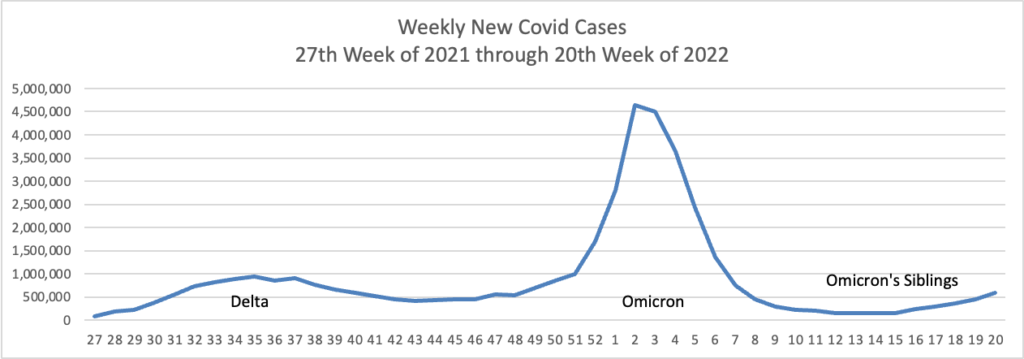
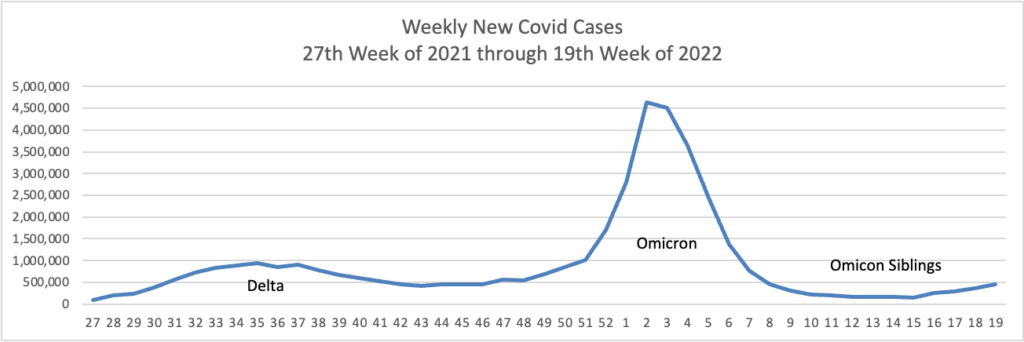
Based on the CDC’s Covid Data Tracker and using Thursday as the first day of the week, here is the FEHBlog’s weekly chart of new Covid cases from the 27th week of 2021 through the 20th week of 2022:
The CDC’s weekly review of its COVID statistics notes
As of May 18, 2022, the current 7-day moving average of daily new cases (101,130) increased by 18.8% compared with the previous 7-day moving average (85,143). A total of 82,820,565 COVID-19 cases have been reported in the United States as of May 18, 2022.
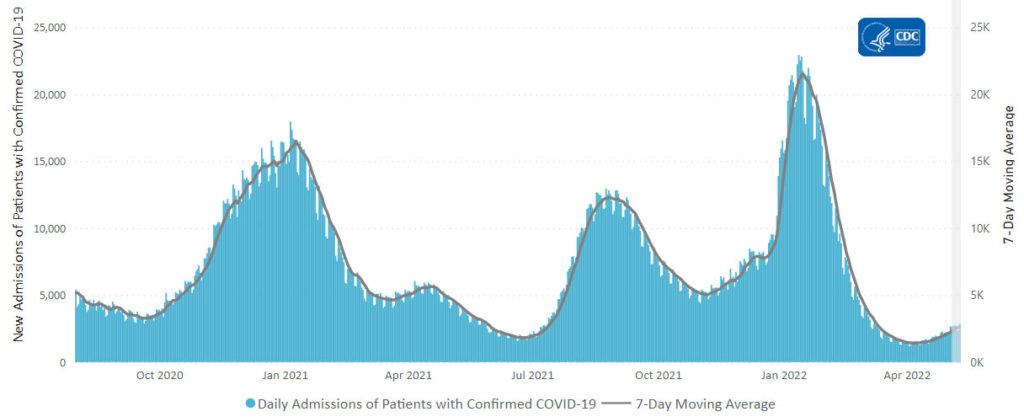
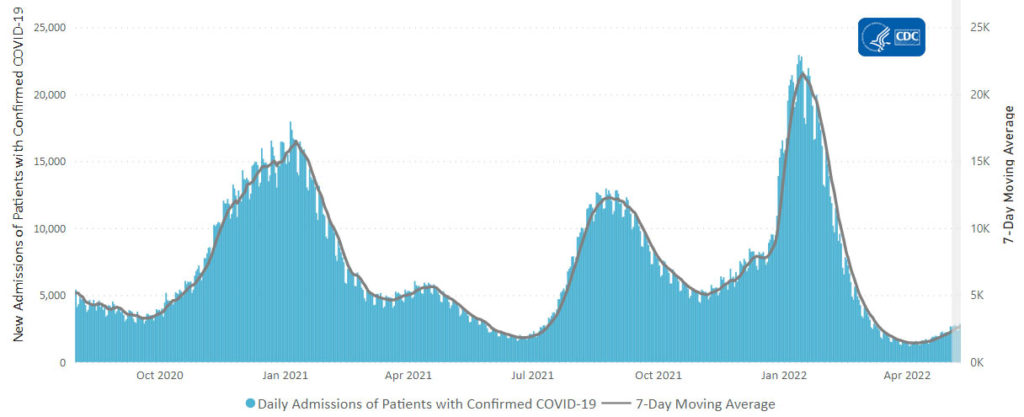
Here is the CDC’s chart seven-day movings averages of new Covid hospital admissions:
The CDC’s weekly review notes “The current 7-day daily average [of new hospital admissions for Covid] for May 11–17, 2022, was 3,250. This is a 24.2% increase from the prior 7-day average (2,617) from May 4–10, 2022.
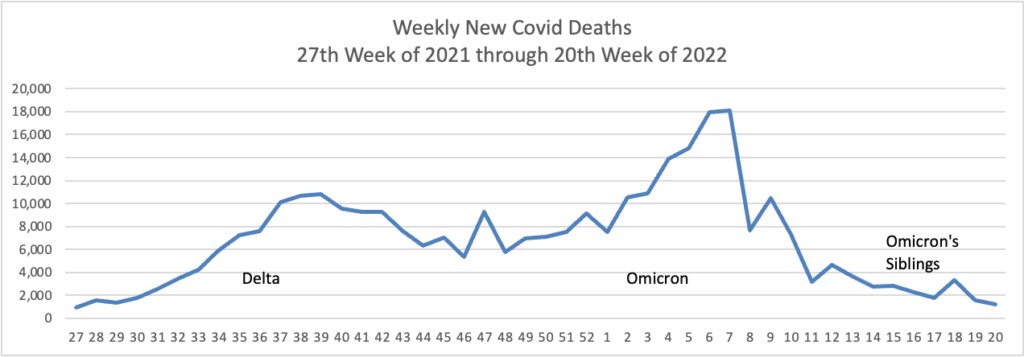
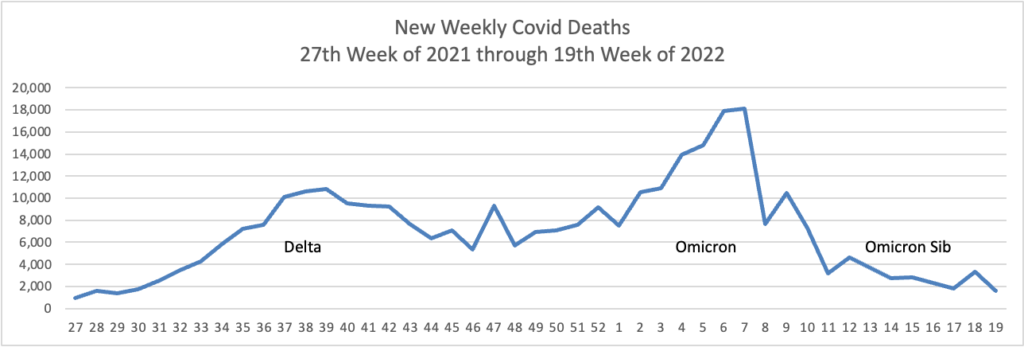
Here’s the FEHBlog’s weekly chart of new Covid deaths over the same period as the new weekly cases chart:
The CDC’s weekly review notes:
The current 7-day moving average of new deaths (280) has decreased 1.2% compared with the previous 7-day moving average (284). As of May 18, 2022, a total of 998,512 COVID-19 deaths have been reported in the United States.
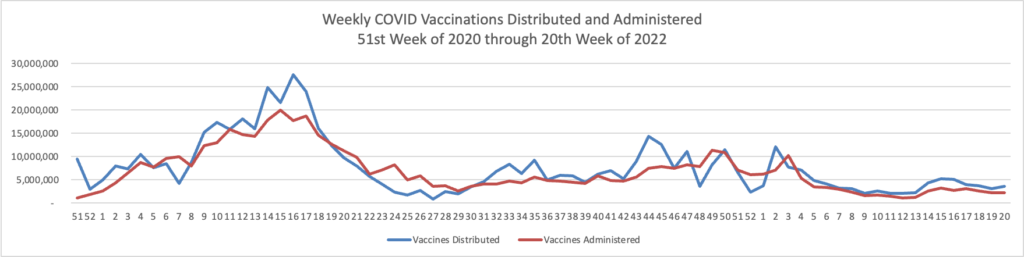
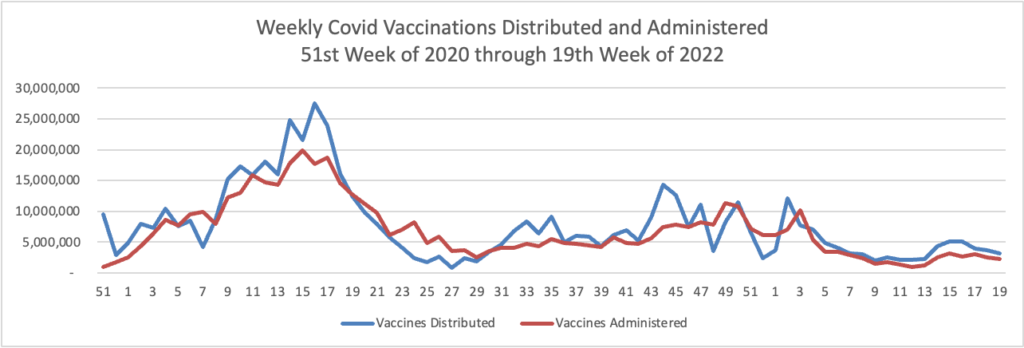
Here’s the FEHBlog’s weekly chart of Covid vaccinations distributed and administered from the beginning of the Covid vaccination program in December 2020 through the 20th week of 2022.
The CDC’s weekly review notes “As of May 18, 2022, the 7-day average number of administered vaccine doses reported (by date of CDC report) to CDC per day was 388,308, a 0.5% decrease from the previous week.”
To sum it up, the CDC’s weekly review points out,
As of May 19, 2022, there are 301 (9.35%) counties, districts, or territories with a high COVID-19 Community Level, 477 (14.81%) counties with a medium Community Level, and 2,442 (75.84%) counties with a low Community Level. This represents a moderate (+5.10 percentage points) increase in the number of high-level counties, a slight (−0.74 percentage points) decrease in the number of medium-level counties, and a corresponding (−5.84 percentage points) decrease in the number of low-level counties. Five (9.62%) of 52 jurisdictions had no high- or medium-level counties this week.
Federal News Network suggests “Federal employees [and annuitants] can use these next few months between now and open season, which begins Nov. 14, to do something that most feds rarely do — research and planning [for Open Season]. The article suggests how to conduct this research, and the FEHBlog thinks that Federal News Network is on the right track.
A growing number of Senate Democrats say they’re ready to take a tough vote on an amendment to keep the Title 42 health order in place at the U.S.-Mexico border if that’s what’s needed to move a stalled COVID-19 relief package.
Senate Majority Leader Charles Schumer (D-N.Y.) has held the bill from the floor because Republicans are insisting on voting on a bipartisan amendment to overrule the Biden administration’s decision to lift Title 42, a pandemic order that has stopped thousands of immigrants from entering the country on asylum claims. * * *
Without giving in to the Republicans’ demand for a vote on the hot-button issue of securing the border, COVID-19 relief could be stalled until after the November election.
The amendment is expected to fail but it’s a tough vote for vulnerable Senate Democrats.
More likely, in the FEHBlog’s view, the Majority Leader is waiting until the Title 42 health order is lifted later this month to see what happens.
Following the recommendation Thursday, many of the nation’s doctors, pharmacies and other vaccination sites are expected to begin offering the extra doses to the 28 million U.S. children in the age group.
The shots are to be given five months after the second dose. The extra dose is one-third the amount that those 12 years old and above receive.
Also Thursday, the CDC said it was strengthening its recommendation that people 12 years and older who are immunocompromised, or who are 50 and older, should receive a second booster dose at least four months after their first.
This means that health plans must start covering the booster with no member cost-sharing pursuant to ACA FAQ 50.
“We are ready from a manufacturing standpoint,” Moderna Chief Executive Stéphane Bancel said during a virtual appearance Thursday at The Wall Street Journal’s Future of Everything Festival.
The FDA/CDC decision is expected next month.
In other virus news, STAT News interviewed a top CDC expert on monkeypox. From the FEHBlog’s standpoint, the key takeaway is that monkeypox is not Covid.
I think we can take away a lot from what we know about monkeypox in Congo Basin and in West Africa. Even if human-to-human transmission is documented, it is generally documented among very close contacts. So family members, people taking care of ill patients. Or health care providers.
In funding news, the Department of Health and Human Services announced today a $1.5 billion funding opportunity under the State Opioid Response
SOR grant program provides formula funding to states and territories for increasing access to FDA-approved medications for the treatment of Opioid Use Disorder (OUD), and for supporting prevention, harm reduction, treatment, and recovery support services for OUD and other concurrent substance use disorders (SUD). The SOR program also supports care for stimulant misuse and use disorders, including for cocaine and methamphetamine. The SOR program helps reduce overdose deaths and close the gap in treatment needs across America by giving states and territories flexibility in funding evidence-based practices and supports across different settings to meet local community needs.
From the miscellany department
Today “the U.S. Office of Personnel Management (OPM) released guidance regarding the implementation of EO 13932; Modernizing and Reforming the Assessment and Hiring of Federal Job Candidates. OPM’s guidance represents a major step towards the federal government’s adoption of skills-based hiring practices and is an important innovation in federal hiring, which has historically relied on education and candidate self-assessments as a proxy for a candidate’s ability to perform in a job. This new approach helps hiring managers recognize and value skills regardless of where they were acquired, whether in a formal degree program, on the job, or on one’s own.”
Employee Benefit News identifies the ten most popular mental health and wellness apps.
Benefits consultant Tammy Flanagan discusses federal employee life insurance benefits in Govexec.
Health Payer Intelligence reports that CMS has updated the Medicare.gov website “to include new features such as highlighting pages that answer popular questions and spotlighting key steps that consumers should take related to Medicare coverage.”
The seven-day moving average of new Covid-19 cases recently topped 94,000 a day, Centers for Disease Control and Prevention data show, nearly four times lows reached in late March. The true number of new cases is likely significantly higher, epidemiologists say, because so many people are self-testing at home or not testing at all.
The rise in cases hasn’t translated thus far into major surges in severe illness. The seven-day average of confirmed cases in hospitalized patients reached about 18,550 on Wednesday, up from lows near 10,000 in mid-April, but far below a record peak above 150,000 in January. The numbers include people who test positive on routine screening after getting hospitalized for other reasons. The daily average of reported deaths has slipped under 300 a day, the lowest point since last summer.
But * * * the more an outbreak spreads, the more likely it will reach the most vulnerable including elderly people and others with compromised immune systems, the experts say, and the more likely the virus will continue to mutate.
As Covid-19 again surges across the US, many people are going without time-sensitive therapeutics like Paxlovid because doctors worried about shortages are reluctant to prescribe the drugs. But the situation has changed and supplies are now abundant.
The Food and Drug Administration has issued emergency-use authorizations for the drug to treat mild to moderate Covid-19 in people who are at high risk. The Centers for Disease Control and Prevention defines those as individuals ages 50 years or older, unvaccinated, or with certain medical conditions like kidney, liver, lung and heart disease, diabetes, cancer and HIV. It also recommends the drug for people who are immunocompromised, pregnant, obese, cigarette smokers or suffering from mood disorders.
You can find the one stop test to treat locations “by using the Department of Health and Human Services’ Test to Treat Locator or by calling 1-800-232-0233.”
Kaiser Health News recommends “improving ventilation and filtration of the air. ‘Ventilation matters a lot,’ said Dr. Amy Barczak, an assistant professor of medicine at Harvard Medical School. ‘If you’re taking care of someone at home, it’s really important to maximize all the interventions that work.’”
Viral particles float through the air like invisible secondhand smoke, diffusing as they travel. Outside the home, viruses are quickly dispersed by the wind. Inside, germs can build up, like clouds of thick cigarette smoke, increasing the risk of inhaling the virus.
The best strategy for avoiding the virus is to make your indoor environment as much like the outdoors as possible.
In related viral news, Beckers Hospital Review tells us
More than 400 children worldwide have developed unusual cases of acute hepatitis, and researchers are still searching for the cause of the outbreak, the World Health Organization said May 17.
As of May 15, the WHO reported 429 probable cases in 22 countries, up from 348 cases a week prior, according to Philippa Easterbrook, MD, a senior scientist in the global hepatitis program at the WHO. Another 40 cases are still under investigation, and 75 percent of all affected children are under age 5.
Twelve countries are reporting more than five cases, double the amount from last week. Of these 12 countries, nine are in Europe. In total, six children have died in the outbreak and 26 have required liver transplants, according to Dr. Easterbrook.
As of May 17, researchers were still investigating the cause of the hepatitis outbreak. The leading hypothesis is that an adenovirus and SARS-CoV-2, the virus that causes COVID-19, may be causing hepatitis in children. Scientists are exploring “how these two infections may be working together as co-factors either by enhancing susceptibility or creating an abnormal response,” Dr. Easterbrook said.
From the healthcare policy front, AHIP today launched
Healthier People through Healthier Markets, a new policy roadmap and set of solutions to improve health care affordability and access for every American. The effort is focused on boosting competition in health care markets and reining in harmful practices that hurt American families. With the launch of this policy roadmap, AHIP sent letters to President Biden and the leadership of Congress that lay out a detailed set of legislative and regulatory enforcement actions to increase competition in health care, drive down costs, and improve health care access for patients.
The Office of Personnel Management on Wednesday urged federal agencies to ensure their employees are aware and can access the mental health benefits provided to federal workers, in light of May being Mental Health Awareness Month.
In a memo to agency heads, OPM Director Kiran Ahuja noted that promoting the federal workforce’s wellbeing, including mental health, is a priority in President Biden’s management agenda.
“We want to make sure that all federal employees understand the supports available to them and underscore that there should be no shame or stigma for taking care of their mental health,” Ahuja wrote. “[As] a reminder, employee assistance programs and Federal Employees Health Benefits health plans offer mental health services to employees and their family members. We encourage agencies to proactively communicate to their workforces about their options and encourage employees to contact their agency benefits officers or EAP coordinator to learn more.”
The FEHBlog encourages OPM to better coordinate mental health care services among FEHB plans, EAPs and wellness programs.
mHealth Intelligence informs us “In the second half of 2020, only 14.1 percent of children used telehealth due to the pandemic, but use was higher among those with asthma, a developmental condition, or a disability, the Centers for Disease Control and Prevention (CDC) found.”
From the survey department, Beckers Payer Issues advises that “Castlight Health analyzed more than 160 million commercial medical claims nationwide to reveal insights about healthcare utilization patterns from 2018 to 2021.” Castlights report ranks the fifty States and DC based on average medical spending per member in 2021.
From the miscellany department —
Beckers Payer Issues reports “Anthem shareholders voted at their annual meeting May 18 to change the company’s name to Elevance Health.”
Federal News Network discusses the Postmaster General’s plans to close and consolidate Postal facilities across the delivery network. “The network transformation initiative will impact nearly 500 network mail processing locations, 1,000 transfer hubs and 100,000 carrier routes. It will also impact 10,000 delivery units, which USPS defines as post offices, stations, branches or carrier annexes that handle mail delivery functions.”
FedSmith tells us “Starting May 26, 2022, federal retirees will notice a new process for signing into the OPM Retirement Services Online website. The login process will now be managed through the federal government’s Login.gov website and will require you to create a new username and password at login.gov if you do not currently have one.”
The Secretary of Health and Human Services has extended the Covid public health emergency for another 90 days. Bloomberg explains, “The declaration allows the US to grant emergency authorizations of drugs, vaccines and other medical countermeasures, as well as administer those products to millions of people at no out-of-pocket cost. It’s also enabled millions of Americans to get health coverage through Medicaid, among other benefits.” Bloomberg’s sources expect the declaration to be renewed again in July 2022.
The American Hospital Association informs us
The Food and Drug Administration today authorized a single Pfizer COVID-19 booster dose for children aged 5-11 who completed the Pfizer vaccine primary series at least five months before. FDA authorized the vaccine for this age group last October.
“The FDA has determined that the known and potential benefits of a single booster dose of the Pfizer-BioNTech COVID-19 Vaccine for children 5 through 11 years of age at least five months after completing a primary series outweigh its known and potential risks and that a booster dose can help provide continued protection against COVID-19 in this and older age groups,” said Peter Marks, M.D., director of FDA’s Center for Biologics Evaluation and Research.
In public health news —
The federal government’s Million Hearts campaign has launched a website discussing hypertensive disorders of pregnancy. The site explains “Hypertensive disorders of pregnancy are a leading cause of maternal mortality and can put both mother and baby at risk for problems during pregnancy.1 High blood pressure can also cause problems during and after delivery. Importantly, hypertensive disorders of pregnancy are often preventable and treatable.”
The Centers for Disease Control has updated its website discussing diabetes and heart disease. The FEHBlog knows from his PCP about the dangerous relationship between those two diseases.
In survey news —
Beckers Hospital Review relates that “The Lown Institute, a nonpartisan healthcare think tank, released its ranking May 17 of the best hospitals in the U.S. for avoiding overuse of low-value tests and procedures.”
Fierce Healthcare tells us, “Utah is the healthiest state for seniors this year, earning high marks for low prevalence of smoking and excessive drinking, according to a new report from the United Health Foundation. The philanthropic arm of UnitedHealth Group issued its annual America’s Health Rankings senior report Tuesday morning, which highlights state-specific performance across a slew of measures as well as progress, or lack thereof, on several key health issues facing seniors.”
Private insurance plans paid hospitals on average 224% more compared with Medicare rates for both inpatient and outpatient services in 2020, a new study found.
Researchers at RAND Corporation looked at data from 4,000 hospitals in 49 states from 2018 to 2020. While the 224% increase in rates is high, it is a slight reduction from the 247% reported in 2018 in the last study RAND performed.
“This reduction is a result of a substantial increase in the volume of claims in the analysis from states with prices below the previous average price,” the study said.
The report showed that plans in certain states wound up paying hospitals more than others. It found that Florida, West Virginia and South Carolina had prices that were at or even higher than 310% of Medicare.
But other states like Hawaii, Arkansas and Washington paid less than 175% of Medicare rates.
The American Hospital Association replies
The RAND Corporation’s latest hospital pricing report again “overreaches and jumps to unfounded conclusions based on incomplete data,” AHA President and CEO Rick Pollacksaid today. “The report looks at claims for just 2.2% of overall hospital spending, which, no matter how you slice it, represents a small share of what actually happens in hospitals and health systems in the real world. RAND also continues to ignore that hospitals are not all the same. Researchers should expect variation in the cost of delivering services across the wide range of U.S. hospitals — from rural critical access hospitals to large academic medical centers. Tellingly, when RAND added more claims as compared to previous versions of this report, the average price for hospital services declined. This suggests what we have long suspected: you simply cannot draw credible conclusions from such a limited and biased set of claims.
“Further, the results highlight what even the Medicare Payment Advisory Commission (MedPAC) acknowledges: Medicare does not fully cover the cost of providing care to Medicare beneficiaries. Pinning commercial prices to inadequate Medicare rates would cause even more financial strain to hospitals already facing tremendous challenges as a result of the ongoing COVID-19 pandemic and rising inflation. The result could be reduced patient access to care.”
I agree with the American Hospital Association that the problem is Medicare. Why Sen. Sanders continues to push Medicare for All is a mystery to the FEHBlog.
Humana plans to open about 100 new value-based primary care clinics for Medicare patients between 2023 and 2025 through its second joint venture with private-equity firm Welsh, Carson, Anderson & Stowe, according to a Monday release from the payer.
The clinics will be managed and operated under Humana’s CenterWell Senior Primary Care brand, and WCAS will have majority ownership while Humana will have a minority stake.
The $1.2 billion expansion builds upon an existing venture with the same firm to open 67 clinics by early 2023.
From the Rx coverage front, Drug Channel reports on “The State of Specialty Pharmacy 2022: Reflections, Trends, and Photos from #Asembia22.”
From the mental healthcare front, Health Payer Intelligence discusses another angle considered in the UHG report on seniors mentioned above.
Over the last decade, seniors have experienced rising rates of mental healthcare needs, drug-related deaths, and early mortality, the UnitedHealth Foundation’s 2022 Senior Report shows.
“The 2022 Senior Report shows that the wellbeing of older adults was declining before the pandemic, which we know exacerbated many of these challenges,” Rhonda Randall, DO, executive vice president and chief medical officer of UnitedHealthcare Employer and Individual, said in the press release.
“We urge people to help the seniors in your lives reconnect with the communities and activities they have enjoyed in the past but may not yet have returned to. We are focused on reducing disparities in the health care system for everyone, including older Americans.”
In webinar news — The Labor Department is holding a virtual event on May 25 concerning building mental health-friendly workplaces.
Bloomberg observes “Covid hospitalitalization count makes vaccines seem less effective, Researchers say. The researchers point out that a patient who tests positive for Covid is a Covid hospitalization even if the patient is hospitalized for an unrelated reason.
In its recent review of Covid pills, the Institute for Clinical Review (ICER) gave a mildly favorable report on using an inexpensive anti-depressant fluvoxamine to treat Covid. This part of the ICER report was physician investigator-initiated. Those investigators sought FDA approval. Today, however, STAT News reports that “In an unusual two-page summary — the FDA does not generally disclose the reasoning behind rejections — regulators said that the doctors failed to provide adequate evidence of the effectiveness of the drug, called fluvoxamine.” The investigators indicated that more fluvoxamine trials are ongoing as well as trials of other repurposed drugs.
The National Institutes of Health announced today that a research team is successfully using deidentified electronic health record data to better identify characteristics of persons with long Covid. “One reason long COVID is difficult to identify is that many of its symptoms are similar to those of other diseases and conditions. A better characterization of long COVID could lead to improved diagnoses and new therapeutic approaches.”
Roll Call delves into the use of wastewater surveillance to track Covid trends. Urban areas are good — rural areas are not so good.
Medpage Today offers an epidemiologist’s perspective on the occasionally observed Omicron rebound from Paxlovid, the Pfizer Covid pill. Reuters adds, “Pfizer has said that from more than 300,000 patients it is monitoring who received the 5-day treatment, around 1-in-3,000 – about 0.03% – reported a relapse after taking the pills.”
The Food and Drug Administration on Monday authorized a test developed by Laboratory Corporation of America Holdings LH, -0.92% that allows people in the U.S. to self-test for respiratory syncytial virus (RSV), a type of common cold, as well as the flu and COVID-19. The test does not require a prescription. People swab at home and send the test by mail to a Labcorp lab. Results are then made available in an online portal. Teens and children are also authorized to test with the support of adults. The test kit costs $169 and may be covered by insurance, according to a spokesperson. It is expected to be available within the next three weeks.
That’s helpful.
From the SDOH front —
Health Day informs us that “a new study shows that telemedicine has closed the gap in access to primary care between Black and non-Black Americans.”
Beckers Payers Issues tells us “Despite little change before the pandemic, the number of adults with medical debt, issues paying medical bills and medical debt in collections have declined since the pandemic began. New policies will be needed to sustain the decrease, according to a May 11 report from the Urban Institute.”
A decrease in cervical cancer rates in the United States, most notably among younger women, may be associated with HPV vaccination approval, according to a retrospective, cross-sectional study published in JAMA Network Open.
Researchers added that an increase in oropharyngeal and anal/rectal cancers, particularly among men, highlights a need for vaccination uptake among both men and women.
From the interoperability front, the Sequoia Project “selected by the Office of the National Coordinator for Health IT (ONC) as the Recognized Coordinating Entity (RCE) to support the implementation of the Trusted Exchange Framework and Common Agreement (TEFCA), today released additional details regarding the process and requirements for becoming a Qualified Health Information Network (QHIN). The Sequoia Project is requesting feedback on these items before the final documents are released.” The Sequoia Project’s comment deadline is June 15, 2022, and “drafts are available on the RCE website.”
From the healthcare business front, Healthcare Dive reports
Hospitals’ labor costs rose by more than a third from pre-pandemic levels by March 2022, according to a report out Wednesday from Kaufman Hall.
Heightened temporary and traveling labor costs were a main contributor, with contract labor accounting for 11% of hospitals’ total labor expenses in 2022 compared to 2% in 2019, the report found.
Contract nurses’ median hourly wages rose 106% over the period, from $64 an hour to $132 an hour, while employed nurse wages increased 11%, from $35 an hour to $39 an hour, the report found.
In other government news —
The Department of Health and Human Service is marking the 10th anniversary of the National Plan to Address Alzheimer’s Disease. “HHS is commemorating the Anniversary through a series of publications and presentations highlighting the Department’s accomplishments in addressing Alzheimer’s disease and related dementias (ADRD), including those at the Centers for Disease Control and Prevention (CDC), Administration for Community Living (ACL), National Institutes of Health (NIH), Indian Health Service (IHS), and other HHS agencies. HHS will also sponsor a state policy roundtable to hear from state leaders about their work to address ADRD. All events and materials will be shared on the 10th Anniversary HHS page.”
The Society for Human Resource Management relates that “An FAQ explains that the EEOC will permit employers to submit their EEO-1 Reports after the May 17 deadline, during what the agency is calling the “failure to file” phase. The EEOC stated, “All filers who have not submitted and certified their mandatory 2021 EEO-1 Component Report(s) by the Tuesday, May 17, 2022, published deadline will receive a notice of failure to file instructing them to submit and certify their data as soon as possible, and no later than Tuesday, June 21, 2022.” All FEHB carriers must file this report.
From the omicron and siblings front, Bloomberg Prognosis reports
People who are vaccinated and then get infected with omicron may be primed to overcome a broad range of coronavirus variants, early research suggests.
A pair of studies showed that infection produced even better immune responses than a booster shot in vaccinated patients. Teams from Covid-19 vaccine maker BioNTech SE and the University of Washington posted the results on preprint server bioRxiv in recent weeks.
The researchers have found the silver lining in the Omicron cloud.
In other encouraging healthcare news, BioPharma Dive informs us
The Food and Drug Administration on Friday approved Eli Lilly’s diabetes drug Mounjaro, a first-of-its-kind treatment that can help control patients’ blood sugar and, potentially, help them lose weight as well.
Mounjaro, also known as tirzepatide, expands Lilly’s diabetes business, which includes insulins as well as other types of therapies. The company recorded $9 billion in diabetes drugs sales last year.
Mounjaro works by stimulating two hormones, called GLP-1 and GIP, that control insulin production. In clinical testing, the drug outperformed several other diabetes medicines, including one made by rival drugmaker Novo Nordisk that only acts on one hormone. Mounjaro was more effective in controlling blood sugar than two types of insulin as well. * * *
The drug’s approval will heighten competition between Lilly and Novo, which have battled for market share in the U.S. for years. Novo, for instance, has recently had success by launching a similar, once-weekly shot to Lilly’s top-selling drug Trulicity, as well as a daily pill that works the same way.
Novo is testing a dual-acting competitor to tirzepatide, but it’s only in Phase 2 testing, well behind Lilly’s drug. Both companies are also trying to develop a once-weekly insulin shot, with similar programs in Phase 3 development.
The next frontier for both companies is in obesity, where they are working to prove their drugs’ worth as weight loss treatments. Novo has already won approval for a drug called Wegovy, while Lilly reported promising data for Mounjaro last month.
The article adds that Lilly did not disclose pricing for its newly approved drug on Friday.
The FEHBlog also noticed that Katie Keith’s latest article on the Affordable Care Act delves into the recent guidance on posting three machine reading pricing files on health plan websites by July 1. The discussion may be found in the closing paragraphs of the article.
From our Nation’s Capital, Cybersecurity Dive reports
On the one-year anniversary of the Executive Order on Improving the Nation’s Cybersecurity, industry experts say the Biden administration has made significant inroads in raising software security standards, but additional work and financial support is necessary to achieve security end goals.
The Office of Management and Budget’s (OMB) federal zero trust strategy enjoys almost unanimous support from federal cybersecurity decision makers, however two-thirds of federal cybersecurity decision makers said the three-year timeline was unrealistic, according to a study from MeriTalk, sponsored by AWS, CrowdStrike and Zscaler. Just 14% of those surveyed believe the program is properly funded.
Almost two-thirds of federal officials expect to achieve zero trust goals by the goal date of 2024, according to a separate study from General Dynamics Information Technology. However, many of those officials see significant challenges, including a lack of sufficient IT staff and the need to replace legacy infrastructure.
A $63 million settlement has been reached in the class-action lawsuit filed over the 2015 data breach of the US Office of Personnel Management (OPM) that exposed the data of over 21 million current, former, and prospective federal employees and families members, the Epoch Times reports. The files were allegedly stolen by China-backed hackers, who exfiltrated highly sensitive information such as fingerprints and psychological and emotional health histories, and it is reported that the Chinese government has been using data from such breaches to build a database on American citizens for political and economic espionage. The agreement explains, “The settlement is the result of extensive negotiations and accounts for the unique aspects of this litigation, including the strict limitation on recovering from the Government and the causation problems that Defendants would have argued result from the hack’s attribution to a foreign state actor…That these data breaches were attributed to the Chinese government, apparently motivated by foreign policy considerations, would have compounded the risks associated with tracing plaintiffs’ harm to [OPM].” Under the settlement, which is still awaiting approval from a federal judge, OPM will pay $60 million and OPM contractor Peraton will pay $3 million into a fund for victims of the hack.
The news strikes the FEHBlog as a good deal for the government.
vosLocker, a prolific ransomware group that was the subject of a recent joint FBI and U.S. Treasury Department warning, claimed this week that it had hit a Dallas-based nonprofit Catholic health system with more than 600 facilities across four U.S. states, Mexico, Chile and Colombia.
The attack on CHRISTUS Health marks the second health care system AvosLocker targeted in the last two months. Michigan-based McKenzie Health System began notifying customers this week that patients’ personal data had been stolen from the company’s network in a “security incident” that “disrupted” some of its IT systems in March. The company did not identify the attacker, but AvosLocker posted purported McKenzie data to its dark web leak site April 6. * * *
Over the past several months, Iran-linked cyberespionage group Charming Kitten has been engaging in financially-motivated activities, the Secureworks Counter Threat Unit (CTU) reports.
Also referred to as APT35, Magic Hound, NewsBeef, Newscaster, Phosphorus, and TA453, the advanced persistent threat (APT) actor is known for the targeting of activists, government organizations, journalists, and various other entities. * * *
The security researchers assess that, while the group has managed to compromise a large number of targets worldwide, “their ability to capitalize on that access for financial gain or intelligence collection appears limited.” However, the use of publicly available tools for ransomware operations shows that the group remains an ongoing threat, Secureworks concludes.
For more on Charming Kitten, check out this Cyberscoop article.
Here is a link to the Bleeping Computer’s Week in Ransomware column.
From the cyber vulnerabilities front, CISA added one new known vulnerability to its catalog.
From the cyber defenses front, here’s a link to a press release of note
The Cybersecurity and Infrastructure Security Agency (CISA), in partnership with the United Kingdom’s National Cyber Security Centre (NCSC-UK), Australian Cyber Security Centre (ACSC), Canadian Centre for Cyber Security (CCCS), New Zealand National Cyber Security Centre (NZ NCSC), National Security Agency (NSA), and Federal Bureau of Investigation (FBI) released an advisory today [May 11] with cybersecurity best practices for information and communications technology (ICT), focusing on enabling transparent discussions between managed service providers (MSPs) and their customers on securing sensitive data. CISA, NCSC-UK, ACSC, CCCS, NZ-NCSC, NSA, and FBI expect state-sponsored advanced persistent threat (APT) groups and other malicious cyber actors to increase their targeting of MSPs against both provider and customer networks.
Security Week offers an expert view on seven steps to reduce risk to your critical infrastructure quickly.
Based on the CDC’s Covid Data Tracker and using Thursday as the first day of the week, here is the FEHBlog’s weekly chart of new Covid cases from the 27th week of 2021 through the 19th week of 2022.
The CDC’s weekly review of its Covid statistics notes
As of May 11, 2022, the current 7-day moving average of daily new cases (84,778) increased 30.7% compared with the previous 7-day moving average (64,863). A total of 82,087,117 COVID-19 cases have been reported in the United States as of May 11, 2022.
Here’s the CDC’s weekly chart of new Covid hospitalizations
The CDC’s weekly review of Covid hospitalization notes, “The current 7-day daily average for May 4–10, 2022, was 2,629. This is a 17.5% increase from the prior 7-day average (2,238) from April 27–May 3, 2022.”
Here’s the FEHBlog’s weekly chart of new Covid deaths from the 27th week of 2021 through the 19th week of 2022:
The CDC’s weekly review notes “The current 7-day moving average of new deaths (273) has decreased 15.4% compared with the previous 7-day moving average (322). As of May 11, 2022, 996,376 COVID-19 deaths have been reported in the United States.”
Finally, here is the FEHBlog’s weekly chart of Covid vaccinations distributed and administered from the beginning of the Covid vaccination era through the 19th week of 2022.
Per the CDC’s weekly review, “As of May 11, 2022, the 7-day average number of administered vaccine doses reported (by date of CDC report) to CDC per day was 390,306, an 11.1% decrease from the previous week.”
76% of the U.S. population aged 18 and older are fully vaccinated against Covid, and 50% of that cadre has received the first booster. Likewise, 90% of the U.S. population aged 65 and older is fully vaccinated, and 70% of that cadre has received the first booster. There is work still to be done but the public health community and the U.S citizenry deserves credit for these accomplishments.
To wrap up this week’s Covid stats, let’s include the CDC’s latest Communities report:
As of May 12, 2022, there are 137 (4.25%) counties, districts, or territories with a high COVID-19 Community Level, 453 (14.07%) counties with a medium Community Level, and 2,630 (81.68%) counties with a low Community Level. This represents a small (+1.77 percentage points) increase in the number of high-level counties, a moderate (+4.10 percentage points) increase in the number of medium-level counties, and a corresponding (−5.87 percentage points) decrease in the number of low-level counties. Eight (15.38%) of 52 jurisdictions had no high- or medium-level counties this week.
NPR Shots offers a valuable article describing three ways to get the Paxlovid pill if diagnosed with Covid. The key takeaway from the FEHBlog’s perspective is the need to have a primary care provider in your life.
For those with health insurance and access to their primary care providers or health care team, you can make an in-person or telehealth appointment to get tested (or share your positive test results), assessed for risks and medications and, if eligible, obtain a prescription for the pills.
Having a provider that knows your medical history, as well as the details of your current situation, can be very helpful, says Dr. Ulrika Wigert, a family medicine physician at CentraCare in Sauk Center, Minnesota. “Did you test the first day [of symptoms]? Did you test the second day? How sick were you when you tested?” And, if you’re starting to feel better by the time you get the medication, do the benefits of taking the medication outweigh any risks? “Having a provider help navigate that on the individual patient basis” can help guide you through an appropriate course of care, she says.
STAT News addresses three burning questions about the future of prescribing drugs using telehealth services (not for a PCP visit).
Research by Lori Uscher-Pines, a senior policy researcher at RAND, suggests that providers are starting to prescribe buprenorphine — a controlled substance used to treat opioid use disorder — without in-person visits. But they’re typically more comfortable continuing the prescriptions virtually for patients they’ve already met, compared to taking on new patients virtually.
Still, “very few studies of medication treatment for opioid use disorder via telehealth have shown safety or diversion concerns,” she said. And she noted that one recent study suggested that relaxed restrictions have improved treatment retention for opioid use disorder patients.
Telehealth prescription could help patients in regions with acute clinician shortages — especially of mental health providers — obtain critical medication.
“A key question going forward is how to strike a balance between increasing access to important medications on the one hand and limiting the potential for misuse on the other,” Uscher-Pines said.
In the past, federal and state regulations have required clinicians to frequently examine patients in-person to guard against misuse, addiction, or fraud. “But are there other ways to accomplish this, perhaps ways that actually leverage telehealth rather than restrict it?” she asked.
A better system might involve hybrid care: In-person exams for certain types of prescriptions blended with virtual follow-ups, for instance. But Schwamm cautioned against over-regulating telehealth prescriptions, given that clinical guidelines evolve faster than federal and state policies typically do.
“Whenever you put these kinds of restrictions in place, you are restricting access to care,” he said. “Do we need to require, and is it good medical practice, to require by regulation that the person come in-person? I would argue that we just don’t know.”
In an Associated Press interview, Jha said Americans’ immune protection from the virus is waning, the virus is adapting to be more contagious and booster doses for most people will be necessary — with the potential for enhanced protection from a new generation of shots.
Epidemiologist David Dowdy of Johns Hopkins’ Bloomberg School of Public Health said that, despite the case increases, hospitalization and death rates overall remain relatively low compared with earlier periods in the pandemic — a reflection of how much immunity there is in the population.
“In some ways, this is encouraging, in that we’re starting to see a divergence between the number of cases and the number of hospitalizations and deaths,” Dowdy said. “But it’s also a little bit discouraging that we’ve been through all this and we’re still seeing a flat line and an uptick in the number of people getting admitted to the hospital and in people dying.”
In the FEHBlog’s view, the coordinator should stop fighting the Delta pandemic by focusing attention on better government distribution of Pfizer’s Paxlovid, which can cure the Omicron if taken timely. Kaiser Health News discusses this continuing and vexing distribution problem.
Unquestionably a need to focus attention on vaccinations and boosters remains essential. Govexec and Kaiser Health News ask why one-third of Americans over 65 have not received the first booster. Nearly all Americans over 65 are fully vaccinated. The article explains
People 65 and older account for about 75% of U.S. covid deaths. And some risk persists, even for seniors who have completed an initial two-dose series of the Moderna or Pfizer vaccine or gotten one dose of the Johnson & Johnson vaccine. Among older people who died of covid in January, 31% had completed a first vaccination round but had not been boosted, according to a KFF analysis of CDC data
FEHB plans are well-positioned to help with this effort, given their demographics.
In other virus news, the American Hospital Association tells us
The Centers for Disease Control and Prevention yesterday updated its testing guidance for clinicians treating children with hepatitis of unknown cause. The agency is investigating 109 potential hepatitis cases of unknown cause in U.S. children since last October, including five deaths. More than 90% of the patients were hospitalized, 14% received liver transplants and more than half had a confirmed adenovirus infection, but officials still don’t know the actual cause of their hepatitis and cautioned that it may take time to assess the evidence and learn more. Potential cases also have been reported in the United Kingdom and other countries.
Following up on last night’s hospital system merger news, Healthcare Dive reports
The Advocate Aurora Health and Atrium Health merger is likely to get a close review from the Federal Trade Commission as the Biden administration has taken a tougher stance on healthcare consolidation, antitrust and legal experts say. * * *
“I don’t think anything of this size in a healthcare transaction today is going to get rubber stamped,” said Bill Horton, a partner at Jones Walker who focuses on healthcare transactions. * * *
“Historically, the FTC concern in hospital and healthcare institution mergers has been the geographic overlap,” Horton said.
Advocate Aurora and Atrium do not have any geographic market overlap. The systems span six separate states through the Midwest and South.
“It doesn’t raise the same red flags, but it doesn’t mean that it gets waved through,” said Leemore Dafny, a Harvard Business School professor and former deputy director of healthcare and antitrust at the FTC.
The FTC is likely to examine whether the two systems negotiate with the same insurers even if they’re in different geographic locations, Dafny said.
From the interoperability front, Health Data Management offers an interesting take on government efforts to meet lofty public health goals for Data Modernization Initiative.
From the mental health care front, and to end on a high note, Health Payer Intelligence informs us
Consumers reported having positive experiences with their employer-sponsored mental and behavioral healthcare coverage during the coronavirus pandemic, a survey conducted on behalf of AHIP discovered.
“Health insurance providers are working every day to support Americans by helping them find the mental health support and counseling they need at a price they can afford,” Matt Eyles, president and chief executive officer of AHIP, said in a press release.
Third time’s a charm. Or so Democrats hope as they attempt to negotiate a third COVID-19 funding deal after their previous two bipartisan agreements — one for $15.6 billion in domestic and international aid, and a second for $10 billion in only domestic funds — stalled out.
The House is taking the lead on the latest iteration. But it’s not yet clear whether they’ll hold out for a bipartisan, bicameral agreement or attempt to move a Democrat-led version that would provide more funding, closer to President Joe Biden’s original $22.5 billion request.
“All the options are on the table,” House Majority Leader Steny H. Hoyer, D-Md., said Wednesday. “But it’s critical to get it done. And the fastest way to get it done is have an agreement on the four corners.”
From the No Surprises Act front, the U.S. Court of Appeals for the Fifth Circuit has granted the federal government/appellant’s “unopposed motion to stay further proceedings in this court pending ongoing rulemaking proceedings involving provisions of the No Surprises Act, with a status report due every sixty (60) days.” It’s worth noting that the final independent dispute resolution rule has not yet appeared on the OMB’s Office of Regulatory Affairs reginfo.gov site.
From the Omicron and siblings front, Fierce Healthcare tells us
Reported cases of COVID-19 and hospitalizations for the disease are on the rise across most of the U.S., with the Centers for Disease Control and Prevention (CDC) recently shifting many counties in the Northeast to medium or high levels of community risk. * * *
COVID-19 hospitalizations—which have become the CDC and other public health experts’ preferred metric for decisionmaking—have similarly begun to tick upward over the past month.
After reaching a seven-day average low of 1,426 daily admissions in early April, national admissions have continually increased and exceeded the seven-day average of 2,400 daily hospitalizations late last week. These new admissions represented an 11% increase over the previous week’s seven-day average, according to the agency, but were still nearly 90% below the January peak of more than 21,500 average daily admissions.
From the opioid epidemic front, the Wall Street Journal reports
Drug-overdose deaths in 2021 topped 100,000 for the first time in a calendar year, federal data showed, a record high fueled by the spread of illicit forms of fentanyl throughout the country.
More than 107,000 people in the U.S. died from drug overdoses last year, preliminary Centers for Disease Control and Prevention data released Wednesday showed, roughly a 15% increase from 2020. The proliferation of the potent synthetic opioid fentanyl has been compounded by the destabilizing effects of the Covid-19 pandemic on users and people in recovery, according to health authorities and treatment providers.
The U.S. has recorded more than one million overdose deaths since 2000, and more than half of those came in the past seven years.
“We’ve never seen anything like this,” said Robert Anderson, chief of the mortality-statistics branch at the CDC’s National Center for Health Statistics, regarding fentanyl’s impact on the numbers.
From the telehealth front, Healthcare Dive informs us
Telehealth visits for COVID-19 diagnoses fell in February, mirroring the sharp decline in new cases of the virus reported to the Centers for Disease Control and Prevention after January’s omicron-driven peak, according to Fair Health’s monthly telehealth claims tracker.
Overall telehealth use also slowed, falling 9.3% in February across the country. Virtual visits were 4.9% of all medical claim lines, down from 5.4% in the prior month.
With declining COVID-19 cases generating fewer telehealth sessions, mental health conditions accounted for a greater share of all diagnoses conducted via virtual platforms, according to the Fair Health data released Monday. Mental health diagnoses rose to about 64% of telehealth claims, up from 60% in January.
The FEHBlog is happy that people are using telehealth for mental healthcare,e which strikes the FEHBlog as a good, productive fit.
From the healthcare business front, Healthcare Dive reports
Advocate Aurora Health and Atrium Health said Wednesday they plan to merge, creating one of the nation’s largest nonprofit health systems with $27 billion in combined revenues and 67 hospitals across six states.
Board members from both systems unanimously approved the agreement, which is subject to regulatory review. The combined entity will be led by both CEOs for the first 18 months, at which time Advocate’s CEO Jim Skogsbergh will retire, leaving Atrium’s CEO Eugene Woods as sole leader.
Advocate and Atrium will have an equal number of board seats. Atrium’s board chair Edward Brown will first serve as chair until the end of 2023, followed by a two-year term for Advocate’s chair Michele Richardson.
The new organization will have a combined footprint across Illinois, Wisconsin, North Carolina, South Carolina, Georgia and Alabama. It will serve 5.5 million patients, operate more than 1,000 sites of care and 67 hospitals, employ more than 7,600 physicians and nearly 150,000 teammates, and have combined annual revenues of more than $27 billion.
Six technology vendors [who] were highlighted for their abilities to address one of the six main points of friction between payers and providers that leading healthcare organizations strive to address, according to a KLAS report that is part of the KLAS Payer/Provider Initiative.
KLAS launched the Payer/Provider Initiative to identify points of friction between payers and providers and to highlight strong collaboration case studies.
The six payer-provider challenges that leading healthcare organizations tackled were prior authorization, value-based care, payer-provider interoperability, denials, credentialing, and patient billing.
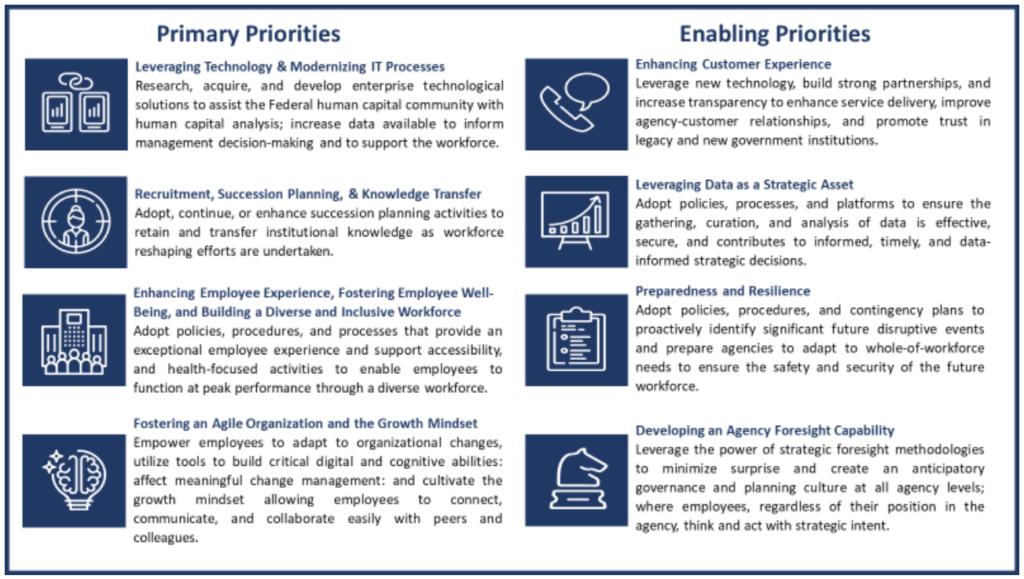
Agencies have to choose two out of four new focus areas to help improve their workforce over the next four years.
Deciding which options are most impactful gives agencies flexibility in how they approach new workforce objectives from the Office of Personnel Management.
Although OPM’s federal workforce priorities report, released on May 10, asks agencies to focus on only two of the four focus areas, implementing all four can help agencies resolve bigger workforce issues.
Among four primary priorities and four enabling priorities, OPM hopes agencies can implement proactive approaches to common issues, such as recruitment challenges.
From OPM’s federal workforce priorities report via Federal News Network
We use cookies on our website to give you the most relevant experience by remembering your preferences and repeat visits. By clicking “Accept”, you consent to the use of ALL the cookies.
This website uses cookies to improve your experience while you navigate through the website. Out of these, the cookies that are categorized as necessary are stored on your browser as they are essential for the working of basic functionalities of the website. We also use third-party cookies that help us analyze and understand how you use this website. These cookies will be stored in your browser only with your consent. You also have the option to opt-out of these cookies. But opting out of some of these cookies may affect your browsing experience.
Necessary cookies are absolutely essential for the website to function properly. These cookies ensure basic functionalities and security features of the website, anonymously.
Cookie
Duration
Description
cookielawinfo-checbox-analytics
11 months
This cookie is set by GDPR Cookie Consent plugin. The cookie is used to store the user consent for the cookies in the category "Analytics".
cookielawinfo-checbox-functional
11 months
The cookie is set by GDPR cookie consent to record the user consent for the cookies in the category "Functional".
cookielawinfo-checbox-others
11 months
This cookie is set by GDPR Cookie Consent plugin. The cookie is used to store the user consent for the cookies in the category "Other.
cookielawinfo-checkbox-necessary
11 months
This cookie is set by GDPR Cookie Consent plugin. The cookies is used to store the user consent for the cookies in the category "Necessary".
cookielawinfo-checkbox-performance
11 months
This cookie is set by GDPR Cookie Consent plugin. The cookie is used to store the user consent for the cookies in the category "Performance".
viewed_cookie_policy
11 months
The cookie is set by the GDPR Cookie Consent plugin and is used to store whether or not user has consented to the use of cookies. It does not store any personal data.
Functional cookies help to perform certain functionalities like sharing the content of the website on social media platforms, collect feedbacks, and other third-party features.
Performance cookies are used to understand and analyze the key performance indexes of the website which helps in delivering a better user experience for the visitors.
Analytical cookies are used to understand how visitors interact with the website. These cookies help provide information on metrics the number of visitors, bounce rate, traffic source, etc.
Advertisement cookies are used to provide visitors with relevant ads and marketing campaigns. These cookies track visitors across websites and collect information to provide customized ads.