FEHBlog

Midweek Update

From Capitol Hill, the Wall Street Journal reports

The House on Wednesday passed a one-week government funding measure to give congressional negotiators time to complete and pass a full-year omnibus spending bill, overcoming opposition from Republicans who urged postponing any deal until next year, when the GOP will take control of the chamber. * * *

The Senate is expected to next approve the one-week extension [on Thursday December 15]. 

The vote on a one-week continuing resolution, which keeps the government funded at fiscal 2022 spending levels, follows the announcement Tuesday that Democratic and Republican negotiators had reached agreement on a framework and would turn to completing the details. 

From the public health front, Healthcare Dive tells us

  • National health spending grew almost 3% in 2021, reaching $4.3 trillion as big increases in healthcare use and insurance coverage were offset by lower government spending on COVID-19.
  • The year’s growth rate was smaller than the 10% notched in 2020. CMS actuaries chalked the deceleration up to lower federal health spending, which fell 3.5% in 2021 compared to a 37% increase in 2020 as funding to combat the pandemic skyrocketed.
  • Health spending grew at a much slower clip than the nation’s gross domestic product, which increased 11% in 2021 — the largest growth rate since 1984.

Here’s the report which is posted on Health Affairs.

Medscape relates

New more aggressive targets for blood pressure and lipids are among the changes to the annual American Diabetes Association (ADA) Standards of Care in Diabetes — 2023.

The document, long considered the gold standard for care of the more than 100 million Americans living with diabetes and prediabetes, was published December 12 as a supplement in Diabetes Care. The guidelines are also accessible to doctors via an app; last year’s standards were accessed more than 4 million times.

The Agency for Healthcare Quality and Research’s Director is posting a series of four reports concerning the agency’s effort to rethink healthcare quality in view of the fact

In seven years, the United States is expected to reach a demographic tipping point that will redraw the picture of healthcare delivery in America.  

In 2030, all baby boomers [birth dates from 1946 to 1964] will be older than 65, according to the U.S. Census Bureau. Just four years later—in 2034—older adults will outnumber children for the first time in history. The scope of this and future demographic shifts—including our population’s growing racial and ethnic diversity—will profoundly impact how healthcare is accessed, delivered, paid for, and evaluated.

The National Institutes of Health reports “Two randomized, placebo-controlled trials evaluating three Ebola vaccine administration strategies in adults and children found that all the regimens were safe in both age groups, according to results published today in the New England Journal of Medicine.”

Health Payer Intelligence informs us

Privately-insured Americans experienced higher rates of heat-related illness diagnoses in 2021 compared to 2016, in some cases a more than 37 percent increase, according to a report from FAIR Health.

“The Centers for Disease Control and Prevention has identified projected increases in extreme summer heat as one source of adverse health impacts from climate change. However, systematic, national data on trends in heat-related illnesses in the United States have been lacking,” the report began.

From the omicron and siblings front, a subset of public health —

  • The New York Times explores the question — who are the never Coviders? Even if you have never had Covid, you certainly have been impacted mightily by Covid. Nevertheless, it is an interesting article.
  • MedPage Today notes “Long COVID played a role in more than 3,500 deaths in the U.S. since the start of the pandemic, according to data from the CDC’s National Center for Health Statistics (NCHS).” The NCHS report may be overestimating because the first death occurred in April 2020 just after Covid got rolling and the most commonly mentioned term on death certificates with long COVID was “post COVID,” which was mentioned in 89.6% of long COVID-related deaths.” This may be a rare case in which the “retrospectoscope” is cloudy. See Dr. Martin Markary’s opinion piece on long Covid in yesterday’s Wall Street Journal.

From the regulatory front —

  • CMS issued a proposed rule on Medicare Part D changes for 2024.
  • Health Affairs began a series of three informative articles on the proposed 2024 notice of benefit payments and parameters released on Monday.
  • STAT News discusses a feature of the parameters notice that is drawing industry attention. To wit, “The Biden administration signaled Monday that it will require health plans on federal exchanges to cover more of the costs of generic drugs, a small tweak that nevertheless has industry groups divided on how best to manage drug costs.”
  • Health Leaders Media examines the gap that must be bridged to achieve a recent HHS proposed rule’s goal of implementing electronic prior authorization.

In agency event news —

  • OPM issued a press release about its “first government-wide summit for diversity, equity, inclusion, and accessibility (DEIA) on December 6-8, 2022.”

Tuesday’s Tidbits

Photo by Patrick Fore on Unsplash

From Capitol Hill, Politico reports tonight

Top appropriators struck a deal Tuesday night on a government funding framework critical to finalizing a mammoth year-end spending package.

In a statement, retiring Senate Appropriations Chair Patrick Leahy (D-Vt.) said appropriators have “reached a bipartisan, bicameral framework that should allow us to finish an omnibus appropriations bill that can pass the House and Senate and be signed into law by the President.”

Leading negotiators didn’t release those government funding totals in announcing the deal, but appropriators have largely settled on an $858 billion defense budget in recent weeks.

That’s good news. Presumably, Congress still plans to extend the continuing resolution from December 16 to December 23 this week in order to allow time to write and pass the omnibus bill.

From the Omicron and siblings front, Healthcare Dive reports that

In the two years since the COVID-19 vaccine became available for U.S. patients, the country’s vaccination program prevented more than 18.5 million hospitalizations and 3.2 million deaths, according to new research from the Commonwealth Fund and Yale School of Public Health.

Many millions of infections were prevented, preserving hospital resources for patients who otherwise would not have received timely care, the researchers said. The vaccine also saved the country $1.15 trillion in medical costs, kept children in school and allowed businesses to reopen, the study said. 

To arrive at its findings, the study used a computer model of disease transmission, comparing the pandemic trajectory to a simulated scenario without a vaccination program. The results can be used to inform future evidence-based decisions on vaccine use to reduce disease burden, the researchers said.

The FEHBlog has no doubt that the rapidly developed mRNA vaccines pulled us out of a jam in winter 2020 while Paxlovid and other anti-virals saved us from the monstrous Omicron surge in winter 2021.

From the CMS front —

  • CMS has activated the Ground Ambulance and Patient Billing Advisory Committee required by the No Surprises Act. The Committee’s report likely will be released in the second quarter of 2023.
  • CMS released a readout from “We Can Do Better: Advancing Maternity Care Together – the first CMS convening on maternal health since the agency launched its Maternity Care Action plan in July 2022 as part of the Biden-Harris Administration’s Blueprint for Addressing the Maternal Health Crisis. Attendees discussed key actions to improve the health of pregnant and postpartum individuals – including the need for a robust and diverse maternity care workforce and the ability for consumers to easily identify health systems engaged in improving maternal care.”
  • CMS also called attention to the “recently released proposed rule that, if finalized, would modify the current National Council for Prescription Drug Programs (NCPDP) retail pharmacy standards for electronic transactions and expand the applicability of the Medicaid pharmacy subrogation transaction to all health plans.”
  • In related news, EHR Intelligence tells us, “In a recent letter, Health Level Seven International (HL7) called on the National Committee on Vital and Health Statistics (NCVHS) to include FHIR as a data standard for electronic clinical attachments. NSG encourages the public to submit comments on the proposed rule by January 9th, 2023.” The original version of HIPAA enacted over 25 years ago called for this attachments standard, which has been a thorn in CMS’s side.

In other HHS news —

  • HHS’s Agency for Healthcare Quality and Research informs us that the U.S. Preventive Services Task Force has proposed to keep in place the grade A recommendation “that clinicians prescribe pre-exposure prophylaxis with effective antiretroviral therapy to persons who are at increased risk of HIV acquisition to decrease the risk of acquiring HIV infection.” The original PREP recommendation was made in 2018.
  • The American Hospital Association relates “The Substance Abuse and Mental Health Services Administration today proposed updating opioid treatment program standards and admission criteria to expand access to treatment. According to the agency, the rule would expand the definition of OTP practitioner to include any provider appropriately licensed to dispense and/or prescribe approved medications; no longer require one year of opioid addiction for admission; add evidence-based delivery models such as telehealth; expand patient access to take-home methadone doses, and no longer require annual reports from practitioners with a waiver to prescribe buprenorphine to up to 275 patients. The agency will accept comments on the proposed rule through Feb. 14.” That makes sense to the FEHBlog.

From the drug development front —

The Wall Street Journal reports

A customized Moderna Inc. MRNA 19.63%increase; green up pointing triangle vaccine helped ward off the recurrence of melanoma in a mid-stage trial, a milestone in long-running efforts to use the shots as treatments and a big step in the biotech’s ascent.

The combination of Moderna’s personalized cancer vaccine and MerckMRK 1.78%increase; green up pointing triangle & Co.’s Keytruda cancer immunotherapy reduced patients’ risk of relapse or death by about 44%, versus Keytruda alone, in the 150-volunteer study, the companies said Tuesday.

The results, which the companies said were statistically significant but haven’t been reviewed by independent scientists, suggest promise for an emerging but unproven class of vaccines that aim to treat diseases rather than prevent infections like typical shots.

MedCity News reports

Multiple myeloma can be treated by several drugs but relapse in this type of blood cancer is common and when that happens, patients need other treatment options. Johnson & Johnson is looking to fill that need with a drug that addresses a novel target. The pharmaceutical company is seeking regulatory approval for this molecule and the most up to date clinical data supporting the application were presented during the annual meeting of the American Society of Hematology (ASH).

Patients in the Phase 1/2 clinical trial had some of the toughest cases that progressed after treatment with at least three different therapies, according to Ajai Chari, director of clinical research in the multiple myeloma program at Mount Sinai and an investigator in the study. Despite that, treatment with the J&J drug, talquetamab, led to response rates of up to 74%.

From the healthcare business front, Fierce Healthcare tells us

Operating margins for the three largest for-profit hospital chains exceeded pre-pandemic levels in the third quarter, according to a new analysis that comes as hospital lobbies are pushing for financial relief from Congress. 

The analysis, released Monday by the Kaiser Family Foundation, looked at the latest financial performance for large hospital chains HCA Healthcare, Tenet Healthcare and Community Health Systems. * * *

Kaiser’s analysis comes a day after The Wall Street Journal published a report that showed hospitals received billions of dollars in aid, with some going to profitable systems that didn’t need it. Part of the problem was a mismatch in the federal government’s allocation of the $175 billion Provider Relief Fund passed by Congress at the onset of the pandemic in early 2020, the report said. 

From the tidbits department, the FEHBlog learned at the ABA Washington Health Law Summit today

  • The third Texas Medical Association case filed November 30 and pending before District Judge Kernodle concerns the manner in which the qualifying payment amount is calculated – a new issue which nevertheless could have been joined to the second lawsuit. Go figure.
  • In 2018, Congress passed a law called the Eliminating Kickbacks in Recovery Act (“EKRA”), 18 U.S.C. § 220. The Epstein, Becker and Green law firm explains, “EKRA initially targeted patient brokering and kickback schemes within the addiction treatment and recovery spaces. However, since EKRA was expansively drafted to also apply to clinical laboratories (it applies to improper referrals for any “service”, regardless of the payor), public as well as private insurance plans and even self-pay patients fall within the reach of the statute.”

Monday Roundup

Photo by Sven Read on Unsplash

From Capitol Hill, Govexec reports

Congress will vote this week on a seven-day stopgap funding bill to avoid a shutdown Friday evening and buy negotiators more time to reach a deal on full-year appropriations. 

Top lawmakers voiced optimism on Monday for the first time in weeks as they inched toward an agreement on setting line-by-line funding levels across the government. The current continuing resolution is set to expire late Friday, while the new measure would push that back by one week and set the new deadline just two days before Christmas.

“Over the weekend, appropriators held positive and productive conversations, enough that both sides are moving forward in good faith to reach a deal,” Senate Majority Leader Chuck Schumer, D-N.Y., said Monday. He advised his colleagues to prepare to take “quick action” on a one-week CR “so we can give appropriators more time to finish a full funding bill before the holidays.” * * *

“We’re trading serious suggestions back and forth,” said Sen. Richard Shelby, R-Ala., who serves as ranking member on the Senate Appropriations Committee. “The main thing is, fund the government. Don’t shut it down.” 

WisPolitics tells us

On Monday, U.S. Sen. Ron Johnson (R-Wis.) and U.S. Sen. Rick Scott (R-Fla.) sent a letter to Gene Dodaro, Comptroller General of the Government Accountability Office (GAO), requesting an audit of health care providers under the Federal Employees Health Benefits (FEHB) Program. Following reports on similar programs, GAO uncovered potential fraud through improper payments causing an increase in the cost of the FEHB Program.

“GAO’s previous work on similar issues in the Medicare program and the Veterans Community Care program has uncovered a number of potentially ineligible providers, flagged weaknesses in provider vetting controls, and made valuable recommendations for improving program integrity and managing the potential risk to the care of Medicare enrollees and veterans, respectively, from ineligible providers,” explained the senators.

FEHB is an employer-sponsored health benefits program with strong controls. The FEHBlog does not expect the GAO to find similar problems in FEHB.

Govexec reports that the incoming Republican Chair of the House Oversight and Reform Committee says that his Committee will return “to its primary duty to root out waste, fraud, abuse, and mismanagement in the federal government.”

From the regulatory front —

  • The Department of Health and Human Services issued its proposed 2024 Notice of Benefit and Payment Parameters as the Affordable Care Act (ACA) requires. Here’s the Fact Sheet.
  • The Internal Revenue Service finalized the rule that it first issued in December 2021 to modify Form 1095-B and 1095-C following the Tax Cuts and Jobs Act sunsetting the ACA’s individual penalty for failure to maintain essential coverage during the tax year. The final rule makes some helpful tweaks to the 2021 modifications.

Today the FEHBlog attended the first day of the American Bar Association’s Washington Health Law Summit. Of note, there was a talk about the looming end of the Covid public health emergency, which, according to Politico reporters, is likely to occur in the first half of 2023. A “soft landing” is predicted, which is the outcome the FEHBlog also expects.

Others spoke about healthcare worker burnout / the workforce problem. Two speakers noted that a noticeable increase in hospital code calls for security assistance compounds the problem. The FEHBlog had not heard of that factor.

Following up on yesterday’s healthcare business post, Healthcare Dive tells us

Amgen on Monday said it has agreed to acquire Ireland-based drugmaker Horizon Therapeutics, outlasting rival suitors Sanofi and Johnson & Johnson in takeover negotiations that were first disclosed last month.

The deal values Horizon at $27.8 billion on a fully diluted basis. In dollar terms, it’s the largest in Amgen’s four-decade history, eclipsing a 2002 acquisition of Immunex that gave the California biotechnology company rights to Enbrel, its top-selling drug and for years one of the most lucrative pharmaceutical products.

While buying Horizon is not likely to give Amgen its next Enbrel, it does hand the company a portfolio of rare and immune disease drugs that are projected to bring in sales of $3.6 billion this year.

Enbrel will lose market exclusivity at the end of this decade and Amgen, like other pharmas facing looming patent cliffs, has turned to dealmaking to hunt for new products. In August, it spent $4 billion to acquire ChemoCentryx and its inflammatory disease drug Tavneos.

Per terms of the acquisition, Amgen will pay $116.50 per Horizon share, a roughly 20% premium to their closing price Friday and 48% higher than what they were worth before Horizon disclosed it was in deal talks. 

Weekend update

Photo by JOSHUA COLEMAN on Unsplash

The House of Representatives and the Senate are in session this week for Committee business and floor voting.

The Wall Street Journal adds

Congressional leaders are set to return to the Capitol on Monday under pressure to negotiate a spending bill that would fund the federal government’s operations beyond Friday.

Negotiators have days to reach a deal on a full-year spending bill or pass a short-term measure delaying the deadline to avoid a partial government shutdown. To reach a longer-term deal, they will have to break the partisan deadlock between Republicans and Democrats, who are split over $26 billion in nondefense spending in talks to craft an omnibus bill. * * *

Senate lawmakers are expected this week to pass a defense policy bill that authorizes U.S. military leaders to purchase new weapons and increase pay for troops, and lifts a requirement for members of the military to get vaccinated against Covid-19. 

Tomorrow is the last day of the Federal Employee Benefits Open Season. According to OPM, the official end is 11:59 pm “in the location of your electronic enrollment system”

The FEHBlog noticed on Linked In that OPM Director Kiran Ahuja spoke last week at the Milken Institute’s Future of Health Summit.

Director Ahuja spoke about eradicating stigmas surrounding mental health treatment and creating a welcoming work environment for all. 

As the largest employer in the nation, the Federal government must continue to invest in policies, tools, and resources that gives every employee the high quality and accessible mental health supports they need

Hey OPM, why don’t you post the Director’s remarks on opm.gov?

From the infectious disease front, the Secretary of the Treasury has written a letter to the state governors on resources available to combat the tripledemic. The FEHBlog has read articles recommending that we must return to masking and social distancing. The FEHBlog, who is a lawyer, not a health professional, thinks that if we accept this mistaken guidance, we will be tied to masking and social distancing in the winter forever. N.B. This is not a criticism of people who choose to mask social distance. The FEHBlog’s point is that the tripledemic was unavoidable.

From the No Surprises Act (NSA) front, the FEHBlog checked out the docket sheet for the second Texas Medical Association versus the federal NSA regulators challenging the revised final rule implementing the NSA’s independent dispute resolution process without giving the revised rule a chance.

The case is at the cross-summary judgment stage. A summary judgment motion asks the Court to decide the case without a trial because the issues presented are entirely legal.

The federal government filed its motion in early November. The FEHBlog knew the AHIP and employee benefit associations subsequently had filed friends of the court/amici briefs supporting the NSA regulators. The FEHBlog was delighted to read that a group of patient/consumer organizations, including “ALS Association, CancerCare, Epilepsy Foundation, Families USA Action, Hemophilia Federation of America, Leukemia & Lymphoma Society, National Multiple Sclerosis Society, United States Public Interest Research Group, Inc., and Cancer Support Community” also filed an amicus brief supporting the NSA regulators. That is an uplifting amici lineup.

From the U.S. healthcare business front, the Wall Street Journal reports

Amgen Inc. is in advanced talks to buy drug company Horizon Therapeutics PLC. according to people familiar with the matter, in a takeover likely to be valued at well over $20 billion and mark the largest healthcare merger of the year.

The U.S. biotechnology company was the last of three suitors standing in an auction for Horizon, the people said, after French drugmaker Sanofi SA said Sunday it was out of the running.

A deal could be finalized by Monday assuming the talks with Amgen don’t fall apart, the people said.

Horizon develops medicines to treat rare autoimmune and severe inflammatory diseases that are currently sold mostly in the U.S. Its biggest drug, Tepezza, is used to treat thyroid eye disease, an affliction characterized by progressive inflammation and damage to tissues around the eyes.

The company is Nasdaq-listed, but based in Ireland and has operations in Dublin, Deerfield, Ill., and a new facility in Rockville, Md.

Wow-wee.

Cybersecurity Saturday

From the cybersecurity policy front, Cyberscoop reports on the highlights of the cybersecurity provisions of the bipartisan National Defense Authorization Act that the House of Representatives passed this week and the Senate is expected to pass next week.

The December 7 FEHBlog quote included the following Roll Call quote:

Also of note, the bill would ban contractors across the government from using Chinese-made semiconductors, after a lengthy phase-in period, an aide with knowledge of the provision said Tuesday. Many federal contractors and other businesses say they are unclear how they will comply.

The Cyberscoop article does not treat this provision as a highlight of the bill. The FEHBlog turned to ComputerWorld, which provides more details on this provision —

While the draft legislation still provides for [Chinese made semiconductor] restrictions to be enacted, contractors now have five years to comply with them, rather than the two years stipulated in an earlier version of the proposal, and the language of the new draft leaves room for waivers to the restrictions under certain circumstances.

Cyberscoop adds

There are a few major exclusions in the combined House and Senate versions, too.

[For example,] FedScoop’s John Hewitt Jones reports that the NDAA left out an amendment to codify a software bill of materials, or SBOM, in the federal procurement process. Lawmakers removed it following strong criticism from industry.

That piece of the legislation would have required “all holders of existing covered contracts and those responding to requests for proposals from the U.S. Department of Homeland Security to provide a bill of materials and to certify that items in the bill of materials are free of vulnerabilities or defects,” Hewitt Jones reported.

Health IT Security tells us

Experts gathered in Boston on December 5 and 6 for the HIMSS Healthcare Cybersecurity Forum to explore topics such as risk quantification, clinical perspectives on cybersecurity, and medical device security.

Speakers included leaders from the Health Sector Coordination Council (HSCC), Northwell Health, Forrester, the Federal Bureau of Investigation, the National Institute for Standards and Technology (NIST), and more.

The presentations collectively showed that healthcare cybersecurity experts are well aware of the risks facing the sector. However, more collaboration, communication, and balance are needed to effectively tackle those risks and emerge stronger as an industry.

The Cybersecurity Infrastructure and Security Agency (CISA) offers a readout from the December 6 meeting of its Cybersecurity Advisory Committee:

[CISA] Director [Jen] Easterly led a discussion with committee members on the CSAC’s strategic focus for 2023.   

“I truly appreciate the caliber of experts who have taken the time to participate in this committee and, moreover, for their continuous work in helping CISA become the Cyber Defense Agency our nation needs and deserves,” said CISA Director Jen Easterly. “I look forward to working with the Committee in the new year to ensure we are continuing to build a more cyber resilient nation to confront the challenges we face in cyber space.”   

“In a time of critical cybersecurity threats, CISA is in a unique position to make a meaningful impact on our Nation’s security,” said the CSAC Chair and Chairman, President & CEO of Southern Company, Tom Fanning. “The Committee members and I look forward to providing strategic recommendations to CISA’s Director Jen Easterly in the coming year to advance CISA’s mission, as they continue to strengthen the cybersecurity posture of the United States.” 

From the cyber vulnerabilities front —

HHS’s Health Sector Cybersecurity Coordinating Center (HC3) released the following documents on this topic:

CISA added one more known exploited vulnerability to its catalog.

Cybersecurity Dive looks back at the log4shell cybersecurity crisis that first gained widespread public attention in December 2021.

One year after the disclosure of a critical vulnerability in the Apache Log4j logging utility, the nation’s software supply chain remains under considerable threat as federal authorities and the information security community struggle to transform how it develops, maintains and consumes applications in a more secure fashion. 

The vulnerability, dubbed Log4Shell, allowed unauthenticated and untrained threat actors to gain control over applications using a single line of code. 

Thus far, many of the initial fears of catastrophic cyberattacks have failed to materialize, but federal authorities warn this constitutes a long-term threat that must be carefully monitored and fully remediated to prevent a major security crisis. 

From the ransomware front —

Cybersecurity Dive reports, “Ransomware attacks shift beyond US borders; U.S.-based organizations remain the top target for ransomware gangs, but the scale of that misfortune is waning, according to Moody’s.” Here’s the Moody report on 2023 Global Cyber Risk.

HC3 released an analyst report on Royal ransomware. “Royal is a human-operated ransomware that was first observed in 2022 and has increased in appearance. It has demanded ransoms up to millions of dollars. Since its appearance, HC3 is aware of attacks against the Healthcare and Public Healthcare (HPH) sector. Due to the historical nature of ransomware victimizing the healthcare community, Royal should be considered a threat to the HPH sector.”

The Bleeping Computer’s Week in Ransomware informs us

This week has been filled with research reports and news of significant attacks having a wide impact on many organizations.

Last week, Rackspace suffered a massive outage on their hosted Microsoft Exchange environment, preventing customers from accessing their email. On Tuesday, Rackspace finally confirmed everyone’s fears that a ransomware attack caused the outage.

However, today [December 9] they began warning customers to be on the lookout for targeted phishing emails and to monitor their credit reports and banking account statements for suspicious activity. This warning could indicate that the ransomware operation likely stole data in the attack.

From the cyber defenses front —

CISA provides us with

Phishing Infographic to help protect both organizations and individuals from successful phishing operations. This infographic provides a visual summary of how threat actors execute successful phishing operations. Details include metrics that compare the likelihood of certain types of “bait” and how commonly each bait type succeeds in tricking the targeted individual. The infographic also provides detailed actions organizations and individuals can take to prevent successful phishing operations—from blocking phishing attempts to teaching individuals how to report successful phishing operations.

ZDNet also discusses how people can identify and deter phishing attacks.

The National Institute of Standards and Technology issued Special Publication (SP) 1800-34, which offers organizations guidance on verifying that the internal components of the computing devices they acquire are genuine and have not been tampered with.

Friday Stats and More

Photo by Sincerely Media on Unsplash

Based on the Centers for Disease Control’s Covid Data Tracker, the CDC’s weekly interpretation of those new cases, hospitalizations and death statistics shows across-the-board increases. Welcome winter.

New Cases

As of December 7, 2022, the current 7-day average of weekly new cases (65,569) increased 49.6% compared with the previous 7-day average (43,825). A total of 99,241,649 COVID-19 cases have been reported in the United States as of December 7, 2022.

Variant Proportions

CDC Nowcast projections* for the week ending December 10, 2022, estimate the proportion of lineages designated as Omicron with estimates above 1%: BA.5—and four of its sublineages (BQ.1, BQ.1.1, BF.7, and BA.5.2.6)—BA.4.6, and XBB. XBB is a recombinant of two BA.2 sublineages.

The two predominant Omicron lineages and the two that are increasing this week are BQ.1.1, projected to be 36.8% (95% PI 34.1-39.6%) and BQ.1, projected to be 31.1% (95% PI 29.0-33.4%) nationally. All other lineages (BA.5, BF.7, XBB, BN.1, BA.5.2.6, and BA.4.6) are decreasing in proportion this week compared to last.

New Hospitalizations

The current 7-day daily average for November 30–December 6, 2022, was 4,844. This is a 13.8% increase from the prior 7-day average (4,256) from November 23–29, 2022.

New Deaths

The current 7-day average of new deaths (426) increased 61.7% compared with the previous 7-day average (263). As of December 7, 2022, a total of 1,080,472 COVID-19 deaths have been reported in the United States.

CNN adds,

Hospitals are more full than they’ve been throughout the Covid-19 pandemic, according to a CNN analysis of data from the US Department of Health and Human Services. But as respiratory virus season surges across the US, it’s much more than Covid that’s filling beds this year.

More than 80% of hospital beds are in use nationwide, jumping 8 percentage points in the past two weeks.

Hospitals have been more than 70% full for the vast majority of that time. But they’ve been 80% full at only one other point: in January, during the height of the Omicron surge in the US. Back in January, about a quarter of hospital beds were in use for Covid-19 patients. But now, only about 6% of beds are in use for Covid-19 patients, according to the HHS data.

From the Omicron countermeasures front, the weekly interpretation tells us

As of December 7, 2022, 657.9 million vaccine doses have been administered in the United States. Overall, about 228.6 million people, or 68.9% of the total U.S. population, have completed a primary series.* More than 42.0 million people, or 13.5% of the U.S. population ages 5 years and older, have received an updated (bivalent) booster dose.

Medscape adds, “Getting at least one dose of a COVID-19 vaccine decreases the chances of having symptoms beyond 3 weeks or developing long COVID, a new analysis shows.”

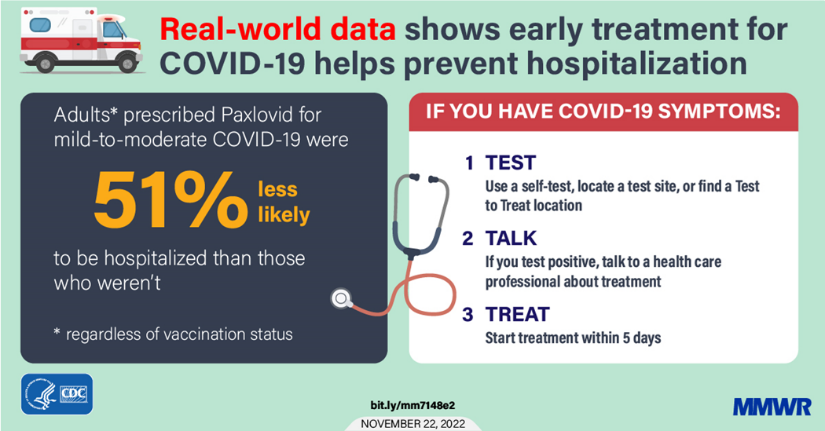
The weekly interpretation usually encourages more Covid vaccinations. This week, the interpretation opens by touting the use of Paxlovid, to wit —

As we enter the holiday season, it’s important to take steps to protect yourself and others from serious illness with COVID-19, including staying up to date on COVID-19 vaccines and promptly talking to your healthcare provider about treatment options if you test positive for COVID-19.

If you have COVID-19 symptoms:

Test : Use a self-test, locate a test site, or find a Test to Treat location.

Talk: If you test positive, talk to a healthcare professional to determine if you are eligible for treatment, even if your symptoms are mild right now.

Treat: Start treatment within five days of developing symptoms.

Note to Readers: Paxlovid is not a replacement for COVID-19 vaccination. COVID-19 vaccination makes you much less likely to get very sick. Still, some vaccinated people, especially those ages 65 years or older or who have other risk factors for severe disease, may benefit from treatment if they get COVID-19. A healthcare provider will help decide which treatment, if any, is right for you.

That’s the full picture for most folks. Here’s the “real-world data” link if you are interested. Thank you CDC.

Here are the key points from this week’s CDC FluView:

  • Seasonal influenza activity is high across the country.
  • Of the influenza A viruses detected and subtyped during week 48, 76% have been influenza A(H3N2), and 24% have been influenza A (H1N1).
  • Seven influenza-associated pediatric deaths were reported this week, for a total of 21 pediatric flu deaths reported so far this season.
  • CDC estimates that, so far this season, there have been at least 13 million illnesses, 120,000 hospitalizations, and 7,300 deaths from flu.
  • The cumulative hospitalization rate in the FluSurv-NET system is higher than the rate observed in week 48 during every previous season since 2010-2011.
  • The number of flu hospital admissions reported in the HHS Protect system increased during week 48 compared to week 47.
  • The majority of influenza viruses tested are in the same genetic subclade as and antigenically similar to the influenza viruses included in this season’s influenza vaccine.
  • All viruses collected and evaluated this season have been susceptible to influenza antivirals.
  • An annual flu vaccine is the best way to protect against the flu. Vaccination helps prevent infection and can also prevent serious outcomes in people who get vaccinated but still get sick with the flu.
  • CDC recommends that everyone ages 6 months and older get a flu vaccine annually. Now is a good time to get vaccinated if you haven’t already.
  • There are also prescription flu antiviral drugs that can be used to treat flu illnesses. It’s very important that flu antiviral drugs are started as soon as possible to treat patients who are hospitalized with flu, people who are very sick with flu but who do not need to be hospitalized, and people with flu who are at higher risk of serious flu complications based on their age or health.
  • Multiple respiratory viruses are currently co-circulating with influenza.  Testing is important to determine the appropriate treatment.

From the FEHB front, the FEHBlog was bowled over to discover on reginfo.gov that on November 29, the Office of Personnel Management took a major step forward in implementing the Postal Service Health Benefits Program by submitting a draft interim final rule to OMB’s Office of Information and Regulatory Affairs for its review. This is the final step before the rule is published in the Federal Register. The statutory deadline for so promulgating this rule is April 8, 2023.

From the miscellany department

  • HR Dive discusses a Mercer report on how employers can impact the maternal mortality problem.
    • EBRI offers a useful analysis of telemedicine and its relationship with other healthcare services, enrollee health, and costs.
    • Chain Drug News reports that PCMA, the prescription drug manager trade association, has issued policy recommendations to accelerate patient biosimilar drug use.
    • The Wall Street Journal offers encouraging news about prison programs to resolve inmate addiction issues.

    Two-thirds of people entering prisons and jails have what the Department of Health and Human Services diagnoses as substance-use disorder. For years, the only treatment in all but a handful of detention centers was to detox.

    Some 630 of the roughly 5,000 jails and prisons nationwide now provide medication treatment for opioid use, according to the nonprofit Jail and Prison Opioid Project, up from about 20 in 2015. The drugs include buprenorphine, which tamps cravings for opioids, naloxone, which reverses their effects, and methadone, which eases withdrawal symptoms. Some are taken daily, others can be taken once a month in extended-release versions. The Biden administration said it wants medication available for every drug user in federal custody and at half of state prisons and jails by 2025.

    Thursday Miscellany

    Photo by Josh Mills on Unsplash

    From Capitol Hill, the Wall Street Journal reports

    A top Senate Democrat said that his party planned to introduce an omnibus spending bill Monday, aiming to pressure Republicans to accept a deal or risk an alternative that would freeze government spending at current levels for the full year and cut off the ability to reallocate money in military and other programs.

    Senate Appropriations Committee Chairman Patrick Leahy (D., Vt.) said that the measure would provide military funding at the level Congress is authorizing in its separate defense policy bill—some $858 billion, or roughly a 10% increase—while also paying for what he called a needed increase to nondefense programs.

    “This is a reasonable path forward, and I suggest my Republican friends take it,” Mr. Leahy said. * * *

    If no deal is reached as the end of the year approaches, lawmakers have said they might need to fall back to a so-called continuing resolution, which funds the government at current levels. Various lawmakers have floated stretching funding into early 2023 or for the full fiscal year, which ends in September. 

    The path forward was unclear, as neither House Speaker Nancy Pelosi (D., Calif.) nor Senate Majority Leader Chuck Schumer (D., N.Y.) announced votes on an omnibus bill for next week.

    The Journal adds,

    House lawmakers on Thursday passed a defense policy bill [discussed in yesterday’s FEHBlog post] that authorizes U.S. military leaders to purchase new weapons and increase pay for troops, and lifts a requirement for members of the military to get vaccinated against Covid-19. * * * The legislation is expected to pass the Senate by the end of next week before heading to President Biden’s desk for his signature.

    STAT News tells us

    Key decision makers in Congress are closer than they’ve been in years to revamping the way the government regulates some of the diagnostic tests that patients use to make crucial decisions about their health care [due to the Theranos fiasco].

    If the VALID act passes, the FDA wouldn’t regulate every single clinical test, but only tests considered “high risk” to patients, where the risk to patients of an inaccurate result could cause serious or irreversible harm.

    One example would be a test for breast cancer that could lead a patient to have a mastectomy, Boiani said. Another would be a genetic test that could determine which cancer treatment patients receive, said Jeff Allen, the president and CEO of Friends of Cancer Research.

    From the Federal Employee Benefits Open Season front, Tammy Flanagan writing in Govexec and Drew Friedman writing in Federal News Network offer last minute decision-making tips.

    Investment News provides advice on income adjusted Medicare premium issues.

    Most Medicare beneficiaries will pay the standard Part B premium of $164.90 per month in 2023, down slightly from this year’s monthly premium of $170.10. Medicare Part B covers doctors’ fees and out-patient services. Coupled with a huge 8.7% cost-of-living adjustment in Social Security benefits next year, most retirees will enjoy larger monthly net Social Security benefits after automatic deductions for their Part B premiums in 2023.

    But about 8%, or about 5 million, of the nearly 63 million Medicare beneficiaries will pay more than the standard monthly premium for both Part B and Part D prescription drug plans based on their income. My husband and I are among them.

    For 2023, single beneficiaries with incomes of $97,000 or more and married couples with joint incomes of $194,000 or more pay a Medicare premium surcharge, officially known as an income-related monthly adjustment amount, or IRMAA. The thresholds increased from $91,000 and $182,000, respectively, in 2022, meaning some beneficiaries may avoid IRMAA surcharges altogether in 2023 or pay less than this year due to the inflation adjustments of the income tiers that trigger those surcharges.

    In other health benefits news, Insurance News Net informs us

    The average per-employee cost of employer-sponsored health insurance rose by 3.2% in 2022, according to Mercer’s 2022 National Survey of Employer-Sponsored Health Plans, released today.

    US employers expect a sharper increase of 5.4% in 2023 — and faster cost growth in the years ahead seems likely

     For now, most employers are prioritizing enhancing benefits to attract and retain workers over cost-cutting; enhancements range from adding perks to improving healthcare affordability

     Mental health remains a top concern of employers and employees – and virtual mental healthcare is proving key to improving access to services

    From the Rx development and coverage front, we have three reports from STAT News —

    • Well, this government action didn’t take long. STAT News relates “The Food and Drug Administration announced Thursday it had amended the emergency use authorizations for the updated Moderna and Pfizer-BioNTech Covid-19 boosters, to allow their use in children aged 6 months and older.”
    • Also according to STAT News, “A year ago, the [Purchaser Business Group on Health] coalition created Emsana Health that, in turn, hatched the EmsanaRx pharmacy benefit manager. [Beginning March 1, 2023,] EmsanaRx will run the technology to ensure prescriptions handled by Cuban Cost Plus Drugs are paid and fulfilled, and report all this information back to the [self-funded] employer. In exchange, EmsanaRx will take a flat 1.5% fee for legal, administrative, and data sharing services, but not charge more than $3 for each insurance claim and will pass along any rebates collected.”
    • Finally from STAT News, “Medicare is willing to reevaluate its coverage of Alzheimer’s drugs in light of a new therapy, called lecanemab, that has shown potentially more promising patient data than its controversial predecessor, Aduhelm, according to the official who oversees the program. “I can’t speak to any specifics, but just to say that our door is really open,” Chiquita Brooks-LaSure, administrator for the Centers for Medicare and Medicaid Services, said Thursday at the Milken Institute Future of Health Summit when asked about how the agency will approach lecanemab. “We will look at it as new data comes.”

    From the public health front —

    An outside group [the Reagan Udall Foundation] that was asked to examine problems at the Food and Drug Administration in the wake of an infant formula crisis this year offered a scathing indictment of the agency’s structure and culture and recommended major restructuring, including possibly breaking up the agency so that oversight of the food system gets more attention. * * *

    In a statement, FDA Commissioner Robert M. Califf said he will review the report and make decisions about the future of the agency with input from experts inside and outside the FDA.

    • The Congressional Research Service issued an “In Focus” report on “Regulating Reproductive Health Services After Dobbs v. Jackson Women’s Health Organization.”
    • Health Payer Intelligence tells us

    Overall, major health outcomes measures are trending in a negative direction, according to America’s Health Rankings Annual Report for 2022.

    The Annual Report examines 23 measures to assess health outcomes trends nationwide, including measures for eight chronic conditions. The data for these measures primarily represented 2021 outcomes, but some measures drew from 2018, 2019, 2020, and 2022.

    A Morning Consult online survey conducted in October 2022 informed the results as well as racial and ethnic subpopulation data and a total of 80 national and state measures to assess the state of healthcare in the US.

    Based on the findings, the coronavirus pandemic has continued to have ripple effects on healthcare. The top three major trends in health outcomes are:

    • Increased drug deaths
    • Increased non-medical drug use
    • Increased premature death

    Midweek update

    Photo by Manasvita S on Unsplash

    From Capitol Hill, the Wall Street Journal reports

    Senate Democrats celebrated their win in Georgia giving them 51 seats next year, a result that enhances their power by allowing them to more easily advance President Biden’s nominees while also providing slightly more flexibility on legislation.

    Sen. Raphael Warnock’s win in a runoff election over GOP challenger Herschel Walker comes after two years in which Vice President Kamala Harris provided a tiebreaking vote in the 50-50 Senate. * * *

    Since early 2021, the two parties have been operating under a power-sharing agreement with evenly divided committees, which has prevented Democrats from issuing subpoenas to witnesses without GOP support. When nominees have tied in a committee vote, Democrats have been forced to hold an extra procedural vote to finalize their nomination. The Warnock victory will give Democrats a narrow majority on each panel.

    “It’ll be easier for Democrats to move forward with some of their nominees, particularly in the judiciary, and that makes it more difficult for us,” said Sen. Mitt Romney (R., Utah). 

    Roll Call informs us

    The newly minted defense authorization bill for fiscal 2023 [NDAA], made public Tuesday night, provides a shot in the arm to the U.S. defense budget but bars the military from discharging any more troops who refuse COVID-19 vaccine shots in their arms. * * *

    [This bill has been approved by a House-Senate conference committee.] The House is expected to vote on the NDAA as soon as Thursday and the Senate to soon follow suit, perhaps next week.  

    The bill would authorize a 4.6 percent across the board pay increase for military personnel and civilians. However, House and Senate negotiators removed a House-passed “inflation bonus” of an additional 2.4 percent for troops and Defense Department civilians making less than $45,000 a year. * * *

    Also of note, the bill would ban contractors across the government from using Chinese-made semiconductors, after a lengthy phase-in period, an aide with knowledge of the provision said Tuesday. Many federal contractors and other businesses say they are unclear how they will comply.

     Govexec offers two more insights on the NDAA

    Congressional negotiators on Tuesday night finally revealed a compromise version of the annual defense policy bill with the aim of passing it through both the House and Senate this week. But to some lawmakers, federal employee groups and good government experts’ chagrin, the measure did not include [Insight link] a provision aimed at blocking Republican-led efforts to strip potentially tens of thousands of federal employees of their civil service protections.

    and

    The authorization bill compromise text contains provisions [Insight link] that seek to increase transparency and accountability of investigations into Inspectors Generals [IG] and operations of the Council of Inspectors General on Integrity Efficiency (and its integrity committee, specifically); ensure IGs are only removed for justiciable and compelling reasons (and Congress is notified); and limit who can serve as acting IGs. There are also stipulations for notifying Congress when an agency doesn’t provide requested information or assistance to an IG and providing more training opportunities for IGs. 

    In an effort to address persistent watchdog job vacancies, the bill’s text states: “If the president fails to make a formal nomination for a vacant inspector general position that requires a formal nomination by the president to be filled within the period beginning on the later of the date on which the vacancy occurred or on which a nomination is rejected, withdrawn, or returned, and ending on the day that is 210 days after that date, the president shall communicate, within 30 days after the end of such period and not later than June 1 of each year thereafter, to the appropriate congressional committees.” 

    From the federal employee benefits front —

    FedWeek gives us last minute guidance on the Federal Employee Benefits Open Season that ends next Monday December 12.

    The Wall Street Journal offers ideas for use of flexible spending account dollars. The article make a point that was not on the FEHBlog’s radar screen:

    This year’s December FSA spending crunch could be worse than usual. While you’re meant to empty your FSA every year, during the pandemic the government relented on this rule, allowing FSA savers to roll over what they saved in 2020 and 2021, with some accounts swelling to more than $7,000

    That special treatment is set to end in 2022, meaning if you have been accumulating money in your FSA, you may need to empty our account by Dec. 31 or you risk losing it all. “Some people might be in for a rude surprise,” says Spiegel.

    Employers are permitted to give workers a little wiggle room—but not much. Some plans include a rollover provision that allows account holders to carry forward a small portion of their savings, although this amount is limited to $570 for 2022. Other plans may allow a spending grace period of up to 10 weeks.  

    From the infectious disease front —

    • The Wall Street Journal brings us up to date on Omicron treatments.
    • The Hill reports on the state of the flu and RSV surges. “Dr. Andrew Pekosz, a virologist and professor at Johns Hopkins Bloomberg School of Public Health, believes the U.S. is still in the “early stages” of a surge in influenza cases, he told Nexstar. * * * “With RSV we seem to be hitting a plateau,” said Pekosz. “Case numbers have not increased significantly for a couple of weeks, but they’re still at a very high level. So the burden of RSV is still great, but we may be closer to the peak there than we are with flu.”
    • Forbes relates, “A newly discovered immune response inside the nose could explain why respiratory illnesses like RSV, Covid, the common cold and flu thrive in winter, according to research published Tuesday in The Journal of Allergy and Clinical Immunology, a finding that challenges the conventional wisdom that infections spread because people are stuck indoors and signposts ways to develop new treatments.”

    From the Rx development and coverage front

    • MPR informs us “The Food and Drug Administration (FDA) has granted Fast Track designation to PH10 for the treatment of major depressive disorder (MDD). * * * Results showed that treatment with PH10 significantly reduced depressive symptoms as early as 1 week based on the 17-item Hamilton Depression Scale (HAM-D-17) scores compared with placebo (P =.022). The intranasal spray was found to be well tolerated, with no serious adverse events reported.”

    Touted by celebrities, raved about by TikTok users, and advertised by med spas, a new class of drugs for treating diabetes and obesity has exploded in popularity for its weight-loss effects, leading to rippling shortages across several of the medications.

    Amid the surge in demand, Eli Lilly and pharmacies have started to tighten access to the latest of this type of drug, tirzepatide, focusing on giving it to people with type 2 diabetes, the only population it’s authorized for so far. But that’s left another set of patients scrambling — people with clinical obesity who turned to the medication as one of their few options for treatment. * *

    There’s much overlap between the two conditions, said Beverly Tchang, an endocrinologist and assistant professor of clinical medicine at Weill Cornell Medicine. “Obesity can lead to diabetes, diabetes can lead to obesity,” she said. “They’re very much intertwined, and to treat one but not the other seems inequitable.” Tchang treats both types of patients and feels the drug shouldn’t be conserved for one group at the expense of the other.

    From the telehealth front, mHealth Intelligence explains

    FAIR Health’s Monthly Telehealth Regional tracker reported no change in telehealth usage in September compared with August and noted that COVID-19 fell in its rankings on top telehealth diagnoses lists in all regions and at the national level.

    The FAIR Health Monthly Telehealth Regional tracker is a complimentary service that analyzes how telehealth activity and use change monthly by tracking various factors such as claim lines, procedure codes, and diagnostic categories. It represents the privately insured population, including Medicare Advantage but excluding Medicare Fee-for-Service and Medicaid beneficiaries.

    From the public health front —

    • MedPage Today informs us “Drug overdose deaths in pregnancy or the postpartum period increased sharply in the U.S. in recent years, with the rise most pronounced at the start of the COVID-19 pandemic in 2020, researchers reported. * * * Jacob S. Ballon, MD, MPH, of Stanford University in California, noted that the study authors did not provide explanations for why the overdose-related death rate rose sharper among the pregnant and postpartum group during the study period, but said it will likely be the basis for further research. “[It’s] an interesting signal,” said Ballon, who was not involved with the study. “But now what do we do with that to explain it or make some sense of it?”
    • Healthcare Dive tells us
    • Increased delays in discharging patients who require additional care after a hospital stay could slow their recovery, potentially harming health outcomes and quality of life, the American Hospital Association cautioned in a report released Tuesday.
    • The inability to discharge patients is putting additional strain on hospitals operating with thin workforces, and health systems are bearing the cost of care for patients who stay excess days without appropriate reimbursement, the AHA said.
    • The association has urged Congress to help offset the costs of care for patients’ additional days in the hospital by creating a temporary per diem Medicare payment targeted to acute, long-term care, rehabilitation and psychiatric facilities.

    From the U.S. healthcare business front —

    Imagine going into your doctor’s office and facing not a staff of overworked doctors and nurses, but an inviting conversation. A talk with a healthcare professional who has plenty of time, isn’t in a hurry and is ready to listen to a recital of the different aches and pains of your life. Someone with expertise in medications dedicated to making your life easier and healthier. A professional who makes and then hands you a cup of coffee before you even start talking.

    With that conversation–easy, low stress–you can begin a level of trust with your doctor’s office that you might not have had before. And the person listening may, in conjunction with the doctors and nurses, find some better paths to helping you get healthier, even if you suffer from a chronic disease.

    That’s the vision that Fergus Hoban has for the American healthcare system. His company, UpStream, provides integrated services for primary care physicians, both independently and as part of networks or bigger healthcare systems. Centered around a prescribing pharmacist, a team of nurses and other professionals work with doctors to provide better care for Medicare patients while at the same time lowering costs.

    LHC Group and UnitedHealth Group have extended their merger agreement as the feds take a deeper look at the deal.

    The agreement was extended until March 28, 2023, and the two companies now expect the merger to close in the first quarter of 2023, according to a filing with the Securities and Exchange Commission.

    That the insurance giant intended to acquire LHC, a home health provider, was announced in March, and the deal is valued at about $5.4 billion. UnitedHealth said it plans to fold LHC into its Optum subsidiary as part of its provider arm, Optum Health, which is one of the country’s largest employers of physicians.

    LHC Group would add 30,000 employees who provide more than 12 million home health services annually.

    • Health Payer Intelligence also tells us about positive provider and payer reactions to the CMS proposed rule to promote widespread use of electronic prior authorizations. As noted here yesterday, “[t]he proposed rule would require the implementation of Health Level 7 (HL7) Fast Healthcare Interoperability Resources (FHIR) standard Application Programming Interface (API) and mandates that payers have to explain the specific reason behind a prior authorization denial. Expedited prior authorizations will have to occur within 72 hours and non-urgent prior authorizations will have to be turned around in seven calendar days.”

    Tuesday’s Tidbits

    Photo by Patrick Fore on Unsplash

    From the Federal employee benefits front, Fedweek offers year-end benefits and tax guidance to federal and postal employees and annuitants.

    From the medical research and development front,

    STAT News reports, “A consensus may be emerging about how to prescribe the new Alzheimer’s drug lecanemab, according to remarks made by both a critic of other Alzheimer’s medicines and the CEO of the company that developed it.”

    The National Institutes of Health announced

    The protein apolipoprotein E (APOE) plays a key role throughout the body. It helps to transport cholesterol and other fatty molecules, or lipids. The gene that produces APOE comes in a few different varieties. The most common is called APOE3.

    The most notorious is APOE4, which has long been linked to an increased risk of dementia in Alzheimer’s diseasePeople who inherit one copy of the APOE4 gene have up to a fourfold greater risk of developing Alzheimer’s disease dementia. Inheriting two copies of APOE4 elevates the risk up to twelvefold. But despite years of study, scientists have little understanding of how APOE4 affects the human brain and boosts dementia risk. * * *

    [NIH] Researchers found evidence that the Alzheimer’s-related gene APOE4 disrupts cholesterol management in the brain and weakens insulation around nerve fibers.

    A drug that affects cholesterol led to improved learning and memory in mice with the gene, pointing to a potential new approach for treating dementia in Alzheimer’s disease.

    The Wall Street Journal reports

    New research has bolstered a once-gutsy idea: Bugs in the digestive system may play a role in depression.

    Two studies published Tuesday in the journal Nature Communications found a link between several types of bacteria in the gut and depressive symptoms. Trillions of microorganisms including bacteria, fungi and yeast live in the digestive tract. Research exploring whether they might affect an array of diseases has increased in recent years.

    The new studies, conducted among thousands of people in two cities in the Netherlands, are among the largest to date demonstrating potential associations between gut microbiota and mental health.

    “Ten years ago if you’d said there was something linking depression and the microbiome, you’d be carried out with a straitjacket,” said Jos Bosch, an associate professor of psychology at the University of Amsterdam who co-wrote both studies. “Now absolutely, it’s very clear there’s a link.”

    . . . Researchers who conducted the studies in the Netherlands called their findings a preliminary step toward identifying biological indicators and therapies for depression. The precise relationship between depression and microbes in the gut couldn’t be determined, they said. Depression can cause a person to eat less healthily, Dr. Bosch pointed out, which can lead to changes in the composition of microorganisms in the gut.

    “Causality is a bit up in the air,” he said. 

    From the mental healthcare front, Fierce Healthcare tells us

    While mental health and substance abuse issues have only grown thanks to the pandemic, a bright spot may be forming: The number of providers available to treat these concerns is increasing, a new study shows.

    The United Health Foundation, the philanthropic arm of insurance giant UnitedHealth Group, released its annual “America’s Health Rankings” report and in the analysis found that between 2020 and 2021, the number of people who reported that their mental health was poor in 14 of the last 30 days increased by 11%.

    In 2020, 13.2% reported frequent mental distress, and that rose to 14.7% in 2021, according to the report.

    At the same time, drug-related deaths spiked. The report found that deaths increased by 20% nationwide between 2019 and 2020, reaching 27.9 deaths per 100,000. This is the largest year-over-year increase in more than a decade, according to the report.

    The report also found that disparities within drug deaths increased in tandem. Such deaths increased by 45% among multiracial populations and by 43% among Black populations. Drug-related deaths were highest among American Indian/Alaskan Native populations, occurring at a rate nine times higher than the lowest group, Asian patients.

    However, the analysis found that the supply of mental health providers reached its highest levels since the report was first published in 2017. The number of mental health providers per 100,000 increased by 7% between 2021 and 2022 and has increased by 40% since the 2017 report.

    There are now 305 mental health providers per 100,000, according to the report.

    Health Payer Intelligence adds

    Having one or more outpatient behavioral health treatment (OPBHT) visits was associated with lower healthcare costs among patients with newly diagnosed behavioral health conditions, a JAMA Network Open study found.

    Adults with a behavioral health condition incur 2.8 to 6.2 times greater medical costs than those without one, and nearly a quarter of adults had a behavioral health condition as of 2018. However, behavioral health condition diagnoses are often delayed, and most individuals receive little or no treatment each year.

    From the Rx coverage front, STAT News tells us

    During 2021, drugmakers substantially raised prices on seven widely used medicines without any new clinical evidence to justify the increases, leading patients and health insurers in the U.S. to spend an additional $805 million last year, according to a new report.

    The drug for which spending increased the most due to a price increase was Xifaxan, which is used to treat both irritable bowel syndrome and a complication of cirrhosis. Salix Pharmaceuticals, a unit of Bausch Health, raised the wholesale price by 7.9%. The net price — after rebates and discounts — rose by 12%, most likely because the company offered fewer concessions than previously.

    Consequently, spending for this drug climbed by $174.7 million, according to the report issued by the Institute for Clinical and Economic Review, a nonprofit that assesses the cost effectiveness of medicines. The report noted that the manufacturer disputed the net price and budget impact, which was provided by the SSR Health market research firm, but did not provide corrected estimates.

    Of course, PBM formularies are designed to correct these issues.

    The Wall Street Journal adds

    Emergent BioSolutions Inc., maker of Narcan, a nasal-spray form of naloxone, said Tuesday that the U.S. Food and Drug Administration fast-tracked an application it submitted for an over-the-counter version of its widely used opioid-reversal nasal spray.

    The company said it had been working on the application for several months. Emergent said the FDA’s priority review gives the drug an expected approval date of March 29, 2023, putting it first in line for approval ahead of competitors that have announced their planned foray into the market. 

    The FDA has encouraged pharmaceutical companies to apply for approval for over-the-counter versions of overdose-reversal medications such as Narcan to help confront a swelling overdose crisis from bootleg versions of the powerful opioid fentanyl.

    Last week, FDA Commissioner Robert Califf said naloxone—which binds to opioid receptors to reverse the effects of opioids—should be as ubiquitous as defibrillators.

    From the fraud, waste, and abuse front, mHealth Intelligence reports

    As telehealth use exploded across healthcare programs provided by federal agencies, a report by a watchdog committee shows several program integrity risks linked to telehealth billing, including duplicate billing and ordering unnecessary durable medical equipment or laboratory tests.

    They found that approximately 37 million individuals used telehealth services from March 2020 through February 2021 in the selected programs administered by the six federal agencies. This represents a massive increase from the 3 million individuals in these programs who used telehealth services the year prior.  

    In most programs, telehealth was used primarily to access office visits with a primary care provider or specialist and for behavioral health services, like individual and group therapy and substance use disorder treatment.

    Overall, the agencies spent more than $6.2 billion on telehealth services, with Medicare accounting for the highest expenditure at $5.1 billion, followed by TRICARE and the Federal Employees Health Benefits Program, which together spent $1 billion.

    But the OIGs found several similar program integrity risks associated with billing for telehealth services across multiple programs. These included “upcoding” telehealth visits by billing for visits longer than they lasted, duplicate billing for the same service, ordering unnecessary durable medical equipment, supplies, or laboratory tests, and billing for services inappropriate or ineligible for telehealth.

    From the plan design front, Fierce Healthcare relates

    The Biden administration released a proposal which, if finalized, would mandate Medicare Advantage (MA), Medicaid managed care, Affordable Care Act (ACA) plans and state Medicaid agencies implement electronic prior authorization systems by 2026. 

    The proposed rule, released Tuesday by the Centers for Medicare & Medicaid Services (CMS), will require payers and states to streamline prior authorization processes and improve the electronic exchange of health data by 2026. It also contains incentives for hospitals and physicians to adopt electronic prior authorization.

    “The prior authorization and interoperability proposals we are announcing today would streamline the prior authorization process and promote healthcare data sharing to improve the care experience across providers, patients and caregivers,” CMS Administrator Chiquita Brooks-LaSure said in a statement. 

    It is the revised version of a Trump administration rule originally finalized in late 2020 but withdrawn after concerns about costs and a short deadline. That rule only applied to Medicaid managed care, the Children’s Health Insurance Program and ACA plans, while the new version would apply also to MA plans. 

    Monday Roundup

    Photo by Sven Read on Unsplash

    From Capitol Hill, Roll Call reports the FY 2023 National Defense Authorization Act is expected to rescind the Defense Secretary’s 2021 Covid vaccine mandate for U.S. service members. “Congressional leaders are aiming to introduce the final compromise NDAA version as soon as Tuesday, with House floor action possible later in the week.”

    From the infectious disease front —

    • Bloomberg Prognosis tells about a study confirming the Paxlovid rebounds have been blown out of proportion.
    • Pfizer has asked the Food and Drug Administration for an emergency use authorization applicable to its bivalent Omicron vaccine designed for children at least six months old and not over four years old.
    • The Health and Human Services Secretary has confirmed reported plans to end the mpox public health emergency when the current declaration expires at the end of January 2023. “But we won’t take our foot off the gas – we will continue to monitor the case trends closely and encourage all at-risk individuals to get a free vaccine.”
    • MedPage Today interviews Demetre Daskalakis, MD, MPH, the deputy coordinator of the White House Monkeypox Response Team, about the course of the illness since it erupted in the summer

    Influenza hospitalizations this early in the season are higher than they have been in a decade, according to the CDC, with 14 pediatric deaths reported so far.

    “Since October 1, there have already been at least 8.7 million illnesses, 78,000 hospitalizations, and 4,500 deaths from flu,” said CDC Director Rochelle Walensky, MD, MPH, on a call with reporters on Monday, held in part to kick off National Influenza Vaccination Week. * * *

    This year, influenza vaccines are “well matched to the viruses currently circulating,” she added. The flu shots contain protection for two influenza A and two influenza B virus strains. Of influenza A viruses detected and subtyped this season, 79% have been A(H3N2) and 21% have been A(H1N1).

    The CDC recommends influenza vaccination particularly for children, immunocompromised individuals, pregnant women, and people 65 and over.

    It was not clear if the pediatric deaths reported so far this season involved unvaccinated children, but Fryhofer noted that previous data showed about 80% of influenza deaths occur in unvaccinated persons.

    Pregnant women who get the flu shot also protect their newborns, who are not eligible for vaccination before they are 6 months of age, Fryhofer said. “If you’re not doing it for you, do it for your baby.”

    • For context, here are the flu case and death statistics from the last flu season before Covid struck, October 2019 through March 2020.
    2019 – 2020 Winter CDC Fluview  3/28/20
    Flu Deaths                  24,000 
    Flu Cases             39,000,000 

    The flu is a highly contagious, dangerous disease.

    • NPR Shots offers consumer advice should they counter pharmacy shelves with a low or no supply of anti-fever drugs.

    From the telehealth front, Health Leaders Media tells us

    According to a survey commissioned by America’s Health Insurance Plans, almost 70% used telehealth in the past year because it’s more convenient than in-person care, and almost 80% say telehealth makes it easier to seek out care.

    Almost 50% used telehealth because they were unable to make an in-person appointment, while 24% said they wanted to save money.

    Some 36% used telehealth just once over the past year, while 53% used it between two and five times.

    From the mental healthcare front, Health Payer Intelligence reports

     CareFirst BlueCross BlueShield (CareFirst) is providing community-based organizations with nearly $8 million in grants to help improve behavioral healthcare access and quality for underserved youth.

    The COVID-19 pandemic exacerbated the mental and behavioral health crisis among children, adolescents, and families. In response, CareFirst is investing in 19 community-based organizations in Maryland, Washington, DC, and Northern Virginia.

    “CareFirst recognizes that behavioral health is an essential part of overall health, which includes a continuum of conditions ranging from severe mental health disorders to the emotional, psychological, and social factors that affect a person’s overall wellbeing,” Destiny-Simone Ramjohn, PhD, vice president of community health and social impact at CareFirst, said in the press release.

    Kudos

    From the Rx coverage front, Fierce Healthcare informs us

    Express Scripts, which is part of Cigna’s Evernorth subsidiary, said Monday that it will add biosimilars for Humira to its largest formularies as preferred products available for patients with inflammatory conditions. Like other major PBMs, Express Scripts sees significant potential in biosimilars to help address the massive costs associated with specialty drugs.

    Specialty drugs account for just 2% of prescriptions but drive half of drug spending.

    In October 2021, Express Scripts announced that it would put Semglee, the first Food and Drug Administration-approved interchangeable insulin biosimilar, on its National Preferred Formulary for 2022. The company estimates that this move generated $20 million in savings in the first year.

    From the federal government employee benefits front, Federal News Network relates

    The Office of Personnel Management plans to suspend applications for the Federal Long Term Care Insurance Program for two years beginning Dec. 19, in anticipation of a sizeable rate hike.

    OPM announced the unusual measure last month in the Federal Register, and noted that federal workers who submit their applications by the deadline will still be considered for enrollment. FLTCIP was created in 2002 and assists with health care costs for participants who need help with daily personal functions, or who have a severe cognitive illness, and covers home care, nursing home or assisted living benefits.

    “OPM is suspending applications for coverage in FLTCIP to allow OPM and the FLTCIP carrier to assess the benefit offerings and establish sustainable premium rates that reasonably and equitably reflect the cost of the benefits provided,” the agency wrote.

    The program will continue to operate normally for current enrollees, although they will not be able to apply to increase their coverage. There are currently around 267,000 federal workers and retirees participating in the insurance plan, and OPM typically receives only a few thousand applications to enroll per year.

    The decision to suspend applications for the program came after John Hancock Life and Health Insurance Co., the contractor that administers the program, informed OPM that it is likely that there will a premium increase sometime next year.

    Finally, the Wall Street Journal offers an interesting article about medical research that is “uncovering links between your ‘subjective age’ [as opposed to your chronological age] and your future health and longevity.”