Weekend update

Weekend update

Congress is now in recess until after Labor Day. Here’s a link to last week’s news up on the Hill.

The New York Times had two stories that bear on our beloved FEHBP this weekend. The first concerned  a claim dispute involving an FEHBP HMO where after about five years of going back and forth with a member about coverage of health care trial related expenses the carrier agreed to pay around $200,000 in benefits plus another $180,000 in interest calculated at the rate that the carrier charges when it is collecting overpayments from healthcare providers (18%).  The ACA now generally requires plans to cover these expenses.

The other story reviews the controversy over Gilead Science’s pricing policy for its Sovaldi drug that treats Hepatitis C. Pricing is as much of an art as it is a science. In the FEHBlog’s view, Gilead deserves a lot of credit for developing this drug but it could not be charging $1,000 a pill with the price support provided by health insurers. Gildead’s $1,000 per pill price has raised the bar for all types of drugs where the market is constricted, e.g., vaccines. The article strikes a hopeful tone that the crisis will be shortlived. Hope does spring eternal.

Medcity News interviews the head of development at Cambia Health Solutions (Regence Blue Cross). The insurer certainly has its fingers in a lot of pies as part of its effort to control healthcare costs.

Many of its wholly owned companies grew out of internal projects. hubbub health is a company initially built for its health plan clients but which now extends to a broader customer base. Healthsparq, which  uses price transparency to guide employer plans, was originally developed for its own plan customers but now serves 65 health plans. Other examples include Wellero, LifeMap, SpendWell and OmedaRx.
But Cambia investments span a much broader range of categories and include many technology-enabled services. There’s Wildflower Health, which is about high-risk pregnancy and pregnancy management, particularly for Medicaid patients; Qliance — a primary care provider; ClearCare — a health IT company for home healthcare agencies, Live!y — a remote monitoring sensor producer to support aging in place; CoPatient — a healthcare bill review service;  Retrofit — a weight loss program using wireless devices and apps; and PockitDoc.

Interesting.

TGIF

It is a pleasant day here in the Nation’s capital. Rep. Kevin McCarthy (R CA) assumes the House Majority Leader from Eric Cantor (R VA) today and Rep. Steve Scalise (R LA) replaces Mr. McCarthy as Majority Whip. 

Yesterday, HHS issued a final rule setting as expected October 1, 2015, as the ICD-10 coding rule compliance date. Congress earlier this year had forced HHS to push back this compliance date from October 1, 2014, to at least October 1, 2015. HHS went with the earliest date which in the FEHBlog’s view is misguided because a January 1 switc hover would fit better for calendar year health plans.

The Milliman actuarial consulting firm issued a report on the impact the new high priced Hepatitis C therapy will have on Medicare Part D.

We estimate that the cost of new HCV drug therapies , including Sovaldi and Olysio, will increase 2015 federal spending on the individual Medicare Part D program by approximately $2.9 billion to $5.8 billion. This is equivalent to a 6% to 11% increase in federal Part D spending or approximately $100 to $200 per Medicare Part D beneficiary per year.
We estimate that the cost of HCV drug therapies will increase total annual individual Medicare Part D beneficiary premiums by $481 million to $965 million in 2015. This is equivalent to a 4.3% to 8.6% increase over 2014 beneficiary premiums or an additional $17 to $33 per beneficiary per year. 

The FEHBlog would not be surprised to see the drug therapy have a similar impact on the FEHBP.

BenefitsPro reports on a new Blue Cross study concluding that consumer driven health plans are less costly and more efficient than traditional plans.

Mid-week update

The FEHBlog was surprised to read this FedSmith article which suggests that based on a 1978 law OPM does not have the authority to extend FEHB coverage to intermittent, seasonal, and temporary employees who meet the ACA’s standard for a full time employee. Assuming the accuracy of the description of the 1978 law, this would only be one of several FEHBA provisions that the ACA impliedly repealed. Go ahead and look in the statute books for 5 U.S.C. 8901 and you’ll see that family member is still defined as a spouse and child under age 22. Nobody blinked in 2010 and there was no reason to blink when OPM jacked up the eligible limit for child coverage to 26 and removed all financial dependency requirements. To the contrary the debate was over whether OPM should have waited until January 1, 2011, to make the change, which it appropriately did. In this case, the ACA’s employer shared responsibility mandate does require the eligibility change that OPM has proposed.

Kaiser Health News collects reports on major health insurers’ 2nd quarter 2014 earnings releases.  The Wall Street Journal and Modern Healthcare report on the earnings release from the major prescription benefits manager Express Scripts which suggest that the Medco acquisition a few years ago combined with the loss of United Healthcare’s business is dragging down earnings.

Ihealthbeat.com reports on a large healthcare consumer study which concludes that  “‘a single exposure of loyalty rewards
significantly influenced enrollment’ in [health plan] online health management
programs. However, they added that ‘additional strategies are required to maintain engagement.'”

Finally, Fierce Health Payer reports on a study which suggests three ways to improve collaboration between those two feuding parties — providers and payers.  The article suggests that payers should take the initiative to

1. Reimburse for the end-to-end population health management workflow — Instead of focusing on only closing care gaps or reducing utilization
rates, for example, payers should reimburse for the entire workflow so
that providers are more willing to invest in the sometimes pricey
resources needed to implement value-based programs.
2. Share as much data as possible –For example, as the publication previously reported, Aetna
shares its data with its provider partners, believing that the
information helps doctors and hospitals do a better job at a lower cost, FierceHealthPayer previously reported. But insurers
shouldn’t just dump data on providers and expect them to understand it;
instead, they should assist in analyzing and drawing specific
conclusions. On the flip side, providers that are collecting their own data, which
is often richer in patient care history than payers’ claims data,
should share this information with insurers. Then, payers and providers
can both use a more complete set of data to improve quality of care. and
3. Collaborate at the organization, rather than the individual practice level. 
 

Weekend Update

The weekend update is a little late this week because the FEHBlog did not return home from Connecticut until late last night. A good time was had by all.

This is expected to be Congress’s last week in DC before the August recess. Here’s a link to the Week [that was] in Congress.

The Congressional Budget Office just released more information on national heath care spending projections.

In tomorrow’s Federal Register, OPM will publish a proposed rule that extends FEHBP coverage with a government contribution to temporary, seasonal, and intermittent federal employees who work 130 hours a month beginning next year. This change is being driven by the Affordable Care Act’s employer shared responsibility mandate, but in the FEHBlog’s opinion, the FEHBA, 5 U.S.C. § 8913, authorizes OPM to take this action.

OPM projects in the rule’s preamble. that this change will not generate many new enrollees because most of the affected employees already have coverage from other sources. The irony is that the ACA imposes an enormous excise tax on insured FEHB plan carriers and other health insurers and HMOs to mop up the “excess profits” stemming from the ACA’s shared responsbility mandates

And speaking of ACA burdens, the IRS last week posted draft forms (1094c and 1095c) that FEHB plan carriers and all other health plans will use to report to the IRS on whether their members comply with the ACA’s individual shared responsibility mandate. This process involves a tremendous administrative burden of of collecting all covered family member Social Security Numbers which of course the IRS uses as Tax Identification Numbers. Remember folks that this collection effort benefits you, not the carrier.

By the way, also last week the IRS announced the cap on the 2014 tax on individuals who don’t have minimum essential coverage —

For 2014, the annual payment amount is:
The greater of:
1 percent of your household income that is above the tax return filing threshold for your filing status, or
Your family’s flat dollar amount, which is $95 per adult and $47.50 per child, limited to a family maximum of $285,
But capped at the cost of the national average premium for a bronze level health plan available through the Marketplace in 2014. For 2014, the annual national average premium for a bronze level health plan available through the Marketplace is $2,448 per individual ($204 per month per individual), but $12,240 for a family with five or more members ($1,020 per month for a family with five or more members).  See Rev. Proc. 2014-46.

P.S. The IRS delayed the required distribution of these forms until January 2016 for the 2015 tax year.

TGIF

The FEHBlog is about to hit the road with his family for fun filled weekend in Connecticut so he only has time to discuss one item and it’s enouraging. 

Reuters reports that the Food and Drug Administration has accepted an application for a  bio-similar drug.

U.S. regulators have accepted an application by Sandoz – the generics arm of Novartis – seeking approval for a copycat version of Amgen’s drug Neupogen, or filgrastim, for patients with low white blood cell counts.
The Food and Drug Administration’s decision to accept the filing under a new pathway for so-called biosimilar drugs marks a milestone in the rollout of cheaper copies of injectable biotech medicines in the United States.
Sandoz said on Thursday that overcoming the first hurdle in the approval process was an important step in increasing U.S. patient access to such treatments.
The generics company already sells a biosimilar version of Amgen’s drug in more than 40 other countries, but the United States has been slower than other markets to establish a regulatory framework for biosimilars.

Better late than never as the saying goes.

Midweek update

Gilead Sciences just came out with its second quarter earnings. Sovaldi sales totalled almost $3.5 billion in the second quarter or around $5.75 billion for the first six months of 2014. The Wall Street Journal reported earlier this week that the prescription drug manufacturers are engage in “unusual” patent litigation / tong wars with Gilead over Sovaldi. CVS officials discuss Gilead’s “unsustainable” pricing policy here.

Speaking of health care costs. Fierce Healthcare reports on a investment bank survey finding that hospital inpatient volumes trend slightly up (0.4%) in the second quarter of 2014, after several years of downward trends. “Researchers attribute the uptick to a combination of the improving economy, the implementation of the Affordable Care Act and patients waiting as long as possible for procedures, compounding demand.”

Yesterday, the U.S. Court of Appeals for the D.C. Circuit ruled that the Affordable Care Act (ACA) does not permit the federal government to pay subsidies to participants in the federal exchanges, only to those in state established exchanges or market places. . The U.S. Court of Appeals for the Fourth Circuit ruled the other way, affirming the Obama Administration’s position.

Employee Benefit News reports that a couple of leading benefits lawyers are predicting that these conflicting decisions could lead the federal government to delay the employer mandate for another year. Evidently the impetus for this prediction is that the employer mandate falls by the wayside if subsidies cannot be paid in the 36 states that use the federal exchanges. Talk about water torture.

The FEHBlog heard a law professor yesterday remark that it would not be a particularly heavy lift for states in the federal exchange to create their own exchanges in the wake of a Supreme Court decision siding with the DC Circuit. In that regard, Maryland is picking up the pieces of its hopelessly broken state exchange and switching to Connecticut’s exchange technology.

Of course, we don’t even know at this point whether the Supreme Court will take the case because there is a high likelihood that the entire bench of active DC Circuit judges (7 Democratic President appointees and 4 Republican appointees) will reverse the panel decision en banc leaving no split in the circuits. The Supreme Court still could take the case, but the lack of circuit split reduces the urgency to do so.

In other legal news, the Hill reports that on Monday the U.S. District Court for the Eastern District of Wisconsin dismissed Sen. Ron Johnson (R Wisc) challenge to OPM’s decision to provide a FEHBP government contribution to members of Congress and their official staffs who have transitioned from the FEHBP to the DC SHOP program, which is part of the ACA’s health insurance market place.  The Hill explains that

The judge dismissed the argument that, without a court challenge, there would be no other way to fix the regulation. Lawmakers can cite the regulation on the campaign trail to sway elections, the judge said, or Congress could use some of its other powers to rein in the executive.
“The Congress itself is surely not helpless to rein in the executive: It has spending authority, investigative powers, and it even wields the blunt instrument of impeachment,” the judge wrote.

Weekend update

The FEHBlog enjoyed the afternoon at Nats Park watching Jason Werth hit a walk off double to win the game over the Milwaukee Brewers. The Nationals pointed out during the President’s race that today is the 45th anniversary of the Apollo 11 moon landing. Federal News Radio has a photo collage of that historic space flight.

Congress is in session this week. Here’s a link to the week in review up on Capitol Hill.

The WSJ Pharmalot blog discusses another very expensive specialty drug called Kalydeco which treats cystic fibrosis. The drug’s manufacturer Vertex Pharmaceuticals charges around $300,000 a year for the drug. Arkansas Medicaid is requiring Medicare beneficiaries suffering from this disease to try less expensive drugs before resorting to Kalydeco. A 14 year old girl with cystic fibrosis, which is a rare genetic disease, is suing the Medicaid Program. Vertex claims that its hands are tied by the Medicaid rules — no special treatment for this girl. Note that if Vertex lowers the cost of the drug for Medicaid, it will wind up lowering the cost of all payers because Medicaid pricing is the floor price for brand name drugs.

The drug manufacturer’s trade association Phrma defends these unconscionable pricing policies here.

The shift from managing a condition to being able to cure it has already occurred for hepatitis C patients. The disease affects nearly three million Americans today who face high medical costs if the infection is left untreated. New and forthcoming treatments have sparked controversy with their high price tag of approximately $1,000 per pill. When considering the $600,000 bill for a liver transplant or the $85 billion combined annual medical costs for all hepatitis C patients projected by 2034, however, the cost doesn’t seem so off base. Additionally, solely looking at the cost of the medicine, fails to account for the invaluable increase in lifespan and quality of life that patients gain from these innovative new medicines.

Why Phrma’s argument is facially appealing, the bottom line is that Gilead Sciences which makes the Sovaldi Hepatitis C drug recovered its research and development costs from the first quarter of Sovaldi sales — over $2 billion according to the NY Times.  The drug manufacturers need to come to their senses fast.  With this attitude there will never be cost savings from medical advances. Gilead reports its second quarter 2014 earnings on Wednesday July 23.

TGIF

Following up on Wednesday’s post about the House passage of the financial services and general government appropriations bill, Federal News Radio points out that

The bill is silent on the issue of a federal pay raise, but that’s
actually good news for federal employees. In the absence of specific legislative
language, President Barack Obama has the authority to order a pay raise for
federal workers. In his fiscal 2015 budget proposal, Obama signaled his intention
to award federal employees a 1 percent pay raise. 

The White House has expressed opposition to this House bill because it would slash funding to the IRS.

The Congressional Budget Office issued a report on the causes of projected growth in spending for Social Security and Major Health Programs, which is worth a look. CBO projects that

the anticipated growth is expected to come from the government’s major health care programs (Medicare, Medicaid, the Children’s Health Insurance Program, and subsidies offered through [the ACA’s] health insurance exchanges): CBO projects that, under current law, total outlays for those programs, net of Medicare premiums and certain other offsetting receipts, would grow much faster than the overall economy, increasing from just below 5 percent of GDP now to 8 percent in 2039.

Speaking of the ACA, the ACA regulators just issued FAQ XX which concerns the Supreme Court’s Hobby Lobby decision.  An FEHBP angle of this issue is that Congress has allowed faith based FEHB plans to opt out of contraceptive coverage since it implemented a contraceptive coverage mandate for the FEHBP in the late 1990s.

Leapfrog Group released a Castlight analysis of its annual hospital survey for 2013 which was loaded with good news:

More hospitals are adopting computerized physician order entry (CPOE) to reduce medication errors, with 616 hospitals fully meeting Leapfrog’s standard, a 65 percent increase from 2012. But some problems with performance of the systems persist, such as failure to alert on potentially fatal medication errors.
• Dramatic improvement in areas of maternity care – especially in reducing early elective deliveries, with the average rate of early elective deliveries declining from 11.2 percent in 2012 to 4.6 percent in 2013. However, too many high-risk babies are being delivered at hospitals that aren’t optimally equipped to care for them. In 2013, less than 24 percent of hospitals fully met Leapfrog’s high-risk delivery standard, a decline from 37 percent in 2011.
• Surprisingly high variance in predicted survival rates for high-risk procedures across hospitals, as well as in hospital-acquired injury and infection rates. For example, the predicted mortality rate varies five-fold for esophagectomies; six-fold for abdominal aortic aneurysm (AAA) repair; and 131 out of 1,302 reporting hospitals have hospital-acquired injury rates of over one in 1,000, which is considered alarmingly high.
• Better compliance with ICU physician staffing standards, shown to decrease mortality by as much as 40 percent. Notably, 41.7 percent of reporting hospitals fully meet this standard in 2013, compared to 39 percent in 2012.
• Strong adoption of Leapfrog’s Never Events policy, with 80 percent of hospitals committing to abide by Leapfrog’s five principles when a Never Event occurs in their facility. 

OPM has encouraged FEHB plans to undertake efforts to support reduction of early elective deliveries and never events.

Midweek update

The House has been debating this week the appropriations bill for the financial services and general government operations (HR 5160), and this afternoon the House passed the bill in a vote along party lines. This is the bill that funds the Office of Personnel Management and the FEHBP. 

On Monday, the Congressional Budget Office released its report on the Senate Postal Service reform bill, S. 1486. That bill would establish a Postal Service health plan within the FEHBP. This new plan would have mandatory integration with Medicare Parts B and D for annuitants. CBO projects that this approach will save the Postal Service $1 billion over 10 years.

The Commonwealth Fund has created an initiative looking at ways to improve provider incentive programs. The “initiative recognizes that a wide range of factors influence providers’ choices, beyond financial rewards or penalties, including intrinsic motivation and medical professionalism, organizational influences, and policy.” An example of a non-financial reward is

Leveraging providers’ innate desire to do a better job. Psychological research also demonstrates that nonmonetary motivators, such as peer comparisons, may strengthen people’s inherent desire to perform well. The introduction of quality report cards for cardiac surgeons across Pennsylvania had a four times larger effect on surgeons’ performance than profit incentives.

Speaking of quality report cards, U.S. News and World Report has released its 2014-15 Best Hospital rankings according to the Fierce Healthcare website. The rankings include an Honor Roll of the top 10 hospitals. The closest top 10 hospital to Washington DC is Johns Hopkins in Baltimore. Johns Hopkins health system has taken over a number of suburban DC hospitals in Maryland and Virginia.

Finally, the Seattle Times reports on health plan efforts to expand coverage of telehealth services. The article discusses the debate over the proper form and role of telemedicine.

It’s a debate that has included the American Medical Association (AMA), which last month offered new guidelines to shape telemedicine’s development; state licensing boards that agreed on their own draft policy in April; five of the nation’s top publicly traded health insurers; and a small group of closely held telemedicine companies convinced their time has come as concerns about medical cost and access rise.
The discussion promises to escalate as patients become increasingly sophisticated in their online pursuits, delays in making doctor appointments grow longer, and the cost of services provided by medical centers increases.
“More and more patients are comfortable seeing a physician online,” said Jonathan Linkous, CEO of the American Telemedicine Association.
“It’s an adoption process. They understand it, and use it,” Linkous said.

Weekend update

Congress is again in session this week. Here’s a link to the last week in Congress report which the FEHBlog finds helpful. 

Last week, the Blue Cross Blue Shield Association published a report on its operations headlining that

Blue Cross and Blue Shield (BCBS) companies across the nation are spending more than $65 billion a year—about one in five medical claim dollars—in programs that provide incentives for better health outcomes for patients while reducing costly duplication and waste in care delivery. 

The New York Times discussed the report in an article explaining that

Aetna, Cigna and UnitedHealth Group, among others, are also all exploring similar ways of rewarding doctors and hospitals, but the move by the Blue Cross plans is significant because of their size in so many markets. The association estimates the plans have arrangements with 215,000 physicians affecting more than 24 million members, including some in Medicare Advantage plans.
The experiments include paying for care delivered in a medical home, which is not a place, but rather a model where patients are closely followed and their care is coordinated. In its program, Horizon Blue Cross Blue Shield of New Jersey pays a primary care doctor roughly $5 per patient a month to manage a patient’s care. The doctor can earn an additional $11 a month per patient by meeting certain quality and efficiency goals. A practice with 1,000 patients could make an extra $60,000 to $192,000 a year.

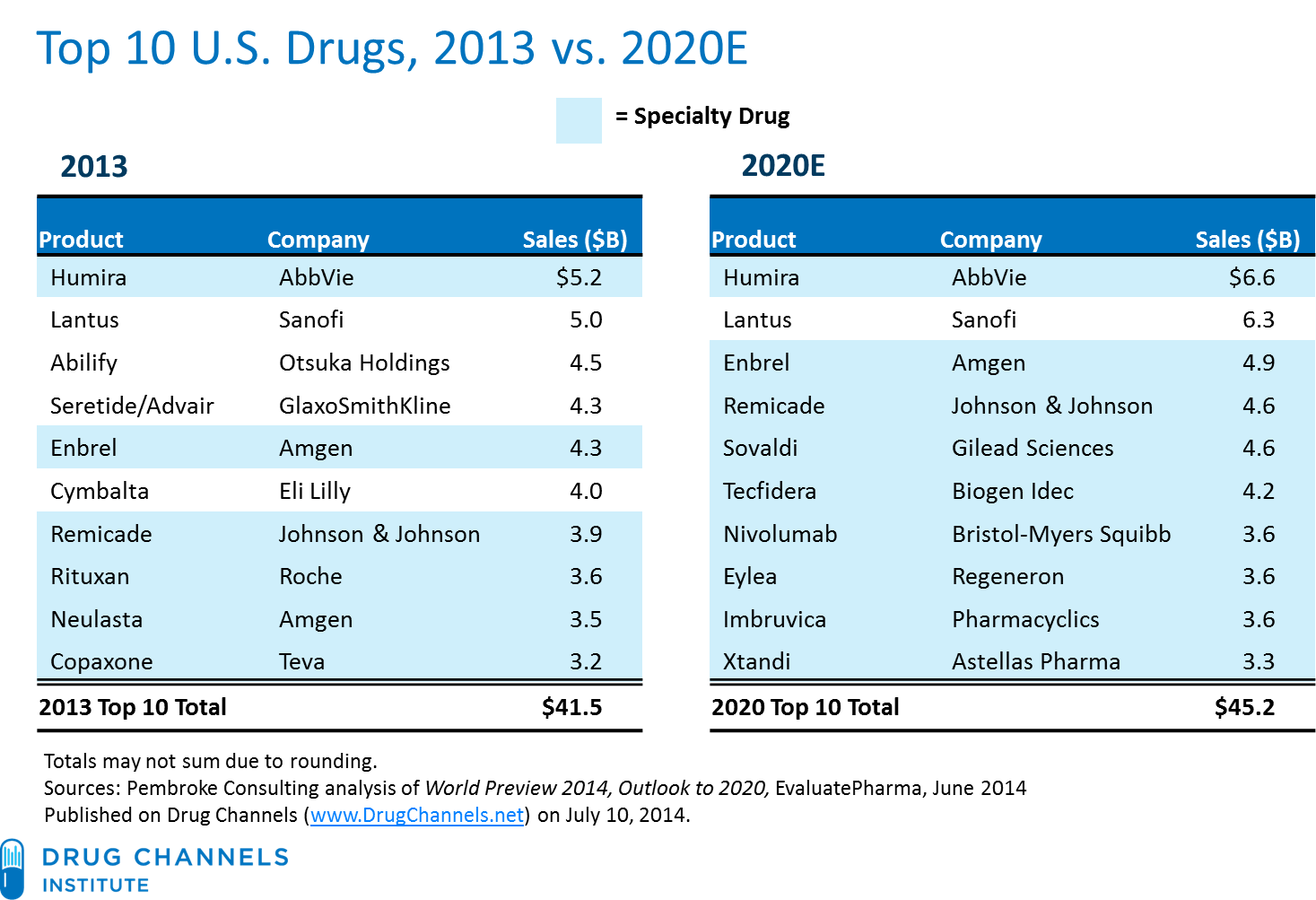
Drug Channels compares the top selling U.S. drugs in 2013 with EvaluatePharma’s projection of top selling U.S. in 2020. The blog adds that

The number of specialty drugs in the top 10 keeps rising. In 2020, 9 of the 10 best-selling drugs by revenue are projected to be specialty drugs, compared with 3 drugs in 2010 and 6 in 2013. EvaluatePharma predicts that AbbVie’s Humira [an arthritis specialty drug] will stay on top. You might be surprised at the Solvadi forecast.  One oddity: EvaluatePharma doesn’t expect biosimilars to do much harm to 2020’s top drugs.

Sovaldi, the Hepatitis C specialty drug, is projected to be the the fifth best selling drug in 2020 with $4.6 billion in sales.

Finally, yesterday’s Wall Street Journal reported that Bill Gates and Warren Buffett share the opinion that the best book about business is Business Adventures by John Brooks which was written in the 1960s.

It’s certainly true that many of the particulars of business have changed. But the fundamentals have not. Brooks’s deeper insights about business are just as relevant today as they were back then. In terms of its longevity, “Business Adventures” stands alongside Benjamin Graham’s “The Intelligent Investor,” the 1949 book that Warren says is the best book on investing that he has ever read.

The article states that the book is out of print. But Amazon must have been clued into the article because paper and Kindle versions of the book are available on Amazon.com. The FEHBlog has downloaded his copy, and the book is fun reading.