Midweek update

Midweek update

A common thread running through the recent mass murder tragedies in our country is severe mental illness.  As the Senate prepares to close up for the August recess, Modern Healthcare reports that a bipartisan mental health reform bill is emerging from that body. The FEHBlog will keep an eye on that proposed legislation that “has yet to provoke early criticism.”

Over the past ten days, the “Big 5” publicly traded health insurance companies have been reporting second quarter 2015 earnings. Fierce Healthcare tells us that those reports have been better than expected due to, among other factors, a lower benefits utilization trend.

Kaiser Health News reports that the Centers for Medicare and Medicaid Services again will be penalizing half of U.S. hospitals due to bad hospital readmission scores. “Since the fines began [in 2011], national readmission rates have dropped, but roughly one of every five Medicare patients sent to the hospital ends up returning within a month.”  The FEHBlog can’t blame this one on the hospitals because having strong caregiver / family support outside the hospital is key to avoiding re-admissions and that’s not a given.

Drug Channels gives us a preview of 2016 Rx formulary changes at Express Scripts and CVS Caremark, the two biggest prescription benefit managers. OPM has been encouraging carriers to adopt such formularies.

Weekend update

The House of Representatives is now out of session until after Labor Day. The Senate continues to meet for this week and then takes off until next month.  Here is a link to the Week in Congress with a description of last week’s action.

The White House, according to Federal News Radio, has withdrawn the nomination of retired Adm. Earl Gay to be OPM deputy director.  OPM has not had a deputy director for many years.

The New York Times reported yesterday that the White House now is considering low key retaliatory action against China for the OPM data breach. Bloomberg reported last week that

The hackers [“Deep Panda”] who stole data on tens of millions of U.S. insurance holders and government employees in recent months breached another big target at around the same time — United Airlines. United, the world’s second-largest airline, detected an incursion into its computer systems in May or early June, said several people familiar with the probe. According to three of these people, investigators working with the carrier have linked the attack to a group of China-backed hackers they say are behind several other large heists — including the theft of security-clearance records from the U.S. Office of Personnel Management and medical data from health insurer Anthem Inc.

On Friday, the Centers for Medicare and Medicaid Services perhaps in celebration to Medicare’s 50th anniversary, issued a slew of provider pricing rules that take effect on October 1.  The most important from the perspective of the FEHBP is the final rule on Medicare Part A payments to inpatient hospitals.  FEHB plans pay secondary to a boatload of Medicare participating annuitants. FEHBP fee for service plans use the Medicare Part A prospective pricing system to pay claims on annuitants over 65 who don’t have Medicare Part A.  This is a diminishing cadre of federal annuitants who retired before 1984.

TGIF

Late yesterday, the Internal Revenue Service issued its second lengthy notice (2015-52) containing initial guidance on the ACA’s 40% high cost plan excise tax a/k/a the Cadillac plan tax.  Timothy Jost from Health Affairs kindly prepared a summary of the notice here. A reader provided a link to a Huffington Post article on the tax which points out that

The bottom line is, as structured, this tax will significantly impact most workers, employers, and health plans. Even the Federal Employees Health Benefits Program (FEHB) will be negatively impacted. In a recent study, the FEHBP Blue Cross Blue Shield standard option plan was projected to hit the 40% tax in 2019 for employee-only coverage, and in 2025 for family coverage.

You can find a link to the referenced study on this American Benefits Council webpage.  The burden of administering this tax will fall on all employers.

Last Sunday, the Washington Post editorialized in favor of the 40% tax explaining that the tax is “a crucial reform” because it curbs the income tax exclusion for employer sponsored health benefits that “distorts the economy in multiple ways.”  If Congress wanted to curb that exclusion, then it should have done so directly rather than by creating this fiendishly complex indirect mechanism.  In the Wall Street Journal today, columnist Peggy Noonan perceptively observed

An untold story right now is that everyone was “right” about health care. The Republicans were right that ObamaCare would not and will never work. Democrats—though they haven’t noticed because they’re so busy clinging to and defending ObamaCare—were right that America would support national health care, but not as they devised it. We’ll get out of ObamaCare by expanding Medicare. Most of America, after the trauma of the past five years, won’t mind.

The FEHBlog is not crazy about this prediction about the next stage but you can’t rule it out.

Mid-week update

Following up on recent posts, the FEHBlog notes that the website for the Alliance to Fight  the 40[% high cost plan excise tax under the ACA, is active and Medpage has an a balanced article on the cost of the newly approved specialty success to statin drugs, the PCSK9 inhibitors. Reuters reports today  that 

Glen Stettin, a senior Express Scripts executive, said an estimated 70 million Americans have high cholesterol.
He estimates fewer than 10 percent of them should qualify for Praluent, based on restrictions from the Food and Drug Administration, which limited the drug’s use mostly to patients with a hereditary form of high cholesterol and people with cardiovascular disease.
“The big worry for our clients, given the cost of these drugs [$1,120 per 28-day treatment cycle — or about $14,600 per year], is whether they will be used beyond ways they were tested,” Stettin said.
Before getting their prescriptions filled, patients in Express Scripts plans will be asked for documentation of their diagnosis, their cholesterol levels, diet and maximum tolerated statin therapy, Stettin said.

Last Monday was the deadline for the public to submit comments in response to the Center for Medicare and Medicaid Service’s (“CMS”) request for public input on what to do with the HIPAA health plan identifier (“HPID”).  HHS rolled out this identifier and then just before the compliance date last Fall pulled it back as unnecessary for HIPAA transactions.   To get a flavor for the public comments here, are links to comments submitted by the American Hospital Association and the American Benefits Council. Both throw cold water on the HPID but the AHA is perfectly willing to let CMS use the HPID in connection with the HIPAA operating rule certification requirement that the ACA imposes on health plans.  The AMA urges CMS to pull that proposed rule out of the deep freeze.

A few weeks ago, the FEHBlog noted that the AMA and CMS had reached agreement on a rather vague transition plan for implementing the fiendishly complex ICD-10 coding system for electronic claims on October 1, 2015. CMS issued FAQs on that transition plan earlier this week.  The FAQs confirm that FEHB plans and other commercial payers are not obligated to implement the CMS transition plan. The FAQs also provide more details on acceptable transition plan coding for the benefit of Medicare providers. iHealthbeat has a more detailed overview of the FAQs here.

Finally, the FEHBlog noticed today that the OPM Inspector General has posted his most recent semi-annual report to Congress and management’s response on his website. That report is always interesting reading.

Weekend Update

The FEHBlog is back from the Outer Banks after a relaxing week in the sun.  Here’s a picture of the FEHBlog with his family and friends before leaving the rental this morning.  The FEHBlog is on the left, front row, wearing the Nationals hat. If you are looking closely at the picture and scratching your head, the FEHBlog and Mrs. FEHBlog built their family through Korean adoption.  

Congress is in session on Capitol Hill for one more week. Here is a link to last week’s developments as reported by the Week in Congress.

It’s also noteworthy that on Friday, the interim OPM Director Beth Cobert published her first Director’s Blog entry which concerns the data breach.

Also on Friday, the Food and Drug Administration approved for marketing the first PCSK9 inhibitor, a new blockbuster specialty (meaning expensive) drug which is expected to be an advance over statins. The Washington Post explains

[B}ecause PCSK9 drugs are so new, there are no definitive answers yet about whether their cholesterol-lowering effects actually will translate into fewer heart attacks, strokes and other heart problems. Over the next couple years, studies already underway should begin to give a clearer picture about such long-term outcomes.

For now, that lack of data is partly why the FDA approved Praluent — developed through a partnership between drug companies Sanofi and Regeneron — only for a limited set of patients. The agency said the drug could be used for people with heterozygous familial hypercholesterolemia, an inherited disorder that can severely elevate LDL levels [bad cholesterol], as well as for patients who have had heart attacks and other serious cardiovascular problems and still cannot reach target LDL levels through the use of statins. 

Later in the summer, the FDA is expected to approve a second PCSK9 drug developed by Amgen; that drug already was approved by European regulators earlier this week. Global pharmaceutical giant Pfizer has yet another PCSK9 drug in the pipeline. 

U.S. News and World Report issued its 2015 list of best hospitals last week. While the FEHBlog is getting weary of these ranking, he did sit up and take notice when he saw that the U.S. News ranks hospitals by category of illness treated which is interesting.

TGIF

It’s not TGIF for the FEHBlog who is on vacation but it continues to be TGIF for readers.  

This morning’s big news is the announcement of Anthem’s acquisition of Cigna for cash and Anthem stock.

The total per share consideration equates to approximately $188.00 for each Cigna share based on Anthem’s closing share price on May 28, 2015, valuing the transaction at $54.2 billion on an enterprise basis.

The Wall Street Journal reports this morning that if regulators bless the Anthem – Cigna and Aetna-Humana transactions, United Healthcare would continue to be the revenue leader at $154 billion annually while Aetna and Aetna would enjoy revenues around $115 billion annually. Anthem would be the health plan membership leader, which suggests that Aetna and UHC derive more revenues for businesses outside traditional health insurance – an option that the ACA has encouraged by capping health insurer revenues as Forbes reported earlier this week.

Joseph Swedish, Anthem’s CEO, will be the Board chairman and CEO in the combined company, and David Cordani, Cigna’s CEO, will be the President and Chief Operating Officer.  Mr. Cordani informed Cigna customers today that

In the coming months, we are committed to delivering the same high-quality service that you have come to expect from us. Cigna will remain separate and independent until closing, and we will continue on our present, positive path until the government reviews are complete and the combination is approved. We expect the transaction to be completed in the second half of 2016. 

Cigna, in contrast to Anthem, Aetna, and Humana, is not an FEHBP carrier but it does participate in the FEHB Program as a medical network provider to several employee organization plans.

In other more mundane news, Govexec informed us that OPM has released a report grading federal agencies on their employee wellness efforts. The grades are based on a CDC survey instrument.  According to the OPM report

291 worksites, from 36 different Federal agencies, participated in the WC assessment.  The average score across participating worksites was 61.5 percent (176 out of 286 possible points).  Individual worksite scores ranged from 28 to a perfect score of 286.  On average, agencies scored the highest in addressing vaccine-preventable diseases, occupational health and safety, and tobacco-free living.  Agencies have the most room for improvement in the areas of nutrition, lactation support, and organizational supports. 

The high-impact wellness strategies that agencies use the most are:
Influenza (flu) vaccinations at the worksite (84 percent)
One or more functioning automated external defibrillator in place (82 percent)
A written policy banning tobacco use at the worksie (79 percent)
A private space (other than a restroom) to express breast milk (77 percent)
Stress management programs (75 percent)
An on-site exercise faciliy (70 percent)

Finally, MedCity News reports that a major telehealth provider American Well is “getting ready to launch telehealth “exchanges,” where patients can search for physicians able to provide immediate online consultations or in-office visits on short notice. Physicians also will be able to make themselves available whenever they have a free time slot. ” Now that could be potentially useful but disruptive technology.

Midweek update

The Washington Post reports that the Obama Administration does not plan to publicly blame, or retaliate, against China for the OPM breaches.

“We have chosen not to make any official assertions about attribution at this point,” said a senior administration official, despite the widely held conviction that Beijing was responsible. The official cited factors including concern that making a public case against China could require exposing details of the United States’ own espionage and cyberspace capabilities.

The government evidently is more willing to sanction economic cyberespionage. Given our country’s history, this seems odd to the FEHBlog. So let’s turn to a few health benefits items.

According to Modern Healthcare, Medicare has decided to test allowing hospices to provide both curative and palliative care to terminally ill patients.

The Medicare Care Choices Model, established by the Affordable Care Act, waives the requirement that terminally ill patients must end curative treatment such as chemotherapy to qualify for Medicare hospice coverage. The model, which will run [at 140 facilities] through 2020, will test [beginning in January 2016] whether the expanded benefits will convince more patients to enter hospice and whether it improves care, enhances patient satisfaction, and reduces costs.

Christmas came early for hospices this year.

Modern Healthcare also reports that

The Institute for Clinical and Economic Review will begin releasing reports that will compare clinical effectiveness of [emerging] drugs, compare prices and their potential impact on the U.S. healthcare system and economy. The agency will then set a value-based benchmark for pricing.  * * *

The first ICER evaluations- which will focus on [pricey] PCSK9 inhibitors for cholesterol and a new Novartis heart failure drug called Entresto – are expected the first week of September. Pearson says future evaluations will be closely timed with new therapies that are in the pipeline for approval for by the Food and Drug Administration, as insurers and others must make decisions about clinical use and coverage relatively soon after approval.

This sounds helpful.

And speaking of helpful ongoing projects, Science Daily reminds us that the Choosing Wisely campaign is continuing its good work of identifying medical procedures that evidently have passed their sell by date.  The latest batch of procedures were identified by neonatologists.

Weekend update

The FEHBlog is not from the generation which takes pictures of food. However, he was moved to take a picture of this rainbow over a hotel in Chesapeake VA as a hopeful premonition for this week’s vacation.  

Time of course marches on. The FEHBlog got a message from Facebook that a page he likes changed over the weekend from Katherine Archuleta to Beth Cobert. Imagine that. 
What’s perhaps more shocking is that the FEHBlog missed an OPM data breach hearing on Capitol Hill last week. Last Wednesday, the Interior Department which housed the breached servers for OPM was up for a grilling by the House Oversight and Government Reform Committee.  Here’s a link to the Nextgov report.  The article suggests that Interior dodged a bullet because its files were “unscathed” by the breach. The FEHBlog doesn’t think that you can dodge a bullet when the gun is not pointed at you. Whoever “exfiltrated” the OPM files was not interested in Smokey Bear’s personnel file, which is available on the internet in any event. 
But seriously folks, Modern Healthcare reports on the results of its annual survey of physician compensation. 

Many healthcare organizations are struggling to find what Travis Singleton, senior vice president at Merritt Hawkins & Associates, refers to as the “Goldilocks zone” on physician compensation—striking the right balance between incentivizing productivity and rewarding quality. “Like it or not our system is still very much one that rewards procedural-based medicine and does not favor diagnostic medicine,” Singleton said. As long as that continues, “specialists will be the big winners when it comes to compensation overall.” 

TGIF

The Week in Congress has a wrap-up on this week’s activities on Capitol Hill.  Congress is in session until August 6 at which point it will take its August recess.

This was the first week that the interim OPM Director Beth Cobert was on the job. Govexec.com reports on her first week in office which of course have focused on the cyber breaches. The Military Times reports that the House Armed Services Committee plans to hold a hearing on OPM’s data breaches after the August recess.

In a heart warming report, the Wall Street Journal tells us that Gilead Sciences “is limiting enrollment to its patient assistance program for hepatitis C drugs, which helps people obtain the [blockbuster and horrendously expensive] Sovaldi and Harvoni treatments when they lack sufficient insurance coverage or the financial wherewithal to get the medicines otherwise.” Why? you ask. To put financial pressure on health plans to expand coverage of Gilead’s drugs __

“This is a way of applying more pressure on payers to expand their coverage criteria,” says Roger Longman of Real Endpoints, a research firm that tracks reimbursement issues.
Meanwhile, Randy Vogenberg, a partner at Access Market Intelligence, a consulting firm that specializes in managed care, says “unfortunately, such a strategy places the patient in the middle as the pawn.”

Nice move.

Midweek update

The Blue Cross Blue Shield Association announced today that 

all Blue Cross and Blue Shield (BCBS) companies will make identity protection services available to their customers nationwide beginning on or before January 1, 2016.  The new services will provide heightened safeguards in the event of fraudulent use of personal and financial information for the millions of Americans that BCBS companies serve. The new offering will be made available on an opt-in basis to all eligible* members for as long as they have a Blue Cross and Blue Shield health insurance policy in effect.

More information is available here. Last week, OPM announced that it is taking the same approach:

In the coming months, the Administration will work with Federal employee representatives and other stakeholders to develop a proposal for the types of credit and identity theft monitoring services that should be provided to all Federal employees in the future – regardless of whether they have been affected by this incident – to ensure their personal information is always protected.

The FEHBlog thinks that this approach makes a lot of sense and he expects to see similar businesses government agencies follow.

Modern Healthcare reports that a newly formed coalition of businesses and insurers called Alliance to Fight the Forty is planning to lobby Congress to repeal the 40% excise tax on high cost health plans that takes effect under the Affordable Care Act in 2018. For a law called Affordable it sure did create a lot of taxes and the FEHBlog has not seen the other lobbying group such as Stop the Health Insurer Tax (another counterproductive levy) have much success to date but have at it.

Fierce Healthcare reports that two consumer groups have created surgeon rating websites — Surgeon Ratings.Org. and Surgeon Scorecard

ERIC provides an overview of the general aspects of the final ACA preventive services rule that was released on Friday. The regulators consolidated their sub-regulatory FAQ guidance on non-contraceptive issues into the final rule. No surprises.  .

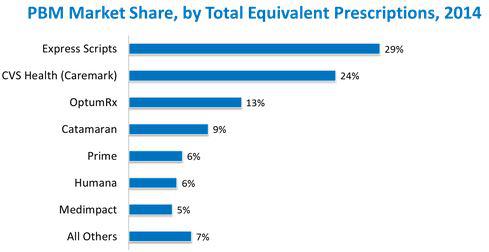
Finally Seeking Alpha has an article which provides the current lay of the land in the PBM world with this fascinating chart from the Pharmacy Benefit Management Institute: