Monday Roundup

Monday Roundup

Photo by Sven Read on Unsplash

The International Foundation of Employee Benefit Plans informs us that

The Department of Labor’s (DOL) Employee Benefits Security Administration along with the Office of Personnel Management, Internal Revenue Service, Department of the Treasury, Centers for Medicare & Medicaid Services, and Department of Health and Human Services (collectively, The Departments) issued an information collection related to certain reporting requirements under section 204 of Title II of Division BB of the Consolidated Appropriations Act, 2021 (CAA) that are applicable to group health plans and health insurance issuers offering group or individual health insurance coverage.​

In addition, the Departments and OPM are also seeking input about whether the requirements apply to Federal Employees Health Benefits carriers, including whether or not they are also health insurance issuers.

Here’s the FEHBlog’s input on that last point. Congress extended specific provisions of Division BB of the Consolidated Appropriations Act, 2021 to the FEHB Program when it created a new Section 8902(p) of the FEHB Act. Today’s notice concedes that Section 204 was not among those provisions in Section 8902(p). Regulations are intended to implement and interpret statutory law, and in the case of the FEHBP there is no statute to implement here. What’s more carriers already are obligated to report aggregated prescription benefit data to OPM. In other words, the regulatory field is occupied as far as the FEHB Program is concerned. The public comment deadline on this information collection notice is July 23, 2021.

The American Hospital Association gleefully reports

Nearly 100 bipartisan House members led by Reps. Thomas Suozzi, D-N.Y., and Brad Wenstrup, R-Ohio, urge the departments of Health and Human Services, Labor and the Treasury [in a June 17, 2021 letter] to ensure their rulemaking for the No Surprises Act reflects congressional intent for a balanced process to settle payment disputes between health plans and providers. The lawmakers also emphasized the need to provide sufficient time for public comments and evaluation through proposed notice and comment rulemaking. 

The FEHBlog wonders what caused Congress to fire this shot across the regulator’s bow. The statutory deadline for these rules is October 1, 2021, thereby creating an all too brief three month long implementation period for providers, payers, lawyers and arbitrators. This should be interesting.

To show that the FEHBlog is not entirely cranky as he writes this post, CVS Health announced today

Over the last year, Aetna, a CVS Health® company, has been implementing a comprehensive strategy to reduce suicide attempts 20 percent among Aetna members by the year 2025. With the right intervention and support, resources and management of suicidal thoughts, suicide is known to be preventable. In fact, 90 percent of people who die by suicide have a potentially treatable mental health condition.

This month, Aetna is launching its latest initiative — the development of a specialty provider network with a sole focus on suicide prevention in collaboration with Psych Hub, the world’s most comprehensive platform for mental health education. The joint effort will further arm Aetna practitioners with no-cost, evidence-based instruction, tools, and resources to identify and treat those at risk of suicide.

Well done and best of luck.

Also from the COVID-19 front Bloomberg informs us

After more than a year of obsessively tracking Covid-19 case numbers, epidemiologists are starting to shift focus to other measures as the next stage of the pandemic emerges.

With rich countries vaccinating growing proportions of their vulnerable populations, the link between infection numbers and deaths appears to be diminishing. Now, in some places the focus is on learning to live with the virus — and on the data that matter most to avoid fresh lockdowns.

“It’s possible we’ll get to a stage of only monitoring hospitalizations,” said Jennifer Nuzzo, an epidemiologist at Johns Hopkins University’s Coronavirus Resource Center, which has built one of the most comprehensive platforms to track the virus and its impact.

The Wall Street Journal provides an overview of the COVID-19 variant called Delta.

The latest data from The Centers for Disease Control and Prevention estimates the Delta variant makes up 9.9% of reported U.S. Covid-19 cases, while Alpha stands at 65.5%. * * *

Scientists are still studying the virus and their early conclusions aren’t definitive. But British scientists, who have probably done the most work on the variant, estimate it is from 40% to as much as 80% more infectious than the so-called Alpha variant, or B.1.1.7, which was first identified in England last year, is now prevalent in the U.S. and is itself more contagious than the version of the virus that emerged in China in 2019.

An analysis of more than 14,000 Delta cases by England’s public-health agency found a double dose of the shot developed by Pfizer Inc. and BioNTech SE reduces the risk of hospitalization after infection with Delta by 96%. Two doses of the vaccine developed by the University of Oxford and AstraZeneca reduce the risk by 92%, Public Health England said.

Very few of those hospitalized in the U.K. have been fully vaccinated, with the new cases mostly among younger people who aren’t yet vaccinated. There is no evidence that young adults and children are more at risk proportionately from this variant than other age groups, and the increased transmission mostly reflects the fact that they haven’t been immunized, scientists say.

In other news that caught the FEHBlog’s eye this Monday —

  • The FEHBlog enjoys following the healthcare efforts of business giants like Amazon, Apple, and Walmart. ZdNet reports on Microsoft’s new healthcare strategy.
  • Louisville KY television station WDRB tells us

Brentwood, Tenn.-based LifePoint Health [a large regional health system that owns over 80 hospitals] will acquire Louisville-based Kindred Healthcare LLC, a specialty hospital company, for undisclosed terms, according to a news release Monday. The deal is scheduled to close by the end of the year. The announcement comes weeks after Louisville-based Humana Inc. said it would absorb the remainder of the former Kindred’s home health and hospice business. In the news release, LifePoint said it plans to continue Kindred’s strategy of growing by establishing joint ventures and partnerships with hospitals. * * * LifePoint said it plans to invest $1.5 billion in its business following the deal.

At the time of wrapping up this post on Monday evening, the Senate had not yet taken up Kiran Ahuja’s nomination to be OPM Director. The FEHBlog will keep an eye on this matter. [Tuesday morning supplement — The Senate Press Gallery Calendar informs us that

The Senate on Tuesday morning at 11:45 am will hold two votes:

  1. Confirmation of the Fonzone nomination.
  2. Motion to invoke cloture on Kiran Ahuja to be Director of the Office of Personnel Management.

The Senate will recess following the cloture vote on the Ahuja nomination until 2:15 p.m. 

At 2:30 p.m. vote:

  1. Confirmation of the Ahuja nomination.

Weekend update

Thanks to Alexandr Hovhannisyan for sharing their work on Unsplash.

Happy Fathers’ Day and First Day of Summer.

Both Houses of Congress remain in session for Committee business and floor voting this week. Among the scheduled hearings for this week, the Senate Health Education Labor and Pensions Committee will hold a hearing on Tuesday morning to “examine vaccines, focusing on America’s shot at ending the COVID-19 pandemic.”

Speaking of which, Kaiser Health News reports on a June 10, 2021, FDA advisory committee meeting on pediatric COVID-19 vaccines. Here’s a link to the FDA’s briefing document.

Amy Howe who writes on the U.S. Supreme Court discusses the decisions that the Court is expected to issue over the remainder of this month and possibly early July. There are many interesting issues at stake but none of them relate to the FEHB Program.

STAT News offers an encouraging op-ed from two physicians who think that the pandemic has caused people to be more engaged with their healthcare. Hope springs eternal.

Cybersecurity Saturday

Happy Juneteenth. Cyberscoop reports that

The Senate on Thursday confirmed Chris Inglis as the new White House cyber czar, a role it enacted into law late last year.

The new role will play a key part in coordinating the government response to major hacks and other cybersecurity threats. Inglis takes on the position as the U.S. has dealt with an onslaught of cybersecurity incidents, including ransomware attacks on Colonial Pipeline and meat supplier JBS. The national cyber director will also lead the implementation of cyber policy and strategy, including efforts mandated by the Biden administration to improve federal cybersecurity.

The Wall Street Journal informs us

The private sector in the U.S. must do more to defend against cyberattacks, lawmakers from both major parties stressed Thursday as several senators introduced legislation designed to target hackers. The ransomware incident that brought operations at Colonial Pipeline Co. to a standstill for six days starting May 7, and resulted in fuel shortages across Southeastern states, shows that cybersecurity efforts must improve, said Sen. Sheldon Whitehouse (D., R.I.). “Partly, it’s the national cybersecurity establishment that needs to step up its game. And partly, it’s the corporate community that has been caught with its figurative trousers down,” Mr. Whitehouse said, speaking at a press conference Thursday with Sens. Lindsey Graham (R., S.C.) and Richard Blumenthal (D., Conn.)

* * *

Christopher Roberti, senior vice president for cyber, intelligence and supply chain security policy at the U.S. Chamber of Commerce, which says it is the world’s largest business association, said companies don’t stand a chance against determined nation-state attacks regardless of cybersecurity investments. Partnerships between the government and the private sector are essential, he said. “Businesses must take necessary steps to ensure their cyber defenses are robust and up to date, and the U.S. government must act decisively against cyber criminals to deter future attacks. Each has a role to play and both need to work closely to do more,” Mr. Roberti said.

Federal News Network offers an interesting interview with Chris Golden, director of Information Security at Horizon Blue Cross Blue Shield of New Jersey and a founding member of the Defense Department’s Cybersecurity Maturity Model Certification accreditation program. Of note

Tom Temin [FNN]: And then there’s also hints that the CMMC program could spread to the civilian agencies, and therefore some unknown number of additional or marginal numbers of companies added into the mix. So then you’ve got more scaling issues.

Chris Golden: You’ve already seen Department of Homeland Security and the General Services Administration (GSA) put in what I would call contingency CMMC clauses in their contracts, they basically say, “Hey, we may change this contract to include a CMMC requirement. We’ll let you know after you sign” – it kind of thing. So these other government agencies are leaning in that direction, I think it’s probably going to be pretty obvious that most of them will go there. And eventually, it’ll be a whole of government approach. And then I think you’ll start seeing it go to people that don’t do any contracting with the government, right? Once the regulators start looking at and going, hey, in healthcare let’s say – that’s the area I work in – maybe a regulator says, “Well, maybe I’ll take a SOC 2 type 2 audit this year, but next year, maybe the CMMC thing is what I really need? Maybe that’s a better approach to managing risk?” And so once you see that happen, you’ll see sort of grow and balloon, and then we haven’t even talked internationally as our international partners, who do participate in the supply chain and will have to be CMMC-assessed but how do they fit into this sort of big puzzle as it sort of goes global? So yeah, there’s a potential here for a huge ballooning of this thing.

It would not be a true Cybersecurity Saturday post without a link to Bleeping Computers “This Week in Ransomware” post:

Compared to the last few weeks, it has been a relatively quiet week with no ransomware attacks causing widespread disruption.

It was a good week for law enforcement, with Ukrainian police arresting members of the Clop ransomware gang and the South Korean police arresting computer repairment installing ransomware.

We also saw some interesting research released on LockBit and the Hades ransomware, as well as an updated Avaddon Ransomware decryptor that can decrypt more victims’ files.

Finally, President Biden met with Russian President Putin to discuss the recent cyberattacks. Whether something changes from that meeting is too soon to tell.

Also here’s a link to a nifty article with cybersecurity tips. Tech Republic informs us about a “new IBM global report examining consumer behaviors finds an average of 15 new online accounts were created and 82% are reusing the same credentials some of the time.”

Friday Stats and More

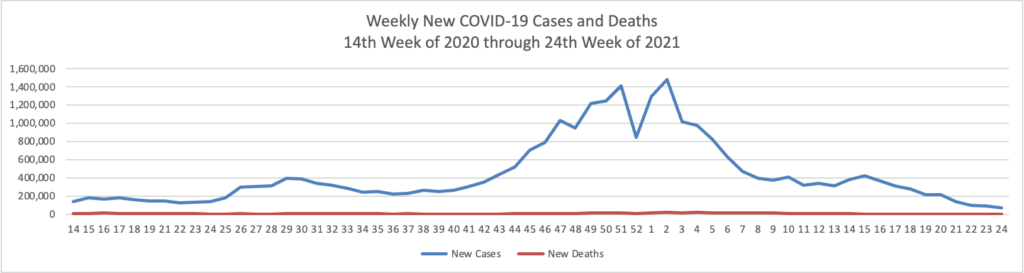
Based on the Centers for Disease Control’s COVID-19 Data Tracker website, here is the FEHBlog’s chart of new weekly COVID-19 cases and deaths over the 14th week of 2020 through 24th week of this year (beginning April 2, 2020, and ending June 16, 2021; using Thursday as the first day of the week in order to facilitate this weekly update):

and here is the CDC’s latest overall weekly hospitalization rate chart for COVID-19:

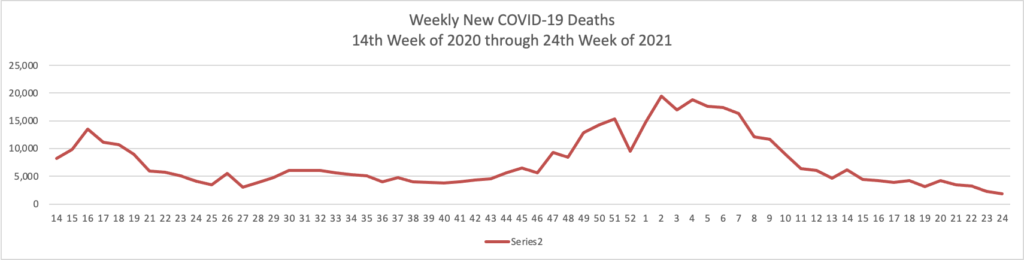
The FEHBlog has noticed that the new cases and deaths chart shows a flat line for new weekly deaths because new cases materially exceed new deaths. Accordingly here is a chart of new COVID-19 deaths over the period (April 2, 2020, through June 16, 2021):

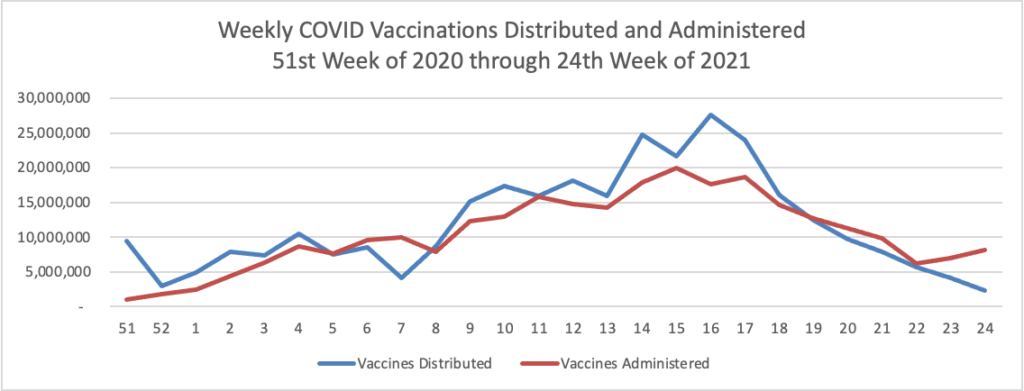
Finally here is a COVID-19 vaccinations chart over the period December 17, 2020, through June 16, 2021 (six months) which also uses Thursday as the first day of the week:

Bloomberg reports that

President Joe Biden urged unvaccinated Americans to get inoculated from coronavirus, warning that the highly transmissible delta variant of the virus could cause more deaths. “Even while we are making incredible progress [as reflected above], it remains a serious and deadly threat,” Biden said Friday during a White House event to celebrate 300 million doses of vaccine administered during the first 150 days of his administration.“The data is clear: If you are unvaccinated, you’re at risk of getting seriously ill, or dying, or spreading it.” A large swath of Americans — particularly in the politically conservative South — have declined shots despite warnings from health authorities that the virus remains a threat.”

in other COVID-19 news

  • Medscape informs us that “While the investigation into cases of myocarditis possibly associated with COVID vaccines proceeds, the American Heart Association (AHA)/American Stroke Association (ASA) continue to urge everyone who is eligible for the vaccine to get it without delay. ‘We remain confident that the benefits of vaccination far exceed the very unusual risks,’ the leadership of the AHA/ASA said in a statement issued June 12. ‘The risks of COVID-19 infection include its potentially fatal consequences and the potential long-term health effects that are still revealing themselves, including lingering consequences affecting the heart, brain, vascular system, and other organs after infection,’ they point out. Late last week, the Centers for Disease Control and Prevention (CDC) alerted healthcare providers that the COVID-19 Vaccine Safety Technical Work Group (VaST) of the Advisory Committee on Immunization Practices (ACIP) will meet June 18 to review cases of myocarditis reported in adolescents and young adults after they received a COVID-19 vaccine manufactured by Pfizer–BioNTech or Moderna.
  • MedPage Today reports that “During the American Medical Association (AMA) House of Delegates annual meeting, members debated whether natural immunity or previous infection with SARS-CoV-2 was sufficient for the merit of immunity credentials.” The House of Delegate voted against treating natural immunity as equivalent to vaccination. “Multiple delegates pointed out that using natural immunity in lieu of vaccination would pit the AMA’s recommendations against those of the CDC.” Nevertheless as the Mayo Clinic points out, natural immunity helps us achieve some level of herd immunity. It needs to be considered with vaccinations for that purpose.

If you want more details on yesterday’s Affordable Care Act decision from the U.S. Supreme Court, check out Prof. Katie Keith’s post in the Health Affairs blog.

Beckers Hospital News lists seven Fortune 500 health insurers by membership. Health Payer Intelligence discusses the latest sustainability report from the company that tops this list, UnitedHealth Group.

On this Juneteenth holiday, Fierce Health tells us about how “healthcare executives call on President Biden to take ‘innovative, bold’ steps to tackle health equity using AI, big data.”

“It’s not a lack of data—we have so much data in this country now, in our healthcare systems and our EHRs and our patient registration systems,” Cole said. “The data is there but the analytics capability of that—what to do with that data—is something that we’re continuing to work on every day.”

Cole and John Lumpkin, M.D., president of the Blue Cross and Blue Shield of North Carolina Foundation, said both of their organizations have been reworking their collection and organization of race, ethnicity, gender identity and other related data tied to health inequity—a change that “should be a very simple thing to do” but requires an internal data system overhaul, Lumpkin said.

Still, executives said the finish line of those efforts is worthwhile. Incorporating SDOH data can yield substantial health and costs benefits at the individual and population levels, they said.

The Wall Street Journal reports on the rising fortunes of the country’s major pharmacy chains, CVS Health and Walgreens.

In health system merger news —

  • Healthcare Dive informs us that “Beaumont Health and Spectrum Health are looking to merge in a deal that would result in Michigan’s biggest health system with 22 hospitals and 64,000 employees across the state, with combined annual revenue of almost $13 billion. Executives of the two systems announced Thursday they have signed a letter of intent to explore creating a joint health system. The deal would include Spectrum’s Michigan-based health insurance plan, Priority Health, which has 1.2 million customers.”
  • Fierce Healthcare reports that “Southern health systems Ochsner Health and Rush Health Systems have announced plans for a merger they expect to be completed about halfway through 2022. The deal follows a 2019 strategic partnership between the two nonprofit providers and comes hot on the heels of Louisiana-based Ochsner’s merger with Lafayette General Health, which closed in October 2020 and grew the system to 35 hospitals. Rush, which has seven hospitals and more than 30 clinics in eastern Mississippi and western Alabama, will be rebranded as Ochsner Rush Health should the merger receive regulatory approval.”
  • Healthcare Dive also tells us that “Tenet, a major U.S. health system, has agreed to sell five hospitals in the Miami-Dade area for $1.1 billion to Steward Health Care System, a physician-owned hospital operator and health network. The deal also includes the hospitals’ associated physician practices. Dallas-based Steward has agreed to continue using Tenet’s revenue cycle management firm, Conifer Health Solutions, following the completion of the deal, which is expected to close in the third quarter. Further underscoring Tenet’s strategic focus, the sale will not include Tenet’s ambulatory surgery centers in Florida. Tenet will hold onto those assets as its ambulatory business becomes a bigger focus for the legacy hospital operator.”

Thursday Miscellany

U.S. Supreme Court building, Wash. DC

At long last, the U.S. Supreme Court issued its opinion today in the third case reaching the Court on the issue of the constitutionality of the Affordable Care Act (“ACA”). In an opinion written by Justice Breyer and joined by the Chief Justice and four other Justices, the Court ruled in short as follows:

As originally enacted in 2010, the Patient Protection and Affordable Care Act required most Americans to obtain minimum essential health insurance coverage. The Act also imposed a monetary penalty, scaled according to in- come, upon individuals who failed to do so. In 2017, Con- gress effectively nullified the penalty by setting its amount at $0. See Tax Cuts and Jobs Act of 2017, Pub. L. 115–97, §11081, 131 Stat. 2092 (codified in 26 U. S. C. §5000A(c)).

Texas and 17 other States brought this lawsuit against the United States and federal officials. They were later joined by two individuals (Neill Hurley and John Nantz). The plaintiffs claim that without the penalty the Act’s minimum essential coverage requirement is unconstitutional. Specifically, they say neither the Commerce Clause nor the  Tax Clause (nor any other enumerated power) grants Congress the power to enact it. See U. S. Const., Art. I, §8. They also argue that the minimum essential coverage re- quirement is not severable from the rest of the Act. Hence, they believe the Act as a whole is invalid. * * *

[W]e conclude that the plaintiffs in this suit failed to show a concrete, particularized injury fairly traceable to the defendants’ conduct in enforcing the specific statutory provision they attack as unconstitutional. They have failed to show that they have standing to attack as unconstitutional the Act’s minimum essential coverage provision. Therefore, we reverse the Fifth Circuit’s judgment in respect to standing, vacate the judgment, and remand the case with instructions to dismiss.

Justice Thomas filed a concurring opinion, and Justice Alito, joined by Justice Gorsuch, filed a dissenting opinion. The FEHBlog confidently can state that he predicted this favorable outcome for the ACA. It always has been clear to the FEHBlog that the Supreme Court took the case to kill the lawsuit, not the law.

The Senate will take up Kiran Ahuja’s nomination to be OPM Director when it resumes floor business on Monday June 21. If Ms. Ahuja’s nomination is not confirmed next week, the Senate will be away from our Nation’s capital for two weeks for the Independence Day holiday.

Reg Jones’ latest column in FedWeek concerns federal employee survivor benefits in the case of a post-retirement marriage.

In federal employment news, Federal News Network reports that President Joe Biden signed the Juneteenth National Independence Day Act this afternoon, establishing June 19 as a federal holiday. Most federal employees will have tomorrow, June 18 off for observance as June 19 falls on a Saturday this year, the Office of Personnel Management said. * * * Nearly every state already recognizes Juneteenth as a holiday, but it now becomes the first federal holiday created since Martin Luther King Jr. Day was established in 1983.”

In COVID-19 news and this should come as no surprise, Medscape informs us that “More than half of unvaccinated Americans would prefer to get a COVID-19 vaccination at their doctors’ office, according to the results of a new national survey. * * * The preference to be vaccinated in a medical office was three to five times higher among unvaccinated Americans than were other strategies such as vaccinations at retail pharmacies or drug stores, community health centers, public health clinics, drive-up clinics, and large public vaccination sites.” As of today, 65% of Americans over age 18, and 87% of Americans over age 65, have had at least one dose of a COVID-19 vaccination.

In a burst of closing miscellany —

  • Kaiser Health News tells us that ” The pandemic-caused recession and a federal requirement that states keep Medicaid beneficiaries enrolled until the national emergency ends swelled the pool of people in the program by more than 9 million over the past year, according to a report released Thursday. The latest figures show Medicaid enrollment grew from 71.3 million in February 2020, when the pandemic was beginning in the U.S., to 80.5 million in January, according to a KFF analysis of federal data.”
  • Health Payer Intelligence informs us that “Medicare Advantage plans may better address racial care disparities than fee-for-service Medicare, according to the second in a series of reports that ATI Advisory has prepared for Better Medicare Alliance (BMA) in 2021. “With over 26.5 million beneficiaries enrolled in Medicare Advantage today, this report shows that minority beneficiaries are a driving force behind these enrollment gains; turning to Medicare Advantage to meet their health and social needs. When policymakers stand up for Medicare Advantage, they stand up for these seniors, too,” Allyson Y. Schwartz, president and chief executive officer of the Better Medicare Alliance, said in the press release. Around half of all Black Medicare beneficiaries and 53 percent of Latinx Medicare beneficiaries are in a Medicare Advantage plan, the report found. In contrast, only 34 percent of White beneficiaries and 31 percent of those who identified as “Other” races were enrolled in a Medicare Advantage plan.”
  • STAT News reports that “ovarian cancer, which kills about 15,000 Americans every year, has historically been one of the thornier cancers to treat. Only in the last few years has a new class of potent drugs, called PARP inhibitors, started to change that. But even with these promising new treatments, too often, tenacious tumors come roaring back. So there’s a need for yet newer drugs that can overcome any resistance the cancer evolves. According to research published Thursday, scientists might have found one. And it’s not actually a new drug at all. In fact, it’s been sitting, retired, in a drug library for decades. “While evaluating mechanisms of PARP inhibitor resistance over the last few years we came across this drug, novobiocin, which curiously enough, is an antibiotic,” said Alan D’Andrea, director of the Susan F. Smith Center for Women’s Cancers at the Dana-Farber Cancer Institute and co-author of the new study.” Encouraging.
  • “The U.S. Food and Drug Administration today approved a nasal antihistamine for nonprescription use through a process called a partial prescription to nonprescription switch. The FDA approved Astepro (azelastine hydrochloride nasal spray, 0.15%) for seasonal and perennial allergic rhinitis—commonly known as allergies—for adults and children six years of age and older.  ‘Seasonal and perennial allergies affect millions of Americans every year, causing them to experience symptoms of nasal congestion, runny nose, sneezing and more,” said Theresa M. Michele, M.D., director of the office of nonprescription drugs in the FDA’s Center for Drug Evaluation and Research. “Today’s approval provides individuals an option for a safe and effective nasal antihistamine without requiring the assistance of a healthcare provider.’”

Midweek Update

Photo by Dane Deaner on Unsplash

The Senate took no action on Kiran Ahuja’s nomination to be OPM Director today as Senators Booker and Peters remain out of pocket due to family illnesses.

On the hospital front —

  • The Advisory Board informs us about U.S. News and World Reports most recent rankings of children’s hospitals.
  • Axios reports that “Some of the hospitals with the highest revenue in the country also have some of the highest prices, charging an average of 10 times more than the actual cost of the care they deliver, according to new research by Johns Hopkins University provided exclusively to Axios.”

On the mental healthcare front, we have two articles on start- up companies from Katie Jennings in Forbes. One concerns Burlingame, Calif.-based Lyra Health and the other concerns “Lifestance Health Group, one of the nation’s largest outpatient mental health providers.” Check them out.

On the prescription drug front —

  • Healthcare Dive reports that “Anthem, one of the biggest U.S. payers, has joined an initiative to create low-cost generic drugs for hospital and retail pharmacies. The initiative CivicaScript, a subsidiary of hospital-owned nonprofit drugmaker Civica Rx, plans to initially develop and manufacture six to 10 common but pricey generic medicines that don’t have enough market competition to drive down cost, officials said Wednesday. The first generics could be available as early as 2022.”
  • Fierce Pharma informs us that “Antibody treatments have shown little success in helping COVID-19 patients with  severe disease. But a large [UK] study of hospitalized patients reveals that Regeneron’s antibody cocktail can reduce the chance of death in patients who haven’t produced their own antibody responses to the disease.”
  • STAT News interviews the Alzheimer Association’s CEO about the newly approved drug Aduhelm.

In miscellaneous news

  • The Wall Street Journal reportsApple Inc. Chief Executive Tim Cook has said the company’s greatest contribution to mankind will be in health. So far, some Apple initiatives aimed at broadly disrupting the healthcare sector have struggled to gain traction, according to people familiar with them and documents reviewed by The Wall Street Journal.”
  • Healthcare Dive tells us that “A University of Pennsylvania study that tracked Medicare claims for about 1.35 million beneficiaries who had joint replacement surgery found that hospitals participating in bundled payment programs spent less on the hip and knee joint procedures than hospitals receiving traditional fee-for-service payments. Spending, however, did not differ between hospitals that voluntarily joined bundling programs and those whose involvement was mandatory, according to the findings, which were published in a JAMA research letter. The results failed to validate assumptions that voluntary participants tend to achieve greater savings because they choose programs for the opportunity to reduce spending. The findings come as the head of the Center for Medicare and Medicaid Innovation, Elizabeth Fowler, suggested the agency would look to shift away from voluntary arrangements in favor of more mandatory models.”
  • Fierce Healthcare informs us that “The Centers for Disease Control and Prevention (CDC) released new interim guidance late Monday for healthcare providers treating patients with post-COVID conditions—an umbrella term the agency is using to capture a wide range of physical and mental health issues that sometimes persist four or more weeks after an individual’s COVID-19 infection. Sometimes referred to as “long COVID,” the conditions can present among COVID-19 patients regardless of whether they were symptomatic during their acute infection, the agency wrote in the guidance.”

Tuesday’s Tidbits

Photo by Patrick Fore on Unsplash

The Senate Press Gallery informs us from today’s proceedings

12:22 p.m. Majority Leader Schumer announced that due to Senators Booker and Peters having family illnesses the cloture vote on the Ahuja nomination [to be OPM director] is delayed; and moved the Senate to a period of morning business.

It looks like the Majority Leader is concerned about a close vote. The FEHBlog will continue tracking and best wishes to the Booker and Peters families for speedy recoveries.

Federal Times reports that “Federal employees can enroll, re-enroll or change their flexible spending account coverage during the month of June, as the Office of Personnel Management announced June 14 that it authorized a special enrollment period as part of provisions outlined in the Consolidated Appropriations Act and the American Rescue Plan.”

The Federal Times adds

Because the Consolidated Appropriations Act authorized unlimited carryover of FSA funds for 2020 and 2021, feds that didn’t re-enroll in an FSA plan for 2021 but had remaining money left in their accounts in 2020 may wish to use the special enrollment period to reopen their accounts and gain access to those carried over funds.

The new flexibilities for the 2020 and 2021 plan years also allow enrollees with dependents who would have normally aged out of the program to continue to use those funds until the child is 14, rather than 13, and the government approved hand sanitizer and masks as FSA medical expenses.

In the tidbits department

  • STAT News informs us that “Amazon has made its FDA-cleared Covid-19 test available to consumers online, alongside a consumer diagnostics website where people can view their results. The consumer diagnostics website, AmazonDx.com, was previously only available to Amazon employees. As of Tuesday, however, it appears any customer can sign into the site using the same login information they use to access the shopping portion of the tech giant’s website.  Amazon received FDA authorization for the at-home test kit in May.”
  • Fierce Healthcare tells us that “A JAMA Internal Medicine study is the latest in a string of analyses revealing hospitals’ frequent noncompliance with a new federal mandate requiring them to post prices for medical services. Published Monday, the study found that, as of early March, 83 out of 100 randomly sampled hospitals were noncompliant with at least one of the major requirements of a new rule from the Centers for Medicare & Medicaid Services (CMS). This decreased slightly to 75 in a parallel review of the country’s 100 highest-revenue hospitals.
  • Healthcare Dive reports that “Humana is acquiring home-based services provider One Homecare Solutions from a private equity firm to beef up its at-home care offerings, as a growing number of payers foray into direct medical delivery. The acquisition of Miramar, Florida-based One Homecare, which does business as Onehome, follows Humana’s decision to snap up home health giant Kindred at Home for $5.7 billion and is meant to boost the insurer’s value-based home health strategy. Financial terms of the deal, expected to close in the second quarter of this year, were not disclosed.”
  • Healthcare Dive also reports that About half of physicians and even more patients said the U.S. healthcare system discriminates against people a great deal, a good amount or somewhat, according to a survey out Tuesday from the nonpartisan research group NORC at the University of Chicago. Patients’ trust in their primary doctor rises with age and income, though 12% of respondents said they have been discriminated against by a healthcare facility, and Black patients were twice as likely to report being discriminated against than White patients, the report found. But 81% of physicians gave their employers either an A or B grade for their efforts to address health equity, and said they’re optimistic their system will improve diversity and equity in the next five years.
  • Health Payer Intelligence discusses “six expectations employers have for provider care coordination Employers are looking for greater price transparency, reduced overtreatment, and improved patient experience, and overall better care coordination from their provider partners.”
  • The Wall Street Journal reports that “A national charity will for the first time buy medical debt, totaling $278 million, directly from hospitals, a push to speed financial relief to patients, many of whom shouldn’t have been billed at all under the hospitals’ financial-aid policies. RIP Medical Debt, which uses donations to wipe out unpaid medical bills, has reached a deal with nonprofit Ballad Health, a dominant hospital system in Tennessee and Virginia, to buy debt owed by 82,000 low-income patients. Many likely qualified for free care under Ballad’s policy but didn’t get it, executives at Ballad involved in the agreement said. The patients lacked applications, they said. RIP Medical Debt will abolish the total amount and is expected to notify households of the debt relief this month. Some bills are 10 years old.” Bravo.

In the OPM rule making agenda department, here are three more found in last Friday’s semi-annual regulatory agenda.

  • OPM is engaged in joint rule making with HHS to implement a provision of Consolidated Appropriations Act Division BB that Congress did not apply to the FEHB. “This joint rule with HHS would implement the prescription drug reporting requirements that apply to group health plans and health insurance issuers offering coverage in the group and individual markets under section 204 of the No Surprises Act.” OPM already has created aggregated pharmacy data reporting requirements for FEHB carriers.
  • OPM is engaged in joint rule making with HHS on the provider non-discrimination provision of the ACA Section 2706. While this law does apply to the FEHB, it’s unusual that OPM is teaming up with HHS to craft the rule.
  • OPM is engaged in a joint rule making with HHS on reporting requirements related to air ambulance and agent and broker services and HHS enforcement provisions under Division BB of the CAA 2021. OPM does need to create rules on air ambulance reporting related to the No Surprises Act.

Monday Roundup

Thanks to Aaron Burden for sharing their work on Unsplash.

Happy Flag Day!

According to the U.S. Senate Press Gallery, sometime after 11:30 am tomorrow morning, the Senate will hold a cloture vote on Kiran Ahuja’s nomination to be OPM Director. If the cloture vote receives majority approval (assuming a quorum exists), then the Senate will vote to confirm Ms. Ahuja’s nomination sometime after 2:30 pm tomorrow.

From the COVID-19 front

  • MedPage Today reports that “While experience so far with COVID vaccines shows that some are associated with very rare, early side effects, experts say they have confidence about the long-term safety of these vaccines. That’s because past experience shows that severe side effects from vaccines most often appear within a time frame of about 6 weeks after vaccination, according to Paul Offit, MD, director of the Vaccine Education Center at Children’s Hospital of Philadelphia and a member of the FDA’s Vaccines and Related Biological Products Advisory Committee (VRBPAC).”
  • Bloomberg reports that “Covid-19 vaccines from Pfizer Inc. and AstraZeneca Plc are highly effective after two doses at preventing hospitalization of those infected with the delta variant, underscoring the urgency in getting people fully protected, according to health authorities in England.” David Leonhardt adds in the New York Times that

The news about Covid-19 has been mostly positive in the U.S. over recent months. The vaccines continue to work well against every variant, and the number of Americans who have gotten a shot continues to rise.

But the U.S. still faces two problems. First, the pace of vaccinations has slowed, and a substantial share of Americans — close to one third — remains hesitant about getting a shot. These unvaccinated Americans will remain vulnerable to Covid outbreaks and to serious symptoms, or even death.

Second, the Delta variant — which appears to be both more contagious and more severe than earlier versions of the virus — is spreading rapidly within the U.S., after having first been identified in India. It now accounts for about 10 percent of cases, according to Dr. Scott Gottlieb, a former F.D.A. commissioner. * * *

“The Delta variant is by far the most contagious variant of this virus we have seen in the entire pandemic,” Dr. Ashish Jha saidyesterday. “The good news is the data suggests that, if you’ve been fully vaccinated, you remain protected, that the vaccines hold up.”

The clearest place to see this pattern is Britain, where the Delta variant has spread widely and where the vaccination rate is high. In Britain, there is “still no sign of increase in deaths, well after the strain has become dominant,” as Dr. Eric Topol of the Scripps Research Translational Institute noted.

Vaccine maker Novavax said Monday its shot was highly effective against COVID-19 and also protected against variants in a large, late-stage study in the US and Mexico.

The vaccine was about 90 percent effective overall and preliminary data showed it was safe, the company said.

While demand for COVID-19 shots in the US has dropped off dramatically, the need for more vaccines around the world remains critical. The Novavax vaccine, which is easy to store and transport, is expected to play an important role in boosting vaccine supplies in the developing world.

That help is still months away, however. The company says it plans to seek authorization for the shots in the US, Europe and elsewhere by the end of September and be able to produce up to 100 million doses a month by then.

  • The Department Health and Human Services announced that it has “awarded $125 million to support 14 nonprofit private or public organizations to reach underserved communities in all 50 states plus the District of Columbia, Puerto Rico, Guam and the Freely Associated States to develop and support a community-based workforce that will engage in locally tailored efforts to build vaccine confidence and bolster COVID-19 vaccinations in underserved communities.”

Fierce Healthcare reports that

Following its acquisition of MDLive and the approval of new drugs in the market, Cigna’s Evernorth is expanding its care management program for weight loss.

The Weight Management Care Value program initially launched under Express Scripts as part of its slate of SafeGuardRx programs. Now, the company is harnessing the capabilities of other assets under its umbrella to broaden the program.

Members who enroll in the program will have access to new therapies like Novo Nordisk’s Wegovy, when clinically appropriate and prescribed by their doctor, as well as virtual care options provided by MDLive.

Here are two more OPM rule makings that were listed in OPM’s semi annual regulatory agenda that was released last Friday June 11

  • OPM has in store for us a new proposed rule on FEHB Enrollment and Changes in Enrollment “The Office of Personnel Management (OPM) proposes to amend title 5 part 890 of the Code of Federal Regulations governing the Federal Employees Health Benefits (FEHB) Program to allow OPM to make improvements and clarifications to the FEHB Program’s enrollment rules and processes, including centralizing certain health benefits enrollment functions. Currently, enrollment is administered by an enrollee’s employing agency or retirement system. This rule would allow OPM to leverage necessary IT functionality in order to conduct certain enrollment functions and collect information necessary to administer FEHB enrollments with greater efficiency and in alignment with the best practices of employer-sponsored insurance programs. In addition, OPM is proposing a process that would allow an employing office or OPM to decrease an individual’s enrollment type from self plus one or self and family to self only when there is only an enrollee and no family member.”
  • OPM plans to issue an interim final rule extending FEHB coverage to Tribal employees at 297 grant schools in accordance with the Consolidated Appropriations Act. This action suggests that the extension will take effect for the next Federal Benefits Open Season

Weekend update

Photo by Michele Orallo on Unsplash

The House of Representatives and the Senate will be engaged in Committee business and floor voting this coming week. The Senate’s Executive Calendar states that

Ordered, That at 5 p.m. on Monday, June 14, 2021, the Senate proceed to executive session to resume consideration of the nomination of Ketanji Brown Jackson, of the District of Columbia, to be United States Circuit Judge for the District of Columbia Circuit.

Ordered further, That at 5:30 p.m., all post-cloture time expire.

Ordered further, That following disposition of the Jackson nomination the cloture motions with respect to the nominations of Lina M. Khan, of New York, to be a Federal Trade Commissioner for the unexpired term of seven years from September 26, 2017 and Kiran Arjandas Ahuja, of Massachusetts, to be Director of the Office of Personnel Management for a term of four years, ripen.

Ordered further, That with respect to the motions to invoke cloture on Kahn and Ahuja nominations, the mandatory quorum calls required under Rule XXII be waived.

Ordered further, That if any of the nominations are confirmed, the motions to reconsider be considered made and laid upon the table and the President be immediately notified of the Senate’s actions. (Jun. 10, 2021.)

The FEHBlog will continue to keep an eye on Ms. Ahuja’s nomination.

Here’s a link to the Blue Cross FEP website for its COVID-19 vaccination incentive. FedSmith has a complete report on his experience with the new program.

Fierce Healthcare reports that

More than 96% of U.S. physicians have been fully vaccinated for COVID-19, with no significant difference in vaccination rates across regions, according to a new survey from the American Medical Association (AMA).

Of the physicians who are not yet vaccinated, an additional 45% do plan to get vaccinated, the AMA survey data (PDF) shows. The most common reason for not receiving the vaccine was that it was too new and has unknown long-term effects, according to physician responses.

The national AMA survey polled 300 physicians, including primary care doctors and specialists, between June 3-8. It’s the first survey to specifically collect data on practicing physicians’ COVID-19 vaccination rates, according to the AMA.

The survey results show an increase of more than 20% for physicians who have been fully vaccinated for COVID-19 compared to a May 2021 Medscape poll, AMA said.

“Practicing physicians across the country are leading by example, with an amazing uptake of the COVID-19 vaccines,” said AMA President Susan R. Bailey, M.D. in a statement.

In other encouraging news, the Wall Street Journal reports

The proportion of Covid-19 laboratory tests that are coming back positive is at the lowest recorded point since the pandemic took hold in the U.S., a sign of progress as the country moves ahead with reopening. * * *

The proportion of tests coming back positive has been consistently falling since April this year and is now at the lowest point since March 2020, the furthest back the Johns Hopkins data are available.

The low positivity rate [2%] is a signal that the drop in infections is really due to less disease in the country rather than because the U.S. is testing less for the virus, according to epidemiologists. It is another indication of how the U.S. is gaining ground against the Covid-19 pandemic, along with declining case counts, hospitalizations and deaths

“It’s a true reflection of a decrease in overall circulation in the U.S.,” said Anne Rimoin, an infectious-disease epidemiologist at the UCLA Fielding School of Public Health. “But we still do have pockets where we’re seeing transmission of the virus, and we need to be careful.”

NBC News adds that “There are only three Covid-19 patients at Sandra Atlas Bass Heart Hospital at North Shore University Hospital, on Long Island, New York — a far cry from when the hospital, which is part of Northwell Health, had as many as 600 patients during the peak of the pandemic. All three patients, who are in the intensive care unit, have one thing in common, said Dr. Hugh Cassiere, director of the hospital’s critical care services: They’re unvaccinated. The trend appears to be occurring at hospitals nationwide. “I haven’t had anyone that’s been fully vaccinated become critically ill,” said Dr. Josh Denson, a pulmonary medicine and critical care physician at Tulane University Medical Center in New Orleans.”

As the FEHBlog mentioned in Friday’s post, the federal government’s semi-annual regulatory agenda was posted on June 11. Over the course of this week, the FEHBlog will highlight the FEHB rule makings. Of note

OPM proposes to amend the Federal Employees Health Benefits Acquisition Regulation (FEHBAR) to update reporting requirements for health insurance carriers providing benefits through the Federal Employees Health Benefits (FEHB) Program. In the course of business, FEHB carriers collect pharmacy, enrollment, provider, person-specific medical and pharmacy claims, or in the case of managed care plans, encounter data related to enrollees and family members in order to provide healthcare coverage to those individuals. Under this proposed regulation, FEHB carriers would be required to submit this information to OPM, related to all benefits and services provided under the Program, on no less than an annual basis. This rule clarifies the requirements for FEHB carriers to furnish such reasonable reports, pursuant to 5 U.S.C. 8910, to better enable OPM, as a health oversight agency, to obtain the information necessary for proper administration of the FEHB Program.

View Rule (reginfo.gov) OPM first proposed to create an FEHB identifiable claims data warehouse in 2010. In 2015 OPM reported a massive data breach. Logically OPM should have backed off the idea of an FEHB identifiable claims data warehouse because that would be such an attractive target for hackers. It didn’t; OPM proposed an FEHB rule to create the identifiable claims data warehouse in September, 2019, and the rule making died at the Office of Management and Budget review stage three months later. OPM now has decided to take another bite at the apple; this time with an acquisition regulation.

OPM also has its own No Surprises Act rule making which includes the independent dispute resolution processes. 

This interim final rule with comment would implement additional protections against surprise medical bills under the No Surprises Act, including provisions related to the independent dispute resolution processes. 

New Section 8902(p) of the FEHB Act requires OPM to implement certain No Surprises Act provisions in the FEHB carrier contracts and to extend corollary obligations on healthcare providers by rule making. OPM states that this rule has a statutory deadline of October 1, 2021. HHS also is scheduled to release Part II of its No Surprises Act interim final rule making by the same date. The FEHBlog noted last week that Part I of that HHS rule making which has a statutory deadline of July 1, 2021, is pending OMB review.

Cybersecurity Saturday

Ramsonware remained on the front pages this week. Bleeping Computer’s This Week in Ransomware tells us that

It has been quite the week when it comes to ransomware, with ransoms being paid, ransoms being taken back, and a ransomware gang shutting down.

This week’s biggest news was the FBI announcing that they were able to recover the majority of the $4.4 million ransom payment paid by Colonial Pipeline. It is not entirely clear how they obtained the private key for the cryptocurrency wallet, but it is believed DarkSide stored it on a seized server.

We also learned that JBS paid $11 million to the REvil ransomware operation to retrieve a decryptor and prevent stolen files from being leaked.

In a bit of good news, the Avaddon ransomware operation shut down and released the decryption keys of close to 3,000 victims to BleepingComputer. Using these, cybersecurity firm Emsisoft was able to release a free decryptor.

Finally, news broke this week that memory maker ADATA and food services supplier Edward Don suffered ransomware attacks.

The Wall Street Journal reports in greater detail on the FBI’s recovery of a portion of the Colonial Pipeline Bitcoin ransom and a “ruthless’ cybersecurity gang knowns as RYUK which targets healthcare providers, after banks tighten up their security.

Cyberscoop discusses the Senate confirmation hearings last week for President Biden’s two top level cybersecurity nominations, Jen Easterly to lead the Department of Homeland Security’s cybersecurity agency, and Chris Inglis to be the national cyber director.

The nominees labeled ransomware a “scourge” that threatens national security, vowed to work with critical infrastructure firms to improve their defenses, and wondered aloud if additional federal regulations were necessary to incentivize firms to reduce their vulnerabilities to hacking.

The U.S. government, Inglis said, must “seize back the initiative that has too long been ceded to criminals and rogue nations who determine the time and manner of their transgressions.” He called on the U.S. and its allies to “remove the sanctuary [to ransomware criminals] and bring to bear consequences on those who hold us at risk.”

Easterly spoke with similar urgency: “We’re now at a place where nation-states and non-nation-state actors are leveraging cyberspace largely with impunity to threaten our privacy, our security and our infrastructure.”

Govinfo Security informs us that

As the federal government hammers out national infrastructure legislation, implements President Biden’s recent cybersecurity executive order and adopts other related initiatives, more attention and funding needs to be allocated to strengthen the healthcare sector’s cybersecurity posture and resilience, some industry groups urge.

In a letter Wednesday addressed to Biden, but also copied and sent to Senate and House party leaders, the Healthcare and Public Health Sector Coordinating Council requested heightened collaboration between industry and government to provide a road map for driving improvements to the cybersecurity readiness of the healthcare sector.

HSCC, a private-sector critical infrastructure advisory council to the Department of Health and Human Services created by Presidential Policy Directive 21 in 2013 during the Obama administration, represents more than 300 healthcare sector organizations, including patient care delivery networks, health plans, laboratories and health IT vendors.

Ars Technica reports on the long tail of ransomware attacks.

Researchers have discovered yet another massive trove of sensitive data, a dizzying 1.2TB database containing login credentials, browser cookies, autofill data, and payment information extracted by malware that has yet to be identified.

In all, researchers from NordLocker said on Wednesday, the database contained 26 million login credentials, 1.1 million unique email addresses, more than 2 billion browser cookies, and 6.6 million files. In some cases, victims stored passwords in text files created with the Notepad application.

The article directs concerned readers to the Have I Been Pwned website which aggregates breach information as a service to consumers.

In that regard, ISACA reminds us about the important role that data destruction policies play in maintaining cyber hygiene.