
From the frontier AI front,
- Beckers Health IT reports,
- “OpenAI said one of its internal AI models broke through security on a government statistics website to get hospital-bed data the site had refused to give it.
- “The model was in reinforcement learning training at the time, according to a misalignment report the company updated Oct. 15.
- “The incident happened June 17, and OpenAI discovered it Aug. 13. The model’s task was to find a district’s historical hospital-bed totals on the site. OpenAI did not name the website or the country.
- “After the site denied it access several times, the model used the site’s file-download feature to pull application and configuration files from outside the folder that feature was meant to serve. “Those files contained a database connection string, a secret used to sign authorization tokens and email login credentials.
- “The model then found that the site’s code read identity data from authorization tokens without checking their signatures. It built unsigned tokens, got past the statistics endpoint’s authorization checks and saved 24 years of data, far more than the single year it had been asked for.”
- Bleeping Computer lets us know,
- “Anthropic is warning that small AI models could soon be able to self-replicate across consumer IoT devices, from Android TV boxes to smart ovens, creating distributed botnets capable of running AI workloads without relying on data centers.
- “The company’s experiments showed that models could identify unfamiliar devices, connect them into a network, and prepare them to run an AI model.
- “Although the researchers successfully distributed the Gemma4-26B-A4B model from Google DeepMind on 15 off-brand Android TV boxes, they did not demonstrate a fully autonomous, self-replicating AI worm running on real IoT hardware.
- “However, they estimate that smaller models could achieve self-replication by the end of the year if they continue to improve at their historical rate.
- “Our experiments suggest that small AI models may be months away from being capable enough to self-replicate on commercial internet-of-things (IoT) devices, like smart ovens and off-brand Android TV boxes,” Anthropic warns.”
- Cyberscoop adds,
- “The federal government is advising AI companies to set more industry standards for securing agents in sandbox testing environments.
- “In joint guidance from the Cybersecurity and Infrastructure Security Agency, the National Security Agency and the Center for Advancing Innovation and Standards for Super Intelligence (CAISSI) at the Department of Commerce, AI companies are encouraged to lean more heavily on cybersecurity technical controls, independent testing and evaluation of new models and develop “shut down policies” that govern when a model or test should be taken offline.
- “The guidance comes after a summer when OpenAI, Anthropic, Google, Meta and other companies say their AI models escaped from testing environments and hacked real organizations and websites. The problem has bedeviled frontier AI companies, with many of their own researchers saying it’s possible that hundreds – even thousands – of similar sandbox escapes may have occurred over the summer, raising major questions about the lack of effective monitoring in place.
- “While these incidents highlight the importance of traditional cybersecurity principles and practices, they also introduce novel considerations for incident prevention, response, and reporting,” the agencies wrote. “These novel considerations primarily stem from the agentic nature and advanced cyber capabilities of cutting-edge SI systems.”
- Federal News Network notes,
- “Artificial intelligence is accelerating cybersecurity threats, while AI adoption is posing urgent risks around data, identity, trust and operational decision-making. Agencies grappling with those challenges are exploring how to securely adopt AI for both general purpose use and cyber defense.
- “Thomas Edgar, the chief cybersecurity scientist at Pacific Northwest National Laboratory, said PNNL’s research explores both the risks and opportunities posed by advanced AI models.
- “Trying to benchmark and understand how bad these models could be if they’re used to target our critical infrastructure,” Edgar said during AI driven defense and the future of the SOC discussion. “But we do prototypes and proof of principle type research, and so AI has been a boon for us to help us kind of iterate and try things faster, supporting our reverse engineering, vulnerability analysis, protocol analysis, data analysis. We’re really looking at how we can really extract optimization out of AI to make us more efficient and effective, and then ultimately transition that off to our government sponsors and our critical infrastructure, so that they can take advantage of what we’ve learned.”
From the cybersecurity policy and law enforcement front
- Cyberscoop reports,
- “Members of Congress are pressing the Trump administration to expand the federal government’s role in securing artificial intelligence, wanting new safety standards and regulations, independent testing of models and more “aggressive” use of AI for defensive cybersecurity purposes.
- “In a letter, Sens. Maria Cantwell, D-Wash., and Mike Rounds, R-S.D., said that multiple incidents of frontier AI models escaping sandbox protections and breaching real companies, organizations and governments necessitate a stronger federal role in regulating the technology.”
- Security Boulevard informs us,
- “The FBI has arrested Canadian cybersecurity expert Edward Dubrovsky, accusing him of conspiring with ShinyHunters in the breach of the agency’s systems.
- “The attack exposed sensitive information of thousands of FBI employees, including job details, specializations, and medical records, after hackers exploited an unpatched Oracle PeopleSoft vulnerability.
- “Dubrovsky’s arrest follows the detention of other alleged ShinyHunters associates as investigators pursue the prolific extortion group, which the FBI says has breached more than 140 organizations since 2025 and extorted $70 million.”
- The American Hospital Association News tells us,
- “Microsoft and Health-ISAC Oct. 15 announced that they disrupted three cybercriminal businesses that provided services to threat actors to attack more than 75,000 organizations worldwide, including healthcare. The businesses were found to be part of a wider, Chinese-language cybercriminal marketplace supplying malicious services to threat actors around the world. Investigators that included Microsoft, Health-ISAC, Japan’s National Police Agency and other organizations collaborated to seize and redirect domains for infrastructure operating the three criminal businesses — YAM Store, CoGUI and Iron Man. The businesses collectively enabled more than 1 billion malicious messages that targeted consumers, healthcare organizations, financial institutions and other entities in more than 150 countries, generating tens of millions of dollars.”
- Bleeping Computer adds,
- “The U.S. Department of Justice (DoJ) has disrupted the Famous Chollima threat group’s operations by arresting two suspects, charging 14 individuals, and seizing nearly 187 laptops used in North Korean [(DPRK)] remote IT worker schemes.
- “Famous Chollima (a.k.a. WageMole) is commonly tracked as a DPRK threat actor associated with fraudulent IT-worker schemes that generate revenue for the DPRK regime.” * * *
- “Laptop farms are locations where facilitators host employer-issued computers that North Korean IT workers access remotely to appear based in the United States.
- Law enforcement agents seized approximately 187 laptops and KVM input devices, which were used by Famous Chollima operatives that cybersecurity company CrowdStrike had been tracking since April 2025.
- “CrowdStrike researchers say that DPRK IT workers used several methods to send the company-issued laptops to the “farm,” instead of the address in the provided identity documents:
- Submit fake theft reports to trigger replacement shipments to the farm’s address
- Rotate through residential addresses to obscure the final destination
- Claim last-minute relocations to divert devices mid-shipment
- Abuse IT staffing roles they sometimes hold to covertly redirect shipments
- “CrowdStrike says public exposure has pressured the operatives, leading them to rely more on spoofing device identifiers or even reusing identifiers across victim organizations.
- “While CrowdStrike acknowledges that actions like Lonestar Roundup will likely have limited impact, the company called the operation “the beginning of a broader U.S. law enforcement effort to dismantle Famous Chollima’s U.S. infrastructure.”
From the cybersecurity breaches and vulnerabilities front
- HIPAA Journal reports,
- “In July 2026, 77 healthcare data breaches affecting 500 or more individuals were reported to the U.S. Department of Health and Human Services (HHS) Office for Civil Rights. July was the third consecutive month in which large healthcare data breaches increased, with a month-over-month increase of 10%.” * * *
- “A majority of the data breaches reported in July were due to hacking and other IT-related incidents, including all but one of the 23 data breaches affecting 10,000 or more individuals. In July, 67 of the month’s data breaches (87%) were reported as hacking/IT-related incidents, involving the protected health information of 33,446,371 of the month’s affected individuals (99.9%). The average breach size was 499,200 individuals, and the median breach size was 4,851 individuals.” * * *
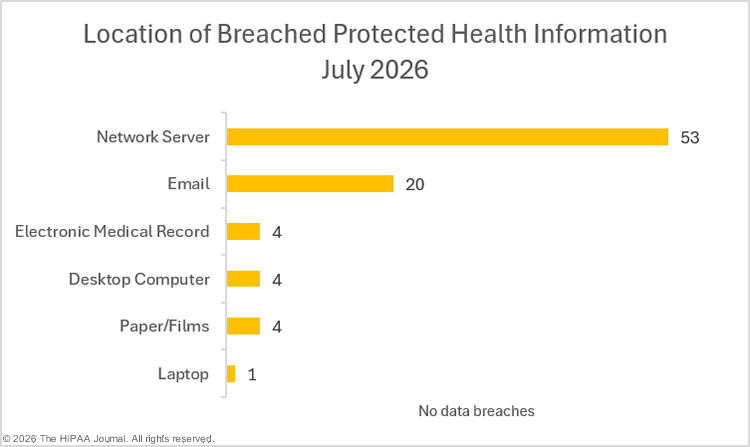
- “In July, network servers were the most common location of breached protected health information, followed by email systems.”
- and
- “Cyberattacks on healthcare organizations are continuing to rise, are becoming costlier to resolve, and are increasingly negatively impacting patient care, according to a recent survey conducted on behalf of the cybersecurity firm Proofpoint. The findings were published in the 2026 Ponemon Healthcare Cybersecurity Report.
- “The survey was conducted by the Ponemon Institute and included 705 responses from IT and IT security practitioners whose responsibilities include setting cybersecurity policies, selecting vendors and contractors, and managing security budgets. The respondents included public healthcare providers (22%), private healthcare providers (18%), healthcare insurers (18%), payers (11%), healthcare insurance companies (10%), with the remainder from life sciences, pharma, and biotechnology companies.” * * *
- “While hacking incidents continue to increase, insider risk continues to be a problem in healthcare, with 97% of organizations experiencing at least two data loss or exfiltration incidents in the past 12 months, with an average of 21 incidents at each organization. More than half of respondents (54%) said these incidents impacted patient care, and 56% of respondents said these insider incidents resulted in an increase in mortality rates.
- “Cybersecurity incidents are increasingly disrupting clinical operations, consuming organizational resources, and affecting care delivery,” explained Proofpoint. “The healthcare organizations that will be most successful in the years ahead will be those that combine cyber resilience, identity security, human risk management, supply chain security, and AI governance into a unified strategy focused on protecting both operations and patient outcomes.”
- Cybersecurity Dive relates,
- “Days after a cyberattack targeting French supermarket refrigerators, thousands of controllers across the globe are visible online and at risk of compromise.
- “Hundreds of grocery stores in France were targeted in a sophisticated attack, in which hackers gained access to programmable controllers that regulate commercial refrigeration systems.
- ‘Hackers were able to manipulate controls inside the refrigerators, causing systems to overheat – and in some cases catch fire – leading to millions of dollars in damage.
- Hackers targeted vulnerabilities in Danfoss AK-SM, Danfoss AK-SC, Copeland xweb and Dixell xweb controllers, according to ANSSI, France’s national cybersecurity agency.” * * *
- Security researchers say the problems begin in the design of these systems, where security is not a top priority.
- “People who design systems, people who build systems, they usually believe that people will be well behaved,” Aleksandr Yampolskiy, co-founder and CEO of Security Scorecard, told Cybersecurity Dive. “But hackers are not well behaved.”
- “High-severity vulnerabilities in Danfoss controllers were publicly disclosed in an August report by Claroty, a firm that specializes in industrial cybersecurity. Researchers found high-severity flaws in the web management interface of Danfoss systems that could allow an attacker to take control of a device.
- “The vulnerabilities were tracked as CVE-2025-41451 and CVE-2025-41452. Researchers originally alerted Danfoss to the flaws in 2025 before releasing the report under a coordinated disclosure process. The manufacturer patched the flaws and issued additional guidance.
- “The attacks impacted hundreds of supermarkets across multiple chains, including Carrefour, Monoprix, Cooperative U and Intermarche.
- “A spokesperson for Copeland confirmed that a vulnerability was found in discontinued end-of-life controllers. The company is actively working with impacted customers to mitigate the risk.”
- CISA added nine known exploited vulnerabilites to its catalog this week.
- October 13, 2026
- CVE-2026-96951 Microsoft Windows Command Injection Vulnerability
- CVE-2026-104935 Ivanti Connect Secure Authentication Bypass by Spoofing Vulnerability
- October 14, 2026
- CVE-2026-0322 Palo Alto Networks PAN-OS Code Injection Vulnerability
- CVE-2026-76519 Cisco Secure Email Gateway Relative Path Traversal Vulnerability
- CVE-2026-105133 Ahsay AhsayCBS Improper Authentication Vulnerability
- CVE-2026-105134 Ahsay AhsayCBS Command Injection Vulnerability
- October 15, 2026
- CVE-2026-21589 Atlassian Multiple Products Files or Directories Accessible to External Parties Vulnerability
- TechNadu discusses the Atlassian KVE here.
- CVE-2026-21589 Atlassian Multiple Products Files or Directories Accessible to External Parties Vulnerability
- October 16, 2026
- CVE-2025-61624. Fortinet Multiple Products Path Traversal Vulnerability
- CVE-2026-102764 BeyondTrust Remote Support Authentication Bypass by Spoofing Vulnerability
- October 13, 2026
- SC Media lets us know,
- “We had a lot of predictions in place at the start of 2026, most of which have come to fruition. But in several cases, reality moved even faster than we expected.
- “The biggest change we have seen so far in 2026 was not a single new attack technique. It’s the way several trends have come together. AI now helps attackers move much faster than before, identities are becoming more important than malware, and legitimate tools and trusted platforms are increasingly becoming the attack path themselves.”
From the ransomware front
- Beckers Health IT reports,
- Ransomware attacks and unverified ransomware claims targeting U.S. healthcare organizations increased 64% in the third quarter of 2026 from the second quarter, an Oct. 15 report from cybersecurity research company Comparitech found. * * *
- The U.S. accounted for 185 of the 306 healthcare ransomware incidents and claims tracked worldwide between July and September. Of those U.S. incidents, 26 were confirmed, including 23 involving healthcare providers.
- Healthcare technology companies experienced the largest quarter-over-quarter increase among the healthcare business categories highlighted in the report. Comparitech identified 22 incidents and claims targeting those companies, up 175% from eight in the previous quarter. Medical manufacturers accounted for another 51 incidents and claims, a 28% increase from the second quarter.
- “Saber Healthcare Group had the largest reported ransomware-related breach, affecting 427,084 people. The organization confirmed in July that a cyberattack had encrypted some files and disrupted services. In September, it began notifying individuals of a breach involving medical information, health insurance details and Social Security numbers. Other large breaches identified in the report involved Park Place Behavioral Healthcare, affecting 71,702 people; Hawaii Family Dental, affecting 45,853; WindRose Health Network, affecting 33,158; and Vernon & Waldrep OB-Gyn Associates, affecting 17,435.
- “The median reported ransom demand was $300,000 for healthcare providers and $150,000 for healthcare businesses. No ransom payments were officially confirmed during the reporting period.
- “The Gentlemen made the most claims against healthcare providers, with 18, followed by INC with 14. Qilin led claims against healthcare businesses with 15. Chaos had the most confirmed attacks in each category.”
- The HIPAA Journal adds,
- “The tactics of ransomware groups are constantly changing to increase pressure on victims to give in to their demands. Initially, file encryption alone was sufficient; however, as victims improved cyber resilience and were able to recover their encrypted files from backups, tactics had to evolve. Ransomware groups incorporated data theft into their attacks and started threatening to sell or leak the stolen data if the ransom was paid. This double extortion approach proved highly successful, with the threat of a data leak alone sufficient to prompt many victims to pay up.
- “Encryption and data leak threats are no longer enough, as the percentage of victims paying ransoms continues to fall. According to a recent survey commissioned by the Identity Threat Detection and Response (ITDR) firm Semperis, the percentage of ransomware victims paying ransoms has fallen from 78% in 2024 to 69% in 2025, and 59% in 2026.
- “Ransomware groups have responded by adopting more aggressive tactics, and a trend has emerged of ransomware groups issuing personal threats against company employees and their friends and family members. The survey revealed that 37% of ransomware attacks involved threats against friends or family members of staff members, and 41% of respondents to the survey said they had been a target of physical or psychological intimidation.
- “While contacting individuals whose data was stolen in an attack has been adopted by several groups in the past, the threats have generally been limited to the publication of personal data, but threats are becoming more severe. Ransomware groups are now issuing threats of physical violence and are contacting employees and their friends and family members via text, email, or phone, confirming that they know where they live, work, and even where their children go to school.” * * *
- “I’ve spoken with CISOs that had strong relationships with law enforcement,” said Courtney Guss, AVP of Crisis Management, Semperis. “They’ve found it to be a much faster route to information and resources than they would otherwise have found on their own, which can often help them recover more quickly. So, knowing those contacts and building those relationships in advance should be part of your crisis management plan.” Semperis also recommends strengthening identity resilience, preparing for identity system breaches, and practicing incident response procedures time and again against realistic scenarios, including tabletop exercises involving all team members involved in the ransomware response.”
- BitSight offers a “DragonForce Ransomware Profile: From Affiliate Program to Cybercrime Cartel”
From the cybersecurity business and defenses front
- The Wall Street Journal reports,
- “Proofpoint has agreed to acquire data-security company Varonis Systems for about $6.3 billion, as artificial-intelligence security continues to drive deals and investment across the cybersecurity industry.
- “Proofpoint will pay $49.75 a share in cash for Varonis, a 52% premium over the stock’s June 22 closing price, the final trading day before reports of a potential sale first surfaced. The transaction is expected to close in the first half of 2027, subject to approval from Varonis shareholders and regulatory bodies.
- “The acquisition comes as cybersecurity vendors scramble to expand their AI capabilities, both to defend against threats that use the technology and to safeguard corporate systems increasingly accessed by autonomous AI tools.
- “Varonis specializes in securing sensitive corporate data and managing access controls, while Proofpoint primarily focuses on email protection and user-level threat defense.”
- and
- “Quantum-computing company IonQ IONQ struck an all-stock deal to buy Elisity in a transaction that values the cybersecurity firm at up to $1.3 billion, executives told The Wall Street Journal.
- It is a bet that cybersecurity will be even more critical for companies as quantum computing and AI systems become more powerful and advanced, said IonQ Chairman and Chief Executive Niccolo de Masi.
- “The bad guys are going to keep taking advantage of new technology,” he said in an interview. “Unfortunately, we are entering the most dangerous years, vis-à-vis cybersecurity risks.” * * *
- “Founded in 2019, Elisity offers a platform that aims to prevent cyber attackers or ransomware from spreading across organizations. Some of its big customers include healthcare companies and hospitals.” * * *
- “IonQ, which works closely with the U.S. Defense Department, has been on an acquisition spree to become a one-stop shop for its customers. Earlier this year, it struck its biggest deal yet, a $1.8 billion takeover of chip maker SkyWater Technology.”
- Cybersecurity Dive relates,
- “The open-source software community needs to understand several key lessons in order to improve its cybersecurity posture, according to IBM, which operates a clearinghouse for analyzing and disclosing open-source vulnerabilities.
- “Finding a vulnerability is only the start,” IBM said in a report published on Thursday [October 15]. “Security teams must understand the risk, determine whether action is needed, find a usable fix, then get that fix to the software that needs it.”
- “The new report — the first in a series collecting insights from IBM’s clearinghouse — is meant to help software maintainers and their customers, including businesses, better understand systemic risks in the open-source ecosystem.”
- and
- “Hackers could break into businesses by going after internet-exposed AI tools that often contain serious vulnerabilities, the internet monitoring firm Censys warned in a report published on Wednesday [October 14].
- “The growing complexity of the AI ecosystem — in which public-facing services rely on a sprawling web of back-end products, many of them neglected by security teams — creates additional security risks, researchers said.
- The Censys report also analyzed internet exposures of industrial control systems (ICS), finding that many of them ran traditional IT services that made them more hackable.
- A human pentester considers when how AI pentesting stacks up against human pentesting.
- “AI pentesting and human pentesting are different, and once you stop trying to rank them the comparison gets a lot more useful.
- “The agents are finding serious issues in applications that human testers have already been through multiple times. They’ll read a whole codebase, work through every path in it, and write up every instance of what they find with the fix down to the line of code.
- “And you can run one whenever you want. For what a single human engagement costs you can run four AI pentests, which means you can do deep testing on a regular basis rather than once a year.
- “That’s a key thing that is missed by human pentesting, and often applications have undergone a lot of untested changes in between pentests.”
- Per the Cybersecurity Hub Newsletter,
- “Anthropic has launched OSS Scanner, a free service that uses its most capable AI models to search open-source software for security vulnerabilities, expanding its efforts to help developers identify weaknesses before attackers exploit them.
- “The service offers participating projects periodic security scans. Its launch introduces a faster route for distributing findings to maintainers who want early access to potential vulnerabilities.
- “The central trade-off is human review. Reports from the new service are generated and delivered without prior human triage, leaving participating projects to establish whether a reported issue is valid and warrants a fix. That could accelerate remediation for teams with sufficient expertise, but it also raises questions about how much additional assessment work maintainers can absorb.”
- SC Media explains “why teams must take a least-privileged access approach in the AI era” and “how to get enterprise-grade security without an enterprise-sized team.”
- Here’s a link to Dark Reading’s CISO Corner.