Roll Call reports that the House of Representatives passed the Senate amended version of the $1.9 trillion American Rescue Plan (HR 1319) by a 220 to 211 vote this afternoon. The President plans to sign the bill into law on Friday March 12. Medpage Today recaps the bill’s healthcare provisions, and the Federal Times recaps its federal employment provisions.
From the healthcare front
Medscape informs us that “A one-time injection of the monoclonal antibody cocktail casirivimab with imdevimab (REGEN-COV), taken within 72 hours of a household member’s diagnosis with SARS-CoV-2, prevented 100% of COVID-19 illness, 100% of high SARS-CoV-2 viral loads, and cut length of asymptomatic infection to 1 week. ‘It’s fantastic news,’ said Rajesh Gandhi, MD, an infectious disease physician at Massachusetts General Hospital and Harvard Medical School, who has been treating people seriously ill with COVID-19 since the pandemic began a year ago in Boston. ‘For individuals who, for whatever reason, don’t get the vaccine or decline the vaccine or haven’t yet gotten the vaccine, it’s really proof that antibodies can prevent disease’ in COVID-19.”
MedPage Today reports that “Data on colorectal cancer (CRC) screening gathered over the past decade have prompted the American College of Gastroenterology (ACG) to update its guidelines, last issued in 2009. The new recommendations, published online in the American Journal of Gastroenterology,state that screening should start at age 45 for persons of average risk.”
The Centers for Medicare and Medicaid Services reminds Medicare Part B beneficiaries who are at risk for diabetes type 2 that they can “join the Medicare Diabetes Prevention Program (MDPP)—part of CDC’s National Diabetes Prevention Program—and take steps to lower your risk for type 2 diabetes by more than 70% [with the help of a health coach]. You’ll also learn the skills needed to improve your overall health and build healthy habits that last a lifetime. And if you have Medicare Part B, it’s free!”
From the regulatory front
Govexec reports that two Senate committees have approved a floor vote for President Biden’s nominee for Deputy Director of the Office of Management and Budget, Shalanda Young. As the OMB Director nominee has withdrawn, Ms. Young will take over the reins of OMB when Senate confirms her. What’s more, bipartisan calls have been made in Congress for the President to nominate Ms. Young to be OMB Director.
Modern Healthcare reminds us that the Department of Health and Human Service has a lot of regulatory work to do in order to launch the No Surprise Billing law’s protections on January 1, 2023.
In healthcare industry news, Beckers Payer Issues informs us that “UnitedHealth Group subsidiary Optum signed a definitive agreement to acquire Atrius Health, a 715-physician group based in Newton, Mass., March 1.”
Roll Call reports that “The House [of Representatives] will vote to clear the $1.9 trillion pandemic relief package for President Joe Biden’s signature on Wednesday, Majority Leader Steny H. Hoyer told reporters.”
From the COVID-19 front
Fierce Pharma informs us that “Vaccine doses are fanning out around the globe, but officials worry that surging coronavirus variants could make the immunization push less effective. Thanks to a new lab study, Pfizer and BioNTech have some good news for them. “Pfizer and BioNTech’s mRNA shot [which the FEHBlog has received] appeared to work against three worrisome variants in a lab study, researchers from both companies and the University of Texas Medical Branch wrote in the New England Journal of Medicine. That includes the P.1 variant that arose in Brazil and has raised concerns about re-infections.”
Fierce Healthcare reports ” As the COVID-19 vaccine rollout continues, payers are gearing up to play a key role in easing vaccine fears and hesitancy. At Humana, for example, this has meant connecting with members at multiple touch points over the past year, and ensuring that vaccine education was not their first conversation with their health plan during the pandemic, Chief Medical Officer William Shrank, M.D., said. “I don’t think any of our members see this as our first outreach,” Shrank said.” But bear in mind health plans better late than never.
The Society for Human Resource Management discusses how employers can take steps now to reduce pandemic fatigue in their employees.
From the general healthcare front —
The Wall Street Journal informs us that “A federal medical panel is calling for a significant expansion of CT scanning for smokers to detect lung cancer, citing studies that found the imaging studies can save more lives than previously known. The U.S. Preventive Services Task Force is advising people ages 50 to 80 to get the screening if they have smoked on average a pack of cigarettes daily for 20 years, and who currently smoke or have quit within the past 15 years. The panel’s previous recommendation, in 2013, recommended people get screened between ages 55 and 80, and have smoked the equivalent of a pack of cigarettes a day for 30 years, and currently smoke or have quit within the past 15 years.” The USPSTF recommendation will result in FEHB coverage of the CT scan for FEHBP members in the expanded group without member cost sharing in 2023.
Health Affairs helpfully reports “Bundled payment has shown promise in reducing medical spending while maintaining quality. However, its impact among commercially insured populations has not been well studied. We examined the impacts on episode cost and patient cost sharing of a program that applies bundled payments for orthopedic and surgical procedures in a commercially insured population. The program we studied negotiates preferred prices for selected providers that cover the procedure and all related care within a thirty-day period after the procedure and waives cost sharing for patients who receive care from these providers. After implementation, episode prices for three selected surgical procedures declined by $4,229, a 10.7 percent relative reduction. Employers captured approximately 85 percent of the savings, or $3,582 per episode (a 9.5 percent relative decrease), and patient cost-sharing payments decreased by $498 per episode (a 27.7 percent relative decrease).” Interesting.
Health Payer Intelligence discusses how payers can take action against racial and ethnic healthcare disparities. Because “the payer industry’s core function is to pay for medical care, insurers can play a key role in overturning local care disparities through their payment strategies, offering funds to organizations that reduce disparities, and by spending locally in a way that is conscious of systemic inequities by purchasing from black and minority-owned businesses,” [Kedar] Mate [president and chief executive officer at the Institute for Healthcare Improvement (IHI), president of the IHI Lucian Leape Institute, and a member of the faculty at Weill Cornell Medical College] said.
From the healthcare industry front
Forbes informs us that “In the largest advertising blitz ever undertaken by the health insurance lobby, America’s Health Insurance Plans will spend at least $10 million on a national education campaign to show how health plans are ‘are working together to deliver affordable and accessible care and coverage.’”
Fierce Healthcare explains that “If there was one key word to come out of Cigna’s investor day on Monday [March 8], it would be “growth.” The insurer spotlighted its ambitions to expand across its enterprise, from its insurance plans to pharmacy to digital tools, at the virtual event for investors Monday morning. CEO David Cordani said that its growth plans “fuel our purpose.”
Fierce Healthcare also reports that “COVID-19 accelerated a number of trends already brewing in the healthcare industry, and that’s not likely to change this year, according to a new report from CVS Health. The healthcare giant released its annual Health Trends Report on Tuesday [March 9], and the analysis projects several industry trends that are likely to define 2021 in healthcare, ranging from technology to behavioral health to affordability. “We are facing a challenging time, but also one of great hope and promise,” CVS CEO Karen Lynch said in the report. “As the pandemic eventually passes, its lessons will serve to make our health system more agile and more responsive to the needs of consumers.”
Drug Channels lists that fifteen largest U.S. pharmacy chains in terms of market share and revenue. CVS Health leads the pack.
From the regulatory front, the Department of Health and Human Services’ Office for Civil Rights (“OCR”) announced today “a 45-day extension of the public comment period for the Notice of Proposed Rulemaking (NPRM) to modify the Health Insurance Portability and Accountability Act (HIPAA) Privacy Rule. OCR first released the NPRM to the public on the HHS website on December 10, 2020, and it was published in the Federal Register on January 21, 2021. The 45-day extension moves the current deadline for the public to submit comments from March 22, 2021, to May 6, 2021. The notice of extension of the comment period is available at https://public-inspection.federalregister.gov/2021-05021.pdf – PDF.” The FEHBlog is pleased that the Biden Administration is giving serious consideration to this proposed rule.
The House [of Representatives] looked on track to pass the latest version of the $1.9 trillion coronavirus relief package later this week, as liberal Democrats swallowed their frustration with the Senate’s changes and prepared to approve the bill for a second time.
The House is expected to narrowly pass the bill Tuesday or Wednesday, sending it to the White House for President Biden’s signature. House Majority Leader Steny Hoyer (D., Md.) had initially said the House would take its first procedural vote on the bill Monday, but processing the bill’s Senate paperwork pushed the vote slightly later in the week, aides said.
In COVID-19 news
The Centers for Disease Control today released guidance for those who are fully vaccinated against the disease (meaning two weeks after the final dose).
The Biden Administration announced “an effort to invest $250 million to encourage COVID-19 safety and vaccination among underserved populations. The U.S. Department of Health and Human Services (HHS) Office of Minority Health (OMH) will offer the funding as health literacy grants to localities, who will partner with community-based organizations, to reach racial and ethnic minority, rural and other vulnerable populations. The new initiative – Advancing Health Literacy to Enhance Equitable Community Responses to COVID-19 – is expected to fund approximately 30 projects in urban communities and 43 projects in rural communities for two years. “
The Food and Drug Administration has given emergency use authorization for “the Cue COVID-19 Test for Home and Over The Counter (OTC) Use. The product is a molecular nucleic acid amplification test (NAAT) that is intended to detect genetic material from SARS-CoV-2 virus present in the nostrils. The test is the first molecular test authorized for at-home use without a prescription.” Here’s a link to the Cue Health website.
In other healthcare news —
Healthcare Dive reports that “for the first time since Fair Health started tracking monthly telehealth claims, COVID-19 became one of the top five diagnoses in the U.S. in December as cases surged, the nonprofit said in a report released Thursday. Overall, telehealth claim lines increased 2,817% year over year, rising from just 0.22% of all medical claim lines in December 2019 to 6.51% in December 2020. Mental health conditions continue to be the No. 1 telehealth diagnosis nationwide.” It’s the last sentence that caught the FEHBlog’s attention.
Benefits Pro writes about the important role that employers and their health plans can help in reducing employee obesity issues. “’Overweight and obesity, which require a comprehensive approach, are top health concerns for employers around the world,’ said Ellen Kelsay, president and CEO of Business Group on Health. ‘Employers play a major part in offering quality health care, understanding obesity’s inextricable link to mental health, lessening the stigma surrounding it and addressing some of the social determinants of health.’ By 2025, one in five adults worldwide will be affected by obesity, according to the organization’s new report, ‘The Global Landscape for Overweight and Obesity: A Guide for Employers.’ As overweight and obesity rates surge worldwide, large employers are positioned to address the chronic medical conditions on multiple fronts, the report said.”
The New York Times reports that “When the pandemic struck last year, many Americans rushed to stock up on alcohol, causing retail sales of wine, beer and liquor to surge across the country. But the uptick in sales was a worrying sign for health experts focused on cancer prevention. In recent years, a growing number of medical and public health groups have introduced public awareness campaigns warning people to drink with caution, noting that alcohol is the third leading preventable cause of cancer, behind tobacco and obesity. * * * [Consumer S]urveys continue to show that most people remain unaware of the risks. When the American Institute for Cancer Research surveyed Americans two years ago to gauge their awareness of different cancer risk factors, the results were striking: fewer than half were aware of the alcohol-cancer link.”
The House of Representatives and the Senate will be engaged in committee and floor work this coming week. Fierce Healthcare reports on healthcare provisions found in the Senate passed American Rescue Plan bill.
Under current law, anyone making 400% above the federal poverty level are not eligible for subsidies to pay down the cost of insurance.
However, under the legislation, anyone making 400% above the poverty level won’t have to pay more than 8.5% of their income on health insurance.
The bill would also ensure that low-income customers won’t have to pay anything for their coverage.
Currently, those making 150% above the poverty level pay no more than 4.3% of their income on healthcare. But the legislation would make their coverage fully subsidized.
The legislation would also offer premium assistance to cover up to 100% of COBRA costs for eligible individuals and families through the end of September.
Another change in the Senate version from the House concerns the removal of a cap on the Medicaid drug rebate, changing the removal of the cap to 2024 instead of 2023. The removal of the rebate cap, which kicks in at 100% of a drug’s average manufacturing price, will lead to higher rebates for Medicaid drugs.
The $1.9 trillion Covid-19 relief bill returns to the House of Representatives this week, where lawmakers will gear up for a vote as soon as Tuesday on the package following narrow approval Saturday by the Senate that came only after concessions to moderate Democrats.
The Senate changes to the bill, which first passed the House Feb. 27 with more generous unemployment provisions, mean House Speaker Nancy Pelosi must hold together her slim majority caucus for a second House vote to send President Biden’s top legislative priority to his desk.
The House is expected to hold a procedural vote on the bill Monday night, with final passage slated for Tuesday.
Speaking of the Affordable Care Act marketplace, Katie Keith updates on the successful first two weeks of the ongoing marketplace special enrollment period.
In other healthcare news
Bloomberg reports on developing approaches to overcome COVID-19 hesitancy. “To do that, officials must make the process of getting shots easier, and fight misinformation about the vaccines, concerns about the speed of development and distrust of government and health-care institutions.” As of today, 23% of the eligible U.S population has received at least one dose of the COVID-19 vaccine. The FEHBlog noticed today that the Johnson & Johnson single dose vaccine is now being administered at the Maryland mass vaccination sites in Baltimore and Waldorf. It strikes the FEHBlog that the single dose vaccine will be more attractive to the hesitant.
NPR Shots offers a physician’s take on five types of medical visits that you should stop putting off. “Emerging evidence tells us that the health threats from postponing some tests and exams — including those for cancer and heart disease, but other crucial appointments too — outweigh the risk of running into the coronavirus at a doctor’s visit, even if the virus is prevalent in your community.”
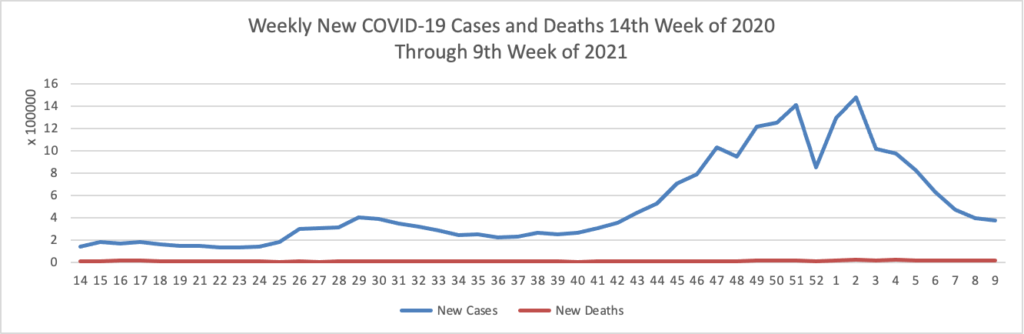
Based on the Centers for Disease Control’s COVID-19 Data Tracker website, here is the FEHBlog’s chart of new weekly COVID-19 cases and deaths over the 14th week of 2020 through 9th week of this year (beginning April 2, 2020, and ending March 3, 2021; using Thursday as the first day of the week in order to facilitate this weekly update):
and here is the CDC’s latest overall weekly hospitalization rate chart for COVID-19:
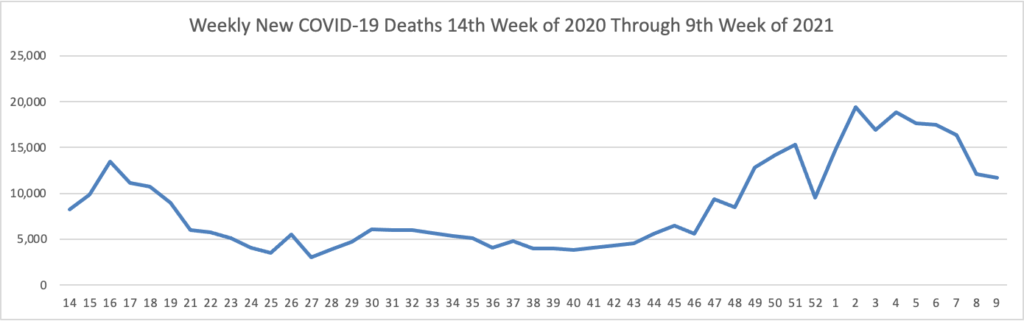
The FEHBlog has noticed that the new cases and deaths chart shows a flat line for new weekly deaths because new cases greatly exceed new deaths. Accordingly here is a chart of new COVID-19 deaths over the period (April 2, 2020, through March 3, 2021):
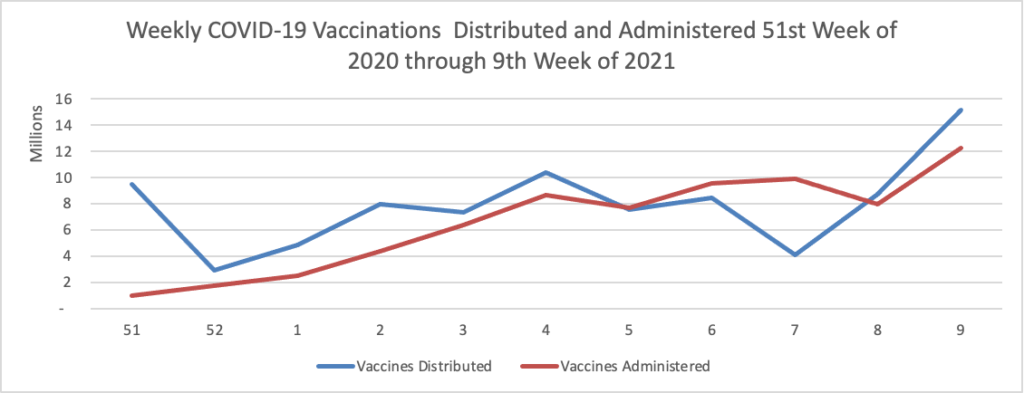
Finally here is a COVID-19 vaccinations chart since mid-December 2020 which also uses Thursday as the first day of the week:
These are all encouraging charts. The CDC reports that as of today 21.7% of eligible Americans (over age 18) have received at least one dose of the COVID-19 vaccine and 11.2% of received two doses.
The CDC’s FluView continues to report that “Seasonal influenza activity in the United States remains lower than usual for this time of year.”
A new study on the topic in JAMA Cardiology is based on the screening of 789 professional athletes who tested positive for Covid-19 between May and October in Major League Baseball, Major League Soccer, the National Hockey League, National Football League, and the men’s and women’s National Basketball Association.
The paper shows that 0.6% of those athletes ultimately had findings suggestive of inflammatory heart disease. Five athletes were held out of competition because of their cardiac results. Three had myocarditis, which is heart inflammation, and two had pericarditis, which is swelling of the tissue that surrounds the heart. All had had moderate cases of Covid.
The findings suggest that long-term heart complications in non-severe Covid cases are unlikely—and that sports leagues are still likely to continue with cardiac screenings during the pandemic.
Govexec offers an interesting interview with National Institutes of Health Director Dr. Francis Collins.
Roll Call reports that the Senate continues to move forward its modified version of the American Rescue Plan which the House of Representatives passed last week. Here’s a link to the Congressional Budget Office’s report on the Senate bill.
The Senate Homeland Security and Governmental Affairs Committee held a confirmation hearing today on the President’s nominations of Shalanda D. Young to be Deputy Director, Office of Management and Budget, and Jason S. Miller to be Deputy Director for Management, Office of Management and Budget. Federal News Network sums up the hearing as follows: “President Joe Biden’s picks to serve in top positions at the Office of Management and Budget vowed on Thursday to remove hurdles from federal hiring, improve employee morale and help agencies keep their workforces safe during the pandemic.”
David Leonhardt of the New York Times does a great job putting the three current COVID-19 vaccines in perspective:
Many Americans are worried that Johnson & Johnson’s Covid-19 vaccine is an inferior product that may not be worth getting. Gov. Doug Burgum of North Dakota recently told The Washington Postthat he was now seeing not only “vaccine hesitancy” but also “the potential for brand hesitancy.”
The perception stems from the headline rates of effectiveness of the three vaccines: 72 percent for Johnson & Johnson, compared with 94 percent for Moderna and 95 percent for Pfizer. But those headline rates can be misleading in a few ways.
The most important measure — whether the vaccine prevents serious illness — shows the Johnson & Johnson vaccine to be equally effective as the other two. All work for nearly 100 percent of people. The picture is murkier for mild cases, but they are not particularly worrisome.
Eli Lilly said Thursday that a study showed its experimental diabetes drug, tirzepatide, reduced patients’ blood sugar and body weight more than a rival medicine, Novo Nordisk’s Ozempic. The study compared three doses of tirzepatide — 5 mg, 10 mg, and 15 mg — to a 1 mg dose of Ozempic. Both drugs were given as injections. Tirzepatide reduced A1C, a measure of blood sugar levels, by 2.09% at the 5-mg dose, 2.37% at the 10-mg dose, and 2.46% at the 15-mg dose. For Ozempic, there was a 1.86% reduction. Patients were followed for 40 weeks.
Patients who received tirzepatide also saw their body weight decline by more than those who received Ozempic. They lost an average of 7.8 kilograms, or 8.5% of their body weight at the lowest dose, 10.3 kg, an 11% decrease, on the middle dose, and 12.4 kg, a 13.1% decrease, on the highest dose. For patients on semaglutide, the decrease in body weight was 6.2 kilograms, or 6.7%.
The differences were all statistically significant.
Lilly plans to virtually present the full trial results at the American Diabetes Association’s annual scientific conference in late June 2021.
In concerning news, the Centers for Disease Control informs us that “a new paper from CDC, in partnership with the University of Utah, estimates that the national healthcare costs associated with infections from six multidrug-resistant pathogens can be substantial at more than $4.6 billion annually. This is one of the largest studies to estimate the cost associated with high-priority antibiotic-resistant pathogens. Issues highlighted in the study align with data and threats in CDC’s 2019 Antibiotic Resistance (AR) Threats Report. This includes the impact of resistant infections in the community, which can put more people at risk, make spread more difficult to identify and contain, and threaten the progress made to protect patients in healthcare.”
Greater liquidity, a stable payer mix and higher-acuity patients helped major hospital chains end 2020 with massive profits despite a financial roller coaster caused by the pandemic.
The latest earnings reports from several for-profit and not-for-profit hospital chains come as patient volumes continue to drift below pre-pandemic levels and as major hospital groups have raised the alarm about financial hardship faced by many hospitals around the country.
And while plenty of health systems around the country are struggling, experts say many of the largest health systems around the nation have remained profitable.
[However] Rural and more independent and smaller facilities already operate on narrower profit margins which have been exacerbated by the pandemic. These financial headwinds could cause more consolidation among such facilities.
The Wall Street Journal reports this evening that “President Biden said the U.S. would have enough Covid-19 vaccines for all American adults by the end of May, two months earlier than he had previously said, after regulators authorized the one-shot Johnson & Johnson vaccine and Merck & Co. agreed to help produce it.” That is very encouraging news.
Politico reports that the President has agreed to comply with Neera Tanden’s request that he withdraw her nomination as Office of Management and Budget Director. “Biden’s statement indicated that he expects Tanden to serve in another role in his administration.”
And here are some tidbits for you —
The House Energy and Commerce Committee held a future of telehealth hearing today. “It is critical to the health, safety and equitable access of our patients to ensure we can continue to provide telehealth services after the end of the public health emergency,” said Megan Mahoney, M.D., chief of staff at Stanford Health Care, who testified at the hearing.
Medpage Today reports that ” Insufficient evidence exists to support any strategy where patients either delay their second dose or only receive one dose of COVID-19 mRNA vaccines [Pfizer and Moderna], even if they have been previously infected with the virus, CDC staff told the agency’s Advisory Committee on Immunization Practices (ACIP) at its Monday meeting. And ACIP committee members seemed to agree * * *.”
Fierce Pharma reports on two recent Food and Drug Administration emergency use authorizations of at home COVID-19 tests.
A friend of the FEHBlog pointed him to this STAT News article written by HHS Office of Inspector General Officials discussing the “importance of adding patients’ diagnoses to their prescriptions.” For example, [d]iagnosis information on prescriptions could help pharmacists identify safety issues,” and electronic prescription systems can accommodate diagnosis information.
CMS, which enforces the HIPAA electronic transaction rules, issued a factsheet on savings available to healthcare providers who use those electronic transactions. “According to data from the 2020 CAQH Index, 16% of medical plans and 36% of dental plans do not fully use electronic HIPAA standard transactions to conduct eligibility and benefits inquiries and responses. The CAQH Index estimates that medical and dental providers could save approximately $7 billion per year by completing eligibility and benefits checks using the HIPAA standard.” Health plans should share this information with their recalcitrant network providers.
Healthcare Dive informs us about four healthcare anti-trust issues to watch in 2021.
Health Payer Intelligence reports that “Blue Cross and Blue Shield of Illinois (BCBSIL) is tackling maternal care disparities in its state by financially supporting community-based interventions that focus on increasing education among new mothers and providing in-person and digital support. ‘By taking a holistic approach to supporting prenatal care that considers the social and economic factors impacting the health of mothers and newborns, we are working to help create an environment that fosters access to affordable benefits, equitable care delivery and wherever possible, better health outcomes,’ said Anita Stewart, MD, medical director at BCBSIL.” Well done.
The Wall Street Journal reports this evening that “The Senate prepared to move ahead this week with Democrats’ sweeping coronavirus relief proposal without an increase in the minimum wage, after a backup plan to raise the wage through tax penalties and incentives fizzled over the weekend.” The Journal of Accountancy helpfully has summarized the tax and non-tax provisions of the House bill. The FEHBlog was surprised to find that the House bill displayed on Congress.gov (H.R. 1319) does not extend the COBRA continuation coverage subsidy to the analogous FEHB’s temporary continuation of coverage program. See page 114 of H.R. 1319.
Pennsylvania-based Blue Cross licensee Highmark announced
today [March 1] that its affiliation unveiled in June 2020 with [fellow Blue Cross licensee] HealthNow New York Inc. has become effective.
“We look forward to bringing our resources, tools and advanced technologies to Western and Northeastern New York,” said Deborah Rice-Johnson, president of Highmark Inc. “With this affiliation, we begin our path forward to enhance customer and clinician engagement, create better health outcomes, control costs and improve affordability for members in Western and Northeastern New York.”
In the coming months, the newly affiliated organization will be rebranded Highmark Blue Cross Blue Shield of Western New York and Highmark Blue Shield of Northeastern New York.
From the healthcare studies front:
Fierce Healthcare reports that “Giving patients discounts for choosing providers that bundle expensive procedures like knee surgeries together resulted in significant savings, a new study finds. The study, published Monday by RAND Corporation, comes as value-based care models have grown in popularity in Medicare but not as much in commercial insurance. The study examined a program that negotiates a preferred price with certain providers to cover an entire episode of care within a 30-day period and waives cost sharing for patients.
The RAND Corporation also has released a report on factors that contribute to COVID-19 vaccine hesitancy in the Black community and how those factors can be addressed.
While payers have been focusing justifiably on diminishing healthcare spending for chronic conditions, rare disease healthcare spending may exceed chronic disease healthcare spending, according to the National Economic Burden of Rare Disease study.
The survey on which this study was founded received responses from nearly 1,400 individuals regarding costs related to 379 rare diseases in 2019.
“This primary survey was specifically designed and administered for this study to deepen the understanding of the full spectrum of rare disease (RD) impact,” the study explained.
“The survey was able to collect detailed data on a broad set of indirect and non-medical costs of RD that were previously unavailable, especially the impact of RD on unpaid caregivers. This survey was one of the largest surveys conducted so far covering multiple RD communities.”
These diseases impacted 15.5 million people and cost $966 billion. This number exceeds even chronic disease cost estimates including the most expensive chronic diseases driving healthcare spending in the US such as diabetes, cancer, and heart disease.
Congress is session this week for committee and floor business. On Tuesday morning the House Energy and Commerce Committee will hold a hearing on “The Future of Telehealth: How COVID-19 is Changing the Delivery of Virtual Care”
The task of passing a coronavirus relief package now rests with the Senate, where Democrats must grapple with emerging divisions over some components of the plan, including a minimum-wage increase. The House early Saturday morning passed [largely along party lines] President Biden’s $1.9 trillion package, which would fund vaccine distribution, enhance and extend federal unemployment benefits, and send direct checks of $1,400 to many Americans and $350 billion to state and local governments.
As mentioned in last Thursday’s post, the Democrat leadership in Congress is trying to figure out a way for the Senate to pass the entire bill under budget reconciliation which requires all fifty Democrat senators plus the Vice President. The $15 minimum wage provision found in the House bill remains a wild card in the Senate.
The President officially sent Kiran Ahuja’s nomination to be OPM Director to the Senate last Wednesday. Federal News Network forecasts six “challenges” that Ms. Ahuja will need to address once confirmed.
In most excellent news, the Food and Drug Administration gave emergency use authorization to the single dose Johnson and Johnson vaccine yesterday and the Centers for Disease Control seconded this action today. This means that health plans, including FEHB plans, become liable for reimbursing administration costs for the Johnson and Johnson vaccine without member cost sharing in 15 days / March 15, 2021. Per CNN with the blessing of these two agencies
[T]he federal government may then begin distributing the 3.9 million available doses of the vaccine, perhaps as soon as Monday.”I just want to state explicitly how very grateful I am that we now have three highly effective vaccines,” said ACIP member Dr. Matthew Daley of the Institute for Health Research with Kaiser Permanente Colorado.
The company has pledged to have 20 million doses available by the end of March and 100 million doses by summer.The vaccine, made by Johnson & Johnson’s Janssen vaccine arm, can be kept at regular refrigerator temperatures, which experts said would make it much easier to distribute than vaccines made by Moderna and Pfizer/BioNTech.
The Wall Street Journal sums it up for us as follows:
The pandemic has opened a new era for vaccines developed with gene-based technologies, techniques that have long stumped scientists and pharmaceutical companies, suggesting the possibility of future protection against a range of infectious disease.
Johnson & Johnson’s Covid-19 vaccine, which was authorized Saturday for use in the U.S., is at the vanguard of a class of shots designed to mobilize a person’s immune defenses against the disease. It will be the first Covid-19 vaccine administered in the U.S. that uses viral-vector technology, which employs an engineered cold virus to ferry coronavirus-fighting genetic code to the body’s cells.
J&J’s vaccine is the third to be authorized in the U.S. after ones from Pfizer Inc. and its partner, BioNTech SE,and Moderna Inc. In a late-stage trial, J&J’s single-shot vaccine was 66% effective in preventing moderate to severe cases of the disease that has killed more than 500,000 people in the U.S. and about 2.5 million world-wide.
“This is one of those giant leap moments for us. These are fundamental shifts in how we will build vaccines for the future,” said C. Buddy Creech, director of Vanderbilt University’s vaccine research program. “I think this really ushers in a golden age of vaccinology.”
By the way the Centers for Disease Control has created its own COVID-19 vaccine finder website. According to the CDC’s COVID-19 data tracker website, currently nearly 20% of the eligible U.S. population has received at least one dose of the vaccine and 10% have received both doses.
Finally, the Choosing Wisely campaign is offering a information and a webinar that address one of the points in OPM’s recent call letter for 2022 benefit and rate proposals from carriers:
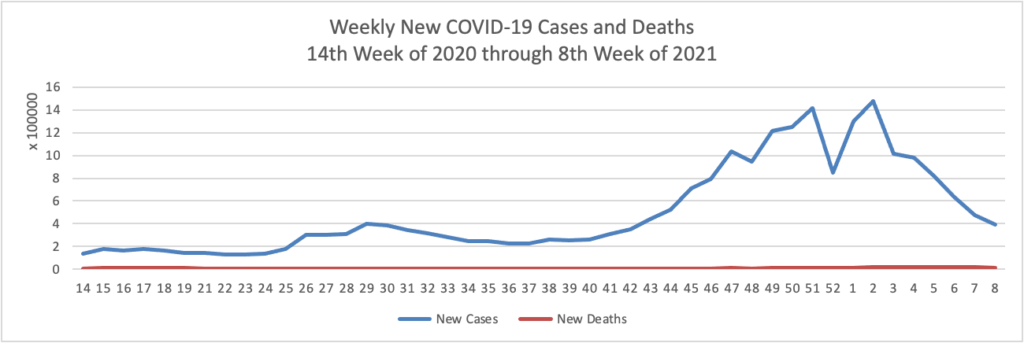
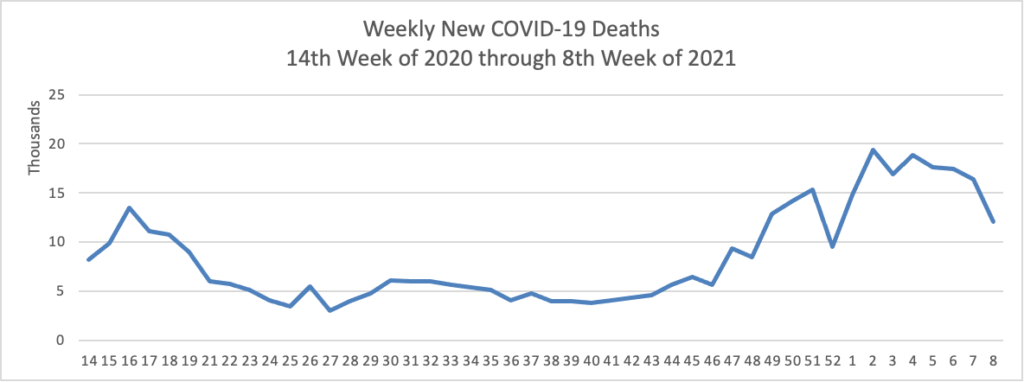
Based on the Centers for Disease Control’s COVID-19 Data Tracker website, here is the FEHBlog’s chart of new weekly COVID-19 cases and deaths over the 14th week of 2020 through 8th week of this year (beginning April 2, 2020, and ending February 24, 2021; using Thursday as the first day of the week in order to facilitate this weekly update):
and here is the CDC’s latest overall weekly hospitalization rate chart for COVID-19:
Covid-19 hospital admissions plummeted 72% in a month in the U.S. as the virus ebbed and the vaccination push accelerated.
Americans 85 years old and over saw the most pronounced drop, down 81% from January to February, according to the U.S. Centers for Disease Control and Prevention, which monitors the data through its Covid-19-Associated Hospitalization Surveillance Network.
The rate was 23.4 hospitalizations per 100,000 residents 85 and over for the week of Feb. 7-13, the latest data available. That was down from 120.3 per 100,000 four weeks earlier. The overall rate across age groups was 4.6, down from 16.7.
The FEHBlog has noticed that the new cases and deaths chart shows a flat line for new weekly deaths because new cases greatly exceed new deaths. Accordingly here is a chart of new COVID-19 deaths over the period (April 2, 2020, through February 24, 2021):
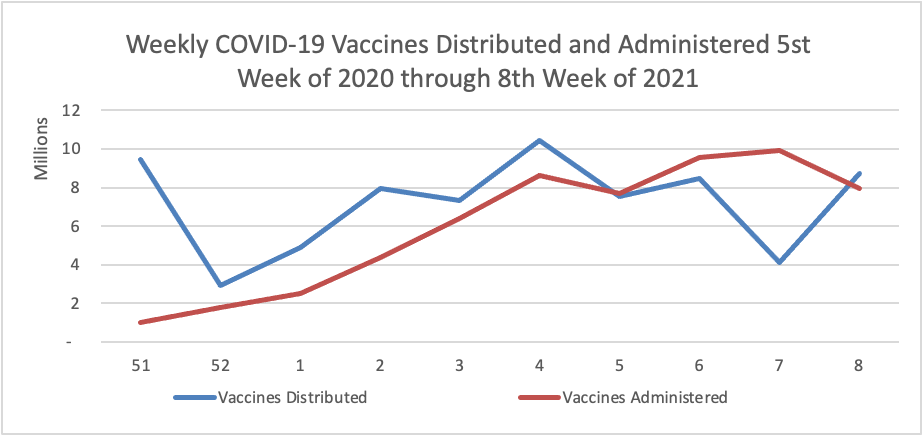
Finally here is a COVID-19 vaccinations chart for past ten weeks which also uses Thursday as the first day of the week:
Johnson & Johnson’s JNJ -2.64% single-dose Covid-19 vaccine worked safely and should be authorized for use in the U.S., a panel of experts advised federal health regulators Friday. The advisory committee’s unanimous vote in support of the vaccine’s authorization is the last step before the U.S. Food and Drug Administration issues a decision, which is expected Saturday.
Yippee!
Reuters reports that “The U.S. Food and Drug Administration on Thursday approved storage and transportation of COVID-19 vaccine developed by Pfizer Inc and German partner BioNTech SE at standard freezer temperatures for up to two weeks instead of ultra-cold conditions. * * * “Alternative temperature for transportation and storage will help ease the burden of procuring ultra-low cold storage equipment for vaccination sites and should help to get vaccine to more sites,” Peter Marks, director of the FDA’s Center for Biologics Evaluation and Research, said.
In other COVID-19 news
The AP informs us that “February is usually the peak of flu season, with doctors’ offices and hospitals packed with suffering patients. But not this year. Flu has virtually disappeared from the U.S., with reports coming in at far lower levels than anything seen in decades.” It’s a silver lining in the COVID-19 cloud.
The Centers for Medicare and Medicaid Service released updated guidance today for health plans, including FEHB plans, on coverage of COVID-19 testing and vaccinations.
States should maintain Covid-19 restrictions such as mask wearing and capacity limitations as case numbers halt their decline, the head of the U.S. Centers for Disease Control and Prevention said Friday, citing the circulation of new variants and infection rates that remain alarmingly high.
CDC Director Rochelle Walensky issued a sobering warning during a press briefing Friday, where she said the more contagious B.1.1.7 variant, first found in the U.K., now accounts for an estimated 10% of current U.S. cases, and that variants in California and New York also appear to spread more easily.
“Things are tenuous — now is not the time to relax restrictions,” Walensky said. “The latest data suggest that these declines may be stalling, potentially leveling off at still a very high number. We at the CDC consider this a very concerning shift in the trajectory.”
STAT News punctured a CDC recent statistic as follows:
The Centers for Disease Control and Prevention made headlines last week when it announced that Covid-19 had reduced the average life expectancy of Americans in 2020 by a full year. The news seemed to starkly illustrate the devastation wrought by our nation’s worst public health crisis in 100 years.
But there was a problem. The pandemic’s appalling toll could not have reduced life span by nearly that much. My own estimate is that when Covid-19’s ravages in 2020 are averaged across the country’s entire population, we each lost about five days of life.
The CDC’s mistake? It calculated life expectancy using an assumption that is assuredly wrong, which yielded a statistic that was certain to be misunderstood. * * * The CDC’s report boils down to a finding that bears no relation to any realistic scenario. Running the 2020 gauntlet for an entire life results in living one year less on average than running that same gauntlet in 2019.
In other healthcare news, Fierce Healthcare informs us that
Cigna will acquire telehealth platform MDLive, the insurer announced Friday morning.
Cigna has been a longtime partner of and investor in MDLive and will fold it into its Evernorth subsidiary, which houses its health services business. The deal is expected to close in the second quarter of 2021, pending regulatory approvals.
Cigna said that it expects to deliver $20 in earnings per share this year, including impacts of the acquisition, and will present additional details about the deal at its investor day on March 8.
Finally, the FEHBlog has been continuing to review the draft Postal Service bill creating a Postal Service Health Benefits Program. He has updated Wednesday’s post on the topic and he wishes to point out an important clarification on how the bill would treat Postal Service annuitants. Per the Committee staff memorandum:
The bill would require future retirees to enroll in Medicare in order to participate in the Postal Employee Benefits Program (similar to the Federal Employee Health Benefit Program but established as a separate risk pool). However, the bill includes several exceptions:
Residents of foreign countries and others without access to Medicare providers would not automatically be enrolled in Medicare; and
Retirees who do not have the requisite 40 quarters of creditable service would not be automatically enrolled in Medicare. This would include many Civil Service Retirement System (CSRS) retirees.
In addition, current retirees would be granted a three-month grace period from the Medicare penalty for late enrollment but would not be required to enroll.
This helps explain why NARFE is willing to support the bill.
We use cookies on our website to give you the most relevant experience by remembering your preferences and repeat visits. By clicking “Accept”, you consent to the use of ALL the cookies.
This website uses cookies to improve your experience while you navigate through the website. Out of these, the cookies that are categorized as necessary are stored on your browser as they are essential for the working of basic functionalities of the website. We also use third-party cookies that help us analyze and understand how you use this website. These cookies will be stored in your browser only with your consent. You also have the option to opt-out of these cookies. But opting out of some of these cookies may affect your browsing experience.
Necessary cookies are absolutely essential for the website to function properly. These cookies ensure basic functionalities and security features of the website, anonymously.
Cookie
Duration
Description
cookielawinfo-checbox-analytics
11 months
This cookie is set by GDPR Cookie Consent plugin. The cookie is used to store the user consent for the cookies in the category "Analytics".
cookielawinfo-checbox-functional
11 months
The cookie is set by GDPR cookie consent to record the user consent for the cookies in the category "Functional".
cookielawinfo-checbox-others
11 months
This cookie is set by GDPR Cookie Consent plugin. The cookie is used to store the user consent for the cookies in the category "Other.
cookielawinfo-checkbox-necessary
11 months
This cookie is set by GDPR Cookie Consent plugin. The cookies is used to store the user consent for the cookies in the category "Necessary".
cookielawinfo-checkbox-performance
11 months
This cookie is set by GDPR Cookie Consent plugin. The cookie is used to store the user consent for the cookies in the category "Performance".
viewed_cookie_policy
11 months
The cookie is set by the GDPR Cookie Consent plugin and is used to store whether or not user has consented to the use of cookies. It does not store any personal data.
Functional cookies help to perform certain functionalities like sharing the content of the website on social media platforms, collect feedbacks, and other third-party features.
Performance cookies are used to understand and analyze the key performance indexes of the website which helps in delivering a better user experience for the visitors.
Analytical cookies are used to understand how visitors interact with the website. These cookies help provide information on metrics the number of visitors, bounce rate, traffic source, etc.
Advertisement cookies are used to provide visitors with relevant ads and marketing campaigns. These cookies track visitors across websites and collect information to provide customized ads.