Tuesday Tidbits

Tuesday Tidbits

Photo by Patrick Fore on Unsplash

Happy Mardi Gras!

As the FEHBlog has noted, the FEHB Program has unique demographics compared to other employer sponsored health plans because the federal government offers generous FEHB annuitant coverage to its employees. FEHB enrollment is roughly 52% active employees and 48% annuitants. The average age of federal and postal employees is late forties and the FEHBlog understands that average age of an FEHB enrollee is sixty. (OPM offers detailed demographic statistics on its workforce but not on its retirement system members. No complaints, just stating a fact.)

Today HHS’s Agency of Healthcare Research and Quality issued a fascinating report titled “Concentration of Healthcare Expenditures and Selected Characteristics of High Spenders, U.S. Civilian Noninstitutionalized Population, 2018.” Here are the report’s highlights:

  • In 2018, the top 1 percent of persons ranked by their healthcare expenditures accounted for about 21 percent of total healthcare expenditures, while the bottom 50 percent accounted for only about 3 percent.
  • Persons ages 65 and older and whites were disproportionately represented in the top spending tiers.
  • Inpatient hospital care accounted for 36 percent of spending for persons in the top 5 percent of the spending distribution.
  • About three-quarters of aggregate expenses for persons in the top 5 percent of spenders were paid for by private insurance or Medicare.

In 2018, the top 1 percent of persons ranked by their healthcare expenditures accounted for 21 percent of total healthcare expenditures (100 minus 79 percent; figure 1), with an annual mean expenditure of $127,284 (figure 2). The group within the top 1 percent is defined as persons who spent $72,212 or more during the year. Cut points for additional percentile groups are shown in table 1 [immediately below]. The top 5 percent of the population accounted for 48.3 percent of total expenditures (100 minus 51.7 percent), with an annual mean expenditure of $58,609. The bottom 50 percent accounted for only 3.2 percent of total healthcare expenditures. Every person in this group spent less than $1,317 during the year (table 1), with an average annual expenditure of $384 (figure 2).

Percentile of population2018 Expenditure
Top 1%$72,212 or more
Top 5%$26,355 or more
Top 10%$14,651 or more
Top 30%$3,776 or more
Bottom 50% Less than $1,317

But given the FEHB’s demographics, this figure particularly caught the FEHBlog’s eye:

Figure 4: Percentage of persons by age group and percentile of spending, 2018

Age groupOverall percentageBottom 50%Top 50%Top 10%Top 5%
0–1722.630.614.56.45.8
18–4435.243.227.320.818.9
45–6425.420.130.733.436.3
65+16.86.027.539.439.0

It is a credit to OPM and the FEHB carriers that they are able to hold premiums rather stable.

On the COVID-19 vaccination front —

  • NPR updates us with encouraging COVID-19 vaccination distribution statistics.
  • Federal News Network tells us that “The Biden administration’s Safer Federal Workforce Task Force has new details on how agencies should handle [COVID-19 vaccination] leave, labor unions and mask mandates during the ongoing pandemic.”
  • The Centers for Disease Control now offers guidance on how to arrange COVID-19 vaccinations for home-bound individuals.

Healthcare Dive reports on CVS Health’s fourth quarter 2020 earnings report. The headline is that CVS Health’s payer arm Aetna plans to return to the Affordable Care Act marketplace for 2022.

CVS’ fourth quarter revenue of $69.6 billion, up 4% year over year, was mostly due to growth in the benefits segment. Healthcare benefits reported quarterly revenue of $19.1 billion, up 11% year over year, driven primarily by membership growth in Medicaid and Medicare products and partially offset by a drop in commercial membership and COVID-19 costs.

As of the end of 2020, CVS covered 23.4 million lives. Despite fluctuating membership and utilization due to COVID-19 over the course of last year, overall utilization in the fourth quarter was generally back to normal, executives said. The company’s medical loss ratio, a marker of how much it’s reinvesting in patient care, was 86.7% in the quarter, compared to 85.7% same time last year.

JDSupra includes this employment law article titled “Employees Starting to Receive the COVID-19 Vaccine – Now What?” which is worth a gander in the FEHBlog’s opinion.

Happy Presidents’ Day

Mount Rushmore

It turns out that MountVernon.org takes offense at the use of the designation Presidents’s Day because the official federal holiday is Washington’s Birthday. The FEHBlog expects that it would be a bigger deal if George Washington had not been our first President.

On the COVID-19 vaccine front —

  • The Wall Street Journal reports that

A study by Clalit, Israel’s largest healthcare provider, showed a 94% drop in symptomatic Covid-19 infections among 600,000 people who received two doses of Pfizer’s vaccine.

The vaccinated group was also 92% less likely to develop severe illness from the disease, according to the study. It compared 600,000 people who got the vaccine with a group of the same size and similar medical histories that didn’t.

Clalit said the study, which was carried out with a team from Harvard University, included 430,000 people who were between 16 and 59 years of age, and 170,000 who were over 60. It was the first of its kind to show such a high level of efficacy for Pfizer’s vaccine for those aged 70 and higher due to the limited scope of the clinical trials.

  • Federal News Network reports that “To date, the Pentagon vaccinated a little more than 800,000 employees. Since Dec. 14, DoD received about one million doses and delivered about 996,000 of them to military installations. DoD spokesman John Kirby said Thursday [February 11] on a call with reporters that the efficiency rate of delivered vaccines to getting them in arms is around 82%.”

The U.S. Postal Service has also reached out to employees, alerting them that they should be eligible for vaccine doses once their states get to the Phase 1B, essential worker stage. In a message to workers last month, USPS encouraged its staff to seek the vaccine by any means available. They cautioned their employees against waiting to get a shot through their workplace. Still, behind the scenes postal management is working with states and other jurisdictions receiving vaccine distributions to set up mass vaccination events at their large plants. To date [last Friday February 12], however, the agency has announced no such plans and employees have voiced frustrations with the lack of communication and sense that they have been left to their own devices. A USPS spokesman recently told Government Executive it was working toward a “standardized priority opportunity” for its workers in conjunction with federal, state and local stakeholders.

In other news —

  • The special enrollment period for the ACA marketplace began today for “consumers in the 36 states that use the HealthCare.gov platform * * * and will continue through Saturday, May 15. At least 13 States plus the District of Columbia, which operate their own Marketplace platforms, have decided to offer a similar opportunity.” USA Today provides more information on the state marketplaces.
  • Health Payer Intelligence discusses at length “How Payer Forecasting Is Shifting Towards Real-Time Data Analytics.”
  • Employee Benefit News discusses the following four workplace policies that employer should be re-evaluating in 2021 —
  • Human Resources policies and procedures
  • Risk management – measurement, management and mitigation
  • Training, education and development
  • Workplace culture

Friday Stats and More

Image result for abraham lincoln birthday

Happy Lincoln’s Birthday.

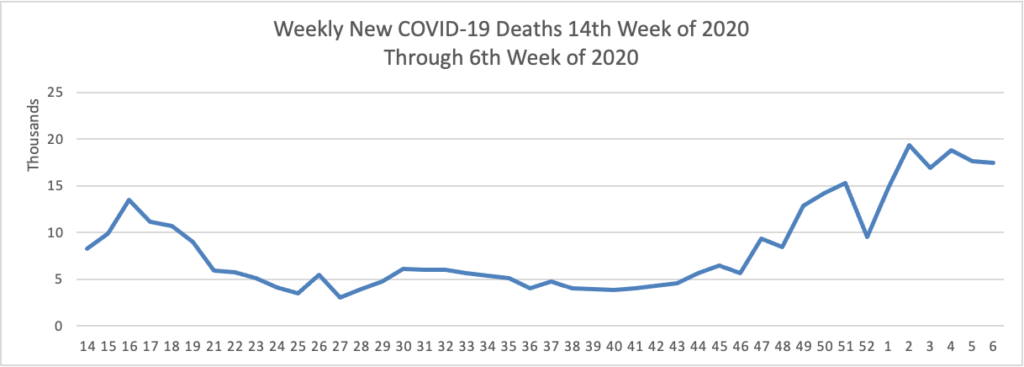
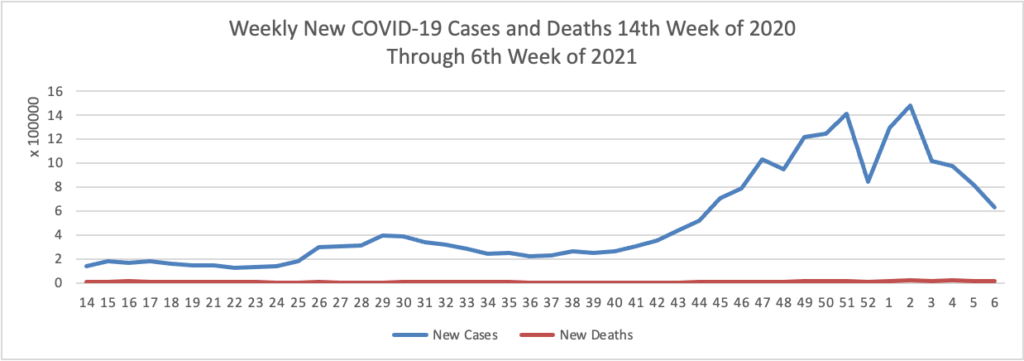
Based on the Centers for Disease Control’s COVID-19 Case Tracker website, here is the FEHBlog’s chart of new weekly COVID-19 cases and deaths over the 14th week of 2020 through the 6th week of this year (beginning April 2, 2021, and ending February 10, 2021; using Thursday as the first day of the week in order to facilitate this weekly update):

and here is the CDC’s latest overall weekly hospitalization rate chart for COVID-19:

The FEHBlog has noticed that the new cases and deaths chart shows a flat line for new weekly deaths because new cases greatly exceed new deaths. Accordingly here is a chart of new weekly COVID-19 deaths over the period April 2, 2020, through February 10, 2021):

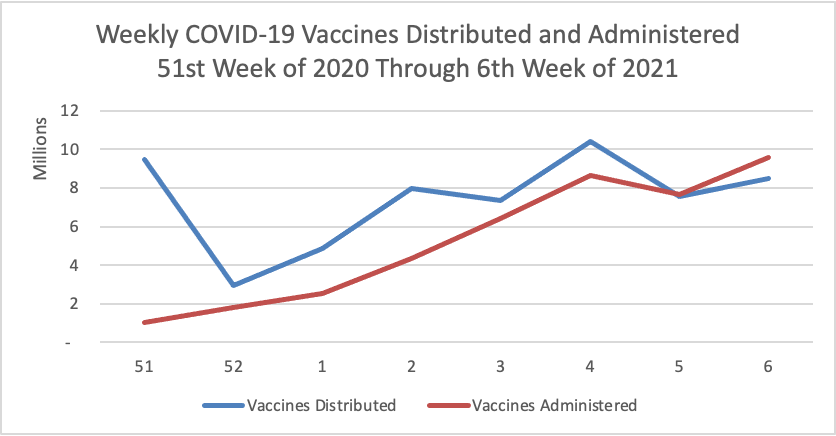
Finally here is a COVID-19 vaccinations chart from December 17, 2020, through February 10, 2021, which also uses Thursday as the first day of the week:

The Wall Street Journal sums it up well for this week :

U.S. Covid-19 deaths [a lagging indicator] appear to finally be slowing, following a broad and steep decline in both newly reported cases and hospitalizations in recent weeks.

While daily deaths remain near record highs, the average number of coronavirus-related fatalities has broadly fallen in recent days, dropping from a seven-day average of 3,172 on Feb. 1 to 2,765 on Wednesday, according to a Wall Street Journal analysis of Johns Hopkins University data.

Vaccinations, meanwhile, appear to be increasing, with about two million shots administered Thursday, according to a Wall Street Journal analysis of data from the Centers for Disease Control and Prevention.

In other vaccination news —

  • Medpage Today informs us about CDC changes to its adult and children vaccination recommendations which were released yesterday.
  • HR Dive reports that

The Society for Human Resource Management and 41 other business groups including the U.S. Chamber of Commerce have asked the U.S. Equal Employment Opportunity Commission (EEOC) to clarify “the extent to which employers may offer employees incentives to vaccinate.”

In a Feb. 1 letter to EEOC Chair Charlotte Burrows HR Dive obtained from the HR Policy Association, a signee, the groups wrote that incentives may aid in coronavirus vaccine distribution. But many employers are concerned about the liability they could create in offering such incentives, the letter said.

The signees asked EEOC to clarify how they might offer vaccination incentives without infringing upon the boundaries established by the Americans with Disabilities Act and other laws enforced by the agency. Specifically, the groups requested that the agency issue guidance that defines “what qualifies as a permissible incentive as broadly as possible.” An EEOC spokesperson said the agency appreciates “input from all stakeholders and will review the letter carefully.”

From the seeking public comment front —

  • The National Committee for Quality Assurance is seeking “feedback on proposed new measures, changes to existing measures and proposed measures for retirement. Public comment is now open for HEDIS® Measurement Year 2022.” The public comment deadline is March 11, 2021.
  • HHS’s Agency for Healthcare Research and Quality “encourage [interested parties] to review the draft report [titled “Strategies to Improve Patient Safety: Draft Report to Congress for Public Comment and Review by the National Academy of Medicine”] and send comments to PSQIA.RC@ahrq.hhs.gov no later than Feb. 16. We’ll review feedback in developing a final report for Congress later this year.” That’s not much time as the notice was posted today.

Thursday Miscellany

Photo by Juliane Liebermann on Unsplash

Today the Department of Health and Human Services (“HHS”) announced that

HHS and Department of Defense (DOD) have purchased an additional 100 million doses of COVID-19 vaccines from both Pfizer Inc. and Moderna Inc. to help meet demand for COVID-19 vaccines in the United States. The orders placed today bring the vaccine purchased by the U.S. government from these two companies to a total of 600 million doses, enough to vaccinate 300 million people. Each company is delivering 300 million doses in regular increments through the end of July 2021. Each company will leverage U.S.-based manufacturing capacity to fill, finish and ship vials as the bulk material is produced.”

The current U.S. population is 333 million and roughly 60 million of those people under age 16 and therefore currently are ineligible for either vaccine. Consequently the government has purchased more than enough of these two vaccines to vaccinate the entire eligible population with both doses. What’s more, 34 million Americans (10% of the entire U.S. population) already has received the first dose of one of these vaccines and another 11 million have received both doses. Also the Johnson and Johnson single dose vaccine should be available early next month. It’s becoming a matter of logistics.

The Wall Street Journal which was the first paper to legally crack into Medicare pricing records has now figured out how to find transparent hospital pricing required by the new HHS rule.

Mayo Clinic offers a search interface at https://costestimator.mayoclinic.org/. The nonprofit hasn’t posted a file covering all of its negotiated rates and says it is working to have one online by this spring.

The hospital chain Sutter Health, on the other hand, is offering downloadable data for all of its hospitals on a single webpage labeled “Healthcare Cost Transparency,” here: https://www.sutterhealth.org/for-patients/healthcare-cost-transparency

Efforts to pull together and standardize data from many hospitals are emerging. Turquoise Health Co. has scoured the websites of every known hospital in the country—more than 6,000 providers—and found disclosures that at least partially meet the requirements for 1,700 hospitals, according to Chris Severn, a co-founder of the company. Consumers can search the data on Turquoise’s website at https://turquoise.health/

“This data was hard to find but it’s incredibly useful and, overall, a large amount of the industry has complied,” Mr. Severn said. “This is a huge step towards cost-informed decision making in health care.”

The American Hospital Association points out that

Leading health providers have come together in unprecedented fashion to unite around the goal of improving the lives of those they serve through data insights. Health provider innovators AdventHealth, Advocate Aurora Health, Baptist Health of Northeast Florida, Bon Secours Mercy Health, CommonSpirit Health, Hawaii Pacific HealthHenry Ford Health SystemMemorial Hermann Health SystemNorthwell Health, Novant Health, Providence health system, Sentara Healthcare, Tenet Health, and Trinity Health have formed Truveta, a new company with a vision to save lives with data. 

Through structuring, normalizing, and de-identifying data from these health providers, a new data platform will be built, with careful protection of patient privacy and security. This new platform, using the power of AI and machine learning, will enable unprecedented insights as providers are able to learn from each other with statistically significant scale and representation of diverse populations. 

Together, these 14 health providers care for tens of millions of patients and operate thousands of care facilities across 40 states. The health providers will govern Truveta’s ethical pursuit of insights from this unprecedented de-identified data set. 

Interesting.

Also the Blue Cross Blue Shield Association announced that

Today, a broad coalition of health care and employer groups called for achieving universal health coverage by expanding financial assistance to consumers, bolstering enrollment and outreach efforts, and taking additional steps to protect those who have lost or are at risk of losing employer-based coverage because of the economic downturn caused by the COVID-19 pandemic. 

The Affordable Coverage Coalition encompasses groups representing the nation’s doctors, hospitals, employers and health insurance providers that collectively serve hundreds of millions of American patients, consumers and employers. The joint commitment by such a broad array of interests is a significant milestone on the path toward universal coverage, which has remained an elusive goal within the U.S. healthcare system. 

The organizations support the following steps to make health coverage more accessible and affordable: 

Protect Americans who have lost or are at risk of losing employer-provided health coverage from becoming uninsured. 

Make Affordable Care Act (ACA) premium tax credits and cost-sharing reductions more generous, and expand eligibility for them. 

Establish an insurance affordability fund to support any unexpected high costs for caring for those with serious health conditions or to otherwise lower premiums or cost-sharing for ACA marketplace enrollees. 

Restore federal funding for outreach and enrollment programs. 

Automatically enroll and renew individuals eligible for Medicaid and premium-free ACA marketplace plans. 

Provide incentives for additional states to expand Medicaid, in order to close the low-income coverage gap. 

Good luck. (Not to be confused with the Council for Affordable Health Coverage which appears to have similar goals.)

Midweek update

Photo by Manasvita S on Unsplash

From Capitol Hill —

  • Katie Keith helpfully provides more detail on the healthcare provisions found in the draft House of Representative’s COVID-19 relief budget reconciliation bill.
  • Govexec.com reports on the federal employee related provisions of the same draft bill.
  • FedSmith informs that “Some Members of Congress are asking the Office of Personnel Management to give federal employees administrative leave for any time they spend getting vaccinated for COVID-19. The letter was sent to OPM by Reps. Don Beyer (D-VA), Eleanor Holmes Norton (D-DC), Gerald E. Connolly (D-VA), Anthony Brown (D-MD), Jamie Raskin (D-MD), David Trone (D-MD), and Jennifer Wexton (D-VA). They state in the letter that mandating that federal agencies provide administrative leave to federal employees is necessary to fight the pandemic. “…it is imperative that the federal government take every possible step to encourage federal employees to receive the vaccine, including providing them with the administrative time to do so,” reads the letter.”
  • Politico reports on Office of Management and Budget Director nominee’s confirmation hearing this morning before the Senate Budget Committee.
  • The Brookings Institute released a report with recommendations on making Capitol Hill a better place to the work. This recommendation caught the FEHBlog’s eye:

Since 2014, members and certain congressional staff have been required to use Washington, D.C.’s small-business marketplace established by the Affordable Care Act to obtain insurance, rather than having their health benefits provided via the Federal Employees Health Benefits Program that insures other federal employees. As the HSCMC’s final report noted, “The transition to the D.C. exchange has been particularly challenging for some district-based staff as finding local health providers who accept patients covered by the D.C. exchange is difficult.” The HSCMC recommended that Congress eliminate this setup, allowing both D.C.- and district-based staff to either enroll in standard federal health plans or to use their relevant local marketplace to purchase coverage.

OPM could implement the “local marketplace” fix via regulation. An interim regulation would be nice as the federal ACA marketplace is about to reopen for three months.

While on the topic of the Affordable Care Act, the Biden Administration’s Justice Department filed a very sensible letter today with the U.S. Supreme Court regarding the California v. Texas case concerning the ACA’s constitutionality. It states that it is now the Justice Department’s position that zeroing out the individual mandate did not render the ACA unconstitutional. “[T]he 2017 amendment preserved the choice between lawful options and simply eliminated any financial or negative legal consequence from choosing not to enroll in health coverage.” How true.

From the COVID-19 front —

  • MedCity News reports that “An Eli Lilly therapy comprised of two antibodies given together has been awarded FDA emergency authorization for treating Covid-19, providing yet another option for patients diagnosed with the disease. The decision comes two weeks after Indianapolis-based Lilly reported clinical trial data showing that given together, the antibodies bamlanivimab and etesevimab reduced Covid-19 patients’ risk of hospitalization and death by 70 percent. The FDA authorization, issued late Tuesday, covers adults and children 12 and older with mild-to-moderate Covid-19 whose cases are at high risk of progressing to severe disease. The authorization also includes patients 65 and older who have certain chronic medical conditions.

New data from the Blue Cross and Blue Shield Association (BCBSA) take a look at just how much COVID-19 cases are costing insurers.

BCBSA studied more than 90,000 confirmed cases of the novel coronavirus pulled from a diverse selection of its membership. The group found COVID-19 cases treated in an outpatient setting cost between $500 and $1,000 per member on average, with the average age of patients seeking such care being 34.

When members were hospitalized with the virus, however, costs were 45 times higher than for cases treated on an outpatient basis. For members who needed a stay in the intensive care unit, costs jumped another 2.5 times compared to other hospitalizations, BCBSA found. The average age for members hospitalized with COVID-19, including in the ICU, was 54, according to the analysis.

  • The Wall Street Journal tonight adds more detail to yesterday’s report on the World Health Organization of the spread of COVID-19 in China.

About 90 people were hospitalized with Covid-19-like symptoms in central China in the two months before the disease was first identified in Wuhan in late 2019, according to World Health Organization investigators, who said they pressed Beijing to allow further testing to determine whether the new virus was spreading earlier than previously known. * * * If the 90 cases included Covid-19 infections, it could help explain suspected coronavirus cases that researchers believe occurred in Europe and possibly the U.S. in November and December 2019. * * * The U.S. said Tuesday it saw no potential origin other than in China and wanted to examine the underlying data from the WHO’s four-week mission.

Finally, Health Payer Intelligence provides its perspective on fourth quarter financial reports from health insurers. “Payers anticipate that increased membership, lower utilization, potentially a higher federal medical assistance percentage, and other factors could offset healthcare spending as it returns to normal levels.”

Tuesday Tidbits

The Wall Street Journal reports tonight that

The most severe surge of the Covid-19 pandemic in the U.S. has weakened significantly, according to key metrics, though public-health experts and epidemiologists urge caution, given the spread of highly contagious new variants.

Newly reported cases have dropped 56% over the past month, based on a seven-day average, marking a significantly steeper fall than the U.S. saw after the spring and summer surges. Hospitalizations have declined 38% since Jan 6. The seven-day average of Covid-19 tests returning positive fell over the past week to 6.93%, the lowest since Oct. 31.

“The concern right now is that while we’re seeing a decline in cases from the holiday surges, as we identify more transmission of the variants within the U.S., this could lead to another surge,” said Saskia Popescu, an assistant professor at the Schar School of Policy and Government at George Mason University.

The American Medical Association reports

[A]s part of its “Understanding Coronavirus in America” study, researchers from the University of Southern California Center for Economic and Social Research recently analyzed data from 6,000 members drawn from its “Understanding America Study.” Data was collected between March 10, 2020, and Jan. 6, 2021, and found that 83% of adults surveyed view wearing a mask as an effective way to stay safe from COVID-19, but that their behavior is inconsistent.

The analysis found:

Two-thirds reported being within less than six feet of someone outside their household in early December, but only half mostly or always wore a mask while doing so.
White people were the least likely to consistently wear a mask when in close contact with people from other households, with 46% reporting wearing a mask compared to 67% of black people, 63% of Latinos and 65% of people of other races.
In rural areas, 42% reported always wearing a mask or wearing one most of the time when they were with people outside of their household. In suburban areas, the number jumped to 52% and it was highest in urban areas at 57%.
Among the 81% who said they went grocery shopping in early December, 90% reported wearing a mask.

This is why the vaccination campaign is so important.

On the Capitol Hill front

  • The Hill explains Sen. Ron Wyden’s plans as the new Chair of the Senate Finance Committee. The Senator has been a critic of high prescription drug prices.
  • The Hill also reports the House of Representatives is developing a COVID-19 relief budget reconciliation bill that would increase and expand the availability of Affordable Care Act subsidies as well as offer 85% subsidies for employer sponsored plan continuation coverage, i.e., COBRA and TCC, during 2021 and 2022.

On the Biden Administration transition front —

  • NPR discusses Office of Management and Budget Director nominee * Neera Tanden’s confirmation hearing before the Senate Homeland Security and Governmental Affairs Committee today. Ms Tanden has a second confirmation hearing scheduled before the Senate Budget Committee tomorrow morning.
  • Federal News Network informs us that President “Biden recently appointed Pam Coleman as OMB’s new associate director for performance management, the agency’s point person on federal workforce issues. * * * Coleman comes from the New Mexico state government, where she led the personnel office for the last two years. Coleman had multiple roles in the Obama administration, including as a leadership development team lead in the White House Presidential Personnel Office and as a liaison to DHS. The OMB associate director for performance management is usually the agency’s go-to on everything from federal pay and benefits to hiring and labor relations. Biden hasn’t yet nominated a new director for the Office of Personnel Management.”
  • STAT News compares the two leading contenders for Food and Drug Administration Dr. Janet Woodcock, the current acting commissioner, “and Josh Sharfstein, a vice dean at the Johns Hopkins Bloomberg School of Public Health who served as the FDA’s second-in-command during the Obama administration.” Dr. Woodcock is an FDA vet while Dean Sharfstein would be “only the second FDA commissioner in modern history to serve as a local public health official. While most FDA commissioners typically come from backgrounds in academic medicine or from other federal agencies, and thus tend to focus primarily on the regulation of drugs, Sharfstein has been far more outspoken about the FDA’s lesser known responsibilities, like regulating cigarettes and food.”

In other tidbits —

  • Beckers Hospital Review lists the HealthGrades top fifty U.S. hospitals for January 2021.
  • Govexec reports on the Postal Service’s latest quarterly financial report and a looming Postal Board of Governors power shift from Republicans to Democrats.
  • The Society for Human Resource Management seeks to keep us up to date on “evolving COVID-19 testing and safety guidelines [for employers] as the pandemic persists.”

Monday Roundup

Photo by Sven Read on Unsplash

The Wall Street Journal reports today that

As vaccinations speed up across the U.S., key Covid-19 metrics are declining from a record-setting fall surge. Newly reported cases fell below 100,000 for the first time this year. Hospitalizations dropped for the 26th day in a row, and the number of Covid-19 patients requiring intensive-care treatment fell to its lowest level since Nov. 19.

The country is now averaging about 1.4 million vaccinations a day, and nearly 10% of the U.S. population has been given at least one dose, according to a Wall Street Journal analysis of data from the Centers for Disease Control and Prevention. Demand is so high in some states it is overwhelming local providers and frustrating people seeking shots.

The Journal also offers an op-ed by former Food and Drug Commissioners and Doctors Scott Gottlieb and Mark McClellan recommending that the federal government start planning now for a potential “glut” of the COVID-19 vaccine beginning in the summer of this year. “It is essential to emphasize in public-health messaging that every adult can benefit and deserves the protections they can provide, and there will be no reason to forgo it once the scarcity problem is solved.”

Fierce Healthcare reports that

Healthcare spending is expected to balloon to $8.3 trillion by 2040, which is $3.5 trillion less than a federal government estimate, a new report from consulting firm Deloitte finds.

The reason for the discrepancy is that consumers will take a more active role in their healthcare and therefore help curb spending, including by getting early signals of disease and addressing them proactively, according to the report released Monday.

“We anticipate that emerging technologies, an ability to cure and prevent disease (or detect disease in the earliest stages), and highly engaged consumers will lead to a deceleration of health spending between now and 2040,” the report said.

Here’s hoping.

Health Payer Intelligence informs us that “Payers are not leveraging care management to its fullest capacity and they have an opportunity reform their care management programs to improve quality of care and return on investment, a report from McKinsey & Company (McKinsey) found.” The report recommends four steps which the article describes in more detail”

First, the report recommended that payers target high-potential sources of value.

Second, payers should leverage care management to address clinically inappropriate healthcare spending, instead of seeking only to reduce total healthcare spend.

Third, the researchers urged payers to embrace consumerism.

Finally, payers should adopt operational metrics and disciplines to govern their care management programs

In the FEHBlog’s experience, good advice, like this, is always worth consideration but also is easier said than done.

In other news —

  • Politico recently reported that “Chiquita Brooks-LaSure, a longtime Democratic health policy expert, has emerged as the leading candidate to run President Joe Biden’s Medicare and Medicaid agency, according to three sources familiar with the Biden team’s discussions.”
  • Reuters reported that a federal district judge has dismissed Walmart’s lawsuit, filed last October, “seeking to preemptively block the U.S. government from blaming the world’s largest retailer for its alleged role in fueling the nation’s opioid crisis. U.S. District Judge Sean Jordan said the government had not waived its sovereign immunity from Walmart’s “sweeping” challenge to the Department of Justice’s and Drug Enforcement Administration’s enforcement of laws governing opioid prescriptions by pharmacies and pharmacists.” Not surprisingly this lawsuit did not deter the Justice Department’s lawsuit against Walmart. Walmart plans to appeal this decision.
  • The Internal Revenue released today the 2021 version of its popular Employer’s Tax Guide to Fringe Benefits (Publication 15-B).

Weekend Update

Image result for super bowl

Happy Super Sunday LV!

The House of Representatives is engaged in committee work. The Senate is engaged in floor and committee work. The Wall Street Journal reports that

Senate Democrats said they expect a short impeachment trial starting this week for former President Donald Trump as they also seek to push ahead with the Biden administration’s proposed $1.9-trillion economic-relief bill.

The two events, combined with continuing hearings and votes on President Biden’s cabinet nominees, presage competing priorities as the new Democratic majority—which is reliant on Vice President Kamala Harris to break tied votes—is still figuring out key details on the trial process and on what provisions to include in the bill.

The Senate Homeland Security and Governmental Affairs is holding a confirmation hearing for Office and Management and Budget Director nominee Neera Tanden on Tuesday morning. The Senate Health Education Labor and Pension Committee is holding a confirmation hearing for the President’s Education Secretary and Labor Secretary nominees on Thursday morning.

On the COVID-19 front

  • The Wall Street Journal’s lead article this afternoon reports that

Vaccination drives hold out the promise of curbing Covid-19, but governments and businesses are increasingly accepting what epidemiologists have long warned: The pathogen will circulate for years, or even decades, leaving society to coexist with Covid-19 much as it does with other endemic diseases like flu, measles, and HIV. The ease with which the coronavirus spreads, the emergence of new strains and poor access to vaccines in large parts of the world mean Covid-19 could shift from a pandemic disease to an endemic one, implying lasting modifications to personal and societal behavior, epidemiologists say.

That’s not a shocker in the FEHBlog’s book. An endemic status would be a vast improvement over what we have faced for the past year.

  • Speaking of which, NPR Shots offers the latest advice on upgrading your COVID-19 masks.

“A cloth mask might be 50% effective at blocking viruses and aerosols,” says Linsey Marr, a researcher at Virginia Tech who studies airborne virus transmission. “We’re at the point now … that we need better than 50%.” When you’re outdoors, where fresh air can quickly disperse virus droplets and smaller particles, a cloth mask is still fine, Marr says. But infectious particles can accumulate indoors, and that’s when you want a better mask. “I am now wearing my best mask to the grocery store. I wasn’t before,” Marr says.

The article explains what Ms. Marr means.

Scientists probing the origins of the coronavirus are wrapping up a lengthy investigation in China and have found “important clues” about a Wuhan seafood market’s role in the outbreak. Peter Daszak, a New York-based zoologist assisting the World Health Organization-sponsored mission, said he anticipates the main findings will be released before his planned [Wednesday] Feb. 10 departure.  * * * “It’s the beginning of hopefully a really deep understanding of what happened so we can stop the next one,” he said over Zoom late Friday. “That’s what this is all about — trying to understand why these things emerge so we don’t continually have global economic crashes and horrific mortality while we wait for vaccines. It’s just not a tenable future.”

In miscellaneous healthcare news —

As every financial professional worth their salt knows, HSAs are a unicorn in the tax world. The accounts are funded with pretax income, grow tax-free and are not taxed when used for eligible expenses — the “triple tax” benefits for which they are so renowned. They represent one of the most efficient ways to squirrel away money for retirement. But they are also kneecapped by their pairing with high-deductible health plans, which are not always optimal for people who regularly anticipate big medical bills.

And while more people have opened HSAs, largely as more employers have opted for high-deductible plans, they are used more like checking accounts than as the long-term saving and investing vehicles they were designed to be.

The pandemic also appears to be having some consequences for HSA use, with those affected by job loss depleting their accounts and those who have remained employed being able to save more than ever, financial advisers say.

The FEHBlog believes that health plans should educate members about getting the most out of their HSA arrangements.

  • A friend of the FEHBlog pointed out that on February 5, the Food and Drug Administration “authorized marketing of a new prescription only device [know as eXciteOSA] intended to reduce snoring and mild obstructive sleep apnea. Unlike devices used while patients sleep, this is the first device used while awake that is intended to improve tongue muscle function, which in time can help prevent the tongue from collapsing backwards and obstructing the airway during sleep.”

Friday Stats and More

Based on the Centers for Disease Control’s COVID Data Tracker website, here is the FEHBlog’s weekly chart of new COVID-19 cases and deaths over the 14th week of 2020 through 5th week of this year (beginning April 2, 2020 and ending February 3, 2021; using Thursday as the first day of the week in order to facilitate this weekly update):

and here is the CDC’s latest overall weekly hospitalization rate chart for COVID-19:

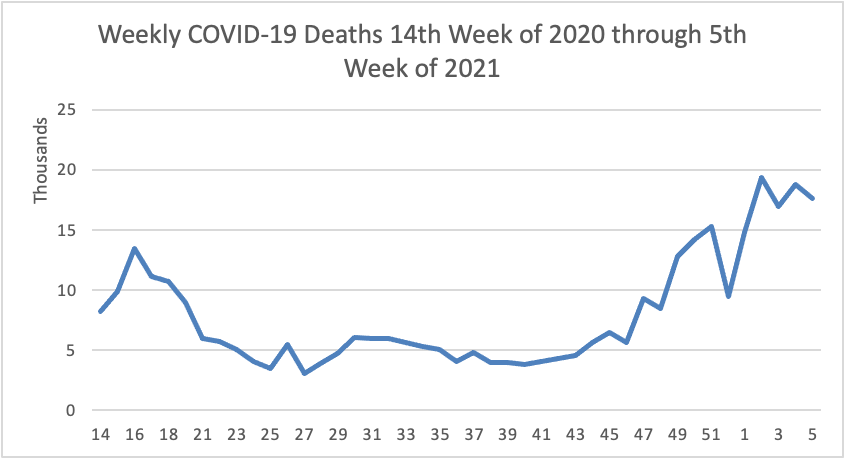
The FEHBlog has noticed that the new cases and deaths chart shows a flat line for new weekly deaths because new cases greatly exceed new deaths. Accordingly here is a weekly chart of new COVID-19 deaths over the same period April 2, 2021 through February 3, 2021:

COVID-19 cases and hospitalizations are dropping, but deaths are not as yet. because deaths are considered to be a lagging indicator. The chart does point to the importance of vaccinating the elderly as soon as possible.

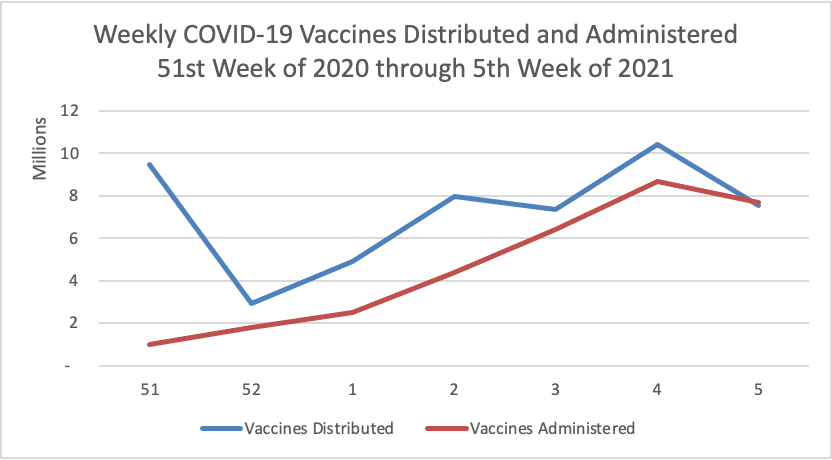
Here is a COVID-19 vaccinations chart for the past month which also uses Thursday as the first day of the week:

The CDC’s Fluview informs us that “Seasonal influenza activity in the United States remains lower than usual for this time of year.” Moreover, “46%: That’s how much U.S. sales of over-the-counter cold, flu, and cough medicine declined in the five week period ending Dec 26, 2020 from the same period last year, according to data from Nielsen, reported by Bloomberg.” These statistics suggest that Americans generally are following the social distancing and masking rules. Nevertheless the CDC recommends how to celebrate Super Sunday safely.

In Capitol Hill news, the Senate last night approved the Democrat’s budget resolution with Vice President Harris breaking the 50-50 vote from the Senators. The Wall Street Journal reports that today

The House approved a budget bill advancing President Biden’s $1.9 trillion relief plan, as Mr. Biden met with top House Democrats and lawmakers dived into crafting the details of the relief package.  The 219-209 vote marked a further step under budget reconciliation, a process that would allow Democrats to pass the relief package without Republican support in the Senate. Now, Democrats will turn to ironing out the details of the package over several weeks, including deciding who will be eligible for $1,400 direct payments and whether or not to raise the minimum wage to $15 an hour

The Journal also reports that a New York State court has ordered local authorities to certify the election of Republican Claudia Tenney in the last undecided U.S. House of Representatives race from the 2020 election. “Ms. Tenney is the second New York Republican to unseat an incumbent Democrat in 2020. She will be the 212th GOP House lawmaker, bringing the margin of Democratic control in the House to nine members.”

In healthcare news

  • The American Health Association reminds us that this February commemorates the 57th Heart Month.

Heart disease continues to be the greatest health threat to Americans and is still the leading cause of death worldwide, according to the AHA’s Heart Disease and Stroke Statistics – 2021 Update. The update, published in the association’s flagship journal Circulation, reports that nearly 18.6 million people across the globe died of cardiovascular disease in 2019, the latest year for which worldwide statistics are calculated. That’s a 17.1% increase over the past decade. And 523.2 million cases of cardiovascular disease were reported in 2019, a 26.6% increase over 2010.

During American Heart Month, the AHA and other organizations reinforce the importance of heart health, the need for more research and efforts to ensure that millions of people live longer and healthier. In most cases, heart disease is preventable when people adopt a healthy lifestyle, which includes not smoking, maintaining a healthy weight, controlling blood sugar and cholesterol, treating high blood pressure, getting at least 150 minutes of moderate-intensity physical activity a week and getting regular checkups. 

  • Health Payer Intelligence informs us that

Blue Cross and Blue Shield of North Carolina (Blue Cross NC) has introduced a value-based care program that focuses on improving health outcomes for members with kidney disease through coordinated and patient-centered care. The initiative, launched on January 1, is the newest feature in the industry-leading Blue Premier value-based care model. Eligible Blue Cross NC members can enroll in the Blue Premier Advanced Kidney Care program at no additional cost.

Thursday Miscellany

Photo by Juliane Liebermann on Unsplash

From the COVID-19 front —

  • Politico reports that “Johnson & Johnson filed Thursday for emergency use authorization [“EUA”] of its single-dose coronavirus vaccine, readying for a pivotal third option in the battle to immunize hundreds of millions of Americans.” This is the single dose vaccine that can be stored in regular pharmacy refrigerators. Following the same pattern as the first two EUA applications for COVID-19 vaccines, the Food and Drug Administration has set an advisory committee hearing on the Johnson & Johnson EUA for February 26. This indicates that the FDA will approve the application on February 28 / this month. That is very good news.
  • Healthcare coaching service TrestleTree has made available its useful “State-by-State COVID-19 Vaccination Access Guide.” Muchos gracias.
  • The American Hospital Association (AHA), American Medical Association (AMA), and American Nurses Association (ANA) released a [joint] public service announcement (PSA) today urging the American public to get the COVID-19 vaccination when it is their turn. 
  • Reuters reports that “Almost all people previously infected with COVID-19 have high levels of antibodies for at least six months that are likely to protect them from reinfection with the disease, results of a major UK study showed on Wednesday. Scientists said the study, which measured levels of previous COVID-19 infection in populations across Britain, as well as how long antibodies persisted in those infected, should provide some reassurance that swift cases of reinfection will be rare.”

From Capitol Hill, CBS News informs us that “The Senate is expected to vote on a budget resolution sometime before the weekend, an important step to passing President Biden’s $1.9 trillion COVID-19 relief proposal through the process of reconciliation, which allows legislation to pass with only a simple majority instead of the typical 60-vote threshold.  But before there can be a final vote on the resolution, Republicans are forcing Democrats to go on the record with a series of votes on a slew of amendments in a politically painful process known as a “vote-a-rama.” Bloomberg adds that this afternoon, “[t]he Senate backed by 99-1 a non-binding call to oppose stimulus checks going to “upper-income taxpayers” — one of a series of messaging votes the chamber is taking in a complex process of preparing President Joe Biden’s $1.9 trillion Covid-19 relief plan for passage through Congress.”

Health Payer Intelligence tells us about health plan trade association efforts to convince the Biden Administration to undo certain Trump Administration actions.

In healthcare corporate news, Healthcare Dive reports

  • Cigna’s net income for the fourth quarter of 2020 was $4.1 billion, a huge increase from the $977 million in the fourth quarter of 2019, partly because of the $6.2 billion sale of its life insurance business, which was completed on Dec. 31. The payer’s medical cost ratio in the fourth quarter was 85.8%, up from 82.3% the prior year because of COVID-19 treatment and testing costs and above Wall Street expectations. In a call with investors Thursday morning, CFO Brian Evanko said deferred care increased in the latter part of the quarter but was outweighed by COVID-19 costs.

and

  • UnitedHealth CEO Dave Wichmann is retiring and will be replaced as chief executive by Andrew Witty, currently the CEO of health services unit Optum. Witty will continue running Optum and become CEO immediately, with Wichmann assisting in a transition period through March, UnitedHealth announced Thursday. Dirk McMahon, CEO of payer business UnitedHealthcare, will become president and chief operating officer, and joins CFO John Rex to round out the Minnetonka, Minnesota-based healthcare behemoth’s C-suite.

From the opioid front

  • The Wall Street Journal reports that “State attorneys general intensified pressure on drug companies to settle claims over the opioid crisis, following consulting firm McKinsey & Co.’s agreement to pay nearly $600 million over its advice to pharmaceutical companies to rev up sales. * * * States have been negotiating since 2019 with the nation’s three largest drug distributors, McKesson Corp. , AmerisourceBergen Corp. , Cardinal Health Inc., as well as drugmaker Johnson & Johnson. The companies have publicly disclosed that they have set aside a collective $26 billion for the deal, most of it to be paid over 18 years, but no final agreement has been reached. In news conferences Thursday, attorneys general said they hoped the McKinsey deal would provide momentum for a bigger settlement, if others facing litigation follow the consulting company’s lead.”
  • Late last month, the Bloomberg School of Public Health announced that “A coalition of 31 professional and advocacy organizations has released a set of principles aimed at guiding state and local spending of the forthcoming opioid litigation settlement funds. The coalition, coordinated by faculty at the Johns Hopkins Bloomberg School of Public Health, is urging state and local officials to avoid the mistakes of the 1998 tobacco settlement and use the expected settlement funds to support evidence-based strategies that save lives. The need for evidence-based funding strategies is especially urgent now, as deaths due to opioid drug overdoses have significantly increased since the COVID-19 pandemic began, with some states reporting increases of 30%.”
  • The Health and Human Services Office of Inspector General today released a report on opioid use in Medicare Part D during the first phase of the COVID-19 public health emergency. “As the pandemic took hold, about 5,000 Medicare beneficiaries per month suffered an opioid overdose during the first 8 months of 2020.”