Tuesday Tidbits

Tuesday Tidbits

Photo by Patrick Fore on Unsplash

The Wall Street Journal reports this evening that “President Biden said the U.S. would have enough Covid-19 vaccines for all American adults by the end of May, two months earlier than he had previously said, after regulators authorized the one-shot Johnson & Johnson vaccine and Merck & Co. agreed to help produce it.” That is very encouraging news.

Politico reports that the President has agreed to comply with Neera Tanden’s request that he withdraw her nomination as Office of Management and Budget Director. “Biden’s statement indicated that he expects Tanden to serve in another role in his administration.”

And here are some tidbits for you —

  • The House Energy and Commerce Committee held a future of telehealth hearing today. “It is critical to the health, safety and equitable access of our patients to ensure we can continue to provide telehealth services after the end of the public health emergency,” said Megan Mahoney, M.D., chief of staff at Stanford Health Care, who testified at the hearing.
  • Medpage Today reports that ” Insufficient evidence exists to support any strategy where patients either delay their second dose or only receive one dose of COVID-19 mRNA vaccines [Pfizer and Moderna], even if they have been previously infected with the virus, CDC staff told the agency’s Advisory Committee on Immunization Practices (ACIP) at its Monday meeting. And ACIP committee members seemed to agree * * *.”
  • Fierce Pharma reports on two recent Food and Drug Administration emergency use authorizations of at home COVID-19 tests.
  • A friend of the FEHBlog pointed him to this STAT News article written by HHS Office of Inspector General Officials discussing the “importance of adding patients’ diagnoses to their prescriptions.” For example, [d]iagnosis information on prescriptions could help pharmacists identify safety issues,” and electronic prescription systems can accommodate diagnosis information.
  • CMS, which enforces the HIPAA electronic transaction rules, issued a factsheet on savings available to healthcare providers who use those electronic transactions. “According to data from the 2020 CAQH Index, 16% of medical plans and 36% of dental plans do not fully use electronic HIPAA standard transactions to conduct eligibility and benefits inquiries and responses. The CAQH Index estimates that medical and dental providers could save approximately $7 billion per year by completing eligibility and benefits checks using the HIPAA standard.” Health plans should share this information with their recalcitrant network providers.
  • Healthcare Dive informs us about four healthcare anti-trust issues to watch in 2021.
  • Health Payer Intelligence reports that “Blue Cross and Blue Shield of Illinois (BCBSIL) is tackling maternal care disparities in its state by financially supporting community-based interventions that focus on increasing education among new mothers and providing in-person and digital support. ‘By taking a holistic approach to supporting prenatal care that considers the social and economic factors impacting the health of mothers and newborns, we are working to help create an environment that fosters access to affordable benefits, equitable care delivery and wherever possible, better health outcomes,’ said Anita Stewart, MD, medical director at BCBSIL.” Well done.


Monday Roundup

Photo by Sven Read on Unsplash

The Wall Street Journal reports this evening that “The Senate prepared to move ahead this week with Democrats’ sweeping coronavirus relief proposal without an increase in the minimum wage, after a backup plan to raise the wage through tax penalties and incentives fizzled over the weekend.” The Journal of Accountancy helpfully has summarized the tax and non-tax provisions of the House bill. The FEHBlog was surprised to find that the House bill displayed on Congress.gov (H.R. 1319) does not extend the COBRA continuation coverage subsidy to the analogous FEHB’s temporary continuation of coverage program. See page 114 of H.R. 1319.

Pennsylvania-based Blue Cross licensee Highmark announced

today [March 1] that its affiliation unveiled in June 2020 with [fellow Blue Cross licensee] HealthNow New York Inc. has become effective. 

 “We look forward to bringing our resources, tools and advanced technologies to Western and Northeastern New York,” said Deborah Rice-Johnson, president of Highmark Inc. “With this affiliation, we begin our path forward to enhance customer and clinician engagement, create better health outcomes, control costs and improve affordability for members in Western and Northeastern New York.”

In the coming months, the newly affiliated organization will be rebranded Highmark Blue Cross Blue Shield of Western New York and Highmark Blue Shield of Northeastern New York.

From the healthcare studies front:

  • Fierce Healthcare reports that “Giving patients discounts for choosing providers that bundle expensive procedures like knee surgeries together resulted in significant savings, a new study finds. The study, published Monday by RAND Corporation, comes as value-based care models have grown in popularity in Medicare but not as much in commercial insurance. The study examined a program that negotiates a preferred price with certain providers to cover an entire episode of care within a 30-day period and waives cost sharing for patients.
  • The RAND Corporation also has released a report on factors that contribute to COVID-19 vaccine hesitancy in the Black community and how those factors can be addressed.
  • Health Payer Intelligence informs us that

While payers have been focusing justifiably on diminishing healthcare spending for chronic conditions, rare disease healthcare spending may exceed chronic disease healthcare spending, according to the National Economic Burden of Rare Disease study.

The survey on which this study was founded received responses from nearly 1,400 individuals regarding costs related to 379 rare diseases in 2019.

“This primary survey was specifically designed and administered for this study to deepen the understanding of the full spectrum of rare disease (RD) impact,” the study explained.

“The survey was able to collect detailed data on a broad set of indirect and non-medical costs of RD that were previously unavailable, especially the impact of RD on unpaid caregivers. This survey was one of the largest surveys conducted so far covering multiple RD communities.”

These diseases impacted 15.5 million people and cost $966 billion. This number exceeds even chronic disease cost estimates including the most expensive chronic diseases driving healthcare spending in the US such as diabetes, cancer, and heart disease.

Weekend Update

Congress is session this week for committee and floor business. On Tuesday morning the House Energy and Commerce Committee will hold a hearing on “The Future of Telehealth: How COVID-19 is Changing the Delivery of Virtual Care”

The Wall Street Journal reports that

The task of passing a coronavirus relief package now rests with the Senate, where Democrats must grapple with emerging divisions over some components of the plan, including a minimum-wage increase. The House early Saturday morning passed [largely along party lines] President Biden’s $1.9 trillion package, which would fund vaccine distribution, enhance and extend federal unemployment benefits, and send direct checks of $1,400 to many Americans and $350 billion to state and local governments.

As mentioned in last Thursday’s post, the Democrat leadership in Congress is trying to figure out a way for the Senate to pass the entire bill under budget reconciliation which requires all fifty Democrat senators plus the Vice President. The $15 minimum wage provision found in the House bill remains a wild card in the Senate.

The President officially sent Kiran Ahuja’s nomination to be OPM Director to the Senate last Wednesday. Federal News Network forecasts six “challenges” that Ms. Ahuja will need to address once confirmed.

In most excellent news, the Food and Drug Administration gave emergency use authorization to the single dose Johnson and Johnson vaccine yesterday and the Centers for Disease Control seconded this action today. This means that health plans, including FEHB plans, become liable for reimbursing administration costs for the Johnson and Johnson vaccine without member cost sharing in 15 days / March 15, 2021. Per CNN with the blessing of these two agencies

[T]he federal government may then begin distributing the 3.9 million available doses of the vaccine, perhaps as soon as Monday.”I just want to state explicitly how very grateful I am that we now have three highly effective vaccines,” said ACIP member Dr. Matthew Daley of the Institute for Health Research with Kaiser Permanente Colorado.

The company has pledged to have 20 million doses available by the end of March and 100 million doses by summer.The vaccine, made by Johnson & Johnson’s Janssen vaccine arm, can be kept at regular refrigerator temperatures, which experts said would make it much easier to distribute than vaccines made by Moderna and Pfizer/BioNTech.

The Wall Street Journal sums it up for us as follows:

The pandemic has opened a new era for vaccines developed with gene-based technologies, techniques that have long stumped scientists and pharmaceutical companies, suggesting the possibility of future protection against a range of infectious disease.

Johnson & Johnson’s Covid-19 vaccine, which was authorized Saturday for use in the U.S., is at the vanguard of a class of shots designed to mobilize a person’s immune defenses against the disease. It will be the first Covid-19 vaccine administered in the U.S. that uses viral-vector technology, which employs an engineered cold virus to ferry coronavirus-fighting genetic code to the body’s cells.

J&J’s vaccine is the third to be authorized in the U.S. after ones from Pfizer Inc. and its partner, BioNTech SE, and Moderna Inc. In a late-stage trial, J&J’s single-shot vaccine was 66% effective in preventing moderate to severe cases of the disease that has killed more than 500,000 people in the U.S. and about 2.5 million world-wide.

“This is one of those giant leap moments for us. These are fundamental shifts in how we will build vaccines for the future,” said C. Buddy Creech, director of Vanderbilt University’s vaccine research program. “I think this really ushers in a golden age of vaccinology.”

By the way the Centers for Disease Control has created its own COVID-19 vaccine finder website. According to the CDC’s COVID-19 data tracker website, currently nearly 20% of the eligible U.S. population has received at least one dose of the vaccine and 10% have received both doses.

Finally, the Choosing Wisely campaign is offering a information and a webinar that address one of the points in OPM’s recent call letter for 2022 benefit and rate proposals from carriers:

In Building A Better Health Care System Post-Covid-19: Steps for Reducing Low-Value and Wasteful Care, Corinna Sorenson, PhD, Duke-Margolis Center for Health Policy, and colleagues outline the impact of the pandemic on low-value care, and the potential opportunities it presents to create a better health care system post COVID-19. She elaborates further on this topic in her January 2021 Choosing Wisely webinar recording.

Friday Stats and More

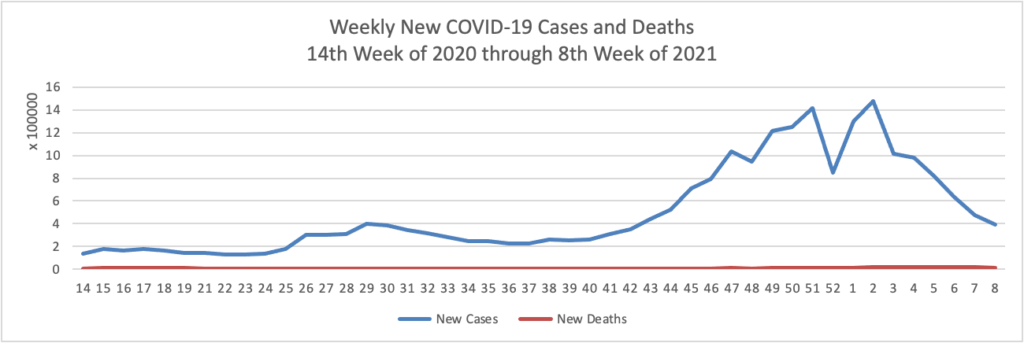
Based on the Centers for Disease Control’s COVID-19 Data Tracker website, here is the FEHBlog’s chart of new weekly COVID-19 cases and deaths over the 14th week of 2020 through 8th week of this year (beginning April 2, 2020, and ending February 24, 2021; using Thursday as the first day of the week in order to facilitate this weekly update):

and here is the CDC’s latest overall weekly hospitalization rate chart for COVID-19:

In this regard, Bloomberg reports that

Covid-19 hospital admissions plummeted 72% in a month in the U.S. as the virus ebbed and the vaccination push accelerated.

Americans 85 years old and over saw the most pronounced drop, down 81% from January to February, according to the U.S. Centers for Disease Control and Prevention, which monitors the data through its Covid-19-Associated Hospitalization Surveillance Network.

The rate was 23.4 hospitalizations per 100,000 residents 85 and over for the week of Feb. 7-13, the latest data available. That was down from 120.3 per 100,000 four weeks earlier. The overall rate across age groups was 4.6, down from 16.7.

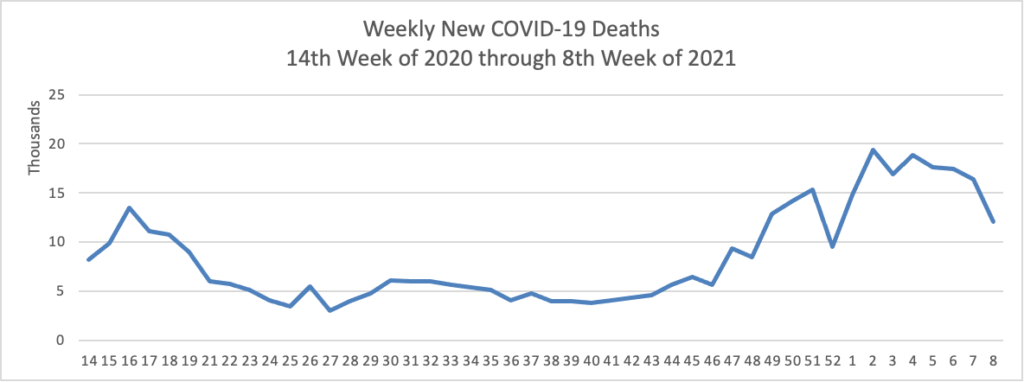
The FEHBlog has noticed that the new cases and deaths chart shows a flat line for new weekly deaths because new cases greatly exceed new deaths. Accordingly here is a chart of new COVID-19 deaths over the period (April 2, 2020, through February 24, 2021):

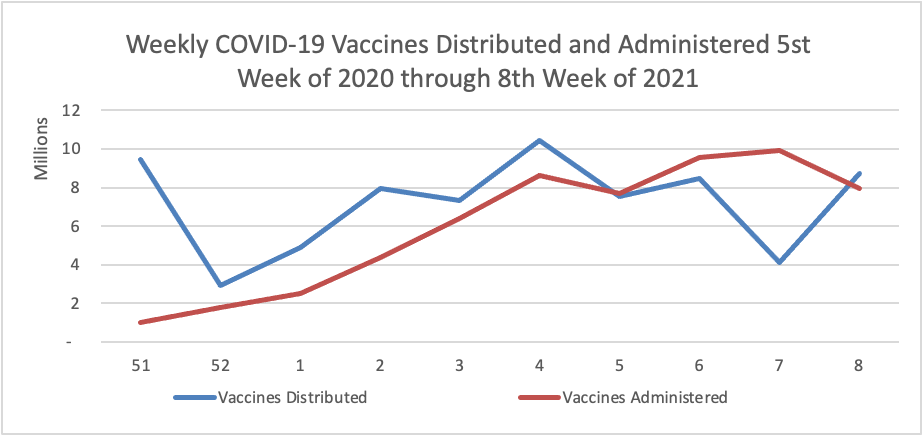
Finally here is a COVID-19 vaccinations chart for past ten weeks which also uses Thursday as the first day of the week:

In other COVID-19 vaccination news

  • The Wall Street Journal reports that

Johnson & Johnson’s JNJ -2.64% single-dose Covid-19 vaccine worked safely and should be authorized for use in the U.S., a panel of experts advised federal health regulators Friday.  The advisory committee’s unanimous vote in support of the vaccine’s authorization is the last step before the U.S. Food and Drug Administration issues a decision, which is expected Saturday. 

Yippee!

  • Reuters reports that “The U.S. Food and Drug Administration on Thursday approved storage and transportation of COVID-19 vaccine developed by Pfizer Inc and German partner BioNTech SE at standard freezer temperatures for up to two weeks instead of ultra-cold conditions. * * * “Alternative temperature for transportation and storage will help ease the burden of procuring ultra-low cold storage equipment for vaccination sites and should help to get vaccine to more sites,” Peter Marks, director of the FDA’s Center for Biologics Evaluation and Research, said.

In other COVID-19 news

  • The AP informs us that “February is usually the peak of flu season, with doctors’ offices and hospitals packed with suffering patients. But not this year. Flu has virtually disappeared from the U.S., with reports coming in at far lower levels than anything seen in decades.” It’s a silver lining in the COVID-19 cloud.  
  • The Centers for Medicare and Medicaid Service released updated guidance today for health plans, including FEHB plans, on coverage of COVID-19 testing and vaccinations.
  • Bloomberg reports that

States should maintain Covid-19 restrictions such as mask wearing and capacity limitations as case numbers halt their decline, the head of the U.S. Centers for Disease Control and Prevention said Friday, citing the circulation of new variants and infection rates that remain alarmingly high.

CDC Director Rochelle Walensky issued a sobering warning during a press briefing Friday, where she said the more contagious B.1.1.7 variant, first found in the U.K., now accounts for an estimated 10% of current U.S. cases, and that variants in California and New York also appear to spread more easily.

“Things are tenuous — now is not the time to relax restrictions,” Walensky said. “The latest data suggest that these declines may be stalling, potentially leveling off at still a very high number. We at the CDC consider this a very concerning shift in the trajectory.”

  • STAT News punctured a CDC recent statistic as follows:

The Centers for Disease Control and Prevention made headlines last week when it announced that Covid-19 had reduced the average life expectancy of Americans in 2020 by a full year. The news seemed to starkly illustrate the devastation wrought by our nation’s worst public health crisis in 100 years.

But there was a problem. The pandemic’s appalling toll could not have reduced life span by nearly that much. My own estimate is that when Covid-19’s ravages in 2020 are averaged across the country’s entire population, we each lost about five days of life.

The CDC’s mistake? It calculated life expectancy using an assumption that is assuredly wrong, which yielded a statistic that was certain to be misunderstood. * * * The CDC’s report boils down to a finding that bears no relation to any realistic scenario. Running the 2020 gauntlet for an entire life results in living one year less on average than running that same gauntlet in 2019.

In other healthcare news, Fierce Healthcare informs us that

Cigna will acquire telehealth platform MDLive, the insurer announced Friday morning.

Cigna has been a longtime partner of and investor in MDLive and will fold it into its Evernorth subsidiary, which houses its health services business. The deal is expected to close in the second quarter of 2021, pending regulatory approvals.

Cigna said that it expects to deliver $20 in earnings per share this year, including impacts of the acquisition, and will present additional details about the deal at its investor day on March 8.

Finally, the FEHBlog has been continuing to review the draft Postal Service bill creating a Postal Service Health Benefits Program. He has updated Wednesday’s post on the topic and he wishes to point out an important clarification on how the bill would treat Postal Service annuitants. Per the Committee staff memorandum:

The bill would require future retirees to enroll in Medicare in order to participate in the Postal Employee Benefits Program (similar to the Federal Employee Health Benefit Program but established as a separate risk pool). However, the bill includes several exceptions:

  • Residents of foreign countries and others without access to Medicare providers would not automatically be enrolled in Medicare; and
  • Retirees who do not have the requisite 40 quarters of creditable service would not be automatically enrolled in Medicare. This would include many Civil Service Retirement System (CSRS) retirees.
  • In addition, current retirees would be granted a three-month grace period from the Medicare penalty for late enrollment but would not be required to enroll.

This helps explain why NARFE is willing to support the bill.

Midweek Update

Photo by Manasvita S on Unsplash

The Federal Times, Govexec, and Federal News Network each report on today’s Postal reform legislation hearing before the House Oversight and Reform Committee. The draft proposed legislation, among other things, would create a Postal Service Health Benefits Program (“PSHBP”) within the FEHBP effective January 1, 2023. FEHB plans covering at least 1500 Postal employees and annuitants in 2022 would be eligible to offer coverage in the PSHBP.

Postal employees first becoming eligible for the FEHB in 2023 or later years must enroll in a PSHBP participating plan. If a Postal employee or annuitant is enrolled in 2022 in a FEHB plan that does not join the PSHBP in 2023, that Postal employee or annuitant may continue to participate in the plan outside the PSHBP. However, a Postal employee or annuitant must follow his or her plan into the PSHBP if that plan joins the PSHBP. (Presumably that employee or annuitant could choose another PSHBP participating plan in that event.)

If a Postal employee or annuitant enrolled in a plan outside the PSHBP decides to changes plans he or she can only choose a PSHBP plan. Also once the PSHBP is up and running, a Postal Service employee enrolled in a plan outside the PSHBP would be required to transfer to the PSHBP upon retirement. Federal News Network indicated that NARFE finds this approach allows acceptable freedom of choice to current annuitants.

Future PSHBP annuitants, e.g., Postal employees who retire on or after January 1, 2023) would be required to pick up Medicare Part B with a limited exception for economic hardship. The PSHBP plan would offer a Medicare Part D EGWP prescription drug coverage to their annuitant members, a big benefit savings. The bill also would relieve the Postal Service of the ability to prefund their employees’ coverage in the FEHBP as annuitants.

Per Govexec

Oversight Committee Chairwoman Carolyn Maloney, D-N.Y., made clear her primary focus was on shepherding her reform legislation through Congress and to Biden’s desk. 

“We will not be delayed or deterred from our north star,” Maloney said. “We need to pass meaningful reforms, and hopefully bipartisan reforms, to put the Postal Service on more sustainable and financially firm footing for years to come.”

Speaking of federal retirement (the Postal Service operates under the federal retirement program too), Fedweek offers a helpful Reg Jones column on “the main retirement-related question regarding the Federal Employees Health Benefits (FEHB) program—carrying coverage into retirement.”

On the COVID-19 front

  • Bloomberg reports that “The shot made by Pfizer Inc. and BioNTech SE was overwhelmingly effective against the virus in a[n Israeli] study, prompting experts to say that immunizations can end the pandemic. Johnson & Johnson’s Covid-19 vaccine is safe and effective, U.S. regulators said, a milestone toward giving Americans the first shot to work in a single dose.” The FDA advisory committee with consider the Johnson & Johnson emergency use application for its COVID-19 vaccine on Friday February 26.
  • Fierce Healthcare informs us that “There’s no question outpatient visits plummeted in the earliest days of the pandemic as providers scrambled to move care to virtual settings. But as the year—and the roller coaster of COVID-19 cases nationwide it brought—went on, it turned out outpatient visits overall were down but still relatively stable, a Harvard University analysis published by The Commonwealth Fund found.”

From Capitol Hill, the Wall Street Journal reports that Office of Management and Budget Director nominee Neera “Tanden’s nomination appears to be in peril, after two Senate committees delayed confirmation votes that had been scheduled for Wednesday morning.” Also the House Rules Committee has scheduled a hearing on Friday morning to consider the $1.9 trillion COVID-19 relief bill which is the last step before the bill reaches the House floor.

President nominates an OPM Director

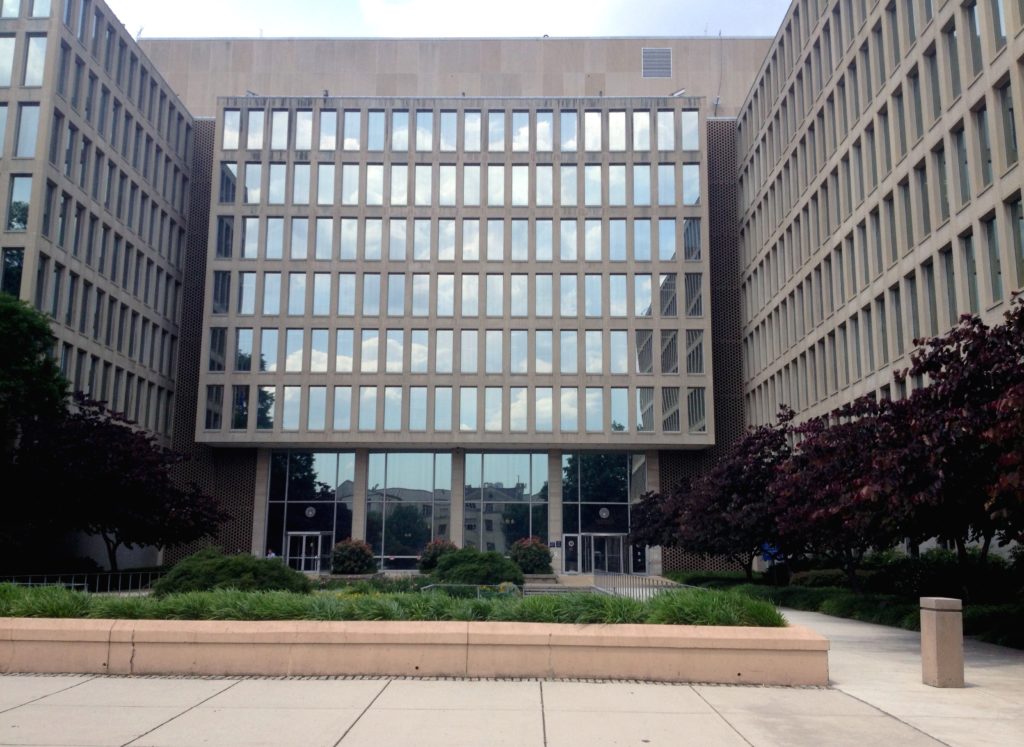
OPM Headquarters a/k/a the Theodore Roosevelt Building

The Federal Times, Govexec, and Federal News Network all report on today’s announcement that the President is nominating Kiran Ahuja to be OPM Director. Ms. Ahuja led the President’s transition review team lead for the agency. “Ahuja has over 20 years of public service and philanthropy experience. She’s currently the CEO of Philanthropy Northwest, and she spent several years as a career civil rights attorney at the Justice Department.” Her nomination is subject to Senate confirmation. In due course, the President also is expected to nominate an OPM Deputy Director and an OPM Inspector General.

Healthcare Dive reports on the first confirmation hearing for the President’s nominee for Secretary of Health and Human Services, Xavier Becerra. Mr. Becerra “told senators on the health committee Tuesday morning he would continue work he did as California attorney general to combat anticompetitive practices in healthcare and go after providers that ‘unfairly jack up prices on patients.'” According to the report, Mr. “Becerra will be back in the hot seat Wednesday for his second confirmation hearing, this one in front of the Senate Finance Committee. That will be the committee voting on whether to send his nomination to the full Senate for a vote.”

Tomorrow, the Senate Homeland Security and Governmental Affairs Committee at 10 am and the Senate Budget Committee at noon each will hold a business meeting on whether to advance to the Senate floor the President’s nomination of Neera Tanden to be Director of the Office of Management and Budget.

Tomorrow at 10 AM, the House Oversight and Reform Committee will hold a hearing on “Legislative Proposals to Put the Postal Service on Sustainable Financial Footing.” The Committee Staff explains in a memorandum,

the Committee will hold a hybrid hearing to review legislative proposals to place the Postal Service on a more sustainable financial footing. The Committee will consider a discussion draft that includes several provisions to relieve the financial burdens under which the Postal Service is currently operating and to enhance transparency regarding performance. That draft is being circulated with this memo. The discussion draft includes provisions on Medicare integration [for Postal annuitants participating along with Postal employees in a separate program within the FEHB] , repealing a requirement for the Postal Service to pre-fund retiree health care, and service performance standards.”

Earlier today, the Oversight and Investigations Subcommittee of the House Energy and Commerce Committee held a hearing on the availability of COVID-19 vaccinations. The hearing featured testimony from executives at the companies manufacturing those vaccines. Fierce Healthcare reports that “Pfizer, Moderna and Johnson & Johnson execs say [at the hearing] they’re working all the angles on increasing COVID-19 vaccine production and expect to amp up weekly deliveries by tens of millions by the end of March.”  

In that regard, a friend of the FEHBlog pointed him to this NIH Director’s blog entry released today

For the millions of Americans now eligible to receive the Pfizer or Moderna COVID-19 vaccines, it’s recommended that everyone get two shots. The first dose of these mRNA vaccines trains the immune system to recognize and attack the spike protein on the surface of SARS-CoV-2, the virus that causes COVID-19. The second dose, administered a few weeks later, boosts antibody levels to afford even better protection. People who’ve recovered from COVID-19 also should definitely get vaccinated to maximize protection against possible re-infection. But, because they already have some natural immunity, would just one shot do the trick? Or do they still need two?

A small, NIH-supported study, published as a pre-print on medRxiv, offers some early data on this important question [1]. The findings show that immune response to the first vaccine dose in a person who’s already had COVID-19 is equal to, or in some cases better, than the response to the second dose in a person who hasn’t had COVID-19. While much more research is needed—and I am definitely not suggesting a change in the current recommendations right now—the results raise the possibility that one dose might be enough for someone who’s been infected with SARS-CoV-2 and already generated antibodies against the virus.

Encouraging news.

Monday Roundup

Photo by Sven Read on Unsplash

The Wall Street Journal reports from Capitol Hill that

The House Budget Committee approved the $1.9 trillion coronavirus relief package Monday, setting up a vote in the full House later this week.

The Budget Committee on Monday officially fused together different portions of the legislation that had advanced earlier this month in nine different House committees. A full House vote is expected Friday or Saturday.

The bill moving through the House would provide $400-a-week unemployment benefits through Aug. 29, send $1,400 per-person payments to most households, provide billions in funding for schools and vaccine distribution, expand the child tax credit, broaden child-care assistance and bolster tax credits for health insurance. It would also increase the federal minimum wage to $15 an hour over four years, a point of division among Democrats.

From the COVID-19 front:

  • The Hill reports that “Johnson & Johnson said Monday [February 22] that it plans to have enough doses of its vaccine for more than 20 million Americans by the end of March if its vaccine is authorized by the Food and Drug Administration.”
  • The Wall Street Journal informs us that

The Food and Drug Administration said Monday it will quickly analyze any vaccine booster shots against Covid-19 variants such as those from South Africa and the U.K., and won’t require further large clinical trials of the new shots’ effectiveness.

The agency issued new guidance for vaccine manufacturers as it looks to establish speedier procedures to deal with virus mutations that could worsen the pandemic. Acting FDA Commissioner Janet Woodcock said in a statement the agency is seeking ‘efficient ways to modify medical products that either are in the pipeline or have been authorized for emergency use to address emerging variants.’”

  • Federal News Network points out that federal agencies have been issuing new COVID-19 safety plans for employees and visitors. Here is a link to OPM’s plan.

Healthcare Dive informs us that “The Biden administration [officially] nominated Chiquita Brooks-LaSure as CMS administrator Friday [February 19]. A press release touted her more than 20 years of experience in health policy and previous work guiding the ACA through passage and implementation.” This position requires Senate confirmation. The White House sent her nomination to the Senate today.

Health Payer Intelligence discusses a Health Action Council and UnitedHealth Group report about the following five conditions other than COVID-19 that fuel costs for employer sponsored health plans: (1) asthsma, (2) diabetes, (3) hypertension, (4) back disorders, and (5) mental health / substance use. Check it out.

Earlier this month, the Health Care Cost Institute announced

the launch of its new health care claims dataset for research. The new dataset is more than 25% larger than the original HCCI dataset, containing more than 1 billion claims per year for more than 55 million people who receive health care coverage from their employers. Researchers will initially have access to data from 2012 to 2018, with 2019 and 2020 information being added as soon as possible. The data is sourced from Aetna/CVS, Humana, Kaiser Permanente and more than 30 non-profit health plans included in the Blue Health Intelligence® national dataset , enabling researchers to conduct analysis at the national, state, and sub-state level. HCCI’s patient-, provider-, and payer-deidentified dataset contains comprehensive diagnostic, procedure, site of care and cost information, including payments made by insurers as well as what patients pay out of pocket. 

“This rich new claims data enables the critical research and reporting that will be needed in the coming years, to understand the impact of the COVID-19 pandemic and other challenges facing the health care system as the US approaches spending 20% of GDP on health care,” said Niall Brennan, President and CEO of HCCI. “HCCI is a critical national resource for researchers, policymakers, employers, journalists, and the public to understand trends in health care access, spending and utilization.”

Good luck.

Thursday Miscellany

Photo by Juliane Liebermann on Unsplash

In a welcome spurt of cautious optimism, Bloomberg reports this evening

The U.S. vaccine supply is poised to double in the coming weeks and months, according to an analysis by Bloomberg, allowing a broad expansion of doses administered across the country. * * * A review of drugmakers’ public statements and their supply deals suggests that the number of vaccines delivered should rise to almost 20 million a week in March, more than 25 million a week in April and May, and over 30 million a week June. By summer, it would be enough to give 4.5 million shots a day.  * * * The analysis assumes drugmakers will meet their new delivery targets — not a guarantee in a year-old pandemic where much has gone wrong.

The FEHBlog’s bet, for what it’s worth, is that Bloomberg’s analysis proves correct.

The urgency of rapid COVID-19 vaccine distribution is reinforced by the Centers for Disease Control’s report today that U.S. life expectancy dropped by one year during the first six months of last year.

For perspective, take a look at the American Medical Association’s interview of John Barry, the author of the Great Influenza. To wit –

In 1918, people didn’t buy the government’s take on the pandemic. They saw what was happening. The disease was much more virulent, killing between 50 million and 100 million people. That would be between 225–450 million people today after adjusting for population. In Philadelphia, Barry said, priests would drive horse-drawn carts down the street calling for people to bring out their dead.

Mr. Barry urges truth telling by all parties holding public trust. By the way, the Great Influenza is fascinating reading.

In regulatory news —

  • Fierce Healthcare informs us that “President Joe Biden has chosen Chiquita Brooks-LaSure to lead the Centers for Medicare & Medicaid Services (CMS), according to a report in The Washington Post.” This post requires Senate confirmation.
  • The National Law Journal reports that “The U.S. Equal Employment Opportunity Commission (EEOC) announced last Friday that it was withdrawing two proposed rules regarding the incentives employers can provide their employees as part of a wellness program without violating the Americans with Disabilities Act (ADA) or Genetic Information Nondiscrimination Act (GINA). Originally, the proposed rules had stated that, for the most part, employers could offer only “de minimis” incentives for employees participating in a wellness program—incentives that potentially could apply to employees receiving a coronavirus (COVID-19) vaccine. With the withdrawal of those rules, employers have little guidance in terms of what incentives, if any, they may offer employees”
  • The Health and Human Services Inspector General announced a court ordered delay in effective date of the Trump Administrations’ rule banning prescription drug rebates in Medicare Part D (but not the FEHBP) to January 1, 2023.
  • The Internal Revenue Service issued guidance implementing the following cafeteria plan changes created by the Consolidated Appropriations Act, 2021. The new law

Provides flexibility with respect to carryovers of unused amounts from the 2020 and 2021 plan years;

Extends the permissible period for incurring claims for plan years ending in 2020 and 2021;

Provides a special rule regarding post-termination reimbursements from health FSAs during plan years 2020 and 2021;

Provides a special claims period and carryover rule for dependent care assistance programs when a dependent “ages out” during the COVID-19 public health emergency; and

Allows certain mid-year election changes for health FSAs and dependent care assistance programs for plan years ending in 2021.

This notice also provides additional relief with respect to mid-year elections for plan years ending in 2021. 

OPM Call Letter Released

OPM Headquarters a/k/a the Theodore Roosevelt Building

Happy OPM Call Letter Day. The call letter is OPM’s call for 2022 benefit and rate proposals from FEHB carriers. Here’s the letter’s summary:

OPM maintains its focus on improving quality and affordability in the FEHB Program, as well as supporting the Biden Administration’s priority focus on health care access and equity. We expect FEHB Carriers to continueto offer forward-thinking proposals that focus onthe strategicprioritiesdescribed in this Call Letter. Our quality initiatives for the 2022 plan year relate to the COVID-19 pandemic, mental health and substance use disorder services, opioids, and prior authorizations for prescription drugs. We also remain focused on enhancements to price and quality transparency, as well as addressing surprise billing and low-value care. We are encouraging FEHB Carriers to expand coverage of certain medical foods for those affected by Inborn Errors of Metabolism (IEM), and to cover fertility preservation related to infertility caused by medical treatment (iatrogenic infertility).

The FEHBlog has provided links to topics that he does not routinely cover. The proposals are due on May 31, 2021. Good luck carriers.

On the COVID-19 front, MedScape encouragingly reports that

Researchers know by now the available COVID-19 vaccines prevent people from getting COVID around 95% of the time. But the million-dollar question remains: Are people less likely to spread the illness after they get the vaccine? According to preliminary data, the odds are good.

“The looming question is, if the person who’s been vaccinated gets infected, does that person have the capability to transmit it to another person,” Anthony Fauci, MD, the White House COVID-19 Response Team’s chief medical adviser, said during a White House briefing Wednesday. “Some studies are pointing in a very favorable direction.”

Fauci cited studies from Spain and Israel published this month, showing the amount of viral load — or the amount of the COVID-19 virus in someone’s body — is significantly lower if someone gets infected after they’ve been vaccinated, compared with people who get infected and didn’t have the vaccine. Lower viral load means much lower chances of passing the virus to someone else, Fauci says.

“There’s a direct correlation with viral load and transmission,” he says. “In other words, higher viral load, higher transmissibility; lower viral load, very low transmissibility.”

Also, the Department of Health and Human Services announced today “new actions to expand COVID-19 testing capacity across the country. These actions will improve the availability of tests, including for schools and underserved populations; increase domestic manufacturing of tests and testing supplies; and better prepare the nation for the threat of variants by rapidly increasing virus genome sequencing.”

From Capitol Hill, this Congressional Budget Office report to the House Ways and Means Committee on the COVID-19 budget reconciliation bill provides a useful overview of the healthcare and employee benefit proposals in the bill. The Speaker intends to pass the $1.9 trillion relief measure by the end of this month.

Health Payer Intelligence discusses a recent Health Affairs article positing that “whether care is affordable for members depends on more than just pricing; affordability is also tied to how clustered healthcare events—and, by extension, healthcare spending—are in a single year.”

The conclusion of this study has clear implications for payers. When members skip care due to affordability, they miss key preventive care services which can result in higher healthcare spending downstream in the members’ healthcare journeys. During the pandemic, payers have waived primary care costs in order to incentivize members to continue receiving care for this very reason. The researchers called on payers, employers, and lawmakers to explore methods for spreading members’ healthcare costs out over time [e.g. monthly deductibles rather than annual deductibles, low copays for essential medicines like insulin].

As we reach the end of the 4th Quarter 2020 financial reporting season, Healthcare Dive summarizes the reports from major health insurers.

Tuesday Tidbits

Photo by Patrick Fore on Unsplash

Happy Mardi Gras!

As the FEHBlog has noted, the FEHB Program has unique demographics compared to other employer sponsored health plans because the federal government offers generous FEHB annuitant coverage to its employees. FEHB enrollment is roughly 52% active employees and 48% annuitants. The average age of federal and postal employees is late forties and the FEHBlog understands that average age of an FEHB enrollee is sixty. (OPM offers detailed demographic statistics on its workforce but not on its retirement system members. No complaints, just stating a fact.)

Today HHS’s Agency of Healthcare Research and Quality issued a fascinating report titled “Concentration of Healthcare Expenditures and Selected Characteristics of High Spenders, U.S. Civilian Noninstitutionalized Population, 2018.” Here are the report’s highlights:

  • In 2018, the top 1 percent of persons ranked by their healthcare expenditures accounted for about 21 percent of total healthcare expenditures, while the bottom 50 percent accounted for only about 3 percent.
  • Persons ages 65 and older and whites were disproportionately represented in the top spending tiers.
  • Inpatient hospital care accounted for 36 percent of spending for persons in the top 5 percent of the spending distribution.
  • About three-quarters of aggregate expenses for persons in the top 5 percent of spenders were paid for by private insurance or Medicare.

In 2018, the top 1 percent of persons ranked by their healthcare expenditures accounted for 21 percent of total healthcare expenditures (100 minus 79 percent; figure 1), with an annual mean expenditure of $127,284 (figure 2). The group within the top 1 percent is defined as persons who spent $72,212 or more during the year. Cut points for additional percentile groups are shown in table 1 [immediately below]. The top 5 percent of the population accounted for 48.3 percent of total expenditures (100 minus 51.7 percent), with an annual mean expenditure of $58,609. The bottom 50 percent accounted for only 3.2 percent of total healthcare expenditures. Every person in this group spent less than $1,317 during the year (table 1), with an average annual expenditure of $384 (figure 2).

Percentile of population2018 Expenditure
Top 1%$72,212 or more
Top 5%$26,355 or more
Top 10%$14,651 or more
Top 30%$3,776 or more
Bottom 50% Less than $1,317

But given the FEHB’s demographics, this figure particularly caught the FEHBlog’s eye:

Figure 4: Percentage of persons by age group and percentile of spending, 2018

Age groupOverall percentageBottom 50%Top 50%Top 10%Top 5%
0–1722.630.614.56.45.8
18–4435.243.227.320.818.9
45–6425.420.130.733.436.3
65+16.86.027.539.439.0

It is a credit to OPM and the FEHB carriers that they are able to hold premiums rather stable.

On the COVID-19 vaccination front —

  • NPR updates us with encouraging COVID-19 vaccination distribution statistics.
  • Federal News Network tells us that “The Biden administration’s Safer Federal Workforce Task Force has new details on how agencies should handle [COVID-19 vaccination] leave, labor unions and mask mandates during the ongoing pandemic.”
  • The Centers for Disease Control now offers guidance on how to arrange COVID-19 vaccinations for home-bound individuals.

Healthcare Dive reports on CVS Health’s fourth quarter 2020 earnings report. The headline is that CVS Health’s payer arm Aetna plans to return to the Affordable Care Act marketplace for 2022.

CVS’ fourth quarter revenue of $69.6 billion, up 4% year over year, was mostly due to growth in the benefits segment. Healthcare benefits reported quarterly revenue of $19.1 billion, up 11% year over year, driven primarily by membership growth in Medicaid and Medicare products and partially offset by a drop in commercial membership and COVID-19 costs.

As of the end of 2020, CVS covered 23.4 million lives. Despite fluctuating membership and utilization due to COVID-19 over the course of last year, overall utilization in the fourth quarter was generally back to normal, executives said. The company’s medical loss ratio, a marker of how much it’s reinvesting in patient care, was 86.7% in the quarter, compared to 85.7% same time last year.

JDSupra includes this employment law article titled “Employees Starting to Receive the COVID-19 Vaccine – Now What?” which is worth a gander in the FEHBlog’s opinion.