Thursday Miscellany

Thursday Miscellany

Photo by Juliane Liebermann on Unsplash

From Capitol Hill, the American Hospital Association gleefully reports that “The Senate today passed by 90-2 vote a bill that, among other health care provisions, would eliminate the 2% across-the-board cut to all Medicare payments, known as sequestration, until the end of 2021. To pay for the change, the bill, which was introduced by Sens. Jeanne Shaheen, D-N.H., and Susan Collins, R-Maine, would increase the fiscal year 2030 sequester cuts. The House is expected to take up the Senate-passed bill when it the week of April 13 when it returns to Washington D.C.”

The U.S. Office of Personnel Management announced six political appointments to the agency which do not require Senate confirmation. Good luck to them.

From the COVID-19 front, the Wall Street Journal observes

In many ways, AstraZeneca, which developed the vaccine in partnership with the University of Oxford, is delivering on its main promises. More than 70 countries, including the U.K. and much of the rest of Europe, have found the shot safe and effective. Although it isn’t a big player in vaccines, AstraZeneca helped make an experimental shot ready for mass use in less than a year. The company has built a manufacturing and distribution network that is delivering doses to the world’s poorest. Unlike most of its big competitors with vaccines or vaccine candidates, it has promised to do all this at no profit. The vaccine has been crucial to the U.K. drive that boasts one of the world’s best per-capita vaccination rates.

But at crucial moments, company executives have fumbled communications with governments, regulators and the public. That has left a reputational cloud over the vaccine effort—an effort that Dr. Soriot has said reflects the company’s desire to play a leading role in battling the pandemic.

The reverse — good public relations by a bad actor — would be a much worse situation. The FEHBlog hopes that the Food and Drug Administration does not delay emergency use authorization for the AstraZeneca vaccine.

Also from the COVID-19 front today, the Centers for Medicare and Medicaid Services issued a fact sheet on the value of monoclonal antibodies (mAb) treatment for high risk Covid-19 positive patients.

mAb treatment for COVID-19 is different from a COVID-19 vaccine. A vaccine triggers your body’s natural immune response, but can take weeks to develop enough antibodies and prevent some kinds of infection. Some vaccines for COVID-19 require two shots, so your body can develop its own immune response to the disease. But if you already have the virus, mAb treatment gives your body the antibodies it needs to protect itself.

That is positive news.

In miscellaneous healthcare news —

Anthem is planning to acquire myNEXUS, a company that manages home-based nursing services for insurers.

According to the announcement, myNEXUS provides support to 1.7 million Medicare Advantage members across 20 states. The company’s platform largely automates the visit and authorization, getting care to the member faster, they said.

MyNEXUS uses a digital analytics tool in tandem with a team of more than 250 clinicians to plan and optimize home care, the companies said. In addition, it works with a nationwide network of providers and nursing agencies for local care.

  • Healio reports that at “the Renal Physicians Association annual meeting, representatives from three companies [led by CVS Health] shared their approach to the changing paradigm of kidney care and emphasized the shift to value-based models that center on the patient.”
  • America’s Health Insurance Plans announced that

Electronic prior authorization (ePA) can significantly reduce the time between a request for prior authorization and a decision and the time to a patient receiving care.  These were two of the top findings from an initiative launched by America’s Health Insurance Plans (AHIP) to better understand the impact of ePA on the prior authorization process.

“Prior authorization is an important tool in helping patients receive safe, effective, clinically appropriate care,” said Kate Berry, Senior Vice President of Clinical Affairs at AHIP.  “We are always looking for ways to enhance the patient and provider experience, and electronic prior authorization is an example.  Today’s analysis provides a blueprint for how to leverage electronic tools to improve prior authorization.”

AHIP launched the Fast Prior Authorization Technology Highway—or Fast PATH—to better understand how electronic prior authorization could impact the process for patients and providers. Six health insurance providers—Blue Shield of California, Cambia Health Solutions, Cigna, Florida Blue, Humana, and WellCare (now Centene)—that collectively cover over 50 million Americans participated in the project, with Availity and Surescripts serving as the technology partners.

Bravo.

  • Health Payer Intelligence informs us that “Payers should prepare for the payer price transparency rule to go into effect by building clear communication paths with members, reassessing their contracting processes, and asking themselves a couple of key questions, according to a report from PricewaterhouseCoopers’s Health Research Institute (HRI).” Check it out.

Midweek update

Photo by Manasvita S on Unsplash

From Capitol Hill, STAT News reports that Senate leaders have reached an agreement to extend a Medicare pay bump for health care providers through 2021, a major lobbying win for hospitals.”

The Wall Street Journal reports two Senate confirmations in healthcare positions:

The Senate [today] confirmed Dr. Rachel Levine as assistant health secretary, making her the first openly transgender federal official approved by the Senate.

The vote was 52 to 48, largely along party lines, with GOP Sens. Lisa Murkowski of Alaska and Susan Collins of Maine joining all 50 Democrats.

The pediatrician and former Pennsylvania secretary of health helped steer the state’s response to Covid-19. She has also worked to increase awareness of equity issues that the LGBT community faces and is a professor of pediatrics and psychiatry at Penn State College of Medicine. 

and

Yesterday, the Senate approved Vivek Murthy, President Biden’s pick for surgeon general, by a 57-to-43 vote, marking his second stint in the post, which he held from 2014 through 2017. Dr. Murthy, who was co-chairman of Mr. Biden’s Covid-19 advisory board, has said he would use his position to provide science-based guidelines for ending the coronavirus pandemic.

From the COVID vaccine front, Medscape informs us that

White House officials said at a briefing Wednesday they are still anticipating updated vaccine data from AstraZeneca, after federal officials called Tuesday’s release of interim phase 3 data from the company “outdated information.”

“Right now, AstraZeneca is getting back with the Data and Safety Monitoring Board and will likely come out with an updated statement,” said Anthony Fauci, MD, a top COVID-19 official and chief of the National Institute of Allergy and Infectious Diseases, the agency that complained to the pharmaceutical company that their current information was “incomplete.”

Andy Slavitt, senior White House adviser for COVID-19 response, added: “Our takeaway is the importance of transparency and trust…. I would urge us not to focus on the process of the last couple days, but instead to focus on what really matters, which is what happens when these applications for these candidates are submitted to the FDA.”

FLASH — The Washington Post reported at 10:30 pm Wednesday night that

An updated company analysis of the coronavirus vaccine developed by AstraZeneca and the University of Oxford showed that the two-shot regimen was robustly effective — 76 percent at preventing symptomatic illness — according to a news release from the drugmaker late Wednesday.

The finding, only slightly lower than results announced days earlier, underscores that the vaccine being widely used by many countries appears to be a powerful tool to help end the pandemic. No severe cases of illness were reported in study volunteers who received the vaccine. Among people 65 and older, the vaccine was 85 percent effective, the company reported.

Yesterday, the FEHBlog watched a Wall Street Journal interview with Mr. Slavitt as part of the WSJ’s Health Forum. The FEHBlog really enjoyed this WSJ video featuring reporter Joanna Stern with a COVID vaccine hunter from New Jersey. It’s certainly worth five and half minutes of your day.

HR Dive reports that

Employers should offer paid sick leave to employees with “signs and symptoms” following COVID-19 vaccination, according to guidance updated March 16 by the Centers for Disease Control and Prevention.

Employers should consider on-site vaccination programs if they have a large workforce with predictable schedules and enough space to run a clinic that meets social distancing requirements, CDC said. Employers that choose to offer vaccinations should record each offer and employees’ decisions. Employers should consider off-site vaccination if they are a small- or medium-sized organization lacking the resources to host a vaccination clinic, it said.

The agency also said that whether an employer may require COVID-19 vaccinations is a matter of state or other applicable law but noted that exemptions may apply: Medical exemptions for people who are at risk for an adverse reaction because of an allergy to one of the components used in the vaccine or a medical condition; and religious exemptions for people who reject being vaccinated because of their religious beliefs.

In healthcare business news, Fierce Healthcare lets us know that

Uber is ramping up its prescription delivery business by teaming up with software company ScriptDrop. The ride-share giant will be the default delivery service for ScriptDrop pharmacies in 37 states and will eventually expand to others.

ScriptDrop works with some of the top grocery chains, pharmacy chains and health systems in the U.S., including Albertsons, Jewel-Osco, Safeway and Vons. Through the tie-up with Uber, those pharmacies will be able to leverage the company’s technology to deliver more prescriptions to more customers.

From the report front, the FEHBlog noticed

Finally March 22 to 28, 2021, is National Drug and Alcohol Facts Week. “Held since 2010, NDAFW brings teens and scientific experts together to discuss the scientific facts about drugs, as well as their potential health effects on teen bodies and brains. ”

Tuesday Tidbits

The FEHBlog was wondering today whether the clinical trial review board had given AstraZeneca a heads up about its concerns with the company’s press release before making the midnight press release on that topic. The New York Times reports that

“Only hours after AstraZeneca announced encouraging news about the effectiveness of its Covid-19 vaccine on Monday, a group of medical experts charged with monitoring the company’s clinical trial made a highly unusual accusation: AstraZeneca had essentially cherry-picked data to make its vaccine look better.

The accusation, in a two-page letter sent Monday to the company and federal officials, was a fresh blow to the credibility of a vaccine whose low price and relatively easy storage have made it critical to the global fight against the coronavirus pandemic.”

In other words, AstraZeneca, which is partnering with the University of Oxford, knew about the credibility concerns yet didn’t pull back the press release in the face of such criticism. The company’s failure to respond lead to a “sharply worded” statement  from the the National Institute of Allergy and Infectious Diseases [issued] on Tuesday shortly after midnight, disclosing the panel’s concerns.

The New York Times explains that

The fight is about the degree of effectiveness of a vaccine that is considered highly safe and effective.

While AstraZeneca said on Monday that its vaccine appeared to be 79 percent effective at preventing Covid-19, the panel of independent experts said the actual number may have been between 69 percent and 74 percent. The mass availability of a vaccine with even a 69 percent efficacy rate could help the world conquer the coronavirus.

But the public airing of a conflict between a pharmaceutical company and a board overseeing a clinical trial is almost unheard-of. It is certain to trigger extra scrutiny of the vaccine by the Food and Drug Administration and other regulators if, as expected, AstraZeneca seeks their authorization to use it on an emergency basis in the United States.

This is a sad state of affairs.

And now for some tidbits

  • The Department of Health and Human Services announced today its decision to the extend the Affordable Care Act marketplace special enrollment period for an additional three months. The last day to enroll will be August 15 instead of May 15, 2021.
  • Fierce Healthcare reports that “The Senate is likely to consider a bill this week that would extend a moratorium on 2% cuts to Medicare payments, according to the American Hospital Association. The extension is a major priority for hospital and doctor groups that say providers are still suffering financially due to the COVID-19 pandemic.”
  • In a piece of good news, Healthcare Dive informs us that

After cancer screenings for breast and colon cancers plummeted at the outset of the COVID-19 pandemic, they rebounded by the end of July, according to a new report in the Journal of General Internal Medicine that analyzed the private insurance claims of 6.8 million people ages 45 to 64.

In fact, the rate of women seeking mammograms was higher by the end of July than in the months leading up to the pandemic. Prior to mid-March, or when the public health crisis began, the median weekly rate of mammogram screenings were 87.8 women per 10,000 beneficiaries. That figure improved to 88.2 screenings per 10,000 beneficiaries by the end of July.

However, the rate of colonoscopies did not return to pre-pandemic levels, but returned to near normal, according to the researchers. In the months leading up to the crisis, median weekly colonoscopy rates were 15.1 per 10,000 beneficiaries and later rebounded to only 12.6 per 10,000 beneficiaries.

  • The Federal News Network reports on the Postal Service’s long awaited ten year business plan which was released today.

Tuesday Tidbits

Photo by Patrick Fore on Unsplash

Fortune offers an insightful story about CVS Health’s CEO Karen Lynch.

Smart Brief discusses news from last week’s AHIP National Policy Conference.

The Society for Human Resource Management offers a helpful list of American Rescue Plan Act provisions impacting employers.

Medscape encouragingly reports that

Vaccination of about 88% of Americans who received the first dose of Pfizer/BioNTech or Moderna’s COVID-19 vaccines was complete, a study of over 12 million people by the U.S. Centers for Disease Control and Prevention (CDC) showed. * * * According to the analysis, about 3% of people in the United States who received the first dose of either vaccine did not get the second dose needed to complete vaccination. The agency said 8.6% had not received the second dose, but were still within the allowable interval to receive it.

As of today, 64.6% of the U.S. population over age 65 has received at least one dose of the COVID-19 vaccine and 36.6% of that group (including the FEHBlog) are fully vaccinated.

Healthcare Dive informs us that “Independent primary care docs more financially stable, but fed up with vaccine exclusion.” The FEHBlog heard today that vaccine distribution will open to more sites of care, including physician offices, once the Food and Drug Administration gives full marketing approval to the COVID-19 vaccines. The FEHBlog, however, could not find a projected date for that action, but he will keep looking.

Healthcare Dive also reports that “Virtual care company Doctor on Demand and clinical navigator Grand Rounds have announced plans to merge, creating a multibillion-dollar digital health firm.” The companies’ joint press release explains

The new company will combine Grand Rounds’ data-driven clinical navigation platform and patient advocacy tools with Doctor On Demand’s preeminent virtual care offering to provide an unparalleled member experience. It will accelerate the adoption of virtual care in key areas including primary care, specialty care, chronic condition management, and behavioral health. Owen Tripp, CEO of Grand Rounds, will serve as the CEO of the expanded business. Both companies will continue to operate under their existing brands for the time being.

“No one has done this before, combining navigation and virtual care delivery. We think it’s the future,” said Owen Tripp, co-founder and CEO of Grand Rounds. “People make unguided healthcare decisions every day, often with higher costs and worse outcomes. Now, with Doctor On Demand, we’ll offer them coordinated support on all fronts—physical, behavioral, financial, administrative—and we’ll do it for everything from acute issues to life-long health. This is truly complete care, and it’s what we all need.”

“We’re building a next-generation virtual care company with a nationwide practice of diverse, dedicated providers and a multidisciplinary care team,” said Hill Ferguson, CEO of Doctor On Demand. “By fully integrating medical and behavioral healthcare with clinical navigation, we’re impacting healthcare where it actually happens—between a patient and their provider—and ensuring that experience is seamless, personalized, and can follow the patient wherever they go.”

In continuing recognition of Patient Safety Awareness Week, here are links to the Agency for Healthcare Research and Quality’s blog post on accelerating progress in patient safety and an AHRQ article on the importance of good communication skills to achieving patient safety.

Midweek update

Photo by Manasvita S on Unsplash

Roll Call reports that the House of Representatives passed the Senate amended version of the $1.9 trillion American Rescue Plan (HR 1319) by a 220 to 211 vote this afternoon. The President plans to sign the bill into law on Friday March 12. Medpage Today recaps the bill’s healthcare provisions, and the Federal Times recaps its federal employment provisions.

From the healthcare front

  • Medscape informs us that “A one-time injection of the monoclonal antibody cocktail casirivimab with imdevimab (REGEN-COV), taken within 72 hours of a household member’s diagnosis with SARS-CoV-2, prevented 100% of COVID-19 illness, 100% of high SARS-CoV-2 viral loads, and cut length of asymptomatic infection to 1 week. ‘It’s fantastic news,’ said Rajesh Gandhi, MD, an infectious disease physician at Massachusetts General Hospital and Harvard Medical School, who has been treating people seriously ill with COVID-19 since the pandemic began a year ago in Boston. ‘For individuals who, for whatever reason, don’t get the vaccine or decline the vaccine or haven’t yet gotten the vaccine, it’s really proof that antibodies can prevent disease’ in COVID-19.”
  • MedPage Today reports that “Data on colorectal cancer (CRC) screening gathered over the past decade have prompted the American College of Gastroenterology (ACG) to update its guidelines, last issued in 2009. The new recommendations, published online in the American Journal of Gastroenterology, state that screening should start at age 45 for persons of average risk.”
  • The Centers for Medicare and Medicaid Services reminds Medicare Part B beneficiaries who are at risk for diabetes type 2 that they can “join the Medicare Diabetes Prevention Program (MDPP)—part of CDC’s National Diabetes Prevention Program—and take steps to lower your risk for type 2 diabetes by more than 70% [with the help of a health coach]. You’ll also learn the skills needed to improve your overall health and build healthy habits that last a lifetime. And if you have Medicare Part B, it’s free!”

From the regulatory front

  • Govexec reports that two Senate committees have approved a floor vote for President Biden’s nominee for Deputy Director of the Office of Management and Budget, Shalanda Young. As the OMB Director nominee has withdrawn, Ms. Young will take over the reins of OMB when Senate confirms her. What’s more, bipartisan calls have been made in Congress for the President to nominate Ms. Young to be OMB Director.
  • Modern Healthcare reminds us that the Department of Health and Human Service has a lot of regulatory work to do in order to launch the No Surprise Billing law’s protections on January 1, 2023.

In healthcare industry news, Beckers Payer Issues informs us that “UnitedHealth Group subsidiary Optum signed a definitive agreement to acquire Atrius Health, a 715-physician group based in Newton, Mass., March 1.”

Tuesday Tidbits

Photo by Patrick Fore on Unsplash

There are a boatload of tidbits today.

Roll Call reports that “The House [of Representatives] will vote to clear the $1.9 trillion pandemic relief package for President Joe Biden’s signature on Wednesday, Majority Leader Steny H. Hoyer told reporters.”

From the COVID-19 front

  • Fierce Pharma informs us that “Vaccine doses are fanning out around the globe, but officials worry that surging coronavirus variants could make the immunization push less effective. Thanks to a new lab study, Pfizer and BioNTech have some good news for them. “Pfizer and BioNTech’s mRNA shot [which the FEHBlog has received] appeared to work against three worrisome variants in a lab study, researchers from both companies and the University of Texas Medical Branch wrote in the New England Journal of Medicine. That includes the P.1 variant that arose in Brazil and has raised concerns about re-infections.”
  • Fierce Healthcare reports ” As the COVID-19 vaccine rollout continues, payers are gearing up to play a key role in easing vaccine fears and hesitancy. At Humana, for example, this has meant connecting with members at multiple touch points over the past year, and ensuring that vaccine education was not their first conversation with their health plan during the pandemic, Chief Medical Officer William Shrank, M.D., said. “I don’t think any of our members see this as our first outreach,” Shrank said.” But bear in mind health plans better late than never.
  • The Society for Human Resource Management discusses how employers can take steps now to reduce pandemic fatigue in their employees.

From the general healthcare front —

  • The Wall Street Journal informs us that “A federal medical panel is calling for a significant expansion of CT scanning for smokers to detect lung cancer, citing studies that found the imaging studies can save more lives than previously known. The U.S. Preventive Services Task Force is advising people ages 50 to 80 to get the screening if they have smoked on average a pack of cigarettes daily for 20 years, and who currently smoke or have quit within the past 15 years. The panel’s previous recommendation, in 2013, recommended people get screened between ages 55 and 80, and have smoked the equivalent of a pack of cigarettes a day for 30 years, and currently smoke or have quit within the past 15 years.” The USPSTF recommendation will result in FEHB coverage of the CT scan for FEHBP members in the expanded group without member cost sharing in 2023.
  • Health Affairs helpfully reports “Bundled payment has shown promise in reducing medical spending while maintaining quality. However, its impact among commercially insured populations has not been well studied. We examined the impacts on episode cost and patient cost sharing of a program that applies bundled payments for orthopedic and surgical procedures in a commercially insured population. The program we studied negotiates preferred prices for selected providers that cover the procedure and all related care within a thirty-day period after the procedure and waives cost sharing for patients who receive care from these providers. After implementation, episode prices for three selected surgical procedures declined by $4,229, a 10.7 percent relative reduction. Employers captured approximately 85 percent of the savings, or $3,582 per episode (a 9.5 percent relative decrease), and patient cost-sharing payments decreased by $498 per episode (a 27.7 percent relative decrease).” Interesting.
  • Health Payer Intelligence discusses how payers can take action against racial and ethnic healthcare disparities. Because “the payer industry’s core function is to pay for medical care, insurers can play a key role in overturning local care disparities through their payment strategies, offering funds to organizations that reduce disparities, and by spending locally in a way that is conscious of systemic inequities by purchasing from black and minority-owned businesses,” [Kedar] Mate [president and chief executive officer at the Institute for Healthcare Improvement (IHI), president of the IHI Lucian Leape Institute, and a member of the faculty at Weill Cornell Medical College] said.

From the healthcare industry front

  • Forbes informs us that “In the largest advertising blitz ever undertaken by the health insurance lobby, America’s Health Insurance Plans will spend at least $10 million on a national education campaign to show how health plans are ‘are working together to deliver affordable and accessible care and coverage.’”
  • Fierce Healthcare explains that “If there was one key word to come out of Cigna’s investor day on Monday [March 8], it would be “growth.” The insurer spotlighted its ambitions to expand across its enterprise, from its insurance plans to pharmacy to digital tools, at the virtual event for investors Monday morning. CEO David Cordani said that its growth plans “fuel our purpose.”
  • Fierce Healthcare also reports that “COVID-19 accelerated a number of trends already brewing in the healthcare industry, and that’s not likely to change this year, according to a new report from CVS Health. The healthcare giant released its annual Health Trends Report on Tuesday [March 9], and the analysis projects several industry trends that are likely to define 2021 in healthcare, ranging from technology to behavioral health to affordability. “We are facing a challenging time, but also one of great hope and promise,” CVS CEO Karen Lynch said in the report. “As the pandemic eventually passes, its lessons will serve to make our health system more agile and more responsive to the needs of consumers.”
  • Drug Channels lists that fifteen largest U.S. pharmacy chains in terms of market share and revenue. CVS Health leads the pack.

From the regulatory front, the Department of Health and Human Services’ Office for Civil Rights (“OCR”) announced today “a 45-day extension of the public comment period for the Notice of Proposed Rulemaking (NPRM) to modify the Health Insurance Portability and Accountability Act (HIPAA) Privacy Rule. OCR first released the NPRM to the public on the HHS website on December 10, 2020, and it was published in the Federal Register on January 21, 2021.  The 45-day extension moves the current deadline for the public to submit comments from March 22, 2021, to May 6, 2021. The notice of extension of the comment period is available at https://public-inspection.federalregister.gov/2021-05021.pdf – PDF.” The FEHBlog is pleased that the Biden Administration is giving serious consideration to this proposed rule.

Monday Roundup

Photo by Sven Read on Unsplash

The Wall Street Journal reports that

The House [of Representatives] looked on track to pass the latest version of the $1.9 trillion coronavirus relief package later this week, as liberal Democrats swallowed their frustration with the Senate’s changes and prepared to approve the bill for a second time.

The House is expected to narrowly pass the bill Tuesday or Wednesday, sending it to the White House for President Biden’s signature. House Majority Leader Steny Hoyer (D., Md.) had initially said the House would take its first procedural vote on the bill Monday, but processing the bill’s Senate paperwork pushed the vote slightly later in the week, aides said. 

In COVID-19 news

  • The Centers for Disease Control today released guidance for those who are fully vaccinated against the disease (meaning two weeks after the final dose).
  • The Biden Administration announced “an effort to invest $250 million to encourage COVID-19 safety and vaccination among underserved populations. The U.S. Department of Health and Human Services (HHS) Office of Minority Health (OMH) will offer the funding as health literacy grants to localities, who will partner with community-based organizations, to reach racial and ethnic minority, rural and other vulnerable populations. The new initiative – Advancing Health Literacy to Enhance Equitable Community Responses to COVID-19 – is expected to fund approximately 30 projects in urban communities and 43 projects in rural communities for two years. “
  • The Food and Drug Administration has given emergency use authorization for “the Cue COVID-19 Test for Home and Over The Counter (OTC) Use. The product is a molecular nucleic acid amplification test (NAAT) that is intended to detect genetic material from SARS-CoV-2 virus present in the nostrils. The test is the first molecular test authorized for at-home use without a prescription.” Here’s a link to the Cue Health website.

In other healthcare news —

  • Healthcare Dive reports that “for the first time since Fair Health started tracking monthly telehealth claims, COVID-19 became one of the top five diagnoses in the U.S. in December as cases surged, the nonprofit said in a report released Thursday. Overall, telehealth claim lines increased 2,817% year over year, rising from just 0.22% of all medical claim lines in December 2019 to 6.51% in December 2020. Mental health conditions continue to be the No. 1 telehealth diagnosis nationwide.” It’s the last sentence that caught the FEHBlog’s attention.
  • Benefits Pro writes about the important role that employers and their health plans can help in reducing employee obesity issues. “’Overweight and obesity, which require a comprehensive approach, are top health concerns for employers around the world,’ said Ellen Kelsay, president and CEO of Business Group on Health. ‘Employers play a major part in offering quality health care, understanding obesity’s inextricable link to mental health, lessening the stigma surrounding it and addressing some of the social determinants of health.’ By 2025, one in five adults worldwide will be affected by obesity, according to the organization’s new report, ‘The Global Landscape for Overweight and Obesity: A Guide for Employers.’ As overweight and obesity rates surge worldwide, large employers are positioned to address the chronic medical conditions on multiple fronts, the report said.”
  • The New York Times reports that “When the pandemic struck last year, many Americans rushed to stock up on alcohol, causing retail sales of wine, beer and liquor to surge across the country. But the uptick in sales was a worrying sign for health experts focused on cancer prevention. In recent years, a growing number of medical and public health groups have introduced public awareness campaigns warning people to drink with caution, noting that alcohol is the third leading preventable cause of cancer, behind tobacco and obesity. * * * [Consumer S]urveys continue to show that most people remain unaware of the risks. When the American Institute for Cancer Research surveyed Americans two years ago to gauge their awareness of different cancer risk factors, the results were striking: fewer than half were aware of the alcohol-cancer link.”

Weekend update

Photo by JOSHUA COLEMAN on Unsplash

The House of Representatives and the Senate will be engaged in committee and floor work this coming week. Fierce Healthcare reports on healthcare provisions found in the Senate passed American Rescue Plan bill.

Insurers will likely be happy with a temporary boost to income-based subsidies for customers on the Affordable Care Act’s exchanges for 2021 and 2022.

Under current law, anyone making 400% above the federal poverty level are not eligible for subsidies to pay down the cost of insurance.

However, under the legislation, anyone making 400% above the poverty level won’t have to pay more than 8.5% of their income on health insurance.

The bill would also ensure that low-income customers won’t have to pay anything for their coverage.

Currently, those making 150% above the poverty level pay no more than 4.3% of their income on healthcare. But the legislation would make their coverage fully subsidized.

The legislation would also offer premium assistance to cover up to 100% of COBRA costs for eligible individuals and families through the end of September.

Another change in the Senate version from the House concerns the removal of a cap on the Medicaid drug rebate, changing the removal of the cap to 2024 instead of 2023. The removal of the rebate cap, which kicks in at 100% of a drug’s average manufacturing price, will lead to higher rebates for Medicaid drugs.

The Wall Street Journal informs us that

The $1.9 trillion Covid-19 relief bill returns to the House of Representatives this week, where lawmakers will gear up for a vote as soon as Tuesday on the package following narrow approval Saturday by the Senate that came only after concessions to moderate Democrats.

The Senate changes to the bill, which first passed the House Feb. 27 with more generous unemployment provisions, mean House Speaker Nancy Pelosi must hold together her slim majority caucus for a second House vote to send President Biden’s top legislative priority to his desk.

The House is expected to hold a procedural vote on the bill Monday night, with final passage slated for Tuesday. 

Speaking of the Affordable Care Act marketplace, Katie Keith updates on the successful first two weeks of the ongoing marketplace special enrollment period.

In other healthcare news

  • Bloomberg reports on developing approaches to overcome COVID-19 hesitancy. “To do that, officials must make the process of getting shots easier, and fight misinformation about the vaccines, concerns about the speed of development and distrust of government and health-care institutions.” As of today, 23% of the eligible U.S population has received at least one dose of the COVID-19 vaccine. The FEHBlog noticed today that the Johnson & Johnson single dose vaccine is now being administered at the Maryland mass vaccination sites in Baltimore and Waldorf. It strikes the FEHBlog that the single dose vaccine will be more attractive to the hesitant.
  • NPR Shots offers a physician’s take on five types of medical visits that you should stop putting off. “Emerging evidence tells us that the health threats from postponing some tests and exams — including those for cancer and heart disease, but other crucial appointments too — outweigh the risk of running into the coronavirus at a doctor’s visit, even if the virus is prevalent in your community.”

Friday Stats and More

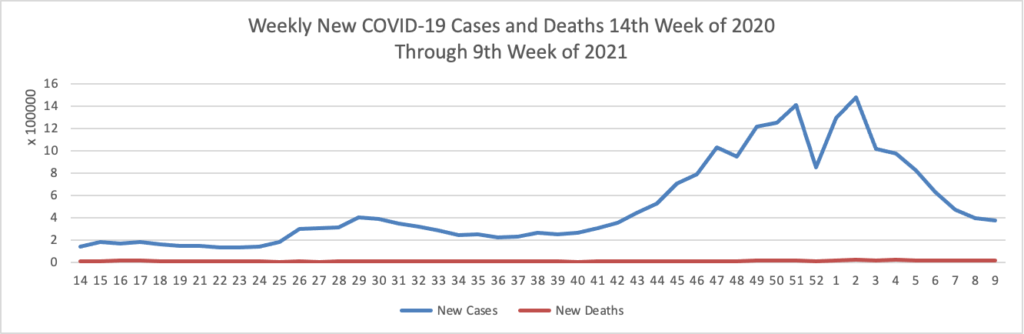
Based on the Centers for Disease Control’s COVID-19 Data Tracker website, here is the FEHBlog’s chart of new weekly COVID-19 cases and deaths over the 14th week of 2020 through 9th week of this year (beginning April 2, 2020, and ending March 3, 2021; using Thursday as the first day of the week in order to facilitate this weekly update):

and here is the CDC’s latest overall weekly hospitalization rate chart for COVID-19:

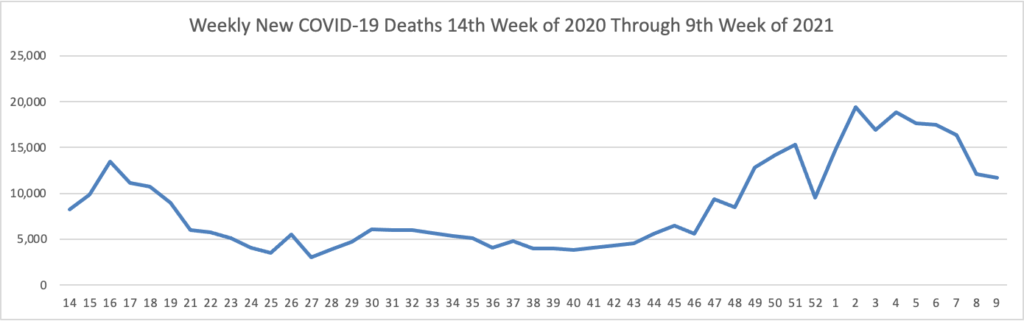
The FEHBlog has noticed that the new cases and deaths chart shows a flat line for new weekly deaths  because new cases greatly exceed new deaths. Accordingly here is a chart of new COVID-19 deaths over the period (April 2, 2020, through March 3, 2021):

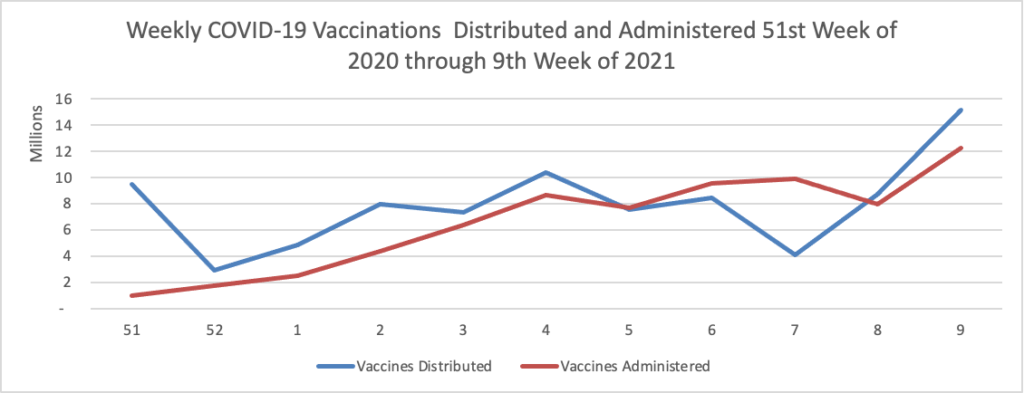
Finally here is a COVID-19 vaccinations chart since mid-December 2020 which also uses Thursday as the first day of the week:

These are all encouraging charts. The CDC reports that as of today 21.7% of eligible Americans (over age 18) have received at least one dose of the COVID-19 vaccine and 11.2% of received two doses.

The CDC’s FluView continues to report that “Seasonal influenza activity in the United States remains lower than usual for this time of year.”

The Wall Street Journal informs us that

A new study on the topic in JAMA Cardiology is based on the screening of 789 professional athletes who tested positive for Covid-19 between May and October in Major League Baseball, Major League Soccer, the National Hockey League, National Football League, and the men’s and women’s National Basketball Association. 

The paper shows that 0.6% of those athletes ultimately had findings suggestive of inflammatory heart disease. Five athletes were held out of competition because of their cardiac results. Three had myocarditis, which is heart inflammation, and two had pericarditis, which is swelling of the tissue that surrounds the heart. All had had moderate cases of Covid.

The findings suggest that long-term heart complications in non-severe Covid cases are unlikely—and that sports leagues are still likely to continue with cardiac screenings during the pandemic.

Govexec offers an interesting interview with National Institutes of Health Director Dr. Francis Collins.

Thursday Miscellany

Photo by Juliane Liebermann on Unsplash

Roll Call reports that the Senate continues to move forward its modified version of the American Rescue Plan which the House of Representatives passed last week. Here’s a link to the Congressional Budget Office’s report on the Senate bill.

The Senate Homeland Security and Governmental Affairs Committee held a confirmation hearing today on the President’s nominations of Shalanda D. Young to be Deputy Director, Office of Management and Budget, and Jason S. Miller to be Deputy Director for Management, Office of Management and Budget. Federal News Network sums up the hearing as follows: “President Joe Biden’s picks to serve in top positions at the Office of Management and Budget vowed on Thursday to remove hurdles from federal hiring, improve employee morale and help agencies keep their workforces safe during the pandemic.”

David Leonhardt of the New York Times does a great job putting the three current COVID-19 vaccines in perspective:

It’s the latest case of vaccine alarmism.

Many Americans are worried that Johnson & Johnson’s Covid-19 vaccine is an inferior product that may not be worth getting. Gov. Doug Burgum of North Dakota recently told The Washington Postthat he was now seeing not only “vaccine hesitancy” but also “the potential for brand hesitancy.”

The perception stems from the headline rates of effectiveness of the three vaccines: 72 percent for Johnson & Johnson, compared with 94 percent for Moderna and 95 percent for Pfizer. But those headline rates can be misleading in a few ways.

The most important measure — whether the vaccine prevents serious illness — shows the Johnson & Johnson vaccine to be equally effective as the other two. All work for nearly 100 percent of people. The picture is murkier for mild cases, but they are not particularly worrisome.

In promising news, STAT News reports that

Eli Lilly said Thursday that a study showed its experimental diabetes drug, tirzepatide, reduced patients’ blood sugar and body weight more than a rival medicine, Novo Nordisk’s Ozempic. The study compared three doses of tirzepatide — 5 mg, 10 mg, and 15 mg — to a 1 mg dose of Ozempic. Both drugs were given as injections. Tirzepatide reduced A1C, a measure of blood sugar levels, by 2.09% at the 5-mg dose, 2.37% at the 10-mg dose, and 2.46% at the 15-mg dose. For Ozempic, there was a 1.86% reduction. Patients were followed for 40 weeks.

Patients who received tirzepatide also saw their body weight decline by more than those who received Ozempic. They lost an average of 7.8 kilograms, or 8.5% of their body weight at the lowest dose, 10.3 kg, an 11% decrease, on the middle dose, and 12.4 kg, a 13.1% decrease, on the highest dose. For patients on semaglutide, the decrease in body weight was 6.2 kilograms, or 6.7%.

The differences were all statistically significant.

Lilly plans to virtually present the full trial results at the American Diabetes Association’s annual scientific conference in late June 2021.

In concerning news, the Centers for Disease Control informs us that “a new paper from CDC, in partnership with the University of Utah, estimates that the national healthcare costs associated with infections from six multidrug-resistant pathogens can be substantial at more than $4.6 billion annually.   This is one of the largest studies to estimate the cost associated with high-priority antibiotic-resistant pathogens. Issues highlighted in the study align with data and threats in CDC’s 2019 Antibiotic Resistance (AR) Threats Report. This includes the impact of resistant infections in the community, which can put more people at risk, make spread more difficult to identify and contain, and threaten the progress made to protect patients in healthcare.”  

Finally, Fierce Healthcare lets us know that

Greater liquidity, a stable payer mix and higher-acuity patients helped major hospital chains end 2020 with massive profits despite a financial roller coaster caused by the pandemic.

The latest earnings reports from several for-profit and not-for-profit hospital chains come as patient volumes continue to drift below pre-pandemic levels and as major hospital groups have raised the alarm about financial hardship faced by many hospitals around the country. 

And while plenty of health systems around the country are struggling, experts say many of the largest health systems around the nation have remained profitable.

[However] Rural and more independent and smaller facilities already operate on narrower profit margins which have been exacerbated by the pandemic. These financial headwinds could cause more consolidation among such facilities.