Tuesday’s Tidbits

Tuesday’s Tidbits

Photo by Patrick Fore on Unsplash

From the Omicron and siblings front —

The American Hospital Association informs us

The share of the U.S. population with antibodies to the SARS-CoV-2 virus in their bloodstream increased from 34% in December 2021 to 58% in February 2022, including 75% of children, according to a study released today by the Centers for Disease Control and Prevention. The study tested blood samples during the COVID-19 omicron period for antibodies produced in response to infection but not in response to COVID-19 vaccines. Children had the highest rates of infection-induced antibodies and adults 65 and older the lowest, with the greatest increases over the period in age groups with the lowest COVID-19 vaccination coverage. 

“Vaccination remains the safest strategy for preventing complications from SARS-CoV-2 infection, including hospitalization among children and adults,” the authors said. 

and

Starting this week, the Administration will allow all pharmacies in the federal pharmacy program to order free oral antiviral treatments directly from the federal government, the White House announced today. The Administration hopes to double the number of participating pharmacies to 40,000 in the coming weeks, and to launch new Test-to-Treat locations that offer the Pfizer and Merck pills, which the Food and Drug Administration authorized in December to treat COVID-19 in patients at risk of progressing to severe disease. Pharmacies also can continue to receive the pills through their state or territorial health department. The Administration said it is working to improve the Test-to-Treat patient experience, including through telehealth options; and to provide more guidance on COVID-19 treatments to prescribers and clinicians.

The New York Times adds more details to this AHA blurb. In short, “experts say that efforts to reach at-risk Americans remain complex and inefficient.”

Medscape adds “Contrary to popular belief, no association appeared between the number of intensive care unit beds and COVID-19 deaths, based on a review of data from all 50 states between March 1, 2020, and June 30, 2021.”

The Wall Street Journal further reports

Pfizer Inc. and partner BioNTech SE asked U.S. health regulators to authorize a booster dose of its Covid-19 vaccine for children 5 to 11 years old.

The request Tuesday to the Food and Drug Administration comes after the companies said earlier this month that a third shot safely generated a strong immune response in the youngsters, including significantly increased antibody levels against the Omicron variant. 

A thumbs-up from the FDA would expand eligibility of boosters to the roughly 28 million children in the U.S. Booster doses are now available for people as young as 12 years old in the U.S., and regulators recently greenlighted second boosters for people who are 50 years old and up or who have weakened immune systems

In FEHB news, OPM issued a paper describing the 2021 highlights of OPM’s FEHB Plan Performance Assessment system. In the FEHBlog’s view, OPM’s PPA system could be improved by (1) seeking plan input on all PPA changes, including, for example, the benchmark change to ALOB and (2) implementing changes for the first measurement year following the change, not the year in which the change is made. Both of these changes are consistent with federal administrative law, in the FEHBlog’s opinion. Also, OPM should use the carrot incentive more than the stick.

In healthcare business news,

Healthcare Dive tells us

Hospitals are experiencing a “massive surge” in expenses for items such as labor, drugs and supplies amid rising inflation, the American Hospital Association said in a report on Monday.

Labor is a particular stressor, making up more than half of hospitals’ total expenses. Overall, hospital labor expenses per patient increased almost 20% from 2019 to 2021, the AHA said. 

The powerful hospital lobby urged Congress to help address these headwinds by adding money to the provider relief fund and creating flexibility on advanced Medicare repayments, among other items.

Medpage Today informs us

Nearly three-fourths of U.S. physicians opted for employment with hospitals, health systems, or other corporate entities, such as private equity firms and health insurers in the pandemic era, according to a new report.

In 2021, 73.9% of physicians were hospital- or corporate-employed, up from 69.3% at the start of 2021, 64.5% at the start of 2020, and 62.2% at the start of 2019, according to the nonprofit Physicians Advocacy Institute (PAI) and consulting firm Avalere. That equates to 484,100 employed physicians, up from 423,800, 391,000, and 375,400 at the start of 2021, 2020, and 2019, respectively.

Perhaps these two trends are related? On the one hand, more physician employees create more hospital expenses. On the other, a hospital receives additional health plan payments for services provided by physician employees. In all likelihood, the revenue exceeds the expense in this case.

From tidbits department,

  • AHRQ reports on “Geographic Variation in Inpatient Stays for Five Leading Mental Disorders, 2016–2018.”

CAQH CORE, the author of national operating rules for the HIPAA-covered administrative transactions, recently released new operating rules to enhance information exchange and healthcare operations related to benefits coverage and supplemental documentation. * * *

The new CAQH CORE Attachments Operating Rule aims to improve the exchange of attachments, a long-standing industry issue. The guidelines will establish key infrastructure and data content requirements, helping providers send electronic health plans documentation to support a claim or prior authorization in a uniform format, the press release stated.

Reassociation or linking the attachment with the original prior authorization request or claim submission is one of the most significant pain points in the attachment workflow, CAQH CORE added.

The new guidelines also offer updates to enhance the exchange of critical eligibility and benefit information related to telemedicine, prior authorization, remaining coverage benefits, procedure-level information, and tiered benefits between health plans and providers.

The second newly released rule, the CAQH CORE Eligibility & Benefits Data Content Rule, intends to enhance provider knowledge regarding their patients’ coverage, leading to more timely care and accurate billing.

Finally, CAQH CORE revised its rules for infrastructure, which now calls for greater health plan system availability and less frequent periods of downtime.


  • Health Payer Intelligence notes “Applying an out-of-pocket spending cap to Medicare Part D could be a tool for promoting health equity, according to an insight from Avalere.”

Monday Roundup

Photo by Sven Read on Unsplash

From the No Surprises Act front, the FEHBlog nearly fell off his chair when he noticed this Healthcare Dive article:

The Department of Justice intends to appeal a federal judge’s ruling that sided with providers over a challenge to the surprise billing rule, according to a Friday filing from the DOJ in the Eastern District of Texas.  

The Texas Medical Association sued the federal government over its interpretation of the No Surprises Act, arguing the rule leans too heavily on one factor arbiters are supposed to consider when resolving payment disputes between payers and providers.      

Federal Judge Jeremy Kernodle’s February ruling said nothing in the bill passed by Congress instructs arbiters to “weigh any one factor … more heavily than the others,” indicating the rule conflicts with the bill.

The Justice Department noticed an appeal to the Fifth Circuit in the referenced Friday, April 22, filing with the District Court. That notice effectuates the appeal. The FEHBlog will keep an eye on the dockets to learn whether the Justice Department will seek a stay of the February ruling while the case is on appeal.

From the Omicron and siblings front —

  • Bloomberg’s Prognosis reviews progress being made in the development of Covid vaccines administered nasally. Nasal vaccines have a better shot at preventing COVID than injected vaccines.
  • The American Hospital Association reports “The Food and Drug Administration today expanded its approval for remdesivir (Veklury) to include pediatric patients under age 12 who test positive for SARS-CoV-2 and are hospitalized or at high risk of progressing to severe COVID-19. The patient must be at least 28 days old and weigh at least 3 kilograms (about 7 pounds). FDA said the approval is supported by a clinical study of 53 pediatric patients as well as trials in adults, given the similar course of disease in adult and pediatric patients.”
  • Medical Dialogues informs us the World Health Organization has recommended Pfizer’s Paxlovid Covid pill over remdesvir, Merck’s pill and monoclonal antibodies for patients with milder forms of Covid and nevertheless at high risk of hospitalization from the disease, e.g. the elderly, the immunocompromised, and the unvaccinated.
  • WebMD News tells us “COVID-19 was the third-leading cause of death in the United States in 2021 for the second straight year, with only heart disease and cancer causing more deaths, the CDC said Friday. * * * The overall number of COVID deaths in 2021 increased around 20% over 2020, when around 384,000 people died from the virus, the CDC said. COVID deaths in 2021 peaked for the weeks ending Jan. 16 and Sept. 11, following holiday periods.”

The WebMD article offers other interesting public health nuggets. For example,

About 693,000 people died of heart disease in 2021, with 605,000 dying of cancer and 415,000 of COVID, the CDC said, citing provisional data that might be updated later.

Unintentional injuries were the fourth-leading cause of death, increasing to 219,000 in 2021 from 201,000 in 2020. Influenza and pneumonia dropped out of the top 10 leading causes of death and suicide moved into 10th place.

Overall, about 3,458,697 deaths were reported in the U.S. last year. The age-adjusted death rate was 841.6 deaths per 100,000 people, an increase of .7% from 2020. The 2021 death rate was the highest since 2003, the CDC said.

From the healthcare business front, Fierce Healthcare reports

Change Healthcare has found a buyer for its payment integrity arm, ClaimsXten, though the sale is contingent on the closure of its merger with UnitedHealth Group.

According to a filing submitted Monday to the Securities and Exchange Commission, ClaimsXten will be sold off to an affiliate of TPG Capital for a base purchase price equal to $2.2 billion in cash. UnitedHealth is listed as the seller.

From the reports department —

  • The National Bureau of Economic Research offers a working paper titled “Pharmacy Benefit Managers and Vertical Relationships in Drug Supply: State of Current Research.”
  • Per HR Morning, “Employer support [of their workforces] is happening in the areas of increased prioritizing employee assistance programs (EAPs), expanded wellness benefits and greater attention to work/life balance. That’s according to Ragan’s 2022 Communications Benchmark Report that surveyed close to 1,000 communicators across industries on opportunities and changes.”
  • Per Health Payer Intelligence, Humana has produced an issue brief that provides “an overview of the policymaking landscape surrounding social determinants of health data collection.”

Weekend update

Photo by Michele Orallo on Unsplash

Congress returns from its two-week-long District / State work break tomorrow and resumes Committee business on Tuesday. The House of Representatives and the Senate also resume floor voting on Tuesday.

The Wall Street Journal adds

Once Congress returns to work, Democrats say they hope to get the bipartisan China competition bill signed into law. In the coming weeks, they are preparing to make a final attempt at resurrecting elements of the healthcare, education and climate package, which included provisions designed to lower the price of some prescription drugs. Sen. Joe Manchin (D., W.Va.), who scuttled the earlier bill in the Senate that all Republicans opposed, has said he could support a narrower package focused on climate and drug prices. * * *

Leaders of the center-left New Democrat Coalition urged the president in a recent meeting to work with Congress to focus on the China legislation and a narrow social spending and climate bill, said Rep. Suzan DelBene (D., Wash.), the group’s chair. In a separate meeting, the Congressional Progressive Caucus urged the president to use executive orders if legislation stalled, said CPC Chair Rep. Pramila Jayapal (D., Wash.).

Republicans say Democrats are out of touch with the electorate and that new spending will add to inflation. They also say that many of Democrats’ proposed actions could actually undercut them at the polls. If Republicans were to win back Congress, “the message to the president would be quit all the left-wing stuff, move to the center and work on things you can agree on,” said Senate Minority Leader Mitch McConnell (R., Ky.).

In other scheduling news, OPM and AHIP will be holding their annual FEHB carrier conference on Wednesday and Thursday this week. The conference will be held virtual. Hopefully next year, the conference will be held in person and a month earlier.

From the Omicron and siblings front, the American Medical Association offers what doctors wish their patients knew about the Omicron BA.2 subvariant. Nancy Crum, MD, an infectious disease specialist at Avita Health System in Galion, Ohio explained

We’ve been seeing a lot more of sore throat and pharyngitis that we didn’t really see before,” said Dr. Crum. Some of the other symptoms experienced are “very similar to the other coronaviruses such as febrile illness and respiratory symptoms.”

“Patients can also have gastrointestinal symptoms such as diarrhea, and loss of taste or loss of smell, although I’ve seen that a lot less with the newer variants,” she said, noting that symptoms for BA.2 may also include muscle or body aches, headache, nausea or vomiting, and congestion.

“We’re seeing very low rates of positivity for coronavirus right now and we’re actually seeing more influenza,” said Dr. Crum. That’s why “everyone coming in with any of those symptoms gets both a COVID test and an influenza test at the same time.”

Bloomberg’s Prognosis adds

The U.S. government is finishing plans to make Pfizer Inc.’s Covid-19 pill available at any pharmacy across the country, with supply increasing as the BA.2 sub-variant drives an uptick in cases and hospitalizations.

The administration will outline a plan [this coming] week aimed at getting the pill, Paxlovid, to additional people who’d otherwise face a more serious case of Covid-19, an administration official said Friday. The official asked not to be identified ahead of an announcement.

Use of oral antiviral pills in the U.S. jumped 103% between March 27 and April 10, the official said. The White House wants to drive that number higher, and signal to health providers to err on the side of prescribing the pills, rather than worrying about scarcity.

Let’s go.

STAT News advises

The World Health Organization said Saturday that 12 countries have reported at least 169 unusual cases of hepatitis in children, with 17 of the children having undergone liver transplants as a consequence. At least one child has died.

The WHO’s European division, which is taking the lead on the investigation into the mysterious outbreak, urged countries to look for, investigate, and report similar cases.

“Although the numbers aren’t big, the consequences have been quite severe,” Richard Pebody, who heads the high threats pathogen team at the WHO’s European division, told STAT in an interview. “It’s important that countries look.” * * *

The U.S. has seen 11 cases — nine in Alabama and two in North Carolina. The first Alabama cases date back to October and November of 2021, the earliest known cases. Pebody said most of the others are more recent. * * *

Suspicion has centered on an unexpected suspect — an adenovirus, specifically adenovirus type 41. At least 74 of the affected children have tested positive for adenovirus infection and molecular testing has turned up evidence of adenovirus 41 in 18 of those children.

Authorities have ruled out any possibility that Covid vaccines might have been involved in these cases. The vast majority of the children were not vaccinated, the WHO statement said.

Friday Stats and More

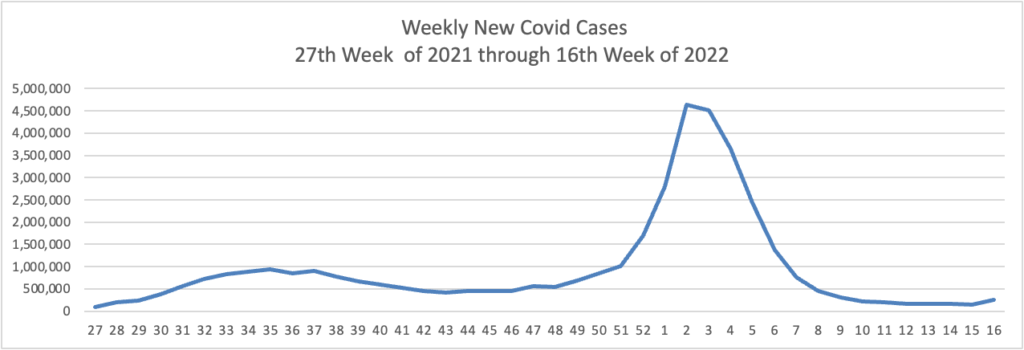
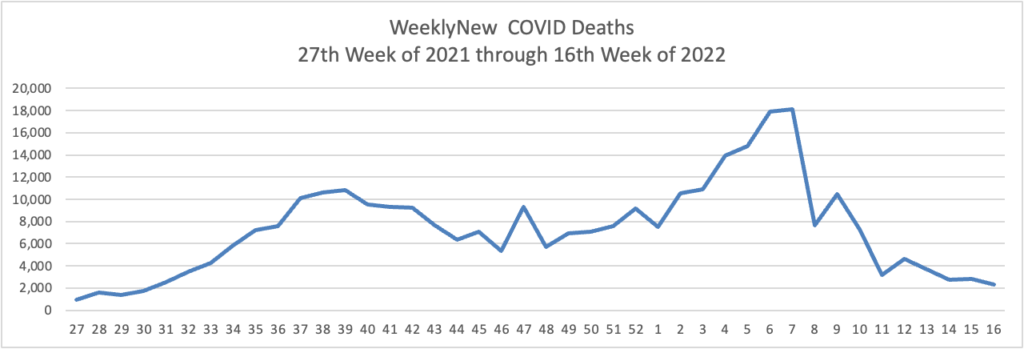
Based on the Centers for Disease Control’s Covid Data Tracker and using Thursday as the first day of the week, here are the FEHBlog’s latest weekly charts of new Covid cases and deaths.

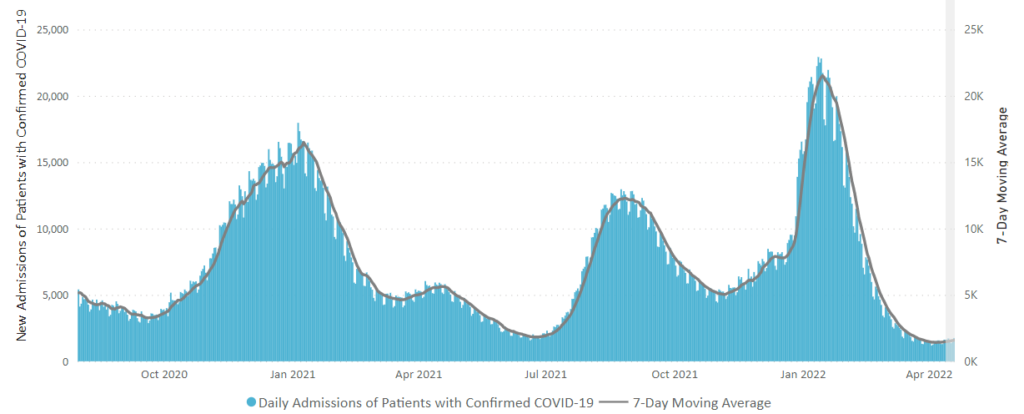
Because David Leonhardt in the New York Times recommends keeping an eye on Covid hospital admissions here is the CDC’s latest chart

The weekly new cases and death chart start in the middle of 2021 when we hit all time lows in new cases. Although our new cases total for the past week was 3 times week 27 in 2021, the new hospitalizations level is lower. That’s good news.

The CDC’s weekly review of its Covid stats adds

Currently, there are 39 (1.21%) counties, districts, or territories with a high COVID-19 Community Level, 231 (7.17%) counties with a medium Community Level, and 2,954 (91.63%) counties with a low Community Level. This represents a slight (0.78%) increase in the number of high-level counties, a small (+1.67%) increase in the number of medium-level counties, and a corresponding (−2.45%) decrease in the number of low-level counties. Twenty-five (44.64%) of 56 jurisdictions had no high- or medium-level counties this week.

To check your COVID-19 community level, visit COVID Data Tracker.

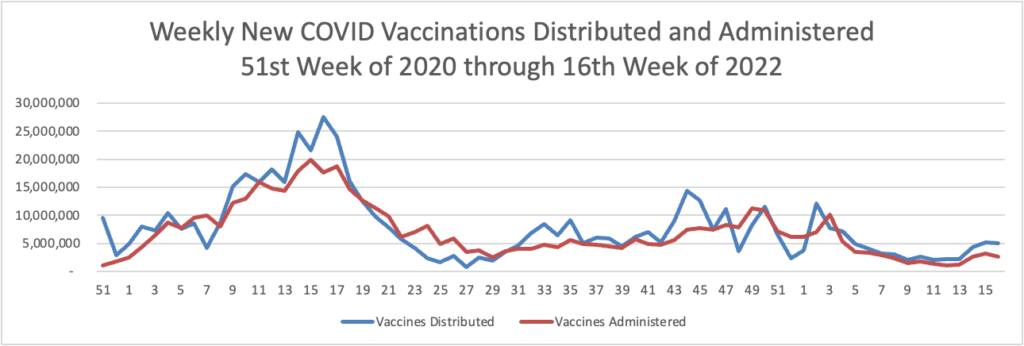
Here’s the FEHBlog’s latest weekly chart of Covid vaccinations distributed and administer from the beginning of the COVID vaccination era to the 16th week of 2022.

New vaccinations remain above 2 million per week.

From the Medicare front, the Centers for Medicare Services announced today a proposed rule that would create five new special Medicare enrollment periods.

  • An SEP for Individuals Impacted by an Emergency or Disaster that would allow CMS to provide relief to those beneficiaries who missed an enrollment opportunity because they were impacted by a disaster or other emergency as declared by a Federal, state, or local government entity.
  • An SEP for Health Plan or Employer Error that would provide relief in instances where an individual can demonstrate that their employer or health plan materially misrepresented information related to enrolling in Medicare timely. 
  • An SEP for Formerly Incarcerated Individuals that would allow individuals to enroll following their release from correctional facilities. 
  • An SEP to Coordinate with Termination of Medicaid Coverage that would allow individuals to enroll after termination of Medicaid eligibility.
  • An SEP for Other Exceptional Conditions that would, on a case-by-case basis, grant an enrollment period to an individual when circumstances beyond the individual’s control prevented them from enrolling during the IEP, GEP or other SEPs. 

These “SEPs that would provide individuals who meet certain exceptional conditions and who missed a Medicare enrollment period an opportunity to enroll without having to wait for the GEP and without being subject to a [Part B] late enrollment penalty.”

From the healthcare business front —

Beckers Payer Issues tells us

UnitedHealth Group subsidiary Optum has quietly acquired at least two independent primary care groups in Oregon, according to The Lund Report.

Optum has purchased Eugene-based Oregon Medical Group and Portland-based GreenField Health. Combined, the two systems have about 120 doctors and clinicians at 11 facilities. 

GreenField Health was purchased last year and Oregon Medical Group in late 2020, according to the Lund Report.

Nationwide, UnitedHealth Group has purchased about 1,500 primary care and specialty facilities, totaling 60,000 physicians.

Fierce Healthcare informs us

Humana will divest its majority stake in Kindred at Home’s hospice business to investment firm Clayton, Dubilier & Rice.

As part of the deal, which was announced Thursday, Humana will sell off a 60% stake in KAH Hospice for $2.8 billion in cash, which reflects an enterprise valuation of $3.4 billion and twelve times the division’s forecasted earnings before interest, income taxes, depreciation and amortization (EBITDA) for this year.

Humana said a year ago when it bought out the majority stake in Kindred at Home that it planned to divest the hospice arm. The insurer believes that it can deliver strong patient outcomes in hospice care without owning KAH Hospice outright, Chief Financial Officer Susan Diamond said in a statement.

From the medical research front, STAT News interviews Helmy Eltoukhy and AmirAli Talasaz, Guardant Health’s founders and co-CEOs.

Bay Area biotech Guardant Health is closer than ever to its ultimate goal — developing and deploying a simple, blood-based test that you could get during an annual doctor’s visit to spot cancer early enough that it might be treated more successfully. And 2022 is shaping up to be a big year for the company’s ambitions.

That’s good news for all of us.

Thursday Miscellany

Photo by Josh Mills on Unsplash

Today is Earth Day. AHRQ offers “A new AHRQ Views blog post in recognition of Earth Day 2022 highlights the Agency’s emerging efforts to reduce the impacts of climate change.”

From the FEHB front, Fedweek warns federal employees to think hard before rejecting FEHB coverage late in a career. As explained in the article you can lose out on one of the best fringe benefits for federal and postal employees — continuing their FEHB coverage into retirement with the full government contribution.

From the Omicron and siblings front —

STAT News informs us

Experts who advise the CDC met yesterday to discuss a thorny issue: Covid vaccine boosters, specifically the new policy to allow people 50 and older and people who are immunocompromised to get a second booster. By the end of the meeting — during which members of the Advisory Committee on Immunization Practices expressed frustration with the lack of clarity about the goal of the U.S. booster policy — it wasn’t entirely clear why people are being offered a second booster at this time. Data presented by CDC experts suggested the protection that immune-competent people have received from their primary series and first booster is holding up and the expected benefits from the fourth shots are modest at best. ACIP member Beth Bell raised concerns about “booster fatigue” and said offering another dose now could undercut confidence in vaccines that are working well at protecting people from severe Covid. The policy to offer the fourth doses was made without consulting ACIP.

What’s more,

Among the many views expressed around vaccine mandates, one theme persists: the idea that Covid-19 infection protects unvaccinated people against reinfection. While CDC says “getting a Covid-19 vaccination is a safer and more dependable way to build immunity to Covid-19 than getting sick with Covid-19,” a research letter in JAMA Network Open tested the concept of natural immunity by analyzing data from more than 121,000 patients receiving health care in the western U.S. from October 2020 through November 2021, before the Omicron variant took hold. Unvaccinated people who’d been sick with Covid had an 85% lower risk of acquiring Covid again compared to unvaccinated individuals without prior Covid. That level is similar to what mRNA vaccines deliver. Previous infection conferred 88% protection against hospitalization after reinfection and 83% protection against reinfection that did not require hospitalization. The authors conclude natural immunity works as well against both mild and severe illness. One difference: Natural immunity didn’t wane, but mRNA vaccines’ protection did. “This study may have important implications for vaccine policy and public health,” they write.

It is illogical to downplay natural immunity when the worst flu epidemic in U.S. history, the 2018 pandemic, was resolved by a combination of deaths and natural immunity. This is not intended to downplay vaccines. In the FEHBlog’s view, the CDC should be paying more attention to natural immunity from Covid.

From the Covid anti-fraud front, Healthcare Dive reports

The Department of Justice has charged 21 people across the U.S. for pandemic-related healthcare fraud, federal prosecutors said Wednesday.

Defendants — including doctors, medical business executives and fake vaccination card manufacturers — caused nearly $150 million in false billing to federal programs, the DOJ alleged.

The prosecution effort involves some of the “largest and most wide-ranging pandemic-related frauds detected to date,” said Kevin Chambers, the DOJ’s director for COVID-19 fraud enforcement.

From the Food and Drug Administration front —

The American Hospital Association tells us

The Food and Drug Administration seeks comments through June 21 on a potential change that would require outpatient settings to dispense opioid pain medications with prepaid mail-back envelopes and pharmacists to provide patient education on safe disposal of opioids.

“This potential modification to the existing Opioid Analgesic Risk Evaluation and Mitigation Strategy would provide a convenient, additional disposal option for patients beyond those already available such as flushing, commercially available in-home disposal products, collection kiosks and takeback events,” the agency said.

Good idea. Also

Health care providers should not use non-invasive prenatal screening tests alone to diagnose genetic abnormalities due to the potential for false results, the Food and Drug Administration warned last week. Also known as cell-free DNA tests or non-invasive prenatal tests, these laboratory developed tests in most cases are not reviewed by the FDA.

“Patients and health care providers should be aware of the risks and limitations of using these genetic prenatal screening tests and that they should not be used alone to diagnose chromosomal (genetic) abnormalities,” FDA said, citing reports that some patients and providers have made critical health care decisions based on the results without additional confirmatory testing. 

From the Rx coverage front, STAT News reports

Thanks to Covid-19 vaccines and therapies, U.S. spending on pharmaceuticals rose 12% in 2021 as use reached record levels and new prescriptions for acute and chronic care largely recovered from the slowdown seen during the pandemic, according to a new analysis.

Meanwhile, out-of-pocket costs paid by patients hit $79 billion, a $4 billion rise from the year before and the same level seen in 2018 after two years of declining costs. Overall, these costs were relatively low — less than $20 per prescription — but about 1% of all prescriptions filled, or 64 million, ran patients $125, underscoring ongoing barriers to affordability. In fact, 81 million prescriptions were not filled last year.

“We’re not in a very different situation from where we were five years ago except for the intensified, competitive market dynamics. But there are no major changes from a major legislative or policy perspective,” said Murray Aitken, senior vice president and executive director of the IQVIA Institute for Human Data Science, which conducted the analysis.

He also noted that the overall use of health services has returned to pre-pandemic levels, but has not yet made up for the backlog in missed patient visits, screenings and diagnostics, elective procedures, and new prescription starts — which IQVIA called a “concerning gap in preventive and treatment services.”

From the opioid epidemic front, the White House announced today

President Biden sent his Administration’s inaugural National Drug Control Strategy to Congress at a time when drug overdoses have taken a heartbreaking toll, claiming 106,854 lives in the most recent 12-month period. The Strategy delivers on the call to action in President Biden’s Unity Agenda through a whole-of-government approach to beat the overdose epidemic.

The Strategy focuses on two critical drivers of the epidemic: untreated addiction and drug trafficking. It instructs federal agencies to prioritize actions that will save lives, get people the care they need, go after drug traffickers’ profits, and make better use of data to guide all these efforts.

Here is a link to the full report

Midweek Update

From the Centers for Disease Control front —

Roll Call informs us

The Centers for Disease Control and Prevention on Wednesday asked the Justice Department to appeal a federal judge’s ruling overturning the federal mask mandate for airlines and other forms of public transportation, setting up a legal battle that could permanently impact the CDC’s ability to weigh in on public health issues.

The Wall Street Journal adds

The judge’s ruling was the latest in a series of court decisions that have left the Biden administration with dwindling legal options for mandates to combat Covid-19. And it came amid a shift away from mask mandates in the U.S., even in Democratic-controlled states along the East and West coasts. An appeal gives the Biden administration the opportunity to persuade a higher court to wipe the Florida ruling off the books, which could prove useful to the White House if it chooses to pursue a mask mandate in the future.

The AP reports

A new U.S. government center [residing within the CDC] aims to become the National Weather Service for infectious diseases — an early warning system to help guide the response to COVID-19 and future pandemics.

The new Center for Forecasting and Outbreak Analytics launched Tuesday. Its leaders say predicting the course of the COVID-19 pandemic in the U.S. has been hampered by data-collection problems.

In contrast, the United Kingdom uses regular population sampling with swab tests and blood draws to get a clearer picture of who’s been infected, said Marc Lipsitch, the new center’s science director. He said similar sampling should be considered in the U.S.

And the Centers for Disease Control and Prevention needs to have better access to data from state governments and hospitals, said Caitlin Rivers, the center’s associate director.

From the Omicron front, STAT News discusses six Covid mysteries that scientists are beginning to unravel.

1. How will the virus evolve next?

2. What will future waves look like?

3. If you’ve never had Covid, how worried should you be right now?

4. How, exactly, does the virus transmit from person to person?

5. Will we get a new, better generation of vaccines, therapeutics, and tests?

6. How long before we understand long Covid?

“The eventual answers will determine our relationship with Covid and how we’ll fight a future pandemic.”

Reuters reports

Hospitalization rates for unvaccinated children ages 5 to 11 were twice as high as among those who were vaccinated during the record COVID-19 surge caused by the Omicron variant, according to a U.S. study released on Tuesday.

For every 100,000 unvaccinated children in the age group, 19.1 per were hospitalized with COVID-19 between mid-December and late February, compared with 9.2 per 100,000 vaccinated kids, the U.S. Centers for Disease Control and Prevention reported.

From the Social Determinants of Health front,

The Center for Medicare Services “outlined an action plan that demonstrates the Biden-Harris Administration’s ongoing efforts to provide high-quality, affordable health care for all people, regardless of their background, and to drive health equity across the Department of Health and Human Services (HHS).”

 “The goals of CMS’ action plan include:

  • Promoting culturally and linguistically appropriate services in organizations;
  • Enrolling more people in Medicare, Medicaid, the Children’s Health Insurance Program and Health Insurance Marketplace; and
  • Incorporating screening for and promoting broader access to health-related social needs.”

“For more information, please visit: www.cms.gov/sites/default/files/2022-04/Health%20Equity%20Pillar%20Fact%20Sheet_1.pdf

The CDC’s Division of Diabetes Translation called attention to its new website on improving health equity

From the No Surprises Act front, the American Medical Association offers an article on how doctors can use the NSA to resolve billing disputes. It’s always helpful to take a peek at the other sides’s strategies.

Cigna announced

Beginning in August, Kaiser Permanente commercial HMO and exclusive provider organization (EPO) members who need urgent care when they are traveling outside of areas served by Kaiser Permanente will have access to Cigna’s national PPO network of more than one million physicians and other providers. This will significantly expand Kaiser Permanente’s ability to provide more affordable and convenient access to valuable, high-quality health care and services for current and future members.

This is a smart move by KP to reduce its exposure to NSA emergency department billing disputes.

From the healthcare business front —

Cigna’s press release adds

In the area of specialty pharmacy services, the agreement seeks to deliver overall value and savings to Kaiser Permanente and its commercial plan members. Accredo, Evernorth’s specialty pharmacy, will become Kaiser Permanente’s preferred external pharmacy for limited distribution drugs, and Evernorth’s CuraScript SD will be a preferred distributor for purchasing certain other specialty products.

The broad agreement between Evernorth and Kaiser Permanente is effective immediately.

Forbes reports

Anthem’s first-quarter profits reached $1.8 billion thanks to strong enrollment in its Medicaid and Medicare Advantage plans. 

Anthem, which operates an array of government and commercial health insurance including Blue Cross and Blue Shield plans in 14 states, Wednesday reported first-quarter profits rose 8.4% to $1.8 billion, or $7.39 per share, compared to $1.67 billion, or $6.71 per share, in the year-ago quarter. Revenue rose nearly 17.6% to $38 billion compared to $32,4 billion a year ago.

Anthem’s membership grew by 3.3 million, or 7.5%, to 46.8 million as of March 31, 2022, compared to a year ago.

Beckers Payer Issues offers 11 takeaways from Anthem’s first-quarter 2022 earnings report.

The American Hospital Association reports

The Department of Health and Human Services today released a report and public data on 2016-2022 ownership changes for hospitals and nursing homes enrolled in Medicare.

According to the report, only 4.6% of hospitals were sold over the period. Small hospitals with 26-64 beds were more likely to be acquired than larger hospitals, and hospitals with the greatest negative margins were over twice as likely as those with the highest positive margins to be acquired (8.6% versus 3.0%). Only one critical access hospital was acquired during the study period, and urban hospitals were more likely to be acquired than rural hospitals (5.6% versus 3.3%). Long-term care hospitals were the most likely to be acquired, while psychiatric and “other” hospitals were the least likely.

The agency plans to update the data on a quarterly basis. 

In telehealth news, mHealth Intelligence tells us

When comparing the use of telehealth among different pediatric subspecialties, a JAMA Network Open study found that pediatric telehealth use was inconsistent across subspecialties, with genetics and behavioral health subspecialists using the care modality the most.

The study included 549,306 patients, representing a total of 1.8 million visits from eight pediatric medical groups from the Children’s Specialty Care Coalition (CSCC). There were 11 different subspecialties, including cardiology, orthopedics, urology, nephrology, dermatology, genetics, behavioral health, pulmonology, endocrinology, gastroenterology, and neurology. The study period began Jan. 1, 2019, and ended Dec. 31, 2021.

Monday Roundup

Photo by Sven Read on Unsplash

From the Omnicron and siblings front

The Centers for Disease Control today posted updated websites for the following topics that include updated or new tools:

AHIP informs us

The White House and the U.S. Department of Health and Human Services (HHS) are hosting an upcoming meeting entitled, Conversations on Encouraging COVID-19 Vaccinations, a virtual program that is part of the “We Can Do This” COVID-19 public education campaign.

The virtual Summit will feature conversations among leading doctors, medical professionals, parents, and community leaders about COVID-19 vaccines and how the broader medical community can encourage vaccination among pregnant people, children, teens, and young adults.

The event will be held on Friday, April 22 at 12:00 PM – 2:30 PM ET.  You can join the meeting here.

Speaking of AHIP, the FEHBlog noticed today that the OPM AHIP FEHB carrier conference website is fully built out. The virtual conference will be held on April 27 and 28.

Speaking of OPM, OPM announced today “the Combined Federal Campaign (CFC) will conduct a special solicitation that will allow the federal community to support charities serving and affected by the war in Ukraine and the resulting humanitarian and refugee crisis. This special solicitation will run through June 30, 2022.”  Thoughtful step on OPM’s part.

Roll Call reports

The Biden administration Monday said it would not enforce the mask mandate for airplanes and transit after a federal judge in Florida struck it down.

In a 59-page order, U.S. District Judge Kathryn Kimball Mizelle said the Centers for Disease Control and Prevention overstepped its authority by requiring passengers to wear masks on public transportation, saying the mandate ”exceeds the CDC’s statutory authority and violates the procedures required for agency rulemaking.”

The Biden administration responded late Monday with a statement saying that the agencies are reviewing the decision and assessing possible next steps. * * *

The CDC recommended that people continue to wear masks in indoor public transportation settings.

USA Today adds

United, American, Southwest, Delta and Alaska and other airlines late Monday said they were dropping their face mask requirement effective immediately given a federal judge’s ruling in Florida and the White House response to it.

From the Medicare front, the Centers for Medicare Services announced

a proposed rule for inpatient and long-term hospitals that builds on the Biden-Harris Administration’s key priorities to advance health equity and improve maternal health outcomes. In addition to annual policies that promote Medicare payment accuracy and hospital stability, the FY 2023 Inpatient Prospective Payment System (IPPS) and Long-Term Care Hospital (LTCH) Prospective Payment System (PPS) rule includes measures that will encourage hospitals to build health equity into their core functions, thereby improving care for people and communities who are disadvantaged and/or underserved by the healthcare system. The rule includes three health equity-focused measures in hospital quality programs, seeks stakeholder input related to documenting social determinants of health in inpatient claims data, and proposes a “Birthing-Friendly” hospital designation.

For acute care hospitals paid under the IPPS that successfully participate in the Hospital Inpatient Quality Reporting Program and are meaningful electronic health record users, the proposed increase in operating payment rates is projected to be 3.2%. This reflects a FY 2023 projected hospital market basket update of 3.1% reduced by a projected 0.4 percentage point productivity adjustment and increased by a 0.5 percentage point adjustment required by statute. Under the LTCH PPS, CMS expects payments to increase by approximately 0.8% or $25 million. * * *

For a fact sheet on the proposed payment rule visit: https://www.cms.gov/newsroom/fact-sheets/fy-2023-hospital-inpatient-prospective-payment-system-ipps-and-long-term-care-hospitals-ltch-pps

For a fact sheet specific to the maternal health and health equity measures included in the proposed payment rule visit: https://www.cms.gov/newsroom/fact-sheets/fy-2023-hospital-inpatient-prospective-payment-system-ipps-and-long-term-care-hospitals-ltch-pps-0

The American Hospital Association’s statement on the proposed rule may be found here. The regulatory battle has been joined.

From the medical research front

  • Medpage Today offers access to “a video [in which], Scott Weiner, MD, MPH, director of the Brigham Comprehensive Opioid Response and Education (B-CORE) Program at Brigham and Women’s Hospital in Boston, discusses his recent study on the risks of chronic use and overdose with hydrocodone versus oxycodone and how providers can keep their patients safe when prescribing these medications.” A transcript of the video also is provided.

Higher levels of “good” cholesterol in the fluid surrounding your brain and spinal cord may help protect you from Alzheimer’s disease, a new study suggests.

“This study represents the first time that small HDL particles in the brain have been counted,” said study co-author Dr. Hussein Yassine. He is an associate professor of medicine and neurology at the University of Southern California’s Keck School of Medicine in Los Angeles.

For the study, Yassine and his colleagues analyzed concentrations of high-density lipoproteins (HDL) — often referred to as “good cholesterol” — in the cerebrospinal fluid of 180 healthy volunteers with an average age of nearly 77.

The study linked a higher number of small HDL particles in cerebrospinal fluid with two key indicators that they might protect against Alzheimer’s. * * *

The results suggest that small HDL particles may point the way to treatments for early Alzheimer’s, long before mental decline occurs.

From the Rx coverage front, STAT News reports

The nation’s preeminent cancer hospitals are charging commercial health insurers anywhere from double to seven times their costs of acquiring cancer drugs, a new study shows.

Most top cancer institutions also are keeping their drug prices secret in direct violation of federal law, potentially exposing themselves to fines.

The findings reinforce how cancer care, especially the drugs, generates significant revenue for hospitals, and how markups on drugs potentially put insured cancer patients in financially perilous situations. * * *

Ultimately, researchers found the amount of money that a hospital gets from an insurance company, just for the cancer therapy, often is more than what the drug company receives.

So it’s not just insulin. No bueno.

Weekend update

CPhoto by Mark Tegethoff on Unsplash

Happy Easter and Passover.

Congress continues with its State / District work period for a second week. Congress resumes its work on Capitol Hill next week.

From the Omnicron and siblings front, the Wall Street Journal reports

In the latest phase of the Covid-19 pandemic, federal and local officials are telling people to decide for themselves how best to protect against the virus. 

Health officials are leaving it up to people to assess if they need booster shots, whether to wear a mask and how long to isolate after a positive test. Businesses, schools and other entities are scaling back specific guidelines as they prepare for a return to normal.

The question of when older adults should get a second vaccine booster is the latest example of the government shifting decisions from broad-based community outreach to personal choice. People 50 years and older can get the additional booster at least four months after their first, but health authorities aren’t pushing those eligible to get the shots. 

That’s sensible. Bloomberg’s Prognosis adds

Nearly a third of employers who previously required Covid-19 shots have dropped or plan to drop the requirement by the end of this year, according to a forthcoming survey from the consulting firm Willis Towers Watson. (Read the full story here.)

From the Social Determinants of Health front, Fierce Healthcare reports

Optum Ventures is investing in senior care startup DUOS to help fuel the company’s growth and build out its technology capabilities.

Launched in 2021, New York-based DUOS helps place expert personal assistants, called “Duos,” into the homes of seniors. The company works directly with consumers as well as with payer and provider organizations.

and

Kaiser Permanente has doubled its Thriving Communities Fund to $400 million, unlocking more money to build affordable housing and other value-based investments. 

The nonprofit healthcare provider’s announcement Thursday comes as the Biden administration is pressing for the industry to tackle social risk factors such as food and housing insecurity.  * * *

Insurer UnitedHealth Group earlier this month announced a $100 million investment in affordable housing, bringing its total housing investment to $800 million. The insurer has created more than 19,000 housing units as part of the initiative. 

CVS also invested $114 million in affordable housing in 2020, hoping to also set aside certain units for the homeless and seniors. 

The major investments in housing come as the healthcare industry is pressing to tackle social risk factors. 

From the novel approaches front

Health Payer Intelligence informs us

Blue Cross Blue Shield of Michigan is making at-home genetic testing available to members as part of a precision medicine approach to care.

The payer will cover genetic testing through Blue Care Network, the company’s nonprofit health maintenance organization (HMO), which covers 840,000 members.

“Our first priority with the Blue Cross Personalized Medicine program is to ensure that a physician is able to provide the right medication, at the right dose, as early in the process as possible,” said Scott Betzelos, MD, chief medical officer and vice president of HMO strategy and affordability at Blue Care Network.

Fierce Healthcare tells us

Cigna’s Evernorth is teaming with the Behavioral Health Center of Excellence (BHCOE) to more effectively measure the quality of care for people with autism.

The partnership will allow the two to collaborate on creating measures that will help people with autism and their caregivers track the efficacy of their treatment. The partners plan to start with measures for applied behavior analysis (ABA), which is the most well-researched and effective intervention for people with autism spectrum disorder.

The lack of common performance measures for ABA makes it hard to track outcomes among providers, according to the announcement.

Thursday Miscellany

Photo by Josh Mills on Unsplash

From the Omnicron and siblings front, the Wall Street Journal reports encouraging news.

The Omicron BA.2 variant has dominated new infections in the U.S. for weeks without setting off a major surge so far, raising hopes among some public-health experts that the nation might dodge a more significant hit.

BA.2 is in particular affecting the Northeast, where virus concentrations in wastewater are rising alongside reported infections in such places as New York, Washington, D.C., and Philadelphia. Concern about BA.2 prompted Philadelphia to restore an indoor-mask requirement and U.S. authorities to extend mask mandates for airplanes and other forms of transportation.

Still, BA.2 hasn’t yet caused the rise in hospitalizations some doctors said they would have anticipated. Disease experts say some combination of immunity from Covid-19 vaccinations and a severe wintertime surge, aided by springtime weather drawing people outdoors, might be keeping the virus at bay.

MedPage Today informs us

A booster dose of the Pfizer-BioNTech COVID-19 vaccine was safe and produced an immune response in kids ages 5 to 11, including against the Omicron variant, the companies said on Thursday.

These data came from two sources: the phase II/III clinical trial on 140 children ages 5 to 11 who received a booster dose at least 6 months after their two-dose primary series, and a subgroup of 30 kids in whom response against Omicron was studied specifically. In this subgroup analysis, there was a 36-fold increase in neutralizing antibody titers compared with levels seen after the two-dose primary series, the companies reported.

The companies plan to submit a request to the FDA for an emergency use authorization (EUA) for a third dose for this age group “in the coming days.” The agency previously authorized a two-dose primary series of the 10 μg formula for this age group in October 2021.

Health IT Analytics tells us, “When comparing groups that experienced the worst effects of COVID-19, a study published in Public Health Nursing found that the pandemic had a significant impact on those who exhibit high social vulnerability, leading them to have the highest mortality levels.” This finding illustrates the importance of resolving health disparities.

On a related note, Govexec reports

More than 90 federal agencies released their first-ever equity action plans on Thursday, laying out more than 300 strategies to better help underserved communities. This follows an executive order President Biden issued on day one of his administration, which directed agencies to conduct equity assessments of their top three to five high-impact services for Americans to determine where there were systematic barriers. These findings helped agencies develop their plans.

“Taken together these 300 actions demonstrate what it means to take a whole-of-government approach to advancing equity,” said a senior administration official on a background briefing call. “For the first time Americans will see a full picture of what it looks like for the entire federal government to advance equity at once.”

For example, Health and Human Services Department plans to better help individuals with limited English proficiency access federal health programs; the General Services Administration seeks to assess the impact on communities of its vast real estate portfolio; and the Office of Personnel Management looks to invest in data to look at potential barriers in the federal hiring process.

In a significant development from the No Surprises Act front, the Affordable Care Act regulators issued helpful Federal Independent Dispute Resolution (IDR) Process Guidance for Disputing Parties and Certified IDR Entities. The new guidance no longer treats the Qualifying Payment Amount as a rebuttable presumption. This action strongly suggests that the QPA’s rebuttable presumption status will be removed from the “final, final” version of the IDR rule. That regulation is due out next month. However, the rule does not yet appear on the OMB Office of Information and Regulatory Affairs’ list of rules currently being subjected to their oversight.

In other regulatory news, the International Foundation of Employee Benefits Plans alerts us, ​

The Department of Justice (DOJ) released guidance including frequently asked questions (FAQs) on how the Americans with Disabilities Act (ADA) protects individuals from discrimination when they are being treated for and recovering from opioid use disorder (OUD).

From Capitol Hill, EndPoint News reports

A group of 30 bipartisan lawmakers sent letters to 7 naloxone manufacturers, calling on them to apply for over-the-counter status for their opioid overdose antidotes and open up supplies further as the opioid crisis continues in the US with record levels of overdoses and deaths.

Citing a Massachusetts study that found substantially increased access to naloxone reduced opioid overdose mortality rates by 46%, the senators and representatives called on Pfizer, Teva Pharmaceuticals, Adamis Pharmaceuticals, Akorn, Amphastar Pharmaceuticals, Emergent BioSolutions, and Hikma Pharmaceuticals to “submit applications to make naloxone available over the counter without delay.”

Currently, there are three FDA-approved forms of naloxone — injectable, auto-injector and nasal spray — and all three currently require a prescription, but in most states and the District of Columbia pharmacists are allowed to dispense naloxone under a standing order, meaning they don’t actually need individual prescriptions. Some states also have given pharmacists direct authority to prescribe and sell naloxone to consumers.

Good idea. The HHS Secretary Xavier Becerra extended the opioid epidemic public health emergency for another 90 days earlier this month.

From the healthcare business front, Healthcare Dive reports on UnitedHealth Group’s 1st Quarter 2022 financial results.

UnitedHealth is bullish on completing its controversial acquisition of data analytics firm Change Healthcare, despite legal action from the Department of Justice to block the deal.

UnitedHealth’s extended agreement with Change “reflects our firm belief in the potential benefits of this combination to improve healthcare and in our ability to successfully overcome the challenge to this merger,” Chief Operating Officer Dirk McMahon told investors on a Thursday morning call regarding first-quarter financial results.

The Minnetonka, Minnesota-based healthcare behemoth beat Wall Street expectations for earnings and revenue in the quarter, with a topline of $80.1 billion, up 14% year over year due to double-digit growth at health services arm Optum and payer business UnitedHealthcare. Net earnings were $5.1 billion, up 3% year over year. UnitedHealth raised its full-year guidance following the results.

STAT News adds

The Omicron surge didn’t lead to an explosion of medical claims at UnitedHealth Group, which contributed to higher-than-expect profits. UnitedHealth ended the first three months of the year with more than $5 billion of profit on $80.1 billion of revenue. The company’s medical loss ratio, which shows the percentage of insurance premiums that were spent on medical claims, was 82% — higher than 80.9% in the first quarter of 2021, but less than what Wall Street expected.

From the miscellany department

  • The ICD 10 Monitor discusses “two extremely encouraging studies in terms of the content coverage and feasibility of replacing ICD-10-CM with ICD-11.”
  • BioPharma Dive reports “AbbVie and Genmab said treatment with their dual-acting antibody epcoritamab led to responses in nearly two-thirds of patients with lymphoma, announcing on Wednesday that their clinical trialsurpassed its benchmark for success. The partners will now take the data to the Food and Drug Administration and other regulators to determine whether it’s good enough to formally submit for approval.”
  • Health Data Management offers useful insights into the ongoing TEFCA launch.

Midweek Update

Photo by Thought Catalog on Unsplash

From the Omicron and siblings front —

The Secretary of Health and Human Services Xavier Becerra renewed the declaration of a public health emergency due to Covid for another 90 days from April 16. Roll Call provides background on this expected decision.

Beckers Hospital Review summarizes an interview the White House’s new COVID-19 response coordinator, Ashish Jha, MD, recently gave to NPR. The article describes Dr. Jha as optimistic.

Roll Call also offers its perspectives on the CDC’s Covid vaccination strategy.

Some experts question boosting with vaccines modeled on the original virus as new variants sweep the globe. The immune system responds most quickly to variants it has already encountered, and evidence has shown that people infected with a significantly different variant of a virus can potentially suffer worse reactions when a new wave hits. 

But it’s not yet clear if this is the case with COVID-19 or whether the current vaccines have broad enough protection to neutralize this phenomenon, known as “original antigenic sin.” 

“Theoretically, repeated exposure to an older variant formula may drive our immune system to concentrate too much on old features and not on new features,” Katelyn Jetelina, an assistant professor at University of Texas Health Science Center, wrote in her Substack newsletter. “But despite some truly surprising evolutionary leaps of the virus (like Omicron) we have not seen any convincing evidence of OAS among humans, which is great news.”

There’s also disagreement in the medical community about whether more COVID-19 shots of any kind are necessary for the broader public beyond the elderly and high-risk. The debate has muddled the message on already confusing booster recommendations.

“The FDA and CDC have kind of come out with, like, a lukewarm, ‘Yeah, you can do this,’ as opposed to, ‘Run and do it now.’ And you know, that’s going to leave most people confused,” said Jen Kates, Kaiser Family Foundation director of global health and HIV policy. 

In this regard, the Wall Street Journal discusses “Why It Is Hard to Know Who Needs a Covid Booster: Mysterious T Cells: Vaccine experts aren’t certain who under 65 years should get a second booster–and when–because the response of T cells is poorly understood.”

Researchers and U.S. health officials measuring whether Covid-19 vaccines work have largely focused on the body’s first-line defense, called antibodies. The Food and Drug Administration recently cleared a second booster shot partly based on real-world research out of Israel showing the extra dose restored antibody levels that had waned and reduced risk of infections.

“You have T cells that are not waning to the same degree and are likely a big part of what’s going to keep you out of the hospital,” said John Wherry, director of the Institute for Immunology at the University of Pennsylvania.

The presence of T cells, vaccine experts say, might explain why many vaccinated people who tested positive for Covid-19 several months after their inoculations managed to avoid severe cases.

The T cells continue to work against the virus, according to the experts and studies, after antibodies have waned or lost effectiveness because of a variant. 

Some studies have found that T cells from Covid-19 shots persist for at least half a year after initial series of vaccination. A study by researchers at La Jolla Institute and published in the journal Cell in March found that the T cells lasted six months and were about 80% as effective against Omicron as other variants. 

Lingering T cells might reduce the need for many healthy people to get a second booster dose within months of their first, some vaccine experts say. In fact, there might be diminishing returns from getting boosters over time if T-cell levels eventually plateau or slowly drop over time as people get more shots, researchers say.

There is limited evidence to go on, however. * * * Dr. Wherry said his lab expects to publish data soon showing that T cells after the initial series of vaccines remain in the body for at least nine to 12 months. “We are building the plane as we’re flying,” Dr. Wherry said. 

From the Covid vaccine mandate for federal employees front, Govexec follows up on last week’s decision from the U.S. Court of Appeals for the Fifth Circuit lifting the preliminary injunction on that mandate. The FEHBlog noted earlier this week that the federal government has asked the Fifth Circuit to accelerate the effective date for that action. Govexec tells us that the plaintiffs’ attorneys have opposed the government’s motion and intend to petition the Court for a rehearing or a rehearing en banc.

The White House announced “Additional Actions in Response to Vice President Harris’s Call to Action on Maternal Health.” Of interest to FEHB carriers, the fact sheet explains

  • “Birthing-Friendly” Hospital Designation: CMS is proposing the “Birthing-Friendly” hospital designation to drive improvements in maternal health outcomes and maternal health equity. The “Birthing-Friendly” hospital designation would assist consumers in choosing hospitals that have demonstrated a commitment to maternal health. The Administration announced this new designation during the White House Maternal Health Day of Action Summit.
    • Initially, the designation would be awarded to hospitals based on attestation that the hospital has participated in maternity care quality improvement collaboratives and implemented best practices that advance health care quality, safety, and equity for pregnant and post-partum patients.
    • Data will be submitted by hospitals for the first time in May 2022, and CMS will post data for October to December 2021 in fall 2022. Criteria for the designation may be expanded in the future.

OPM’s call letter for 2023 benefit and rate proposals suggested that carriers keep an eye on this initiative.

Speaking of government initiatives, Federal News Network brings us up to date on the TEFCA initiative that would create a backbone for the country’s regional health data networks, among other data resources.

From the government reporting front, HR Dive informs us

The U.S. Equal Employment Opportunity Commission today opened 2021 data collection reporting for its Employment Information Report (EEO-1), Standard Form 100, Component 1. The filing deadline is May 17, 2022, EEOC said.

Generally, private employers with at least 100 employees must submit an EEO-1 Component 1 report. So must federal contractors with 50 or more employees. 

The window for reporting has been shortened significantly compared to the last two years, with HR given a little over one month to complete the form.

Gee, the FEHBlog understood that the Covid public health emergency had been extended.

From the medical research from LifeSciences Intelligence reports

A major international study recently identified 75 genes associated with an increased risk of developing Alzheimer’s disease, including 42 new genes not previously discovered. 

The study involving UK Dementia Research Institute researchers enrolled over 100,000 individuals with Alzheimer’s disease and over 600,000 healthy individuals across the UK, US, Australia, and Europe. Researchers studied the differences in their genetic makeup. 

Notably, 60–80% of disease risk is based on genetics. Therefore, researchers must continue to uncover the biological causes and develop treatments for the millions of people affected globally.  

From the mental healthcare front, Beckers Hospital Review offers a suicide rate of each U.S. state and the District of Columbia in 2020, according to a ranking Kaiser Family Foundation released on April 12. The national age-adjusted suicide rate was 13.5 per 100,000 people in 2020. Wyoming had the highest rate and the District of Columbia the lowest.