Midweek update

Midweek update

Photo by Manasvita S on Unsplash

The Hill brings us up to date on the status of bipartisan negotiations over a COVID-19 relief bill. At least the negotiated bill may be teed up for the lame duck session of Congress next month.

On Monday, Healthcare Dive reported the CVS Health is hiring 10,000 pharmacy technicians to administer vaccinations and today, and today

the U.S. Department of Health and Human Services (HHS), through the Assistant Secretary for Health (ASH), issued guidance under the Public Readiness and Emergency Preparedness Act (PREP Act) authorizing qualified pharmacy technicians and State-authorized pharmacy interns to administer childhood vaccines, COVID-19 vaccines when made available, and COVID-19 tests, all subject to several requirements. This guidance clarifies that the pharmacy intern must be authorized by the State or board of pharmacy in the State in which the practical pharmacy internship occurs, but this authorization need not take the form of a license from, or registration with, the State board of pharmacy.

Smart move, CVS.

On Monday, NCQA released the results of its Spring 2020 telehealth questionnaire. Check it out.

On the opioid front, the Wall Street Journal reports today that

Purdue Pharma LP agreed to plead guilty to three felonies related to its marketing and distribution of powerful painkiller OxyContin, as part of an $8.34 billion settlement that caps yearslong federal investigations into tactics the government said helped fuel the opioid crisis.

The Justice Department unveiled the settlement Wednesday, alongside a deal with Purdue’s owners, members of the Sackler family. The price tag for Purdue, however, is largely symbolic: The bankrupt company’s assets fall well short of $8 billion. It will pay the federal government $225 million, and much of the rest of the fines will be waived to allow more money to flow to states, counties and tribes that accuse Purdue of sparking widespread opioid addiction and deaths.

The Sacklers, meanwhile, resolved civil charges for a separate $225 million, but prosecutors made clear criminal investigations into the family continue.

Thursday Miscellany

Photo by Juliane Liebermann on Unsplash

Well, this year’s FEHBP / FEDVIP Open Season announcement will be the latest in recorded history as the FEHBlog found on opm.gov that the past champion turtle was the Open Season announcement issued on October 7. OPM did send out its second Benefit Administration Letter on the Open Season today but that’s not the same thing as announcing 2021 premium changes. What’s particularly odd is that OPM usually settles all of the FEHBP premium negotiations by mid-August. What possibly could be the reason for this hold up? The FEHBlog hopes that this is not the new normal as the ongoing delay impairs FEHBP competition.

In an example of good corporate citizenship, Forbes reports today that

The large hospital operator HCA Healthcare Thursday said it will “return, or repay early” about $6 billion in federal stimulus money from the Coronavirus Aid, Relief, and Economic Security Act, known as CARES. HCA, one of the nation’s biggest hospital operators, has been performing well financially and earlier this year reported a profit of more than $800 million in its second quarter thanks to CARES Act funds.

In other business news, Fierce Healthcare reports that

[Telehealth vendor] Amwell’s stock climbed 38% Wednesday just three weeks after raising an outsized initial public offering of $742 million. Investor interest in Amwell was fueled by speculation that insurer UnitedHealth may buy the telehealth giant, according to healthcare analysts, Business Insider reporter Blake Dodge reported.

The article adds that “UnitedHealth Group also is reportedly in talks to buy online pharmacy DivvyDose that would put the insurer in direct competition with Amazon’s PillPack.” Interesting moves.

On the COVID-19 front today, the Wall Street Journal confirmed by its investigational reporting, at least to the FEHBlog’s satisfaction, that the COVID-19 virus was spreading across our country months before the mid-March commencement of the great hunkering down. “While the country was still looking outward [in January and February 2020, researchers now believe the earliest infections in many states came mostly from travel within the U.S.” This reminds me of the course of the Great Influenza in 1918 according to J.M. Barry’s Great Influenza book. Again, the difference between then and now is 100 years of medical advances. The FEHBlog continues to have faith in the U.S. healthcare system as well as the common sense of the American people.

Midweek Update

Photo by Maria Teneva on Unsplash

The Blue Cross Blue Shield Association has a new president and CEO effective January 4, 2021 — Kim A. Keck. Ms. Keck, who will be the first woman to hold this position, is currently president and CEO of Blue Cross of Rhode Island. She worked for Aetna for 28 years. Of course, she succeeds Scott Serota. Congratulations, Ms. Keck.

Congratulations as well to the 2020 winners of the Nobel Prize in Chemistry, Emmanuelle Charpentier of the Max Planck Institute in Berlin and Jennifer Doudna of the University of California, Berkley, for their work in developing “genetic scissors” known as CRISPR-Cas9 “that can cut DNA at a precise location, allowing scientists to make specific changes to specific genes.” NPR explains that

“Once in a long time, an advance comes along that utterly transforms an entire field and does so very rapidly,” says Francis Collins, director of the National Institutes of Health, which has long supported Doudna’s research. “You cannot walk into a molecular biology laboratory today, working on virtually any organism, where CRISPR-Cas9 is not playing a role in the ability to understand how life works and how disease happens. It’s just that powerful.”

In other good news Precision Vaccinations reports that

The CDC researchers noted in the Morbidity and Mortality Weekly Report published on October 2, 2020, that during the 2019-20 flu season, 61.2 percent of surveyed pregnant women received the flu vaccine, which was 7.5 percentage points higher than the previous flu season. In addition, 56.6 percent of the women received the Tdap vaccine during pregnancy, and 40.3 percent received both vaccines. The percentage of women receiving both vaccines significantly increased from 35 percent just one year ago.

These increases were driven by increased vaccination coverage among Black and Hispanic women and those of other races reported the CDC. The CDC authors stated: “Racial disparities in vaccination coverage could decrease further with consistent provider offers or referrals for vaccination, in combination with culturally competent conversations with patients.” Specifically, this data found approximately 20 percent of pregnant women reported not receiving a provider recommendation for these vaccinations.

On the COVID-19 front, STAT News informs us that Eli Lilly reports good results with its synthetic antibody treatments for COVID-19. Lilly is seek emergency authorization use approval from the Food and Drug Administration as it continues to clinical trials on the treatments.

In other news —

The Department of Health and Human Services (“HHS”) announced today that

Surgeon General VADM Jerome M. Adams, M.D., M.P.H., issued a Call to Action urging Americans to recognize and address hypertension control as a national, public health priority. The Surgeon General’s Call to Action to Control Hypertension provides strategies for those on the frontlines of health care and public health to address this costly, dangerous and far too common chronic health condition.

According to Fierce Healthcare, Express Scripts has added new tools to its digital formulary that address “women’s health needs, tobacco cessation, muscle and joint pain, caregiver care and COVID-19 workplace support. The formulary’s goal is to assist employers and other plan sponsors in finding the digital health solutions that best fit their worker’s needs, and which have been vetted by experts at Express Scripts for key concerns like effectiveness, value, user experience and security.”

Healthcare Dive lets us know that

Doctors and consumers expect to use virtual care more often after COVID-19 than they did before, according to a new survey from telehealth vendor Amwell, hinting at the long-term potential of the virtual care model in healthcare. Prior to the pandemic, the majority of virtual visits were for on-demand urgent care. But this year, the volume of virtual specialty and scheduled visits outpaced urgent care, suggesting telehealth is becoming normalized across more fields and use cases. Only about 21% of consumers had a virtual visit for on-demand urgent care visit this year. By comparison, 54% had a scheduled visits with their primary care physician.

HHS’s Office for Civil Rights announced another HIPAA scalping of a healthcare provider that failed to provide individual access to their medical record, a top OCR priority at this time. “Dignity Health, doing business as St. Joseph’s Hospital and Medical Center (“SJHMC”), has agreed to take corrective actions and pay $160,000 to settle a potential violation of the HIPAA Privacy Rule’s right of access provision. SJHMC, based in Phoenix, Arizona, is a large, acute care hospital with several hospital-based clinics that provide a wide range of health, social, and support services.”

Weekend Update

The House of Representatives is now on a district work period / the campaign trail until after election day. According to the Hill, the Senate which had planned to hold votes this week will be switching to pro-forma session for the next two week as three Republican Senators unfortunately have been diagnosed with COVID-19. The Senate Majority Leader expects to resume holding votes during the week of October 19.

Over the summer, the House leadership changed its rules to permit remote House floor voting during the COVID-19 public health emergency. That action permits the House leadership to rapidly schedule a House vote in October if necessary. The FEHBlog wonders whether the Senate leadership will take the same action this month.

The House and Senate will be holding a handful of Committee meetings this week.

The FEHBlog is confident that this will be the week that OPM publicizes 2021 premiums for FEHBP and FEDVIP carriers.

Tomorrow, being the first Monday in October, the U.S. Supreme Court will begin its October 2020 Term with virtual oral arguments. The Court will virtually hear argument in a blockbuster ERISA state law preemption case on Tuesday October 6. Courts tend to read certain aspects of the ERISA and FEHBA state law preemption provisions similarly.

Last Friday, the Internal Revenue Service announced delays and flexibilities in 2020 ACA Form 1095-B and 1095-C reporting similar to those that were in effect for 2019, the first reporting year in which the individual mandate penalty was zeroed out. These reports are now ordinarily used for the six jurisdictions that have reinstated the individual mandate penalty for their respective residents.

Health Payer Intelligence offers a helpful overview of three categories of telehealth that payers cover – synchronous communication between members and providers of care by telephone, tablet, or PC; asynchrouous secure direct messaging between members and providers, and remote monitoring of member health.

For example, UnitedHealth Group designed its new diabetes program, Level2, around a remote patient monitoring device. The company transformed the continuous glucose monitor—which is usually used for patients with type 1 diabetes—into a tool for those with type 2 diabetes.

The monitor delivered hundreds of readings per day. These readings go into the member’s individual health record. By looking at the readings over time, the payer can assess potential trends.

However, the remote patient monitoring device provides instantaneous information, meaning that the payer can also address health concerns the moment they occur even though the member is not in a provider’s office.

If a member had a sugar spike, the payer’s platform would let the member know certain steps he could take to control his sugar levels, through exercise or food consumption, for example.

Friday Stats and More

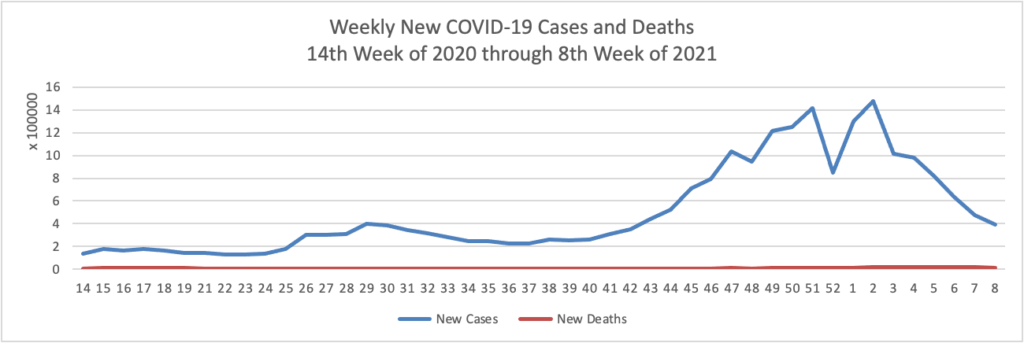
Based on the CDC’s Cases in the U.S. website, here is the FEHBlog’s chart of new weekly COVID-19 cases and deaths over the 20th through 39th weeks of this year (beginning May 14 and ending September 30; using Thursday as the first day of the week in order to facilitate this weekly update):

and here is the CDC’s latest overall weekly hospitalization rate chart for COVID-19:

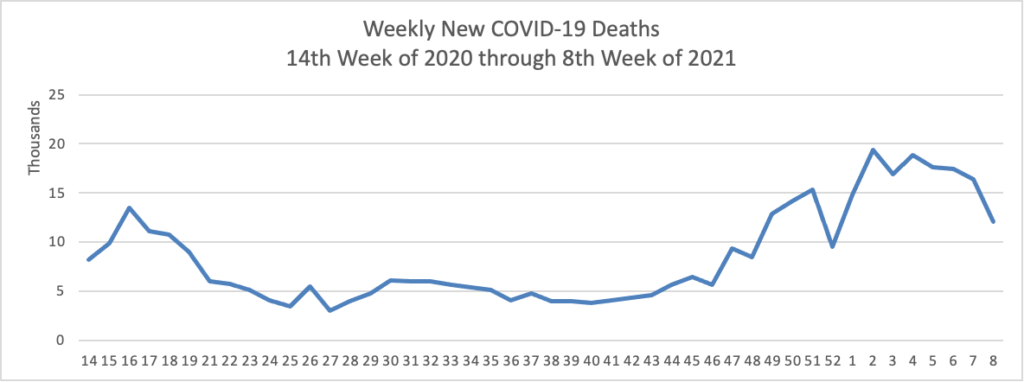
Because the FEHBlog does look at his charts which are intended to show trends, he realized that new deaths chart is flat because new cases greatly exceed new deaths. Accordingly here is a chart of new COVID-19 deaths over the same period (May 14 through September 30):

The trends generally are down but the number of cases and deaths is still high as illustrated by the President’s condition. Of course, the FEHBlog hopes for a speedy recovery for all afflicted by COVID-19.

In COVID-19 miscellany:

  • “The National Academies of Sciences, Engineering, and Medicine today released the final report of a consensus study recommending a four-phased equitable allocation framework that the U.S. Department of Health and Human Services (HHS) and state, tribal, local, and territorial (STLT) authorities should adopt in the development of national and local guidelines for COVID-19 vaccine allocation.”
  • The Wall Street Journal reports that the Speaker of the House and the Treasury Secretary are continuing their discussions about a compromise fourth COVID-19 relief bill.
  • The Society for Human Resources Management has collected answers to the most common questions raised by employers in the COVID-19 era.
  • The Department of Health and Human Services announced yesterday “$20 billion in new funding for providers on the frontlines of the coronavirus pandemic. Under this Phase 3 General Distribution allocation, providers that have already received Provider Relief Fund payments will be invited to apply for additional funding that considers financial losses and changes in operating expenses caused by the coronavirus. Previously ineligible providers, such as those who began practicing in 2020 will also be invited to apply, and an expanded group of behavioral health providers confronting the emergence of increased mental health and substance use issues exacerbated by the pandemic will also be eligible for relief payments.” Providers can begin applying for these funds on Monday October 5.

In other news, Healthcare Dive reports

Consumers are overwhelmingly satisfied with telehealth, but barriers to virtual care access remain, according to a new survey by J.D. Power of more than 4,300 people between June and July who had a telehealth visit within the past year. The overall consumer satisfaction score for telehealth was 860 out of 1,000 — among the best J.D. Power has ever recorded in its surveys of the healthcare, finance and insurance sectors, the data analytics firm said. However, many consumers said they still experienced barriers in obtaining such a visit, and those who considered themselves to be in poorer health were far less satisfied with the experience than those who considered themselves healthy.

Here’s the study finding the caught the FEHBlog’s eye — “Among patients who used a telehealth offering this year, 46% say their top reason for choosing telehealth was safety. That compares with just 13% in 2019.”

Tuesday Tidbits

Photo by Patrick Fore on Unsplash

Today the Senate invoked cloture on the compromise FY 2021 continuing resolution (HR 8337) by an 82 to 6 vote. The Senate now is in a position to pass the legislation and send it to the President for signature before the end of this federal government fiscal year, tomorrow September 30.

The Wall Street Journal reports that House Speaker Nancy Pelosi and Treasury Secretary Stephen Mnuchin have resumed discussing a compromise COVID-19 relief bill. Their discussions will continue tomorrow.

Healthcare consulting company WillisTowersWatson released a new white paper about the impact of the COVID-19 public health emergency on healthcare spending in the U.S.

Health care plan sponsors may see an unprecedented decrease in year-over-year medical costs in 2020, as system capacity shifts and fear of contracting COVID-19 in medical settings drives a significant volume of foregone and deferred care. Significant uncertainties remain however, including the course of the pandemic, the availability of effective vaccines and treatments, and changes in the health care delivery system that could impact future health care costs.

Willis Towers Watson has evaluated a set of potential future care utilization scenarios contemplating a variety of patterns of infection and care return. Across our scenarios, 2021 costs to employer plans are expected to be slightly higher (0.5% to 5.0%) than the non-pandemic baseline projection. Nevertheless, when 2020 and 2021 are combined, all scenarios show cost reductions (–2.8% to –3.8%) relative to the non-pandemic baseline. The baseline comparison from which these estimates were developed reflects projected costs for 2020 and 2021 assuming the pandemic never occurred. Employers should consider these scenarios as they budget for and measure the performance of their health care plans in the upcoming year.

Speaking of COVID-19 vaccines, the National Institutes of Health today announced that based on a separate Phase I study, the COVID-19 vaccine being jointly developed by Moderna and NIH had a positive impact on 40 older adult volunteers. This vaccine currently is in the Phase III study with a younger cohort. The separate Phase I study found that “Overall, the researchers found that “the investigational vaccine was well-tolerated in this older age group. Importantly, the immune response to the vaccine seen in older volunteers was comparable to that seen in younger age groups.” NIH is proposing that the Phase III study be expanded to include a senior cohort.

In other tidbits

  • Beckers Hospital Review reports on “13 things to know about Aetna, Anthem, Cigna, Humana and UnitedHealthcare’s virtual care strategies.” The article reminds the FEHBlog that the current end date for the federal government’s COVID-19 public health emergency technically is October 23. In all likelihood HHS will extend the deadline for another ninety days to Inauguration Day.
  • Healthcare Dive reports that “HHS has sent the Office of Management and Budget an interim final rule, called Information Blocking and the ONC Health IT Certification Program: Extension of Compliance Dates and Timeframes in Response to the COVID-19 Public Health Emergency, received on Sept. 17. ONC declined to comment on the rule. But the title implies it will extend dates identified in the sweeping information blocking provisions — notably, the looming November compliance deadline for providers — and dates for the Conditions and Maintenance of Certification provisions requiring EHR platforms to be interoperable.”

Monday Roundup

Photo by Sven Read on Unsplash

In COVID-19 vaccine news —

  • The American Hospital Association has a COVID-19 vaccine resources and information website.
  • PharmaManufacturing is reporting that ” Pfizer’s CEO recently stated that the company could be ready to submit data from a late-stage trial of its coronavirus vaccine by the end of October — but experts are urging the company to slow its roll. According to Bloomberg Law, more than 60 bioethicists and researchers have penned a letter asking Pfizer to delay data reporting until November.” Why not let the Food and Drug Administration do its job?

In COVID-19 rapid testing news, HHS announced today a detailed “national distribution plan for the Abbott BinaxNOW Ag Card rapid test to assist Governors’ efforts to continue to safely reopen their states. BinaxNOW is a unique testing option to provide support to K-12 teachers and students, higher education, critical infrastructure, first responders, and other priorities as governors deem fit. The BinaxNOW rapid test – the only U.S. Food and Drug Administration-authorized antigen rapid point-of-care test that does not require an instrument – is easy to use, will produce COVID-19 test results in 15 minutes, and costs $5. * * * The Federal government purchased these Abbott BinaxNOW diagnostic tests on August 27, 2020, to ensure equitable distribution of the first 150 million units – one day after an Emergency Use Authorization (EUA) was issued by the FDA to ensure they would be expeditiously distributed to vulnerable populations as quickly as possible.

In other news —

  • The Centers for Disease Control reported today about COVID-19 trends among school age children in our country. “Since March, 277,285 COVID-19 cases in children have been reported [out of seven million in total]. COVID-19 incidence among adolescents aged 12–17 years was approximately twice that in children aged 5–11 years.”
  • Healio reports on the multiple uses of telehealth beyond acute primary care. “[T]elehealth has been routinely incorporated in specialties such as psychiatry and asthma/allergy care, even prior to the COVID-19 era [‘PC”]. * * * Further, telemedicine allows for triage of patients with COVID-19 symptoms without requiring face-to-face visits to help direct next steps for testing and treatment. Telehealth can be effectively incorporated into oncology care — provided thoughtful and appropriate measures are taken.”
  • There has been a lot of press about the nomination of Judge Amy Coney Barrett to the Supreme Court following the sad occasion of Justice Ruth Bader Ginsburg’s death. It is quite likely that Judge Barrett will be sitting on the Supreme Court when the California v. Texas case is argued on November 10. Speculation is rife about this development and it is truly unfortunate that the Trump Administration is now siding with the States opposing the law’s constitutionality in the California v. Texas case. In the FEHBlog’s opinion, the position against the law’s constitutionality is a weak cup of tea. The FEHBlog is confident that the Supreme Court opted to hear the case to end this litigation in favor of the ACA’s general constitutionality. Congress obviously did not intend to render the ACA unconstitutional by zeroing out the individual mandate. The American Prospect observes

The whole legal argument [against the ACA’s constitutionality] depends on the fact that Republicans used reconciliation to pass the 2017 tax bill through the Senate with a simple majority. Due to the restrictions around reconciliation, Republicans couldn’t technically repeal the mandate in total, instead just lowering the penalty to nothing. The case effectively goes away if Congress either adds back in a penalty (even of just one cent), or just officially repeals the mandate, thereby severing it from the whole health care law.

Trying to bring back a penalty is a terrible option. The mandate is deeply unpopular, and it would be easy for Senate Republicans to oppose that move. What’s more, in the months since the mandate penalty went away, we’ve learned that it wasn’t as necessary to making the Obamacare system work as Democrats insisted in 2009 and 2010. Fully repealing the individual mandate, on the other hand, is an easy fight to win, as well as good policy. It is generally bad to have unenforced laws on the books.

Congress should take this action now by enacting an individual mandate repeal just as it repealed other ACA taxes in 2019. This is not to suggest that Congressional action is the only step that could save the law. But it would short circuit this craziness.

Midweek update

Photo by Manasvita S on Unsplash

The Federal Times and Govexec.com report that the Senate Homeland Security and Governmental Affairs Committee postponed voting this morning on John Gibbs’ nomination to be Office of Personnel Management Director. Federal employee organizations have publicly opposed his nomination.

It occurs to the FEHBlog that OPM has not had a long acting director since Ambassador John Berry who served in that role for President Obama’s entire first term. Before Mr. Berry the OPM Directors usually lasted one Presidential term. So for the past eight years OPM has mirrored the Washington Football Team’s approach to head coaches and quarterbacks.

Healthcare Dive reports that

Cigna is rebranding its growing health services segment, including pharmacy benefit manager Express Scripts, as Evernorth, the Connecticut-based payer announced Wednesday. The new umbrella brand will encompass Express Scripts, specialty pharmacy Accredo, medical benefit manager Evicore and Cigna’s other health service product lines starting in the third quarter. The rebranding, which has been in the works for months pre-pandemic, is the next evolution of the Cigna-Express Scripts tie-up completed in late 2018, as the combined entity looks to spur more interest in its products from third parties in the industry.

The late U.S. Navy Admiral and Arctic explorer Robert Peary would be pleased.

Healthcare Dive also reports that

  • “CVS Health has struck a deal with Apple to give temporary free access for the health giant’s clients, customers and employees to Apple’s new subscription fitness service.
  • Beneficiaries enrolled in Aetna’s commercial or CVS Caremark’s prescription plans will be offered a free one-year subscription to the feature, called Apple Fitness+. A free two-month subscription will be offered to CVS Pharmacy ExtraCare members and all CVS employees after the service is launched, per Tuesday {September 15]’s release.
  • The announcement coincided with Apple’s unveiling of the subscription service, which offers virtual fitness classes. The tech giant on Tuesday also released the latest model of its Apple Watch, which includes a new blood oxygen level tracker.”

The National Committee for Quality Assurance released yesterday the final report of its Task Force on Telehealth. Here are the task force’s recommendations:

Policymakers should make permanent the following specific COVID-19 policy changes:

Lifting geographic restrictions and limitations on originating sites. Allowing telehealth for various types of clinicians and conditions. Acknowledging, as many states now do, that telehealth visits can meet requirements for establishing a clinician/patient relationship if the encounter meets appropriate care standards or unless careful analysis demonstrates that, in specific situations, a previous in-person relationship is necessary. Eliminating unnecessary restrictions on telehealth across state lines.

Policymakers should look closely at the effect of expanding prescribing authority to telehealth, as authorized by the PHE. They should evaluate what policies and guidelines could be applied to virtual prescribing to ensure patient safety and avoid adverse outcomes.

Policymakers should fully reinstate enforcement of Health Insurance Portability and Accountability Act (HIPAA) patient privacy protections that was suspended at the start of the public health emergency.

The Department of Health and Human Services and the Defense Department announced their COVID-19 vaccine distribution strategy today.

The strategic overview lays out four tasks necessary for the COVID-19 vaccine program:

  • Engage with state, tribal, territorial, and local partners, other stakeholders, and the public to communicate public health information around the vaccine and promote vaccine confidence and uptake.
  • Distribute vaccines immediately upon granting of Emergency Use Authorization/ Biologics License Application, using a transparently developed, phased allocation methodology and CDC has made vaccine recommendations.
  • Ensure safe administration of the vaccine and availability of administration supplies.
  • Monitor necessary data from the vaccination program through an information technology (IT) system capable of supporting and tracking distribution, administration, and other necessary data.

Federal News Network helpfully has created an online payroll deferral calculator for this federal employees and military members who are subject to this COVID-19 relief action.

Monday Roundup

Photo by Sven Read on Unsplash

Becker’s Health IT offers 20 bold health IT predictions for the next five years. Here are the FEHBlog’s favorites:

1. Joel Klein, MD. Senior Vice President and CIO of University of Maryland Medical System (Baltimore): I think at least half of all healthcare in America will be virtual within five years. There are two barriers:

• Payers. They might pay less but if they pay enough, it will be enough. If we can figure out how to solve emergency department visits with widespread, cost effective on-demand care, that will make a difference.
• ‘But I want to see my doctor.’ That might be true for some things, but the convenience factor (especially for tertiary care… especially for millennials…) once you really start doing it overwhelms most of the physical presence upsides.

Edward Lee, MD. CIO of The Permanente Federation (Oakland, Calif.): In five years, physicians will no longer need to manually document their notes into the EHR. Instead, artificial intelligence will capture all the pertinent information from the patient-physician encounter. This will enable physicians to spend quality time with their patients instead of worrying about writing their notes or placing orders in a computer system. Joy and meaning for physicians will increase, physician burnout will decrease, and above all, patient care will improve.

Michael Pfeffer, MD. Assistant Vice Chancellor and CIO of UCLA Health: Health IT will enable each patient to have a unified, interactive view of their health information regardless of place of care or type of clinical data (i.e. phenotypic, genomic, imaging). AI-based apps will help make sense of their data, taking into account social determinants of health and potential health disparities to improve health equity and health literacy. This intelligence will be paired with personal health preferences and data on health provider quality, access, pricing and satisfaction to help patients make truly informed decisions about their care.

Fierce Biotech reports that “Just under a week after it stopped its key phase 3 pandemic vaccine test [due to a safety concern], AstraZeneca and the University of Oxford have been given the green light to restart in the U.K.” What’s more

While AZ and Oxford have been highlighted as [COVID-19 vaccine] race leaders, so too have Pfizer and BioNTech, which said they now want to boost their phase 2/3 trial for one of their five mRNA vaccines, BNT162b2, from around 30,000 to 44,000.

Also over the weekend, the companies said they have asked the FDA for the extra participants in order to include a broader patient population and with plans to include adolescents as young as 16 and people with chronic, stable HIV (human immunodeficiency viruses), hepatitis C or hepatitis B infection to “provide additional safety and efficacy data.”

It said it’s on track to hit its original target of 30,000 patients this week; despite wanting more people, Pfizer said in a statement that it was still on course to deliver data by the end of next month.

CVS Health announced last week that in response to demand created by children returning to school, it has made “children age 12 years and older eligible for testing at the more than 2,000 test sites located at select CVS Pharmacy drive-thru testing locations, starting last Friday, September 11.”

In other news

  • The Washington Post reports that commuting in the Washington DC metropolitan area may not be back to normal until next summer.

Some 430 employers representing about 275,000 workers in the greater-Washington region — stretching from Baltimore to Richmond — participated in the survey conducted Aug. 10 to 28. Their responses offer a snapshot of what companies are thinking as they weigh resuming in-office operations.
A clear majority of Washington-area employers said they are adopting a phased approach to returning to the office, although many said they remain uncertain about the timing of that return. A third of the region’s employers said they don’t know whether they will have their workers back on site by next summer.

  • Govexec.com reports that “The Office of Personnel Management issued a proposed rule [today] that would enable federal agencies to appoint employees in STEM jobs, or positions on temporary or new projects or organizations, for a decade. OPM said the change would give agencies more flexibility when tackling long-term science, technology, engineering and mathematics projects and other non-permanent work. Current regulations require agencies to get special permission from OPM to keep any term employee on staff for longer than four years.” The public comment deadline is November 10, 2020.
  • The House Oversight and Reform subcommittee on government operations held a postal update hearing today. It turns out that the subcommittee’s objective was to be to call the Postmaster General’s qualifications into question. A bipartisan Postal Service Board of Governors selects the Postmaster General, rather than following the usual Presidential appointment followed by Senate confirmation route.

Friday Stats and More

First let’s agree to never forget that the anniversary of the September 11, 2001, attack on our country and all of the lives that were cut short on that tragic day.

Based on the CDC’s Cases in the U.S. website, here is the FEHBlog’s chart of new weekly COVID-19 cases and deaths over the 20th through 36th weeks of this year (beginning May 14 and ending September 9; using Thursday as the first day of the week in order to facilitate this weekly update):

and here is the CDC’s latest overall weekly hospitalization rate chart for COVID-19:

Because the FEHBlog does look at his charts which are intended to show trends, he realized that new deaths chart is flat because new cases greatly exceed new deaths. Accordingly here is a chart of new COVID-19 deaths over the same period.

The charts are trending down which is hopeful.

Fierce Healthcare reports on ‘Decision Resources Groups’ two-part [telehealth] survey of 4,855 practicing U.S. physicians conducted in March and April, with a follow-up survey in July.” According to the Group’s press release,

  • As of July 2020, 80% of U.S. physicians had conducted a virtual patient consultation in the previous three months – up from 39% in April and 9% in early March, when use of virtual consults was unchanged over 2019 levels
  • This trend likely portends more multi-modal care delivery post-pandemic, with physicians making greater use of video visits, emails and phone calls with patients as a means of supplementing traditional in-person visits. Among those physicians surveyed in June and July who said they had conducted virtual consultations in the past three months, 52% said they will likely continue to do so after COVID-19 mitigation measures have ended.
  • However, barriers to telemedicine use remain – 58% of U.S. physicians have lingering reservations about the quality of care they can provide remotely.

In federal and postal employment news, Federal News Network reports that

The Office of Management and Budget has, at last, offered up more information on the president’s payroll tax deferral, which the Trump administration will implement for most federal employees and military members later this month. But the guidance is brief, vague and leaves many questions unanswered.

The Wall Street Journal informs us that the Postal Service will not be implementing the payroll tax deferral.

Law360 reports that “The U.S Department of Labor issued much-anticipated regulations Friday [September 11] laying out who qualifies for emergency paid sick leave under the Families First Coronavirus Response Act, revising parts of a rule that a New York federal judge recently struck down.” The Labor Department’s press release explains that “the revisions do the following:

  • Reaffirm and provide additional explanation for the requirement that employees may take FFCRA leave only if work would otherwise be available to them.
  • Reaffirm and provide additional explanation for the requirement that an employee have employer approval to take FFCRA leave intermittently.
  • Revise the definition of “healthcare provider” to include only employees who meet the definition of that term under the Family and Medical Leave Act regulations or who are employed to provide diagnostic services, preventative services, treatment services or other services that are integrated with and necessary to the provision of patient care which, if not provided, would adversely impact patient care.
  • Clarify that employees must provide required documentation supporting their need for FFCRA leave to their employers as soon as practicable.
  • Correct an inconsistency regarding when employees may be required to provide notice of a need to take expanded family and medical leave to their employers.”