Healthcare Dive reminds us that the Healthcare Information and Management Systems Society will hold its annual conference in Orlando, Florida, this week. In addition, Healthcare Dive notes several headliner presentations planned for that conference.
From the health equity front, the Wall Street Journal reports
The fatal overdose rate among Black people surpassed that for white people in the first year of the pandemic, as an increasingly lethal drug supply and Covid-19’s destabilizing effects exacted a heavy toll on vulnerable communities in the U.S.
The proliferation of the potent opioid fentanyl, and a pandemic that has added hazards for people who use drugs, are driving new records in U.S. overdose deaths, and Black communities have been hit especially hard. Black people often have uneven access to healthcare including effective drug treatment, putting them at high risk, researchers and public-health experts say.
The most recent full-year of federal data, through 2020, shows the rate of drug deaths among Black people eclipsed the rate in the white population for the first time since 1999, researchers at the University of California, Los Angeles recently demonstrated.
What is an effective treatment for substance use disorder? The Journal adds
Researchers at the University of Michigan examining outpatient visits for substance use in recent years found white patients were three to four times as likely as Black patients to receive buprenorphine, a prescription medication to treat opioid dependence that is more readily available to people with health insurance or the means to pay out of pocket.
Health providers are more likely to direct Black patients to methadone, which is delivered by highly regulated opioid-treatment programs that often require daily visits to obtain the medication, researchers have found.
According to Sam Quinones’s books on the opioid and fentanyl problems plaguing our country, drug dealers hang out at methadone clinics.
On a related note, The Psychiatric Times informs us
The positive implications for screening for and treating individuals with SUDs are vast, from preventing HIV and hepatitis in injection-drug users to improving patients’ physical health, mental health, employment, and housing.
Also, the New York Times reports on today’s front page about the serious logistical problems facing the federal and state governments as they seek to launch the new 988 suicide hotline on July 1, 2022.
Fierce Healthcare discusses the advantages of using teledentistry with rural patients.
Teledentistry enables rural access to care, lowers costs and helps provide preventive services, a new study has found.
The CareQuest Institute looked at data for patients in Oregon and Washington. The study included data from more than 60,100 individuals who had a dental visit either in person or through teledentistry in the second half of 2020.
Most (79%) patients with a teledentistry visit had a follow-up visit sometime in 2021, the vast majority of which were in person. Most (60%) had this visit within three weeks of their teledentistry visit, which primarily consisted of diagnostic and restorative services.
The Senate has locked in a deal to quickly pass a massive government funding bill that includes $13.6 billion in Ukraine aid.
The agreement, announced by Senate Majority Leader Charles Schumer (D-N.Y.), puts the funding bill on a glide path to pass on Thursday night, capping off hours of would-they-won’t-they drama.
Mazaal tov to Congress.
Also on Capitol Hill today, the Senate Homeland Security and Governmental Affairs Committee held a confirmation hearing for Krista Boyd, the President’s nominee to serve as OPM Inspector General. Fedweek notes that “Ms. Boyd is a senior staff member of the House Oversight and Reform Committee with long experience on Capitol Hill in federal workplace matters.”
From the Omicron front, Becker’s Hospital Review informs us “The rate of new COVID-19 cases involving the omicron subvariant BA.2 appears to be slowing in the U.S., according to variant proportion estimates from the CDC.”
Also, the Justice Department announced “Effective immediately, Associate Deputy Attorney General Kevin Chambers will serve as the Director for COVID-19 Fraud Enforcement.”
From the litigation front, Reuters reports “The judge overseeing Purdue Pharma’s bankruptcy on Wednesday approved a $6 billion opioid settlement funded by its Sackler family owners, overruling objections from the Department of Justice and 20 states that opposed the deal.”
Anthem plans to change its name to Elevance Health, if the move is approved by shareholders, the company said Thursday.
The new name is meant to reflect the company’s offerings beyond traditional health insurance. “Elevance Health’s companies will serve people across the entire care journey, connecting them to the care, support, and resources they need to lead healthy lives,” Anthem CEO Gail Boudreaux said in a statement.
Elevance was chosen as a combination of the words “elevate” and “advance.” There will not be any changes to leadership or organizational structure accompanying the new name.
If approved, the Elevance name will start being used at the end of the second quarter of this year. Anthem Blue Cross and Blue Shield plans will still use the Anthem name.
From the telehealth front, Healthcare Dive reports
[Virtual care vendor] Amwell and LG Electronics are teaming up to jointly develop new digital health devices and tools, starting with hospital care in the U.S., the companies announced Wednesday.
South Korea-based LG, which manufactures a wide range of devices from refrigerators to computer monitors, already provides smart TVs for inpatient rooms.
Now, through the partnership, LG will also create devices that can host services from Amwell’s virtual care platform, Converge.
PYMTS.com reports this electronic health records news from the Vive conference being held in Miami
Electronic health records containing some of the most guarded personal data about people are making headlines again as a consortium of players join forces to create a universal single sign-in, allowing patients secure access to unified health data via digital identity.
Coming out of the ViVE health technology conference happening this week in Miami Beach, the effort is led by consumer-directed healthcare advocacy group the CARIN Alliance, working together with the Department of Health and Human Services (HHS) and other stakeholders.
On Tuesday (Mar. 8), Politico reported that HHS “is working with several health systems, insurers and health tech groups to roll out a single way for patients to log in and access their medical records across multiple systems. The launch later this month will set up a test environment for integrating the technology, said Ryan Howells, principal at Leavitt Partners and program manager at the CARIN Alliance, which is spearheading the efforts.”
CARIN is working with the Office of the National Coordinator for Health Information Technology and the Centers for Medicare and Medicaid Services (CMS), which will act as “government observers.”
From the FEHB front, benefits consultant Tammy Flanagan writes in Govexec about the Postal Service Health Benefits Program which will launch in 2025 as part of the Postal Reform Act of 2022. She observes
The version of the postal bill that eventually passed balances the risk pools, and the Office of Personnel Management now estimates premiums should go down for postal and non-postal employees and retirees alike.
The new law keeps all postal workers in FEHB, in their own group. All workers will be able to keep their current plans and avail themselves of the annual open season to choose other options within FEHB.
Future postal retirees will be required to enroll in Medicare A and B at 65. Retiree health coverage will then become a combination of Medicare and FEHB.
The question now is whether that requirement will eventually be extended to all federal employees, and what effect that would have on the premiums retirees pay. If that happens, at least federal employees will face one less tough decision at the time of retirement.
The FEHBlog expects that PSHBP premiums will be materially lower than FEHB premiums because PSHBP will accept Medicare funding for prescription drug benefits in the form of Part D EGWPs. Federal law has permitted the FEHB to offer premium-reducing Part D EGWPs for nearly twenty years. Nevertheless, OPM and a string of Administrations from George W. Bush to Joe Biden have refused to implement that law. Implementing that law in 2005 when it first took effect likely would have avoided the balkanization of the FEHB that we will soon experience with the PSHBP.
The FEHBlog does not expect the FEHB to adopt the mandatory Part B approach being taken by the PSHBP. Fewer retiring federal employees are picking up Part B because of the income-adjusted Part B premiums. As basic and income-adjusted Part B premiums continue to climb and climb, the FEHBlog expects that the PSHBP will liberalize, and then do away with, mandatory Part B. Meanwhile, the PSHBP’s undoubtedly favorable experience with Medicare funding of prescription drugs will lead OPM to allow FEHB the same opportunity.
With both branches of the Program using Part D EGWPs and integrated Medicare Advantage plans, everyone will enjoy reasonable premiums for high-quality healthcare. That in turn could lead to a reunion of the two branches. Hopefully, the PSHBP will be a relatively brief experiment that leaves the FEHB Program stronger.
The saving grace of the FEHB Program is that everyone in a plan option pays the same premium and the premiums are pooled to cover all plan option enrollees. That’s the bedrock principle of group health insurance that the FEHB Program has shown to work.
From Capitol Hill, the Senate late this afternoon agreed by a 74-17 vote to end debate on the Postal Reform Act of 2022 (H.R. 3076). “The Senate stands in recess until 10:30 am on Tuesday, March 8, 2022. Following Leader remarks, the Senate will resume consideration of Calendar #273, H.R. 3076, Postal Service Reform Act, post-cloture.” The time for the final Senate vote on H.R. 3076 is yet to be determined. Senate passage, which requires a simple majority vote, is assured.
Federal News Network calls attention to the fact that a month ago today the White House issued a statement of administration policy on H.R. 3076 which reads in pertinent part
H.R. 3076 would also establish a new, separate Postal Service Health Benefits Program (PSHBP) within the existing Federal Employees Health Benefits Program (FEHBP), that integratesPostal employees and annuitants into Medicare. Making these changes would improve the Postal Service’s long-run financial outlook, without sacrificing quality, affordable healthcoverage for Postal employees and retirees. The Administration is mindful that these reforms wouldimpose administrative burdens on the Office of Personnel Management and FEHBP, and further,that there could be potential challenges with operationalizing Medicare integration and withensuring ongoing funding to support administration of the new PSHPB. The Administration looks forward to working with Congress to ensure that the goals of H.R. 3076 are met in anefficient, equitable, and cost-effective manner, while safeguarding the continued stability of the FEHBP
Top appropriators and congressional leaders are aiming to wrap up omnibus negotiations within 24 hours so they can file the massive spending package in the House on Tuesday, vote on it in that chamber Wednesday and get it through the Senate before Friday at midnight when stopgap funding expires.
While so-called open items remained, there was confidence on both sides of the aisle that talks were going well enough on the massive, long-overdue package that a fourth continuing resolution for the fiscal year that began Oct. 1 wouldn’t be necessary.
A new report released Monday charts a path for the transition out of the Covid-19 pandemic, one that outlines both how the country can deal with the challenge of endemic Covid disease and how to prepare for future biosecurity threats.
The report plots a course to what its authors call the “next normal” — living with the SARS-CoV-2 virus as a continuing threat that needs to be managed. Doing so will require improvements on a number of fronts, from better surveillance for Covid and other pathogens to keeping tabs on how taxed hospitals are; and from efforts to address the air quality in buildings to continued investment in antiviral drugs and better vaccines. The authors also call for offering people sick with respiratory symptoms easy access to testing and, if they are positive for Covid or influenza, a quick prescription for the relevant antiviral drug.
The 136-page report was written by nearly two dozen experts, a number of whom have advised the Biden administration on its Covid-19 policies. Thirty other experts contributed to the report, entitled “Getting to and Sustaining the Next Normal: A Roadmap to Living with Covid.”
Helpful. Speaking of which, the Centers for Disease Control offers advice on how to prepare children and teens for Covid vaccination.
From the healthcare cost front, Healthcare Dive reports
Higher-priced emergency care was associated with lower mortality in hospital markets with less hospital concentration, but survival rates were similar for low- and high-priced hospitals in more concentrated markets, according to a working paper released last week from the nonprofit National Bureau of Economic Research.
The researchers determined that additional spending on quality improvements at expensive hospitals in unconcentrated markets is potentially cost-effective.
However, they found no evidence of better outcomes among patients admitted for emergency care to pricier hospitals in markets with less competition, despite substantially higher costs. “In these concentrated markets, high prices likely reflect patients’ lack of alternative options, not hospital quality,” the study said.
From the healthcare business front, Fierce Healthcare tells us
GoodRx is scooping up vitaCare Prescription Services from TherapeuticsMD to beef up its growing pharma manufacturer solutions business.
VitaCare is a technology and services platform designed to make the complex process of filling prescriptions simple, cost-effective and stress-free for patients.
In recent months, the COVID-19 pandemic has highlighted the value of pharmaceutical companies being able to connect directly with patients, according to TherapeuticsMD in its latest earnings release. This in combination with the rise of interest and investment in other hub service and pharmacy services companies has driven outside interest in vitaCare both from pharmaceutical companies seeking to utilize vitaCare for their products and from potential partners or sponsors seeking to acquire a controlling interest in vitaCare.
GoodRx has agreed to acquire vitaCare for $150 million in cash, with an additional $7 million consideration contingent upon vitaCare’s financial performance through 2023, according to the companies.
The transaction is expected to close in mid-2022.
From the telehealth from, HR Tech shares large employer tips on how to promote employee use of telehealth or as its now called virtual care.
March is Women’s History Month, and the Veterans Administration gives us a chance to virtually meet several VA oncologists, some of the women who are making cancer history.
Thanks to ACK15 for sharing their work on Unsplash.
From Capitol Hill, the House of Representatives and the Senate will be in session this week for Committee business and floor voting. Of note, the Senate will continue its voting process on the Postal Reform Act of 2022 (H.R. 3076) at 5:30 pm ET tomorrow. The continuing resolution funding the the federal government expires after 11:59 pm on Friday March 11.
The Wall Street Journal notes “House Democrats set to be in Philadelphia starting Wednesday for a long-planned retreat, negotiators need to make progress quickly.” The Journal’s article adds “Some aides and lawmakers of both parties said that the chances of passing an omnibus spending measure this week had increased, in part because a fiscal 2022 measure would include financing for Ukraine and Eastern European allies and give the military flexibility for any related needs.”
From the Omicron front —
The New York Times reports on the difficulties encountered in the distributing the Evusheld antibiotic treatment that shields immunocompromised Americans who cannot receive a Covid vaccination. According to the article, immunocompromised Americans represent 3% of the population.
Novavax Inc.’s long-awaited Covid-19 vaccine is moving toward U.S. authorization after the company said it resolved manufacturing problems that had held up its application.
Clearance in the U.S. isn’t imminent because the Food and Drug Administration must sort through a large amount of study data from several countries, a person familiar with the matter said. A decision is getting closer, however, since Novavax formally submitted an authorization request in late January.
If the shot is rolled out in the U.S., it could boost vaccination efforts that have flagged among the hesitant, according to Novavax and doctors.
Vaccination campaigns have lagged behind in much of the developing world, as many countries struggle to distribute shots outside major urban areas. In Asia, countries like India, Indonesia and the Philippines have fully vaccinated half their populations. That is higher than the 13% of people living in Africa who are vaccinated, with 4% immunized in Nigeria, the continent’s most populous country. Latin America has done better. Many countries, including Brazil and Peru, have vaccinated more than 70% of their people.
Natural immunity, which refers to antibodies acquired through infection, was widespread in Indonesia when Omicron arrived. One study from October to December of roughly 20,000 Indonesians found that 74% of unvaccinated Indonesians had protective antibodies, according to Pandu Riono, a University of Indonesia epidemiologist who worked with government researchers on the study.
Based in part on the results, Mr. Riono and his colleagues estimate that 70% of Indonesians had been infected with Covid-19 as of December, far higher than the 34% of Americans who had been infected by then, according to a survey by the U.S. Centers for Disease Control and Prevention.
From the federal employment front, Federal News Network offers a transcript of an interview between Federal News Network reporter Tom Temin and American University professor Bob Tobias about the demographic characteristics of federal employees. For example, “74% of the workforce, federal workforce is 40 or older, versus 54% in the private sector.” Unquestionably, the experience of the federal employee population benefits all of us, but older workforce also impacts FEHB premiums.
From the telehealth front, Fierce Healthcare reports
Striking the balance between virtual and in-person care is a key trend to watch heading into the rest of 2022, according to a new survey from Evernorth.
Ipsos surveyed 3,000 consumers, 575 human resources professionals and 58 health plan leaders on behalf on the Cigna subsidiary. The report underscores patients’ growing comfort with virtual care and telemedicine in the wake of COVID-19, with 75% saying they agree more care will be provided virtually; 57% of those surveyed said they used virtual care over the last year.
However, consumers are not enthusiastic about virtual options in all settings, according to the survey. While 35% of those surveyed said they were satisfied with their experience in virtual primary care, just 11% said the same about behavioral health care. Nineteen percent said they were satisfied with virtual care for specialty services, while 5% said the same for physical therapy and 6% for nutrition and diet services.
While satisfaction with virtual behavioral health care was mixed in the survey, a growing number of people are seeking behavioral health services in virtual settings.
Boom!
From the strategery front, Becker’s ASC News discusses the 2022 growth strategies of Optum’s three business divisions:
Optum Health, the healthcare provider division which includes physician groups and ambulatory surgery centers
Optum Insight, which houses the data analytics platforms designed to connect clinical, administrative and financial data, and
Optum Rx, a pharmacy benefits and care services business.
From Capitol Hill, the Senate approved a motion to proceed to a vote on the Postal Reform Act of 2022 (HR 3076) by a voice vote. This vote suggests to the FEHBlog that the Senate will approve the bill this week.
Roll Call discusses the status of the Consolidated Appropriations Act for Fiscal Year 2022. Congress has a week and half to finish cobbling together this law before it needs a fourth continuing resolution.
From the Omicron vaccine front, the American Hospital Association tells us
The Centers for Disease Control and Prevention today released a study examining the effectiveness of the Pfizer COVID-19 vaccine at preventing emergency department and urgent care visits by children aged 5-11 and 12-17. Among children aged 5-11, effectiveness 14-67 days after dose 2 (the longest interval in this age group) was 46%, significantly lower than overall estimates for adolescents aged 12-17. However, most encounters among children aged 5-11 occurred during omicron predominance, when the vaccine’s effectiveness also significantly declined for adolescents, suggesting that the lower effectiveness for children aged 5-11 was likely driven by the predominant variant rather than differences in effectiveness across age groups, the authors said. During omicron predominance, there was no evidence 2 doses protected adolescents after 150 days; however, a booster dose restored effectiveness to 81% in this age group, the authors said.
Another study released today by the CDC looks at reactions to the Pfizer booster in adolescents aged 12-17, which were generally mild to moderate and transient. Myocarditis was less frequently reported after a booster dose than a second primary dose, the authors said.
Federal agencies can relax their mask and testing protocols in the wake of new public health guidance.
The Centers for Disease Control and Prevention’s released on Friday a “new framework” that “moves beyond just looking at cases and test positivity to evaluate factors that reflect the severity of disease, including hospitalizations and hospital capacity, and helps to determine whether the level of COVID-19 and severe disease are low, medium, or high in a community,” Dr. Rochelle Walensky, the agency’s director, said on a call with reporters. Guidance from the Biden administration’s Safer Federal Workforce Task Force on Monday reflects this new framework.
“This document provides federal agencies with initial implementation guidance they should follow in utilizing the CDC’s COVID-19 Community Levels to determine the appropriate mask-wearing and screening testing requirements for each federal facility at a given time,” said the guidance.
Wild demand swings have been a subplot in the pandemic, from vaccines to hand sanitizer, along with tests. On the first day of the White House test giveaway in January, COVIDtests.gov received over 45 million orders. Now officials say fewer than 100,000 orders a day are coming in for the packages of four free rapid tests per household, delivered by the U.S. Postal Service.
It would be a good idea for the federal government to tell health plans to refer their members to the federal site if they are interested in receiving test kits.
To sum it up from the Omicron front, check out the lead article from the NIH Director’s blog titled “How Covid immunity holds up over time.”
From the tidbits department —
The CDC discusses the unholy connection between diabetes and chronic kidney disease.
UnitedHealth Group is beginning to act on its November promise to shore up its sustainability efforts by halting its mailing paper of prior authorization and clinical decisions to providers, according to a Feb. 25 post on the California Medical Association website.
The first move — a nationwide shift to digital clinical decision letters — is effective March 4 for most UnitedHealthcare Medicare Advantage and commercial plan members. Instead of receiving a mail appeal decision, providers can view the decisions digitally immediately after they are made.
President Joe Biden is calling for more federal employees to return to the office, saying “significant progress” fighting the COVID-19 pandemic has made it safer to do so.
Ahead of his State of the Union address, Biden issued a letter Tuesday thanking the federal workforce for its “tireless work this past year” confronting the pandemic and leading economic recovery efforts.
A return to the office, however, doesn’t necessarily mean a return to the pre-pandemic status quo.
Biden urged agencies to “build on the innovations and technologies that we put to work serving the American people throughout the pandemic, making our government more efficient, resilient, and effective.”
To the FEHBlog’s dismay, the Labor Department’s Employee Benefits Security Administration announced this evening that the federal government is accepting, at least for the time being, Judge Kernodle’s interpretation of the No Surprises Act discussed in yesterday’s Weekend Update post.
The Departments [/ the ACA regulators] are reviewing the court’s decision and considering next steps. This announcement serves as a notification to health care providers, emergency facilities, providers of air ambulance services, group health plans, health insurance issuers, Federal Employees Health Benefits (FEHB) Carriers (“Disputing Parties”), and certified IDR entities of steps the Departments are taking to conform to the court’s order. Specifically, the Departments will:
— Effective immediately, withdraw guidance documents that are based on, or that refer to, the portions of the Rule that the court invalidated. Once these documents have been updated to conform with the court’s order, we will promptly repost the updated documents
— Provide training on the revised guidance for certified IDR entities and Disputing Parties. This training will be offered through webinars and roundtable discussions, and will occur after the above-referenced documents are updated.
— Open the IDR process for submissions through the IDR Portal. For disputes for which the open negotiation period has expired, the Departments will permit submission of a notice of initiation of the IDR process within 15 business days following the opening of the IDR Portal.
The Departments had the option of filing a notice of appeal and asking the court to stay the case pending the appeal’s outcome. The Departments thought this favorable outcome is unlikely. But, in the timeless words of Kenny Rogers, you have to know when to hold them and when to fold them.
The Senate Press Gallery reports this evening the Senate voted 74-20 to invoke cloture on the Postal Reform Act of 2022, H.R. 3076, which means that the bill will be called up on the Senate floor later this week for a final vote. That vote requires a simple majority for passage.
Earlier in the day, the Congressional Budget Office released a supplemental letter on HR 3076 in which
CBO addresses the following questions concerning the agency’s assessment of the budgetary effects of H.R. 3076, the Postal Service Reform Act of 2022, which CBO transmitted on February 4, 2022.
— What are the budgetary effects and costs to the Medicare program of H.R. 3076 over the next 20 years?
— What is the effect of the legislation on the Medicare Hospital Insurance Trust Fund?
— What is the effect on Medicare premiums in Part B and Part D?
In health equity news, Kaiser Permanente announced
Colorectal cancer disparities between Black and white adults were eliminated among Kaiser Permanente members in Northern California after the health care organization instituted a regionwide, structured colorectal cancer screening program, new research shows.
“Our study found that organized screening works to improve colorectal cancer outcomes for all of our members,” said the study’s senior author Theodore R. Levin, MD, a research scientist at the Kaiser Permanente Division of Research and a gastroenterologist with The Permanente Medical Group. “I knew our program had helped to reduce disparities, but I was surprised by the magnitude and the rate of improvement. It exceeded my expectations.”
The article provides details on a structured program. Bravo KP.
From the telehealth front, Healthcare IT News reports
Teladoc Health announced this week that it was partnering with Amazon to launch voice-activated virtual care on Alexa-supported Echo devices.
According to the companies, U.S. customers around the country can connect with a Teladoc provider via audio at any time for general medical needs.
“By introducing and integrating our virtual-first care experience with Echo devices, we are providing an innovative and convenient way for users to connect with a doctor,” Donna Boyer, chief product officer at Teladoc Health, said in a statement.
“We are meeting consumers where they are, to continue to deliver value and high-quality care to members,” Boyer said.
From the looking forward department, ICD 10 Monitor tells us
On Feb. 11, the World Health Organization (WHO) released ICD-11 2022. This is the official version of the 11th revision of the International Classification of Diseases (ICD) coding set that WHO member countries will be implementing worldwide. In fact, according to the WHO release announcement, 35 countries are already using ICD-11.
In addressing implementation timeframes, the WHO anticipates that * * * countries with highly sophisticated information systems, where earlier versions of ICD are already in use [such as the U.S.], may require 4 -5 years to transition to ICD-11. * * *
So, when will the U.S. replace ICD-10-CM and begin using a version of ICD-11 for reporting on healthcare claims? Well, we don’t know yet. But this release of the official ICD-11 is sure to spur activity in this respect.
In September 2021, the National Committee on Vital and Health Statistics (NCVHS) issued recommendations to the Secretary of the U.S. Department of Health and Human Services (HHS) advising on a research agenda to evaluate the use of ICD-11 in the U.S. This release of the official ICD-11 2022 version from the WHO is sure to increase research activity.
So, while the timeline for a U.S. transition to ICD-11 is still uncertain, it’s clear that planning for the transition to ICD-11 is underway.
The FEHBlog, whose crystal ball is not the clearest, predicts 2029 as the over/under year for ICD-11 implementation.
Sanofi and GlaxoSmithKline weathered clinical trial delays for their Covid-19 vaccine, but the partners now have data to support filings seeking regulatory authorizations. Key features of the vaccine may be able to persuade the vaccine hesitant; it may also be well-suited for use as a booster.
This news bears similarities to the reports about the Novavax Covid vaccine already submitted to the Food and Drug Administration for emergency use authorization.
The American Hospital Association informs us
The Food and Drug Administration yesterday listed all over-the-counter COVID-19 diagnostic tests authorized for home use, including links to home use instructions for each test.
Walmart has administered tens of millions of COVID-19 vaccines to date, with 80% delivered in medically underserved communities, the retail giant announced Wednesday.
The company released a report (PDF) looking back at its progress in providing vaccines over the course of 2021. Cheryl Pegus, M.D., executive vice president of health and wellness at Walmart, told Fierce Healthcare the company has focused on connecting with people who may not otherwise have been able to get the shot.
From the health equity front —
The American Hospital Association tells us
The U.S. maternal mortality rate increased to 23.8 deaths per 100,000 live births in 2020 from 20.1 in 2019 as rates for Black and Hispanic women increased, according to data released today by the Centers for Disease Control and Prevention. The maternal mortality rate for Black women was nearly three times the rate for white women. Mortality rates increased with maternal age, with the rate for women aged 40 and over nearly eight times higher than the rate for women under 25.
The AHA’s Better Health for Mothers and Babies initiative offers resources to help hospitals and health systems eliminate maternal mortality and address health disparities for mothers and babies.
What can be more tragic than a baby losing a mother?
Beckers Payer Issues adds from the mental health perspective
Work-sponsored health plans aren’t addressing the growth of loneliness, which leads to employees missing work and decreased productivity, according to data from Cigna’s Loneliness Index shared with Becker’s.
The data, which is slated to be published in the Journal of Organizational Effectiveness: People and Performance, surveyed nearly 6,000 employees between July 16 and Aug. 2, 2019.
Six insights:
1. The widespread presence of loneliness affected 3 in 5 (62 percent) adults before the COVID-19 pandemic. Feelings of loneliness play key roles both in employee health and work performance, according to the study.
2. On average, preventable, stress-related absences caused lonely employees to miss about five more work days than their counterparts who did not identify as lonely.
3. Employees who reported higher levels of loneliness were almost twice as likely to consider quitting their current job than employees who were less lonely.
4. The study estimates that absenteeism and productivity losses tied to preventable loneliness cost employers $154 billion each year.
5. The study said work-based factors like communication, work-life balance and social companionship play key roles in determining employee loneliness. Personal resilience and a feeling of connection outside of the workplace also play a role.
6. Employers looking to combat employee loneliness should consider actions that hit on these factors, including flexible work hours, email “blackout” periods and forming employee resource groups.
From the Black History Month department, Everywell, an at-home testing service, celebrates ten Black pioneers who improved healthcare in our country. Bravo.
From the U.S. healthcare front, Healthcare Finance News reports
Including federal government support, national health spending grew by 3.4% in 2021, according to new data released by Altarum.
This growth in spending, the analysis found, reflected the fact that support from the federal government was strong in 2020, likely in response to the recession caused by the COVID-19 pandemic, and was lower in 2021.
Taking these support dollars out of both 2020 and 2021 estimates, spending growth from 2020 to 2021 would have been 8.4%, as the economy continued to recover.
Despite worries that demand for telehealth could fall as the U.S. emerges from the COVID-19 pandemic, virtual care giant Teladoc beat Wall Street expectations with its 2021 financial results, and issued strong future growth projections Tuesday.
The New York-based vendor posted revenue of more than $2 billion in 2021, 86% higher than in 2020. Total visits were up 38% to 15.4 million, and Teladoc closed out the year with 53.6 million U.S. paid members, up just slightly from the year prior.
Beckers Hospital Review identifies 92 U.S. health systems with CMS-approved “hospital at home” programs.
Tired of grappling with the rising costs and poor quality of healthcare, a coalition of major healthcare purchasers is taking things into its own hands, establishing a company that is designing healthcare products to meet its members’ needs. “There’s an incredibly high frustration level among buyers of healthcare,” says Elizabeth Mitchell, president and CEO of the Purchaser Business Group on Health (PBGH) in San Francisco.
The nonprofit PBGH represents almost 40 large private employers and public entities that together spend $100 billion each year on healthcare services for more than 15 million Americans and their families. PBGH members include Microsoft, Walmart and American Airlines.
The decision to create the company, Emsana Health, was made about two years ago, with the initial focus on “really understanding the needs on a deep level,” Mitchell says. The company officially launched in the fall, and its first venture is setting up a pharmacy benefit manager (PBM), EmsanaRx, which went started operating on Jan. 1.
Finally, in a troubling tidbit, the Wall Street Journal reports
U.S. life insurers, as expected, made a large number of Covid-19 death-benefit payouts last year. More surprisingly, many saw a jump in other death claims, too.
Industry executives and actuaries believe many of these other fatalities are tied to delays in medical care as a result of lockdowns in 2020, and then, later, people’s fears of seeking out treatment and trouble lining up appointments.
Some insurers see continued high levels of these deaths for some time, even if Covid-19 deaths decline this year.
George Washington was born in Virginia on February 11, 1731, according to the then-used Julian calendar. In 1752, however, Britain and all its colonies adopted the Gregorian calendar which moved Washington’s birthday a year and 11 days to February 22, 1732.
Americans celebrated Washington’s Birthday long before Congress declared it a federal holiday. The centennial of his birth prompted festivities nationally and Congress established a Joint Committee to arrange for the occasion.
Washington’s Birthday was celebrated [as a federal holiday] on February 22nd [from 1879] until well into the 20th Century. However, in 1968 Congress passed the Monday Holiday Law to “provide uniform annual observances of certain legal public holidays on Mondays.” By creating more 3-day weekends, Congress hoped to “bring substantial benefits to both the spiritual and economic life of the Nation.”
One of the provisions of this act changed the observance of Washington’s Birthday from February 22nd to the third Monday in February. Ironically, this guaranteed that the holiday would never be celebrated on Washington’s actual birthday, as the third Monday in February cannot fall any later than February 21.
Contrary to popular belief, neither Congress nor the President has ever stipulated that the name of the holiday observed as Washington’s Birthday be changed to “President’s Day.”
Average daily COVID-19 cases and hospitalizations are continuing to fall in the U.S., providing a signal that the Omicron variant is receding across the country.
* * *
Deaths are also beginning to decline, with an average of about 2,100 daily, according to the data tracker from The New York Times. More than 2,500 daily deaths were being reported in early February.
The Omicron sublineage BA.2, which raised alarms because of its transmission advantage, accounts for just 4% of cases in the U.S., and experts suggested it’s not likely to reverse the current downward trend of cases overall.
BA.2 has certainly increased in prevalence, but its been a slow trajectory, according to CDC data. BA.1.1, another Omicron sublineage, actually became the dominant strain in the U.S. in mid-January, the agency reported, with the original lineage, B.1.1.529, currently accounting for about 23% of U.S. cases.
“The BA.2 Omicron variant is increasing in prevalence slowly in both CDC and private data,” tweeted Scott Gottlieb, MD, former FDA commissioner and current Pfizer board member. “While it may become a dominant strain in time, it appears increasingly unlikely that it will cause a significant change in the downward trajectory of the current epidemic wave.”
That has certainly been the case for South Africa, where BA.2 accounts for nearly 100% of cases, according to Tulio de Oliveira, PhD, of the Centre for Epidemic Response & Innovation in Stellenbosch.
“This comes on a background of decreasing infections,” de Oliveira tweeted. The country now has a 7-day average of about 2,500 daily infections, down from a peak of about 23,000 in mid-December.
“At present, the Omicron BA.2 is not of great concern in South Africa,” he tweeted. “But our network is following very close and is alerted to its emergence.”
From the Covid vaccination mandate front, the Society for Human Resource Management reports that the U.S. Court of Appeals for the Fifth Circuit ordered the lower court to reconsider whether United Airlines vaccination mandate offered sufficient protection under Tittle VII to religious objectors.
From the No Surprises Act front, the American Hospital Association tells us
The Centers for Medicare & Medicaid Services will host a conference call for health care providers Feb. 23 at 2 p.m. ET on the No Surprises Act’s continuity of care, provider directory and public disclosure requirements. To participate in the Special Open Door Forum, dial 888-455-1397 and reference passcode 5109694. Slides for the call are available here. Participants may email questions in advance to Provider_Enforcement@cms.hhs.gov. A recording will be available after the call through Feb. 25 by dialing 866-373-4993.
The cost of being transported by ground ambulance has increased steadily over the past five years, according to a new report from nonprofit Fair Health, threatening patients with few protections from balance billing in disputes between insurers and ambulance providers.
More ambulance trips are billing payers for advanced life support ( ALS), denoting a higher level of care (and reimbursement) than basic life support (BLS) services. Private insurers’ average payments for those trips increased 56% between 2017 and 2020, from $486 to $758, according to the analysis. Before accounting for discounts negotiated with payers, the rate that ambulance operators charged for trips jumped 23% in the same time period and now average almost $1,300.
However, the average reimbursement for advanced life support ambulance rides climbed by 5% for patients covered by Medicare, from $441 to $463, suggesting the government program is keeping a lid on rising costs.
Although at this point only air ambulance charges are subject to the No Surprises Act, this type of report could lead Congress to expand the law to include ground ambulance charges.
From the medical research front, Biopharma Dive informs us
Eli Lilly is again upping its investment in genetic medicine, announcing Tuesday plans to establish a Boston research center that will use RNA- and DNA-based technologies to develop new drugs.
The Lilly Institute for Genetic Medicine will take up 334,000 square feet in Boston’s Seaport neighborhood, with occupancy slated to begin in 2024. Lilly, which has earmarked around $700 million for the project, expects the institute to grow from 120 employees to 250 within five years. Roles will include data scientists, chemists and research biologists with expertise in genetic medicine.
Alongside drug development, the institute will take a page from another Lilly venture — Lilly Gateway Labs — and offer shared lab and office space to support biotechnology startups in the area. Use of the shared space, Lilly said, could create as many as 150 additional new jobs once it’s fully occupied.
Women who had ever experienced sexual violence in their lifetime — including sexual assault and workplace sexual harassment — were more likely to develop high blood pressure over a seven-year follow-up period, according to findings from a large, longitudinal study of women in the United States. The research, funded by the National Institutes of Health and published in the Journal of the American Heart Association, indicated that sexual violence was a common experience, affecting more than 20% of the women in the sample.
“Our results showed that women who reported experiencing both sexual assault and workplace sexual harassment had the highest risk of hypertension, suggesting potential compounding effects of multiple sexual violence exposures on women’s cardiovascular health,” said Rebecca B. Lawn, Ph.D.(link is external), of the Harvard T. H. Chan School of Public Health, Boston, lead author on the study.
From the healthcare initiative front, the Centers for Disease Control detailed its Million Hearts 2027 initiative.
From the virtual care front, Healthcare IT News tells us
The American Medical Association, in conjunction with Manatt Health, published a report this week exploring the ways that virtual care and other digital tools can accelerate the adoption of the integrated delivery of behavioral and physical healthcare.
In the report, the organizations note that behavioral health integration is essential for solving the country’s dire need for access to services.
“The demand for behavioral health services is significant and rising, but so is the potential for digital technology to support the integrated delivery of physical and behavioral health services,” said AMA President Dr. Gerald Harmon in a statement.
Moreover, in Health Affairs, the National Coordinator for Health Information Technology Micky Tripathi discusses delivering on the promise of health information technology in 2022.
From the healthcare business front, Healthcare Finance reports
The Department of Justice has until Saturday, February 27 to block the merger between UnitedHealth Group and Change Healthcare, according to a Securities and Exchange Commission filing on February 17.
The filing, by Change, was done in accordance with a timing agreement made with the DOJ. In November 2021, the two companies agreed not to consummate their merger before February 22.
The timing agreement provides the DOJ with 10 days’ notice to sue to block the deal.
“Effective February 17, 2022, UnitedHealth Group and the Company provided such notice to the DOJ,” Change said in the filing. “Accordingly, the DOJ now has until February 27, 2022 to initiate litigation to block the consummation of the merger.”
The DOJ is preparing the lawsuit to block UnitedHealth from purchasing Change, according to Seeking Alpha.
From the awards front
STAT News released its inaugural STATUS List which “recongizes standout individuals in health, medicine, and science. And although there are countless contenders to choose from, we’ve selected just 46 — an homage to the number of chromosomes in human DNA.”
OPM “announceda call for nominations for the 2022 Presidential Rank Awards (PRAs). A Presidential Rank Award is one of the most prestigious awards in the federal career civil service, and these awards are critical to recognizing the hard work and important contributions of dedicated civil servants in the American federal workforce. The awards – which recognize exceptional performance by members of the career Senior Executive Service (SES) and Senior Career Employees – reflect the Biden-Harris Administration’s commitment to supporting the federal workforce and recognizing federal employees who serve with distinction.” The nomination deadline is March 25, 2022.
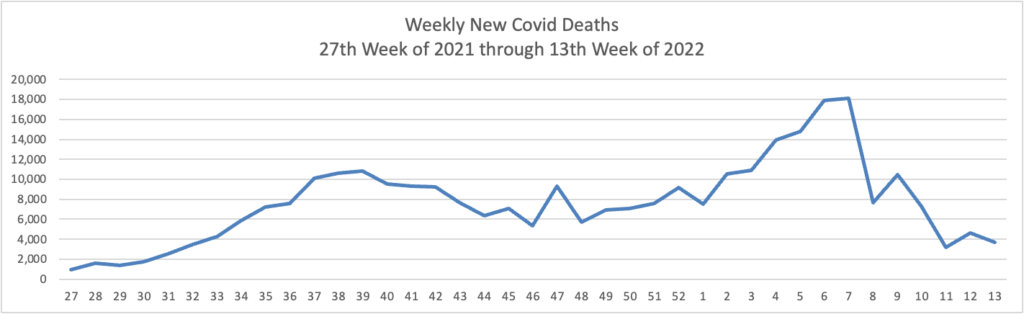
Based on the CDC’s Covid Data Tracker and using Thursday as the first day of the week, here are the FEHBlog’s weekly charts of new Covid cases and deaths beginning with the 27th week of 2021 and ending with the 7th week of 2022.
At last, both charts are headed down.
Here’s the FEHBlog’s weekly chart of Covid vaccinations distributed and administered beginning with the 51st week of 2020, when the vaccination program launched, and the 7th week of this year.
As of today, nearly 75% of Americans aged 18 and older (74.7%) are fully vaccinated, and 46.5% of Americans in that age group are boostered.
More than one year after the first COVID-19 vaccine was administered in the United States, new data from a recent survey conducted online by The Harris Poll show 73% of consumers would like to see additional COVID-19 vaccines become available.
Currently, the World Health Organization has listed ten different COVID-19 vaccines based on various technologies.
But the U.S. FDA has only authorized/approved three COVID-19 vaccines.
Moreover, consumers would like to see COVID-19 vaccines developed from traditional methods, such as technologies used to produce diphtheria, mumps, chickenpox, or polio vaccines.
Novavax’s traditionally developed Covid vaccine is pending Food and Drug Administration emergency use authorization. The FDA’s Vaccines Advisory Committee will consider the EUA application first. That Committee’s next meeting will be held on March 3, 2022. The agenda is not available yet.
[W]ith [Covid] cases plummeting thanks to the omicron decline, and government orders continuing to roll into pharmacies, doctors and health officials in New York and across the country say the supply is looking plentiful in many areas.
“You have lots of the drug and very few cases — that’s the best place you could possibly be,” says Infectious Diseases Society of America spokesman Aaron E. Glatt. The pills are broadly available, he said, though not at every corner drugstore.
The federal government tracks Paxlovid on a public-facing website that names which pharmacies have it, and a federal website for health-care providers indicates more than 130,000 courses are available.
Dare we hope that the country will be prepared for the next Covid variant if it crops up?
Here are links to the CDC’s Covid Data Tracker weekly review and its FluView. The top line of FluView reads, “Sporadic influenza activity continues across the country. In some areas, influenza activity is increasing.” The current winter continues to mirror the 2020-21 winter, with Omicron edging out the flu.
From the Covid fallout front, Health Payer Intelligence informs us
Nearly three out of ten adults over 50 (28 percent) delayed care due to the coronavirus pandemic in 2021.
“Whether they chose to postpone or their provider did, these patients missed opportunities for preventive care and for early detection and effective management of chronic conditions, not to mention operations and procedures to address a pressing health need,” said Jeffrey Kullgren, MD, associate director of the poll and a health care researcher and associate professor of internal medicine at Michigan Medicine in the University of Michigan’s academic medical center.
The National Poll on Healthy Aging surveyed 1,011 adults ages 50 and older in late January 2022. Seniors could complete the survey by phone or online.
Considering the FEHB’s demographics, this report should be relevant to FEHB carriers.
Speaking earlier of the FDA, here is a link to the FDA’s roundup for February 18, 2022. Moreover, Fierce Healthcare reports
Hospitals on average charge double the price for the same drugs compared to those offered by specialty pharmacies, according to a new insurer-funded study released as federal regulators ponder a probe into the pharmacy benefit management industry.
The study (PDF), released Wednesday by insurance lobbying group AHIP, comes as specialty pharmacies have grown in use among PBMs and payers to dispense specialty products. The study was released a day before a scheduled meeting Thursday of the Federal Trade Commission on whether to probe the competitive impact of PBM contracts and how they could disadvantage independent and specialty pharmacies.
“The data are clear, specialty pharmacies lower patient costs by preventing hospitals and physicians from charging patients, families, and employers excessively high prices to buy and store specialty medicines themselves,” said Matt Eyles, president and CEO of AHIP, in a statement.
From the telehealth front, mHealth Intelligence notes
Doximity, an online networking service and telehealth platform for healthcare professionals, conducted the new survey last November, polling 2,000 US adults, of whom 1,000 identified as having a chronic illness.
As telehealth becomes integrated into care delivery, questions around patient preferences arise. The survey helps shed some light, showing that 79 percent of patients would prefer a call or text letting them know that their doctor is ready to see them versus having to wait in a virtual waiting room. Even among chronic illness patients only, an overwhelming majority (81 percent) would prefer to receive a call or text.
Patients also displayed a strong preference for familiarity with a provider. Overall, 83 percent of patients surveyed said they would wait one to three days to see their current doctor rather than seeing a new physician immediately.
If these statistics float your boat, you will find many more exciting telehealth stats in the article.
Sen. Marsha Blackburn lifted a hold on a stopgap bill needed to avoid a partial government shutdown this weekend after she won a commitment from the Biden administration that it wouldn’t fund pipes for smoking illicit substances through a substance-abuse program. * * *
[Senate Minority Leader Sen. Mitch] McConnell said Tuesday that he expected there to be some amendment votes in conjunction with the vote on the so-called continuing resolution. “I think it will all be worked out,” he said. “There’s no danger of a government shutdown.”
The House of Representatives held a pro forma, the four-minute-long session this morning at which
[The] Clerk notified the House that she had received the following message from the Secretary of the Senate on February 14, 2022, at 6:30 p.m.: That the Senate agreed to return the papers to the House of Representatives at their request for H.R. 3076 [the Postal Reform Act of 2022] * * *.
The House is not scheduled to resume floor voting until February 28 and the Senate will be on a State work period next week so Congressional passage of this bill may not occur until next month.
The Senate on Tuesday confirmed Robert Califf to lead the Food and Drug Administration, 50-46, a much narrower vote than when he previously held the position during the Obama administration, though many thought the latest vote could be even closer.
Califf’s confirmation means the Biden administration has a permanent FDA commissioner during the COVID-19 pandemic after 13 months with longtime agency official Janet Woodcock acting as its leader.
Califf needed bipartisan support to cross the finish line. Retiring Sens. Patrick J. Toomeyof Pennsylvania and Roy Blunt of Missouri joined four Republicans who sit on the Health, Education, Labor and Pensions Committee to confirm Califf.
From the Omicron front, the Wall Street Journal offers interesting commentary from Dr. Marc Siegal about the Novovax vaccine which is the subject of an emergency use authorization at the Food and Drug Administration.
The Novavax vaccine is based on tried and true technology. It involves growing the virus’s spike protein in moth cells and then combining it with an adjuvant, a chemical that amplifies the protein’s effect on the immune system. Whereas the mRNA vaccines signal human cells to make part of the protein, Novavax injects it directly as a “nanoparticle,” which induces a robust immune response (antibodies and T-cells). Side effects appear to be minimal: flulike symptoms, headache, temporary fatigue and pain at the injection site.
There are several reasons to think that Novavax may give a more powerful boost than a third or fourth mRNA shot. For one thing, the nanoparticle includes the whole spike protein, which could provoke a more complete immunity. So could the glycosylation of the spike—the addition of a sugar molecule in insect cells, which isn’t what the virus is expecting. Perhaps most important, the adjuvant (known as Matrix-M1), which comes from the inner bark of a Chilean soapbark tree, is very high in quality and has been used to make a malaria vaccine effective.
From the health equity front, Health Payer Intelligence discusses a Northeast Business Group on Health report on strategies for making progress on resolving inequities created by social determinants of health. Check it out.
In a similar vein, the Agency of Healthcare Research and Quality blog post on integrating patient-generated health data into electronic health records.
The 63-year-old patient has hypertension. With encouragement from his family, he checks his blood pressure daily using a digital blood pressure monitor. And thanks to advances in digital technology, he saves each reading on a mobile application whether he’s at home, at work, or on vacation.
What is the reward for his persistence? With his health data easily integrated into his electronic health record, his primary care doctor has a fuller picture of his health—one that is not limited to the traditional snapshot taken in an exam room. Using that data, he and his physician can have more informed conversations about treatment options and next steps.
While this scenario accurately recognizes that today’s patients can easily collect their own health data outside of the clinical setting, many ambulatory care practices lack the technical infrastructure, functional workflows, workforce capacity, and training to support the intake and use of patient-generated health data (PGHD).
With those challenges in mind, AHRQ has released a new guide on increasing the use of PGHD, one that provides practical tools for ambulatory care practices to implement PGHD programs and improve patient outcomes. It includes tips, ideas, and learning activities to let users tailor solutions to their needs. To our knowledge, this is the first practical guide that includes detailed considerations and steps for implementing a PGHD program.
The AHRQ guide may be helpful to health plan case managers, too.
From the tidbits department
Roll Call and Fierce Healthcare offer different takes on the public comments submitted on the Centers for Medicare Services controversial proposed national coverage deterimination on Biogen’s Alzheimers Disease drug Aduhelm. A final decision is expected in April.
The CDC encourages people with pre-diabetes to become heart health role models.
The platform is now available to all Evernorth clients and to Cigna members in employer plans or Affordable Care Act marketplace plans in 20 states.
Monument offers an evidence-based, virtual treatment program for alcohol use disorder. Evernorth said in the announcement that alcohol use has been on the rise for the past several decades, and that some 60% of people have reported higher alcohol intake under the pandemic.
We use cookies on our website to give you the most relevant experience by remembering your preferences and repeat visits. By clicking “Accept”, you consent to the use of ALL the cookies.
This website uses cookies to improve your experience while you navigate through the website. Out of these, the cookies that are categorized as necessary are stored on your browser as they are essential for the working of basic functionalities of the website. We also use third-party cookies that help us analyze and understand how you use this website. These cookies will be stored in your browser only with your consent. You also have the option to opt-out of these cookies. But opting out of some of these cookies may affect your browsing experience.
Necessary cookies are absolutely essential for the website to function properly. These cookies ensure basic functionalities and security features of the website, anonymously.
Cookie
Duration
Description
cookielawinfo-checbox-analytics
11 months
This cookie is set by GDPR Cookie Consent plugin. The cookie is used to store the user consent for the cookies in the category "Analytics".
cookielawinfo-checbox-functional
11 months
The cookie is set by GDPR cookie consent to record the user consent for the cookies in the category "Functional".
cookielawinfo-checbox-others
11 months
This cookie is set by GDPR Cookie Consent plugin. The cookie is used to store the user consent for the cookies in the category "Other.
cookielawinfo-checkbox-necessary
11 months
This cookie is set by GDPR Cookie Consent plugin. The cookies is used to store the user consent for the cookies in the category "Necessary".
cookielawinfo-checkbox-performance
11 months
This cookie is set by GDPR Cookie Consent plugin. The cookie is used to store the user consent for the cookies in the category "Performance".
viewed_cookie_policy
11 months
The cookie is set by the GDPR Cookie Consent plugin and is used to store whether or not user has consented to the use of cookies. It does not store any personal data.
Functional cookies help to perform certain functionalities like sharing the content of the website on social media platforms, collect feedbacks, and other third-party features.
Performance cookies are used to understand and analyze the key performance indexes of the website which helps in delivering a better user experience for the visitors.
Analytical cookies are used to understand how visitors interact with the website. These cookies help provide information on metrics the number of visitors, bounce rate, traffic source, etc.
Advertisement cookies are used to provide visitors with relevant ads and marketing campaigns. These cookies track visitors across websites and collect information to provide customized ads.