Thursday Miscellany

Thursday Miscellany

Photo by Josh Mills on Unsplash

From Capitol Hill, the Wall Street Journal reports that the Senate majority’s leadership is rallying the caucus to pass the Schumer – Manchin compromise reconciliation bill that would address climate and healthcare concerns while raising taxes. The goal is for the Senate to pass the bill next week which immediately precedes the Senate’s August recess.

The Hill adds that

A day after Sen. Joe Manchin (D-W.Va.) stunned Washington by endorsing hundreds of billions of dollars for President Biden’s domestic agenda, House Democrats are rallying behind the nascent package as a crucial — if incomplete — strategy for tackling the climate crisis and easing working class economic strains.

Both articles discuss the flies remain in the reconciliation ointment.

Govexec informs us

The odds that Congress would increase the average 4.6% pay raise planned for federal employees in 2023 got a little longer Thursday, after Senate appropriators revealed that they would effectively endorse President Biden’s pay increase proposal.” The Senate Appropriations Committee on Thursday revealed all of their initial versions of fiscal 2023 spending bills, including the package governing financial services and general government, which is the vehicle by which Congress weighs in on federal employee compensation. That bill makes no mention of changes to career federal employees’ pay, effectively endorsing the pay raise plan offered by Biden in his fiscal 2023 budget proposal.

Here is a link to the Senate Appropriations Committee’s press release unveiling those bills. What caught the FEHBlog’s eye is the statement in the press release that the Senate appropriations bills, like the House appropriations bills, do not include the Hyde amendments limiting federal funding of abortions to cases of rape, incest, or endangerment of the mother’s life. That tectonic change would draw the FEHBP into the post-Dobbs controversy.

From the Affordable Care Act front, Prof. Katie Keith does her usual outstanding job breaking down the proposed ACA Section 1557 individual non-discrimination rule in Health Affairs Forefront. In the FEHBlog’s view, the rule is unnecessarily complicated. It is the FEHBlog’s understanding that this HHS rule would not apply to FEHBP and that HHS would refer Section 1557 complaints involving FEHB plans to OPM. As the preamble points out, Section 1557 is a law that doesn’t need an implementing rule. Nevertheless, HHS recommends that other agencies with programs covered by Section 1557 adopt their own implementing rule using the HHS rule as a template.

The ACA regulators issued a 13-page long ACA FAQ 54 describing in detail the ACA rule requirements under which health plans must cover contraceptive drugs and services for women without cost sharing.

On a related note, Healthcare Dive tells us

Melanie Fontes Rainer is now acting director of HHS’ Office of Civil Rights. Fontes Rainer will replace Lisa Pino, who oversaw rulemaking related to patient safety, reproductive rights and other healthcare issues and issued policy regarding health equity, long COVID and firearm injury and death prevention, the agency said in an emailed statement.

From the federal employee benefits front, Fedweek explains the circumstances under which survivors of federal employees (as opposed to federal annuitants) are eligible for federal survivor benefits.

If you are an employee who was married when you die and you had at least 18 months of creditable civilian service, your spouse will be entitled to a survivor annuity.  * * * f you were enrolled in either the self plus one or self and family options of the Federal Employees Health Benefits program when you died, the person(s) on your enrollment could continue that coverage. If you weren’t enrolled in the program (or were enrolled but in the self only option), any otherwise eligible survivors would be out of luck.

From the Omicron and siblings front, the American Medical Association offers a helpful Q&A on Covid boosters.

From the monkeypox front, Reuters makes two reports

  • The United States has the capacity to conduct 60,000-80,000 tests for monkeypox virus per week, Health and Human Services Secretary Xavier Becerra said on Thursday. When the monkeypox outbreak began, the U.S. was able to conduct only 6,000 tests per week, Becerra told reporters during a telephone briefing.
  • The U.S. Centers for Disease Control and Prevention (CDC) said on Wednesday it plans to make the rapidly spreading monkeypox disease a nationally notifiable condition. The designation, which is set to take effect on Aug. 1, updates criteria for reporting of data on cases by states to the agency and would allow the agency to monitor and respond to monkeypox even after the current outbreak recedes, the CDC said.

From the U.S. healthcare business front —

The American Hospital Association issued a report attacking the commercial health insurance industry, which in the FEHBlog’s view is akin to strangling the golden goose.

Healthcare Dive reports

Teladoc beat Wall Street expectations for revenue in the second quarter, with a topline of $592 million, up 18% year over year. Chronic care membership came in higher than analysts expected, while member utilization improved year over year.

But “all eyes” are on the vendor’s guidance for the rest of the year, which implies a third-quarter miss and a steep ramp-up for earnings in the fourth quarter, SVB Securities analyst Stephanie Davis wrote in a note on the results.

STAT News chimes in

Telehealth giant Teladoc is bracing for disappointing earnings this year as it faces headwinds that could also thwart competitors struggling to turn a profit — including increasingly frugal employers delaying or dropping contracts for virtual care.

“The challenge that we’re seeing is in these times of economic uncertainty, all purchases are just getting a significantly higher level of scrutiny,” CEO Jason Gorevic said in an earnings call Wednesday.

Gorevic also noted that declining yield on advertising suggests that individual patients may start spending less on direct-to-consumer services like BetterHelp, the company’s mental health care offering. Those hurdles aren’t unique to Teladoc. Competitors like Amwell and Talkspace could also have to grapple with cutbacks.

Healthcare Dive also delves into Amazon’s planned acquisition of One Medical. “The deal fast-tracks Amazon’s ambitions in healthcare, while giving One Medical a cushion in today’s tricky economic environment.”

Yesterday, the FEHB wrote about the hospitals receiving five stars from Medicare. Today Becker’s Hospital Review lists the 192 hospitals receiving a single start from that program.

Finally STAT News lists the 41 best books and podcasts on health and science to check out this Summer.

Midweek Update

From Capitol Hill —

The Wall Street Journal reports

Sen. Joe Manchin (D., W.Va.) agreed to back a package aimed at lowering carbon emissions and curbing healthcare costs while raising corporate taxes, marking a stunning revival of core pieces of President Biden’s economic and climate agenda that the West Virginia Democrat had seemingly killed earlier this month

The deal, negotiated privately between Messrs. Manchin and Senate Majority Leader Chuck Schumer (D., N.Y.) since the start of last week, would raise roughly $739 billion, with much of the revenue coming from a 15% corporate minimum tax and enhanced tax enforcement efforts at the Internal Revenue Service, as well as projected savings from allowing Medicare to negotiate some prescription-drug prices.

Of that new revenue, roughly $369 billion would be spent on climate and energy programs, with another $64 billion dedicated to extending healthcare subsidies for three years for some Affordable Care Act users. The bill would dedicate the rest of the new revenue toward reducing the deficit, according to a summary provided by Messrs. Schumer and Manchin. * * *

The deal will still need the support of almost every other Democrat in Congress. Passing the agreement into law will test Mr. Schumer and the ability of House Speaker Nancy Pelosi (D., Calif.) to convince an ideologically diverse group of lawmakers to accept a deal announced by one of the party’s most conservative members. 

The announcement of a deal on Wednesday appeared to catch other Democrats off guard.

The Hill informs us

The House passed a bill Wednesday to expand telehealth services that were first introduced during the COVID-19 pandemic.

The legislation, titled the Advancing Telehealth Beyond COVID–19 Act, passed in a 416-12 vote. Eleven Republicans and one Democrat objected to the measure. Two Republicans did not vote.

The measure seeks to continue a number of telehealth policies established under Medicare that were first implemented at the beginning of the COVID-19 pandemic. If passed by the Senate and signed into law, the provisions would continue through 2024.

Fierce Healthcare adds

A key House panel advanced legislation to create an electronic prior authorization process for Medicare Advantage plans and several other reforms.

The House Ways and Means Committee unanimously advanced on Wednesday the Improving Seniors Timely Access to Care Act of 2022. The legislation has more than 300 co-sponsors and wide support across the healthcare industry.

From the Omicron and siblings front, Medpage Today asks “Can I boost with Novovax?”

While the Novavax shot is not yet authorized by the FDA as a booster, several experts told MedPage Today it could be headed that way.

“Probably the best niche now for Novavax’s purified protein vaccine is as a booster strategy for mRNA vaccines,” Paul Offit, MD, of Children’s Hospital of Philadelphia, who served on the FDA’s Vaccines and Related Biological Products Advisory Committee (VRBPAC) on Novavax, told MedPage Today.

Robert “Chip” Schooley, MD, an infectious disease expert at the University of California San Diego who has served on VRBPAC in the past, said since there “aren’t many people left who have been neither vaccinated nor infected … it will likely be mainly used as a booster.”

NPR Shots tells us

The Biden administration may scrap plans to let more younger adults get second COVID-19 boosters this summer. Instead, officials are trying to speed up availability of the next generation of boosters in the fall, NPR has learned.

The new strategy is aimed at trying to balance protecting people this summer with keeping people safe next winter, when the country will probably get hit by yet another surge.

But the possible shift is being met with mixed reactions. The Food and Drug Administration could make a final decision by the end of the week. 

The dilemma facing the FDA is that the immunity many people have gotten from getting vaccinated or infected has been wearing off. At the same time, the most contagious version of the virus to emerge yet — the omicron subvariant BA.5 — is making people even more vulnerable.

So as COVID is starting to become more serious than a cold or flu again, most people younger than age 50 aren’t eligible for fourth shots — second boosters — to protect themselves. In response, the FDA was considering opening up eligibility for second boosters for all adults.

But letting more people get boosted with the original vaccine now could interfere with plans to boost them with updated, hopefully more protective vaccines in the fall to blunt the toll of the winter surge. 

It’s quite a conundrum for the experts.

From the monkeypox front

  • NPR provides a helpful FAQ on the disease.

The Centers for Disease Control and Prevention (CDC) has expanded access to vaccines, tests, and treatments for monkeypox, agency officials said in a webinar Tuesday.

The CDC expects to release more than 750,000 doses of the JYNNEOS vaccine from its strategic stockpile within days, said panelists at the Clinician Outreach and Communication Activity (COCA) call.

In addition, by working with commercial labs, the agency has expanded US testing capacity and streamlined requirements for administering the antiviral tecovirimat, they said.

Encouraging news from the HIV front. The Wall Street Journal reports

A 66-year-old man in Southern California and a woman in her 70s in Spain are the latest in a small group of people who appear to have beaten their HIV infections, providing researchers new clues to a possible cure at a time when Covid-19and other crises are slowing progress against the spreading virus.

Doctors caring for the man said they haven’t found any human immunodeficiency virus that can replicate in his body since he stopped antiretroviral drug therapy in March 2021 after a transplant of stem cells containing a rare genetic mutation that blocks HIV infection. He was given the transplant for leukemia, for which people with HIV are at increased risk. Details of his case were made public Wednesday and will be presented at a large international AIDS conference in Montreal that opens Friday.

“He saw many of his friends and loved ones become ill and ultimately succumb to the disease and had experienced some stigma associated with having HIV,” she said. His success “opens up the opportunity potentially for older patients to undergo this procedure and go into remission from both their blood cancer and HIV.

Also from the medical research front, STAT News informs us

[F]or several years, a small New Haven, Conn.-based startup has quietly been building technology to move the needle on suicide rates among the people at highest risk: those with a history of attempts or who have suicidal thoughts and have expressed a strong desire to die.

The company, called Oui Therapeutics, has raised roughly $26 million from high-profile investors like CVS Health Ventures and First Round Capital to develop and launch an app designed to train people how to quell their suicidal impulses. It pulls from in-person therapy methods that have shown dramatic reductions in suicide attempts — nearly 60% — in a randomized trial of soldiers at high risk. * * *

If the research bears out and the app secures buy-in from regulators, it could become a powerful tool in curbing suicide, which kills over 45,000 people in the U.S. each year. Oui is part of a broader constellation of efforts — including a new national suicide prevention hotline number and the development of prevention frameworks like Zero Suicide — in recent years that aim to address rates that have risen stubbornly high.

Fingers crossed for both worthy efforts.

From the Medicare front, Beckers Hospital Review reports

CMS updated its Overall Hospital Quality Star Ratings for 2022, giving 429 hospitals a rating of five stars.

CMS assigned star ratings to hospitals nationwide based on their performance across five quality categories. This year:

* 192 hospitals received a one-star rating

* 692 hospitals received a two-star rating

* 890 hospitals received a three-star rating

* 890 received a four-star rating

* 429 received a five-star rating

The article lists all of the five star hospitals by state.

From the U.S. healthcare business front, Healthcare Dive tells us

Humana raised its profit estimates for the full year after reporting lower than expected medical costs during the second quarter.

“The lower utilization trends and lack of COVID headwinds seen to date, give us confidence in raising our full year adjusted [earnings per share] guide,” Humana CFO Susan Diamond said Wednesday on a call with investors.

Humana’s net income increased 18% to $696 million for the second quarter as the Louisville-based insurer recorded increased revenues of $23.6 billion amid enrollment growth in both Medicare and Medicaid.

The insurer noted lower inpatient utilization among Medicare members for Q2.

But the lower-than-anticipated inpatient utilization has been partially offset by higher unit costs, Diamond said. * * *

The company’s total medical membership of 17.1 million was up 0.8% year over year.

As the company continues on its value creation plan to trim $1 billion in costs, Humana said it will restructure its organization into two distinct units as it looks to simplify the company’s overall organization.

Revcycle Intelligence reports on how healthcare spending varies by region and payer type.

There is substantial variation and low correlation in healthcare spending across Medicare, Medicaid, and private insurance plans within different US regions, a study published in JAMA Network Open found.

The US spends around $3.8 trillion per year on healthcare funded by Medicare, Medicaid, and private insurers. However, spending and healthcare utilization are rarely the same for all three payers. * * *

Healthcare spending per beneficiary varied across payers. The mean private insurance spending per beneficiary was $4,441, while the Medicare mean was $10,281, and the Medicaid mean was $6,127 per beneficiary. The overall mean for the three payers was $5,782 per beneficiary.

Medicaid had the most variation in spending per beneficiary across the [241 hospital referral regions] HRRs, with a coefficient of variation of 0.233, according to the study. Private insurance had a coefficient of variation of 0.160 and Medicare had a coefficient of variation of 0.126.

Medicaid and private insurance plans likely saw more variation in spending than Medicare because Medicare relies on regulated payments to hospitals, while Medicaid and privately insured prices are generally determined by the region’s market.

In addition to spending variation among the payers individually, there was low spending correlation within regions across all three payers.

For example, the correlation coefficient between HRR level spending was 0.020 for private insurance and Medicare, 0.213 for private insurance and Medicaid, and 0.162 for Medicare and Medicaid.

Monday Roundup

Photo by Sven Read on Unsplash

From the Omicron and siblings front, STAT News reports

The Biden administration is preparing a sweeping initiative to develop a next generation of Covid-19 immunizations that would thwart future coronavirus variants and dramatically reduce rates of coronavirus infection or transmission, building on current shots whose impact has been mainly to prevent serious illness and death, the White House told STAT.

To kick off the effort, the White House is gathering key federal officials, top scientists, and pharmaceutical executives including representatives of Pfizer and Moderna for a Tuesday “summit” to discuss the new technologies and lay out a road map for developing them.

“These are vaccines that are going to be far more durable, that are going to provide far longer-lasting protection, no matter what the virus does or how it evolves,” Ashish Jha, the White House Covid-19 response coordinator, said in an interview. “If we can drive down infections by 90% … Covid really begins to fade into the background, and becomes just one more respiratory illness that we have to deal with.”

Here’s hoping. Curiously, the federal government did not start this effort last year when Delta was raging.

The Centers for Disease Control posted an information sheet on the Novovax vaccine. The FEHBlog was surprised to read “Novavax COVID-19 vaccine is not authorized for use as a booster dose.” The FEHBlog had read months ago that the Novovax vaccine would make a dandy booster to a series of mRNA shots.

Medscape discusses long Covid symptoms.

People who reported sore throats, headaches, and hair loss soon after testing positive for COVID-19 may be more likely to have lingering symptoms months later, according to a recent study published in Scientific Reports.

Researchers have been trying to determine who faces a higher risk for developing long COVID, with symptoms that can last for weeks, months, or years after the initial infection. So far, the condition has been reported in both children and adults, healthy people, those with preexisting conditions, and a range of patients with mild to severe COVID-19.

“These people are not able to do necessarily all the activities they would want to do, not able to fully work and take care of their families,” Eileen Crimmins, PhD, the senior study author and a demographer at the University of Southern California’s Leonard Davis School of Gerontology, told the Los Angeles Times.

“That’s an aspect of this disease that needs to be recognized because it’s not really as benign as some people think,” she said. “Even people who have relatively few symptoms to start with can end up with long COVID.”

From the Affordable Care Act front, the Department of Health and Human Services released today a proposed third version (Obama, Trump, Biden) version of a rule implementing Section 1557, the individual non-discrimination provision of the Affordable Care Act. Here are links to the proposed rule and the Department’s fact sheet. The law needs an implementing rule because its wording is garbled. The FEHBlog didn’t think he would ever see a more complicated rule than the Obama Administration’s 2016 rule, but at least at first glance, it appears that the Biden Administration has cleared that high bar. Later this week, the FEHBlog will offer his take on the extent of the rule’s application to the FEHBP. The public comment period will be 60 days long once the proposed rule is published in the Federal Register.

The Wall Street Journal has launched an investigative journalism campaign against certain large charitable hospitals.

Nonprofit hospitals get billions of dollars in tax breaks in exchange for providing support to their communities. A Wall Street Journal analysis shows they are often not particularly generous.

These charitable organizations, which comprise the majority of hospitals in the U.S., wrote off in aggregate 2.3% of their patient revenue on financial aid for patients’ medical bills. Their for-profit competitors, a category including publicly traded giants such as HCA Healthcare Inc., wrote off 3.4%, the Journal found in an analysis of the most-recent annual reports hospitals file with the federal government.

Among nonprofits with the smallest shares of patient revenue going toward charity care—well under 1%—were high-profile institutions including the biggest hospitals of California’s Stanford Medicine and Louisiana’s Ochsner Health systems. At Avera Health, a major hospital system in South Dakota, charity care was roughly half of 1% of patient revenue across all its 18 hospitals.

You get the gist. These Journal investigations usually attract attention on Capitol Hill.

From the public health front, the Washington Post discusses the meaning of a pre-diabetes diagnosis to the over 65 crowd.

More than 26 million people 65 and older have prediabetes, according to the Centers for Disease Control and Prevention. How concerned should they be about progressing to diabetes?

Not very, some experts say. Prediabetes — a term that refers to above-normal but not extremely high blood sugar levels — isn’t a disease, and it doesn’t imply that older adults who have it will inevitably develop Type 2 diabetes, they say.

“For most older patients, the chance of progressing from prediabetes to diabetes is not that high,” said Robert Lash, the chief medical officer of the Endocrine Society. “Yet labeling people with prediabetes may make them worried and anxious.”

Other experts believe it is important to identify prediabetes, especially if doing so inspires older adults to add more physical activity, lose weight and eat healthier diets to help bring their blood sugar under control.

Based on personal experience, the FEHBlog finds himself supporting “the other experts.”

From the OPM / FEHB front —

  • OPM today issues a fact sheet on the steps being taken to implement the President’s June 2021 Executive Order on increasing diversity, equity, and inclusion in the federal workforce.
  • FedSmith has an article encouraging federal annuitants to take look this Open Season at FEHB plans which offer an integrated Medicare Advantage. The number of those plans has been growing over the past two Open Seasons and the FEHBlog anticipates the number will continue to grow this coming Open Season.

From the telehealth front, mHealth Intelligence points out

The benefits of breastfeeding are well-documented. Breast milk is a comprehensive source of infant nutrition, can help stave off some short-and long-term illnesses, and enables babies to gain valuable antibodies from their mothers, according to the Centers for Disease Control and Prevention. Further, breastfeeding can reduce the mother’s risk of developing several conditions, including breast and ovarian cancer and type 2 diabetes.

Though a majority of babies are breastfed initially, there appears to be a drop-off at the six-month mark, and rates continue to decline from there. In total, about 84 percent of babies were breastfed in 2018, but only 57 percent were breastfed at six months and 35 percent at 12 months, according to CDC data.

To support breastfeeding, the five-hospital Trinity Health of New England system joined forces with Nest Collaborative last month to launch a telehealth program.

The telehealth-enabled breastfeeding support program, launched at the end of June, connects pregnant women and new mothers to a nationwide network of lactation consultants.

Nest Collaborative’s [lactation consultants] help families reach their breastfeeding goals and assist them in making informed decisions about infant feeding options,” said Judith Nowlin, CEO of Nest Collaborative, in an email.

Thursday Miscellany

Photo by Josh Mills on Unsplash

From the Omicron and siblings’ front —

MedPage Today reports “Second COVID booster shot boosted antibodies in Seniors — but small Israeli study did not determine how quickly response will wane.”

Becker’s Hospital Reviews tells us

At least 18 cases of the newest omicron subvariant BA.2.75 have been confirmed in seven U.S. states as of July 20, early disease surveillance data shows. 

Globally, researchers have identified 201 cases in more than a dozen countries as of July 12, according to data from outbreak.info, a platform that tracks data on coronavirus variants and is supported by the CDC and other national research groups. 

The subvariant has a large number of mutations that may make it more adept than BA.5 — the nation’s current dominant strain — at spreading quickly and evading immune protection. Experts say it’s still unclear whether BA.2.75 will compete against BA.5 or cause more severe illness, according to CNN.

This leads us to the Wall Street Journal’s editorial board comments

The President’s [Omicron] infection [disclosed today] demonstrates how hard it is to avoid the new and highly transmissible Covid variants. The White House has gone to great lengths to protect Mr. Biden, but there’s only so much staff can do if the President is going to do his job. 

Despite continuing pleas from the White House and public-health elite, vaccination by now provides little protection against transmission. * * * The evidence is that the vaccines do reduce the chances of getting serious Covid and being hospitalized, though many elderly patients who have been vaccinated are still dying from the virus.

While this quote is an opinion, not a news report, it struck a chord with the FEHBlog. The FEHBlog wishes the President a speedy recovery.

From the unusual viruses front, the Department of Health and Human Services offers a fact sheet on its response to the monkeypox outbreak.

In mergers and acquisitions news, Healthcare Dive informs us

Amazon has agreed to acquire primary care network One Medical for $18 a share, valuing the company at $3.9 billion.

The all-cash deal for San Francisco-based One Medical comes after months of speculation about a potential acquisition, reportedly drawing interest from companies including CVS Health, according to Bloomberg.

Analysts said a potential buyout for One Medical, which has grown rapidly since it was founded in 2007, could come at a significant premium. Amazon’s price of $18 a share represents a premium of 43% over its closing price of $10.18 a share on Wednesday.

STAT News explains why Amazon pursued adding One Medical to its healthcare portfolio.

With One Medical, Amazon is also tapping deeper into the vein of health care’s payment system. One Medical gets paid through two main avenues: commercial health insurers and Medicare. The Medicare side came from Iora, which One Medical bought for $1.4 billion last year.

Commercially insured patients, or those who get coverage through their jobs, are by far the most profitable within health care and overlap with a large chunk of Amazon’s subscription base. Even though One Medical focuses on less expensive primary care, there’s evidence One Medical charges some of the highest rates for those routine office visits and services, and that’s largely assisted by One Medical’s hospital partners.

Hospitals pay fixed sums to One Medical to care for patients, but they also “extend their health insurance contracts” to One Medical, the company said when it went public in 2020. The result: Hospitals that ink deals with One Medical get the most profitable patients in their market referred to them for more intensive services, and One Medical gets to piggyback off the lucrative payments that those dominant hospitals wring out of insurers.

STAT News concludes

Amazon’s success — and how disruptive it might prove to be to telehealth competitors — will depend in part on how well it integrates One Medical into its existing in-person and virtual offerings through Amazon Care. Analysts said that will become clear over the next year.

Whether it does draw patients away from traditional health care providers depends on their partnership with payers and their fees, said Aaron Neinstein, vice president of digital health for UCSF Health. “There’s no question that the One Medical annual fee is out of reach for most people in the U.S. Might Amazon change that or bundle it with Prime? Who knows.”F

Health Leaders Media reports that, notwithstanding the Federal Trade Commission’s nascent efforts,

Hospital and health system mergers and acquisitions in Q2 of 2022 have returned to trendlines that Kaufman Hall has been following since the beginning of the pandemic, the consulting firm said in its recently released M&A quarterly report.

During the second quarter of 2022, there were 13 hospital and health system M&A transactions, on-trend and only one transaction less than the 14 transactions reached in Q2 of 2021 and 2020. However, the total transacted revenue in the second quarter reached a “historic high” of $19.2 billion, more than doubling the $8.5 billion transacted revenue in the same quarter in 2021.

From the reports department and via Axios, the FEHBlog ran across this comprehensive McKinsey and Company report on the future of U.S. healthcare: what’s next for the industry post-Covid. Check it out.

From the Rx coverage front, DrugChannels calls our attention to this Amgen preview of 2022 trends in the biosimilars market. Adam Fein observes

As I predicted two years ago, the biosimilar boom is finally here. Prices are dropping while adoption accelerates. Prices are now declining by 9% to 22% annually. For therapeutic areas with biosimilars launched in the last three years, biosimilars’ market share averages 74%.  See Amgen slides 8 and 9.

Before the boom began, Dr. Scott Gottlieb, a former FDA commissioner, argued that we shouldn’t give up on biosimilars and prematurely regulate prices. As we can now see, Dr. Gottlieb was right. #NoTowel

From the SDOH front, Health Payer Intelligence explains

Race and ethnicity data collection is complex, but there are steps that health insurers—and the healthcare industry at large—can take to improve the process, according to a report from Urban Institute funded by Elevance Health (formerly Anthem).

From the miscellany department

  • Fierce Healthcare discusses a recent Fitch report on non-profit hospitals.

Labor, supply and capital cost increases have been rampant across the industry this year thanks to broader inflation pressures and other pandemic factors, the ratings agency wrote.

Reversing the margin trends will likely require nonprofit hospitals to take on a combination of rate hikes in the short term, “relentless” cost-cutting and productivity initiatives for the medium term and “transformational changes to the business model” for the long term, Fitch wrote.

Fortunately for those hospitals, many organizations already have the means to weather the storm as they overhaul their operations.

“The vast majority of our rated credits have strong balance sheets that will offset lower margins for a period of time and allow for operational improvements,” Fitch wrote. “Without more substantial changes to the current business model, or with additional coronavirus surges this fall or winter, this balance sheet cushion could eventually erode.”

Rate negotiations with payers will likely be an upward battle, the group wrote.

  • Healthcare Forefront points out the value of underutilized fentanyl test strips

Fentanyl test strips (FTS) are a simple, inexpensive, and evidence-based method of averting drug overdose. FTS are small strips of paper that can detect the presence of fentanyl in any drug batch—pills, powder, or injectables. This tool might be lifesaving for the teenager experimenting for the first time, the individual in the throes of a severe opioid use disorder, the concert-goer looking for a trip, the person using a preferred substance obtained from a new source, or the individual years into recovery. FTS also support the dignity and well-being of people who use drugs (PWUD), enabling them to make educated decisions about their safety.

And yet after years of press and discussions of the strips’ utility, FTS aren’t as widely available as one would expect them to be. It is time to take a more critical look at the importance of destigmatizing this tool and increasing its distribution and availability, while highlighting the grave risks in not doing so.

  • HealthDay gives us some good news.

U.S. hospitals became much safer places for patients over the past decade, with medical errors and adverse events declining significantly across the nation, federal government data show.

Between 2010 and 2019, patient safety dramatically improved among the four types of conditions for which people are most often hospitalized: heart attacks, heart failure, pneumonia and major surgical procedures.

“There has been a precipitous, very important drop in the number of these events, which to me validates the idea that these were preventable,” said senior researcher Dr. Harlan Krumholz, director of the Yale New Haven Hospital Center for Outcomes Research and Education in New Haven, Conn. “The status quo wasn’t written in stone. We have been able to actually make hospitals safer for those conditions.”

The new study relied on data gathered by the Medicare Patient Safety Monitoring Program, an effort created in the wake of a landmark 1999 Institute of Medicine report that drew national attention to patient safety in hospitals, the study authors said in background notes.

  • Fedweek reviews the steps that federal employees should take to position themselves for retirement.

Thursday Miscellany

Photo by Josh Mills on Unsplash

From Capitol Hill, Roll Call reports

West Virginia Democrat Joe Manchin III is yet again upending his party’s priority economic package, jettisoning climate measures and tax increases he previously favored and leaving only provisions focused on lowering health care costs.

Manchin communicated the decision to his negotiating partner, Senate Majority Leader Charles E. Schumer, on Thursday, according to two Democratic sources familiar with the situation.

The move came one day after Manchin expressed heightened anxiety about inflation, after the June consumer price index data released that morning showed inflation climbed 9.1 percent on an annualized basis over the previous year.

and

The House on Thursday passed, 329-101, its version of the fiscal 2023 National Defense Authorization Act, which would authorize $840.2 billion in national defense spending, after sifting through hundreds of amendments and hours of debate.

The sprawling Pentagon policy bill, which has been enacted into law every year for the past 61 years, would authorize funds for the Defense Department and national security programs within the Department of Energy. * * *

In the coming months, the Senate will take up its own version of the annual defense policy bill.

This must-pass bill typically includes significant federal procurement changes that can impact FEHB contracts.

From the Omicron and siblings front, MedPage Today offers an expert opinion on whether to get a second Covid booster or wait until the fall for potentially improved Covid shots?

For those still deciding, the CDC’s booster calculator provides guidance for anyone unsure about their eligibility. Generally speaking, for people age 60 and older, a first booster is recommended for those who received primary immunization more than 5 months previously, and a second booster is recommended for those who received their first booster more than 4 months ago.

James Grisolia, MD, a San Diego neurologist, described it as a physician’s dilemma. “While we were between surges, I would have given similar advice (to wait before getting the second booster) but as of several weeks ago, it was obvious we were going into another surge. I began encouraging older folks to get their second booster.”

From the FEHB front —

  • Fedweek discusses the differences in levels of FEHB coverage.
  • Benefits consultant Tammy Flanagan wraps up her three-part series on one federal employee’s journey into retirement with an article on FEHB issues.

From the telehealth front, Healthcare Dive offers an interview with Teladoc’s chief medical officer, Vidya Raman-Tangella.

From the mental healthcare front, here is a link to SAMHSA’s 988 nationwide suicide/mental healthcare crisis hotline which becomes available on Saturday, July 16.

From the reports department

  • CVS Health released its Health Care Insights 2022 report.
  • The Kaiser Family Foundation issued a report on the cost of delivering a baby in the U.S. “This analysis examines the health costs associated with pregnancy, childbirth, and post-partum care using a subset of claims from the IBM MarketScan Encounter Database from 2018 through 2020 for enrollees in large employer private health plans. It finds that health costs associated with pregnancy, childbirth, and post-partum care average a total of $18,865 and the average out-of-pocket payments total $2,854.”

From the U.S. healthcare business front, MedPage Today identifies the largest physician groups in our country.

Midweek Update

From Capitol Hill, Fierce Healthcare reports

Senate Democrats have narrowly reached a deal on legislation to give Medicare the power to negotiate for lower drug prices.

The Senate released text Wednesday (PDF) on the deal that also repeals the controversial Part D rebate rule and installs a cap on monthly cost-sharing payments for Part D and Medicare Advantage plans. 

The legislative text shows that starting in 2026, the Department of Health and Human Services will choose 10 drugs eligible for negotiation. The next year, the number of eligible drugs will increase to 15, and in 2029 and every year after by 20. 

The sole-source drugs subject to negotiation will be chosen based in part on their total spending under Medicare Parts B and D. There is an exception for small biotech drugs from 2026 through 2028 such as vaccines and excludes certain orphan drugs as well.

Roll Call adds “Congress is fast approaching its scheduled August recess, followed by peak campaign season, so Democratic lawmakers only have a few more weeks in session to push their legislative priorities before they could lose control of either chamber in November.”

From the Omicron and siblings front, the American Hospital Association tells us

The Food and Drug Administration today authorized state-licensed pharmacists to prescribe Paxlovid (nirmatrelvir and ritonavir) to patients as a treatment for those at high risk of severe COVID-19. Because Paxlovid must be taken within five days of symptom onset, the change could spur expanded access and more-timely treatment of eligible patients. The change was made through an amended emergency use authorization. 

This standing order approach should accelerate the continuing rollout of test to treat locations.

Regrettably the Wall Street Journal adds

Governments, drugmakers and vaccination sites are discarding tens of millions of unused Covid-19 vaccine doses amid sagging demand, a sharp reversal from the early days of the mass-vaccination campaign, when doses were scarce. * * *

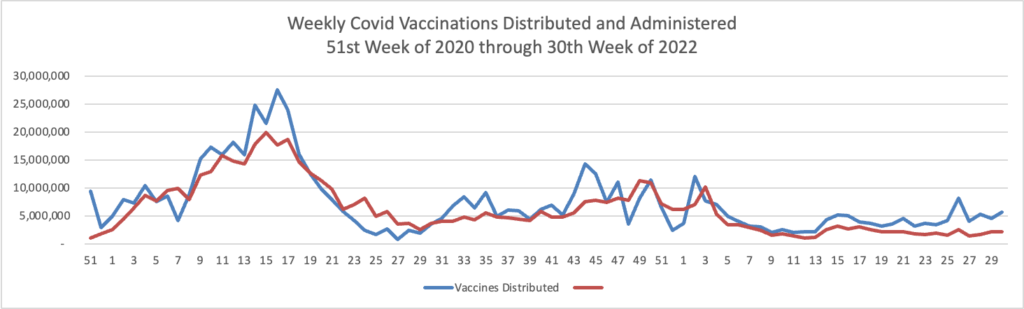
In the U.S., about 90.6 million Covid-19 doses have been wasted, or 11.9% of the more than 762 million Covid-19 vaccine doses delivered since the shots became available in late 2020, according to the Centers for Disease Control and Prevention.

The wastage rate has accelerated recently: Some 12 million of the discarded doses have been thrown out since late May.

The disposals come during a significant drop in demand for Covid-19 vaccines, even with young children recently becoming eligible. The seven-day moving average of doses administered daily in the U.S. was about 155,000 as of June 21, down from about 1.1 million on Jan. 1 and the peak of about 3.5 million daily in April 2021.

Partly driving the wastage, health experts said, is the way the Covid-19 vaccines are packaged in multiuse vials containing from five to 20 doses. Once opened, the vials generally must be used within about 12 hours of opening or the remaining doses discarded.

From the telehealth front

Healthcare Dive reports

COVID-19 made its way back into the top five telehealth diagnoses nationally on Fair Health’s monthly tracker in April for the first time since January, according to the report out Wednesday.

Every U.S. census region except the South saw COVID-19 return to the top five diagnoses list, and the uptick is in line with rising cases reported in April by the Centers for Disease Control and Prevention.

Telehealth use overall also rose nationally and in every region after two months of decline, the report found.

Fierce Healthcare informs us

Teladoc is further building out its primary care offering, Primary360, with new services that enhance care coordination and grow in-home options.

Primary360 will now provide care coordination support and health plan in-network referrals alongside free same-day medication delivery from Capsule and in-home, on-demand phlebotomy services backed by Scarlet Health, according to an announcement Wednesday from Teladoc.

The new care coordination capabilities will allow Primary360’s care team to take a “holistic” view of the patient’s coverage and make streamlined referrals to Teladoc services they can access. The care team can also then ensure a patient is referred to an in-network provider when in-person services are necessary.

mHealth Intelligence reports “The burgeoning mental health epidemic in America is widespread across age groups, but the youth have faced a particularly challenging time amid the COVID-19 pandemic. As the youth mental health crisis reaches new heights, providers are increasingly turning to telehealth to help expand access to behavioral healthcare.”

In the same spirit, Health Data Management discusses best practices for hospitals interested in providing acute care at home services.

From the U.S healthcare front, Beckers Hospital Review calls our attention to the fact that “Money, formerly Money Magazine, and Leapfrog Group collaborated for their first shared ranking of “best hospitals” to help consumers make decisions about which healthcare institutions are best for their money. The inaugural list was released July 6 and can be found in full here.” Check it out.

From the fraud, waste and abuse front, Healthcare Dive reports

The federal government won or negotiated more than $5 billion in healthcare fraud judgments and settlements in its 2021 fiscal year, the largest amount ever in the history of the HHS and Department of Justice’s fraud and abuse enforcement program.

Due to those and other efforts from previous years, the government clawed back almost $1.9 billion, according to a new report from the departments.

Of that $1.9 billion, about $1.2 billion went to the Medicare trust funds, which are on increasingly precarious financial footing due to growing stress on the insurance program. In addition, roughly $99 million in federal Medicaid money was transferred back to the CMS.

 Finally, Govexec brings us up to date on projections for 2023 annual raises for federal employees.

President Biden and House appropriators seem thus far to be in agreement that federal employees should receive an average 4.6% pay raise next year, but there are still several steps officials must take before it can be implemented at the end of the year. * * *

On Capitol Hill, there are still a few opportunities for federal employee groups and some lawmakers to try to increase the raise to the average 5.1% figure they have been advocating for.

Monday Roundup

Photo by Sven Read on Unsplash

From Capitol Hill, Federal News Network discusses the federal employee pay raise angles presented by the House financial service and general appropriations bill which cleared the House Appropriations Committee last Friday. Federal News Network indicates that the bill leaves the door open for the Senate to also accept the President’s proposed 2023 4.6% pay raise for federal employees and the military.

From the Dobbs case front, Govexec.com reports

President Joe Biden announced two actions immediately after the ruling: one directing the Department of Health and Human Services to safeguard access to contraception and medication abortion, and another protecting travel for medical appointments.

To those ends,

  • Govexec tells us that OPM today confirmed that its policy allowing federal employees to apply sick time to travel out of state remains in effect after the high court struck down Roe v. Wade, and
  • The Department of Health and Human Services (HHS) announced that a meeting was held today between Affordable Care Act regulators, including the HHS and Labor Department Secretaries, and health plan executives to emphasize the importance of full compliance with the ACA’s contraceptive coverage with no cost-sharing mandate when delivered in-network. The ACA regulators also issued a letter to health plans making the same point.

The FEHBlog ran across this NPR Shots article which explains that the Plan B or morning-after pill is considered a contraceptive and not an abortion drug. The Wall Street Journal informs us

Some of the nation’s biggest retailers are rationing over-the-counter emergency contraceptive pills as demand spikes following the Supreme Court ruling overturning a constitutional right to abortion.CVS Health Corp.,  Walmart Inc., and Rite Aid Corp. were limiting purchases of the pills, which were in short supply or out of stock Monday morning on major retailer websites. CVS and Rite Aid were limiting purchases to three. Walmart had some pills available without limits, but only in cases where they wouldn’t ship until next month. Pills available this week were limited to four or six.

From the Omicron and siblings and monkeypox front

  • Govexec reports on a U.S. Court of Appeals for the Fifth Circuit decision order rehearing a federal employee vaccine mandate case which upheld the mandate on lack of plaintiffs’ standing to challenge the mandate. The mandate nevertheless has remained on hold while the case winds it way through the appellate court.
  • USA Today reports on when and how to access the monkeypox vaccine.

From the Medicare front, HHS announced

a new model aimed at improving cancer care for Medicare patients and lowering health care costs. CMS’ Center for Medicare and Medicaid Innovation (Innovation Center) designed the Enhancing Oncology Model (EOM) to test how to improve health care providers’ ability to deliver care centered around patients, consider patients’ unique needs, and deliver cancer care in a way that will generate the best possible patient outcomes. The model will focus on supporting and learning from cancer patients, caregivers, and cancer survivors, while addressing inequities and providing patients with treatments that address their unique needs.

From the reports and studies department —

  • The next issue of Health Affairs offers a bevy of articles on Type 2 diabetes and pre-diabetes which are available at this link.
  • The Congressional Budget Office has made available examples of the work performed by its Health Analysis Division.
  • HealthDay reports “More than 18 million Americans have now survived cancer, a new report shows. The American Cancer Society (ACS) and the U.S. National Cancer Institute collaborated on the report to estimate cancer prevalence and help public health officials better serve survivors.”
  • mHealth Intelligence calls our attention to a telehealth-oriented  Healthcare Experience Report: 2022 released by Zocdoc. The FEHBlog was pleased to read “Mental health continues to hold a place of dominance in telehealth. In May of 2020, 2021, and 2022, the percentage of mental health visits that occurred virtually was 74 percent, 85 percent, and 87 percent, respectively.” Hub and spoke telehealth, e.g, Teladoc, brings mental health care in-network thereby lowering benefit costs while improving access to care.

Happy First Day of Summer 2022

Thanks to Aaron Burden for sharing their work on Unsplash.

From Capitol Hill, the Hill reports

The Senate voted 64 to 34 Tuesday evening to advance an 80-page gun safety bill to strengthen background check requirements for gun buyers under 21, provide funding to states to administer red flag laws and to provide billions of dollars in new federal funding for mental health services.  * * *

Senate Majority Leader Schumer (D-N.Y.) said a successful initial procedural vote would set the bill up to pass by the end of the week.  

Last week, a House Appropriations subcommittee approved the Fiscal Year 2023 Financial Services and General Government Appropriations bill, which funds OPM and the FEHB Program. The accompanying bill summary points out

  • Office of Personnel Management (OPM) – The bill includes $448 million, an increase of $75 million above the FY 2022 enacted level, for OPM to manage and provide guidance on Federal human resources and administer Federal retirement and health benefit programs.
  • Fosters equality for women and men: Eliminates provisions preventing the FEHBP from covering abortion services.

The House Appropriations Committee will mark up this bill at a meeting scheduled for Friday, June 24.

The U.S. Supreme Court today issued a 7-2 decision holding that the Medicare Secondary Payer law does not permit healthcare providers to make disparate impact claims against health plans. This decision protects ERISA and FEHB Program plans against costly litigation. Fierce Healthcare and Health Payer Intelligence also report on the decision.

From the Omnicron and siblings front —

MedPage Today informs us

Most people who have been infected with COVID-19 in the U.S. in the past couple of months likely had the BA.2 or BA.2.12.1 variant, both lineages of the original Omicron strain of SARS-CoV-2.

Now, BA.4 and BA.5 are here, and they’re starting to make up a larger proportion of U.S. cases.

So if someone was recently infected with a BA.2 lineage, are they mostly protected against reinfection with BA.4 or BA.5?

Probably not, infectious disease experts say.

“It’s expected that there’s probably not much cross-protection between them,” Amesh Adalja, MD, an infectious disease physician at the Johns Hopkins Center for Health Security in Baltimore, told MedPage Today.

The American Hospital Association tells us

More than 1 million prescriptions for the COVID-19 antiviral pills Lagevrio and Paxlovid were dispensed between late December 2021 and May 2022, but dispensing rates were lowest in the most socially and economically disadvantaged communities, according to a study released today by the Centers for Disease Control and Prevention. In a separate study of electronic health records from Kaiser Permanente Southern California over the period, fewer than 1% of patients aged 12 and older who received Paxlovid to treat mild-to-moderate COVID-19 had a COVID-19-related hospitalization or emergency department visit in the next five to 15 days. CDC said the studies “highlight the importance of ensuring access to oral antiviral medicine in treating COVID-19, a key strategy in preventing hospitalization and death.”

Speaking of hospitals, Beckers Hospital Review reports

Healthgrades has recognized 399 hospitals as recipients of its 2022 Outstanding Patient Experience Award, the organization said June 21. This represents the top 15 percent of hospitals in the U.S. for patient experience.  * * * Healthgrades has recognized 399 hospitals as recipients of its 2022 Outstanding Patient Experience Award, the organization said June 21. This represents the top 15 percent of hospitals in the U.S. for patient experience.  * * * View the full list of recipients here

From the Rx coverage front —

  • The Food and Drug Administration released one of its news roundups today.
  • Per Stat News, a group of researchers writing in the Annals of Internal Pharmacy used Mark Cuban’s online pharmacy pricing to puncture Medicare Part D’s pricing on generic drugs.
  • Per Fierce Healthcare, CVS Health is expanding its Project Health program to Richmond, Virginia and Las Vegas. “The healthcare giant announced Tuesday that it will hold 72 events dedicated to seniors and children this year. It is also adding four new mobile units in 2022.”
  • Per Healthcare Dive, Walgreens “has partnered with managed care company Buckeye Health Plan in Ohio to open new Health Corner locations in five of the state’s northeast neighborhoods this summer. * * * About 2.3 million patients will have access to Health Corner services across 60 locations in Ohio, California and New Jersey by the summer’s end, Walgreens said on Tuesday. By the end of this year, Walgreens expects to increase the number of Health Corners from 55 to about 100, including the new Ohio locations.”

From the interoperability and telehealth fronts

  • Epic, the largest purveyor of electronic health record systems in the U.S., announced “its plan to join a new health information exchange framework to improve health data interoperability across the country. The Trusted Exchange Framework and Common Agreement (TEFCA) will bring information networks together to help ensure that all people benefit from complete, longitudinal health records wherever they receive care. In the future, TEFCA will expand to support use cases beyond clinical care, such as public health.” That’s a big boost for TEFCA, which will serve as the backbone for the nation’s EHR systems.
  • AHRQ offers research on telehealth for women’s preventive healthcare services.

Finally, STAT News reports

President Biden will soon nominate Arati Prabhakar, a physicist and former DARPA director, to serve as his next top science adviser, the White House announced on Tuesday.

If confirmed by the Senate, Prabhakar would replace the genomics researcher Eric Lander, who resigned as the head of the White House science office in February amid a workplace-bullying scandal.

The new post would be Prabhakar’s third tour as head of a federal science office. She ran DARPA, the high-stakes military research agency, from 2012 to early 2017, and served as director of the National Institute of Standards and Technology in the 1990s.

Tuesday’s Tidbits

Photo by Patrick Fore on Unsplash

From the Omicron and siblings front, MedPage Today reports

A committee of independent vaccine experts recommended that the FDA grant an emergency use authorization (EUA) for the two-dose Moderna COVID-19 vaccine for kids ages 6 to 17 years.

The Vaccines and Related Biological Products Advisory Committee (VRBPAC) voted 22-0, agreeing unanimously that the benefits of vaccination outweigh the risks in two age groups: kids ages 6 to 11 years and teens ages 12 to 17. They recommended two 50-mcg doses for the younger kids and two 100-mcg doses for teens.

The Wall Street Journal adds

The FDA will consider the vote in making a final decision on whether to clear the vaccine for use in children 6 years and older. * * * An FDA authorization could come within days. It would open the use of Moderna’s vaccine to children for the first time in the U.S., and give anyone still intending to inoculate their children 6 years and older against Covid-19 a second option.

Medpage Today also informs us

Only a very small number of high-risk patients with COVID-19 experienced “rebound symptoms” after being treated with nirmatrelvir/ritonavir (Paxlovid), a retrospective study found.

Among nearly 500 patients, 93% of whom were fully vaccinated, two patients were hospitalized due to symptoms that were not directly related to “rebounding” within a month and required care in the intensive care unit (ICU), and four experienced rebound symptoms at a median of 9 days (interquartile range [IQR] 7-14.5), reported Nischal Ranganath, MD, PhD, of the Mayo Clinic in Rochester, Minnesota, and colleagues.

All rebound symptoms were resolved with symptom-directed treatment, and no deaths were reported in any patients after 30 days following their initial COVID-19 diagnosis, the group noted in Clinical Infectious Diseases.

“We found that rebound phenomenon was uncommon in this group of patients,” said co-author Aditya Shah, MBBS, also of the Mayo Clinic, in a statement. “The four individuals who experienced rebound represent only 0.8% of the group, and all of them recovered quickly without additional COVID-directed therapy.”

That’s certainly good news to read.

From the Rx coverage front, the Drug Channels blog tears apart a recent JAMA study concluding that the pricing of recently launched drugs has skyrocketed in recent years.

[T]he study’s headline conclusion is highly misleading. The authors obscure the real story with mathematical sleight-of-hand that misrepresents the underlying data and overlooks the true nature of today’s pharmaceutical innovations. 

Most notably, the authors discount the fact that the most expensive new drugs treat ultra-rare conditions affecting extraordinarily small patient populations. Their policy recommendations would therefore have a devastating impact on these patients and their hope for treatments and cures. 

As Nobel prize winner Ronald Coase observed: “If you torture the data long enough, it will confess to anything.”

And the Dr. Fein can back up his conclusion.

From general healthcare front, Kaiser Health News offers thought provoking articles about

The first article draws an important distinction between medical care and SDOH. Unfortunately, the second article reminds us that no good deed goes unpunished. If the government simply had relied on personal responsibility (outside of Medicaid), we would not find ourselves in this pickle.

Monday Roundup

Photo by Sven Read on Unsplash

From the Omicron and siblings front, the Wall Street Journal reports

A Covid-19 vaccine developed by Sanofi SA and GSK PLC to target the Beta strain of the virus produced a stronger antibody response against variants of Omicron when given as a booster compared with certain first-generation shots, two studies have found.

The results are the latest indication that tweaking vaccines can nudge antibody responses in the direction of new variants, possibly helping to shore up immunity as the virus mutates. The study results may also provide an opportunity for Sanofi and GSK, two vaccine giants that were late to develop Covid-19 immunizations, to play a role in providing booster shots.

What’s more, according to the Journal

A panel of advisers to the Food and Drug Administration is set to meet Tuesday [June 14] to consider whether use of Moderna Inc.’s Covid-19 vaccine should be expanded to include children ages 6 through 17.

The advisory committee is expected to vote Tuesday afternoon on whether the benefits of vaccinating children in this age group outweigh the risks. The FDA will consider the vote in making a final decision on whether to clear the vaccine for use in children 6 years and older.

An FDA authorization could come within days. It would open the use of Moderna’s vaccine to children for the first time in the U.S., and give anyone still intending to inoculate their children 6 years and older against Covid-19 a second option.

Moderna’s vaccine has been authorized for use in adults 18 years and older since late 2020, while use of the other leading Covid-19 vaccine, from Pfizer Inc. and BioNTech SE, was expanded to anyone 5 and older last year.

From the FTC investigation front, FierceHealthcare updates us on the recently launched FTC investigation of the six largest PBMs. In other FTC news, Healthcare Dive tells us

** UnitedHealth and LHC Group have been hit by a request for additional information on their acquisition from the Federal Trade Commission, as regulators take an increasingly active role in overseeing healthcare M&A.

** The second request extends the waiting period the FTC has to challenge the deal. UnitedHealth agreed to acquire home health and hospice provider LHC for $5.4 billion in March.

** https://www.healthcaredive.com/news/regulators-unitedhealth-lhc-request-merger/625343/?utm_source=Sailthru&utm_medium=email&utm_campaign=Issue:%202022-06-13%20Healthcare%20Dive%20%5Bissue:42394%5D&utm_term=Healthcare%20DiveIn a filing with the SEC on Friday, the companies said they have been complying with regulators and will continue to do so.

Speaking of home health care, Home Health News discusses Aetna’s interest in the topic.

Aman Gill, Aetna’s director of product strategy and innovation, told Home Health Care News last month that a home health acquisition was “on the table” for the company. 

This past week, at HHCN’s VALUE event, Aetna CMO Dr. Kyu Rhee reiterated the company’s commitment to the home as a setting of care. He also explained how care delivery has changed over the course of the last few years.

“We’ve been committed to home health and virtual care during the pandemic,” Rhee said. “And in our Medicare program, we’ve delivered tens of thousands of healthy at-home visits as well. … So my challenge to us as we think about the opportunity we have now and the next stage of this pandemic is: Are we going to persist in those values and make sure that the system delivers on those values, that hopefully we’ve learned over the last couple of years?”

From the Rx coverage front, the Food and Drug Administration announced

the [agency approved Olumiant (baricitinib) oral tablets to treat adult patients with severe alopecia areata, a disorder that often appears as patchy baldness and affects more than 300,000 people in the U.S. each year. Today’s action marks the first FDA approval of a systemic treatment (i.e. treats the entire body rather than a specific location) for alopecia areata.

“Access to safe and effective treatment options is crucial for the significant number of Americans affected by severe alopecia,” said Kendall Marcus, M.D., director of the Division of Dermatology and Dentistry in the FDA’s Center for Drug Evaluation and Research. “Today’s approval will help fulfill a significant unmet need for patients with severe alopecia areata.”

The drug initially was FDA-approved for the treatment of rheumatoid arthritis in 2018.

From the HIPAA Privacy Rule front, the U.S. Department of Health and Human Services (HHS), through its Office for Civil Rights (OCR), announced

issuing guidance on how covered health care providers and health plans can use remote communication technologies to provide audio-only telehealth services when such communications are conducted in a manner that is consistent with the applicable requirements of the Health Insurance Portability and Accountability Act of 1996 (HIPAA) Privacy, Security, and Breach Notification Rules, including when OCR’s Notification of Enforcement Discretion for Telehealth – PDF is no longer in effect. * * *

The Guidance on How the HIPAA Rules Permit Health Plans and Covered Health Care Providers to Use Remote Communication Technologies for Audio-Only Telehealth may be found at: https://www.hhs.gov/hipaa/for-professionals/privacy/guidance/hipaa-audio-telehealth/index.html.