Friday Stats and More

Friday Stats and More

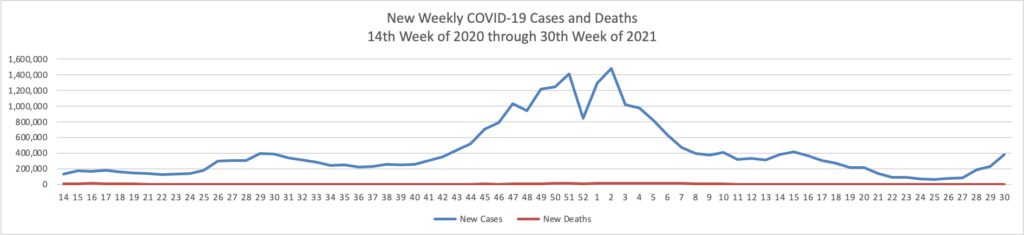
Based on the CDC’s Cases in the U.S. website, here is the FEHBlog’s chart of new weekly COVID-19 cases and deaths over the 20th through 37th weeks of this year (beginning May 14 and ending September 16; using Thursday as the first day of the week in order to facilitate this weekly update):

and here is the CDC’s latest overall weekly hospitalization rate chart for COVID-19:

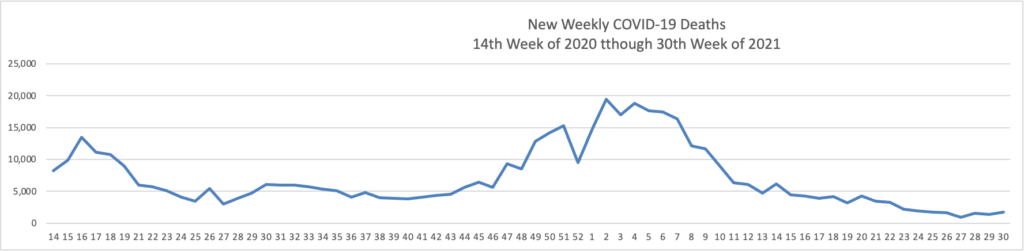
Because the FEHBlog does look at his charts which are intended to show trends, he realized that new deaths chart is flat because new cases greatly exceed new deaths. Accordingly here is a chart of new COVID-19 deaths over the same period (May 14 through September 16 (basically four months).

In other COVID-19 news:

  • The Wall Street Journal reports

U.S. hospitals expect to be better prepared if a second wave of Covid-19 cases hits in coming months, doctors and administrators say, after gaining a better understanding how to triage patients, which drugs to use and what supplies are needed. When the new coronavirus first struck, beds filled up at record speed, ventilators were in short supply and proven treatments were scant. Since then, doctors say, they have developed a better understanding of who needs a ventilator and how quickly a patient can be discharged, and studies have pointed to a few drugs like the antiviral remdesivir and the steroid dexamethasone that can help

The FEHBlog heartily agrees that the country is better prepared but he believes that the Journal is assuming facts not in evidence when it speaks about a second wave because we really are still in the first wave.

  • Medscape offers an MD’s perspective on the leading COVID-19 vaccine candidates.
  • The Wall Street Journal reports that the Centers for Disease Control withdrew last month’s highly criticized advice that people who had contact with asymptomatic COVID-19 patients don’t need a COVID-19 test. “The Sept. 18 updated recommendation now says that close contacts of a person with a confirmed Covid-19 infection need a test even in the absence of symptoms. The changes were described as a clarification, rather than a revision, on the CDC website.”
  • Speaking of COVID-19 testing, Mercer Consulting offers advice on how to cover COVID-19 testing which Congress made unnecessarily complicated.

In other news,

  • Govexec.com reports that “House Democrats are preparing to vote [next week] on a six-week stopgap spending bill that would keep agencies open through Dec. 11, according to Democratic aide.” From reading the article, it looks like the continuing resolution which is not fully backed will be enacted thereby avoiding what would be the craziest government shutdown in American history.
  • Speaking of criticism, Fierce Healthcare reports that “the American Academy of Family Physicians, which represents about 135,000 physicians, said the recommendations miss the mark and skew toward virtual-only telehealth vendors and large medical systems with established telehealth infrastructure. The task force’s report doesn’t address the needs of independent practices that need guidance, support and payment advocacy, wrote Stephanie Quinn, AAFP senior vice president of advocacy, practice advancement and policy in a blog post Tuesday.” The most encouraging tele heath acceleration that the FEHBlog witnessed during the great hunker down is patients holding telehealth visits with their own doctors. That FEHBlog agrees with AAFP that this trend that should be strongly encouraged.
  • Healthcare Dive reports that “Privately insured patients pay 247% more at hospitals on average than Medicare patients for the same care, according to a new study by nonprofit think tank RAND. The study, based on 2018 data, shows the gap is increasing from 2017 and 2016, which saw disparities of 230% and 224%, respectively. If private payers had paid Medicare rates over the three-year study period, they would have saved $19.7 billion, RAND determined. The study could provide fodder for proponents of a government-run public option, a key tenet of Democratic presidential nominee Joe Biden’s healthcare agenda, which — like Medicare — would negotiate prices with hospitals and other providers.

Hey, Healthcare Dive, in contrast to health plans which do negotiate with healthcare providers Medicare imposes prices on providers. Government price fixing leads to disparities like this and it’s far from a good thing.

Thursday Miscellany

Photo by Juliane Liebermann on Unsplash

Healthcare Dive informs us about the American Hospital Association’s reaction to yesterday’s final FY 2020 inpatient prospective payment system rule.

The American Hospital Association quickly criticized the price transparency element of the final rule Wednesday night.

“By continuing to focus on negotiated rates rather than expanding access to a patient’s out-of-pocket costs, the Administration fails to meet the goal it set for itself — assisting consumers in becoming more prudent purchasers of health care,” the group said in a statement. “We once again urge the agency to focus on what is really important to patients — ready access to their out-of-pocket costs.”

Evidently, the hospitals seek to dump the entire transparency burden on the health plans. The FEHBlog thinks that consumers would better informed by requiring hospitals and all providers to publicly announce the health plan network(s) in which they participate, an analog to the summary of benefits and coverage that health plans must distribute to members.

Speaking of comparison tools, the Centers for Medicare and Medicaid Services today launched

Care Compare, a streamlined redesign of eight existing CMS healthcare compare tools available on Medicare.gov. Care Compare provides a single user-friendly interface that patients and caregivers can use to make informed decisions about healthcare based on cost, quality of care, volume of services, and other data. With just one click, patients can find information that is easy to understand about doctors, hospitals, nursing homes, and other health care services instead of searching through multiple tools.

CMS notes that “Although the tool was created for people with Medicare in mind, many of the measures shown here apply to people who may not have Medicare. Information on this site isn’t an endorsement or advertisement for any provider type.”

Speaking of FY 2020, the Hill reports

Treasury Secretary Steven Mnuchin and Speaker Nancy Pelosi (D-Calif.) have informally agreed to pursue a clean, short-term stopgap measure to avert a government shutdown at the end of the month, sources in both parties confirmed Thursday. That means the continuing resolution (CR) needed to keep the government open past Sept. 30 would be free of controversial policy riders that have bogged down previous funding bills, significantly lowering the odds of a shutdown leading up to the crucial Nov. 3 elections.

That my friends is good news for the country.

In other news —

  • The Wall Street Journal brings us up to date on the cost, accuracy, and turnaround times for popular (?) COVID-19 testing methods.
  • The Department of Human Services released an action plan for improving rural healthcare in the United States.
  • Beckers Hospital Review reports that Walmart will be bringing Oak Health primary care centers into their super centers located in Arlington, Benbrook and Carrollton, Texas, later this year.
  • HR Dive discusses recent back to school guidance from the Labor Department regard the federal relief acts COVID-19 paid leave program. It’s complicated just like COVID-19.

Midweek update

Section 1557 is the individual non-discrimination provision of the Affordable Care Act. In June 2020, the Department of Health and Human Services issued a final rule making numerous changes to the Obama Administration’s rule. Both rule makings sparked lawsuits challenging their legality.

Last time around, the lead case, Franciscan Alliance v. HHS, was filed in the Northern District of Texas. That case is still pending on appeal before the U.S. Court of Appeals for the Fifth Circuit.

This time around, the lead case, Whitman-Walker Clinic v. HHS, was filed in Washington, D.C. Roughly one month following oral argument in the case, U.S. District Judge James Boasberg this afternoon denied the plaintiffs’ motion for a preliminary injunction against enforcement of HHS’s revised Section 1557 rule with two exceptions:

  • The Court preliminarily enjoined the revised rule’s repeal of the sex discrimination definition found in the replaced Obama Administration rule. That definition afforded express protection to transgendered people.
  • The Court also preliminarily enjoined the revised rule’s religious organization exception to the law’s sex discrimination restrictions.

Here is a link to the lengthy yet illuminating opinion and the implementing order. The decision called to the FEHBlog’s attention another interesting civil rights provision of the ACA — Section 1554. This provision places limits on the HHS Secretary’s broad reaching regulatory powers under the ACA.

Judge Boasberg’s decision expands on the Brooklyn federal court decision issued August 17, 2020, that stayed enforcement of the sex discrimination definition repeal. While the federal government has not appealed the Brooklyn decision, the plaintiffs in the FEHBlog’s opinion are likely to appeal the denial of their preliminary injunction motion in the Whitman-Walker Clinic case. And so it goes.

The Centers for Medicare and Medicaid today released its final Medicare Part A inpatient prospective payment system rule for the government fiscal year beginning October 1, 2020.

The increase in operating payment rates for general acute care hospitals paid under the IPPS that successfully participate in the Hospital Inpatient Quality Reporting (IQR) Program and are meaningful electronic health record (EHR) users is approximately 2.9 percent. This reflects the projected hospital market basket update of 2.4 percent and a 0.0 percentage point productivity adjustment. This also reflects a +0.5 percentage point adjustment required by legislation.

Hospitals may be subject to other payment adjustments under the IPPS, including:

— Penalties for excess readmissions, which reflect an adjustment to a hospital’s performance relative to other hospitals with a similar proportion of patients who are dually eligible for Medicare and full-benefit Medicaid
— Penalty (1 percent) for worst-performing quartile under the Hospital-Acquired Condition Reduction Program
— Upward and downward adjustments under the Hospital Value-Based Purchasing Program

Medicare is one complicated program. Medicare is relevant to the FEHBP because the program impact the prices that FEHB plans pay for patient care and there is a large cadre of annuitant enrollees with Medicare Part A coverage.

In other healthcare related news —

  • Reuters reports that “President Donald Trump said on Tuesday he planned to meet with pharmaceutical companies this week regarding his so-called most- favored-nation executive order aimed at lowering drug prices paid by the U.S. federal government.”
  • STAT News reports that

A new analysis of several studies in which [inexpensive] steroid drugs were used to treat severely ill Covid-19 patients found the drugs significantly helped reduce patient deaths, bolstering earlier, preliminary evidence for the benefit of these medications. In multiple studies involving a total of 1,700 patients, a number of corticosteroids—anti-inflammatory drugs that can damp the effects of an overactive immune system—helped reduce deaths from Covid-19 by about a third, compared with patients who didn’t receive steroids, according to the analysis published Wednesday in the Journal of the American Medical Association.

  • HHS’s Office for Civil Rights, which enforces the HIPAA Privacy and Security Rules, has created a consolidate website regarding HIPAA and Health Apps. The site includes links to generally helpful technical information on cloud computing and HIPAA and HIPAA and health IT. Check it out.

Midweek Update

It’s another rainy night in Bethesda.

Fierce Pharma reports that “the U.S. has ordered 800 million doses [of various COVID-19 vaccines currently in phase 3 testing] for a country with a population of about 330 million, likely under the assumption that some vaccines won’t make it through clinical testing. The government is “assembling a broad portfolio of vaccines to increase the odds that we will have at least one safe, effective vaccine as soon as the end of this year,” HHS secretary Alex Azar said in a statement.”

The Wall Street Journal informs us that

Doctors, nursing homes and federal officials are scrambling to get rapid-response Covid-19 antigen testing supplies from the two companies that secured emergency approval to produce them, as cases continue to rise in the U.S.

Rapid-response antigen tests make up a small but growing area of Covid-19 testing in the U.S. and are seen as helpful in tamping down outbreaks because they offer faster results than many molecular tests that must be sent to labs for processing. The tests search for virus proteins while other tests look for the virus’s genetic material.

Quidel Corp. QDEL 4.36% and Becton Dickinson & Co., the only companies that so far have federal emergency authorization to supply such diagnostic tests, also make machines that process them. The boxlike test-analyzers, which before the pandemic processed tests for ailments such as the flu, are found in doctors’ offices and nursing homes, allowing facilities to avoid shipping samples to commercial labs for processing. They can deliver results in about 15 minutes and process dozens of samples an hour.

Quidel is struggling to produce enough analyzers to meet demand, while Becton Dickinson’s challenge is making enough tests, the companies say. * * *

Public health officials have raised some concerns that rapid antigen tests deliver false-negative results at a higher rate than other tests. But federal officials have said that, as these tests become more widespread, they appear equal in sensitivity to the more broadly used polymerase chain reaction diagnostic tests.

Perhaps Kodak can help (FEHBlog humor).

Fierce Healthcare lets us know that “According to the J.D. Power 2020 U.S. Pharmacy study, the expansion of pharmacy companies into the primary care realm has driven ‘significant increases in both satisfaction and consumer spending.'” On a related note, Forbes reports that “CVS Health is back on track with the rollout its new health hub concept to 1,500 stores across the U.S. within the next two years despite the continuing spread of the coronavirus strain Covid-19. CVS Health currently has 205 HealthHubs opened in 22 states. “CVS HealthHubs dedicate more than 20% of the store to health services that include new durable medical equipment, supplies and various new product and service combinations. CVS is adding thousands of new personal care items as well as additional services at its MinuteClinics in the HealthHub stores.”

The Centers for Medicare and Medicaid Services announced today its proposed national coverage decision that would allow local Medicare administrative contractors to make the initial decision on whether to cover an artificial heart or a ventricular assist device for Medicare beneficiaries with end stage heart disease. Currently the devices are treated as experimental treatments that CMS can cover on an exception basis. The CMS announcement explains that 6.5 million Americans “are living with heart failure.” A CMS decision whether or not to finalize the proposal will be made within 60 days following the end of the 30 day public comment period which began today.

Earlier this week the Centers for Disease Control announced their “Hear Her” campaign to reduce maternal mortality.

Over 700 women die each year in this country from problems related to pregnancy or delivery complications. Every death is a tragedy, especially when we know that two thirds of pregnancy-related deaths could be prevented. As many as 50,000 women experience severe, unexpected health problems related to pregnancy that may have long-term health consequences.

CDC’s Division of Reproductive Health is committed to healthy pregnancies and deliveries for every woman. The Hear Her campaign supports CDC’s efforts to prevent pregnancy-related deaths by sharing potentially life-saving messages about urgent warning signs.

Women know their own bodies better than anyone and can often tell when something does not feel right. The campaign seeks to encourage partners, friends, family, coworkers, and providers—anyone who supports pregnant and postpartum women—to really listen when she tells you something doesn’t feel right. Acting quickly could help save her life.

How true. This campaign deserves support from health plans as well as healthcare providers.

Tuesday Tidbits

The U.S. Office of Personnel Management today announced the companies that were awarded FEDVIP contracts for a seven year term beginning January 1, 2021. OPM added two new dental carriers — UnitedHealthCare (nationwide) and HealthPartners (regional) for a total of twelve dental carriers. OPM added one new vision carrier — MetLife (all vision plans are nationwide) — for a total of five vision carriers beginning next year.

The Centers for Medicare and Medicaid Services announced an initiative to “transform rural health.” Healthcare Dive explains

CMS’s new payment model for rural hospitals and accountable care organizations that will use upfront and capitated payments. Participating facilities will be able to waive cost-sharing for Medicare Part B services, provide transportation for beneficiaries and expand telehealth services, among other flexibilities.

The Community Health Access and Rural Transformation model has two tracks, one of which is focused on ACOs. In the other track, $75 million will be provided to lead organizations in 15 rural communities, which will be announced early next year with a planned start of the model next summer.

The lead organizations, which can be state Medicaid agencies, local health departments or academic medical centers, among others, will receive $2 million after being accepted and another $3 million in upfront funding as the model progresses.

Fierce Healthcare discusses Teladoc’s acquisition of Livongo which was announced Wednesday August 5. “The combination of two of the largest publicly-traded virtual care companies announced Wednesday will create a health technology giant just as the demand for virtual care soars.” However,

Both companies’ stock dropped Wednesday after news of the deal broke. Teladoc’s stock was down 15% and Livongo’s stock also fell by 14%. As of Thursday, both companies’ stock was still trading lower.

Analysts say the total deal price of $158.99 per share represents a 10% premium over Livongo stock’s record closing price of $144.53 as of Aug. 5, leading to the market pushback on the high valuation.

The Drug Channels blog offers its useful annual update “on pricing at five of the largest pharmaceutical manufacturers—Eli Lilly, Janssen, Merck, Novartis, and Sanofi.” Drug Channels finds that

Average discounts from [prescription drug manufacturer] list prices have been deepening.Merck’s average discount rate went from -41% in 2016 to -44% in 2019, while Lilly’s rate went from -50% to -57%. We estimate that in 2019, the total value of gross-to-net reductions for brand-name drugs was $175 billion. That figure has doubled over the past six years.

In other encouraging news, STAT News tells us about an experimental drug to treat coronaviruses like COVID-19.

A research team at the University of California, San Francisco, has synthesized a molecule that they say is among the most potent anti-coronavirus compounds tested in a lab to date. Called nanobodies because they are about a quarter of the size of antibodies found in people and most other animals, these molecules can nestle into the nooks and crannies of proteins to block viruses from attaching to and infecting cells.
The lab-made one created by the UCSF team is so stable it can be converted into a dry powder and aerosolized, meaning it would be much easier to administer than Covid-19 treatments being developed using human monoclonal antibodies. While the work is still very preliminary, the goal is to deliver the synthetic nanobody via simple inhaled sprays to the nose or lungs, allowing it to potentially be self-administered and used prophylactically against Covid-19 — if it’s shown safe and effective in both animal tests and clinical trials.

Let’s go. This my friends is the difference between 1918 and 2020. We must have faith in medical research.

Finally the FEHBlog’s favorite podcast EconTalk provided a timely insight into Shakespeare’s Romeo and Juliet in this week’s episode. Journalist and author Ben Cohen talked about his book, The Hot Hand, with EconTalk host Russ Roberts. The Hot Hand concerns streaks. and Shakespeare wrote three of his most popular plays, including Romeo and Juliet, from 1605-1606 when London was suffering from the plague. What’s more,

The reason why Romeo doesn’t know that Juliet has taken this potion and that she is simply sleeping and not actually dead is because this whole harebrained scheme had not been explained to him because he never gets the [explantory] letter [that a messenger was tasked to bring him].

So, if you think about it, it’s really a bonkers plot line. The flyer says, ‘I will–Juliet, take this sleeping potion, it will knock you out. Your family will think you’re dead. When they think you’re dead, Romeo is going to come back and he’s going to sweep you away and take you and live happily ever after.’

Now, this is the stuff that like you wouldn’t even see on a reality show or some terrible soap opera now. And yet, it’s our most famous love story.

And so, why does it fall apart? She takes the sleeping potion, right? She gets knocked out. Her family thinks she’s dead. Romeo comes back and sees her in the open crypt. All of the crazy stuff [Romeo and then Juliet committing suicide] actually turns out–where the whole scheme falls apart–is simply on getting a letter to Romeo. And it falls apart because the plague is sweeping through and the messenger gets stuck in quarantine.

So, all of this is the plague.

Now that’s a 1605 twist that rings true nearly 400 years later.

Monday Roundup

The Wall Street Journal reports tonight that the Democratic House leadership and the White House are cautiously optimistic about achieving a compromise COVID-19 relief bill this week. The negotiations continue tomorrow.

The FEHBlog listened to the oral argument this afternoon over the Whitman-Walker Clinic’s motion for a preliminary injunction to stay the upcoming effective date of the newly revised HHS rule implementing the ACA’s individual non-discrimination clause, Section 1557. The Court focused the parties’ attention on the Constitutionally required standing of the Clinic and its co-plaintiffs to bring the case and the justiciability of the issue. The Court allowed the government defendants to submit a brief responding to the new case law support that the plaintiffs raised at the oral argument. That brief is due on August 10 a week before the rule takes effect on August 18. Associational standing is a complicated issue.

The President today signed a wide ranging executive order on improving rural health and telehealth access. Speaking of executive orders, Health Payer Intelligence reports that America’s Health Insurance Plan’s recently criticized the President’s recent executive order against pharmacy rebating practices because “Nothing in the proposed rule would require Big Pharma to lower their prices,” the payer organization stated, referring to the rebate rule. “Instead, it undermines competitive negotiations – a misguided approach that makes the problem of out-of-control drug prices worse.” That is indeed the rub.

On the COVID-19 front,

  • Fierce Biotech reports that “Eli Lilly has started a phase 3 trial to evaluate whether its antibody LY-CoV555 stops the residents of nursing homes from developing COVID-19. Lilly has created customized mobile research units to run the clinical trial at nursing homes as the long-term care facilities lack experience running studies.”
  • The FEHBlog’s dogs requested that after all of his compliments to the monkey community last week he should point out that a German study has found that specially trained dogs may be able smell the COVID-19 virus in saliva or other human bodily discharges.

In other healthcare news —

  • Healthcare Finance reports that the second House appropriations minibus appropriations bill passed last Friday includes a provision that would permit the government to fund work on the develop and promulgation of the HIPAA patient identifier rule.
  • Forbes reports that

Health insurer Humana said [last Wednesday July 29] it is investing $100 million in the in-home primary care company, Heal, to bring in-person physician “house calls and one-touch medicine” to seniors in its Medicare Advantage plans. Heal is a fast-growing startup company that offers primary care house calls on-demand and has delivered more than 200,000 home visits in the company’s first five years in eight U.S. markets. Heal’s services also include telemedicine, telepsychology and related digital monitoring services, which Humana says will be key for its elderly health plan subscribers.

  • Health Payer Intelligence informs us today that in reaction to CMS’s decision to open Medicare Advantage to Medicare beneficiaries under age 65 suffering from end stage renal (kidney) disease “Humana will be partnering with a chronic kidney disease management and awareness organization to provide home healthcare and care coordination to Medicare Advantage members. * * * The payer is partnering with REACH Kidney Care, a nonprofit affiliate of Dialysis Clinic, Inc., in order to provide better kidney care services in Alabama, North Carolina, South Carolina, and Tennessee.”

Midweek Update

FCW.com reports that “The Senior Executives Association, which represents members of the Senior Executive Service and other federal mangers, is looking for sweeping change to the government’s human resources organization and practice.” Here’s a link to a the SEA’s report titled “Transforming the Governance of Federal Human Capital Management.” Of note, check out their recommendation for the OPM group that manages our beloved FEHBP:

The Healthcare and Insurance enrollment function should be assessed to determine if there would be benefits to reengineering and/or outsourcing. The federal government already does this with its vision and dental program (FEDVIP), which is administered by BENEFEDS. Reengineering should, as needed, focus on customer service and cost savings through efficiency. The nation’s largest employers, such as Walmart, outsource their benefits administration, as do most private-sector organizations. Once reengineering is complete, service level agreement and transactional cost ratios should be established. OPM could then explore if it is an appropriate candidate for outsourcing. If it is determined that outsourcing is more effective, OPM should maintain policy oversight and HC data ownership and control.

It’s not the first time that the FEHBlog has heard this recommendation made.

On the innovation front —

  • The FEHBlog was wondering today what was going on with his preferred candidate for COVID-19 treatment, convalescent plasma. Wonder and you shall receive for the Wall Street Journal advises tonight that

The Food and Drug Administration is nearing a decision to authorize emergency use of antibody-rich blood plasma from recovered Covid-19 patients for treating people infected with the coronavirus, people familiar with the matter said. The authorization could come as soon as next week, according to the people, though the agency could also decide to delay a decision. The designation could open the way for faster and wider access to one of the most promising treatments for Covid-19 patients. Only a Gilead Sciences Inc. antiviral drug known as remdesivir [currently] carries the designation.

  • Employee Benefit News informs us that

CVS Health is expanding their voluntary benefits to tackle mental health and anxiety treatment with a new digital offering.

The company added Daylight, an app that uses cognitive behavioral therapy techniques to combat anxiety, to its Point Solutions Management lineup. Both employer clients and CVS employees will have access to the app.

CVS looked to one of its existing partners — Big Health, the makers of the digital sleep benefit, Sleepio — for its newest offering. Daylight uses AI to make personalized recommendations on therapy exercises for users experiencing anxiety and stress.

On the Medicare front —

  • The Centers for Medicare and Medicaid Services announced today that “The average basic Medicare Part D premium will be $30.50 in 2021. The 2021 and 2020 average basic premiums are the second lowest and lowest, respectively, average basic premiums in Part D since 2013. This trend of lower Part D premiums, which have decreased by 12 percent since 2017.” Of course, Medicare Part D covers outpatient prescription drugs.
  • Forbes reports that

Americans who depend on Medicare Part B are accustomed to a yearly cost increase for their coverage. The Senate Republican proposals for a second stimulus package would freeze 2021 Medicare Part B premiums at 2020 levels. Negotiations between Republican and Democratic leaders continue in Congress, with multiple potential provisions for a second stimulus package on the table. Both sides have indicated they would like to pass a new stimulus bill before Congress departs for a month-long break on Aug 7.

In other news —

  • The Department of Health and Human Services (“HHS”) released today the HHS Secretary’s Report on Addressing Surprise Billing. Here’s Healthcare Dive’s take on the report. “HHS on Wednesday prodded Congress to pass legislation that bans surprise medical billing but did not take on stance on the best method to do so or endorse any particular bill.”
  • HHS also released “a new report showing the dramatic utilization trends of telehealth services for primary care delivery in Fee-for-Service (FFS) Medicare in the early days of the coronavirus disease 2019 (COVID-19) pandemic. The report analyzes claims data from January through early June.” Here’s is Healthcare Dive’s take on that report. “Almost half — 43.5% — of all Medicare primary care visits were being conducted through telehealth in April. That’s up from just 0.1% in February.” Wow.
  • Finally, Federal News Network informs us that

Four months after Congress approved a $10 billion loan for the Postal Service under the CARES Act, the Treasury Department and USPS leadership have struck a deal on the terms of that loan. According to the terms of the loan, released by top Democrats in the House and Senate, USPS has agreed to give Treasury access to its biggest negotiated service agreements with industry partners. The Postal Service will have access to the loan to fund operating expenses until March 27, 2022, but Treasury won’t advance any of the funds if USPS has a cash balance of more than $8 billion. In addition, USPS has agreed to give Treasury monthly reports on its cash flow and year-over-year changes in volume for its major lines of business, as well as changes in revenue and expenses.

Tuesday Tidbits

Following up on last Friday’s and Sunday’s posts on the President’s executive orders on drug pricing, here for greater perspective is a link to a Fierce Healthcare article offering the positions of the health insurance and PBM industry trade associations’ positions on the orders. Essential Hospitals lets us know that the text of the fourth international pricing index executive order has not yet been made public.

The Wall Street Journal reports that “Eastman Kodak Co. has won a $765 million government loan under the Defense Production Act, the first of its kind. The purpose: to help expedite domestic production of drugs that can treat a variety of medical conditions and loosen the U.S. reliance on foreign sources. * * * Kodak’s loan has terms similar to a commercial loan and must be repaid over 25 years, [Kodak CEO Jim] Continenza said. He said Kodak will produce “starter materials” and “active pharmaceutical ingredients” used to produce generic medicines. “We have a long, long history in chemical and advanced materials—well over 100 years,” Mr. Continenza said. He added that Kodak’s existing infrastructure allows the company “to get up and running quickly.”

On the COVID-19 front —

  • Federal News Network informs us that

About 4,000 federal employees have filed workers’ compensation claims with the Labor Department due to COVID-19. 60 people have filed death claims. Labor projects COVID-19 claims among federal employees may reach 6,000 in the coming weeks. The department’s inspector general says the division that handles federal employee claims is anticipating a strain in resources due to demand and social distancing mandates. It has alternative staffing plans if COVID-19 compensation claims continue to surge. Labor says it’s accepted over 1,600 federal employees claims so far. Over 2,300 are unadjudicated.

  • The Society for Human Resource Management brings us up to date on the Senate majority’s new $1 trillion COVID-19 relief bill, the HEALS Act.
  • The Center for Medicare and Medicaid Services released “an early snapshot of the impact of the coronavirus disease 2019 (COVID-19) pandemic on the Medicare population. The data shows that older Americans and those with chronic health conditions are at the highest risk for COVID-19 and confirms long-understood disparities in health outcomes for racial and ethnic minority groups and among low-income populations.” A large cadre of the Medicare population of course is also enrolled in the FEHBP so this data is worth a gander.
  • The National Institutes of Health announced the successful results of a double blind study of the Moderna / NIAID COVID-19 vaccine on non-human primates / rhesus macaques. As noted yesterday that vaccine entered phase 3 human trials this week.

In other news —

  • Becker’s Hospital Review identifies the highest ranking hospital in each State as found in U.S. News and World Report.
  • NPR discusses two new studies suggesting that the risk of Alzheimer’s disease can be reduced by taking flu and pneumonia vaccines.
  • HHS’s Office for Civil Rights (“OCR”) which enforces the HIPAA Privacy and Security Rules announced that “Lifespan Health System Affiliated Covered Entity, a non-profit health system based in Rhode Island, has agreed to pay $1,040,000 to the OCR and to implement a corrective action plan to settle potential violations of the Health Insurance Portability and Accountability Act (HIPAA) Privacy and Security Rules related to the theft of an unencrypted laptop [thereby evidently allowing access to protected health information on over 20,000 patients in 2017].

Midweek Update

A House of Representatives appropriations subcommittee approved by voice vote today the bill funding financial services and general government for the 2021 fiscal year. That bill encompasses OPM and the FEHBP. Yesterday’s FEHBlog post discussed the relevant substance of the bill considered today. The bill now moves onto full appropriations committee consideration.

Fierce Healthcare reports that “Healthcare leaders and health IT groups are calling on Congress to repeal a section of the law that prevents the U.S. Department of Health and Human Services (HHS) from working with the private sector to develop a nationwide patient identification strategy.” The advocates are pointing to the COVID-19 emergency as another reason for taking this sensible action. ” Amid the COVID-19 pandemic, contact tracing efforts are hampered without accurate demographic information that correctly identifies the right patient.”

Also, on the COVID-19 front, the National Institutes of Health (“NIH”) announced today that “The National Institute of Allergy and Infectious Diseases (NIAID), part of the NIH, has established a new clinical trials network that aims to enroll thousands of volunteers in large-scale clinical trials testing a variety of investigational vaccines and monoclonal antibodies intended to protect people from COVID-19.”

The Wall Street Journal reports that

Drugmaker Emergent Biosolutions Inc. plans to work with Mount Sinai Health System in New York City to test whether a drug derived from the blood plasma of recovered Covid-19 patients can prevent infections in doctors, nurses and military forces. The proposed study, which the partners announced Wednesday, would add to efforts evaluating the coronavirus-fighting potential of experimental drugs made from plasma donated by recovered patients. If the drug proves to work safely, it could help protect health-care workers and other people working in essential jobs who are at high risk of infection until a vaccine is ready and perhaps even after.

On the general U.S. healthcare front Healthcare Dive reports that

Walgreens on Wednesday announced plans to open up to 700 primary care clinics across the country over the next five years in partnership with medical services provider VillageMD, and “hundreds more” after that. As part of the agreement, Walgreens will invest $1 billion in equity and convertible debt in Chicago-based VillageMD over the next three years, including a $250 million equity investment Wednesday. VillageMD will use 80% of the funds to pay for opening the clinics, called Village Medical at Walgreens, and integrate digitally with Walgreens.

and that

Walmart will now sell health insurance policies directly to its customers, a spokesperson told Healthcare Dive, confirming speculation sparked by job postings from the retailer for Medicare sales managers and insurance agents, first reported by the Arkansas Democrat Gazette. Analysts with SVB Leerlink said the move underscores the attractiveness of this market and the likelihood of increased competition over time, while Walmart’s reach across U.S. consumers — including seniors — has the potential to drive up volume for Medicare plans.

What’s more, Health Payer Intelligence discusses why some health plans seek out seriously ill members to wit “By developing a greater understanding of seriously ill populations, payers and policymakers can more accurately target their population health management strategies.”

And a Forbes columnist criticizes government telehealth parity mandates. The column provides an interesting perspective on the telehealth craze. As the FEHBlog’s late grandmother frequently advised “moderation in all things.”

Last but not least, FedWeek explores the OPM Federal Employees Benefits Survey to understand why some federal employees don’t enroll in our beloved FEHBP.

the survey found that of those not enrolled [roughly 19% of the surveyed population], 90 percent are obtaining health care through some other program, most commonly through a spouse’s employment and most commonly through the military TRICARE program. “Less than one percent of respondents said that they are not enrolled in FEHB and do not have health insurance because they do not think there is a need,” OPM said.

Tuesday Tidbits

Federal News Network reports that

House appropriators are silent on federal [employee] pay for now, increasing the likelihood that a planned 1% raise for civilian employees next year will advance as the president intended.

A draft budget bill for 2021, which the House Appropriations Subcommittee on Financial Services and General Government released Tuesday afternoon, makes no mention of a federal pay raise for General Schedule employees next year.

In their silence, House appropriators are essentially deferring to the proposal President Donald Trump offered earlier this year. In his budget request for 2021, the president recommended a 1% across-the-board federal pay raise for civilian employees next year, with no further locality pay adjustments. Military members are on track to receive a 3% pay raise next year.

The House bill also includes the three standard FEHBP appropriations clauses — a provision prohibiting the application of full Cost Accounting Standards coverage to FEHB plans (Sec. 611), a provision restricting abortion coverage (Sec. 611), and a provision mandating contraception coverage (Sec. 613).

Fortune Magazine discusses CMS Administrator Seema Verma’s comments on data accessibility and telemedicine at a Fortune conference today. Fierce Healthcare adds that “

CMS is eyeing ways to make expanding access to telehealth permanent, though the final word in overhauls to Medicare lies with Congress, Verma said. “It’s not a panacea; it’s not going to solve every problem,” she said. “Not everything is going to be able to be addressed by telehealth. But it’s a very powerful tool for medicine.”

Healthcare Dive provides us with background on the healthcare providers who received Payroll Protection Program loans from the federal government. In the FEHBlog’s book, the PPP is one of the best relief measures that Congress has dreamed up.

On the prescription benefit management front, Fierce Healthcare informs us that

Anthem’s pharmacy benefit manager IngenioRx will acquire ZipDrug, a data-driven pharmacy management company.

The acquisition expands IngenioRx’s offerings to include a platform that directs consumers to pharmacies with high-performing pharmacies and that offers home prescription delivery, the insurer announced (PDF) Monday.

IngenioRx will offer ZipDrug’s services both integrated into its broader PBM platform and as a standalone service, according to the announcement.

and that

Startup pharmacy benefit manager Capital Rx is teaming up with Walmart to bring greater transparency to specialty and mail-order prescriptions.

Capital Rx provides PBM services to employers and health plans through its “clearinghouse” model, in which they provide unit costs for drugs upfront to clients. The model is also designed to prevent “spread pricing,” in which a PBM charges a payer significantly more than a pharmacy’s price for a drug to reap profits.