Midweek update

Midweek update

From the Omicron front, Roll Call reports that

The White House COVID-19 Response Team stopped short of announcing major changes to anticipated guidance surrounding masks and instead focused on changes to testing strategy on Wednesday.

Experts have been calling for the Centers for Disease Control and Prevention to update its mask guidance to recommend high-filtration masks such as N95s and KN95s in light of the surge of the omicron variant. * * *

CDC Director Rochelle Walensky also echoed that an update to the CDC’s mask guidance was coming to “best reflect the options that are available to people, as you note, and the different levels of protection different masks provide.”

But she also doubled down on refusing to endorse a certain type of mask, instead repeating that the “best” masks are those that individuals will wear continuously in indoor settings.

“We are updating information on our mask website to provide information to the public,” she said. “We will provide information on improved filtration that occurs with other masks, such as N95s, and information that the public needs about how to make a choice of which mask is the right one for them. But most importantly, we want to highlight the best mask for you is the one that you can wear comfortably.”

For context, Bloomberg tells us that

The omicron variant represents about 98% of cases, Centers for Disease Control and Prevention Director Rochelle Walensky said Tuesday. That number is based on data for the week ending Jan. 8 and is a significant increase from just two weeks prior, when omicron accounted for 71.3% of cases. 

Omicron’s heightened transmissibility coupled with the immunity some have built to combat the delta through vaccination and exposure, have made conditions favor the “more mild” variant, said David Wohl, a professor at the Institute of Global Health and Infectious Diseases at the University of North Carolina-Chapel Hill. But experts warn that for those who remain unvaccinated or who suffer from other health concerns, infection from any Covid-19 variant is a major concern. 

For even additional context, Bloomberg informs us that

Switzerland joined Spain and the U.K. in suggesting that the coronavirus pandemic may be shifting to an endemic phase. 

From the COVID vaccine front, Bloomberg reports that

Almost all teenagers who needed intensive care for Covid-19 were unvaccinated, according to a study published by the New England Journal of Medicine, bolstering the case for using the Pfizer-BioNTech shot in youths.

The vaccine prevented 98% of ICU visits and 94% of Covid-related hospitalizations in the real-world study of more than 1,000 adolescents ages 12 to 18 in 23 states. The research from the Centers for Disease Control and Prevention and a network of 31 hospitals is one is one of the most detailed yet showing that vaccines can prevent severe Covid complications in teenagers.

Following up on yesterday’s proposed national Medicare coverage determination on Aduhelm, Healthcare Finance News provides stakeholder perspectives on that decision. STAT News points out that because the CMS decision, if finalized would apply to all drugs under development to treat Alzheimers Disease that fall into the same drug class as Aduhelm — monoclonal antibody, the proposed decision is bad news for several of Biogen’s competitors too.

Both Eli Lilly and Roche have such treatments in the works, and Biogen has still two more, developed in partnership with Eisai, as well. All of those drug makers now have a big incentive to pressure Medicare to loosen the restrictions in the final version of its policy, which is due out this April.

“While so much of the focus has been on what this means for [the Biogen drug], this recommendation impacts an entire class of drug and is likely to result in a more aligned effort by stakeholders as they try to influence the final version,” said a consultant for different drug makers, including Biogen.

“All of the other companies have to start over,” said George Vradenburg, the founder of the advocacy group UsAgainstAlzheimer’s. “This now applies to three drugs that, in fact, might be better.”

In other healthcare news —

  • Fierce Healthcare reports on the third day of the JPMorgan Healthcare Conference.
  • Health Affairs discusses how to create a stronger Medicare.
  • The director of NIH’s Heal Inititiative which focuses on substance use disorders / overdose deaths offers her ideas on the new year.
  • Forbes reports that “Walgreens Boots Alliance will have more than 160 of its doctor-staffed Village Medical clinics open next to drugstores by the end of this year.”

In Postal Service news, Govexec reports that

The U.S. Postal Service on Wednesday elected a new Republican chairman of its governing board, elevating one of President Trump’s appointees over President Biden’s picks.  

Roman Martinez, who joined the USPS board of governors in 2019, will serve as the panel’s 25th chairman. Anton Hajjar, a former American Postal Workers Union official nominated to his post by Biden, will serve as vice chairman. The board members voted unanimously for the leadership positions at a meeting on Wednesday. * * *

The new chairman has been an ally of Postmaster General Louis DeJoy, defending his controversial decisions, endorsing his 10-year plan to improve postal finances through, among other things, service cuts and price hikes, and calling him the right leader for the Postal Service. Hajjar, meanwhile, has voiced a lukewarm response to DeJoy’s tenure. The new vice chairman has said, however, that there was “a lot to like” in DeJoy’s plan, despite having reservations over some provisions.  * * *

DeJoy said on Wednesday he has “benefited from Martinez’s broad experience and wise counsel throughout my tenure as postmaster general and especially during the development of the Delivering for America plan.”

Keeping DeJoy in charge and one of his allies in charge of the board raises the prospect for sweeping postal reform legislation to make its way through Congress, with a House bill so far earning only tepid Republican support. 

It’s worth noting too that at 10 am ET tomorrow the U.S. Supreme Court will release decisions in pending cases which could include a stay of the OSHA ETS as OSHA began the enforcement clock on that measure last Monday.

Monday Roundup

Photo by Sven Read on Unsplash

From the Omicron front, the Labor Department’s Employee Benefit Security Administration has released guidance for health plans and the Centers for Medicare and Medicaid Services has released guidance for consumers on the President’s mandate that health plans cover over the counter COVID tests for their members.

Basically, under this mandate guidance, if a health plan offers its members an online program to obtain the OTC Covid tests at no cost (for the test or shipping), then the plan can limit out of network reimbursement of OTC Covid tests to the lesser of the actual price or $12 per test. (Binax and Quickvue include two tests in a package. Consequently the maximum reimbursement for one package would be $24.)  

If a health plan plan does not offer such an online program, then it must reimburse member claims in full. (There is an section in the EBSA guidance on FWA issues.)

The guidance also allows the health plan to limit coverage of OTC Covid tests to eight tests per member / belly button per month.

The mandate takes effect this coming Saturday January 15. That’s not a lot of time for implementation. Also, in this regard, ECRI has issued a report on the usability of COVID at home antigen test kits.

On the COVID vaccine front, Medscape informs us that

The FDA on Friday shortened the time that people who received Moderna’s COVID-19 vaccine need to wait for a booster — from 6 months to 5 months.

That means Americans 18 years old and older who received their second shot of the two-dose Moderna vaccine at least 5 months ago can now get a third dose.

“The country is in the middle of a wave of the highly contagious Omicron variant, which spreads more rapidly than the original SARS-CoV-2 virus and other variants that have emerged,” Peter Marks, MD, director of the FDA’s Center for Biologics Evaluation and Research, said in a statement. * * *

On Friday afternoon, Rochelle Walensky, MD, the director of the CDC, said she also approved of shortening the timeline for the Moderna booster dose, according to CNN. The CDC’s vaccine advisory committee recommended the FDA’s decision, and she signed off on it.

Last Wednesday, the government authorities approved the same six to five month reduction for the Pfizer vaccine.

Medscape adds that

Some Americans with a weakened immune system who face high risks for severe COVID-19 become eligible this week to receive a fourth dose of a coronavirus vaccine.

The CDC endorsed a third dose of the Pfizer or Moderna vaccines for moderately and severely immunocompromised people on Aug. 13, which is considered part of their first immunization series rather than a booster shot.

In October, the CDC said moderately and severely immunocompromised people could receive a booster shot, or a fourth dose of the vaccine, 6 months after their third dose.

But the CDC last week shortened the timeline to 5 months for a booster shot of the Pfizer or Moderna vaccines. That means immunocompromised people could begin signing up for a fourth shot later this week,  The New York Times reported.   

Bloomberg reports that

Pfizer Inc. is developing a hybrid vaccine that combines its original shot with a formulation that shields against the highly transmissible omicron variant, the drug giant’s top executive said. 

While research continues, Pfizer will evaluate the new hybrid formulation against an omicron-specific shot, and determine which is best suited to move forward by March, Chief Executive Officer Albert Bourla said at the JPMorgan Healthcare Conference on Monday. Pfizer will be ready in March to approach U.S. regulators for clearance of the modified vaccine and bring it to market, and it has already begun production, Bourla said.

Speaking of the JPMorgan Healthcare conference, being held this week, Fierce Healthcare offers a full report on other news from that event from earlier today.

Also, the FEHBlog suggests that his readers check out this week’s episode of Econtalk in which host Russ Roberts chats with Wall Street Journal reporter Greg Zuckerman about his recent book on the development of the COVID vaccines.

From the COVID treatment front, Bloomberg reports that

U.S. regulators may decide within a week or two whether to approve a shorter course of Gilead Sciences Inc.’s Covid-19 drug remdesivir that could be used for patients outside the hospital, Chief Executive Officer Daniel O’Day said in an interview.

A five-day course of the infused drug is already a mainstay for hospitalized Covid patients. Gilead has applied for U.S. clearance of a three-day course that could be used in the outpatient setting, after a big trial last year showed it could sharply reduce hospitalizations in at-risk patients. * * * Officials at the U.S. Food and Drug Administration “are working really collaboratively with us, quickly with us,” O’Day said in the interview. “Everything is moving really fast.” * * *

An an infused drug, remdesivir is more complicated to administer than the Pfizer Inc. Covid pill Paxlovid. But Gilead has an abundance of supply on hand, O’Day said in the interview. By contrast, supplies of Pfizer’s drug are limited in the short term as the company ramps up supply. * * *

Meanwhile, O’Day said that Gilead is working hard to develop a chemical cousin of remdesivir that could be given as a pill. That oral drug is about to begin human trials. If it works, it could be combined with other drugs to treat Covid, he said.

In interesting Medicare news, Healthcare Dive explains that

HHS Secretary Xavier Becerra has instructed CMS to reassess its recommendation for Medicare premiums this year after Biogen cut the price for its controversial Alzheimer’s drug Aduhelm in half.

CMS in November published a historic 14.5% hike in monthly premiums for outpatient care in 2022 — the program’s largest premium increase ever. One of the factors regulators cited for the increase was uncertainty over the cost of Aduhelm, a new and pricey drug that has raised eyebrows for unclear effectiveness.

It’s an unusual step for HHS, given the plan year has already begun, and comes just days before a CMS deadline to issue a draft decision that will shape Aduhelm coverage nationwide.

Given Medicare’s shaky financial position, one wonders why the HHS Secretary is interested in turning away additional revenue.

STAT News adds

Biogen cut the price of Aduhelm nearly in half from $56,000 a year to $28,200 in December following disappointing sales, a price some still maintain is higher than necessary. Despite the pharma giant’s high hopes for the drug, other healthcare operators have proved less certain of its efficacy.

A number of health systems have said they wouldn’t prescribe the drug to patients. Meanwhile, most major payers are waiting on CMS to issue a national coverage determination before deciding whether to cover the expensive drug.

CMS is currently hammering out a single, nationwide policy for all amyloid-targeting treatments for Alzheimer’s, which purport to slow dementia by reducing clumps of plaque in the brain. * * *

Another major variable is which patients will be eligible to receive Aduhelm, which is still unknown. Medicare is scheduled to release a draft coverage decision that could make or break the drug’s future by Wednesday. Officials are not supposed to consider a drug’s cost in deciding whether to cover it for Medicare beneficiaries.

The final coverage decision, which is scheduled to be released by April 12, could cause significant changes in how much Aduhelm could cost the Medicare program, depending on how much patient access is restricted by diagnostic test results, which physicians could prescribe the drug or other limitations.

Monday Roundup

Photo by Sven Read on Unsplash

From the Capitol Hill front, Roll Call reports that an extension of the continuing resolution currently funding the federal government appears to be on tap.

Senate Democrats and Republicans are eyeing a two- to three-month continuing resolution that would punt final decisions on fiscal 2022 appropriations into February or March, according to sources familiar with the talks.

That decision, if blessed by House Democrats and the Biden administration, would decouple a complicated omnibus spending bill covering every federal agency from thorny negotiations over budget reconciliation and the debt limit.

But it wasn’t yet clear Democrats across the Capitol were unified behind that strategy, with some pushing a much shorter stopgap measure running for two weeks, to Dec. 17. That would keep the pressure on for a spending deal before the winter holiday season and allow lawmakers to clear the decks for next year’s agenda.

Another possibility is lawmakers try out a stopgap bill to Dec. 17, see how much progress is possible, and then pass another CR, this time through the end of February or March.

From the Delta variant vaccine mandate front —

  • It’s worth noting that the Federal Acquisition Regulation Council is expected to consider a draft proposed rule implementing the mandate for federal government contractors this coming Wednesday November 17.
  • With regard to OSHA’s large business mandate, the Society for Human Resource Management tells us that “

OSHA stated that it “has suspended activities related to the implementation and enforcement of the ETS pending future developments in the litigation,” although it “remains confident in its authority to protect workers in emergencies.” OSHA noted that the court ordered it to take no steps to implement or enforce the ETS until further court order.

“OSHA’s course of action should give some comfort to employers taking a wait-and-see approach,” said Kyle Johnson, an attorney with Frost Brown Todd in Louisville, Ky., Jeff Shoskin, an attorney with Frost Brown Todd in Cincinnati, and Catherine Burgett and Anne Duprey, attorneys with Frost Brown Todd in Columbus, Ohio, in a firm legal update. “Because the future of the order is uncertain, employers should keep apprised of the status of the legal challenges ahead and have a plan to comply with the ETS should the order be modified or dissolved.” 

The Centers for Disease Control reminds us that Antibiotic Awareness Week begins this Thursday November 18. “USAAW is an annual observance that raises awareness of the threat of antibiotic resistance and the importance of appropriate antibiotic use.”

Following up on the large increase in Medicare Part B premiums for 2022, Healthcare Dive informs us that “CMS said the hike is mostly due to potential use of Biogen’s Aduhelm, a drug for Alzheimer’s disease that’s drawn criticism for carrying a high price tag despite unclear effectiveness, along with ongoing uncertainty from the coronavirus pandemic.” That’s puzzling as the Biogen drug has been a colossal sales flop. What’s more, STAT News broke the news tonight that

Al Sandrock, Biogen’s top scientist and the face of its years-long campaign to develop a treatment for Alzheimer’s disease, is leaving the company after more than two decades, STAT has learned.

The surprise departure of Sandrock, who oversees all of Biogen’s research and development, leaves a void in the company’s upper ranks. And it comes as Biogen is facing a worsening business outlook, saddled with a string of setbacks to its research pipeline and forced to defend its scientific integrity after the approval of the polarizing Alzheimer’s treatment Aduhelm.

STAT News also offers an interesting story about the two anti-viral drugs that could become Flonase for COVID. For example,

At the headline level, Pfizer’s pill reduced the risk of hospitalization and death by 89%,while Merck showed a reduction of 50%. But neither firm has disclosed detailed data from its pivotal studies, and the trials were not identically designed.

The studies enrolled similar populations — unvaccinated people with mild to moderate Covid-19 and at least one risk factor for severe disease — but they had slightly different measures of efficacy. Pfizer’s 89% figure comes from patients who started getting its pill, Paxlovid, within three days of their first Covid-19 symptoms. Merck’s 50% applies to patients who began treatment within five days. In the Paxlovid study, patients who started treatment within five days saw an 85% improvement in hospitalization or death versus placebo. Merck has not shared data on patients who got its drug within three days of symptom onset.

We will have to keep our fingers crossed while the Food and Drug Administration considers granting these drugs emergency use authorization.

Friday Stats and More

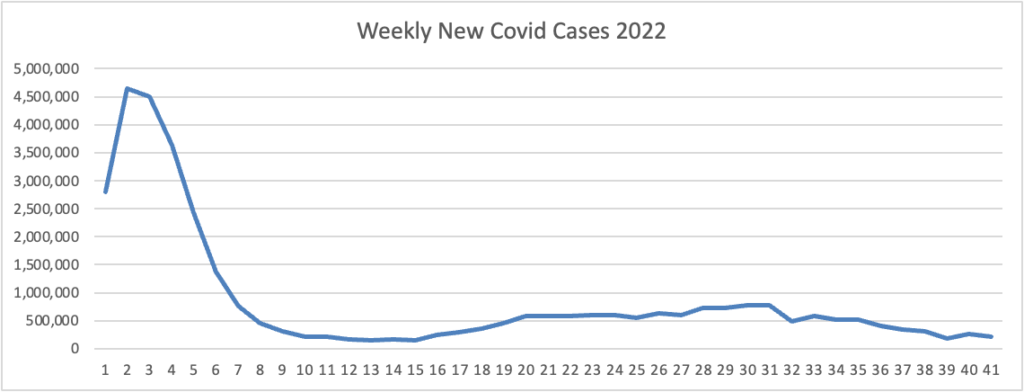
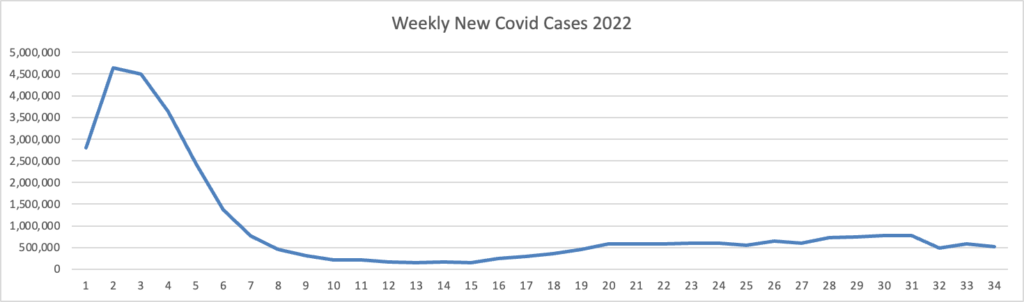
Based on the CDC’s COVID Data Tracker and using Thursday as the first day of the week, here is the FEHBlog’s current weekly chart of new COVID cases for 2021:

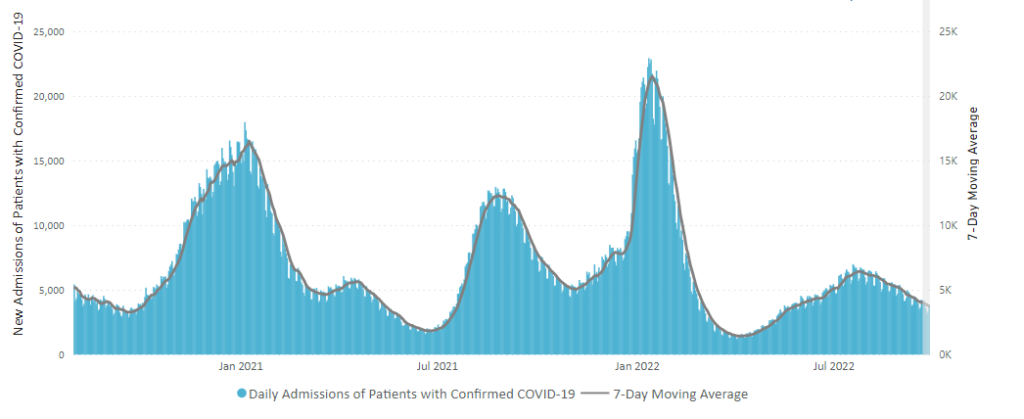
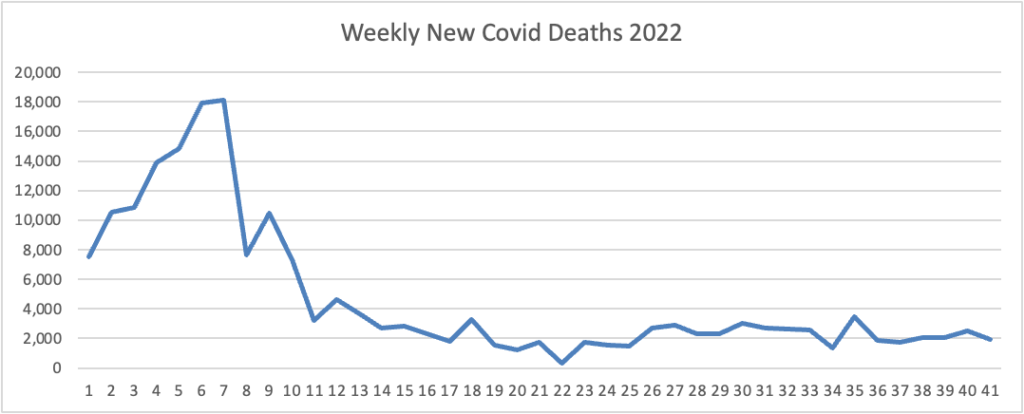
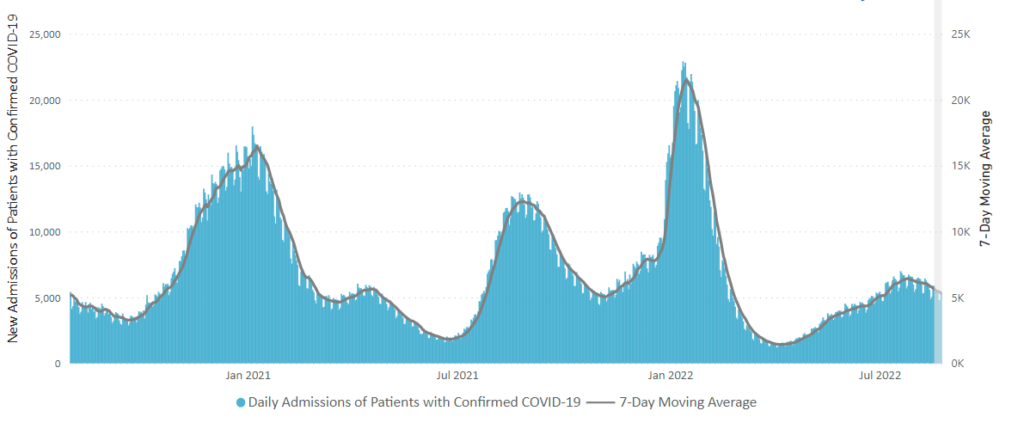
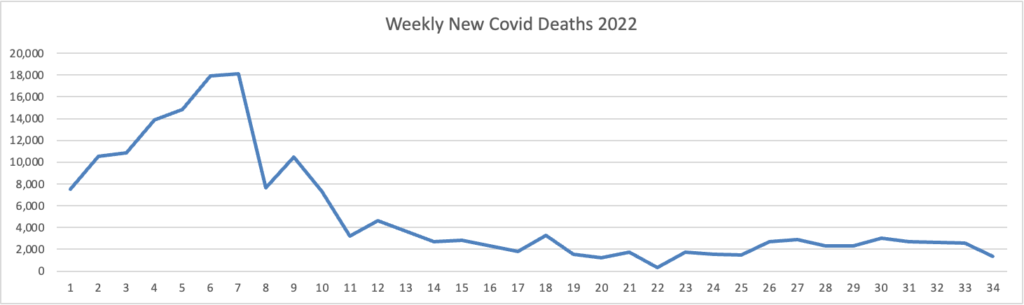
Here is a link to the CDC’s weekly chart of new COVID related hospital admissions, and here is the FEHBlog’s current weekly chart of new COVID deaths:

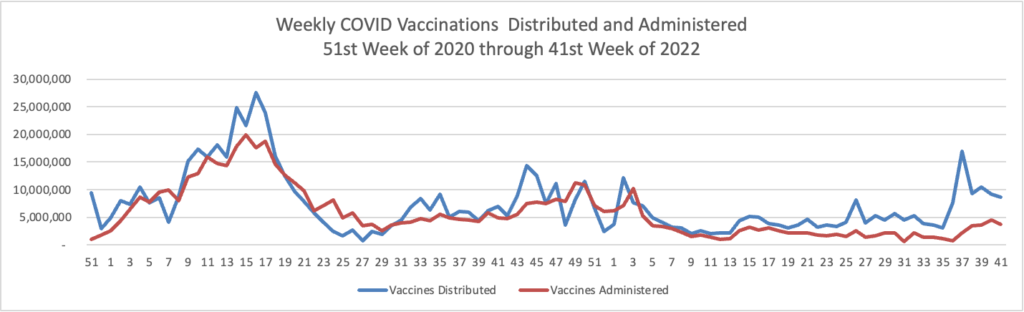
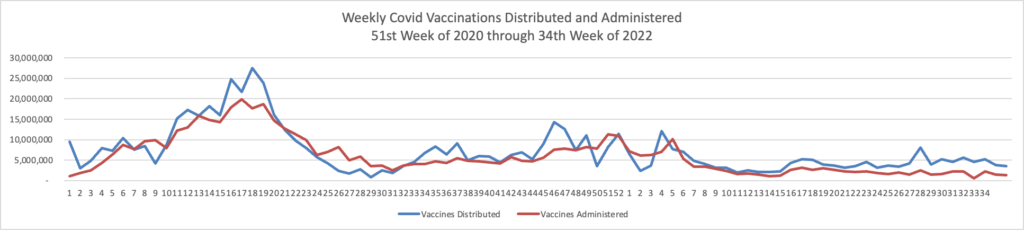
Finally here is the FEHBlog’s current weekly chart of COVID vaccinations distributed and administered:

As of today, 86% of the U.S. population over age 65 has been fully vaccinated and 1/3 of that cadre has received a COVID booster.

Here’s a link to the CDC’s weekly interpretation of its COVID statistics. The CDC points out that “Starting the week of November 8th, vaccines [for children aged five through 11] will be available at pediatricians’ offices, pharmacies, Federally Qualified Health Centers, and more. To find vaccine near you, visit vaccines.gov; text your ZIP code to 438829 (GETVAX); or call 1-800-232-0233.”

The CDC’s Fluview informs us that “Seasonal influenza activity in the United States remains low, but the number of influenza virus detections reported by public health laboratories has increased in recent weeks.”

The best summary of where we stand with COVID is found in today’s New York Times column by David Leonhardt on whether it’s time to start back to returning to normalcy on COVID. His theme struck a chord with the FEHBlog:

“Among the Covid experts I regularly talk with, Dr. Robert Wachter is one of the more cautious. He worries about “long Covid,” and he believes that many people should receive booster shots. He says that he may wear a mask in supermarkets and on airplanes for the rest of his life.””

“Yet Wachter — the chair of the medicine department at the University of California, San Francisco — also worries about the downsides of organizing our lives around Covid. In recent weeks, he has begun to think about when most of life’s rhythms should start returning to normal. Increasingly, he believes the answer is: Now.

“This belief stems from the fact that the virus is unlikely to go away, ever. Like most viruses, it will probably keep circulating, with cases rising sometimes and falling other times. But we have the tools — vaccines, along with an emerging group of treatments — to turn it into a manageable virus, similar to the seasonal flu.”

In other news —

The Centers for Medicare and Medicaid Services finally announced 2022 Medicare Medicare Parts A and B premiums and cost sharing.

  • The Part A inpatient hospital deductible will increase from $1484 to $1556.
  • The Part B calendar year deductible will increase from $203 to $221.
  • The monthly standard Part B premium will increase from $148.50 to $170.10.

All of the changes and the income based Part B premium adjustments for high income beneficiaries is available here.

STAT News informs us that

Robert Califf, President Biden’s new pick to lead the Food and Drug Administration, doesn’t have much to show for his first tenure at the agency.

His grand plans for modernizing the way drug makers and the FDA collect patient data were shelved in 2017 after he left the agency’s top spot. His efforts to ban flavored tobacco products were foiled by the Obama White House. Even his push to finally fix the FDA’s hiring woes still hasn’t been fully implemented.

Now Califf, who Biden formally tapped on Friday to retake the FDA’s top job, will have another shot at delivering on those promises.

Health Payer Intelligence tells us that

More than eight out of ten survey participants in UnitedHealthcare’s sixth annual Consumer Sentiment Survey indicated that they are ready to choose a health plan during 2022 open enrollment season.

“Most Americans said they are prepared to select a health plan during this year’s open enrollment season, while the COVID-19 pandemic continues to spur interest in virtual care for medical services and digital fitness apps to help people pursue at-home fitness routines,” the press release shared.

UnitedHealthcare fielded the survey from September 10 through September 12, 2021 and received 1,013 responses from individuals 18 years old and older.

Health Payer Intelligence also discusses a Humana program for employer sponsored plans in which “Humana is partnering with a type 2 diabetes reversal vendor [Virta] that uses remote patient monitoring and nutrition to help members manage and improve their type 2 diabetes.”

The article included this interesting tidbit on diabetes treatment

Diabetes is one of the top chronic conditions in the US that drive healthcare spending, alongside conditions such as cancer, heart disease, and obesity. As such, payers have heavily targeted this condition with various chronic disease management strategies.

It was not until August 2021, however, that the American Diabetes Association (ADA) officially determined that the phrase “diabetes reversal” was often more clearly identified as “remission,” Humana pointed out in its press release.

“Remission strikes an appropriate balance, noting that diabetes may not always be active and progressive yet implying that a notable improvement may not be permanent. It is consistent with the view that a person may require ongoing support to forestall relapse, and regular monitoring to allow intervention should hyperglycemia recur,” ADA decided. 

“The term reversal is used to describe the process of returning to glucose levels below those diagnostic of diabetes, but it should not be equated with the state of remission.”

Monday Roundup

Photo by Sven Read on Unsplash

From the FEHB Open Season front, consultant Tammy Flanagan reports on the new trend of FEHB plans to offer Medicare Part B premium reimbursement contingent upon joining a related Medicare Advantage plan.

From the Delta variant front, the American Hospital Association informs us that

The Food and Drug Administration Friday authorized another over-the-counter COVID-19 diagnostic test for emergency use. The iHealth COVID-19 Antigen Rapid Test delivers results in 15 minutes. The company anticipates producing 100 million tests per month, with capacity increasing to 200 million per month in early 2022, FDA said.

STAT News offers an interesting snapshot of the now diminishing Delta variant surge.

Chart comparing hospitalizations by vaccine status

The chart truly speaks for itself.

In the maternal health field, the Health and Human Services Department announced that “200+ hospitals that are participating in the HHS Perinatal Improvement Collaborative, a contract with Premier, Inc. This new network is focused on improving maternal and infant health outcomes by reducing disparities. Comprised of hospitals from all 50 states, the collaborative is the first to evaluate how pregnancy affects overall population health by linking inpatient data of newborns to their mothers.” A list of the participating hospitals may be found at the bottom of the HHS press release.

From the Rx coverage front, STAT News tells us

Nearly a dozen of the highest-rated hospitals in the U.S. charged commercial health insurers and cash-paying patients significantly more than what Medicare has recently paid for 10 infused medicines on which the government spends the most money, according to a new analysis.

Median prices exceeded the Medicare Part B payment limit by a low of 169% at Rush University Medical Center in Chicago, while the Mayo Clinic Hospital in Phoenix exceeded the payment limit by 344%. Among cash-paying customers, the prices ranged from 149% of the Medicare payment limit at Rush to 306% at Brigham and Women’s Hospital and Massachusetts General Hospital, both based in Boston.

The Part B infused medicines for which Medicare Part B spent the most money were Rituxan, Orencia, Enbrel, Prolia, Eylea, Opdivdo, Keytruda, Avastin, Lucentis, Neulasta, and Remicade, but the list did not include biosimilar versions. These medications are variously used to treat conditions including cancer, rheumatoid arthritis, and macular degeneration.

Medicare Part B already sets Part B drug prices which tend to be injectables administered at facilities. Democrat legislators in Congress also want Medicare Part D to fix prices for certain drugs distributed by pharmacies. Government price fixing has never worked successfully in the American economy in the FEHBlog’s understanding.

Also from the healthcare pricing front, Health Payer Intelligence informs

Outcomes-based contracts continue to be popular for certain therapies as healthcare costs mount, an Avalere study found.

Avalere’s findings draw on survey responses from 51 insurers and pharmacy benefit managers. Altogether, the survey participants cover approximately 59 million members. The survey was fielded from September 27 to October 8, 2021 and it is Avalere’s fifth annual survey on the subject.

“OBCs typically include an agreement between health plans and drug or device manufacturers that ties product reimbursement to specific clinical, quality, or utilization outcomes,” Avalere researchers explained.

Let’s go.

Tuesday Tidbits

From the Delta variant vaccination front, AHIP informs us that

Photo by Patrick Fore on Unsplash

Today, the Centers for Disease Control and Prevention’s (CDC) Advisory Committee on Immunization Practices (ACIP) met to discuss the safety, efficacy and clinical considerations for the Pfizer-BioNTech COVID-19 vaccine in children aged 5-11 years. The committee unanimously voted (14-0) to recommend the vaccine with the following statement:

“The Pfizer-BioNTech COVID-19 vaccine is recommended for children 5-11 years of age in the U.S. population under the FDA’s Emergency Use Authorization (EUA).”

During the meeting, representatives from Pfizer and the CDC presented data that showed the vaccine to be immunogenic and safe, with majority of adverse events documented as injection site pain. Data from Pfizer showed no correlation of the vaccine with incidence of multisystem inflammatory syndrome MIS-C, and the CDC will continue to monitor the long-term effects of myocarditis in this population. The CDC also noted the disparities in COVID-19 disease epidemiology, that Black, Hispanic, and American Indian/Native Alaskan children are at greater risk for hospitalization and disease severity.  * * *

Additionally, the American Academy of Pediatrics, American Academy of Family Physicians, National Association of Pediatric Nurse Practitioners, and the Pediatrics Infection Disease Society endorsed the COVID-19 vaccine’s administration in all eligible children as authorized by the FDA.

The Wall Street Journal adds that the CDC Director Dr. Rochelle Walensky has ratified the ACIP’s recommendation.

The endorsement * * * on Tuesday, was the last step before doctors, nurses and pharmacists could start giving the shots. Some sites could start administering the vaccine as early as Wednesday, though federal officials don’t expect vaccinations in the age group to be in full swing across the U.S. until next week.

Over 2/3rds of the vaccine eligible U.S. population (12 years and older) are fully vaccinated and a quarter of Americans over age 65 have received a booster according to today’s CDC update.

From the also busy Medicare front, the American Hospital Association tells us about three final Calendar Year 2022 rules released today:

Hospital Outpatient Services (Part A): The Centers for Medicare & Medicaid Services late today issued a final rule that increases Medicare hospital outpatient prospective payment system rates by a net 2.0% in calendar year 2022 compared to 2021.  In addition, as urged by AHA, CMS finalized its proposals to reverse two policies finalized in CY 2021. The first policy halts the elimination of the inpatient only list and adds back to the IPO list almost all of the services removed in 2021. The second reinstates several patient safety criteria for adding a procedure to the ambulatory surgical center covered procedures list that were in place in CY 2020 and prior. The rule also removes 255 of the 258 surgical procedures that had been added to the ASC CPL in 2021.

Hospital Price Transparency: CMS also finalizes as proposed a number of modifications to the hospital price transparency rule, including significant increases to the civil monetary penalty for noncompliance. * * * Currently, the CMP is set at a maximum amount of $300/day. CMS will scale up the CMP based on a hospital’s bed count, with a minimum of $300/day for small hospitals (30 or fewer beds) and an additional $10/bed/day for larger hospitals with a daily cap of $5,500. CMS also will prohibit specific barriers to accessing the machine-readable files, including through automated searches and direct downloads. CMS provides updated clarifications on the price estimator tools for those hospitals that choose to use them to fulfill the shoppable service requirement, including allowing patients to manually input their insurance information and permitting broad disclaimers, as appropriate.

Home Healthcare Services (Part A): The Centers for Medicare & Medicaid Services today released its calendar year 2022 final rule for the home health prospective payment system. The rule finalized a net update of 3.2% relative to CY 2021. This includes a 2.6% market basket increase ($465 million), a 0.7% increase for high-cost outlier cases ($125 million), and 0.1% decrease to rural payments as required by law (-$20 million).

Physician Services (Part B): The Centers for Medicare & Medicaid Services late today released its calendar year 2022 final rule for the physician fee schedule. The rule cuts the conversion factor to $33.59 in CY 2022, as compared to $34.89 in CY 2021, which reflects the expiration of the CY 2021 3.75% payment increase, a 0.00% conversion factor update, and a budget neutrality adjustment. The rule also finalizes several policies to expand access to telehealth for mental health services, including, in certain instances, covering audio-only services. In addition, as urged by the AHA, CMS finalized a delayed implementation of the payment penalty phase of the Appropriate Use Criteria program to the later of Jan. 1, 2023, or the Jan. 1 that follows the end of the COVID-19 public health emergency. Currently, the penalty phase is set to begin Jan. 1, 2022.   “The AHA applauds today’s ruling by CMS to delay the proposed enforcement of the Appropriate Use Criteria (AUC) program as well as to expand access to telehealth for behavioral health services,” said AHA Executive Vice President Stacey Hughes. 

Speaking of telehealth, Healthcare Dive calls attention to its finding that ‘While women are more likely than men to visit doctors and consume healthcare services in general, telehealth seems to be uniquely attractive to women.” Moreover, [t]he data also suggests female physicians offer virtual care services at higher rates than their male counterparts.”

In the tidbits department, we find

  • Healthcare Dive reports that “The median change in operating margins for hospitals fell 18.2% in September compared to August, according to the latest monthly report from Kaufman Hall, a hospital consultant group. Patient volumes declined in almost every key category, including emergency room visits and operating room minutes, potentially signaling that the rise in the delta variant caused some to once again defer care out of concern over contracting the coronavirus. Outpatient revenues declined, too, further underscoring this potential trend. Although fewer patients were admitted, patients were sicker and stayed longer. The average length of stay is also trending above pre-pandemic levels.”
  • MedPage Today offers an interesting story on Chicago’s Rush Medical Center “journey to health equity” using social determinants of health data, among other tools.
  • Federal Times reports that “The Partnership for Public Service held its annual Samuel J. Heyman Service to America awards Nov. 1, honoring nine federal employees and their associated teams out of 29 nominees for making a significant impact through their public service.” Congratulations to all of the nominees and thanks for your service to our country.

Friday Stats and More

Using the CDC’s COVID Data Tracker and using Wednesday as the last day of the week, here is the FEHBlog’s chart of weekly new COVID cases for this year:

New cases continue to fall as do new COVID hospital admissions. What’s more, new weekly COVID deaths, a lagging indicator are trending down now too.

Finally, here’s the FEHBlog’s chart of weekly new COVID vaccinations distributed and administered from the 51st week of 2020 through the 42nd week of 2021:

Over two thirds of the vaccination eligible U.S. population (age 12 and older) is fully vaccinated. Medscape adds that

Pfizer says its vaccine for children is 90% effective at preventing COVID-19 infections.

The Pfizer vaccine for kids ages 5 to 11 is 10 micrograms, roughly one-third of the dose given to adolescents and adults. * * *

The vaccine effectiveness data comes from a study of more than 2,000 kids ages 5 to 11. Two-thirds of the children were randomly assigned to receive a child-sized dose of the Pfizer-BioNTech vaccine, while the other third was sorted into the placebo group.

According to the company’s analysis of its own studies, side effects seen in the study were nearly all mild. The most common side effect reported was pain at the site of the shot. Kids in the group that received the vaccine also had fatigue, headaches, fever, and chills at higher rates than were seen in the placebo group. These were most common after the second dose. Some skin reactions were seen in the study, like itching and rashes, but these were mostly mild and went away within a few days.

Kids also could have swollen lymph nodes after their vaccinations, as adults sometimes do, but these reactions were temporary.

One child developed a tic, a recurring involuntary muscle twitch or vocal sound, that came one week after their second dose of the vaccine. It was judged by study investigators to be related to the vaccine. The company says it was going away by the time the study was being published.

Reassuringly, no cases of heart inflammation called myocarditis were found in the study. Myocarditis is rare and temporary, but it requires hospital care. The highest rates of myocarditis are seen in males younger than 30. That group has a risk of about 11 cases for every 100,000 doses given, according to a recent study in the New England Journal of Medicine.

Also, here are links to the Health and Human Services Department’s new COMBAT COVID website (catchy!) and the CDC’s interpretation of this week’s COVID statistics.

The CDC’s most recent Flu View (October 16) sums it up as follows: Seasonal influenza activity in the United States remains low. Just like last year so far.

In other news, CNBC informs us that

The standard Medicare Part B premium is projected to be $158.50 per month [in 2022], up from $148.50 this year. However, the rates for next year have not been officially announced. * * *

People with incomes above certain levels will pay more for Medicare Part B coverage. This is known as the Income-Related Monthly Adjustment Amount, or IRMAA.

A new table for Medicare Part B premiums for 2022 has also not yet been released. However, this year’s IRMAA rates will likely be reasonably close, Elsasser said.

Both Social Security and SSI beneficiaries will be notified by mail in December as to what their benefit payments will be next year. That information will also be available online through personal My Social Security accounts.

New benefit amounts for 2022 will not be calculated for those covered by Medicare until after the premiums for next year are announced. Medicare changes for 2022 will be available at Medicare.gov.

Weekend Update

Thanks to ACK15 for sharing their work on Unsplash.

This coming week, the U.S. House of Representatives will engage in Committee business and the Senate will engage in both Committee business and the Senate will engage in Committee business and floor voting. Roll Call explains that “President Joe Biden told House Democrats on Friday to hold off on his bipartisan infrastructure bill until they reach agreement on a scaled-back partisan tax and spending package funding the rest of his economic agenda.”

The U.S. Supreme Court opens its October 2021 term tomorrow. Two Affordable Care Act Section 1557 (individual non-discrimination law) cases will be argued this calendar quarter.

On the Delta variant front, the Wall Street Journal reports that

The cost of similar Covid-19 treatments can vary by tens of thousands of dollars a patient, even within the same hospital, according to a Wall Street Journal analysis of pricing data that indicates pandemic care hasn’t escaped the complex economics of the U.S. health system.

One kind of patient, with a type of severe respiratory condition that is common among those admitted with Covid-19, is an example of the wide range. The rates for these patients usually spanned from less than $11,000 to more than $43,000, the analysis found, but some prices could be far higher, depending on the severity of the case.

Federal News Network informs us that

The Office of Personnel Management on Friday offered up more details on how agencies might approach disciplinary action against employees who fail to comply with the Biden administration’s recent federal vaccine mandate.

Because employees aren’t considered fully vaccinated until two weeks after receiving a single-shot series or the second dose of a two-shot series, they must get the vaccine by Nov. 8 to comply with the federal mandate.

Therefore, agencies can begin the disciplinary process for employees who are unvaccinated by Nov. 8 on the following day, Nov. 9, OPM Director Kiran Ahuja said Friday in a new memo.

On the No Surprises Act front, Prof. Katie Keith and her colleagues delves into the details of the second interim final rule on the NSA which concerns the independent dispute resolution process.

On the newly opened Federal Benefits Open Season front, the FEHBlog notes that Blue Cross FEP and Kaiser Permanente have posted information about 2022 benefits on their respective websites. Here’s a belated link to OPM’s announcement of 2022 premiums from last Thursday.

On a related note Healthcare Dive informs us that

Average Medicare Advantage premium rates are dropping 10% to $19 a month next year as nearly 30 million people are expected to be enrolled in the program, an increase of about 2.6 million from this year, CMS said in a Thursday press release.

Cigna and UnitedHealthcare are expanding their MA footprints. Cigna is going into three new states and increasing its geographic coverage by 30%. UnitedHealthcare is entering 276 new counties, giving it access to 94% of Medicare members.

Analysts at Cowen said in a note Friday that after reviewing benefits for the three largest plans from top insurers, it saw stability to modest improvements. That indicates conservative bids among the uncertainty of the COVID-19 pandemic.

Open enrollment for Medicare runs from Oct. 15 to Dec. 7.

Midweek Update

Photo by Josh Mills on Unsplash

The American Hospital Association informs us that

The Senate early this morning approved on a party line vote a $3.5 trillion budget resolution, which included reconciliation instructions which will provide the majority party with the means to pass a comprehensive reconciliation package with just 51 votes in the Senate, rather than the usual 60-vote hurdle. The House will reconvene on Aug. 23 to consider the budget resolution. Once the resolution has passed both chambers, the House and Senate majorities can proceed with the reconciliation process, a resolution to which is expected in the fall. 

Bloomberg adds

Translating the budget framework into law will require Biden and Democratic congressional leaders keeping their party’s moderate and progressive wings marching together.

Just hours after passage of the budget blueprint, Senator Joe Manchin, a Democrat from West Virginia, said he couldn’t support a social spending bill with a $3.5 trillion price tag. Senator Kyrsten Sinema, an Arizona Democrat, has said the same. One Democratic objection is all it would take to scuttle the package in the Senate.

Time will tell but we are talking about $3.5 trillion on top of the $1 trillion infrastructure bill and multi-trillion COVID-19 relief bills that Congress has passed in the last 18 months. It appears that Congress is trying to disprove the adage that money can’t solve all problems.

One of the initiatives in the budget reconciliation package is to add dental, vision, and hearing coverage to Medicare. Kaiser Health News discusses the issue here.

From the Delta variant front

  • The Centers for Disease Control’s Advisory Committee on Immunization Practice released a helpful report on COVID-19 adverse side effects which it summarized as follows

What is already known about this topic?

Rare serious adverse events have been reported after COVID-19 vaccination, including Guillain-Barré syndrome (GBS) and thrombosis with thrombocytopenia syndrome (TTS) after Janssen COVID-19 vaccination and myocarditis after mRNA (Pfizer-BioNTech and Moderna) COVID-19 vaccination.

What is added by this report?

On July 22, 2021, the Advisory Committee on Immunization Practices reviewed updated benefit-risk analyses after Janssen and mRNA COVID-19 vaccination and concluded that the benefits outweigh the risks for rare serious adverse events after COVID-19 vaccination.

What are the implications for public health practice?

Continued COVID-19 vaccination will prevent COVID-19 morbidity and mortality far exceeding GBS, TTS, and myocarditis cases expected. Information about rare adverse events should be disseminated to providers, vaccine recipients, and the public.

  • Forbes tells us that today “The Centers for Disease Control and Prevention encouraged anyone pregnant and breastfeeding to get vaccinated against coronavirus Wednesday, pointing to a growing amount of evidence that vaccines are safe and effective as new cases and hospitalizations linked to the virus surge across the country.” The Washington Post adds “Just 23 percent of pregnant women have received at least one shot of vaccine.”
  • Also from Forbes as schools begin to reopen “Vaccine rates among teenagers have remained lower than the U.S. population overall, with only 43% of 12- to 15-year-olds and 52.8% of 16- and 17-year-olds receiving at least a first dose as compared with 58.9% of the total population and 71.2% of adults.”
  • The Boston Globe discusses this teenage hesitancy issue — “The top reservation among parents of unvaccinated teens was the lack of information about the long-term effects of the shot, followed by concerns about side effects and fertility — despite conclusive evidence that the vaccine has no negative impacts on reproduction. Dr. Jill Kasper, a pediatrician at Cambridge Health Alliance, said she typically encounters ‘very little hesitancy’ from parents about routine adolescent vaccinations. That hasn’t been the case with COVID-19.”

The HHS Agency for Healthcare Quality and Research issued two noteworthy studies today. Here are the topline findings

  • #1 Overuse or low-value procedures may result in patient physical, psychological, or emotional harm. This study explored the association between eight low-value care procedures and length of stay (LOS) and cost. All eight procedures were associated with increased LOS and cost, particularly spinal fusion. Patients receiving low-value care may be exposed to increased risk of adverse events and hospital-acquired conditions.
  • #2 Medication administration errors made by parent or caregivers can result in medication errors at home. This systematic review found that 30% to 80% of pediatric patients experience a medication error at home, and that the risk increases based on characteristics of the caregiver and if a prescription contains more than two drugs.

Healthcare Dive informs us that

  • CVS Health said its Aetna unit will offer virtual primary care to self-funded employers nationwide in a move that underscores the growing popularity of telehealth services fueled by the COVID-19 public health emergency.
  • Using Teladoc Health’s physician-led care team model, the Aetna Virtual Primary Care service is intended to help strengthen the patient-doctor relationship and improve access to care, the vertically integrated company announced Tuesday. Members can receive health services remotely and in person.

Such support for primary care should be applauded.

In other healthcare news

  • STAT News reports that The Department of Veterans Affairs has decided not to cover a new Alzheimer’s drug from Biogen [Adulhelm], citing insufficient evidence of “a robust and meaningful clinical benefit” and concerns about safety. In a notice issued by the agency, the VA said it will make exceptions for “highly selected patients” and listed several hurdles that must be cleared before the medicine will be covered, such as requiring it to be prescribed by providers who specialize in treating dementia and ensuring patients had recently received MRI brain scans. * * * ‘Its bad news for Biogen,’ said Ira Loss of Washington Analysis, which tracks legislative and regulatory issues affecting the pharmaceutical industry for investors, who noted several private insurers have either declined or delayed coverage for the drug. ‘The VA is a big buyer of medicines. And you don’t like this kind of publicity, that’s for sure.’”
  • Fierce Healthcare continues to report from the HIMSS conference in Las Vegas. “Health IT giant Epic launched a new customer story-sharing website that lets Epic users share insights, tips and creative ideas around using health IT to improve their organizations and patient care. The site, EpicShare.org, combines insights from industry leaders, quick tips on improving outcomes and performance, in-depth case studies as well as a “Hey Judy” column from Epic founder and CEO Judy Faulkner.”

Monday Roundup

Photo by Sven Read on Unsplash

The American Hospital Association (“AHA”) reports that “Lawmakers in the U.S. Senate this weekend unveiled the text of a bipartisan infrastructure package that has been under negotiation for several months. The package does not rescind any Provider Relief Funds as an offset for the package, though it does extend the Medicare sequester for one additional year, through fiscal year 2031.” Fierce Healthcare points out two other healthcare provisions in the bill. Fierce Healthcare adds that

The Senate is expected to vote this week on the package. It will then consider a $3.5 trillion package that could clear the chamber via a procedural move called reconciliation that ensures budget bills can pass via a simple majority and bypass the 60 votes needed to break a filibuster.

Democrats have sought to add more healthcare related provisions in the $3.5 trillion package, including adding dental, vision and hearing benefits to Medicare.

Sen. Ron Wyden, D-Oregon, told Fierce Healthcare last week that he is working to add drug pricing provisions into the package, including giving Medicare the authority to negotiate for lower prices.

From the Delta variant front

  • Federal News Network discusses federal employee reaction to the President’s COVID-19 vaccination mandate.
  • The Society for Human Resource Management offers solid advice to employers on how businesses should respond to the Delta variant.
  • The American Medical Association discusses how providers can address high blood pressure problems worsened by the pandemic.

From the employee perspective front, Health Payer Intelligence tells us that “Employees are looking for employers to bolster preventive care services, mental healthcare, and access to employees’ providers in their employer-sponsored health benefits, a Marathon Health survey revealed. The researchers surveyed over 1,100 employees—all of whom were working full-time—and 430 human resource leaders in June 2021. “While Americans prize healthcare above every other benefit, our survey also indicates employees and employers see major shortcomings in their healthcare plans. This is especially true when it comes to cost, preventive care, and mental health,” Jeff Wells, co-founder and chief executive officer of Marathon Health, summarized in the press release.”

From the regulatory front today the Centers for Medicare and Medicaid Services finalized the fiscal year 2022 Medicare Part A payment policies for inpatient hospital care.

Before taking into account Medicare disproportionate share hospital (DSH) payments and Medicare uncompensated care payments, the increase in operating payment rates, increases in capital payments, increases in payments for new medical technologies, increases in payments due to implementation of the imputed floor, and other changes will increase hospital payments in FY 2022 by $3.7 billion, or 3.1 percent. CMS projects Medicare DSH payments and Medicare uncompensated care payments to decrease in FY 2022 compared to FY 2021 by approximately $1.4 billion. Overall, CMS estimates hospitals payments will increase by $2.3 billion.

Here is a link to the AHA’s generally favorable reaction to the final rule.