Monday Roundup

Monday Roundup

Photo by Sven Read on Unsplash

The FEHBlog ran across this Health and Human Services letter to U.S. Governors thanks to the American Hospital Association’s daily email. It states in pertinent part

We are writing to you today to share more details regarding the public health emergency (PHE) for COVID-19, as declared by the Secretary of Health and Human Services (HHS) under section 319 of the Public Health Service Act (42 U.S.C. §247d). The current public health emergency was renewed effective January 21, 2021, and will be in effect for 90 days. To assure you of our commitment to the ongoing response, we have determined that the PHE will likely remain in place for the entirety of 2021, and when a decision is made to terminate the declaration or let it expire, HHS will provide states with 60 days’ notice prior to termination.

All right then.

FCW reports that President Biden “announced a raft of senior officials to help lead the Office of Personnel Management on Jan. 25. The positions are for appointments that don’t require Senate confirmation.” Consequently the lengthy list does not include the OPM Director and Deputy Director nominees. The acting Director remains Chief Management Officer Kathleen McGettigan.

The Washington Post reports that 50-50 Senate Minority Leader Mitch McConnell is ready to approve the “clean” power sharing agreement offered by Senate Majority Leader Chuck Schumer. Why? Two Democratic Senators strongly voiced opposition to repealing the legislative filibuster.

On the COVID-19 vaccination front

  • President Biden answering press questions yesterday (more detail at the link and the FEHBlog points this out because for what it’s worth it’s his sense too.)

Q   [Josh from Bloomberg] Well, my question was at what date — or, roughly, when do you think anyone who wants [a COVID-19 vaccination] would be able to get it?  Summer? 

THE PRESIDENT:  Oh, I — no, I think it’ll be this spring.  I think we’ll be able to do that this spring.  And — but it’s going to be a logistical challenge that exceeds anything we’ve ever tried in this country, but I think we can do that.

I feel confident that, by summer, we’re going to be well on our way to heading toward herd immunity and increasing the access for people who aren’t on the first — aren’t on the list, all the way going down to children and how we deal with that.  But I feel good about where we’re going, and I think we can get it done. 

  • Govexec.com reports on efforts by the Department of Veterans Affairs and the Postal Service to arrange for vaccinating their essential workforce members.
  • Stat News informs us that “Moderna is studying adding booster doses to its vaccine regimen after finding its Covid-19 vaccine was less potent against a coronavirus variant that was first identified in South Africa, the company said Monday. * * * Nevertheless, [b]oth the Moderna vaccine and the immunization from Pfizer-BioNTech produce such powerful levels of immune protection — generating higher levels of antibodies on average than people who recover from a Covid-19 infection have — that they should be able to withstand some drop in their potency without really losing their ability to guard people from getting sick.”
  • NPR News discloses that “Merck is halting development of its two COVID-19 vaccine candidates, saying that while the drugs seemed to be safe, they didn’t generate enough of an immune response to effectively protect people against the coronavirus. * * * While Merck is shelving both of its vaccine candidates, the company says it will keep working on two therapeutic drugs, including one that aims to protect the body’s respiratory system from the coronavirus’s ravaging effects. Last month, the company signed a deal with the U.S. government agreeing to supply up to 100,000 doses of one of those drugs for about $356 million.

In other healthcare news —

  • Fierce Healthcare reports that Consulting firm ADVI Health reviewed the websites for 20 (PDF) of the largest hospitals in terms of bed size and found that the largest hospitals all posted some type of pricing information online [in response to a federal transparency rule that took effect on January 1, 2021]. But many of the hospitals did not provide healthcare common procedural codes for the services, according to the analysis, which did not list the hospitals. “Many institutions didn’t use the codes, which makes it difficult to make comparisons across facilities,” said Caitlin Sheetz, lead author of the analysis and head of analytics for ADVI.”
  • Fierce Healthcare updates us on that Blue Cross’s new high performance network. “BCBSA said 45 companies have signed on to offer the Blue HPN plan to employees, reaching 55 markets and 340,000 potential members. The plan is the only HPN available in the 10 largest U.S. cities, BCBSA said. Jennifer Atkins, vice president of global network solutions at BCBSA, told Fierce Healthcare that even in its early days, Blue HPN has found success in lowering costs for employers. The HPN plan saved 11% in the total cost of care compared to a traditional PPO, she said.”
  • Fierce Healthcare also informs us that non-profit “Civica Rx announced a plan to build a major manufacturing facility to produce sterile injectable drugs for hospitals, a major step for the organization comprised of health systems such as Mayo and Intermountain. The $124.5 million project is planned for Petersburg, Virginia — just south of Richmond — and is expected to potentially create more than 180 jobs. The 120,000-square-foot manufacturing facility aims to address a major source of shortages for hospitals. Sterile injectable drugs have been a major source of shortages in recent years due in part to fewer companies making the products, according to the Food and Drug Administration.”

Weekend update

Photo by JOSHUA COLEMAN on Unsplash

Both Houses of Congress are engaged in committee and floor business this coming week. The Senate is focused on confirming the President’s cabinet nominations.

Politico reports

As Senate Majority Leader Chuck Schumer and Senate Minority Leader Mitch McConnell negotiate a power sharing agreement for a 50-50 Senate, committee assignments are still up in the air. That means that Republicans like [Sen. Ron] Johnson [R Wisc] are, for now, holding hearings and markups for President Joe Biden’s Cabinet nominees, even though Democrats are in charge of the Senate floor. 

Johnson, who will eventually hand over the top GOP slot to Sen. Rob Portman (R-Ohio), said that his committee will hold a meeting next week on Biden’s pick to lead the Department of Homeland Security, Alejandro Mayorkas. Mayorkas is facing resistance from Republicans and could be stuck in committee if he doesn’t receive enough GOP support.

The Hill reports that President Biden has released a topical daily schedule for the coming week which is full of new Executive Orders. January 28 will be Healthcare Day:

Biden on Thursday will take the highly anticipated action among pro-choice advocates of rescinding the so-called Mexico City policy, which bans the use of U.S. funding for foreign organizations that provide or promote abortions.

The policy, described as a “global gag rule” by reproductive health advocates, was first instated by then-President Reagan, and has been repeatedly rescinded by Democratic presidents and reinstated by Republican presidents in the years since.

Biden will also order a review of the Trump administration’s controversial changes to the Title X family planning program, which required family planning providers participating in the program to stop providing or promoting abortions to remain eligible for funding. 

The president is also slated to sign an executive order aimed at strengthening Medicaid and initiating an open enrollment period under the Affordable Care Act.

Fierce Healthcare reports that “Micky Tripathi, Ph.D., a recognized name in the health tech world, has been tapped as the new national coordinator for health IT under President Joe Biden’s administration. * * * Tripathi will replace the outgoing Don Rucker, M.D., who held the position since April 2017. The Office of the National Coordinator for Health Information Technology (ONC) provides counsel for the development and implementation of a national health information technology framework. * * * An expert on interoperability, privacy, and technology standards, Tripathi most recently served as chief strategy officer at Arcadia Analytics, a population health management solutions company. 

On the COVID-19 vaccination front:

  • The Wall Street Journal offers a very informative article with advice from doctors about what to expect when you have an appointment to receive the COVID-19 vaccine. This is understandably of the Journal’s top five articles.
  • America’s Health Insurance Plans has created a robust website about the COVID-19 vaccines.
  • According to the CDC’s Vaccinations data website, over 4.3 million doses of COVID-19 vaccines were administered in the U.S. on Friday and Saturday.

On the reports front —

Friday Stats and More

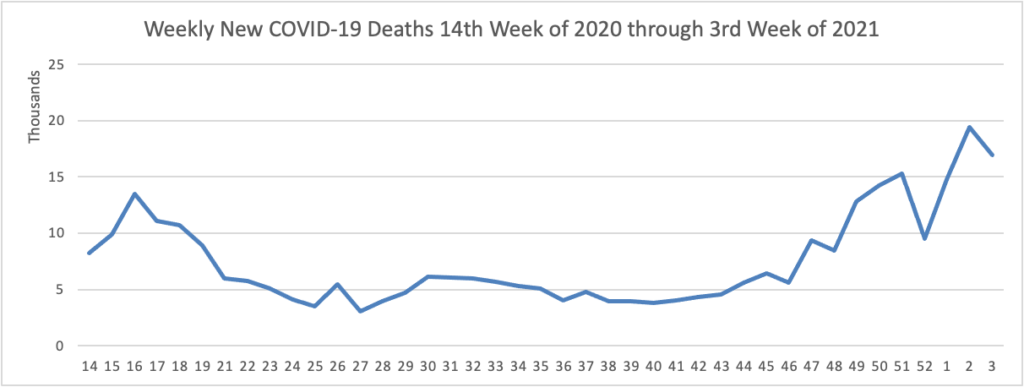
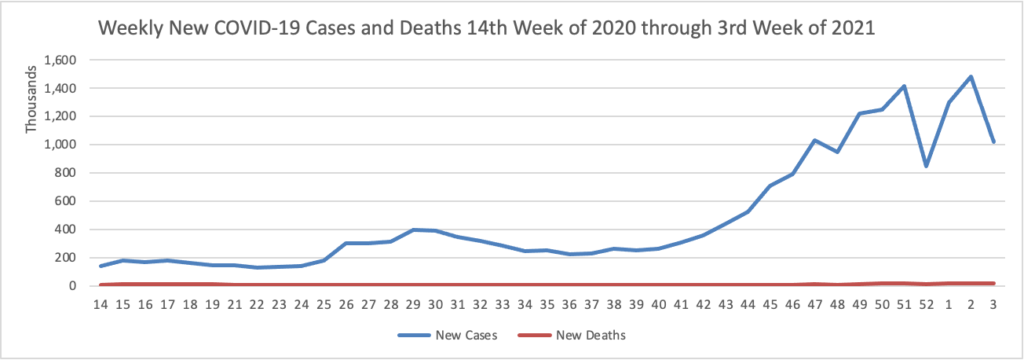
Based on the CDC’s Cases in the U.S. website, here is the FEHBlog’s chart of new weekly COVID-19 cases and deaths over the 14th week of 2020 through third week of this year (beginning April 2, 2020, and ending January 20, 2021; using Thursday as the first day of the week in order to facilitate this weekly update):

and here is the CDC’s latest overall weekly hospitalization rate chart for COVID-19:

The FEHBlog has noted that the new cases and deaths chart shows a flat line for new weekly deaths  because new cases greatly exceed new deaths. Accordingly here is a chart of new COVID-19 deaths over the period (April 2, 2020, through January 20, 2021):

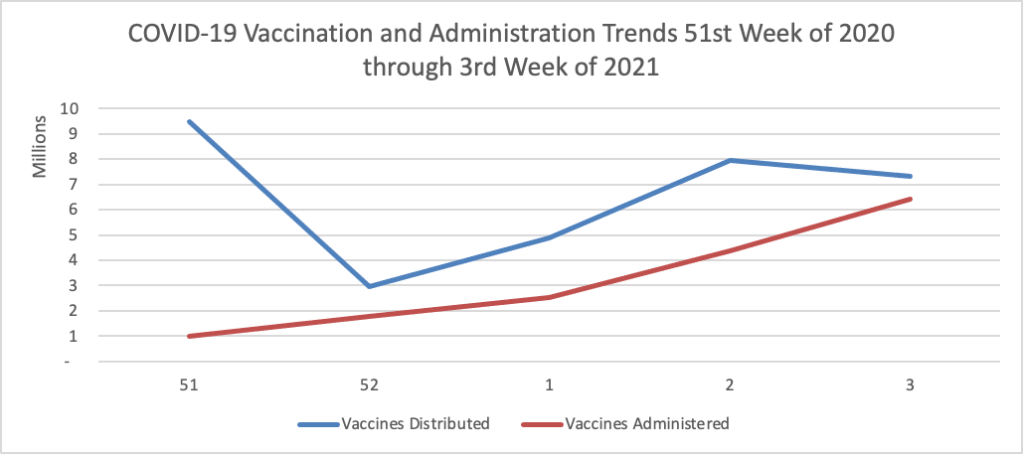
Finally here is a COVID-19 vaccinations chart for the past month which also uses Thursday as the first day of the week:

Here’s more from the COVID-19 vaccine front —

Bloomberg reports

As of Thursday, 940,000 shots a day were administered on average over a seven-day period, according to data from the Bloomberg Vaccine Tracker. The most recent two days topped a million doses.

Anthony Fauci, Biden’s chief medical adviser, said on Thursday that vaccinating 70% to 85% of the country by the end of the summer would enable a return to normalcy. To do so would mean administering 460 million to 560 million doses, since the current vaccines require a first shot followed by a booster. That’s more than double the rate of Biden’s 100-day goal.

The President’s goal cannot be considered a stretch goal and the FEHBlog is not suggesting that he had been doing so. Bloomberg adds

The U.S. spent more than any country in the world to help speed up the development and deployment of [COVID-19] vaccines. It secured more than 1 billion doses from six companies before any of the shots had been approved. For all the criticism that has been directed at the early fumbles of the vaccine rollout, the U.S. still leads the world in shots administered and is fifth in the world on per-capita basis.

The American Hospital Association reports in its daily email about “rare” levels of allergic reactions to the COVID-19 vaccines:

The Centers for Disease Control and Prevention today reported 10 cases of anaphylaxis, a life-threatening allergic reaction, among the more than 4 million people who received a first dose of the Moderna COVID-19 vaccine between Dec. 21, 2020, and Jan. 10, 2021. That’s an estimated 2.5 cases per 1 million doses. Nine cases occurred within 15 minutes of vaccination and one after 30 minutes. All of the individuals received emergency treatment with epinephrine; four were treated in an emergency department and six were hospitalized. All eight for whom follow-up information was available reportedly recovered. On Jan. 6, CDC reported 21 cases of anaphylaxis among the nearly 1.9 million people who received a first dose of the Pfizer COVID-19 vaccine between Dec. 14 and 23. That’s an estimated 11.1 cases per 1 million doses, but still a rare outcome, according to Nancy Messonnier, M.D., director of CDC’s National Center for Immunization and Respiratory Diseases. CDC recommends that locations administering COVID-19 vaccines adhere to its guidance, including screening recipients for contraindications and precautions, implementing recommended post-vaccination observation periods and immediately treating suspected anaphylaxis with intramuscular epinephrine injection.

Bloomberg reports on second dose timing:

People may receive their follow-up doses of the Covid-19 vaccines up to six weeks later if it’s not feasible to get them in the recommended interval, the Centers for Disease Control and Prevention said.

The guidance posted in a Jan. 21 update to the CDC website said a second dose should be administered as close to the recommended schedule as possible, either three weeks for the Pfizer Inc.BioNTech SE vaccine or four weeks for the Moderna Inc. shot.

But if it’s impossible to get the follow-up shot on time, the CDC says people may schedule it as much as six weeks, or 42 days, after their initial dose. There is “limited data on efficacy” of the vaccines beyond that interval, according to the guidance, but if the second dose is administered later “there is no need to restart the series.”

Bloomberg adds

Vaccine supply and the pace of vaccinations could accelerate rapidly when new shots are cleared for use. A vaccine by Johnson & Johnson has enough data to begin analyzing now, and could have results in a week or two, Fauci said this week. The Food and Drug Administration has moved within days to authorize vaccine applications based on early results. 

The U.S. has secured contracts with J&J for enough vaccine to inoculate 100 million people—the same as its agreements with Pfizer and Moderna. Unlike the two vaccines that are currently available in the U.S., J&J’s vaccine requires only one dose — which could accelerate the pace of vaccinations. It also can be stored in standard refrigerators, unlike Pfizer’s vaccine, which requires special freezers to keep temperatures below -94 degrees Fahrenheit.

Two other vaccines, from AstraZeneca Plc and Novavax Inc., have yet to be cleared for use in the U.S. but could add hundreds of millions of additional doses to the effort to stop the pandemic. 

In other encouraging COVID-19 vaccine news, FiercePharma reports that “Americans are back on the COVID-19 vaccine bandwagon. Sixty-nine percent now plan to get a COVID-19 vaccine, close to the previous high of 73% in April, according to the latest data from The Harris Poll.”

Thursday Miscellany

Photo by JOSHUA COLEMAN on Unsplash

President Biden has issued a blizzard of executive orders over the last day and a half. The Hill summarizes them in this article, and for more details you can find the text of each order on Whitehouse.gov.

STAT News reports that

The Biden administration is willing to consider almost anything to boost the nation’s dwindling supply of Covid-19 vaccines.

A new strategy document released Thursday, totaling nearly 200 pages, offers the first clear list of the options President Biden has before him, though it doesn’t specifically say he’ll actually take all of the steps. On the list are some controversial ideas, like cutting the amount of vaccine being administered to each American. He’s also made it clear he wants to utilize the Defense Production Act to ramp up production of key supplies, and some more straightforward options like buying more doses.

Governors and mayors around the country have complained in recent weeks that they do not have enough vaccines to meet current demand. Biden, too, has acknowledged that the supply of physical vaccines is not where it needs to be to vaccinate a majority of Americans. Already, the Trump administration stopped holding vials in reserve, in hopes of releasing more vaccines to the public.

As of today, the CDC reports that nearly 38 million doses of the two dose vaccines have been distributed and around 17.5 million have been administered. 2.1 million of those doses have been administered at long term care facilities.

In that regard, the AP reports that

Drugmaker Eli Lilly said Thursday its antibody drug can prevent COVID-19 illness in residents and staff of nursing homes and other long-term care locations.

It’s the first major study to show such a treatment may prevent illness in a group that has been devastated by the pandemic. 

Residents and staff who got the drug had up to a 57% lower risk of getting COVID-19 compared to others at the same facility who got a placebo, the drugmaker said. Among nursing home residents only, the risk was reduced by up to 80%.

The study involved more than 1,000 residents and staff at nursing homes and other long-term care locations like assisted living homes. The vast majority tested negative at the start of the study. Some were assigned to get the drug, called bamlanivimab and which is given through an IV, and others got placebo infusions.

Also on the prescription drug front, STAT News informs us that

The Food and Drug Administration has approved a monthly injectable medication, a regimen designed to rival pills that must be taken daily.

The newly approved medicine, which is called Cabenuva, represents a significant advance in treating what continues to be a highly infectious disease. In 2018, for instance, there were approximately 36,400 newly infected patients living with HIV in the U.S., according to the Centers for Disease Control and Prevention. About 1.7 million people worldwide became newly infected in 2019, according to UNAIDS.

Although several medicines exist for treating HIV, ViiV Healthcare is banking on the improved convenience of getting a monthly shot, even if it must be administered by a health care provider. The company, which is largely controlled by GlaxoSmithKline (GSK), gathered data showing nine of 10 patients in pivotal studies claimed to prefer the shot over taking pills each day.

The Wall Street Journal reports on a phenomenon that has attracted the FEHBlog’s attention — the low levels of flu infections this winter across the Northern Hemisphere, including the U.S.

The WHO says the measures people and governments are taking to prevent the spread of Covid-19, such as wearing masks and limiting public gatherings, have probably helped keep the flu in check. Increased flu vaccination rates may also be contributing, it says.

Another hypothesis holds that the broad spread of SARS-CoV-2, the virus that causes Covid-19, in countries like the U.S. may play a role in blocking the flu by lifting people’s immunity against other viruses. One study in the spring of 2020 in New York City found that people testing positive for SARS-CoV-2 were far less likely to be carrying other common viruses such as influenza viruses. Still, research into that hypothesis is just beginning.

What is clear is the historically low number of people with the flu.

The FEHBlog also ran across another interesting Cyberscoop article with more of the backstory on the SolarWinds backdoor hack as uncovered by Microsoft.

Attackers behind an espionage campaign that exploited software built by the federal contractor SolarWinds separated their most prized hacking tool from other malicious code on victim networks to avoid detection, Microsoft said Wednesday.

The findings make clear that, while the hackers have relied on a variety of tools in their spying, the tampered SolarWinds software functioned as the cornerstone of an operation that Microsoft described as “one of the most sophisticated and protracted” of the decade. Multiple U.S. federal agencies focused on national security have been breached in the campaign, which U.S. officials have linked to Russia. * * *

After the SolarWinds trojan was delivered to organizations, the attackers spent about a month pinpointing victims, according to Microsoft. As early as May 2020, the hackers were doing the “real hands-on-keyboard activity” of moving through victim networks for valuable data, Microsoft said.

The hackers were meticulous in covering their tracks. They prepared unique malicious code implants for each victim machine, according to Microsoft, and changed timestamps of the digital clues they left behind to complicate the recovery process for organizations. Microsoft called the former technique an “incredible effort normally not seen with other adversaries and done to prevent full identification of all compromised assets.”

Happy Inauguration Day

Mount Rushmore

Joe Biden and Kamala Harris were sworn in as President and Vice President this morning. Good luck to them both on this National Day of Unity.

The President issued fifteen executive orders today. Among the new requirements are the following per the Wall Street Journal

  • The 100-day [COVID-19] mask mandate applies on federal property and on airlines, trains and transit systems traveling between states, though Mr. Biden will direct the government to work with state and local authorities on similar steps.
  • [The establishment of] an office of White House Covid-19 response, headed by Jeffrey Zients, Mr. Biden’s coronavirus czar, which will work with federal agencies and report directly to the president. Goals include securing more protective equipment for workers, increasing testing and vaccinations and reopening schools.
  • Mr. Biden also called for extending the federal eviction moratorium until at least March 31 and the pause on interest and principal payments for direct federal loans until at least Sept. 30.

The President’s chief of staff imposed a regulatory freeze pending review and approval by Biden Administration officials. This order applies, for example, the proposed HIPAA Privacy Rule amendments discussed in yesterday’s post as well as the HHS and CMS rule makings discussed earlier this month. That’s a sensible action.

Govexec.com reports that Kathleen McGettigan is replacing Michael Rigas, who resigned, as acting OPM Director. Ms. McGettigan, who is OPM’s Chief Management Officer, previously served in this position during other transition periods. Govexec.com adds that President “Biden has yet to name a nominee for OPM director.”

In other developments today

  • STAT News reports that “Amazon has reached out to President Joe Biden to offer logistical and technical support for his goal of vaccinating 100 million Americans within his first 100 days in office.”
  • Healthcare Dive informs us that “UnitedHealth Group beat Wall Street expectations for both earnings and revenue in fourth-quarter financial results released Wednesday, as care consumption and prescriptions returned to more normal levels despite fears of renewed deferrals as COVID-19 cases surge.”
  • The Health Affairs Blog identifies five healthcare trends to watch this year.

Happy Martin Luther King, Jr. Day

The FEHBlog hopes that everyone is having an enjoyable, contemplative holiday.

Both Houses of Congress are back at legislative grindstone this week. Here is a link to the brief Committee schedule. CNN reports

The top two Senate leaders are nearing a power-sharing agreement to hash out how the evenly divided chamber will operate, with Democrats in charge of setting the schedule but both parties likely to hold an equal number of seats on Senate committees, according to sources familiar with the talks.

The negotiations between Democratic Leader Chuck Schumer and Republican Leader Mitch McConnell have been built largely around how the Senate operated the last time the body was split 50-50: When George W. Bush initially became president in 2001. Final details are still being sorted out between the two leaders, sources said.

Similar to those rules, set in January 2001, Schumer and McConnell aides are discussing allowing bills and nominations to advance to the Senate floor even if they are tied during committee votes, something that could become common given that each party is expected to have the same number of seats on committees. Democrats will hold the chairmanships of the committees, giving them power to set the agenda, and Schumer will be granted the title of majority leader since Vice President-elect Kamala Harris will cast tiebreaking votes on the floor.

The Senate ultimately must approve these rules.

The FEHBlog noticed today that on January 13, 2021, the President signed into law the bill (H.R. 1418), now Pub. Law No. 116-327, that exposes health and dental insurers to federal antitrust liability.

On the COVID-19 front, NBC News discusses the new COVID-19 mutations that have cropped up in our country.

Dr. Dan Jones, vice chair of the division of molecular pathology at Ohio State University Wexner Medical Center, told NBC News that vaccination is key to both stop the spread of variants, as well as reduce the odds of new variants emerging.

“The larger your pool of [susceptible] patients, the more possibility for a mutation to survive and emerge,” he said. “It has to pass from person to person, so if you’re not getting a lot of infection in the population [because of vaccination], then even an important mutation may just peter out, because the person who was infected doesn’t transmit the virus to anyone else.”

Even “having an optimally fit, pathogenic change in the virus doesn’t do any good if it keeps meeting a wall of vaccinated people,” Jones added.

Well put, Dr. Jones.

Friday Stats and More

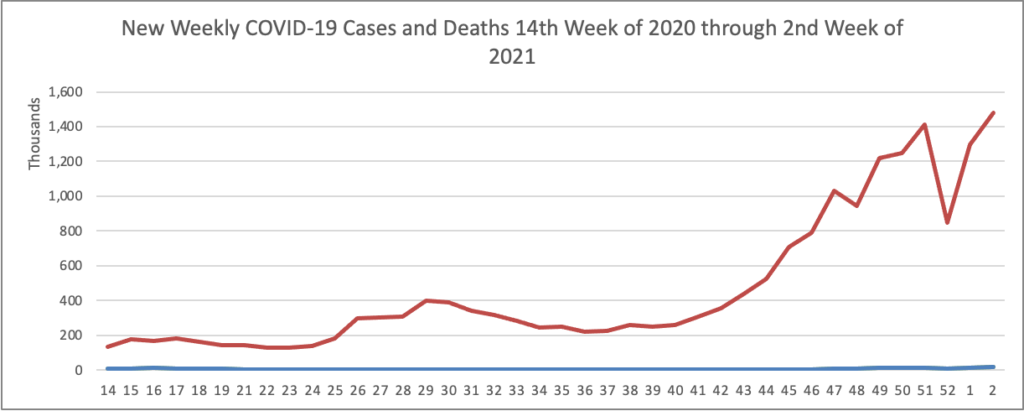
Based on the CDC’s COVID Data Tracker website, here is the FEHBlog’s chart of new weekly COVID-19 cases and deaths over the 14th week of 2020 through the second week of this year (beginning April 2, 2020 and January 13, 2021; using Thursday as the first day of the week in order to facilitate this weekly update):

and here is the CDC’s latest overall weekly hospitalization rate chart for COVID-19:

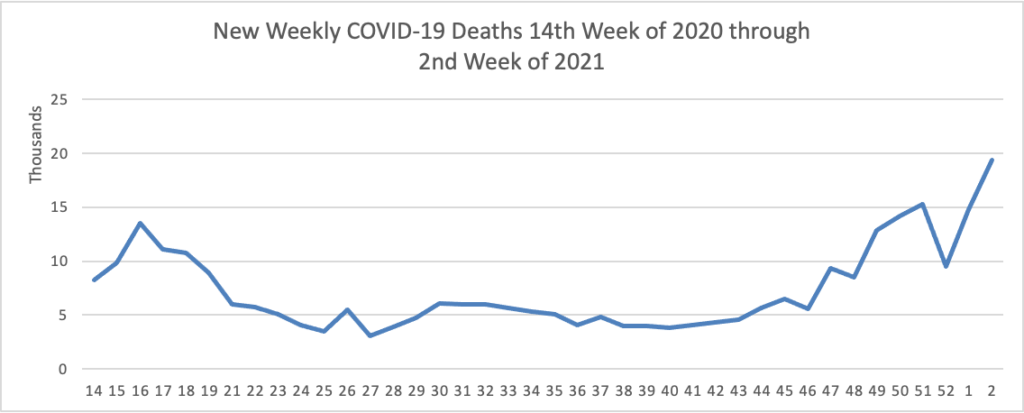
The FEHBlog has noted that the new cases and deaths chart shows a flat line for new weekly deaths  because new cases greatly exceed new deaths. Accordingly here is a chart of new COVID-19 deaths over the same period April 2, 2020 through January 13, 2021:

Finally here is a COVID-19 vaccinations chart for the past month which also uses Thursday as the first day of the week:

The CDC reports that as of today at 9 am roughly 10.6 million American have received one dose of either the Pfizer or Moderna vaccine and 1.6 million American have received both doses. 1.1 million doses of the vaccines were administered yesterday in total.

President-elect Biden announced additional members of his COVID-19 response team today, including

David Kessler, Chief Science Officer of COVID Response
David A. Kessler, M.D., who serves as a co-chair of the COVID-19 Task Force for President-elect Joe Biden, was the Commissioner of the Food and Drug Administration from 1990 to 1997, under Presidents George H. W. Bush and Bill Clinton. 

Per the American Hospital Association, this role will assume the responsibilities of the current head of Operation Warp Speed.” Beckers Hospital Review informed us on January 13 that “Moncef Slaoui, PhD, chief advisor of Operation Warp Speed, submitted his resignation at the request of President-elect Joe Biden’s team, although he’ll stay on for another month to oversee the transition to the new administration, CNBC reported Jan. 12. To close the loop NPR reports that the Biden Administration plans to retire the Operation Warp Speed moniker.

Also on the COVID-19 vaccine front, the Wall Street Journal reports tonight that

If manufacturing projections previously put forth by companies hold up, Mr. Biden’s pledge to administer 100 million doses of Covid-19 vaccines during the first 100 days of his presidency should be possible, according to manufacturing and supply chain experts. But efforts to significantly ramp up vaccines and curtail spread of the virus will depend on state partnerships and public buy-in for some public health measures. * * *

The success of the vaccination push rests in part on available supplies and the ability of a workforce to provide shots. Mr. Biden’s plan seeks to address both challenges through the expanded use of the Defense Production Act and a call for letting more people, including retired medical professionals, administer vaccines with training. He would also expand the use of pharmacies to provide vaccines.

The federally backed community vaccination centers would involve the Federal Emergency Management Agency, the National Guard and state and local teams. The administration would use federal resources and its emergency contracting authority to help launch the centers.

Midweek Update

Photo by Manasvita S on Unsplash

Bloomberg reports that Johnson & Johnson now expects to receive Food and Drug Administration emergency use authorization for its single dose COVID-19 vaccination in late February or early March 2021 which is later than initially anticipated.

J&J’s vaccine offers advantages in ease of distribution and administration [over the currently authorized Pfizer and Moderna vaccines]. Health systems have been navigating relatively complex two-shot campaigns for vaccines from Pfizer and Moderna. J&J’s shot will likely protect people with a single dose, and can be stored at refrigerator temperatures for three months; the Pfizer and Moderna vaccines must be frozen. Speaking Wednesday at a JPMorgan Healthcare Conference event, [Moncef] Slaoui said he expects the J&J shot to have 80% to 85% efficacy, surpassing the objective the company outlined in its clinical trial design.

Speaking of the virtual annual JPMorgan Healthcare Conference, the National Law Review reports on Day 1 of the conference here and Day 2 of the conference there. Take a gander at this interesting tidbit from Day 1

[Blue Shield of California CEO] Paul Markovich spoke to the need for real-time quality information that can result in real-time feedback and incentivization to physicians and other providers, rather than the costly and slow HEDIS pursuits we see today.  One health plan noted that it spends about $500 million a year going into physician offices looking at medical records for HEDIS pursuits, but the information is totally “in the rearview mirror” as it is too old when finally received and digested to allow for real-time treatment changes, improvement or planning.  Markovich suggested four initiatives (including the above, pay for value and shared decision making through better, more open data access) that he thought could save $100 billion per year for the country.  Markovich stressed that all of these four initiatives required a digital ecosystem and asked for help and partnership in creating one. He also noted that the State of California is close to creating a digital mandate and statewide health information exchange that could be the launching point for this exciting vision of data sharing and a digital ecosystem where the electronic health record is the beginning, but not the end of the healthcare data journey.

Health Payer Intelligence informs us that

The tension between payers and pharmaceutical companies over drug pricing has carried into 2021, as evidenced by a press release from America’s Health Insurance Plans (AHIP) criticizing pharmaceutical companies for January 2021 drug pricing increases.

“Americans are being hurt by out-of-control drug prices, which are set and fully controlled by Big Pharma alone,” Matt Eyles, president and chief executive officer of AHIP, said in a related blog post.

“The incoming Biden-Harris administration should focus on bipartisan, workable solutions to protect patients, taxpayers, and all Americans from higher drug prices, especially in the midst of the ongoing COVID-19 crisis.”

Meanwhile STAT News reports that

In an unexpected move, the high-profile billionaire [Mark Cuban] has launched the Mark Cuban Cost Plus Drug Company, which its website says is “dedicated to producing low-cost versions of high-cost generic drugs” and claims that everyone will get the same low price for every drug it makes.

As part of its mission, the company pledged to provide “radical transparency” about its manufacturing, distribution, and marketing costs. The plan is to add a flat 15% margin to wholesale prices to ensure profitability, but Cuban also promised there will be no hidden costs, no middlemen, and no rebates available only to insurers.

“This is our first step towards taking on the pricing of generic drugs,” Cuban tweeted in announcing the company, which will start by producing a medicine to treat parasites, but plans to introduce more than 100 other medicines by the end of 2021. There are also plans to build a factory in Dallas by next year, according to its web site.

The article reminds us that

[In 2018] several large hospital systems form[ed] Civica Rx, a nonprofit that contracts with manufacturers to ensure sufficient supplies to hospitals across the U.S. The idea is to entice companies, which make injectable and infused medicines but have a minimum amount of sales, to ramp up investment in production. The Civica network, which began with $100 million in capital and loans from three philanthropic organizations, now has more than 50 health systems that represent more than 1,200 hospitals and over 30% of all licensed U.S. hospital beds. The nonprofit is also teaming with the Blue Cross Blue Shield Association and 18 of its health plans to supply copycat medicines and combat rising prices.

Bleeping Computer provides us with an update on the SolarWinds backdoor hack, including an explanation of how the hack was implemented and the hacker’s various malware strains.

A week ago, the FBI, CISA, and the NSA also disclosed in a joint statement that a Russian-backed Advanced Persistent Threat (APT) group is likely behind the SolarWinds hack.

“The U.S. government and many private-sector experts have stated the belief that a foreign nation-state conducted this intrusive operation as part of a widespread attack against America’s cyberinfrastructure,” SolarWinds CEO Sudhakar Ramakrishna said today.

“To date, our investigations have not independently verified the identity of the perpetrators.”

Tuesday Tidbits

Photo by Patrick Fore on Unsplash

Good news. The Wall Street Journal reports

The Trump administration is releasing second doses of coronavirus vaccines that were reserved for booster shots and is urging states to give the vaccine to anyone age 65 and older, as well as to people with pre-existing health conditions, a shift in strategy that vastly expands the pool of those eligible for shots while presenting another hurdle for the logistics of administering the vaccine at state and local levels.

Starting in two weeks, doses will be allocated based on the pace that states say they are administering the vaccine, as well as the size of a state’s population of people age 65 and older. 

Health and Human Services Secretary Alex Azar announced the plan on ABC’s “Good Morning America” on Tuesday. “We now believe that our manufacturing is predictable enough that we can ensure second doses are available to people from ongoing production. So everything is now available to our states and our health-care providers,” he said.

The government had been allocating about half of newly available doses from Pfizer Inc. and Moderna Inc. to states since the vaccine rollout began last month. Federal officials said there is enough supply to ensure booster shots will be available and that they won’t extend the current recommended dosing schedules.

Drug makers expect to be able to produce enough vaccine doses to accommodate the new plans, vaccine manufacturers and supply-chain experts say.

The Journal also explains that while scientists are confident that the COVID-19 vaccines will protect you from contracting the disease, they don’t know yet whether they will prevent you from spreading the disease asymptomatically.

“Most vaccines prevent disease as opposed to preventing infection,” says Anna Durbin, a professor of international health at Johns Hopkins Bloomberg School of Public Health who is working on the AstraZeneca Covid-19 vaccine trial and previously worked on the Pfizer vaccine trial. She believes Covid vaccine studies will eventually show a reduction in asymptomatic transmission but not a complete elimination.

Even if vaccines don’t prevent transmission completely, they can still help populations achieve herd immunity if enough people take them, says Arnold Monto, an epidemiology professor at the University of Michigan School of Public Health who chairs the U.S. Food and Drug Administration’s Vaccines and Related Biological Products Advisory Committee. “We can still accomplish a lot even if it is demonstrated that there is still some asymptomatic infection occurring post-vaccination,” says Dr. Monto.

STAT News reports that the Pharmaceutical Care Management Association (“PCMA”) has asked the federal district court in DC to block a Trump Administration rule preventing the use of prescription drug manufacturer rebates in the Medicare Part D program. PCMA contends that the CMS rule impermissibly conflicts with a statutory exemption permitting the use of such rebates in Medicare Part D. Of course.

The Biden administration, which is set to take office on Jan. 20, could also choose not to defend the rebate policy in court, thus mooting the lawsuit.

Biden has not yet taken a position on eliminating drug rebates, but a number of prominent Democrats, including House Speaker Nancy Pelosi have spoken out against the policy as a ndout to the pharmaceutical industry.

Studies —

The death rate from cancer in the U.S. dropped 2.4% from 2017 to 2018, the biggest single-year decline on record and a sign of the impact of new treatments on lung cancer especially, the American Cancer Society said.

It was the second year in a row with a record-setting drop, and the progress continues gains that have been made for more than a quarter-century, the cancer society said in a report published Tuesday. The researchers analyzed cancer mortality data from 1930 to 2018, before the start of the Covid-19 pandemic.

Overall, the cancer mortality rate has fallen 31% since its peak in 1991, according to the report, which was published online in the journal CA: A Cancer Journal for Clinicians. The latest decline left the mortality rate at 149 deaths for every 100,000 people in the general population in 2018, according to the American Cancer Society.

Use of telehealth jumped sharply during the first months of the coronavirus pandemic shutdown, with the approach being used more often for behavioral health services than for medical care, according to a new RAND Corporation study.

Between mid-March and early May 2020, telehealth was used by more than 40% of patients with a chronic physical health condition and by more than 50% of those with a behavioral health condition, according to findings published in the Journal of General Internal Medicine.

Overall, almost half of the people who were undergoing treatment when the pandemic shutdown began reported using some form of telemedicine.

Researchers found that the use of telehealth for behavioral health conditions was lower among women and among people over the age of 60. Use of telehealth also was lower among non-Hispanic whites relative to non-Hispanic Blacks, and was lower among those with less than a high school education relative to those with a college degree.

Monday Roundup

Photo by Sven Read on Unsplash

The Centers for Medicare and Medicaid Services has released a COVID-19 Vaccine Toolkit for health insurance issuers and Medicare Advantage plans. The toolkit’s purpose is as follows:

CMS is committed to ensuring that the private health insurance industry has the necessary tools to respond to the COVID-19 public health emergency (PHE). As safe and effective COVID- 19 vaccines become available, CMS issued this toolkit to help health insurance issuers and Medicare Advantage plans identify the issues that need to be considered and addressed in order to provide coverage and reimbursement for vaccine administration. Because COVID-19 vaccines will be federally purchased, this toolkit primarily focuses on vaccine administration. CMS remains available to provide technical assistance to issuers, Medicare Advantage plans, and other stakeholders. This toolkit:
• Provides a list of operational considerations for issuers and Medicare Advantage plans as they design their approach to promoting COVID-19 vaccinations and information on how issuers and Medicare Advantage plans can communicate with providers and enrollees on vaccinations and coverage;
• Outlines legislative and regulatory provisions applicable to issuers that ensure that enrollees can receive a COVID-19 vaccine in a convenient setting, with no out-of-pocket costs;
• Encourages issuers and Medicare Advantage plans to implement streamlined processes to quickly administer COVID-19 vaccine coverage; and • Describes how issuers and Medicare Advantage plans can maximize the number of their enrollees who get vaccinated once a COVID-19 vaccine becomes available

Meanwhile the Centers for Disease Control have released facts sheets on what to expect after you receive your first dose of COVID-19 vaccine and how to improve ventilation in your house during the great hunkering down.

Benefits Pro reports that the Equal Employment Opportunity Commission is poised to release proposed rules addressing the level of incentives employers may lawfully offer to encourage employee participation in wellness programs that require disclosure of medical information. “

Because the {Americans with Disabilities Act] ADA and [Genetic Information Non-Discrimination Act] GINA do not define “voluntary,” the NPRM proposes that in order to comply with the acts, employers may offer no more than a “de minimis” incentive to encourage participation in wellness programs. The exception would be for “wellness programs that are part of, or qualify as, group health plans and that require employees to satisfy a standard related to a health factor to receive a reward or avoid a penalty,” according to the proposed rule under the ADA.

Under the GINA regulation, the proposed rule makes an exception that would allow incentives for genetic information “when a wellness program offers an employee an incentive in return for his or her family member providing information about the family member’s manifestation of disease or disorder.”