Tuesday Tidbits

Tuesday Tidbits

The Wall Street Journal reports tonight that

The most severe surge of the Covid-19 pandemic in the U.S. has weakened significantly, according to key metrics, though public-health experts and epidemiologists urge caution, given the spread of highly contagious new variants.

Newly reported cases have dropped 56% over the past month, based on a seven-day average, marking a significantly steeper fall than the U.S. saw after the spring and summer surges. Hospitalizations have declined 38% since Jan 6. The seven-day average of Covid-19 tests returning positive fell over the past week to 6.93%, the lowest since Oct. 31.

“The concern right now is that while we’re seeing a decline in cases from the holiday surges, as we identify more transmission of the variants within the U.S., this could lead to another surge,” said Saskia Popescu, an assistant professor at the Schar School of Policy and Government at George Mason University.

The American Medical Association reports

[A]s part of its “Understanding Coronavirus in America” study, researchers from the University of Southern California Center for Economic and Social Research recently analyzed data from 6,000 members drawn from its “Understanding America Study.” Data was collected between March 10, 2020, and Jan. 6, 2021, and found that 83% of adults surveyed view wearing a mask as an effective way to stay safe from COVID-19, but that their behavior is inconsistent.

The analysis found:

Two-thirds reported being within less than six feet of someone outside their household in early December, but only half mostly or always wore a mask while doing so.
White people were the least likely to consistently wear a mask when in close contact with people from other households, with 46% reporting wearing a mask compared to 67% of black people, 63% of Latinos and 65% of people of other races.
In rural areas, 42% reported always wearing a mask or wearing one most of the time when they were with people outside of their household. In suburban areas, the number jumped to 52% and it was highest in urban areas at 57%.
Among the 81% who said they went grocery shopping in early December, 90% reported wearing a mask.

This is why the vaccination campaign is so important.

On the Capitol Hill front

  • The Hill explains Sen. Ron Wyden’s plans as the new Chair of the Senate Finance Committee. The Senator has been a critic of high prescription drug prices.
  • The Hill also reports the House of Representatives is developing a COVID-19 relief budget reconciliation bill that would increase and expand the availability of Affordable Care Act subsidies as well as offer 85% subsidies for employer sponsored plan continuation coverage, i.e., COBRA and TCC, during 2021 and 2022.

On the Biden Administration transition front —

  • NPR discusses Office of Management and Budget Director nominee * Neera Tanden’s confirmation hearing before the Senate Homeland Security and Governmental Affairs Committee today. Ms Tanden has a second confirmation hearing scheduled before the Senate Budget Committee tomorrow morning.
  • Federal News Network informs us that President “Biden recently appointed Pam Coleman as OMB’s new associate director for performance management, the agency’s point person on federal workforce issues. * * * Coleman comes from the New Mexico state government, where she led the personnel office for the last two years. Coleman had multiple roles in the Obama administration, including as a leadership development team lead in the White House Presidential Personnel Office and as a liaison to DHS. The OMB associate director for performance management is usually the agency’s go-to on everything from federal pay and benefits to hiring and labor relations. Biden hasn’t yet nominated a new director for the Office of Personnel Management.”
  • STAT News compares the two leading contenders for Food and Drug Administration Dr. Janet Woodcock, the current acting commissioner, “and Josh Sharfstein, a vice dean at the Johns Hopkins Bloomberg School of Public Health who served as the FDA’s second-in-command during the Obama administration.” Dr. Woodcock is an FDA vet while Dean Sharfstein would be “only the second FDA commissioner in modern history to serve as a local public health official. While most FDA commissioners typically come from backgrounds in academic medicine or from other federal agencies, and thus tend to focus primarily on the regulation of drugs, Sharfstein has been far more outspoken about the FDA’s lesser known responsibilities, like regulating cigarettes and food.”

In other tidbits —

  • Beckers Hospital Review lists the HealthGrades top fifty U.S. hospitals for January 2021.
  • Govexec reports on the Postal Service’s latest quarterly financial report and a looming Postal Board of Governors power shift from Republicans to Democrats.
  • The Society for Human Resource Management seeks to keep us up to date on “evolving COVID-19 testing and safety guidelines [for employers] as the pandemic persists.”

Monday Roundup

Photo by Sven Read on Unsplash

The Wall Street Journal reports today that

As vaccinations speed up across the U.S., key Covid-19 metrics are declining from a record-setting fall surge. Newly reported cases fell below 100,000 for the first time this year. Hospitalizations dropped for the 26th day in a row, and the number of Covid-19 patients requiring intensive-care treatment fell to its lowest level since Nov. 19.

The country is now averaging about 1.4 million vaccinations a day, and nearly 10% of the U.S. population has been given at least one dose, according to a Wall Street Journal analysis of data from the Centers for Disease Control and Prevention. Demand is so high in some states it is overwhelming local providers and frustrating people seeking shots.

The Journal also offers an op-ed by former Food and Drug Commissioners and Doctors Scott Gottlieb and Mark McClellan recommending that the federal government start planning now for a potential “glut” of the COVID-19 vaccine beginning in the summer of this year. “It is essential to emphasize in public-health messaging that every adult can benefit and deserves the protections they can provide, and there will be no reason to forgo it once the scarcity problem is solved.”

Fierce Healthcare reports that

Healthcare spending is expected to balloon to $8.3 trillion by 2040, which is $3.5 trillion less than a federal government estimate, a new report from consulting firm Deloitte finds.

The reason for the discrepancy is that consumers will take a more active role in their healthcare and therefore help curb spending, including by getting early signals of disease and addressing them proactively, according to the report released Monday.

“We anticipate that emerging technologies, an ability to cure and prevent disease (or detect disease in the earliest stages), and highly engaged consumers will lead to a deceleration of health spending between now and 2040,” the report said.

Here’s hoping.

Health Payer Intelligence informs us that “Payers are not leveraging care management to its fullest capacity and they have an opportunity reform their care management programs to improve quality of care and return on investment, a report from McKinsey & Company (McKinsey) found.” The report recommends four steps which the article describes in more detail”

First, the report recommended that payers target high-potential sources of value.

Second, payers should leverage care management to address clinically inappropriate healthcare spending, instead of seeking only to reduce total healthcare spend.

Third, the researchers urged payers to embrace consumerism.

Finally, payers should adopt operational metrics and disciplines to govern their care management programs

In the FEHBlog’s experience, good advice, like this, is always worth consideration but also is easier said than done.

In other news —

  • Politico recently reported that “Chiquita Brooks-LaSure, a longtime Democratic health policy expert, has emerged as the leading candidate to run President Joe Biden’s Medicare and Medicaid agency, according to three sources familiar with the Biden team’s discussions.”
  • Reuters reported that a federal district judge has dismissed Walmart’s lawsuit, filed last October, “seeking to preemptively block the U.S. government from blaming the world’s largest retailer for its alleged role in fueling the nation’s opioid crisis. U.S. District Judge Sean Jordan said the government had not waived its sovereign immunity from Walmart’s “sweeping” challenge to the Department of Justice’s and Drug Enforcement Administration’s enforcement of laws governing opioid prescriptions by pharmacies and pharmacists.” Not surprisingly this lawsuit did not deter the Justice Department’s lawsuit against Walmart. Walmart plans to appeal this decision.
  • The Internal Revenue released today the 2021 version of its popular Employer’s Tax Guide to Fringe Benefits (Publication 15-B).

Weekend Update

Image result for super bowl

Happy Super Sunday LV!

The House of Representatives is engaged in committee work. The Senate is engaged in floor and committee work. The Wall Street Journal reports that

Senate Democrats said they expect a short impeachment trial starting this week for former President Donald Trump as they also seek to push ahead with the Biden administration’s proposed $1.9-trillion economic-relief bill.

The two events, combined with continuing hearings and votes on President Biden’s cabinet nominees, presage competing priorities as the new Democratic majority—which is reliant on Vice President Kamala Harris to break tied votes—is still figuring out key details on the trial process and on what provisions to include in the bill.

The Senate Homeland Security and Governmental Affairs is holding a confirmation hearing for Office and Management and Budget Director nominee Neera Tanden on Tuesday morning. The Senate Health Education Labor and Pension Committee is holding a confirmation hearing for the President’s Education Secretary and Labor Secretary nominees on Thursday morning.

On the COVID-19 front

  • The Wall Street Journal’s lead article this afternoon reports that

Vaccination drives hold out the promise of curbing Covid-19, but governments and businesses are increasingly accepting what epidemiologists have long warned: The pathogen will circulate for years, or even decades, leaving society to coexist with Covid-19 much as it does with other endemic diseases like flu, measles, and HIV. The ease with which the coronavirus spreads, the emergence of new strains and poor access to vaccines in large parts of the world mean Covid-19 could shift from a pandemic disease to an endemic one, implying lasting modifications to personal and societal behavior, epidemiologists say.

That’s not a shocker in the FEHBlog’s book. An endemic status would be a vast improvement over what we have faced for the past year.

  • Speaking of which, NPR Shots offers the latest advice on upgrading your COVID-19 masks.

“A cloth mask might be 50% effective at blocking viruses and aerosols,” says Linsey Marr, a researcher at Virginia Tech who studies airborne virus transmission. “We’re at the point now … that we need better than 50%.” When you’re outdoors, where fresh air can quickly disperse virus droplets and smaller particles, a cloth mask is still fine, Marr says. But infectious particles can accumulate indoors, and that’s when you want a better mask. “I am now wearing my best mask to the grocery store. I wasn’t before,” Marr says.

The article explains what Ms. Marr means.

Scientists probing the origins of the coronavirus are wrapping up a lengthy investigation in China and have found “important clues” about a Wuhan seafood market’s role in the outbreak. Peter Daszak, a New York-based zoologist assisting the World Health Organization-sponsored mission, said he anticipates the main findings will be released before his planned [Wednesday] Feb. 10 departure.  * * * “It’s the beginning of hopefully a really deep understanding of what happened so we can stop the next one,” he said over Zoom late Friday. “That’s what this is all about — trying to understand why these things emerge so we don’t continually have global economic crashes and horrific mortality while we wait for vaccines. It’s just not a tenable future.”

In miscellaneous healthcare news —

As every financial professional worth their salt knows, HSAs are a unicorn in the tax world. The accounts are funded with pretax income, grow tax-free and are not taxed when used for eligible expenses — the “triple tax” benefits for which they are so renowned. They represent one of the most efficient ways to squirrel away money for retirement. But they are also kneecapped by their pairing with high-deductible health plans, which are not always optimal for people who regularly anticipate big medical bills.

And while more people have opened HSAs, largely as more employers have opted for high-deductible plans, they are used more like checking accounts than as the long-term saving and investing vehicles they were designed to be.

The pandemic also appears to be having some consequences for HSA use, with those affected by job loss depleting their accounts and those who have remained employed being able to save more than ever, financial advisers say.

The FEHBlog believes that health plans should educate members about getting the most out of their HSA arrangements.

  • A friend of the FEHBlog pointed out that on February 5, the Food and Drug Administration “authorized marketing of a new prescription only device [know as eXciteOSA] intended to reduce snoring and mild obstructive sleep apnea. Unlike devices used while patients sleep, this is the first device used while awake that is intended to improve tongue muscle function, which in time can help prevent the tongue from collapsing backwards and obstructing the airway during sleep.”

Friday Stats and More

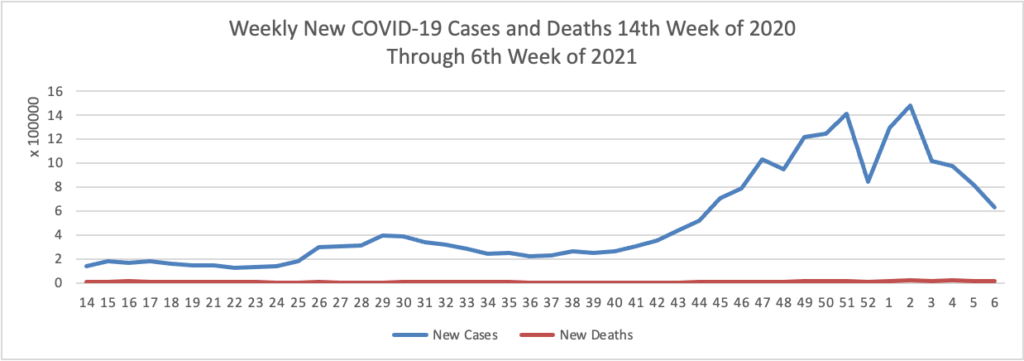
Based on the Centers for Disease Control’s COVID Data Tracker website, here is the FEHBlog’s weekly chart of new COVID-19 cases and deaths over the 14th week of 2020 through 5th week of this year (beginning April 2, 2020 and ending February 3, 2021; using Thursday as the first day of the week in order to facilitate this weekly update):

and here is the CDC’s latest overall weekly hospitalization rate chart for COVID-19:

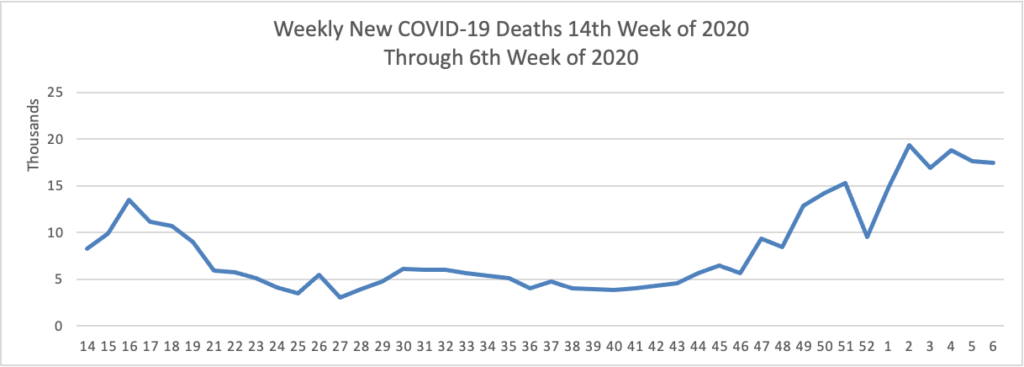
The FEHBlog has noticed that the new cases and deaths chart shows a flat line for new weekly deaths because new cases greatly exceed new deaths. Accordingly here is a weekly chart of new COVID-19 deaths over the same period April 2, 2021 through February 3, 2021:

COVID-19 cases and hospitalizations are dropping, but deaths are not as yet. because deaths are considered to be a lagging indicator. The chart does point to the importance of vaccinating the elderly as soon as possible.

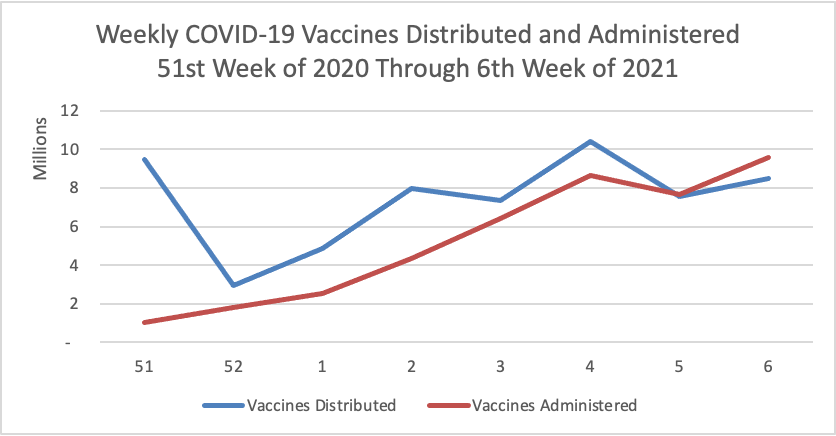
Here is a COVID-19 vaccinations chart for the past month which also uses Thursday as the first day of the week:

The CDC’s Fluview informs us that “Seasonal influenza activity in the United States remains lower than usual for this time of year.” Moreover, “46%: That’s how much U.S. sales of over-the-counter cold, flu, and cough medicine declined in the five week period ending Dec 26, 2020 from the same period last year, according to data from Nielsen, reported by Bloomberg.” These statistics suggest that Americans generally are following the social distancing and masking rules. Nevertheless the CDC recommends how to celebrate Super Sunday safely.

In Capitol Hill news, the Senate last night approved the Democrat’s budget resolution with Vice President Harris breaking the 50-50 vote from the Senators. The Wall Street Journal reports that today

The House approved a budget bill advancing President Biden’s $1.9 trillion relief plan, as Mr. Biden met with top House Democrats and lawmakers dived into crafting the details of the relief package.  The 219-209 vote marked a further step under budget reconciliation, a process that would allow Democrats to pass the relief package without Republican support in the Senate. Now, Democrats will turn to ironing out the details of the package over several weeks, including deciding who will be eligible for $1,400 direct payments and whether or not to raise the minimum wage to $15 an hour

The Journal also reports that a New York State court has ordered local authorities to certify the election of Republican Claudia Tenney in the last undecided U.S. House of Representatives race from the 2020 election. “Ms. Tenney is the second New York Republican to unseat an incumbent Democrat in 2020. She will be the 212th GOP House lawmaker, bringing the margin of Democratic control in the House to nine members.”

In healthcare news

  • The American Health Association reminds us that this February commemorates the 57th Heart Month.

Heart disease continues to be the greatest health threat to Americans and is still the leading cause of death worldwide, according to the AHA’s Heart Disease and Stroke Statistics – 2021 Update. The update, published in the association’s flagship journal Circulation, reports that nearly 18.6 million people across the globe died of cardiovascular disease in 2019, the latest year for which worldwide statistics are calculated. That’s a 17.1% increase over the past decade. And 523.2 million cases of cardiovascular disease were reported in 2019, a 26.6% increase over 2010.

During American Heart Month, the AHA and other organizations reinforce the importance of heart health, the need for more research and efforts to ensure that millions of people live longer and healthier. In most cases, heart disease is preventable when people adopt a healthy lifestyle, which includes not smoking, maintaining a healthy weight, controlling blood sugar and cholesterol, treating high blood pressure, getting at least 150 minutes of moderate-intensity physical activity a week and getting regular checkups. 

  • Health Payer Intelligence informs us that

Blue Cross and Blue Shield of North Carolina (Blue Cross NC) has introduced a value-based care program that focuses on improving health outcomes for members with kidney disease through coordinated and patient-centered care. The initiative, launched on January 1, is the newest feature in the industry-leading Blue Premier value-based care model. Eligible Blue Cross NC members can enroll in the Blue Premier Advanced Kidney Care program at no additional cost.

Thursday Miscellany

Photo by Juliane Liebermann on Unsplash

From the COVID-19 front —

  • Politico reports that “Johnson & Johnson filed Thursday for emergency use authorization [“EUA”] of its single-dose coronavirus vaccine, readying for a pivotal third option in the battle to immunize hundreds of millions of Americans.” This is the single dose vaccine that can be stored in regular pharmacy refrigerators. Following the same pattern as the first two EUA applications for COVID-19 vaccines, the Food and Drug Administration has set an advisory committee hearing on the Johnson & Johnson EUA for February 26. This indicates that the FDA will approve the application on February 28 / this month. That is very good news.
  • Healthcare coaching service TrestleTree has made available its useful “State-by-State COVID-19 Vaccination Access Guide.” Muchos gracias.
  • The American Hospital Association (AHA), American Medical Association (AMA), and American Nurses Association (ANA) released a [joint] public service announcement (PSA) today urging the American public to get the COVID-19 vaccination when it is their turn. 
  • Reuters reports that “Almost all people previously infected with COVID-19 have high levels of antibodies for at least six months that are likely to protect them from reinfection with the disease, results of a major UK study showed on Wednesday. Scientists said the study, which measured levels of previous COVID-19 infection in populations across Britain, as well as how long antibodies persisted in those infected, should provide some reassurance that swift cases of reinfection will be rare.”

From Capitol Hill, CBS News informs us that “The Senate is expected to vote on a budget resolution sometime before the weekend, an important step to passing President Biden’s $1.9 trillion COVID-19 relief proposal through the process of reconciliation, which allows legislation to pass with only a simple majority instead of the typical 60-vote threshold.  But before there can be a final vote on the resolution, Republicans are forcing Democrats to go on the record with a series of votes on a slew of amendments in a politically painful process known as a “vote-a-rama.” Bloomberg adds that this afternoon, “[t]he Senate backed by 99-1 a non-binding call to oppose stimulus checks going to “upper-income taxpayers” — one of a series of messaging votes the chamber is taking in a complex process of preparing President Joe Biden’s $1.9 trillion Covid-19 relief plan for passage through Congress.”

Health Payer Intelligence tells us about health plan trade association efforts to convince the Biden Administration to undo certain Trump Administration actions.

In healthcare corporate news, Healthcare Dive reports

  • Cigna’s net income for the fourth quarter of 2020 was $4.1 billion, a huge increase from the $977 million in the fourth quarter of 2019, partly because of the $6.2 billion sale of its life insurance business, which was completed on Dec. 31. The payer’s medical cost ratio in the fourth quarter was 85.8%, up from 82.3% the prior year because of COVID-19 treatment and testing costs and above Wall Street expectations. In a call with investors Thursday morning, CFO Brian Evanko said deferred care increased in the latter part of the quarter but was outweighed by COVID-19 costs.

and

  • UnitedHealth CEO Dave Wichmann is retiring and will be replaced as chief executive by Andrew Witty, currently the CEO of health services unit Optum. Witty will continue running Optum and become CEO immediately, with Wichmann assisting in a transition period through March, UnitedHealth announced Thursday. Dirk McMahon, CEO of payer business UnitedHealthcare, will become president and chief operating officer, and joins CFO John Rex to round out the Minnetonka, Minnesota-based healthcare behemoth’s C-suite.

From the opioid front

  • The Wall Street Journal reports that “State attorneys general intensified pressure on drug companies to settle claims over the opioid crisis, following consulting firm McKinsey & Co.’s agreement to pay nearly $600 million over its advice to pharmaceutical companies to rev up sales. * * * States have been negotiating since 2019 with the nation’s three largest drug distributors, McKesson Corp. , AmerisourceBergen Corp. , Cardinal Health Inc., as well as drugmaker Johnson & Johnson. The companies have publicly disclosed that they have set aside a collective $26 billion for the deal, most of it to be paid over 18 years, but no final agreement has been reached. In news conferences Thursday, attorneys general said they hoped the McKinsey deal would provide momentum for a bigger settlement, if others facing litigation follow the consulting company’s lead.”
  • Late last month, the Bloomberg School of Public Health announced that “A coalition of 31 professional and advocacy organizations has released a set of principles aimed at guiding state and local spending of the forthcoming opioid litigation settlement funds. The coalition, coordinated by faculty at the Johns Hopkins Bloomberg School of Public Health, is urging state and local officials to avoid the mistakes of the 1998 tobacco settlement and use the expected settlement funds to support evidence-based strategies that save lives. The need for evidence-based funding strategies is especially urgent now, as deaths due to opioid drug overdoses have significantly increased since the COVID-19 pandemic began, with some states reporting increases of 30%.”
  • The Health and Human Services Office of Inspector General today released a report on opioid use in Medicare Part D during the first phase of the COVID-19 public health emergency. “As the pandemic took hold, about 5,000 Medicare beneficiaries per month suffered an opioid overdose during the first 8 months of 2020.”

Midweek Update

Photo by Piron Guillaume on Unsplash

The Hill reports that “New coronavirus cases in the U.S. have fallen to pre-Thanksgiving levels, the head of the Centers for Disease Control and Prevention (CDC) said Wednesday, and infection rates are continuing to decline. ‘We now appear to be in a consistent downward trajectory’ for both cases and hospital admissions, CDC Director Rochelle Walensky told reporters during a White House COVID-19 briefing.” * * * Walensky cautioned Americans not to let their guard down, especially as variants that likely have increased transmissibility continue to multiply.”

Roll Call informs us that “The Senate broke out of limbo Wednesday, adopting a power-sharing resolution that allows for committees to organize and Democrats to take the [committee] gavels after a month of tenuous and divided control. Majority Leader Charles E. Schumer brought the resolution to the floor Wednesday evening and it was adopted by unanimous consent.”

From the fourth quarter 2020 earnings front, Healthcare Dive lets us know that

  • An uptick in COVID-19 testing and treatment led Humana to report a loss for the fourth quarter of 2020 of $2.07 per share and a pre-tax loss of $458 million, a large swing from a pre-tax income of $593 million during the prior-year period. Analysts had expected an adjusted loss of $2.37 per share, but Humana slightly beat expectations with an adjusted loss of $2.30 per share. The payer said the increase in COVID-19 care experienced during the last two months of the quarter was coupled with a decline in non-COVID-19 utilization after largely returning to normal levels. The decline was about 15% below the normal baseline, executives said during Wednesday’s call with investors. Still, Humana remained in the black for the full year of 2020. It posted pre-tax income of $4.6 billion for the full year, a 33% increase compared with 2019.

and

  • HCA Healthcare beat Wall Street expectations on both earnings and revenue in the fourth quarter of 2020, as high-acuity patients and cost controls made up for a slow recovery in volume during the strongest surge in COVID-19 patients to date. [From HCA’s website: HCA Healthcare is comprised of more than 180 hospitals and 2,000+ sites of care in 21 states and the United Kingdom.] Revenue of $14.3 billion was up almost 6% year over year, while net income of $1.4 billion was up 33% year over year for the for-profit system, according to financial results released Tuesday. HCA released full-year guidance for 2021, and expects to bring in revenue between $53.5 billion and $55.5 billion this year, and adjusted earnings per share of $12.10 to $13.10. HCA stock was up slightly in early morning trading following the release.

In healthcare news

  • The Government Accountability Office recently released a report on public impact of rural hospital closings.

Rural hospitals provide essential health care to rural communities. Yet, over 100 rural hospitals closed from January 2013-February 2020. When rural hospitals closed, people living in areas that received health care from them had to travel farther to get the same health care services—about 20 miles farther for common services like inpatient care. People had to travel even farther—about 40 miles—for less common services like alcohol or drug abuse treatment. Before rural hospitals closed, counties where these hospitals were located had fewer doctors than counties without any closures. The number of doctors further decreased when hospitals closed.

Heal, a company that offers both telemedicine and doctor house calls, has expanded its service to Illinois, Louisiana, North Carolina and South Carolina. In addition to large cities such as Chicago, Heal is targeting rural or low-income areas such as Lafayette, Louisiana, noted Nick Desai, co-founder and CEO of Heal.

“When you look at specific areas where we are expanding, for example, Lafayette, Louisiana, many of these patients do not have other options when it comes to quality healthcare,” Desai told Fierce Healthcare. “That’s why we want to bring Heal to areas like this, ultimately elevating quality of care for patients that might be struggling to pinpoint the right solutions.”

  • The Healthcare Transformation Taskforce calls our attention to the Maternal Health Hub website which The Commonwealth Fund supports and the Task Force manages. Check it out.

Tuesday Tidbits

Photo by Patrick Fore on Unsplash

President Biden announced that his Administration is increasing the weekly COVID-19 vaccine supply released to States, etc., and starting on February 11 to supply partner pharmacies with vaccine to administer the vaccine to customers.

The Society for Human Resource Management brings us to date on OSHA efforts to implement one of the President’s executive orders by issuing “worker safety guidance for coronavirus protection programs on Jan. 29, requiring greater input from employees and enhanced mask protections.”

The Hill provides us with the latest on efforts to pass a sixth COVID-19 relief bill in Congress. Govexec reports that a bicameral, bipartisan push is underway inn Congress to repeal the Postal Service’s unique obligation to refund its employees FEHB coverage in retirement.

In other interesting healthcare news

  • Becker’s Payer Issues reports that “Cigna will no longer require prior authorization for some CT scans of the heart, according to an updated precertification list. The change is effective Feb. 1. * * * In addition, Cigna removed prior authorization for fractional flow reserve-computed tomography. For coverage under the policy, patients must have stable chest pain and an intermediate risk of coronary artery disease. “The favorable policy update shows that Cigna recognizes the use of CTA and FFR-CT as a front-line test which can lead to improved patient outcomes,” Dustin Thomas, MD, chair of the society’s advocacy committee, said in a news release.”
  • Access Management Intelligence informs us that “Ascent Health Services (Ascent Health) is a pharmaceutical group purchasing organization that is part of Evernorth, a subsidiary of Cigna Corporation. Humana has agreed to join Ascent Health in a move that the health insurer says will help drive down its drug costs for its [1.3 million] commercial members. Beginning April 1, Humana will join Ascent Health to give it access to greater discounts from drug makers. Ascent Health manages commercial rebates, the payments that drug makers make to health plans. The agreement covers drug contracting and negotiations for Humana’s commercial business.

Monday Roundup

Photo by Sven Read on Unsplash

Good news on the COVID-19 front —

Bloomberg’s headline story this evening is that

More Americans have received at least one dose of a Covid-19 vaccine than have tested positive for the virus, an early but hopeful milestone in the race to end the pandemic.

As of Monday afternoon, 26.5 million Americans had received one or both doses of the current vaccines, according to data gathered by the Bloomberg Vaccine Tracker. Since the first U.S. patient tested positive outside of Seattle a year ago, 26.2 million people in the country have tested positive for the disease, and 441,000 have died, according to data from Johns Hopkins University.

The U.S. has been administering shots at a faster daily rate than any country in the world, giving about 1.35 million doses a day, according to data gathered by Bloomberg. While the rollout stumbled in its early days, in the six weeks since the first shots went into arms almost 7.8% of Americans have gotten one or more doses, and 1.8% are fully vaccinated.

“It’s worth noting that today, for the first time, the data said that more people were vaccinated than were reported as newly diagnosed cases,” said Paula Cannon, a professor of microbiology at the University of Southern California’s Keck School of Medicine. “That’s worth celebrating. I’m all for that win.

A New York Times columnist earlier today explained

Right now, public discussion of the vaccines is full of warnings about their limitations: They’re not 100 percent effective. Even vaccinated people may be able to spread the virus. And people shouldn’t change their behavior once they get their shots.

These warnings have a basis in truth, just as it’s true that masks are imperfect. But the sum total of the warnings is misleading, as I heard from multiple doctors and epidemiologists last week.

“It’s driving me a little bit crazy,” Dr. Ashish Jha, dean of the Brown School of Public Health, told me.

“We’re underselling the vaccine,” Dr. Aaron Richterman, an infectious-disease specialist at the University of Pennsylvania, said.

“It’s going to save your life — that’s where the emphasis has to be right now,” Dr. Peter Hotez of the Baylor College of Medicine said.

The Moderna and Pfizer vaccines are “essentially 100 percent effective against serious disease,” Dr. Paul Offit, the director of the Vaccine Education Center at Children’s Hospital of Philadelphia, said. “It’s ridiculously encouraging.”

Let’s go.

On the COVID-19 testing front, the Wall Street Journal reports that

The Biden administration said it has reached a $230 million deal with Australian diagnostics company Ellume USA LLC to produce at-home, over-the-counter Covid-19 tests. 

The Food and Drug Administration previously authorized the test. So far, the FDA has cleared three Covid-19 tests that can be processed entirely at home, but Ellume’s is the only one that doesn’t require a prescription. None are widely available at this point. 

The company is expected to produce 19 million tests a month by the end of the year, Andy Slavitt, senior adviser to the White House Covid-19 response team, said Monday. Based on the agreement, 8.5 million tests will be guaranteed to the U.S. government. 

Smart move.

In other news —

  • Roll Call brings us up to date on the COVID-19 relief bill developments on Capitol Hill.
  • Katie Keith helpfully updates us on Affordable Care Act litigation in the Health Affairs blog.
  • Dispatch Health and Humana announced ” an [interesting] agreement to provide Humana members with access to an advanced level of care in the home – to help enhance patients’ experience and health outcomes. These services will be available in Denver, Colo., and Tacoma, Wash., with expansion to additional markets in Texas, Arizona and Nevada planned for later this year. The agreement will provide members living with multiple chronic conditions – such as cellulitis, kidney and urinary tract infections, chronic obstructive pulmonary disease, heart failure and many others – an opportunity to be treated safely at home and thereby avoid hospital visits. Last November, the U.S. Centers for Medicare & Medicaid Services announced a waiver program to allow qualified health care providers to offer acute, hospital-level care in the home. The Dispatch-Humana agreement is believed to be the country’s first program to provide hospital-level care involving a national payer.

In pharmacy C-suite news —

  • Healthcare Dive reports that “Karen Lynch has officially stepped into the CEO role at CVS Health [on February 1, 2021]. Lynch previously served as president of the Aetna business, and was a key figure in directing CVS Health’s COVID-19 response.”
  • AP reported last week that “Walgreens has tapped Starbucks executive Roz Brewer as its new CEO, which will make her the only Black woman leading a Fortune 500 company. Starbucks announced Tuesday January 26 that Brewer was departing after a little more than three years as its chief operating officer. Walgreens later confirmed that Brewer will take over as its CEO on March 15.

Good luck.

Weekend Update

Photo by Clarisse Meyer on Unsplash

Congress continues it floor and committee work this coming week. Committees are in engaged in organizational meetings on both sides of Congress. Senate Committees principally will be engaged in holding hearings on Presidential cabinet nomination.

The House Oversight and Reform Committee, whose jurisdiction includes the FEHBP, holds its organizational meeting tomorrow at 2 pm. The Chair will continue to be Rep. Carolyn Maloney (D NY) and the Ranking Member will be Rep. James Comer (R KY). The party ratio will be 25 Democrats and 20 Republicans.

Meanwhile, Bloomberg reports that

Joe Biden’s presidency began at a choreographed sprint, with a series of executive actions to erase Donald Trump’s legacy and reset the nation’s course. But as his first full week in office came to a close, the new president was discovering the limits of his power.

His administration’s efforts to bolster vaccine production ran into the same hurdles that plagued the Trump administration — bottlenecks both at factories and in clinics — and Biden’s advisers had to clean up after the president said any American would be able to get inoculated by the spring. * * *

[FEHBlog note — Per the CDC’s Vaccinations site, on average 1.3 million doses of COVID-19 vaccine were administered on Friday and Saturday.]

He’s meanwhile encountering familiar roadblocks in Congress, where just four of his cabinet nominees have been confirmed 12 days into his presidency, and he’s found no traction among congressional Republicans for another big stimulus bill. * * *

Ten GOP senators wrote to Biden on Sunday with an alternative proposal for a slimmed-down stimulus bill. The White House says it will review the offer. A smaller plan that passed with bipartisan support would leave Democrats free to pursue more contentious elements using a partisan budget tool.

The Wall Street Journal adds

The offer is the first Republicans have forwarded since Mr. Biden proposed the $1.9 trillion plan, which Republicans have said is too costly and includes unneeded initiatives, and tests whether the Biden administration and Democrats in Congress will seek compromise or try to pass the relief package themselves. Democratic leaders have said they plan to begin a legislative process that would bypass the need for Republican support this week, with the first step coming as soon as Monday.

FEHBlog Public Service Announcement: The Centers for Disease Control on Saturday implemented one of the President’s executive orders by requiring

the wearing of masks by all travelers into, within, or out of the United States, e.g., on airplanes, ships, ferries, trains, subways, buses, taxis, and ride-shares. The mask requirement also applies to travelers in U.S. transportation hubs such as airports and seaports; train, bus, and subway stations; and any other areas that provide transportation.  Transportation operators must require all persons onboard to wear masks when boarding, disembarking, and for the duration of travel. Operators of transportation hubs must require all persons to wear a mask when entering or on the premises of a transportation hub.

This order will be effective on February 2, 2021. For more information on the Order or to view frequently asked questions, visit: https://www.cdc.gov/quarantine/masks/mask-travel-guidance.html

Thursday Miscellany

Photo by Juliane Liebermann on Unsplash

As the FEHBlog mentioned on Sunday, today was healthcare day at the White House. Here are links to the President’s executive order intended to strengthen Medicaid and the Affordable Care Act and the related fact sheet. Health Payer Intelligence explains that

In response to the executive order, the Department of Health and Human Services (HHS) will open a special enrollment period on the federal health insurance marketplace platform. The special enrollment period will last from February 15, 2021 through May 15, 2021.

This move will give the uninsured or underinsured individuals more time to enroll on the Affordable Care Act marketplace. Not only will it open up the federally-facilitated marketplace, but this executive order will also allow state-based marketplaces on the federal platform to have a special enrollment period.

“The President will also direct federal agencies to reconsider rules and other policies that limit Americans’ access to health care, and consider actions that will protect and strengthen that access,” said the fact sheet.

The Wall Street Journal adds “Mr. Biden’s sweeping call to review decisions that could limit access to health care marks the start of a tougher battle that is likely to spur political conflict between his administration and Republicans.”

The FEHBlog did watch the Washington Post’s online Prognosis 2021 today. Dr. Vivek Murthy, the President’s nominee for Surgeon General, commented that the President’s goal of 100,000,000 doses of COVID-19 vaccine in his first 100 days in office / April 30, 2021 is a floor not a ceiling. The ultimate goal of achieving herd immunity “goes beyond” April 30. On January 26 and 27, over 2.65 million doses were administered according to the CDC. Progress is being made.

Prognosis 2021 also featured BCBSA CEO Kim Keck, who discussed the Affordable Care Act. She accurately quipped that the Affordable Care Act should be known as the Access to Care Act as we are still waiting for a law that would reduce healthcare costs.

Prognosis 2021 also included an interview with U.S. Senator and Doctor Bill Cassidy (R La.). He touted the recently enacted No Surprises Act intended to protect patients against out of network surprise billing in emergency care, air ambulance and ancillary care at in-network hospital situations. While this law will be a heavy lift to implement, the FEHBlog does expect it to be effective. Video highlights of Prognosis 2021 are available here.

Speaking of healthcare costs Healthcare Dive reports that “U.S. hospitals lost more than $20 billion from suspending elective surgeries over three months at the beginning of the COVID-19 pandemic’s onset in this country, according to an article published recently in the Annals of Surgery.” Holy smoke.

Patient safety advocate the Leapfrog Group announced

Recognizing Excellence in Diagnosis, a new national initiative to publicly report and recognize hospitals for preventing patient harm due to diagnostic errors. Developed in collaboration with The Society to Improve Diagnosis in Medicine (SIDM) and key experts, the project is funded with a two-year grant of $1.2 million by the Gordon and Betty Moore Foundation. * * *

Joining Leapfrog in leading this effort is SIDM, a nationally recognized organization focused on catalyzing efforts to improve diagnostic quality and safety, as well as convener of the Coalition to Improve Diagnosis, of which Leapfrog is a member. SIDM will develop resources to guide health systems and clinicians on improving diagnostic safety. * * *

Recognizing Excellence in Diagnosis will be conducted over two years. As a first step, the initiative will convene an advisory group of Leapfrog and SIDM representatives, patient and payor stakeholders, and experts in diagnosis and performance analysis. With guidance from the advisory group, the project will identify best practices in diagnosis and put together a roadmap for hospitals and health systems to achieve excellence. SIDM will facilitate the development of training and educational materials to support hospitals and health systems in their adoption of the best practices. In year two, Leapfrog will pilot test a national survey, similar to the annual Leapfrog Hospital Survey, to collect data from up to 100 hospitals and health systems on their adoption of identified best practices. A national report will be issued on the current status of diagnostic safety, best practices for achieving excellence, and strategies for payors and patients to incentivize improvement.

Good luck with this initiative.