Today, the FEHBlog virtually attended the NCQA Digital Quality Summit. A highlight was a VA healthcare speaker who pointed out the VA’s access to care website which is nifty. The site, for example, includes comprehensive comparisons of VA care versus outside care. The site should be useful to FEHB carriers because the FEHB Program covers a large cadre of veterans.
The Centers for Medicare Services released its proposed calendar year 2022 Medicare Part B physician payment rule. According to the fee schedule fact sheet
With the proposed budget neutrality adjustment to account for changes in RVUs (required by law), and expiration of the 3.75 percent payment increase provided for CY 2021 by the Consolidated Appropriations Act, 2021 (CAA), the proposed CY 2022 PFS conversion factor is $33.58, a decrease of $1.31 from the CY 2021 PFS conversion factor of $34.89. The PFS conversion factor reflects the statutory update of 0.00 percent and the adjustment necessary to account for changes in relative value units and expenditures that would result from our proposed policies.
That would cause a cost shift to commercial carriers.
From the tidbit front —
The first interim final rule implementing the No Surprises Act was published in the Federal Register today. It turns out that the public comment deadline is Tuesday, September 7, 2021.
Many people, including me, have experienced a sense of gratitude and relief after receiving the new COVID-19 mRNA vaccines. But all of us are also wondering how long the vaccines will remain protective against SARS-CoV-2, the coronavirus responsible for COVID-19.
Earlier this year, clinical trials of the Moderna and Pfizer-BioNTech vaccines indicated that both immunizations appeared to protect for at least six months. Now, a study in the journal Nature provides some hopeful news that these mRNA vaccines may be protective even longer [1].
In the new study, researchers monitored key immune cells in the lymph nodes of a group of people who received both doses of the Pfizer-BioNTech mRNA vaccine. The work consistently found hallmarks of a strong, persistent immune response against SARS-CoV-2 that could be protective for years to come.
Though more research is needed, the findings add evidence that people who received mRNA COVID-19 vaccines may not need an additional “booster” shot for quite some time, unless SARS-CoV-2 evolves into new forms, or variants, that can evade this vaccine-induced immunity. That’s why it remains so critical that more Americans get vaccinated not only to protect themselves and their loved ones, but to help stop the virus’s spread in their communities and thereby reduce its ability to mutate.
In other NIH news, NIH researchers report a conundrum:
Medications to treat alcohol use disorder, although effective, are only being used to treat 1.6% of people with the disorder, according to a new study.
The findings show that medications for alcohol use disorder are rarely prescribed, even though approved drugs are available.
In an article that may be helpful for FEHB plans to share with members, the Centers for Disease Control discusses the causes for type 2 diabetes.
Health Payer Intelligence reports that employers are shifting the focus of their wellness programs from physical health to mental health. “Over nine in ten employers said that they were increasing their mental health and wellness programming in 2021, including pediatric mental health programs, according to a survey from Fidelity and Business Group on Health. Almost 75 percent reported that they were extending work-life balance support.and nearly 70 percent were expanding their paid leave policies.”
The New York Times reports that “The Food and Drug Administration warned on Monday that Johnson & Johnson’s coronavirus vaccine can lead to an increased risk of a rare neurological condition known as Guillain–Barré syndrome, another setback for a [one dose] vaccine that has largely been sidelined in the United States. Although regulators have found that the chances of developing the condition are low, they appear to be three to five times higher among recipients of the Johnson & Johnson vaccine than among the general population in the United States, according to people familiar with the decision. The warning was attached to factsheets about the vaccine for providers and patients.”
USA Today offers a success story on AHIP’s Vaccine Community Connectors program. “Most important, this effort helped the industry home in on one specific strategy to accelerate health equity: better access to health care data that incorporates the social determinants of health.” Speaking SDOH data, Health IT Analytics informs us about the use of SDOH data in researching and managing Alzheimer’s Disease.
The American Hospital Association reminded folks today to keep its Vaccine Communications Resources website in mind.
“The Biden administration has started to investigate whether Medicare should cover the extremely pricey Alzheimer’s drug aducanumab. The Centers for Medicare & Medicaid Services announced Monday it is opening a National Coverage Determination (NCD) analysis on the drug that will cost patients $56,000 a year. Advocates and experts have called for the agency to move quickly to decide whether to cover the drug. “We want to consider Medicare coverage of new treatments very carefully in light of the evidence available,” said CMS Administrator Chiquita Brooks-LaSure, in a statement Monday. “That’s why our process will include opportunities to hear from many stakeholders.”
Earlier press reports on Aduhelm, as well as common sense, indicate that commercial health plans likely will follow CMS’s lead on coverage of that drug.
Healthcare Dive tells us that “Telehealth use overall has stabilized at levels 38 times higher than before the COVID-19 pandemic, ranging from 13% to 17% of visits across all specialties, according to new data from McKinsey released roughly a year since the first major spike in COVID-19 cases.” * * * On the provider side, 58% of physicians continue to view virtual care more favorably than before the pandemic, though that’s down slightly from September, when 64% of physicians were in support. As of April this year, 84% of doctors were offering telehealth, and 57% said they’d prefer to continue offering it. However, that’s largely dependent on reimbursement: 54% of doctors said they wouldn’t provide virtual care if it was paid at a 15% discount to physical services.”
HR Dive discusses the President’s July 9 executive order provision “taking aim at” non-compete agreements.
Biden’s order leaves some questions unanswered. It does not ban or impact any existing employment agreement, Chris Marquardt, partner at Alston & Bird, told HR Dive in an email. “Employers will need to wait and see what the Federal Trade Commission does in response to the Executive Order before thinking about its potential impact,” he said.
Among other reasons, intellectual property and trade secrets have been cited as cause for use of non-competes. But the agreements have been the subject of criticism for potentially driving down wages in certain industries and geographic areas.
Govexec.com offers an interesting take on how the July 9 executive order seeks to use Federal procurement and regulations to promote competition
This coming week, the House of Representatives resumes Committee business and the Senate resumes both Committee business and floor voting. The Wall Street Journal adds that “After a two-week recess, senators return to Washington this week to determine the fate of much of President Biden’s roughly $4 trillion agenda. Senate Majority Leader Chuck Schumer (D., N.Y.) told Senate Democrats in a letter on Friday that he expects that the chamber will take up both a roughly $1 trillion infrastructure agreement and a resolution setting the parameters of a bill encompassing other Democratic priorities in the coming weeks.”
Returning to the President’s July 9, 2021, executive order on competition the accompanying Fact Sheet explains that with regard to healthcare:
BEGIN QUOTE
In the Order, the President:
Directs the Food and Drug Administration to work with states and tribes to safely import prescription drugs from Canada, pursuant to the Medicare Modernization Act of 2003.
Directs the Health and Human Services Administration (HHS) to increase support for generic and biosimilar drugs, which provide low-cost options for patients.
Directs HHS to issue a comprehensive plan within 45 days to combat high prescription drug prices and price gouging.
Encourages the FTC to ban “pay for delay” and similar agreements by rule.
Hearing Aids: Hearing aids are so expensive that only 14% of the approximately 48 million Americans with hearing loss use them. On average, they cost more than $5,000 per pair, and those costs are often not covered by health insurance. A major driver of the expense is that consumers must get them from a doctor or a specialist, even though experts agree that medical evaluation is not necessary. Rather, this requirement serves only as red tape and a barrier to more companies selling hearing aids. The four largest hearing aid manufacturers now control 84% of the market. In 2017, Congress passed a bipartisan proposal to allow hearing aids to be sold over the counter. However, the Trump Administration Food and Drug Administration failed to issue the necessary rules that would actually allow hearing aids to be sold over the counter, leaving millions of Americans without low-cost options.
In the Order, the President:
Directs HHS to consider issuing proposed rules within 120 days for allowing hearing aids to be sold over the counter.
Hospitals: Hospital consolidation has left many areas, especially rural communities, without good options for convenient and affordable healthcare service. Thanks to unchecked mergers, the ten largest healthcare systems now control a quarter of the market. Since 2010, 139 rural hospitals have shuttered, including a high of 19 last year, in the middle of a healthcare crisis. Research shows that hospitals in consolidated markets charge far higher prices than hospitals in markets with several competitors.
In the Order, the President:
Underscores that hospital mergers can be harmful to patients and encourages the Justice Department and FTC to review and revise their merger guidelines to ensure patients are not harmed by such mergers.
Directs HHS to support existing hospital price transparency rules and to finish implementing bipartisan federal legislation to address surprise hospital billing.
Health Insurance: Consolidation in the health insurance industry has meant that many consumers have little choice when it comes to selecting insurers. And even when there is some choice, comparison shopping is hard because plans offered on the exchanges are complicated—with different services covered or different deductibles.
In the Order, the President:
Directs HHS to standardize plan options in the National Health Insurance Marketplace so people can comparison shop more easily.
END QUOTE
Roll Call and Healthcare Dive relate industry reaction to the order. The FEHBlog is not happy with drug importation from Canada directive because our population exceeds Canada’s by ten times. It’s a gimmic. Also the FEHBlog disagrees with standardizing plan designs which by definition inhibits competition. Also the objections to hospital and health insurer consolidation overlooks the fact that the Affordable Care Act largely has driven the consolidation, in the FEHBlog’s opinion.
The Health Affairs Blog discusses Centers for Medicare Services efforts to keep its Medicare Part B schedule current. The article explains
Currently, physician services in the US are priced by Medicare every January 1 in relative value units (RVUs). Every physician service is assigned a Medicare-allowed price in RVUs based on its work “intensity” defined by time, effort, skill, and stress relative to all other services. RVUs are converted to dollars via the Medicare “conversion factor,” which CMS sets annually. Total Medicare allowed payment for each service also includes RVUs for practice expenses and malpractice risk, which are theoretically unrelated to physician compensation.
Commercial insurers generally use the same RVU fee schedule as the basis for physician payments. Value-based payment models use Medicare valuations for calculating costs and payments.
In recent decades, technological advances have substantially expanded the number of procedural services, which are generally priced far above evaluation and management (E/M) services. As procedures are increasingly completed safely in less time, the RVU generation potential of procedurally oriented physician work has also grown. In contrast, the analogous expansion of therapeutic choices and medications that are at the core of E/M services have not been reflected by increased valuations. This has contributed to widened income gaps between proceduralists and non-proceduralists, leading to the lack of incentives for trainees to enter lower-reimbursed specialties, including primary care, endocrinology, oncology, rheumatology, and infectious diseases.
After a slower January and February, federal retirement seems to be picking back up in the first half of 2021 compared to 2020. June stats from the Office of Personnel Management for newly filed claims showed last month was higher than a year ago, when the pandemic was in full effect.
OPM received 7,264 new retirement claims last month compared to 6,555 new claims in June 2020 — a 10.8% increase. March, April and May each saw year-over-year increases ranging from 15.6%- 47.2%.
Processing them all is a different matter, as last month saw 6,884 claims processed compared to 7,300 processed in June 2020 — a 5.7% decrease. After peaking in March, the claims backlog has been moving downward, but at 24,999 last month is still 30.3% higher than a year ago and 92.3% higher than the steady state goal of 13,000 claims — nearly double.
From the COVID-19 front, Bloomberg informs us that “In the U.S., 334 million doses have been given so far. In the last week, an average of 506,771 doses per day were administered.” According to the CDC, 159.3 million Americans are fully vaccinated. The Wall Street Journal adds that “[While] millions of Americans have rolled up their sleeves to get vaccinated against Covid-19, one group is well behind: young adults.
Their reluctance is a significant part of why the U.S. missed the Biden administration’s goal of getting 70% of the adult population a first dose by July 4, and it is impeding efforts to develop the communitywide immunity sought to move past the pandemic and fend off Delta and other variants.
Now government health authorities are dialing up efforts encouraging 18- to 29-year-olds to get vaccinated.
Turning to the telehealth front,
The American Medical Association provides tips on how physicians can being warmth to the virtual visit.
Healio informs us that “New research suggests a letter may be all that it takes to lower the number of telehealth no-shows among older patients, even during a pandemic. * * * ‘The letter was a very simple reminder, stating ‘You have an upcoming telehealth visit with your doctor’ and included the date and a range of time that the provider would call, typically a 30-minute period,’ [researcher / physician Sarah] King said in the interview. * * * Overall, the researchers said their intervention was associated with a 33.1% drop in the telehealth no-show rate and an 8% drop in the no-show rate for in-person visits.”
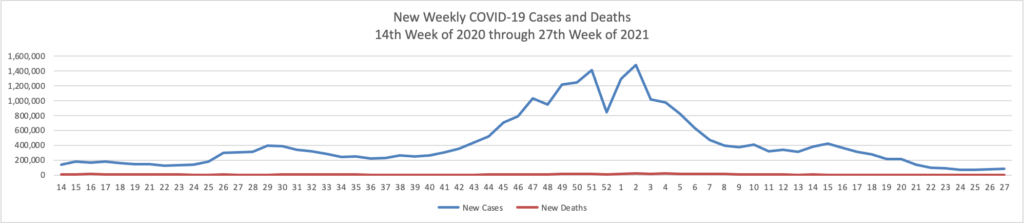
Based on the Centers for Disease Control’s COVID-19 Data Tracker website, here is the FEHBlog’s chart of new weekly COVID-19 cases and deaths over the 14th week of 2020 through 27th week of this year (beginning April 2, 2020, and ending July 7, 2021; using Thursday as the first day of the week in order to facilitate this weekly update):
and here is the CDC’s latest overall weekly hospitalization rate chart for COVID-19:
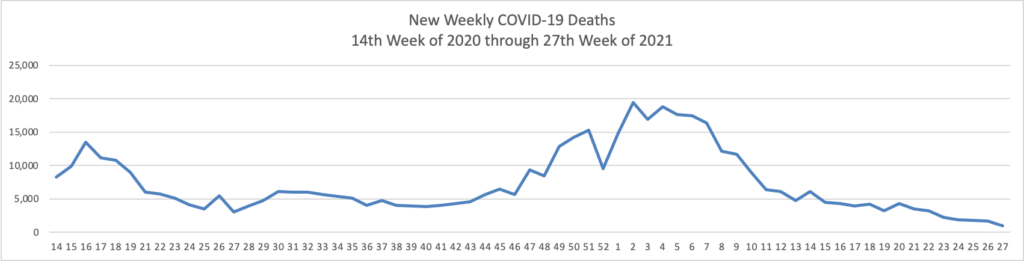
The FEHBlog has noticed that the new cases and deaths chart shows a flat line for new weekly deaths because new cases significantly exceed new deaths. Accordingly here is a chart of new COVID-19 deaths over the period (April 2, 2020, through July 7, 2021):
This is the first week since the FEHBlog began the chart that the number of new weekly deaths (955) has fallen below 1,000 nationwide.
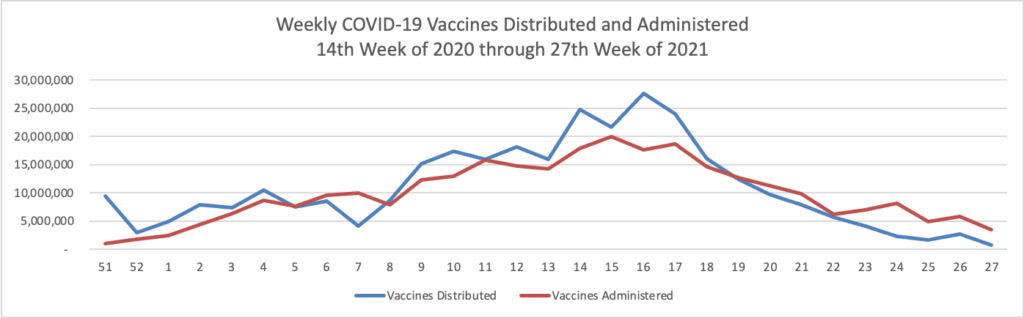
Finally here is a COVID-19 vaccinations chart over the period December 17, 2020, through July 7, 2021 which also uses Thursday as the first day of the week:
The Centers for Disease Control reports that “The COVID Data Tracker Vaccination Demographic Trends tab shows vaccination trends by age group. As of July 8, 88.5% of people ages 65 or older have received at least one dose of vaccine and 78.8% are fully vaccinated. Just over two-thirds (67.3%) of people ages 18 or older have received at least one dose of vaccine and 58.5% are fully vaccinated. For people ages 12 or older, 64.5% have received at least one dose of vaccine and 55.8% are fully vaccinated.”
Today, the President issued a wide ranging executive order on promoting competition in the American economy, which of course had been humming along nicely before the pandemic struck. Here’s a link to the fact sheet on the executive order which recounts its 70+ initiatives. The FEHBlog call attention to several healthcare initiatives in Sunday’s posts. The FEHBlog sense that this executive order will generate a lot of litigation.
The Food and Drug Administration’s acting commissioner, Janet Woodcock, is taking the highly unusual step of asking for a federal investigation of doctors within her own agency who met with the makers of an Alzheimer’s drug before the medicine’s recent approval.
Dr. Woodcock, in a letter made public Friday, called for the Office of Inspector General of the Department of Health and Human Services, which oversees the FDA, to review interactions between the drugmaker [Biogen] and FDA staff during the approval process.
The drug’s approval has been highly controversial, partly because of its annual price pegged at $56,000, and partly because evidence of the drug’s effectiveness was inconclusive.
This unusual step certainly will make the FDA decision makers think twice before crossing their advisory committee again. Biogen added fuel to the fire with its outrageous pricing.
Fierce Healthcare reports that “The quick rollout of the COVID-19 vaccine in the U.S. saved an estimated 279,000 lives and prevented 1.25 million hospitalizations, a new study finds. The study, released Wednesday, warns, however, that surges of new cases due to the highly transmissible delta variant could reverse these gains. “Until a greater majority of Americans are vaccinated, many more people could still die from this virus,” said Alison Galvani, Ph.D., director of the Yale Center for Infectious Disease Modeling and Analysis, which conducted the study alongside the Commonwealth Fund.”
The Wall Street Journal reports that “Children are at extremely slim risk of dying from Covid-19, according to some of the most comprehensive studies to date, which indicate the threat might be even lower than previously thought. Some 99.995% of the 469,982 children in England who were infected during the year examined by researchers survived, one study found. In fact, there were fewer deaths among children due to the virus than initially suspected. Among the 61 child deaths linked to a positive Covid-19 test in England, 25 were actually caused by the illness, the study found.”
The Journal also informs us that “Pfizer Inc. will seek clearance from U.S. regulators in coming weeks to distribute a booster shot of its Covid-19 vaccine to heighten protection against infections as new virus strains rise. The company said also it plans to start clinical trials in August of an updated version of its vaccine that would better protect against the Delta variant.” While the FEHBlog looks forward to lining up for the booster, Axios reports that “People who are fully vaccinated against the coronavirus do not need a booster shot at this time, the Food and Drug Administration and the Centers for Disease Control and Prevention said in a joint statement released Thursday evening.” Axios adds
One dose of the Pfizer-BioNTech or AstraZeneca coronavirus vaccine “barely” protects against the Delta variant of the virus, because of mutations the variant has developed, a new study published in the journal Nature Thursday found.
But two doses of those vaccines generated a neutralizing response to the variant in 95% of people, highlighting the importance of full vaccination against COVID-19, Axios’ Jacob Knutson writes.
Bloomberg discusses the idea of offering COVID-19 vaccines at Dollar General stores. “The researchers found that in the most vulnerable decile, the number of retail pharmacies that are eligible to provide vaccines through the Federal Retail Pharmacy Program is the lowest. But these vulnerable regions are also where Dollar General and other discount stores like it tend to cluster.” It’s worth a shot?
The National Institutes of Health released its annual joint report on cancer mortality. “The report shows a decrease in death rates for 11 of the 19 most common cancers among men, and for 14 of the 20 most common cancers among women, over the most recent period (2014-2018). Although declining trends in death rates accelerated for lung cancer and melanoma over this period, previous declining trends for colorectal and female breast cancer death rates slowed and those for prostate cancer leveled off. Death rates increased for a few cancers like brain and other nervous system and pancreas in both sexes, oral cavity and pharynx in males, and liver and uterus in females.” STAT News points out
Accelerating declines in lung cancer deaths may account for much of the overall progress seen in recent years, the authors of the report said. Over the past two decades, the death rate for lung cancer has declined even faster than the rate at which patients are diagnosed with the disease. And while part of the early success in preventing lung cancer can be attributed to the massive drop in smoking rates, the authors note the most recent downward trends seem to correspond with the approval of new treatments for non-small cell lung cancer that improved the likelihood of survival.
Death rates from melanoma also saw an accelerated decline in the past decade, despite a growing number of diagnoses. Like in lung cancer, authors point to the introduction of novel treatments around the same time as the turnaround on the death rate. New targeted and immune checkpoint inhibitors were approved by the Food and Drug Administration in 2011, one year before major declines in death rates were seen in women and two years before they were seen in men.
On the prescription drug front
The New York Times reports that “Under fire for approving a questionable drug for all Alzheimer’s patients, the Food and Drug Administration on Thursday greatly narrowed its previous recommendation and is now suggesting that only those with mild memory or thinking problems should receive it. The reversal, highly unusual for a drug that has been available for only a few weeks, is likely to reduce the approximate number of Americans who are eligible for the treatment to 1.5 million from six million.”
GoodRX points out and discusses the fifteen most addictive prescription drugs and resource available to help the addicted. The National Institute on Drug Abuse has an outreach website for teenagers, for example.
In other healthcare news
Health Affairs blog bangs the drum for Congress to fund a universal patient identifier. For the reasons explained in the article, this step called for in the HIPAA statute of 1996 is long overdue.
Healthcare Dive reports that “Telehealth claim lines as a percentage of all medical claims dropped 13% in April, marking the third straight month of declines, according to new data from nonprofit Fair Health. The dip was greater than the drop of 5.1% in March, but not as large as the decrease of almost 16% in February. However, overall utilization remains significantly higher than pre-COVID-19 levels. The decline appears to be driven by a rebound in in-person services, researchers said. Mental health conditions bucked the trend, however, as the percentage of telehealth claim lines associated with mental conditions — the No. 1 telehealth diagnosis — continued to rise nationally and in every U.S. region.” The FEHBlog considers that to be good news because telehealth at least currently is best suited for mental health care and out of schedule healthcare situations.
In closing, the FEHBlog wants to emphasize an important aspect of last Thursday’s No Surprise Billing rule. As explained in the government’s model consumer notice for use by health plans,
When you get services from an in-network hospital or ambulatory surgical center, certain providers there may be out-of-network. In these cases, the most those providers may bill you is your plan’s in-network cost-sharing amount. This applies to emergency medicine, anesthesia, pathology, radiology, laboratory, neonatology, assistant surgeon, hospitalist, or intensivist services. These providers can’t balance bill you and may not ask you to give up your protections not to be balance billed.
If you get other services at these in-network facilities, out-of-network providers can’t balance bill you, unless you give written consent and give up your protections.”
The vast majority of surprise bills stem from out-of-network service provided by emergency rooms, air ambulance, and the types of providers listed above, all of whom are locked into using negotiation and baseball arbitration with the health plan. The only doctors who can approach the patient for a balancing billing waiver are the surgeon or oncologist in a non-emergency setting who meets with the patient well before the surgery. That makes sense.
This approach, however, will promote use of the independent dispute resolution system which the tri-agencies will unveil October 1. Three months is more than ample time for the FEHBlog’s fellow lawyer to prepare for this new business opportunity. Health plans should make sure that their out of network pricing negotiators are adequately staffed.
The Wall Street Journal reports that “The highly transmissible Delta variant has become the dominant strain of the Covid-19 virus circulating in the U.S., according to federal data. It is spreading rapidly as communities loosen pandemic restrictions and officials struggle to reach unvaccinated people. The Delta variant, also known as B.1.617.2, made up 51.7% of Covid-19 infections in the two weeks ended July 3, according to genetic sequences from positive Covid-19 tests submitted to the U.S. Centers for Disease Control and Prevention.”
The Journal adds that “Covid-19 vaccines available in the U.S. protect against the Delta variant, but the virus is of great risk to people who aren’t vaccinated, according to public-health and infectious-disease experts. * * * Warm weather is helping to keep numbers of new cases down, and infections are likely to rise again in the fall, said Dr. Paul Sax, clinical director of the Division of Infectious Diseases at Brigham and Women’s Hospital in Boston. ‘Last summer we got a little bit overconfident,’ he said. ‘I don’t want us to make the same mistake again this time. We need to push as hard as we can to get as many people vaccinated as possible.’”
AHIP updates us on the progress made by its Vaccination Community Connectors program. “The COVID-19 pandemic has been a fundamental part of Americans’ lives for 15 months and counting. America cannot afford to lose any more time in achieving community immunity. Public-private partnerships have helped to support our communities through the crisis this far. By extending those partnerships through secure sharing of data about who has been immunized, we can better target every outreach and connection to put an end to the pandemic and get back to the moments we all miss. For more information, read our white paper with Blue Cross Blue Shield Association (BCBSA) and the Association for Community Affiliated Plans (ACAP).”
The FEHBlog noticed today that the OPM Inspector General has posted his semi-annual report to Congress for the period ended April 30, 2021, and OPM’s management response thereto. The Inspector General’s report includes an update of his earlier assessment of the pandemic’s impact on the FEHB Program. With all due respect, the FEHBlog finds the OIG’s assessment unnecessarily pessimistic but it’s for the readers to form their own opinions.
From the innovation front
Fierce Pharma reports that “Many pursuits have been put on hold during the coronavirus pandemic. But biopharmaceutical innovation isn’t one of them. In 2020, the FDA approved 53 new drugs, the second-most in a single year, after 2018’s bounty of 59. And the momentum has continued through the first half of 2021. With the FDA endorsing its 29th novel drug on June 30, the industry was slightly ahead of last year’s pace. * * * n terms of treatment areas, it is of little surprise that oncology accounts for 12 of this year’s approvals. That figure represents 44% of all new drug approvals this year, an even higher rate than in 2020 when 20 of 53 new drugs were in the oncology class. * * * The FDA’s roundups of 2021’s novel drug approvals can be found here and here.”
Employee Benefit News informs us that “Employers have a new tool in their arsenal to help employees reach a healthier weight and reduce their healthcare costs. DayTwo, a precision medicine company, has released new outcomes from its employer and health plan nutrition programs, to tackle high-risk and high-cost metabolic conditions, like obesity, Type 2 diabetes and pre-diabetes. The program provides users with a microbiome screening, which measures how the body digests food, in order to offer AI-powered nutritional plans tailored to their needs. After one year, employees who used the DayTwo program lost an average of 19 pounds and reduced their body mass index by 3.3 points, according to a release. The program is meant to reduce the reliance on medication and help employees with obesity and Type 2 diabetes lose weight naturally.”
mHealthIntelligence tells us that “While many healthcare providers are just now getting into the remote patient monitoring arena, Ochsner Health has scaled its platform to a national level, and is now monitoring more than 20,000 people in health plans across the country. And still, says Julie Henry chief operating officer for the New Orleans-based health system’s digital medicine department, ‘we’re learning lessons each and every day.’ That’s one of the guiding principles behind a connected health service that is seeing immense growth in the wake of the coronavirus pandemic, which has pushed many health systems to shift healthcare services from the hospital to the home. It’s a work in progress for everyone, from those deploying the technology to those paying for it. And there isn’t a hospital, clinic or practice out there that isn’t learning something new.”
In other healthcare news
The Federal Register announced today the last Thursday’s No Surprises Act interim final rule will be published in the July 13 issue. Publication triggers the sixty day public comment period which should end on Monday September 13 (as the 60 day period ends on Saturday September 11.)
Beckers Hospital Review reports that “Amazon Care, the e-commerce giant’s new healthcare venture, has approached several big health insurers in an effort to expand coverage of its services, Insider reported July 7. The healthcare venture reportedly talked to Aetna, Premera Blue Cross and Blue Cross Blue Shield of Massachusetts, according to people familiar with the discussions.”
The Hill informs us that “President Biden on Tuesday pleaded with Americans to get vaccinated against COVID-19 as the White House signaled a shift toward grassroots tactics to reach those who have yet to get a shot.” Here is a link to the President’s full remarks.
NPR Shots offers a daily look at each state’s progress in vaccinating its residents.
From the hospital pricing transparency front —
The Wall Street Journal explains how it has been analyzing the pricing data that federal law required hospitals to make publicly available on January 1, 2021. “The Journal reviewed hospital pricing disclosures collected by Turquoise Health Co., a startup that has been gathering the data from hospital websites since the regulations went into effect.” The Turquoise Health website is worth a gander.
NPR Shots also analyzed the newly available hospital pricing data. “While it’s still an unanswered question about whether price transparency will lead to overall lower prices, KHN took a dive into the initial trove of data to see what it reveals. Here are five takeaways from the newly public data and tips for how you might be able to use it to your benefit: 1) As expected prices are all over the map; 2. Patients can look up information but the info is incomplete; 3. Third party firms like Turquoise Health are trying to make searching prices simpler and cash in; 4. Consumers can use the data to negotiate with hospitals when paying cash, and 5. Hospitals are not fully on board currently.
In the tidbits department —
Today, the Centers for Medicare and Medicaid Services announced Dr. Meena Seshamani, M.D., Ph.D. [formerly with MedStar Health] as Deputy Administrator and Director of Center for Medicare. She started her work today.
Fierce Healthcare reports “The United Health Foundation, the philanthropic arm of the UnitedHealth Group, released its America’s Health Rankings Health Disparities Report last week, and the healthcare giant found a number of disparities worsened in the 2017 to 2019 time frame. While the data come from before the pandemic, experts say they offer a baseline that can be used to address critical public health needs. For example, adults who did not graduate high school had a rate of frequent mental distress that was 123% higher than people with a college degree. Females had a 70% higher rate of depression than males, according to the report.”
NPR Shots discusses how an “obesity drug’s [Wegovy] promise now hinges on insurance coverage.”
In clinical trials, weekly injections of semaglutide — or Wegovy, as it’s been branded —helped people drop an average of 15% of their body weight. That’s an average of about 34 pounds over 16 months, before their weight plateaued, a far greater weight loss, obesity specialists say, than achieved with other drugs on the market. At least as important, Wegovy raised none of the alarm bells with the FDA or obesity doctors that it might trigger serious side effects of the sort some people experienced by taking fen-phen or other previous medical treatments for obesity.
But with a price tag for Wegovy of $1,000 to $1,500 a month, a big question remains: Will insurers cover its significant cost for the millions who might benefit? * * *
Insurance coverage, it turns out, is a giant question — not just with Wegovy but with obesity drugs in general. Some private insurers do include some prescription obesity drugs in the list of medicines they’ll cover; it’s too early to tell whether Wegovy will make those lists. Many doctors and patients are optimistic, because it is a higher dose of an existing diabetes medication called Ozempic, which insurers often cover.
A few select state Medicaid programs will cover medications that treat obesity in some circumstances. But, significantly, Medicare does not cover obesity drugs — and many private insurers typically follow Medicare’s lead.
Yet the demand for a good treatment is there, says Dr. Fatima Cody Stanford, a leading obesity researcher at Harvard. She was not involved in conducting the Wegovy clinical trial but closely followed it. “I’m excited about it,” she says, because of the dramatic weight loss.
The drug acts on the brain so people eat less and store less of what they eat. That helps address the excess weight as well as helping with related diseases of the liver or heart, for example.
The FEHBlog enjoys book recommendations and so he lapped up STAT’s list of “the 36 best books and podcasts on health and science to check out this summer. Among them, this one particularly caught the FEHBlog’s attention as he has enjoyed reading this author’s output and the topic is intriguing: “The Code Breaker: Jennifer Doudna, Gene Editing, and the Future of the Human Race”By Walter Issacson I recommend it because this captivating book provided clear and accessible explanations of the scientific discovery of CRISPR-Cas9 and its remarkable power as a gene editing tool, interwoven with the complex human stories of Jennifer Doudna and her relationships with the many other accomplished scientists who brought it all together.— Anthony Fauci, director of the National Institute of Allergy and Infectious Diseases”
Both Houses of Congress are on State / District work breaks this week.
From the COVID-19 front, the Wall Street Journal offers two important reports:
As the Delta variant of the coronavirus surges through the United Kingdom [U.K.], almost half of the country’s recent Covid-19 deaths are of people who have been vaccinated. But doctors and scientists aren’t sounding the alarm about the apparently high proportion of deaths among the vaccinated population. On the contrary, they say the figures so far offer reassurance that vaccines offer substantial protection against the variant, particularly after two doses. Delta, first identified in India, has since spread to at least 85 countries, including the U.S., where it is now estimated to be the most common variant.
Also here are the top line recommendations for what parents with unvaccinated children should know this summer: 1. Keep unvaccinated kids’ masks on indoors; 2. Look out for regional hotspots; 3. weigh travel plans carefully / stay closer to home; 4. consider higher precautions for higher risk children; 5. get your family vaccinated as soon as a family member becomes eligible; and check local recommendations before traveling.
From the cybersecurity front, the Journal updates us on the Kaseya ransomware situation:
The hackers were able to distribute ransomware by exploiting several vulnerabilities in the VSA software, a Kaseya spokeswoman said.
One of them, discovered by a Dutch security researcher, was in the process of being patched by Kaseya before the ransomware attack occurred, said Victor Gevers, chairman of the volunteer-run security group, the Dutch Institute for Vulnerability Disclosure.
“Kaseya understood the problem and they were rushing to produce a patch,” Mr. Gevers said. Mr. Gevers said the bug was due to a simple error in the company’s code.
About 50 of Kaseya’s customers were compromised and about 40 of those customers were sellers of IT services, known as managed service providers, Mr. Voccola said. By breaking into MSP’s, the hackers were able to expand their impact, performing what security experts call a supply-chain attack.
Security companies estimate that hundreds of organizations, all of them customers of those 40 or so service providers, have now been hit by the ransomware, making it one of the most widespread incidents to date. But almost all of them are small and medium-size organizations, cybersecurity experts said, with the impact often not immediately apparent to the wider public. * * *
The hackers behind the latest incident are known as the REvil ransomware group. They are asking for $70 million to unlock all the affected systems but victims of the group can also pay amounts varying between $25,000 and $5 million directly to unlock their systems even if nobody pays the $70 million.
In an eye-catching tidbit, Beckers Hospital Review reports that the staff at Fort Worth’s Andrews Women’s Hospital delivered 107 babies over a 91 hour period last week. A COVID baby boom?
On Sunday evening, roughly 1,000 people—mostly essential workers and military families—gathered on the White House’s South Lawn. It was covered with red, white and blue decorations and dotted with festive tables and signs that read “America’s Back Together.” The crowd listened to military bands and dined on burgers, chicken sandwiches and pulled pork.
Mr. Biden struck an optimistic tone in his remarks, noting that Americans were gathering and celebrating for the holiday. However, he emphasized the lives lost and acknowledged that the virus hasn’t been defeated yet, urging people to get vaccinated.
“Do it now, for yourself, for your loved ones, for your community and for your country,” he said. “While the virus hasn’t been vanquished, we know this: It no longer controls our lives, it no longer paralyzes our nation, and it’s within our power to make sure it never does again.”
True that.
However, while grateful for our great country, the principal reason why the FEHBlog is posting tonight is to supplement yesterday’s post on the “REvil * * * attack on Kaseya VSA, software used by large companies and technology-service providers to manage and distribute software updates to systems on computer networks, according to security researchers and VSA’s maker, Kaseya Ltd.” The Journal reports that “REvil is a well-known purveyor of ransomware—malicious software that locks up a victim’s computer until a digital ransom is paid, typically in the form of bitcoin. This latest attack appears to be its largest ever. The incident may have infected as many as 40,000 computers world-wide, according to cybersecurity experts.”
Here is a link to “CISA-FBI Guidance for Managed Service Providers (MSP) and their Customers Affected by the Kaseya VSA Supply-Chain Ransomware Attack”:
CISA and FBI recommend affected MSPs:
Download the Kaseya VSA Detection Tool. This tool analyzes a system (either VSA server or managed endpoint) and determines whether any indicators of compromise (IoC) are present.
Enable and enforce multi-factor authentication (MFA) on every single account that is under the control of the organization, and—to the maximum extent possible—enable and enforce MFA for customer-facing services.
Implement allowlisting to limit communication with remote monitoring and management (RMM) capabilities to known IP address pairs, and/or
Place administrative interfaces of RMM behind a virtual private network (VPN) or a firewall on a dedicated administrative network.
CISA and FBI recommend MSP customers affected by this attack take immediate action to implement the following cybersecurity best practices. Note: these actions are especially important for MSP customer who do not currently have their RMM service running due to the Kaseya attack.
CISA and FBI recommend affected MSP customers:
Ensure backups are up to date and stored in an easily retrievable location that is air-gapped from the organizational network;
Revert to a manual patch management process that follows vendor remediation guidance, including the installation of new patches as soon as they become available;
Implement:
Multi-factor authentication; and
Principle of least privilege on key network resources admin accounts.
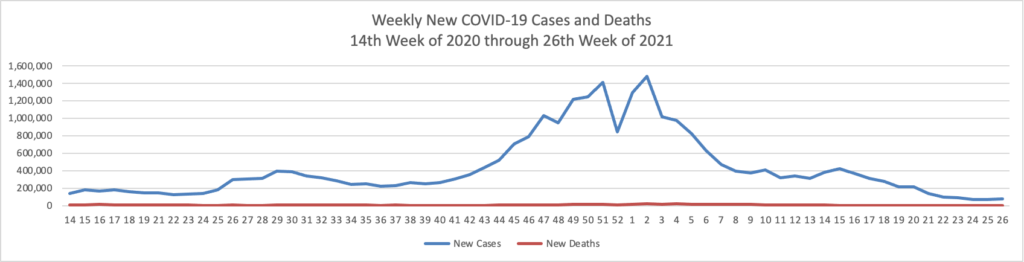
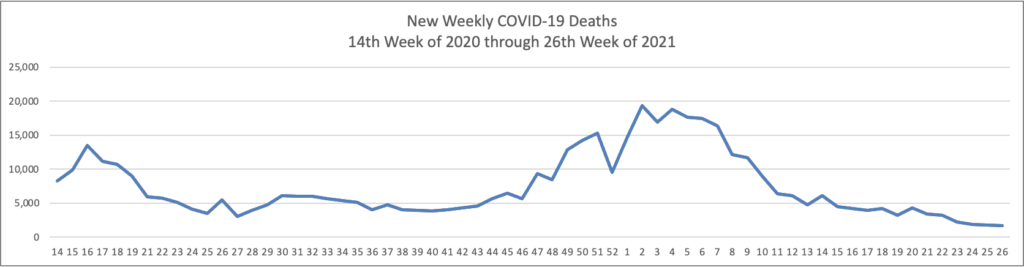
Based on the Centers for Disease Control’s (“CDC”) improved COVID-19 Data Tracker website, here is the FEHBlog’s chart of new weekly COVID-19 cases and deaths over the 14th week of 2020 through 26th week of this year (beginning April 2, 2020, and ending June 30, 2021; using Thursday as the first day of the week in order to facilitate this weekly update):
and here is the CDC’s latest overall weekly hospitalization rate chart for COVID-19:
The FEHBlog has noticed that the new cases and deaths chart shows a flat line for new weekly deaths because new cases significantly exceed new deaths. Accordingly here is a chart of new COVID-19 deaths over the period (April 2, 2020, through June 30, 2022):
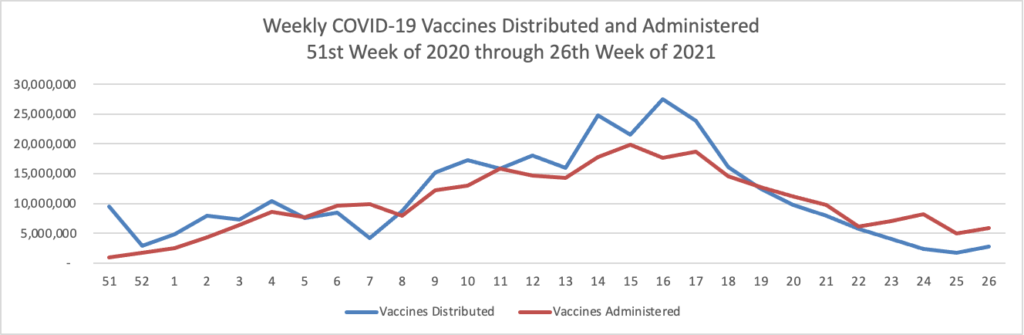
Finally here is a COVID-19 vaccinations chart over the period December 17, 2020, through June 30, 2022 which also uses Thursday as the first day of the week:
In its weekly COVID-19 update the CDC reminds us that
The emergence and spread of variants also have the potential to chip away at our nation’s progress to end this pandemic. On June 15, 2021, CDC announced classification of the SARS-CoV-2 variant B.1.617.2 (Delta) as a variant of concern because it spreads more easily. The spread of the more transmissible B.1.617.2 variant combined with the U.S. population that remains unvaccinated leaves many people at risk of infection. With B.1.617.2 now spreading across the country and infecting people worldwide, it’s more important than ever that all eligible people get vaccinated as soon as possible.
The COVID-19 vaccines authorized for use in the United States offer protection against all known variants, including the B.1.617.2 variant. Getting vaccinated will protect you and the people you love. COVID-19 vaccines are free and available for everyone ages 12 and up. They are nearly 100% effective against severe disease and death, meaning nearly every death due to COVID-19 is preventable. No matter your age, or your health history, until you’re fully vaccinated*—you are at risk of infection. By getting vaccinated and encouraging those around you to do the same, you can safely engage in activities you enjoyed prior to the COVID-19 pandemic. Get vaccinated, help others get vaccinated, and use prevention measures if not fully vaccinated so we can all celebrate our freedom from the virus.
Also from the COVID-19 front Becker’s Payer Issues reports that
The Vaccine Community Connectors program, which was launched by AHIP and the Blue Cross Blue Shield Association, has helped vaccinate more than 2 million people over 65 against COVID-19 in under 100 days, according to a July 1 news release.
More than 50 health insurers are now participating in the program, which was initiated to expand vaccination efforts of people in low-income communities.
“The most vulnerable people in our country have suffered disproportionately from the COVID-19 crisis, which is why we have been working side-by-side with industry partners to help millions of vulnerable Americans get vaccinated against the virus,” BCBSA CEO Kim Keck said in the statement.
Bravo! Health Payer Intelligence reports on how employers can best assist the nationwide vaccination campaign.
Seventy-three percent of workers whose employers encouraged them to receive the coronavirus vaccine had at least one vaccine shot. Additionally, 75 percent of those who received paid time off to get the vaccine have gotten at least one shot.
In contrast, only four in ten of those whose employers did not encourage employees to get vaccinated had received a coronavirus vaccine shot. Similarly, half of those whose employers did not provide paid time off to get the vaccine reported that they had received the coronavirus vaccine.
These distinctions remained true regardless of variations in race, age, ethnicity, income, and even regardless of whether the individual identified as Republican or Democrat.
In the more news category:
The U.S. Supreme Court today added two healthcare cases to its October 2021 docket. According to Law360, the Court “agreed to review whether the federal government lawfully cut billions of dollars from reimbursements for drugs bought through a discount program for hospitals in low-income areas, as well as a reimbursement calculation for hospitals that serve a high amount of low-income individuals.”
Benefits Pro reports that “Under pressure to rein in skyrocketing prescription drug costs, states are targeting companies that serve as conduits for drug manufacturers, health insurers and pharmacies. More than 100 separate bills regulating those companies, known as pharmacy benefit managers, have been introduced in 42 states this year, according to the National Academy for State Health Policy, which crafts model legislation on the topic. The flood of bills comes after a U.S. Supreme Court ruling late last year backed Arkansas’ right to enforce rules on the companies. At least 12 of the states have adopted new oversight laws. But it’s not yet clear how much money consumers will save immediately, if at all.” The source of the cost problem is not the PBMs who work with health plans to control costs. The PBMs vastly expanded prescription drug coverage for Americans. The sources of the cost problem are the manufacturers and wholesales. All these new state law simply adds more costs to the drug distribution process in the FEHBlog’s view.
Becker’s Payer Issues explains how the BCBSA chief innovation officer seeks to transform healthcare one step at a time. Good luck to her. The FEHBlog loves her title.
We use cookies on our website to give you the most relevant experience by remembering your preferences and repeat visits. By clicking “Accept”, you consent to the use of ALL the cookies.
This website uses cookies to improve your experience while you navigate through the website. Out of these, the cookies that are categorized as necessary are stored on your browser as they are essential for the working of basic functionalities of the website. We also use third-party cookies that help us analyze and understand how you use this website. These cookies will be stored in your browser only with your consent. You also have the option to opt-out of these cookies. But opting out of some of these cookies may affect your browsing experience.
Necessary cookies are absolutely essential for the website to function properly. These cookies ensure basic functionalities and security features of the website, anonymously.
Cookie
Duration
Description
cookielawinfo-checbox-analytics
11 months
This cookie is set by GDPR Cookie Consent plugin. The cookie is used to store the user consent for the cookies in the category "Analytics".
cookielawinfo-checbox-functional
11 months
The cookie is set by GDPR cookie consent to record the user consent for the cookies in the category "Functional".
cookielawinfo-checbox-others
11 months
This cookie is set by GDPR Cookie Consent plugin. The cookie is used to store the user consent for the cookies in the category "Other.
cookielawinfo-checkbox-necessary
11 months
This cookie is set by GDPR Cookie Consent plugin. The cookies is used to store the user consent for the cookies in the category "Necessary".
cookielawinfo-checkbox-performance
11 months
This cookie is set by GDPR Cookie Consent plugin. The cookie is used to store the user consent for the cookies in the category "Performance".
viewed_cookie_policy
11 months
The cookie is set by the GDPR Cookie Consent plugin and is used to store whether or not user has consented to the use of cookies. It does not store any personal data.
Functional cookies help to perform certain functionalities like sharing the content of the website on social media platforms, collect feedbacks, and other third-party features.
Performance cookies are used to understand and analyze the key performance indexes of the website which helps in delivering a better user experience for the visitors.
Analytical cookies are used to understand how visitors interact with the website. These cookies help provide information on metrics the number of visitors, bounce rate, traffic source, etc.
Advertisement cookies are used to provide visitors with relevant ads and marketing campaigns. These cookies track visitors across websites and collect information to provide customized ads.