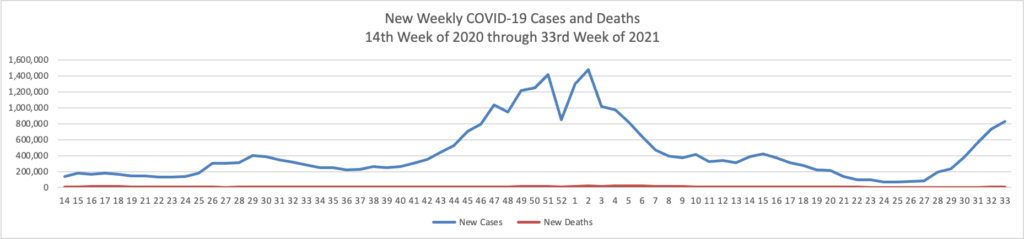
Based on the Centers for Disease Control’s COVID-19 Data Tracker website, here is the FEHBlog’s chart of new weekly COVID-19 cases and deaths over the 14th week of 2020 through 33rd week of this year (beginning April 2, 2020, and ending August 18, 2021); using Thursday as the first day of the week in order to facilitate this weekly update):
and here is the CDC’s latest overall weekly hospitalization rate chart for COVID-19:
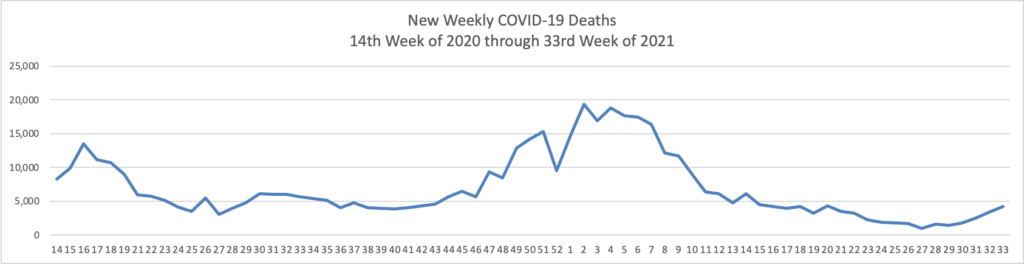
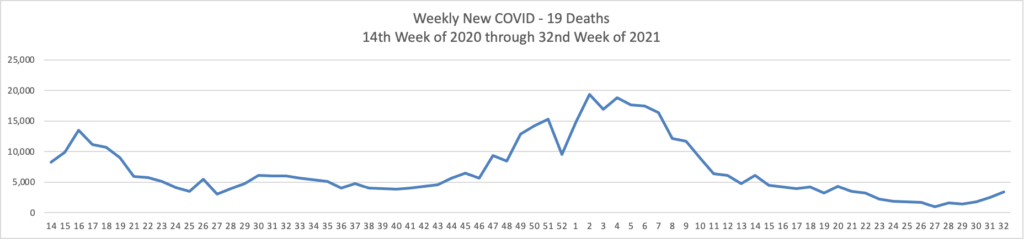
The FEHBlog has noticed that the new cases and deaths chart shows a flat line for new weekly deaths because new cases significantly exceed new deaths. Accordingly here is a chart of new COVID-19 deaths over the period (April 2, 2020, through August 18, 2021):
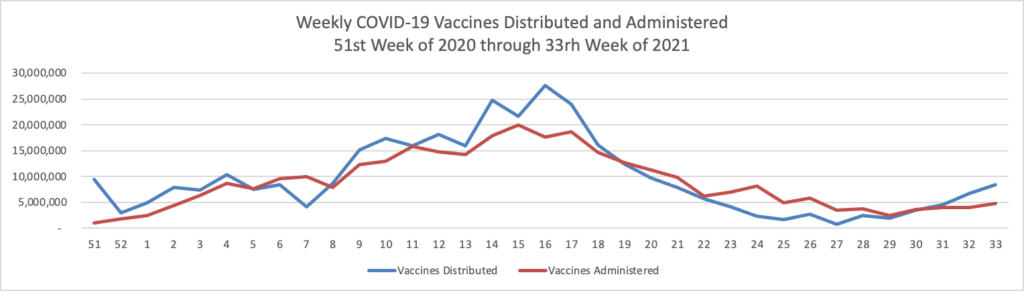
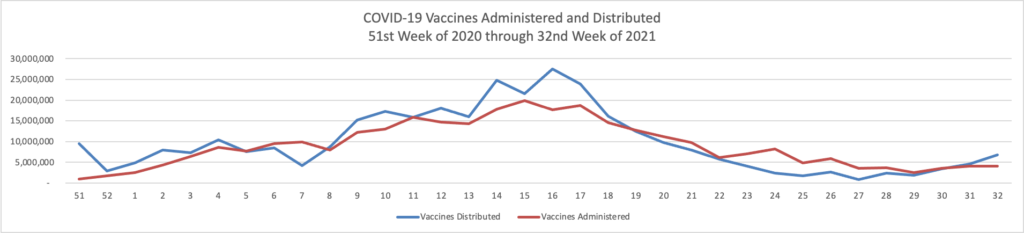
Finally here is a COVID-19 vaccinations chart over the period December 17, 2020, through August 18, 2021, which also uses Thursday as the first day of the week:
Here’s a link to the CDC’s weekly interpretation of its COVID-19 statistics.
Politico reports that “More than one million Americans received a dose of Covid-19 vaccine on Thursday[August 19] , a benchmark the nation has not met in nearly seven weeks amid a resurgence of the coronavirus pandemic.”
Antibodies generated by COVID-19 vaccines are effective against the Delta variant and other coronavirus variants of concern, new research shows.
The findings may help explain why most vaccinated people have avoided the surge of Delta variant cases sweeping across the United States.
“In face of vaccination, Delta is relatively a wimpy virus,” said study co-author Ali Ellebedy, an associate professor of pathology and immunology at Washington University School of Medicine in St. Louis.
The Food and Drug Administration is expected next week to grant full approval of the Covid-19 vaccine from Pfizer Inc.and partner BioNTechSE, according to people familiar with the planning, an action that could spur more vaccination requirements by employers and encourage more people who are hesitant to get vaccinated. * * *
Once fully approved, the vaccine would be eligible for off-label prescriptions, such as booster doses, according to the FDA. However, analysts said, the critical element for broad boosting is a recommendation from the Advisory Committee on Immunization Practices to the FDA, as physicians often follow ACIP recommendations.
With full approval, Pfizer would likely be permitted to market the vaccine to doctors, providers and the general public as it does with other approved products. The FDA is permitted to restrict such communications with emergency authorization.
The Journal adds that
Of the three authorized vaccines in the U.S., only Pfizer has submitted all the required information to the FDA, according to the companies, and analysts expect it to be the first receive clearance.
Moderna Inc., whose authorized two-dose shot uses similar mRNA technology as the Pfizer-BioNTech, has said it is still completing rolling data submissions.Johnson & Johnson, whose shot was authorized in February, has said it plans to file for full approval later this year.
Fierce Healthcare reports that Janet Woodcock will not be nominated for a promotion from acting to permanent Food and Drug Commissioner due in large part to Aduhelm fallout.
From the regulatory front
After issuing a minimalist Affordable Care Act (“ACA”) FAQ 48 earlier this week, the ACA regulatory departments issued a blockbuster ACA FAQ 49 about payer transparency rule implementation and enforcement delays and answering many No Surprises Act (“NSA”) implementation issues left hanging by the first NSA interim final rule (“IFC”) released July 1.
OMB’s Office of Information and Regulatory Affairs (“OIRA”) has scheduled more meetings on the second No Surprises Act IFC which concerns the independent dispute resolution process. Those listening sessions now run late into next week. That means that the IFC won’t be released before the week of August 30 but that still would be about a month before the statutory deadline.
The American College of Emergency Physicians and Blue Cross each met with OIRA this past week. Here are links to their supporting letters. BCBSA OIRA IDR 8.17.21.pdf and ACEP EDPMA Pre-IDR Rulemaking Letter (8.10.21).pdf Common sense as expressed in the Blue Cross letter must prevail if the parties want to avoid having the second IFC also create major system changes.
The Society for Human Resource Management informs us that “covered employers [such as FEHB plan carriers] now have until Oct. 25 to file their 2019 and 2020 EEO-1 reports, according to a recent announcement from the U.S. Equal Employment Opportunity Commission (EEOC). Although the reporting deadline has been delayed several times during the COVID-19 pandemic, the agency said it will not authorize any more extensions.”
Yesterday’s HHS COVID-19 booster plan for all of the U.S. has generated expert opposition as reported in STAT News and Forbes. From STAT, for example
“I would have preferred that this had been vetted a little bit more,” said Paul Offit, a vaccine expert from Children’s Hospital of Philadelphia, who is on an expert committee that advises the FDA on vaccines. “This just seems to be a declaration without the kind of vetting you would like to have seen.”
Offit thinks boosters may eventually be needed. But he’s not convinced they are needed now. Almost all the evidence to date suggests protection against severe disease is still holding and may well last several years, he said.
“So the notion that we are trying to get ahead of it by boosting after eight months I think is premature,” he said, also arguing that using more doses in the U.S. will inevitably slow vaccination in low-income countries.
Forbes adds
The impending rollout of booster doses in the U.S. could thwart vaccine export and donations to nations which are in desperate need of inoculating their most vulnerable residents, experts worry. “To me it just essentially shows that here is another rich nation that is really prioritizing its own population before thinking about the global response,” says Rupali Limaye, from Johns Hopkins Bloomberg School of Public Health, who studies vaccine inequity and hesitancy.
The FEHBlog hopes that the HHS experts have not gotten too far out in front of their skis on this issue.
Flu shots are now available at all CVS Pharmacy and MinuteClinic locations across the country. Both CVS Pharmacy and MinuteClinic, the retail health clinic of CVS Health inside select CVS Pharmacy and Target stores, offer convenient options for people of all ages to get their flu shot, seven days a week with expanded evening and weekend hours.
“Getting your flu shot is a great way to be proactive about your health and the health of your community,” said Angela Patterson, DNP, FNP-BC, NEA-BC, FAANP, Chief Nurse Practitioner Officer, MinuteClinic and Vice President, CVS Health. “It’s an easy way to protect yourself and those around you who may be more vulnerable to serious complications from the flu, such as infants and young children, older adults, and people with certain chronic health conditions.”
In health plan coverage news, Fierce Healthcare informs us that
Most insurers are no longer waiving cost sharing for COVID-19 treatments as healthcare use rebounded from lows exacerbated by the pandemic, a new analysis found.
The analysis, released Thursday from the Kaiser Family Foundation, found 72% of large health plans are no longer providing cost-sharing waivers as of this month. Another 10% of plans expect to phase out the waivers by the end of October. * * *
An earlier analysis from Kaiser found that large group enrollees hospitalized for pneumonia, which requires similar treatment costs to COVID-19, paid out an average $1,300 out-of-pocket.
“Although this is a large amount to most patients, and could be an incentive to get vaccinated, it still only represents a fraction of the cost born to society for these largely preventable hospitalizations,” the analysis said.
In encouraging news, STAT News reports that Michael Segel and Blake Lash, two scientists who work in the lab of CRISPR pioneer Feng Zhang at Boston’s Broad Street Institute, have discovered a new CRISPR related technology. “This new method of delivering different RNA payloads, called SEND, for Selective Endogenous eNcapsidation for cellular Delivery, was reported today in Science. It has the potential to address significant and longstanding limitations to translating powerful gene editing and gene replacement technologies, as well as mRNA — the guts of the most successful Covid-19 vaccines — into broadly useful therapies.” The article concludes “It’s too soon to say whether SEND will ultimately challenge lipid nanoparticles and viral vectors as the dominant methods for delivering gene editing treatments and gene therapies. But it does offer some distinct advantages.” Bravo.
From the miscellany department
AHIP’s Blog discusses the rise of social media influencers in healthcare.
Fierce Healthcare reports that by closing on its deal to acquire Kindred at Home, Humana has become the largest provider of home healthcare in our country. “Kindred will be folded into the insurer’s Home Solutions business arm and will adopt Humana’s payer-agnostic health services branding, CareWell, under which it will operate as CenterWell Home Health beginning next year.”
Healthcare Dive reports that the American Hospital Association has “sent a letter Wednesday to top officials in the White House, HHS, Department of Justice and Federal Trade Commission defending health system M&A and attempting to shift Washington’s rising antitrust focus from providers to commercial health plans.” After all the best defense is a strong offense. But Healthcare Dive adds that “The letter included an updated AHA-funded study on the benefits of hospital mergers, which was previously criticized by outside experts for cherry-picked data, among other methodological weaknesses.”
In a joint statement, a group of high ranking HHS public health experts explained today that
“We have developed a plan to begin offering [COVID-19 vaccination] booster shots this fall subject to FDA conducting an independent evaluation and determination of the safety and effectiveness of a third dose of the Pfizer and Moderna mRNA vaccines and CDC’s Advisory Committee on Immunization Practices (ACIP) issuing booster dose recommendations based on a thorough review of the evidence. We are prepared to offer booster shots for all Americans beginning the week of September 20 and starting 8 months after an individual’s second dose. At that time, the individuals who were fully vaccinated earliest in the vaccination rollout, including many health care providers, nursing home residents, and other seniors, will likely be eligible for a booster. We would also begin efforts to deliver booster shots directly to residents of long-term care facilities at that time, given the distribution of vaccines to this population early in the vaccine rollout and the continued increased risk that COVID-19 poses to them.
“We also anticipate booster shots will likely be needed for people who received the Johnson & Johnson (J&J) vaccine. Administration of the J&J vaccine did not begin in the U.S. until March 2021, and we expect more data on J&J in the next few weeks. With those data in hand, we will keep the public informed with a timely plan for J&J booster shots as well.”
The FEHBlog will be in line for his third dose of the Pfizer vaccine when the time comes.
The Wall Street Journal reports that “Early data from Israel suggests a booster shot of Pfizer Inc.’s Covid-19 vaccine can significantly improve immunity in those aged 60 and above, as the U.S. and other countries plan additional doses to increase protection against the highly infectious Delta variant.”
Health Affairs reports on a study suggest”[ing] that the early COVID-19 vaccination campaign was associated with reductions in COVID-19 deaths. As of May 9, 2021, reductions in COVID-19 deaths associated with vaccines had translated to value of statistical life benefit ranging between $625 billion and $1.4 trillion.” The smartest move that the government made was to prioritize the elderly who suffered the most deaths during the pre-vaccination era of COVID-19.
From the federal employee vaccination screening program front, the Safer Federal Workforce task force issued a set of FAQs on COVID-19 testing employees, contractors and visitors who cannot attest to receiving a COVID-19 vaccination. The FEHBlog was pleased to read that the FAQs impose the testing cost on the agencies, not on the FEHB Program, which is the proper legal outcome under the federal CARES Act (unnumbered FAQ 3). Federal News Network makes its own observations on the Testing FAQs here.
In healthcare utilization news, Healthcare Dive reports that
More than one in 10 adults ages 16 to 64 said they delayed or went without needed healthcare services due to virus fears in the past 30 days, an April survey from the Urban Institute funded by the Robert Wood Johnson Foundation found.
One in 10 parents delayed seeking care for their children for that reason, according to the report published Wednesday.
Hispanic and Black adults, along with adults with lower incomes, reported delaying care at higher rates than other groups. Adults with chronic health problems were also more likely than those without such conditions to say they went without needed care.
It’s worth noting that this survey was conducted during the month that vaccinations became widely available and before the Delta variant broke out.
In other healthcare news
Govexec reports that “Officials at the Centers for Disease Control and Prevention announced on Wednesday that the agency is launching a new organization to focus on disease forecasting. The Center for Forecasting and Outbreak Analytics will be a hub for research and innovation aimed at mitigating the effects of future disease threats. Its launch comes as the federal government continues to fight the coronavirus pandemic and now the rapidly spreading Delta variant. It will build on current modeling efforts at the agency. * * * The center’s initial funding will come from the $1.9 trillion American Rescue Plan enacted in March for coronavirus relief.”
The NCQA Blog discusses the hospital at home movement in the U.S. “Humana Home Solutions Vice President Dr. Amal Agarwal estimated that up to 35% of Medicare Advantage spending might be addressable at home. As Mayo Clinic Platform President John Halamka explained, hospital at home also “brings the family back into wellness.” This matters because family involvement affects patient satisfaction.” Interestingly the experts explained that hospital at home care is best suited for mid-level acuity patients, not folks who need the ICU or folks who don’t require hospitalization.
Dr. Halamka used an accessible and memorable analogy to outline the long-term possibilities for hospital at home.
He explained that the tractor manufacturing company John Deere transformed itself into a data company by covering its tractors with sensors. The sensors report back information about the weight and volume of crops that customers harvest—soybeans, for example. The predictive value of the information reported to John Deere is so high that the data are now used to forecast soybean prices.
Likewise, Americans are filling their homes and strapping to their bodies millions of behavioral and biometric sensors.
“We are instrumenting homes with sensors to gather patient data that we can use to understand not only that patient’s progression, but aggregating and analyzing that data [to] understand the progression of similar patients,” said Halamka.
Well put, Doctor.
In support of extending initiatives like this to rural areas of the country, the Department of Health and Human Services announced today “key investments that will strengthen telehealth services in rural and underserved communities and expand telehealth innovation and quality nationwide. These investments—totaling over $19 million—are being distributed to 36 award recipients,” such as “Telehealth Centers of Excellence (COE) program: $6.5 million is being awarded to 2 organizations to assess telehealth strategies and services to improve health care in rural medically underserved areas that have high chronic disease prevalence and high poverty rates. The Telehealth COEs will be located in academic medical centers and will serve as telehealth incubators to pilot new telehealth services, track outcomes, and publish telehealth research. The COEs will establish an evidence-base for telehealth programs and a framework for future telehealth programs.’
From Capitol Hill, the Wall Street Journal reports that “Top House Democrats said the chamber would move forward with voting on the budget blueprint for a $3.5 trillion healthcare, education and climate package next week, rebuffing demands from a group of centrist Democrats to first vote on a $1 trillion infrastructure bill and urging their caucus to stay unified around President Biden’s agenda” According to the article the centrist Democrats opposed the Speaker’s compromise approach discussed in Sunday’s Post and the much larger Democrat progressive causus pushed hard for this outcome. Speaker Pelosi can only afford to lose three of the nine Democrat centrists as the Republicans are expected to unanimously oppose the budget blueprint.
From the Delta variant front
Bloomberg reports that the Southern states continue to experience robust vaccination rates one month after the mid-July low point.
The Wall Street Journal informs us that “The Delta variant of the Covid-19 virus appears to be breaking through the protection vaccines provide at a higher rate than previous strains, a Wall Street Journal analysis found, though infections among the fully inoculated remain a tiny fraction of overall cases, and symptoms tend to be milder.”
Most significantly the New York Times reports tonight that
The Biden administration has decided that most Americans should get a coronavirus booster vaccination eight months after they received their second shot, and could begin offering third shots as early as the third week of September, according to administration officials familiar with the discussions.
Officials are planning to announce the decision on Wednesday at the White House. Their goal is to let Americans who received the Pfizer-BioNTech or Moderna vaccines know now that they will need additional protection against the Delta variant, which is causing caseloads to surge across much of the nation. But the new policy will depend on the Food and Drug Administration authorizing additional shots.
Recipients of the Johnson & Johnson vaccine, which was authorized as a one-dose regimen, will also most likely require an additional dose, the officials said. But they are waiting for results, expected this month, from a clinical trial that provided participants with two doses. So far, only about 14 million people in the United States have gotten the Johnson & Johnson shot, which the government began offering in March. The first Pfizer and Moderna vaccines were given in December.
The first boosters would probably go to nursing home residents, health care workers and emergency workers, who were the first to be vaccinated last winter. They would likely be followed by other older people, then by the general population. Officials envision giving people the same vaccine they originally received.
On the federal employment front, Federal News Network tells us that OPM is promulgating an interim final rule that will allow agencies to “hire [bachelors degree or graduate] students to a temporary appointment of a year or a term appointment of one-to-four years. Students will work for their agency at the General Schedule 11 level or below while in school. Students who finish their degrees and meet a series of other requirements are eligible for a permanent position at the same agency, OPM said.”
From the federal guidance front
The National Law Review informs us that “OSHA’s Revised COVID-19 Guidance [released August 13] Adopts CDC’s Latest Recommendation on Masks for Vaccinated Employees, Advocates for Vaccination, and Suggests Periodic Testing for Unvaccinated Employees.” “Although OSHA disclaims that its recommendations are legally binding on employers, the agency also includes language that signals that failure to adhere to the recommendations could be legally significant for the employer. Specifically, OSHA prefaces its guidance by stating: “The recommendations are advisory in nature and informational in content and are intended to assist employers in providing a safe and healthful workplace free from recognized hazards that are causing or likely to cause death or serious physical harm.”
The tri-agencies issued Affordable Care Act FAQ 48 informing interested parties that in response to litigation they are working on an amending the “2018 final regulations that expanded exemptions for entities with religious or moral objections to the contraceptive coverage requirement to which their health plans would otherwise be subject.” That rulemaking of course will lead to more litigation and so on.
A new study found that the number of adults who used two widely prescribed stimulants nearly doubled in recent years, raising concerns about a potential wave of abuse since both medicines can be highly addictive.
Specifically, an estimated 4.1 million adults reported using amphetamines and methylphenidate in 2018, an increase of nearly 80% from 2013. Measured by total prescriptions, the use of amphetamines rose 119% during that time, while the use of methylphenidate grew about 39%, according to the study, which was published in BMJ Open.
The article warns that this surge could turn into another epidemic.
On the healthcare utilization front, Fierce Healthcare reports that
Hospitals did not experience a major rebound in deferred care in the first part of 2021, foretelling that such care may not be coming back, a new analysis finds.
The analysis from Kaiser Family Foundation and the Epic Health Research Network, released Tuesday, found hospital spending was 4.1% below expected levels in June. It is the latest evidence of how the lingering impact of the pandemic could affect hospital finances, especially as the highly transmissible delta variant is causing new surges in most states.
“Several factors may be contributing to the lower-than-expected number of hospital admissions in early 2021,” the analysis said. “For example, the economic effects of the pandemic may depress the number of people seeking services.”
Researchers explored data from 250 hospitals across 47 states and 112 million patients through April 9, 2021.
Hospital admission rates were nearly 90% of what were expected if the pandemic did not happen, the analysis found.
From the tidbits department
Health Day tells us that “A small, new study suggests that getting out of your chair every half hour may help improve your blood sugar levels and your overall health.”
Fierce Healthcare informs us that “New York City-based Unite Usannounced this morning [August 17] the acquisition of Carrot Health, a consumer data and predictive analytics platform offering engagement insights to payer and provider customers. With its new purchase, the social determinants of health software platform said it will be better positioned to help healthcare organizations identify patients with unmet social needs and connect them to community resources across all 50 states. Unite Us did not disclose the terms of the deal, which has already closed.”
In this week’s NIH Director’s blog, Dr. Francis Collins discusses how advanced brain scanning can help guide neurosurgeons.
Last but certainly not least the HHS Agency for Healthcare Quality and Research issued a call to action on achieving health equity.
Govexec tells us that last Friday August 13, the Department of Justice issued its internal guidance on employee, on-site contractor, and visitor COVID-19 vaccine attestation program required by the White House. ‘Federal employees, regardless if they are working in person or teleworking, must complete a Certification of Vaccination Form and update it if there is a change in their vaccination status. ‘Employees who are not fully vaccinated will be required to obtain and provide to their supervisor (or component designee) a negative COVID-19 test result, from a test taken within the past three days, each time they enter a department facility or participate in an official meeting or function in another location other than the telework location,’ said the memo. ‘The department is developing a program to facilitate testing for employees.’”
The American Medical Association informs us about the reasons why moderately and severely immuno-compromised Americans who compose 2.7% of the population should get an mRNA vaccine booster. “[Food and Drug Administration] Approval of a third dose comes amid growing evidence that people with weakened immune systems do not get adequate protection from the normal two-dose regimen of Pfizer and Moderna COVID-19 vaccines. This makes immunocompromised people especially susceptible to breakthrough COVID-19 infections.”
The Wall Street Journal reports that Pfizer and BioNTech are starting to share clinical evidence of the value of a third booster vaccination for a broader swath of the U.S. population administered six months to a year following the first two doses. “Pfizer and BioNTech are also conducting a larger late-stage study evaluating whether a third dose safely provides more protection. The companies said they expect those results shortly and will then submit the data to the FDA. The FDA is considering a broader booster strategy, which the agency could issue in the next few weeks.”
With regard to the other public health emergency, the American Hospital Association points us to it web resources for the addressing opioid epidemic.
In healthcare business news
Labcorp has announced the acquisition of “Ovia Health, a digital health platform used by millions of women seeking information and support with family planning, pregnancy and parenting.”
CareMax, a “technology-enabled provider of value-based care to seniors, announced [on August 13] it has signed a collaboration agreement with Anthem, a national health benefits company. Through this collaboration, CareMax plans to build medical centers in areas where Anthem will offer a value-based care model to improve patient outcomes. * * * Through this collaboration agreement, CareMax plans to open approximately 50 medical centers with a focus on Indiana, Texas, Kentucky, Wisconsin, Georgia, Connecticut, and Virginia, among others.”
From the studies front
The University of Michigan’s Institute for Healthcare Policy and Innovation has released an eye opening study on telehealth. The FEHBlog commends it to his readership.
Benefits Pro tells us that “Interest in health savings accounts is on the rise, but there is still a gap in understanding about how HSAs work and how they can be used as a retirement savings tool. According to the Plan Sponsor Council of America’s (PSCA) 2021 HSA Survey, education about HSAs remains a key goal for plan sponsors. * * * The study pointed to a potential missed opportunity for employers to solicit HSA rollovers for newly hired employees, with less than 20 percent indicating they do so.”
The National Institutes of Health informs us that “A single two-hour session of a pain management skills class could offer as much benefit as eight sessions of cognitive behavioral therapy (CBT) for patients experiencing chronic low-back pain (CLBP), suggests a study published in JAMA Network Open(link is external). Supported by the National Center for Complementary and Integrative Health (NCCIH) and the National Institute on Drug Abuse, both part of the National Institutes of Health, the study explored whether a compressed intervention could lead to the same benefits as a longer-course of CBT.”
STAT News reports that the National Institute for Mental Health’s “Director Joshua Gordon told STAT the agency recognizes that new treatments for depression are needed and that it is funding research to explore the underlying biology beyond the monoamine hypothesis. When it comes to understanding depression, “there are fewer and fewer questions of importance with regard to the monoamine systems,” he said. He noted that in addition to federal funding, many startups and small companies are pursuing new treatments for depression. Currently, almost all patients with depression are first treated with medications called selective serotonin reuptake inhibitors, a class of drugs that includes both Zoloft and Prozac. They increase the amount of the neurotransmitter serotonin in the brain, which controls mood, emotions, and cognition. Serotonin and two other neurotransmitters targeted by some antidepressants, norepinephrine and dopamine, are called monoamines because they contain one chemical group called an amine.” The article also discusses those new treatments, including .
The House of Representatives and the Senate remain on District / State work breaks this week. Of course the Congressional staff never rests. The Wall Street Journal reports that “House Speaker Nancy Pelosi (D., Calif.) on Sunday asked a top committee [the House Rules Committee] to look at moving forward on a $1 trillion bipartisan infrastructure bill along with the $3.5 trillion budget framework in an effort to balance the demands of her party’s ideological factions.” Fierce Healthcare identifies three major healthcare policy areas in the budget framework which healthcare lobbyists are watching carefully.
On the Delta variant front
The Wall Street Journal informs us that “Hospitalizations of Covid-19 patients in their 30s have hit a new record, U.S. government data show, a sign of the toll that the highly contagious Delta variant is taking among the unvaccinated.”
The message about the inportance of being vaccinated appears to be breaking through to the reluctant. Bloomberg tells us that “The U.S. reported almost 1 million Covid-19 vaccine doses on Saturday, the most for a single day since early July, reflecting a faster pace of inoculation as the delta variant spreads.” Nearly 60% of the vaccine eligible U.S. population (at least 12 years old) is fully vaccinated.
On the healthcare business front, Fierce Healthcare tells us that
UnitedHealth Group and Change Healthcare have entered into a timing agreement with the Department of Justice for their planned $8 billion merger.
In late March, DOJ made a second request for additional details and documentary information related to the merger. Under the timing agreement, which was reached on Aug. 7, UnitedHealth and Change agree to not “consummate” their merger before 120 days have passed since the two certified their compliance with the agency’s request.
The exception is if they receive written confirmation from DOJ that it has completed its investigation in that window, according to a Securities and Exchange Commission filing from Change Healthcare.
As we all know, timing is everything.
On the federal retirement front, Federal News Network reports
Federal retirements in July saw a big jump compared to last year, but the average processing time has swelled to nearly three months.
OPM received 8,922 retirement claims last month, compared to 6,819 claims in July 2020 — a 30.8% increase. Processed claims, meanwhile, only saw a 4.5% increase from 6,620 in July 2020 to 6,920 last month.
The latest numbers show that 2021 is generally seeing far more federal retirements than in 2020, when the pandemic reached its height. With the exception of January and February, every month this year has had year-over-year increases ranging from 10.8% to 47.2%.
Most notably, the 22% increase in federal retirements from June to July has led to a growing claims backlog. The inventory of claims ballooned from 24,999 in June to 27,001 in July, reversing the backlog’s downward trend after its peak in March.
Congress created two extremely complicated federal retirement programs. In the FEHBlog’s view, it’s up to those busy Congressional staffers to streamline the programs in order to facilitate automated claims processing.
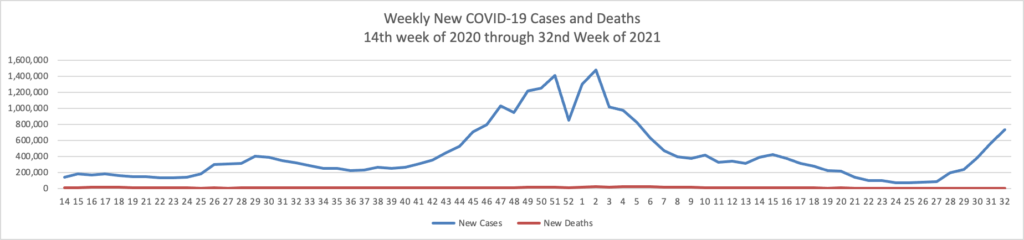
Based on the Centers for Disease Control’s COVID-19 Data Tracker website, here is the FEHBlog’s chart of new weekly COVID-19 cases and deaths over the 14th week of 2020 through 32nd week of this year (beginning April 2, 2020, and ending August 11, 2021); using Thursday as the first day of the week in order to facilitate this weekly update):
and here is the CDC’s latest overall weekly hospitalization rate chart for COVID-19:
The FEHBlog has noticed that the new cases and deaths chart shows a flat line for new weekly deaths because new cases significantly exceed new deaths. Accordingly here is a chart of new COVID-19 deaths over the same period (April 2, 2020, through August 11, 2021):
Finally here is a COVID-19 vaccinations chart over the period December 17, 2020, through August 11, 2021, which also uses Thursday as the first day of the week:
Here is a link to the Centers for Disease Control’s (“CDC”) latest weekly review for the COVID data tracker upon which the FEHBlog relies. The review is aptly titled: “Put on Your Masks and Thinking Caps.”
The American Hospital Association has released on You Tube a two minute long presentation on the value of COVID-19 vaccines. It’s called Eight Things to Know About the COVID-19 Vaccine. Its message should be widely distributed.
The Federal Times reports that Kaiser Permanente which is the third largest carrier in the FEHB Program announced a COVID-19 vaccine incentive for its FEHB plan membership today.
The CDC also issued 2021-22 Flu Season FAQs today. Among thing the FEHBlog learned that “All flu vaccines will be quadrivalent (four component), meaning designed to protect against four different flu viruses. For more information: Quadrivalent Influenza Vaccine | CDC.”
In an ironic twist, check out this quote from Fierce Healthcare
“The recent emergence of the delta variant has introduced some uncertainty to our second half visits outlook,” said Ido Schoenberg, M.D., chairman and CEO of Amwell, during the call.
“With mask mandates quickly returning and also acknowledging other trends we are observing within visit mix and volumes, we need to account for these other dynamics and a likely weaker cold and flu season due to these variant-related protective measures,” he said, also noting the company does not expect extra COVID-related demand.
“Consequently, we are adjusting down our visit forecast for the remainder of the year to account for these factors,” he said.
As the French say, “quelle domage”.
But seriously folks, Revcycle Intelligence informs us that
The percentage of telehealth claim lines has stabilized at about 5 percent of medical claim lines, indicating a new balance of virtual and in-person care.
The analysis conducted by FAIR Health as part of its Monthly Telehealth Regional Tracker included data representing the privately insured population, including Medicare Advantage, and excluded Medicare fee-for-service and Medicaid claims data.
The data revealed that the percentage telehealth claim lines increased slightly to 5 percent in May 2021, from 4.9 percent the previous month. The slight increase suggests a stabilization of telehealth utilization since telehealth claim lines had declined each month from February to April of this year.
And what’s more —
Healthcare Dive has a helpful wrap up article on the HIMSS conference. Take a look.
Federal News Network reports that the General Services Administration released federal employee travel per diems for the fiscal year beginning October 1, 2021. The combined per diems provide a cap of the federal contractor travel expenses that can be charged against an experience rated FEHB contract.
From Capitol Hill, Roll Call reports that nine centrist House Democrats have told Speaker Pelosi in writing that “We will not consider voting for a budget resolution until the bipartisan Infrastructure Investment and Jobs Act passes the House and is signed into law.” Roll Call adds that “Together, they’ve got more than enough support to stall the budget in the narrowly divided House where Democrats can lose no more than three members on party-line votes. No Republicans are expected to vote for the budget resolution, which is needed to begin the process on a $3.5 trillion reconciliation package chock full of Democratic priorities.”
The Veterans Affairs Department will more than triple the number of employees who must receive the vaccine, bringing the total to 360,000. VA originally required just its frontline health care staff—those hired under Title 38 of the U.S. Code—to be inoculated, which amounted to about 115,000 workers.
The mandate will now include Title Five employees within the Veterans Health Administration—such as housekeepers, engineers and administrative staff—and health care providers such as psychologists, pharmacists, physical therapists, nursing assistants and others in “Hybrid Title 38” positions.
“We’re now including most VHA employees and volunteers and contractors in the vaccine mandate because it remains the best way to keep veterans safe, especially as the Delta variant spreads across the country,” Secretary Denis McDonough said. “This pandemic is not over and VA must do everything in our power to protect veterans from COVID-19. With this expanded mandate, we can once again make—and keep—that fundamental promise.”
Employees impacted by the new mandate will have eight weeks to get the vaccine or prove they already have.
In the same vein, the Department of Health and Human Services (“HHS”) announced today that
[HHS] will require more than 25,000 members of its health care workforce to be vaccinated against COVID-19.
Staff at the Indian Health Service (IHS) and National Institutes of Health (NIH) who serve in federally-operated health care and clinical research facilities and interact with, or have the potential to come into contact with, patients will be required to receive the COVID-19 vaccine. This includes employees, contractors, trainees, and volunteers whose duties put them in contact or potential contact with patients at an HHS medical or clinical research facility.
Additionally, U.S. Surgeon General Dr. Vivek Murthy will immediately require members of the U.S. Public Health Service Commissioned Corps to be vaccinated against COVID-19 as part of medical readiness procedures to prepare for any potential deployment need as emergency responders
Those two mandates apply to about 20% of the federal workforce. In contrast, the general approach is a vaccine screening requirement — either attest to receiving the vaccine or wear a facemask and receive regular COVID-19 testing.
The U.S. Food and Drug Administration authorized booster shots for certain people with weakened immune systems, likely the launch of broader efforts to better protect against evasive variants like Delta.
The agency on Thursday cleared giving a third dose of a messenger RNA Covid-19 vaccine from Pfizer Inc. PFE 2.01% and its partner BioNTech SEBNTX 4.13% or from Moderna Inc. MRNA 1.58% to immunocompromised people who had received a solid organ transplant or individuals who have been diagnosed with conditions that are considered to have an equivalent level of immunocompromise.
From the health equity front, the National Institutes of Health released a disturbing study on maternal mortality:
Racial and ethnic disparities in maternal mortality — deaths related to pregnancy or childbirth — in the United States may be larger than previously reported, suggests a study funded by the National Institutes of Health. By re-examining information on death certificates from 2016 and 2017, researchers found that the maternal mortality rate among non-Hispanic Black women was 3.5 times higher than among non-Hispanic white women. Previously, standard analyses had indicated a 2.5-times-higher death rate for Black women.
The new analysis also revealed that these disparities were concentrated among a few causes of death. Postpartum cardiomyopathy (disease of the heart muscle) and the blood pressure disorders preeclampsia and eclampsia were leading causes of maternal death for Black women, with mortality rates five times higher than those for white women. Pregnant and postpartum Black women were two to three times more likely than white women to die of hemorrhage (severe bleeding) or embolisms (blood vessel blockages).
The study was funded by NIH’s Eunice Kennedy Shriver National Institute of Child Health and Human Development (NICHD) and led by Marian MacDorman, Ph.D., of the Maryland Population Research Center at the University of Maryland. It appears in the American Journal of Public Health.
Healthcare Dive reports on HIMSS conference presentations on this important topic of achieving health equity.
Healthcare executives do say equity is a top priority for their organizations, with half of the CEOs surveyed by Deliotte early this year saying its among their top three organizational priorities this year, according to a recent report from the consultancy.
However, companies are at different stages of actually implementing equity and inclusion programs, with some reporting they’ve been focused on addressing disparities for years, and others just beginning to define what it means to their organization.
Of the 20 chief executives surveyed by Deliotte, 17 said they had a dedicated team or budget for health equity initiatives.
That top-level buy-in is important, but addressing health inequities needs to be a whole-enterprise mission, [Ronald] Copeland[, the chief equity, inclusion and diversity officer for integrated health giant Kaiser Permanente] said, integrated into every facet of payer and provider goals. One strategy to achieve this could be to make health equity a formal dimension of quality improvement, a policy that’s even recently been considered in federal payer programs under the Biden administration.
In other HIMSS conference news —
Fierce Healthcare informs about HIMSS conference discussion on rationalizing patient and provider experiences with multiple front end apps.
Healthcare Dive interviews Teladoc’s president of hospitals and health systems, Joe DeVivo about the state of the telehealth market and the company’s ambitions.
STAT News informed us today that 19,000 people attended the HIMSS conference in person and 5,000 attended virtually. 700 exhibitors attended. Both of those totals are about half of the normal in person attendance at HIMSS.
From the drug costs front, the White House released the President’s ideas on how to reduce prescription drug costs. The President leads off with encouraging Congress to allow CMS to negotiate Medicare Part D drug contracts. That change may save money for the federal government but it shift those savings to the commercial sector including the FEHB.
Also the HHS Inspector General released a report on opioid use among Medicare beneficiaries in 2020. “More than 43,000 Medicare Part D beneficiaries suffered an opioid overdose—from prescription opioids, illicit opioids, or both—in 2020.” The Inspector General also noticed a drop in prescriptions for opioid treatments which the OIG found concerning. “A May 2020 OIG data brief recommended that CMS educate Part D beneficiaries and providers about access to MAT drugs and naloxone. We continue to encourage CMS to take these steps. It is also critical for CMS to closely monitor the number of beneficiaries receiving MAT drugs and naloxone and take action, if needed. OIG is also committed to continuing our work on opioid use and access to treatment.”
In litigation news, the prescription benefit manager trade association, PCMA, has filed a lawsuit against HHS in the District of Columbia’s federal court challenging the legality of certain aspects of the payer transparency rule scheduled to start phasing in on January 1, 2022.
PCMA is not challenging the portions of the rule that direct plans to provide useful information directly to patients. But we are challenging the portions of the rule that do not meet those important objectives and will not produce information that patients and physicians can use.
These parts of the Trump administration’s transparency rule will drive prescription drug costs higher. By requiring disclosure of “historical” net prices, which are essentially current year net prescription drug prices, the rule will directly provide drug manufacturers access to their competitors’ negotiated rebates, discounts, and price concessions. This in turn will allow drug manufacturers to discount less deeply as they realize their price concessions went beyond those of competitors.
In addition, outside entities will not be able to develop reported information into a useful and understandable format for patients. Unlike health plans and PBMs, third-party application developers will not know patients’ existing insurance enrollment and eligibility or their current benefits and whether they have met a deductible or reached an out-of-pocket limit, and so the third-party applications are likely to cause widespread confusion among patients. Net prices are generally not useful information to patients because their deductible and coinsurance payments are calculated based on negotiated rates, not net prices.
PBMs and health plans already have real-time benefits tools for patients and prescribers, which they can use at the point of prescribing to check on cost-sharing for every patient based on their individual situation and health plan.
Coincidentally, the U.S. Chamber of Commerce has filed a substantially similar lawsuit in the federal court for the Eastern District of Texas. That case challenges the legality of the “historical net prices” provision and the “three machine readable tapes” provision of the HHS rule on the ground that they have no utility to consumers. Good luck.
Finally, the Census Bureau released a lot more 2020 census data today. The Wall Street Journal observes that “The nation’s population grew just 7.4% during the decade, the second slowest on record for a decennial census. Only the 1930s—the era of the Great Depression—saw slower growth.”
The Senate early this morning approved on a party line vote a $3.5 trillion budget resolution, which included reconciliation instructions which will provide the majority party with the means to pass a comprehensive reconciliation package with just 51 votes in the Senate, rather than the usual 60-vote hurdle. The House will reconvene on Aug. 23 to consider the budget resolution. Once the resolution has passed both chambers, the House and Senate majorities can proceed with the reconciliation process, a resolution to which is expected in the fall.
Translating the budget framework into law will require Biden and Democratic congressional leaders keeping their party’s moderate and progressive wings marching together.
Just hours after passage of the budget blueprint, Senator Joe Manchin, a Democrat from West Virginia, said he couldn’t support a social spending bill with a $3.5 trillion price tag. Senator Kyrsten Sinema, an Arizona Democrat, has said the same. One Democratic objection is all it would take to scuttle the package in the Senate.
Time will tell but we are talking about $3.5 trillion on top of the $1 trillion infrastructure bill and multi-trillion COVID-19 relief bills that Congress has passed in the last 18 months. It appears that Congress is trying to disprove the adage that money can’t solve all problems.
One of the initiatives in the budget reconciliation package is to add dental, vision, and hearing coverage to Medicare. Kaiser Health News discusses the issue here.
From the Delta variant front
The Centers for Disease Control’s Advisory Committee on Immunization Practice released a helpful report on COVID-19 adverse side effects which it summarized as follows
What is already known about this topic?
Rare serious adverse events have been reported after COVID-19 vaccination, including Guillain-Barré syndrome (GBS) and thrombosis with thrombocytopenia syndrome (TTS) after Janssen COVID-19 vaccination and myocarditis after mRNA (Pfizer-BioNTech and Moderna) COVID-19 vaccination.
What is added by this report?
On July 22, 2021, the Advisory Committee on Immunization Practices reviewed updated benefit-risk analyses after Janssen and mRNA COVID-19 vaccination and concluded that the benefits outweigh the risks for rare serious adverse events after COVID-19 vaccination.
What are the implications for public health practice?
Continued COVID-19 vaccination will prevent COVID-19 morbidity and mortality far exceeding GBS, TTS, and myocarditis cases expected. Information about rare adverse events should be disseminated to providers, vaccine recipients, and the public.
Forbes tells us that today “The Centers for Disease Control and Prevention encouraged anyone pregnant and breastfeeding to get vaccinated against coronavirus Wednesday, pointing to a growing amount of evidence that vaccines are safe and effective as new cases and hospitalizations linked to the virus surge across the country.” The Washington Post adds “Just 23 percent of pregnant women have received at least one shot of vaccine.”
Also from Forbes as schools begin to reopen “Vaccine rates among teenagers have remained lower than the U.S. population overall, with only 43% of 12- to 15-year-olds and 52.8% of 16- and 17-year-olds receiving at least a first dose as compared with 58.9% of the total population and 71.2% of adults.”
The Boston Globe discusses this teenage hesitancy issue — “The top reservation among parents of unvaccinated teens was the lack of information about the long-term effects of the shot, followed by concerns about side effects and fertility — despite conclusive evidence that the vaccine has no negative impacts on reproduction. Dr. Jill Kasper, a pediatrician at Cambridge Health Alliance, said she typically encounters ‘very little hesitancy’ from parents about routine adolescent vaccinations. That hasn’t been the case with COVID-19.”
The HHS Agency for Healthcare Quality and Research issued two noteworthy studies today. Here are the topline findings
#1 Overuse or low-value procedures may result in patient physical, psychological, or emotional harm. This study explored the association between eight low-value care procedures and length of stay (LOS) and cost. All eight procedures were associated with increased LOS and cost, particularly spinal fusion. Patients receiving low-value care may be exposed to increased risk of adverse events and hospital-acquired conditions.
#2 Medication administration errors made by parent or caregivers can result in medication errors at home. This systematic review found that 30% to 80% of pediatric patients experience a medication error at home, and that the risk increases based on characteristics of the caregiver and if a prescription contains more than two drugs.
CVS Health said its Aetna unit will offer virtual primary care to self-funded employers nationwide in a move that underscores the growing popularity of telehealth services fueled by the COVID-19 public health emergency.
Using Teladoc Health’s physician-led care team model, the Aetna Virtual Primary Care service is intended to help strengthen the patient-doctor relationship and improve access to care, the vertically integrated company announced Tuesday. Members can receive health services remotely and in person.
Such support for primary care should be applauded.
In other healthcare news
STAT News reports that The Department of Veterans Affairs has decided not to cover a new Alzheimer’s drug from Biogen [Adulhelm], citing insufficient evidence of “a robust and meaningful clinical benefit” and concerns about safety. In a notice issued by the agency, the VA said it will make exceptions for “highly selected patients” and listed several hurdles that must be cleared before the medicine will be covered, such as requiring it to be prescribed by providers who specialize in treating dementia and ensuring patients had recently received MRI brain scans. * * * ‘Its bad news for Biogen,’ said Ira Loss of Washington Analysis, which tracks legislative and regulatory issues affecting the pharmaceutical industry for investors, who noted several private insurers have either declined or delayed coverage for the drug. ‘The VA is a big buyer of medicines. And you don’t like this kind of publicity, that’s for sure.’”
Fierce Healthcare continues to report from the HIMSS conference in Las Vegas. “Health IT giant Epic launched a new customer story-sharing website that lets Epic users share insights, tips and creative ideas around using health IT to improve their organizations and patient care. The site, EpicShare.org, combines insights from industry leaders, quick tips on improving outcomes and performance, in-depth case studies as well as a “Hey Judy” column from Epic founder and CEO Judy Faulkner.”
The Senate passed a roughly $1 trillion infrastructure package with broad bipartisan support Tuesday, advancing a central piece of President Biden’s economic agenda that would amount to one of the most substantial federal investments in roads, bridges and rail in decades.
With 19 Republicans including Senate Minority Leader Mitch McConnell (R., Ky.) joining all 50 Democrats to pass the bill 69 to 30, the legislation sailed through the Senate. The bill will face a more complicated path in the House, where Democrats have yoked the fate of the infrastructure effort to the passage of a broad $3.5 trillion antipoverty and climate effort.
Professor Katie Keith in the Health Affairs blog discusses the Administration’s health policy objectives in the budget reconciliation bill that the Senate is now taking up. “Vice President Harris emphasized the need for Congress to build on these [Affordable Care Act special enrollment period] coverage gains by 1) extending the American Rescue Plan Act subsidy enhancements; 2) closing the Medicaid coverage gap; 3) expanding Medicare to include dental, vision, and hearing coverage; and 4) lowering prescription drug costs.”
Becker’s Hospital review tells us how COVID-19 vaccination rates have changed in the states for the week ended August 9. The rates in 40 states lead by Mississippi (and the District of Columbia) are up and only 10 states are down.
As the world amasses experience with Covid-19 vaccines, something we should have known from the start is coming into sharp focus.
Vaccines that are injected into arm muscles aren’t likely to be able to protect our nasal passages from marauding SARS-CoV-2 viruses for very long, even if they are doing a terrific job protecting lungs from the virus. If we want vaccines that protect our upper respiratory tracts, we may need products that are administered in the nose — intranasal vaccines.
Can they be made? Probably. Will they do what we want them to do, if they are made? Possibly. Is there still room for this type of next-generation product, given the record number of Covid vaccines that have already been put into use? Potentially. Will it be difficult to get them through development? Likely.
In this regard the National Institutes of Health reports on a successful animal study of a COVID-19 intranasal vaccine based on the Oxford / Astra Zeneca model. What’s more, “[a] clinical trial at the University of Oxford is now testing intranasal vaccination in human volunteers.”
Fierce Healthcare is running a daily HIMSS21 roundup from the conference being held in Las Vegas this week.
Reg Jones writes in FedWeek about FEHB coverage for adult children of federal employees and annuitants who are incapable of self support. This is a rather unique feature of the Program.
The U.S. Postal Service plans to charge more for packages shipped during the holidays, including those sent by individuals, to offset the rising cost of deliveries at the busiest time of the year.
The agency on Tuesday proposed adding surcharges on most packages shipped domestically between Oct. 3 and Dec. 26, saying the fees would apply to both commercial and retail customers. That means it won’t just be Amazon.com Inc.,Target Corp. TGT 0.63% and other big holiday shippers paying higher-than-normal rates; it will also cost more to ship a box of cookies to grandma.
The agency said the added fees, ranging from 25 cents for smaller packages to $5 for heavier items traveling longer distances, are in line with broader industry practices to charge more during the holiday season.
We use cookies on our website to give you the most relevant experience by remembering your preferences and repeat visits. By clicking “Accept”, you consent to the use of ALL the cookies.
This website uses cookies to improve your experience while you navigate through the website. Out of these, the cookies that are categorized as necessary are stored on your browser as they are essential for the working of basic functionalities of the website. We also use third-party cookies that help us analyze and understand how you use this website. These cookies will be stored in your browser only with your consent. You also have the option to opt-out of these cookies. But opting out of some of these cookies may affect your browsing experience.
Necessary cookies are absolutely essential for the website to function properly. These cookies ensure basic functionalities and security features of the website, anonymously.
Cookie
Duration
Description
cookielawinfo-checbox-analytics
11 months
This cookie is set by GDPR Cookie Consent plugin. The cookie is used to store the user consent for the cookies in the category "Analytics".
cookielawinfo-checbox-functional
11 months
The cookie is set by GDPR cookie consent to record the user consent for the cookies in the category "Functional".
cookielawinfo-checbox-others
11 months
This cookie is set by GDPR Cookie Consent plugin. The cookie is used to store the user consent for the cookies in the category "Other.
cookielawinfo-checkbox-necessary
11 months
This cookie is set by GDPR Cookie Consent plugin. The cookies is used to store the user consent for the cookies in the category "Necessary".
cookielawinfo-checkbox-performance
11 months
This cookie is set by GDPR Cookie Consent plugin. The cookie is used to store the user consent for the cookies in the category "Performance".
viewed_cookie_policy
11 months
The cookie is set by the GDPR Cookie Consent plugin and is used to store whether or not user has consented to the use of cookies. It does not store any personal data.
Functional cookies help to perform certain functionalities like sharing the content of the website on social media platforms, collect feedbacks, and other third-party features.
Performance cookies are used to understand and analyze the key performance indexes of the website which helps in delivering a better user experience for the visitors.
Analytical cookies are used to understand how visitors interact with the website. These cookies help provide information on metrics the number of visitors, bounce rate, traffic source, etc.
Advertisement cookies are used to provide visitors with relevant ads and marketing campaigns. These cookies track visitors across websites and collect information to provide customized ads.