Midweek Update

Midweek Update

Photo by Manasvita S on Unsplash

In anticipation of tomorrow morning’s markup session, the House Appropriations Committee today released the draft Fiscal Year 2022 financial services and general government appropriations bill. Of note,

  • Office of Personnel Management (OPM) – The bill includes $372 million, an increase of $42 million above the FY 2021 enacted level, for OPM to manage and provide guidance on Federal human resources and administer Federal retirement and health benefit programs.
  • [The bill] eliminates provisions preventing the FEHBP from covering abortion services [subject to limited exceptions, e.g. life of the mother is endangered by continuing the pregnancy].

Govexec.com adds that “the bill makes no mention of a pay raise for federal employees, effectively endorsing [President] Biden’s plan to give feds an average 2.7% pay raise next year. It remains unclear how the White House would divvy up the 2.7% between an across-the-board increase to basic pay and an average increase in locality pay, although traditionally 0.5% has been reserved for locality pay increases.

From the COVID-19 front, the American Hospital Association informs us

The AHA today joined the Department of Health and Human Services, Centers for Disease Control and Prevention, and other national health care and public health organizations in encouraging COVID-19 vaccination for everyone age 12 and older who is eligible. “Today, the CDC Advisory Committee on Immunization Practices (ACIP) met to discuss the latest data on reports of mild cases of inflammation of the heart muscle and surrounding tissue called myocarditis and pericarditis following COVID-19 vaccination among younger people,” the statement notes. “The facts are clear: this is an extremely rare side effect, and only an exceedingly small number of people will experience it after vaccination. Importantly, for the young people who do, most cases are mild, and individuals recover often on their own or with minimal treatment. In addition, we know that myocarditis and pericarditis are much more common if you get COVID-19, and the risks to the heart from COVID-19 infection can be more severe.” 

Separately, the Food and Drug Administration today told ACIP that it was moving quickly to adjust the language on its emergency use authorization fact sheets for the Pfizer and Moderna COVID-19 vaccines to note a likely association in rare cases of myocarditis and pericarditis in vaccine recipients.

Bloomberg reports in this regard that

CDC Director Rochelle Walensky said Wednesday that mRNA vaccines have been successful in preventing severe illness and death among young people. For every million second doses of an mRNA vaccine administered to those 18-to-24-year-olds, the CDC projects 26,000 cases of Covid and 1,657 hospitalizations are prevented, while only 49 to 61 cases of myocarditis may develop. Speaking at the Milken Institute Future of Health Summit, Walensky added that the data presented at the advisory committee meeting still “overwhelmingly demonstrate that the benefits of vaccination far outweigh the risks.”

The Society for Human Resource Management offers advice on confronting COVID-19 vaccination misinformation in the workplace.

From the prescription drug front, Fierce Healthcare reports that employer groups are asking Congress to look into Biogen’s pricing of its new Alzheimer’s drug at $56,000 per course of treatment and the CVS Health continues to remove hyperinflationary drugs from its formularies in order to control drug spending.

Posaconazole, an antifungal medication, is priced at $4,500 for a 30-day supply—while an alternative, fluconazole, costs less than $14. This is an example of a growing trend: medications, including many generics, with “hyperinflated” prices, experts at CVS Caremark say. The pharmacy benefit manager giant culled 72 such drugs from its formulary in 2020 alone, leading to savings of $1.2 billion compared to 2018.

From the price transparency world, RevCycle Intelligence tells us that “The majority of the top 100 hospitals by gross revenue are using a price estimator tool to comply with a landmark hospital price transparency rule from HHS, according to a recent study.”

Finally, CIGNA has added a telemental service called Brightside to its behavioral health network. According to the provider’s press release,

Brightside, a mental health telemedicine platform that offers access to high-quality anxiety and depression care from anywhere, today announced that it has joined the national behavioral health network for Cigna Corporation, a global health service company. Cigna’s 14 million behavioral health customers can now access Brightside’s evidence-based and data-driven approach to treating anxiety and depression through their commercial health care plans.” * * * “The pandemic has shined a light on the need for broader, more convenient access to mental health care. Cigna is committed to providing our customers with the behavioral health care they need, when and where they need it – and that is what Brightside will help us offer,” said Dr. Doug Nemecek, Cigna’s chief medical officer for behavioral health. “By increasing access through virtual care, customers can talk to a psychiatrist or therapist from the comfort and privacy of their homes. This is another demonstration of our commitment to provide timely and convenient access to depression and anxiety care for Cigna members.

The FEHBlog appreciates such services because in contrast to in person care where the mental health providers are typically out of network, telemental providers in a spoke and hub arrangement like this one are always in-network, thereby creating savings for the plan and the member.

New OPM Director plus Tuesday’s Tidbits

OPM Headquarters a/k/a the Theodore Roosevelt Building

The Senate narrowly confirmed Kiran Ahuja to be Office of Personnel Management Director this afternoon. Here’s the Senate play by play from the Senate Press Gallery website.

1:37 p.m. Cloture was invoked on the Ahuja nomination, 51-50. Vice President Harris broke the tie.

2:26 p.m. Senator Peters spoke in support of the Ahuja nomination.

2:30 p.m. The Senate began a vote on confirmation of Executive Calendar #107 Kiran Arjandas Ahuja to be Director of the Office of Personnel Management for a term of four years.

3:26 p.m. By a vote of 51-50, the Senate confirmed Executive Calendar #107 Kiran Arjandas Ahuja to be Director of the Office of Personnel Management for a term of 4 years. The Vice President cast the tie breaking vote. 

Here is a link to Ms. Ahuja’s Wikipedia page. Here are links to the Federal Times, Govexec and Federal News Network reports on this event. The FEHBlog wishes Ms. Ahuja good luck.

The Senate Health Education Labor and Pensions Committee held a hearing on COVID-19 vaccination efforts today. Here is a link to the Sen. Patty Murray’s (D Wash) statement on the hearing. Sen. Murray is the Committee chair.

In this regard, the Wall Street Journal reports that

The White House said the U.S. will fall short of President Biden’s goal for 70% of the adult population to receive at least one coronavirus vaccine dose by July 4.

Mr. Biden had set the goal in early May, with an aim for a return to normalcy to mark the Independence Day holiday. White House Covid-19 coordinator Jeffrey Zients said Tuesday the target had been met for those age 30 and over but not for the overall eligible population.

Mr. Zients said it would take a few extra weeks to reach the president’s target and cited a reluctance to get the vaccine among people between the ages of 18 and 26 as one of the challenges facing the country.

“The reality is many younger Americans have felt like Covid-19 is not something that impacts them and they have been less eager to get the shot,” Mr. Zients said.

On Thursday, June 24, at 10 am, the Financial Services and General Government Subcommittee of the House Appropriations Committee will markup the fiscal year 2022 appropriations bill that includes OPM and FEHB appropriations. Here’s a link to a Fedweek article on the markup.

STAT News offers a couple of sobering articles, one on antibiotic resistance and the other on health equity concerns

  • According to a new STAT Report an estimated 700,000 people die annually from antimicrobial resistance, a number that could rise to 10 million by 2050, according to a World Health Organization report issued in 2019. In the U.S. alone, there are more than 2.8 million antibiotic-resistant infections and 35,000 deaths from those infections each year, according to data from the Centers for Disease Control and Prevention. A number of issues have fueled resistance and stunted development of new antibiotics. And while there are various efforts underway to address those challenges, creating incentives to change the trajectory of antibiotic resistance takes commitment and imagination. There are several experiments under way that aim to spur development of new products while still ensuring profit. In the U.K. and Sweden, pilot programs are testing a pull incentive, which involves a subscription-style business model in which a government offers upfront payments to drug makers in exchange for unlimited access to their antibiotics. The idea is to enable drug companies to recover their costs and make an appropriate profit without having to sell large volumes of antibiotics. Last week, U.S. lawmakers re-introduced legislation to create a similar mechanism.
  • [Researchers have identified]232 counties in the mainland U.S. where men aged 49 and under are at unusually high risk of dying from colorectal cancer, according to a study published last year in the American Journal of Cancer Research. The researchers also found that compared with white men, Black men in these hot spots who have colorectal cancer are more likely to be diagnosed with advanced stages of the disease and less likely to survive it. * * * [S]ince the 1990s, even as colorectal cancer rates have declined for people 50 and older, they have more than doubled among American adults under 50, according to the National Cancer Institute. By 2030, predicts a study published in April, colorectal cancer will be the leading cause of cancer-related deaths in people aged 20 to 49. The reason behind the rise remains a mystery. “We don’t know where this is coming from,” said Charles R. Rogers, an assistant professor of public health at the University of Utah School of Medicine and lead author of the hot spots study. “Just like we don’t really know why Black people have the highest chance of getting and dying from it.” The article explains how researches like Professor Rogers are shedding light on the cause of this inequity by studying the hot spots, among other things.

In brighter Tuesday Tidbits

  • The Patient Centered Outcomes Research Institute funded by health plan premiums is seeking public comment on its national health priorities. The public comment period runs from June 28 through August 27.
  • Fierce Healthcare reports that “Five Blues plans are teaming up to invest in a new pharmacy solutions venture called Evio. Blue Cross Blue Shield of Massachusetts, Blue Cross Blue Shield of Michigan, Blue Shield of California, Highmark Health and Independence Blue Cross are backing Evio, according to an announcement released Tuesday. The new company aims to establish outcomes-based arrangements with drugmakers, especially for high-cost therapies. In addition, Evio aims to collect and provide real-world evidence for medications to ensure the right product is getting to the right patient.” Makes sense to the FEHBlog.
  • Fierce Healthcare also informs us that “Amazon Web Services wants to help incubate early-stage digital health companies that can collaborate with the tech giant’s healthcare customers and partners. Amazon’s cloud division launched a healthcare accelerator to boost startups’ growth in cloud technologies and enable early-stage companies to tap into AWS’ technical and commercial expertise. The program will focus on technologies such as remote patient monitoring, data analytics, patient engagement, voice technology and virtual care, according to a blog post from Sandy Carter, vice president of worldwide public sector partners and programs at AWS.”

Weekend update

Thanks to Alexandr Hovhannisyan for sharing their work on Unsplash.

Happy Fathers’ Day and First Day of Summer.

Both Houses of Congress remain in session for Committee business and floor voting this week. Among the scheduled hearings for this week, the Senate Health Education Labor and Pensions Committee will hold a hearing on Tuesday morning to “examine vaccines, focusing on America’s shot at ending the COVID-19 pandemic.”

Speaking of which, Kaiser Health News reports on a June 10, 2021, FDA advisory committee meeting on pediatric COVID-19 vaccines. Here’s a link to the FDA’s briefing document.

Amy Howe who writes on the U.S. Supreme Court discusses the decisions that the Court is expected to issue over the remainder of this month and possibly early July. There are many interesting issues at stake but none of them relate to the FEHB Program.

STAT News offers an encouraging op-ed from two physicians who think that the pandemic has caused people to be more engaged with their healthcare. Hope springs eternal.

Friday Stats and More

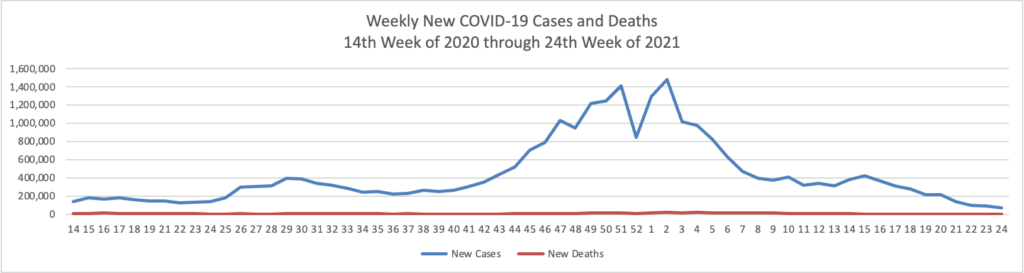
Based on the Centers for Disease Control’s COVID-19 Data Tracker website, here is the FEHBlog’s chart of new weekly COVID-19 cases and deaths over the 14th week of 2020 through 24th week of this year (beginning April 2, 2020, and ending June 16, 2021; using Thursday as the first day of the week in order to facilitate this weekly update):

and here is the CDC’s latest overall weekly hospitalization rate chart for COVID-19:

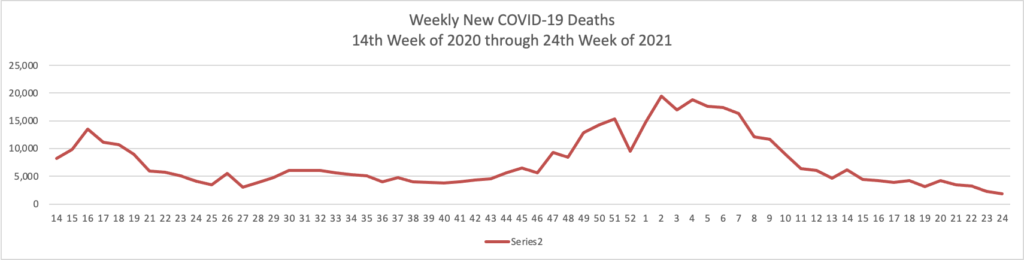
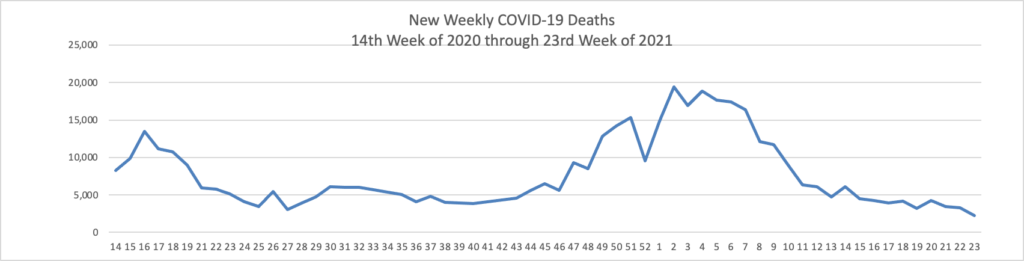
The FEHBlog has noticed that the new cases and deaths chart shows a flat line for new weekly deaths because new cases materially exceed new deaths. Accordingly here is a chart of new COVID-19 deaths over the period (April 2, 2020, through June 16, 2021):

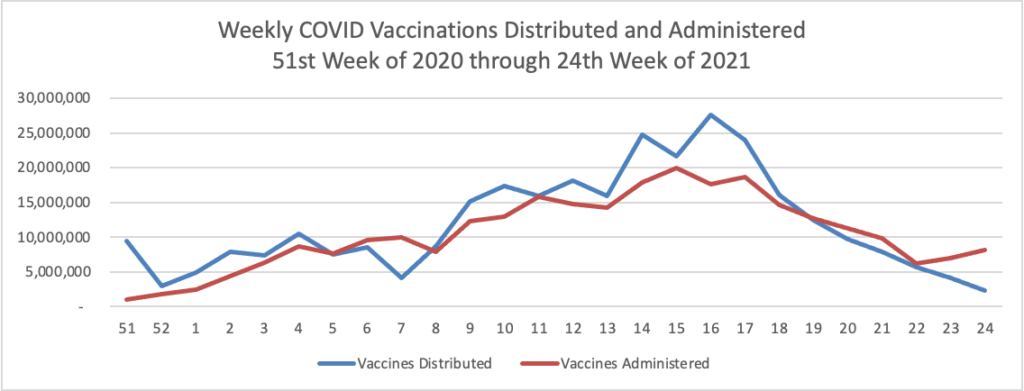
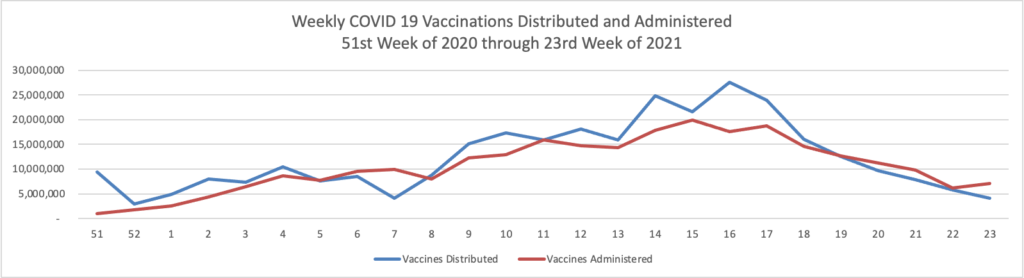
Finally here is a COVID-19 vaccinations chart over the period December 17, 2020, through June 16, 2021 (six months) which also uses Thursday as the first day of the week:

Bloomberg reports that

President Joe Biden urged unvaccinated Americans to get inoculated from coronavirus, warning that the highly transmissible delta variant of the virus could cause more deaths. “Even while we are making incredible progress [as reflected above], it remains a serious and deadly threat,” Biden said Friday during a White House event to celebrate 300 million doses of vaccine administered during the first 150 days of his administration.“The data is clear: If you are unvaccinated, you’re at risk of getting seriously ill, or dying, or spreading it.” A large swath of Americans — particularly in the politically conservative South — have declined shots despite warnings from health authorities that the virus remains a threat.”

in other COVID-19 news

  • Medscape informs us that “While the investigation into cases of myocarditis possibly associated with COVID vaccines proceeds, the American Heart Association (AHA)/American Stroke Association (ASA) continue to urge everyone who is eligible for the vaccine to get it without delay. ‘We remain confident that the benefits of vaccination far exceed the very unusual risks,’ the leadership of the AHA/ASA said in a statement issued June 12. ‘The risks of COVID-19 infection include its potentially fatal consequences and the potential long-term health effects that are still revealing themselves, including lingering consequences affecting the heart, brain, vascular system, and other organs after infection,’ they point out. Late last week, the Centers for Disease Control and Prevention (CDC) alerted healthcare providers that the COVID-19 Vaccine Safety Technical Work Group (VaST) of the Advisory Committee on Immunization Practices (ACIP) will meet June 18 to review cases of myocarditis reported in adolescents and young adults after they received a COVID-19 vaccine manufactured by Pfizer–BioNTech or Moderna.
  • MedPage Today reports that “During the American Medical Association (AMA) House of Delegates annual meeting, members debated whether natural immunity or previous infection with SARS-CoV-2 was sufficient for the merit of immunity credentials.” The House of Delegate voted against treating natural immunity as equivalent to vaccination. “Multiple delegates pointed out that using natural immunity in lieu of vaccination would pit the AMA’s recommendations against those of the CDC.” Nevertheless as the Mayo Clinic points out, natural immunity helps us achieve some level of herd immunity. It needs to be considered with vaccinations for that purpose.

If you want more details on yesterday’s Affordable Care Act decision from the U.S. Supreme Court, check out Prof. Katie Keith’s post in the Health Affairs blog.

Beckers Hospital News lists seven Fortune 500 health insurers by membership. Health Payer Intelligence discusses the latest sustainability report from the company that tops this list, UnitedHealth Group.

On this Juneteenth holiday, Fierce Health tells us about how “healthcare executives call on President Biden to take ‘innovative, bold’ steps to tackle health equity using AI, big data.”

“It’s not a lack of data—we have so much data in this country now, in our healthcare systems and our EHRs and our patient registration systems,” Cole said. “The data is there but the analytics capability of that—what to do with that data—is something that we’re continuing to work on every day.”

Cole and John Lumpkin, M.D., president of the Blue Cross and Blue Shield of North Carolina Foundation, said both of their organizations have been reworking their collection and organization of race, ethnicity, gender identity and other related data tied to health inequity—a change that “should be a very simple thing to do” but requires an internal data system overhaul, Lumpkin said.

Still, executives said the finish line of those efforts is worthwhile. Incorporating SDOH data can yield substantial health and costs benefits at the individual and population levels, they said.

The Wall Street Journal reports on the rising fortunes of the country’s major pharmacy chains, CVS Health and Walgreens.

In health system merger news —

  • Healthcare Dive informs us that “Beaumont Health and Spectrum Health are looking to merge in a deal that would result in Michigan’s biggest health system with 22 hospitals and 64,000 employees across the state, with combined annual revenue of almost $13 billion. Executives of the two systems announced Thursday they have signed a letter of intent to explore creating a joint health system. The deal would include Spectrum’s Michigan-based health insurance plan, Priority Health, which has 1.2 million customers.”
  • Fierce Healthcare reports that “Southern health systems Ochsner Health and Rush Health Systems have announced plans for a merger they expect to be completed about halfway through 2022. The deal follows a 2019 strategic partnership between the two nonprofit providers and comes hot on the heels of Louisiana-based Ochsner’s merger with Lafayette General Health, which closed in October 2020 and grew the system to 35 hospitals. Rush, which has seven hospitals and more than 30 clinics in eastern Mississippi and western Alabama, will be rebranded as Ochsner Rush Health should the merger receive regulatory approval.”
  • Healthcare Dive also tells us that “Tenet, a major U.S. health system, has agreed to sell five hospitals in the Miami-Dade area for $1.1 billion to Steward Health Care System, a physician-owned hospital operator and health network. The deal also includes the hospitals’ associated physician practices. Dallas-based Steward has agreed to continue using Tenet’s revenue cycle management firm, Conifer Health Solutions, following the completion of the deal, which is expected to close in the third quarter. Further underscoring Tenet’s strategic focus, the sale will not include Tenet’s ambulatory surgery centers in Florida. Tenet will hold onto those assets as its ambulatory business becomes a bigger focus for the legacy hospital operator.”

Monday Roundup

Thanks to Aaron Burden for sharing their work on Unsplash.

Happy Flag Day!

According to the U.S. Senate Press Gallery, sometime after 11:30 am tomorrow morning, the Senate will hold a cloture vote on Kiran Ahuja’s nomination to be OPM Director. If the cloture vote receives majority approval (assuming a quorum exists), then the Senate will vote to confirm Ms. Ahuja’s nomination sometime after 2:30 pm tomorrow.

From the COVID-19 front

  • MedPage Today reports that “While experience so far with COVID vaccines shows that some are associated with very rare, early side effects, experts say they have confidence about the long-term safety of these vaccines. That’s because past experience shows that severe side effects from vaccines most often appear within a time frame of about 6 weeks after vaccination, according to Paul Offit, MD, director of the Vaccine Education Center at Children’s Hospital of Philadelphia and a member of the FDA’s Vaccines and Related Biological Products Advisory Committee (VRBPAC).”
  • Bloomberg reports that “Covid-19 vaccines from Pfizer Inc. and AstraZeneca Plc are highly effective after two doses at preventing hospitalization of those infected with the delta variant, underscoring the urgency in getting people fully protected, according to health authorities in England.” David Leonhardt adds in the New York Times that

The news about Covid-19 has been mostly positive in the U.S. over recent months. The vaccines continue to work well against every variant, and the number of Americans who have gotten a shot continues to rise.

But the U.S. still faces two problems. First, the pace of vaccinations has slowed, and a substantial share of Americans — close to one third — remains hesitant about getting a shot. These unvaccinated Americans will remain vulnerable to Covid outbreaks and to serious symptoms, or even death.

Second, the Delta variant — which appears to be both more contagious and more severe than earlier versions of the virus — is spreading rapidly within the U.S., after having first been identified in India. It now accounts for about 10 percent of cases, according to Dr. Scott Gottlieb, a former F.D.A. commissioner. * * *

“The Delta variant is by far the most contagious variant of this virus we have seen in the entire pandemic,” Dr. Ashish Jha saidyesterday. “The good news is the data suggests that, if you’ve been fully vaccinated, you remain protected, that the vaccines hold up.”

The clearest place to see this pattern is Britain, where the Delta variant has spread widely and where the vaccination rate is high. In Britain, there is “still no sign of increase in deaths, well after the strain has become dominant,” as Dr. Eric Topol of the Scripps Research Translational Institute noted.

Vaccine maker Novavax said Monday its shot was highly effective against COVID-19 and also protected against variants in a large, late-stage study in the US and Mexico.

The vaccine was about 90 percent effective overall and preliminary data showed it was safe, the company said.

While demand for COVID-19 shots in the US has dropped off dramatically, the need for more vaccines around the world remains critical. The Novavax vaccine, which is easy to store and transport, is expected to play an important role in boosting vaccine supplies in the developing world.

That help is still months away, however. The company says it plans to seek authorization for the shots in the US, Europe and elsewhere by the end of September and be able to produce up to 100 million doses a month by then.

  • The Department Health and Human Services announced that it has “awarded $125 million to support 14 nonprofit private or public organizations to reach underserved communities in all 50 states plus the District of Columbia, Puerto Rico, Guam and the Freely Associated States to develop and support a community-based workforce that will engage in locally tailored efforts to build vaccine confidence and bolster COVID-19 vaccinations in underserved communities.”

Fierce Healthcare reports that

Following its acquisition of MDLive and the approval of new drugs in the market, Cigna’s Evernorth is expanding its care management program for weight loss.

The Weight Management Care Value program initially launched under Express Scripts as part of its slate of SafeGuardRx programs. Now, the company is harnessing the capabilities of other assets under its umbrella to broaden the program.

Members who enroll in the program will have access to new therapies like Novo Nordisk’s Wegovy, when clinically appropriate and prescribed by their doctor, as well as virtual care options provided by MDLive.

Here are two more OPM rule makings that were listed in OPM’s semi annual regulatory agenda that was released last Friday June 11

  • OPM has in store for us a new proposed rule on FEHB Enrollment and Changes in Enrollment “The Office of Personnel Management (OPM) proposes to amend title 5 part 890 of the Code of Federal Regulations governing the Federal Employees Health Benefits (FEHB) Program to allow OPM to make improvements and clarifications to the FEHB Program’s enrollment rules and processes, including centralizing certain health benefits enrollment functions. Currently, enrollment is administered by an enrollee’s employing agency or retirement system. This rule would allow OPM to leverage necessary IT functionality in order to conduct certain enrollment functions and collect information necessary to administer FEHB enrollments with greater efficiency and in alignment with the best practices of employer-sponsored insurance programs. In addition, OPM is proposing a process that would allow an employing office or OPM to decrease an individual’s enrollment type from self plus one or self and family to self only when there is only an enrollee and no family member.”
  • OPM plans to issue an interim final rule extending FEHB coverage to Tribal employees at 297 grant schools in accordance with the Consolidated Appropriations Act. This action suggests that the extension will take effect for the next Federal Benefits Open Season

Weekend update

Photo by Michele Orallo on Unsplash

The House of Representatives and the Senate will be engaged in Committee business and floor voting this coming week. The Senate’s Executive Calendar states that

Ordered, That at 5 p.m. on Monday, June 14, 2021, the Senate proceed to executive session to resume consideration of the nomination of Ketanji Brown Jackson, of the District of Columbia, to be United States Circuit Judge for the District of Columbia Circuit.

Ordered further, That at 5:30 p.m., all post-cloture time expire.

Ordered further, That following disposition of the Jackson nomination the cloture motions with respect to the nominations of Lina M. Khan, of New York, to be a Federal Trade Commissioner for the unexpired term of seven years from September 26, 2017 and Kiran Arjandas Ahuja, of Massachusetts, to be Director of the Office of Personnel Management for a term of four years, ripen.

Ordered further, That with respect to the motions to invoke cloture on Kahn and Ahuja nominations, the mandatory quorum calls required under Rule XXII be waived.

Ordered further, That if any of the nominations are confirmed, the motions to reconsider be considered made and laid upon the table and the President be immediately notified of the Senate’s actions. (Jun. 10, 2021.)

The FEHBlog will continue to keep an eye on Ms. Ahuja’s nomination.

Here’s a link to the Blue Cross FEP website for its COVID-19 vaccination incentive. FedSmith has a complete report on his experience with the new program.

Fierce Healthcare reports that

More than 96% of U.S. physicians have been fully vaccinated for COVID-19, with no significant difference in vaccination rates across regions, according to a new survey from the American Medical Association (AMA).

Of the physicians who are not yet vaccinated, an additional 45% do plan to get vaccinated, the AMA survey data (PDF) shows. The most common reason for not receiving the vaccine was that it was too new and has unknown long-term effects, according to physician responses.

The national AMA survey polled 300 physicians, including primary care doctors and specialists, between June 3-8. It’s the first survey to specifically collect data on practicing physicians’ COVID-19 vaccination rates, according to the AMA.

The survey results show an increase of more than 20% for physicians who have been fully vaccinated for COVID-19 compared to a May 2021 Medscape poll, AMA said.

“Practicing physicians across the country are leading by example, with an amazing uptake of the COVID-19 vaccines,” said AMA President Susan R. Bailey, M.D. in a statement.

In other encouraging news, the Wall Street Journal reports

The proportion of Covid-19 laboratory tests that are coming back positive is at the lowest recorded point since the pandemic took hold in the U.S., a sign of progress as the country moves ahead with reopening. * * *

The proportion of tests coming back positive has been consistently falling since April this year and is now at the lowest point since March 2020, the furthest back the Johns Hopkins data are available.

The low positivity rate [2%] is a signal that the drop in infections is really due to less disease in the country rather than because the U.S. is testing less for the virus, according to epidemiologists. It is another indication of how the U.S. is gaining ground against the Covid-19 pandemic, along with declining case counts, hospitalizations and deaths

“It’s a true reflection of a decrease in overall circulation in the U.S.,” said Anne Rimoin, an infectious-disease epidemiologist at the UCLA Fielding School of Public Health. “But we still do have pockets where we’re seeing transmission of the virus, and we need to be careful.”

NBC News adds that “There are only three Covid-19 patients at Sandra Atlas Bass Heart Hospital at North Shore University Hospital, on Long Island, New York — a far cry from when the hospital, which is part of Northwell Health, had as many as 600 patients during the peak of the pandemic. All three patients, who are in the intensive care unit, have one thing in common, said Dr. Hugh Cassiere, director of the hospital’s critical care services: They’re unvaccinated. The trend appears to be occurring at hospitals nationwide. “I haven’t had anyone that’s been fully vaccinated become critically ill,” said Dr. Josh Denson, a pulmonary medicine and critical care physician at Tulane University Medical Center in New Orleans.”

As the FEHBlog mentioned in Friday’s post, the federal government’s semi-annual regulatory agenda was posted on June 11. Over the course of this week, the FEHBlog will highlight the FEHB rule makings. Of note

OPM proposes to amend the Federal Employees Health Benefits Acquisition Regulation (FEHBAR) to update reporting requirements for health insurance carriers providing benefits through the Federal Employees Health Benefits (FEHB) Program. In the course of business, FEHB carriers collect pharmacy, enrollment, provider, person-specific medical and pharmacy claims, or in the case of managed care plans, encounter data related to enrollees and family members in order to provide healthcare coverage to those individuals. Under this proposed regulation, FEHB carriers would be required to submit this information to OPM, related to all benefits and services provided under the Program, on no less than an annual basis. This rule clarifies the requirements for FEHB carriers to furnish such reasonable reports, pursuant to 5 U.S.C. 8910, to better enable OPM, as a health oversight agency, to obtain the information necessary for proper administration of the FEHB Program.

View Rule (reginfo.gov) OPM first proposed to create an FEHB identifiable claims data warehouse in 2010. In 2015 OPM reported a massive data breach. Logically OPM should have backed off the idea of an FEHB identifiable claims data warehouse because that would be such an attractive target for hackers. It didn’t; OPM proposed an FEHB rule to create the identifiable claims data warehouse in September, 2019, and the rule making died at the Office of Management and Budget review stage three months later. OPM now has decided to take another bite at the apple; this time with an acquisition regulation.

OPM also has its own No Surprises Act rule making which includes the independent dispute resolution processes. 

This interim final rule with comment would implement additional protections against surprise medical bills under the No Surprises Act, including provisions related to the independent dispute resolution processes. 

New Section 8902(p) of the FEHB Act requires OPM to implement certain No Surprises Act provisions in the FEHB carrier contracts and to extend corollary obligations on healthcare providers by rule making. OPM states that this rule has a statutory deadline of October 1, 2021. HHS also is scheduled to release Part II of its No Surprises Act interim final rule making by the same date. The FEHBlog noted last week that Part I of that HHS rule making which has a statutory deadline of July 1, 2021, is pending OMB review.

Friday Stats and More

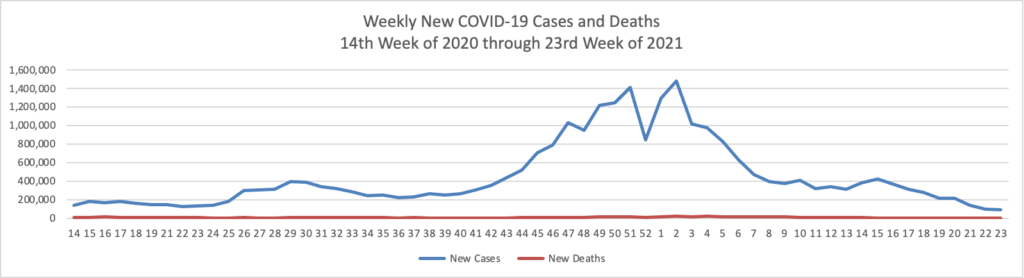
Based on the Centers for Disease Control’s COVID-19 Data Tracker website, here is the FEHBlog’s chart of new weekly COVID-19 cases and deaths over the 14th week of 2020 through 23rd week of this year (beginning April 2, 2020, and ending June 9, 2021; using Thursday as the first day of the week in order to facilitate this weekly update):

and here is the CDC’s latest overall weekly hospitalization rate chart for COVID-19:

The FEHBlog has noticed that the new cases and deaths chart shows a flat line for new weekly deaths  because new cases significantly exceed new deaths. Accordingly here is a chart of new COVID-19 deaths over the period (April 2, 2020, through June 9, 2020):

Finally here is a COVID-19 vaccinations chart over the period December 17, 2020, through June 9, 2021, which also uses Thursday as the first day of the week:

All signs continue to look up. 50% of the American population over 12 years old is fully vaccinated per the CDC.

In COVID-19 news, the Food and Drug Administration announced the latest actions stemming from its ongoing investigation of the problematic Emergent Biosolutions Baltimore factory that had been manufacturing the Johnson & Johnson one dose COVID-19 vaccine:

[The FDA] is authorizing for use, under the emergency use authorization (EUA) for the Janssen COVID-19 vaccine, two batches of vaccine drug substance manufactured at the Emergent BioSolutions facility in Baltimore. Before making this decision, the FDA conducted a thorough review of facility records and the results of quality testing performed by the manufacturer. Based on this review and considering the current COVID-19 public health emergency, the FDA concluded these batches are suitable for use. While the FDA is not yet ready to include the Emergent BioSolutions plant in the Janssen EUA as an authorized manufacturing facility, the agency continues to work through issues there with Janssen and Emergent BioSolutions management. * * *

The FDA has determined several other batches are not suitable for use, but additional batches are still under review and the agency will keep the public informed as those reviews are completed.

Per Fierce Healthcare, the New York Times is reporting that the unsuitable batches total 60 million vaccine doses. Yikes.

HR DIve reports

Most employers “no longer need to take steps to protect their workers from COVID-19 exposure in any workplace, or well-defined portions of a workplace, where all employees are fully vaccinated,” the Occupational Safety and Health Administration said in guidance updated Thursday.

The agency also published an emergency temporary standard for U.S. healthcare employers. Employers included in the emergency temporary standard’s definition must develop and implement a plan to protect employees from COVID-19 in the workplace, and they must designate one or more workplace COVID-19 safety coordinators to implement and monitor their plans. The document also lays out requirements for patient screening and management, personal protective equipment and physical distancing, among other subjects.

OSHA’s updated guidance for all industries, meanwhile, encourages employers to grant paid time off for employees to get vaccinated. Employers also should implement physical distancing for unvaccinated and other at-risk workers in communal work areas, including limiting the number of such workers in one place at any given time.

In other healthcare news

  • Precision Vaccines informs us about an Avalere Heath study finding that non-COVID immunizations among adolescents and adults were significant down last year.
  • The American Medical Association discusses five ways healthcare must change for the post-pandemic world.
  • Becker’s Hospital Review tells us that

Cleveland Clinic, IBM, Aetna and Anthem have partnered to form a blockchain health firm, called Avaneer Health.

The Chicago-based healthcare company will aim to use blockchain capabilities to make healthcare more efficient and reduce administrative costs, according to a June 9 news release.

Five things to know:

Avaneer Health will be formed as a standalone business with significant investments from its founders: Aetna, Anthem, Cleveland Clinic, Health Care Service Corporation, IBM, The PNC Financial Services and Norfolk, Va.-based Sentara Healthcare.

Avaneer Health is a member-based open network supporting utilities developed for the healthcare industry. It is expected to improve healthcare by removing administrative barriers and alleviate inefficiencies in cross-party transactions that slow down care delivery.

The incoming CEO will be Stuart Hanson, former managing director and senior healthcare industry executive at JPMorgan Chase. He will take the helm in August.

The company will be built on blockchain technology to ensure privacy and reduce costs of data exchange.

Finally, the Biden Administration released its Spring 2021 semi-annual regulatory agenda.

The Unified Agenda provides uniform reporting of data on regulatory and deregulatory activities under development throughout the Federal Government, covering approximately 60 departments, agencies, and commissions. Each edition of the Unified Agenda includes regulatory agendas from all Federal entities that currently have regulations under development or review. Agencies of the United States Congress are not included. Fall editions of the Unified Agenda include The The Regulatory Plan, which presents agency statements of regulatory priorities and additional information about the most significant regulatory activities planned for the coming year. 

The FEHBlog will be discussing the OPM agenda in next week’s posts.

In this week’s Econtalk podcast episode, the host Russ Roberts holds a conversation with author Ian Leslie about his book Conflicted. “Leslie argues that, far from being a negative thing, conflict is often the essential ingredient that helps us get to the right answer or best solution. Because some of our best thinking comes in collaboration with others, learning how to disagree civilly when our views conflict is the key to productive conversation in business and in marriage.” Outstanding.

Thursday Miscellany

Photo by Juliane Liebermann on Unsplash

From the COVID-19 front

  • Sobering news from the Wall Street Journal that “It took less than six months for the globe to record more than 1.88 million Covid-19 deaths this year, according to a Wall Street Journal analysis of data collected by Johns Hopkins University. The university’s count for 2021 edged just ahead of the 2020 death toll on Thursday. These numbers underscore how unevenly the pandemic spread around the globe, often hitting poorer nations later, but before they had access to the vaccines that have benefited Europe and the U.S. * * * Vastly different vaccination rates have sharpened the global divide. Only 2% of people in Africa and just over 6% in Asia have received at least one dose of vaccine, according to Our World in Data. That compares with 22% in South America, more than 40% in the European Union and more than half in the U.S. * * * World leaders are due to discuss their response to the pandemic when they gather in Cornwall, in southwestern England, on Friday.” David Leonhardt sheds light on the vaccinating the world in the New York Times. The bottom line is as he points out: “A rapid global vaccination program — combined with natural immunity in people who have already had Covid — could create the same virtuous cycle that’s underway in the U.S., Britain and other countries: A decline in cases feeds on itself, as there are fewer infected people able to spread the virus to others. And by prioritizing older people for shots, countries can cause deaths to decline even more sharply than cases.”
  • To that end, here in the U.S., Moderna “has requested an emergency use authorization (EUA) for its [two dose, mRNA] COVID-19 vaccine in adolescents [ages 12-17] with the U.S. Food and Drug Administration (FDA). Pfizer’s two dose, mRNA vaccine already is being administered to adolescents in this age group.
  • Johnson & Johnson announced that “the U.S. Food & Drug Administration (FDA) has authorized an extension of the shelf life for the Johnson & Johnson single-shot COVID-19 vaccine from 3 months to 4.5 months.” Absent this science based extension, large surplus of unused doses of this vaccine would have begun to expire later this month.  The Wall Street Journal adds that the federal government continues to suspend shipments of new doses of the single dose vaccine, evidently to allow the surplus to deplete.
  • Fierce Healthcare reports on Kaiser Permanente’s efforts to boost the COVID-19 vaccination numbers. As of today, 64% of Americans over age 18 have received at least one dose and over 75% of Americans over age 65 are fully vaccinated.

In big healthcare legal news, a friend of the FEHBlog pointed out to him today that yesterday the Department of Health and Human Services submitted its interim final rule on No Surprise Billing Act implementation rule to the Office of Management and Budget’s Office of Information and Regulatory Affairs for final review before publication in the Federal Register.

AGENCY: HHS-CMS RIN: 0938-AU63Status: Pending Review
TITLE:Requirements Related to Surprise Billing; Part I (CMS-9909)
STAGE: Interim Final Rule ECONOMICALLY SIGNIFICANT: Yes 
RECEIVED DATE: 06/08/2021LEGAL DEADLINE: Statutory  

In other healthcare and healthcare business news:

  • Healthcare Dive informs us that “UnitedHealthcare, the biggest private payer in the U.S., is delaying a controversial policy that could retroactively deny emergency room bills it deems non-emergent — potentially saddling patients with costly medical bills — following intense backlash from patient advocates and hospital groups. ‘Based on feedback from our provider partners and discussions with medical societies, we have decided to delay the implementation of our emergency department policy until at least the end of the national public health emergency period,’ UnitedHealthcare tweeted on Thursday.
  • Health Payer Intelligence identifies four payers that have embraced value based contracting with healthcare providers in the first half of 2021.
  • STAT News reports on what’s ahead for Biogen’s new Alzheimer’s Disease drug. The article concludes “Despite the controversies, Mark Miller, the former executive director of the Medicare Payment Advisory Commission, thinks Aduhelm will be widely used and make billions for Biogen. Infusion centers used for cancer patients and others can accommodate Aduhelm patients, said Miller, now the executive vice president at the Arnold Ventures philanthropy. Doctors will make good money providing the drug. Most Medicare patients have supplemental coverage that will pick up the 20 percent copay. ‘There’s not a lot of friction here to say, “Don’t do this,’ he said.”
  • STAT News also tells us that “The treatment known as CAR-T, in which white blood cells are genetically modified to attack blood cancer, is one of the most exciting and expensive in medicine. But it has not been directly compared to standard treatments in a randomized trial — until now. Bristol Myers Squibb said Thursday that its CAR-T, Breyanzi, prevented the return of large B-cell lymphoma better than the standard of care treatment, which includes a chemotherapy regimen and a stem cell transplant, in which bone marrow cells are replaced to try to cure blood cancer. The news was released in a terse press release that does not include any details about how the therapy performed. But if the results hold up when published in a medical journal or presented at a medical meeting, they would represent a big step forward for CAR-T therapy.”
  • The American Medical Association offers a blueprint for controlling blood pressure.
  • NIH Director Dr. Francis Collins in his blog interviews U.S. Surgeon General Vivek Murthy on fighting the ongoing opioid epidemic.

In federal employment news, Federal News Network reports that

The Biden administration has lifted the 25% occupancy limit at federal buildings, though agencies must still jump through several hoops before bringing more employees back for in-person work.

The Office of Management and Budget, along with the Office of Personnel Management and General Services Administration, on Thursday issued detailed guidance on the administration’s approach for reopening agency offices during the pandemic — and offered a highly-anticipated glimpse at their approach for telework, remote work and other workforce flexibilities in a post-pandemic world.

Midweek Update

Mark Gongloff in Bloomberg opinion lays out the global COVID-19 situation quite clearly

Former FDA chief Scott Gottlieb, a sensible observer throughout this disaster, tells Michael R. Strain he sees Covid-19 becoming like the flu, both in its seasonality and fatality rate. He figures Americans will be fully back to work and school by the fall and then face a new Covid wave in the winter. But with widespread vaccinations, it shouldn’t be worse than a bad flu season. Sounds kind of nice. 

But in the developing world, vaccinations are lagging badly, giving the disease too many chances to evolve. The scariness of India’s “delta” variant may be overhyped, but it seems both more transmissible and severe than others, writes Sam Fazeli. Vaccines are effective against it. But it could make Covid more tiger-like again for unvaccinated Americans and Brits, including young people.

So developed countries must get far more serious about vaccinating the rest of the world to stem further deaths, mutations and economic damage. President Joe Biden promising to give the world 500 million Pfizer doses is a great start, but it’s only a start. 

Former U.K. Prime Minister Gordon Brown writes this Friday’s G-7 meeting is a chance for countries to commit to more such concrete action and spending. The world’s biggest countries must pony up to the best of their ability, as they have with other emergencies. 

Also from the COVID-19 front

  • The Centers for Medicare and Medicaid Services announced today that

While many Medicare beneficiaries can receive a COVID-19 vaccine at a retail pharmacy, their physician’s office, or a mass vaccination site, some beneficiaries have great difficulty leaving their homes or face a taxing effort getting around their communities easily to access vaccination in these settings. To better serve this group, Medicare is incentivizing providers and will pay an additional $35 per dose for COVID-19 vaccine administration in a beneficiary’s home, increasing the total payment amount for at-home vaccination from approximately $40 to approximately $75 per vaccine dose. For a two-dose vaccine, this results in a total payment of approximately $150 for the administration of both doses, or approximately $70 more than the current rate.

  • The Department of Health and Human Services announced that

The U.S. government will procure approximately 1.7 million courses of an investigational antiviral treatment, molnupiravir (MK-4482), for COVID-19 from Merck, pending emergency use authorization (EUA) or approval from the U.S. Food and Drug Administration (FDA).

Molnupiravir (MK-4482) is designed to induce viral genome copying errors to prevent the virus from replicating in the human body, and evidence to date from clinical trials in patients with COVID-19 suggests that molnupiravir may reduce replication of the SAR-CoV-2 virus.

This treatment is being evaluated in an ongoing Phase 3 trial for its potential to reduce the risk of hospitalization or death in non-hospitalized patients who have symptoms for five days or less and are at high risk for severe illness. The trial plans to enroll a total of 1,850 patients globally with final data expected in the fall of 2021.

  • FedSmith offers more details on Blue Cross Federal Employee Program (FEP)’s announcement that it will offer a $50 wellness incentive to FEP members over age 18 who are fully vaccinated against COVID-19. Notably, “FedSmith has been advised that eligible members who have already been vaccinated for COVID-19 can also take advantage of this program and receive the $50 on their MyBlue Wellness Card. These individuals will also have to submit evidence of their COVID-19 vaccination record.”

From the general healthcare front

  • PriceWaterhouseCoopers (PwC) released its Health Research Institute’s 2022 projection of medical cost trend.

PwC’s Health Research Institute (HRI) is projecting a 6.5% medical cost trend in 2022, slightly lower than the 7% medical cost trend in 2021 and slightly higher than it was between 2016 and 2020. Healthcare spending is expected to return to pre-pandemic baselines with some adjustments to account for the pandemic’s persistent effects.

HRI defines medical cost trend as the projected percentage increase in the cost to treat patients from one year to the next, assuming benefits remain the same. Typically, spending data from the prior year is used as an input in the projection. For 2021 and 2022, the medical cost trend is the projected percentage increase over the prior year’s spending, with the effects of the pandemic removed from the prior year’s spending.

  • Not surprisingly, the American Hospital Association sent a letter to UnitedHealthcare stating in pertinent part that

America’s hospitals and health systems are deeply concerned by UnitedHealthcare’s (UHC) recent policy announcement [recently mentioned in the FEHBlog] to allow for the retroactive denial of coverage for emergency-level care in facilities. This policy would put patients’ health and wellbeing in jeopardy, and we urge you to reverse the policy immediately.

The AHA contends that UHC’s policy violates the Affordable Care Act’s requirement that heath plans adjudicate emergency care claims using a prudent layperson standards. The FEHBlog expects that UHC has taken this legal requirement into account. The FEHBlog will continue to follow this matter.

  • mHealth Intelligence reports that “New research out of the University of California Davis finds that telehealth treatments for people with non-urgent mental health needs can be delivered via an asynchronous (store-and-forward) platform just as well as through an audio-visual platform.” This approach could make the delivery of mental healthcare more efficient.
  • According to a company press release, “Datavant, the leader in helping healthcare organizations securely connect their data, and Ciox Health, the leader in clinical data exchange, today announced that they have signed a definitive agreement to merge the two companies in a transaction valued at $7.0 billion. The combined entity, to be named Datavant, will be the nation’s largest health data ecosystem, enabling patients, providers, payers, health data analytics companies, patient-facing applications, government agencies, and life science companies to securely exchange their patient-level data. “The fragmentation of health data is one of the single greatest challenges facing the healthcare system today,” said Pete McCabe, CEO of Ciox Health. “Each of us has many dozens of interactions with the healthcare system over the course of our lives, and that information is retained in siloed databases across disparate institutions. Every informed patient decision and every major analytical question in healthcare requires the ability to pull that information from across the health data ecosystem while protecting patient privacy. We are thrilled to join forces with the Datavant team to connect health data to improve patient outcomes. Together we are well positioned to navigate the technical, operational, legal, and regulatory challenges to doing so, and are committed to acting as a neutral connectivity solution for our many customers and partners.”
  • The National Committee for Quality Assurance answers questions about the use of electronic clinical data in HEDIS reporting. For example,

Q: How does administrative reporting relate to ECDS reporting?

A: Administrative claims are considered a key data source for ECDS reporting if the data can also be made available to a member’s care team. It is one of the four major data categories for ECDS reporting. The ECDS reporting method expands the types of data permitted for HEDIS® reporting by allowing the use of structured data from electronic health records, health information exchanges and clinical registries, and case management systems in addition to administrative claims.

Q: Is NCQA going to phase out the hybrid method of data collection from HEDIS?

A: NCQA is actively assessing the appropriateness of removing the hybrid reporting method from select HEDIS measures as other data sources improve.

Tuesday’s Tidbits

Photo by Patrick Fore on Unsplash

The Blue Cross Blue Shield Association announced today that

the Blue Cross and Blue Shield (BCBS) Government-wide Service Benefit Plan, also known as the Federal Employee Program® (FEP®) announced it will launch a COVID-19 Vaccination Incentive Program starting Friday, June 11, 2021, to encourage members to get vaccinated against COVID-19 and help meet President Biden’s goal of having at least 70% of the U.S. adult population receive one or more vaccinations for COVID-19 by July 4, 2021.

Eligible members – those over the age of 18 with an FEP MyBlue® account – will receive $50 on their MyBlue Wellness Card when they provide official documentation of their COVID-19 vaccination record. Members can use these incentive funds to purchase qualified medical expenses. FEP is the first Federal Employees Health Benefit program to offer a vaccination incentive like this to its members.

In other COVID-19 news —

  • The Wall Street Journal reports that

Pfizer and partner BioNTech SE said Tuesday that they have begun testing their vaccine in children under 12 years old in a pivotal study. If the results prove positive, Pfizer said it would ask U.S. health regulators in September to expand use to some of the younger children.

Meantime, Moderna Chief Executive Stephane Bancel said results of testing Moderna’s vaccine in children as young as five years could become available by the fall, which if positive could lead to regulatory authorization of its use in the younger age group.

  • Dr. Marty Makary writes in a Journal op-ed that “The news about the U.S. Covid pandemic is even better than you’ve heard. Some 80% to 85% of American adults are immune to the virus: More than 64% have received at least one vaccine dose and, of those who haven’t, roughly half have natural immunity from prior infection. There’s ample scientific evidence that natural immunity is effective and durable, and public-health leaders should pay it heed.”

Hospitals, state health departments and the federal government are racing to decide how to use up millions of Johnson & Johnson’s vaccine doses that are set to expire this month.

The prospect of so many doses going to waste in the U.S. when developing nations are desperate for shots would add pressure on the Biden administration to share stockpiled vaccines. But there are few practical solutions to administering them quickly in the U.S. or distributing them in time to foreign countries, according to those involved in the vaccination drive.

The stockpile is, in part, an unintended consequence of the U.S.’s decision in April to temporarily suspend administration of J&J doses to assess a rare blood-clot risk. The pause forced states and providers to cancel large blocks of appointmentsthat were never rescheduled, leaving a surplus of supply, and in some areas increasing hesitancy over the J&J vaccine’s safety, according to industry officials. * * *

The issue of expiring doses is the latest setback for J&J’s Covid-19 vaccine effort. An accident at a contract manufacturer’s plant led to the contamination of material that could have yielded up to 15 million doses and led to a halt in production of the J&J vaccine there.

This serious Johnson & Johnson one dose COVID-19 vaccine distribution problem impairs efforts to vaccinate people like the unhoused who are unlikely to return for a second dose of the mRNA vaccine.

Following up on yesterday’s news about Food and Drug Administration of an Alzheimer’s Disease drug, the Wall Street Journal offers a medical specialist’s observations on this terrible disease. Also Fierce Healthcare informs us that Biogen has “unveiled collaborations with CVS Health, Cigna to boost access to its Alzheimer’s drug.”

The Washington Post informs us that

Senate Republicans are blocking a quick confirmation for President Biden’s nominee to lead the federal personnel agency, targeting her past emphasis on the concept of systemic racism known as “critical race theory” that has become a lightning rod for conservatives.

Republicans also are pushing back on Kiran Ahuja’s support for abortion rights at a time when a long-standing ban on federal funding for the procedure — known as the Hyde Amendment — has emerged as a renewed flash point for the right because of Biden’s support for overturning it.

The delay on Ahuja’s nomination is being led by Sen. Josh Hawley (R-Mo.), although several Republicans objected to a quick confirmation vote for her, according to senior Democratic and GOP officials. The move will force Senate Majority Leader Charles E. Schumer (D-N.Y.) to go through procedural hurdles on the Senate floor, rather than move quickly with a pro forma vote that is more common for nominees to lower-profile posts.

In the tidbits department —

The majority of the average healthcare premium dollar goes toward prescription drugs and outpatient and inpatient hospital costs, according to AHIP’s most recent research.

AHIP looked at 30 commercial health insurance providers’ financial statements between 2016 and 2018 to get the breakdown of how payers were spending members’ premiums. The data included spending by employer-provided coverage and coverage that individuals can purchase on the healthcare market.

The biggest chunk of the healthcare dollar went towards prescription drugs, with 21.5 cents dedicated to payments for outpatient prescription medications and prescription medications administered in a physician’s office or clinic.

Prescription drugs are closely followed by spending on outpatient hospital and inpatient hospital services, both around 19 cents while medical services come in at 12 cents.

  • Healthcare Dive informs us that yesterday “Apple unveiled new health features aimed at patient-doctor data exchange.” Moreover, “Apple is launching new mobility capabilities for its iPhone. Using information from its motion sensors, the phone can now collect data on someone’s balance, stability and coordination by measuring stride length and timing, and warn them they might be at risk for a harmful fall if they’re walking unsteadily. Usually, fall risk is assessed by a provider using a questionnaire and in-person exam.” The new features will be available on Apple devices in the fall of this year.
  • According to a Department of Health and Human Services press release, “The White House, the U.S. Department of Health and Human Services (HHS) Office of the Assistant Secretary for Preparedness and Response (ASPR) and the U.S. Food and Drug Administration (FDA) today released a series of policy recommendations to address the vulnerabilities in U.S. pharmaceutical supply chains. Led by FDA and ASPR, the White House report – PDF and its recommendations have been accepted by President Biden.”

“To secure the supply chain, the report’s recommendations center on four pillars:

  1. Boosting local production and fostering international cooperation;
  2. Promoting research and development that establishes innovative manufacturing processes and production technologies to strengthen supply chain resilience;
  3. Creating robust quality management maturity to ensure consistent and reliable drug manufacturing and quality performance, and
  4. Leveraging data to improve supply chain resilience.”