Monday Roundup

Monday Roundup

Photo by Sven Read on Unsplash

From the Omicron front, the Labor Department’s Employee Benefit Security Administration has released guidance for health plans and the Centers for Medicare and Medicaid Services has released guidance for consumers on the President’s mandate that health plans cover over the counter COVID tests for their members.

Basically, under this mandate guidance, if a health plan offers its members an online program to obtain the OTC Covid tests at no cost (for the test or shipping), then the plan can limit out of network reimbursement of OTC Covid tests to the lesser of the actual price or $12 per test. (Binax and Quickvue include two tests in a package. Consequently the maximum reimbursement for one package would be $24.)  

If a health plan plan does not offer such an online program, then it must reimburse member claims in full. (There is an section in the EBSA guidance on FWA issues.)

The guidance also allows the health plan to limit coverage of OTC Covid tests to eight tests per member / belly button per month.

The mandate takes effect this coming Saturday January 15. That’s not a lot of time for implementation. Also, in this regard, ECRI has issued a report on the usability of COVID at home antigen test kits.

On the COVID vaccine front, Medscape informs us that

The FDA on Friday shortened the time that people who received Moderna’s COVID-19 vaccine need to wait for a booster — from 6 months to 5 months.

That means Americans 18 years old and older who received their second shot of the two-dose Moderna vaccine at least 5 months ago can now get a third dose.

“The country is in the middle of a wave of the highly contagious Omicron variant, which spreads more rapidly than the original SARS-CoV-2 virus and other variants that have emerged,” Peter Marks, MD, director of the FDA’s Center for Biologics Evaluation and Research, said in a statement. * * *

On Friday afternoon, Rochelle Walensky, MD, the director of the CDC, said she also approved of shortening the timeline for the Moderna booster dose, according to CNN. The CDC’s vaccine advisory committee recommended the FDA’s decision, and she signed off on it.

Last Wednesday, the government authorities approved the same six to five month reduction for the Pfizer vaccine.

Medscape adds that

Some Americans with a weakened immune system who face high risks for severe COVID-19 become eligible this week to receive a fourth dose of a coronavirus vaccine.

The CDC endorsed a third dose of the Pfizer or Moderna vaccines for moderately and severely immunocompromised people on Aug. 13, which is considered part of their first immunization series rather than a booster shot.

In October, the CDC said moderately and severely immunocompromised people could receive a booster shot, or a fourth dose of the vaccine, 6 months after their third dose.

But the CDC last week shortened the timeline to 5 months for a booster shot of the Pfizer or Moderna vaccines. That means immunocompromised people could begin signing up for a fourth shot later this week,  The New York Times reported.   

Bloomberg reports that

Pfizer Inc. is developing a hybrid vaccine that combines its original shot with a formulation that shields against the highly transmissible omicron variant, the drug giant’s top executive said. 

While research continues, Pfizer will evaluate the new hybrid formulation against an omicron-specific shot, and determine which is best suited to move forward by March, Chief Executive Officer Albert Bourla said at the JPMorgan Healthcare Conference on Monday. Pfizer will be ready in March to approach U.S. regulators for clearance of the modified vaccine and bring it to market, and it has already begun production, Bourla said.

Speaking of the JPMorgan Healthcare conference, being held this week, Fierce Healthcare offers a full report on other news from that event from earlier today.

Also, the FEHBlog suggests that his readers check out this week’s episode of Econtalk in which host Russ Roberts chats with Wall Street Journal reporter Greg Zuckerman about his recent book on the development of the COVID vaccines.

From the COVID treatment front, Bloomberg reports that

U.S. regulators may decide within a week or two whether to approve a shorter course of Gilead Sciences Inc.’s Covid-19 drug remdesivir that could be used for patients outside the hospital, Chief Executive Officer Daniel O’Day said in an interview.

A five-day course of the infused drug is already a mainstay for hospitalized Covid patients. Gilead has applied for U.S. clearance of a three-day course that could be used in the outpatient setting, after a big trial last year showed it could sharply reduce hospitalizations in at-risk patients. * * * Officials at the U.S. Food and Drug Administration “are working really collaboratively with us, quickly with us,” O’Day said in the interview. “Everything is moving really fast.” * * *

An an infused drug, remdesivir is more complicated to administer than the Pfizer Inc. Covid pill Paxlovid. But Gilead has an abundance of supply on hand, O’Day said in the interview. By contrast, supplies of Pfizer’s drug are limited in the short term as the company ramps up supply. * * *

Meanwhile, O’Day said that Gilead is working hard to develop a chemical cousin of remdesivir that could be given as a pill. That oral drug is about to begin human trials. If it works, it could be combined with other drugs to treat Covid, he said.

In interesting Medicare news, Healthcare Dive explains that

HHS Secretary Xavier Becerra has instructed CMS to reassess its recommendation for Medicare premiums this year after Biogen cut the price for its controversial Alzheimer’s drug Aduhelm in half.

CMS in November published a historic 14.5% hike in monthly premiums for outpatient care in 2022 — the program’s largest premium increase ever. One of the factors regulators cited for the increase was uncertainty over the cost of Aduhelm, a new and pricey drug that has raised eyebrows for unclear effectiveness.

It’s an unusual step for HHS, given the plan year has already begun, and comes just days before a CMS deadline to issue a draft decision that will shape Aduhelm coverage nationwide.

Given Medicare’s shaky financial position, one wonders why the HHS Secretary is interested in turning away additional revenue.

STAT News adds

Biogen cut the price of Aduhelm nearly in half from $56,000 a year to $28,200 in December following disappointing sales, a price some still maintain is higher than necessary. Despite the pharma giant’s high hopes for the drug, other healthcare operators have proved less certain of its efficacy.

A number of health systems have said they wouldn’t prescribe the drug to patients. Meanwhile, most major payers are waiting on CMS to issue a national coverage determination before deciding whether to cover the expensive drug.

CMS is currently hammering out a single, nationwide policy for all amyloid-targeting treatments for Alzheimer’s, which purport to slow dementia by reducing clumps of plaque in the brain. * * *

Another major variable is which patients will be eligible to receive Aduhelm, which is still unknown. Medicare is scheduled to release a draft coverage decision that could make or break the drug’s future by Wednesday. Officials are not supposed to consider a drug’s cost in deciding whether to cover it for Medicare beneficiaries.

The final coverage decision, which is scheduled to be released by April 12, could cause significant changes in how much Aduhelm could cost the Medicare program, depending on how much patient access is restricted by diagnostic test results, which physicians could prescribe the drug or other limitations.

Weekend update

The House of Representatives convenes tomorrow for its second session of the 117th Congress. Both House and the Senate expect to engage in Committee business and floor votes this week.

The Wall Street Journal reports that the President has accepted the House Speaker’s invitation to give his State of the Union address on March 1. The date of the address was push back to March to avoid conflicting with the 2022 Winter Olympics, which will be held from February 4 to 24. Roll Call adds that the Administration plans to release the President’s Fiscal Year 2023 budget proposal following the State of the Union address.

From the Omicron front, NPR informs us that

Scientists at Case Western Reserve University have preliminary evidence that the risk of being admitted to the hospital or the intensive care unit during the omicron surge in the U.S. is about half of the risk observed during the delta surge. And this reflects what doctors across the country are now seeing firsthand with their patients. * * *

[A]s with any variant of SARS-CoV-2, your absolute risk depends on many factors, including whether you’re vaccinated and boosted, your age, your overall health and your economic situation.

“In the older age group, it’s still a nasty disease, even if it’s less [nasty] than the delta variant,” says Dr. Pamela Davis, who’s a pulmonologist at Case Western Reserve University and a senior author on the new study. “You don’t get off scot-free just because you happen to be infected in the time of omicron.”

As with previous variants, the vast majority of people infected with omicron have a mix of symptoms that resolve relatively quickly and don’t require hospital care. * * *

And doctors are finding many of these cases tend to look like an ordinary upper respiratory infection. In other words, what you think of as the common cold.

“It’s mostly that runny nose, sore throat and nasal congestion,” says Dr. John Vanchiere, the associate director of the Center for Emerging Viral Threats at LSU Health Shreveport. “The cough is milder [than previous variants], if there’s any cough at all, and fever seems to be a little less common.”

The New York Times discusses an increase in Omicron-related hospitalizations of children aged 4 and younger.

The number of hospitalized young children infected with the coronavirus rose precipitously last week to the highest levels since the beginning of the pandemic, according to data released on Friday by the Centers for Disease Control and Prevention.

The increase was observed in children who were 4 and younger, who are not eligible for vaccination, and the data included children who were admitted to hospitals for reasons other than Covid.

The rise may be partly explained by the surge of Omicron cases, which affects all populations, and the spread of other respiratory infections.

But the data do not show a similar steep rise in coronavirus infections among hospitalized children of other ages, and federal health officials were considering the possibility that Omicron may not be as mild in young children as it is older children.

According to the article the youngest among us are most at risk for upper respiratory infections such as Omicron.

“They’re smaller, their airways are smaller,” Dr. Kristin Oliver, a pediatrician at Mount Sinai Hospital in New York, said of young children.

“It does seem reasonable in a disease that if it looks like it’s affecting the upper airway more, that they would be more impacted,” she added. “They are more at risk for that — for longer, prolonged cases, as well as the hospitalization that can come along with a more severe case.”

That may explain why more hospitalized children aged 4 and younger have tested positive for the coronavirus throughout the pandemic than those 5 and older. It’s also why young children are more vulnerable to other pathogens, like respiratory syncytial virus, and to having the seal-like cough associated with croup.

Healthline summarizes the situation as follows:

A record number of children have recently been hospitalized with COVID-19. Still, health officials say many of these kids are not in the hospital because of COVID-19 but instead incidentally tested positive when admitted for other health issues. Still, due to the sheer volume of pediatric COVID-19 cases right now, children’s hospitals across the country are seeing an increase in kids being hospitalized for COVID-19. Severe illness in kids remains rare, and even hospitalized kids tend to recover well. Still, others require intravenous fluids, steroids, and antivirals. Doctors recommend that families mask up, avoid crowded spaces, and get all eligible kids vaccinated.

From the COVID testing front, PBS reports that

Starting Jan. 15, private insurers will be required to cover the cost of at-home testing, the same way they cover the cost of PCR lab tests. People will have the option of buying tests at a store or online, then seeking reimbursement from their health insurance provider. Those with public health insurance through Medicare or Medicaid, or without insurance, will be directed to the forthcoming website to order tests or to community health centers in their area offering free testing.

However, the FEHBlog sees this program as making a change to current testing coverage rules. According to ACA FAQ 44, a healthcare provider acting within the scope of his or her license must provide an individualized clinical assessment regarding COVID-19 diagnostic testing in order to obtain health plan coverage. The provision of such assessment can be demonstrated by the provider conducting the PCR test or referring the patient to a testing facility.

That individualized clinical assessment does not occur when a consumer decides on his or her own initiative to purchase a rapid at home antigen test kit. Indeed in ACA FAQ 44, the regulators stated that

Plans and issuers are not required to provide coverage of testing such as for public health surveillance or employment purposes. But there is also no prohibition or limitation on plans and issuers providing coverage for such tests.

Thus the new at home test coverage guidance expected this week may involve a material change to the current COVID testing coverage rule. In that event, you can expect a lawsuit challenging the mandate.

The FEHBlog also expected the guidance by January 15, not implementation by that date. The regulators have to allow an opportunity for insurer feedback and then implementing this new program. We shall see.

Thursday Miscellany

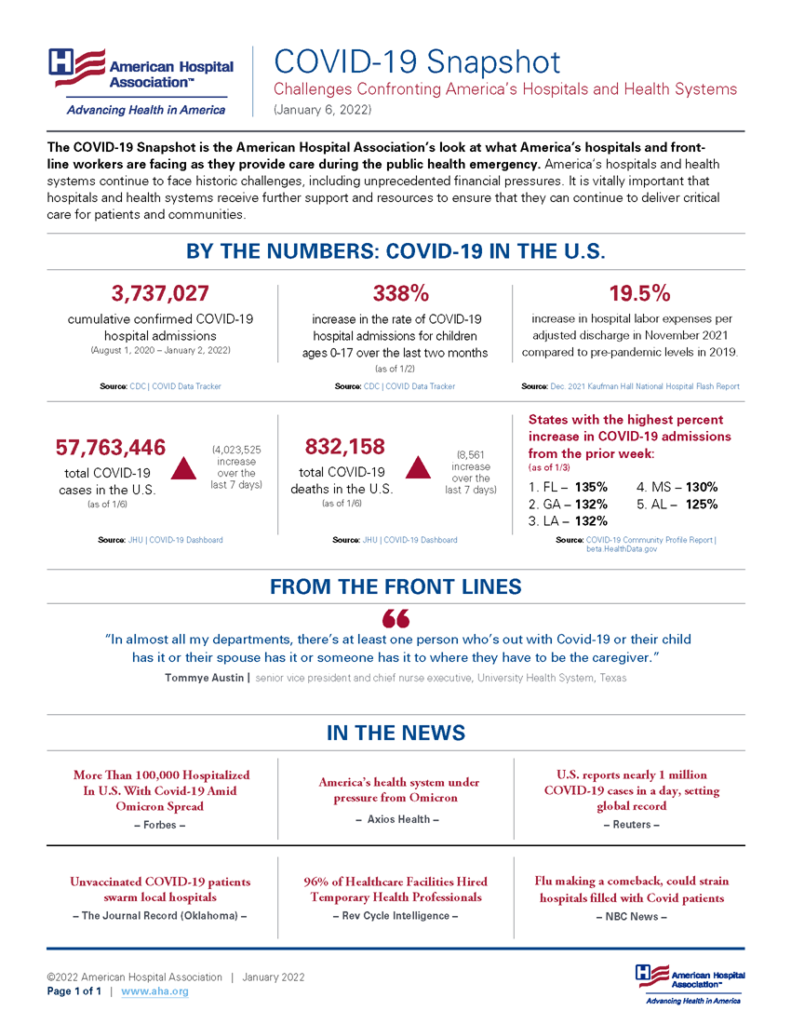
From the Omicron front, the American Hospital Association offers its January 2022 monthly COVID snapshot. “The COVID-19 Snapshot is the American Hospital Association’s look at what America’s hospitals and frontline workers are facing as they provide care during the public health emergency.”

From the COVID testing front, the FEHBlog commends this 20 minute long Wall Street Journal podcast on why at home COVID tests are so hard to find.

In that regard STAT News offers a report on a

new study raises significant doubts about whether at-home rapid antigen tests can detect the Omicron variant before infected people can transmit the virus to others.

The study looks at 30 people from settings including Broadway theaters and offices in New York and San Francisco where some workers were not only being tested daily but were, because of rules at their workplaces, receiving both the antigen tests and a daily test that used the polymerase chain reaction, or PCR, which is believed to be more reliable.

On days 0 and 1 following a positive PCR test, all of the antigen tests used produced false-negative results, even though in 28 of the 30 cases, levels of virus detected by the PCR test were high enough to infect other people. In four cases, researchers were able to confirm that infected people transmitted the virus to others during the period before they had a positive result on the rapid antigen test.

This study suggests to the FEHBlog that one rapid at home tests are still useful to help decide whether to end an isolation or quartine period at five days or once available whether or not a COVID pill should be taken. However, one use of a rapid at home test may not be so reliable to help decide whether or not to enter a gathering. In fairness to Abott and Quickvue, both manufacturers include two tests in each kit so that the test can be repeated a couple days later. If you are using these at home tests follow the manufacturers’ instructions.

From the COVID vaccine mandate front, the U.S. Court of Appeals for the Sixth Circuit on January 5 upheld by a 2-1 vote a regional stay on the Biden Administration’s government contractor mandate. As you know the U.S. Court of Appeals for the 11th Circuit is considering a nationwide stay on that mandate after deciding the stay may remain in place pending the Court’s final decision on that matter.

On Friday morning the U.S. Supreme Court will consider whether or not to maintain stays on the Biden Administation’s healthcare worker vaccination mandate and its OHSA ETS vaccinate or test program for employers with 100 or more employees. The Supreme Court allows the public to listen to the oral argument or read the transcript. The proceedings will begin at 10 am ET. The FEHBlog expects a decision from the Court in this accelerated proceeding next month.

On the private sector initiated vaccine front, the Society for Human Resource Management (SHRM) adds that

​Employers are on safer legal footing terminating employees for violating mandatory vaccination policies than imposing lesser punishments, legal experts advise. They say employers should not opt, for example, to withhold pay raises, make only vaccinated workers eligible to apply for internal positions or promote only vaccinated employees.

Many lower courts have upheld employers’ mandatory vaccination policies, which, unlike the Occupational Safety and Health Administration’s emergency temporary standard, aren’t yet before the Supreme Court, though the court may address them in passing.

On the human resources front —

  • SHRM offers 2022 guidance and reminders for benefit and compensation managers.
  • Govexec digs into the details of the President’s recent executive order adjusting federal employee compensation for 2022.

From the healthcare business front —

Healthcare Dive tells us that

Value-based primary care provider Vera Whole Health has announced plans to acquire health data and navigation company Castlight in a deal valued at approximately $370 million.

The transaction, which will bring a value-based care model to the employer healthcare market by integrating Castlight’stechnology with Vera’s clinical network and medical workers, is structured as an all-cash tender offer under which Vera will acquire all of Castlight’s outstanding shares.

Vera’s majority equity holder, Clayton, Dubilier & Rice, has committed to invest up to $338 million in the combination, while major health insurer Anthem (a long-time Castlight customer) has also pledged to make an investment, the size of which has yet to be disclosed.

Fierce Healthcare reports that

Magellan Healthcare has partnered with NeuroFlow to launch a digital emotional well-being program accessible to all Magellan members. 

The program went live at the start of the new year and aims to be a self-help tool, enabling members to take charge of their own mental health and build confidence and stress-management skills. NeuroFlow supplies the technology via a member-facing platform, which can be accessed either via an iOS or Android app or web browser. 

Members who use the platform can access exercises that are meant to keep them engaged and can receive recommendations for resources based on their needs. Activities include evidence-based videos, behavioral trackers and digital cognitive behavioral therapy programs developed by Magellan. The program can also refer members to a care manager or therapist.

Midweek update

Photo by Josh Mills on Unsplash

From the Omicron front —

  • David Leonhardt, writing in the New York Times, informs us that while the surge of Omicron cases is stressing hospitals, Omicron has created less hospitalizations, milder hospitalizations, and fewer deaths compared to the Delta variant which Omicron replaced.
  • Becker’s Hospital Review reports that “The national surge in COVID-19 cases fueled by the highly transmissible omicron variant may last weeks, rather than months, according to the most recent projections from the COVID-19 Scenario Modeling Hub, a consortium of researchers helping the CDC track the pandemic’s trajectory.”
  • Medscape offers expert opinions on whether the current Omicron surge will hasten the transition from pandemic to endemic. For example —

Whether the current surge will mean the predicted switch to endemic COVID-19 will come sooner, however, “is very hard to predict,” Michael Lin, MD MPH, told Medscape Medical News.

“It’s an open question,” he said, “if another highly transmissible variant will emerge.”

On a positive note, “at this point many more people have received their vaccinations or been infected. And over time, repeated infections have led to milder symptoms,” added Lin, hospital epidemiologist at Rush Medical College in Chicago, Illinois.

“It could end up being a seasonal variant,” he said.

On the COVID vaccine front, AHIP tells us that

Today the Centers for Disease Control’s Advisory Committee on Immunization Practices (ACIP) recommended a single Pfizer-BioNTech COVID-19 vaccine booster dose for persons aged 12-17 years at least 5 months after their primary series, by a vote of 13-1.

The Committee reviewed real-world data from Israel and the CDC showing there are no new safety concerns following a booster in this population, and that adverse events were less common from a 3rd dose as compared to the primary series.

Members of the Committee also stressed the primary focus continues to be vaccination of unvaccinated individuals, and that there is a need to increase education and understanding of the effects of COVID-19 on children and adolescents in order to help parents make informed decisions.

The FDA noted that it continues to review data on children aged 5-11 and will update recommendations when more data is available.

On the COVID testing front, Bloomberg offers a comprehensive look at the state of the Biden Administration’s efforts to improve availability of rapid at home COVID tests. Of note to health plans —

Private insurers will reimburse for at-home tests beginning at some point next week, when a Biden administration rule is set to take effect. That will allow Americans to submit claims, and could spark an initial spike in demand. But it remains to be seen whether people will take advantage of the reimbursement as filing insurance claims can be a time-consuming and tedious task.

In the FEHBlog’s view the Affordable Care Act converted health plans into public utilities. Aside from the wisdom of imposing this public health responsibility on health plans, this approach does not make sense due to the high administrative cost of processing paper claims. It will become a side show.

On the COVID treatment front, STAT News reports that

The Biden administration doubled its order of Covid-19 pills from Pfizer, a move that will modestly increase the limited U.S. supply of the treatment in the short term amid a record-setting surge in coronavirus casesThe New York Times writes. The new order will eventually provide enough pills for an additional 10 million Americans, bringing the government’s total order of the drug to 20 million treatment courses. But they will not all be available right away. Only 35,000 of the additional courses will be delivered this month, and 50,000 more in February, supplementing 350,000 treatment courses that were already expected over the next two months.

From the COVID vaccine mandate front, Govexec reports that the Postal Service has asked the Occupational Health and Safety Administration for “a 120-day extension to implement the [vaccinate or test] rule, saying that would allow enough time to update its systems for record collection and bargain with its unions over the details.”

From the Rx coverage front

  • Reuters reports that “Pfizer Inc  and Germany’s BioNTech SE  will develop an mRNA-based vaccine for viral infection shingles, collaborating for the third time after th success of their COVID-19 vaccine based on the same technology.
  • Healthcare Dive offers its observations on where drug prices are headed this year.
  • Biopharma Dive identifies five Food and Drug Administration approval decisions to watch in the first quarter of 2022.
  • In related news, mHealth Intelligence tells us that

“Researchers from the University of Massachusetts Amherst, Syracuse University and SUNY Upstate Medical University have collaborated to create a wireless sensor designed to prevent opioid relapses and overdoses. * * *

The opioid epidemic has steadily worsened across the country since the late 1990s. In 2019, nearly 50,000 people in the U.S. died from opioid-related overdoses, according to data from the National Institute on Drug Abuse. Further, around 21 to 29 percent of patients prescribed opioids for chronic pain misuse them, the federal data shows.  

To combat this issue, the research team — headed by Tauhidur Rahman, PhD, an assistant professor in the College of Information and Computer Sciences at UMass Amherst and co-director of the MOSAIC Lab — is developing a sensor, which will use machine learning to pinpoint psychophysiological signs in real time and determine whether they are consistent with opioid cravings. Cravings are one of the main drivers behind relapses and overdoses.

If a craving is identified, the sensor providers the user with mindfulness-based interventions. These ultimately could be customized based on the user’s behaviors and clinician input.

“Nothing like this exists today,” Rahman said in the news release. “And we believe that mobile technologies can provide an effective mechanism for people with addiction to monitor their condition and manage their cravings better.”

Cool.

From the OPM front, Govexec reports that

The Office of Personnel Management is set to publish regulations implementing a 2021 law aimed at improving agency accountability for acts of discrimination and whistleblower retaliation against federal workers.

The Elijah E. Cummings Federal Employee Antidiscrimination Act, named for the late lawmaker who led the House Oversight and Reform Committee and signed on Jan. 1, 2021, encourages agencies to take action against federal employees who are found to be responsible for “intentional” acts of discrimination or retaliation, and be more transparent with the public when such incidents are adjudicated.

In a proposed rule set to be published to the Federal Register Thursday, OPM said that [among other new requirements] agencies will be expected to post a notification on their public-facing websites within 90 days of the finalization of any case in which the agency was found to have discriminated or retaliated against a federal employee.

Tuesday’s Tidbits

Photo by Patrick Fore on Unsplash

Lots of updates from the Centers for Disease Control (“CDC”) today

  • “Today, CDC is updating our recommendation for when many people can receive a booster shot, shortening the interval from 6 months to 5 months for people who received the Pfizer-BioNTech COVID-19 Vaccine.  This means that people can now receive an mRNA booster shot 5 months after completing their Pfizer-BioNTech primary series.  The booster interval recommendation for people who received the J&J vaccine (2 months) or the Moderna vaccine (6 months), has not changed.”
  • The CDC released a study of over 40,000 COVID- vaccinated pregnant women.

In a retrospective cohort of >40,000 pregnant women, COVID-19 vaccination during pregnancy was not associated with preterm birth or small-for-gestational-age at birth overall, stratified by trimester of vaccination, or number of vaccine doses received during pregnancy, compared with unvaccinated pregnant women.

These data support the safety of COVID-19 vaccination during pregnancy. CDC recommends COVID-19 vaccination for women who are pregnant, recently pregnant, who are trying to become pregnant now, or who might become pregnant in the future.

  • As expected, the CDC revised and lengthened its revised COVID quarantine and isolation policy by, e.g., adding “at home testing when available,” right at the time that at home COVID test are hard to purchase. What’s more, the Wall Street Journal reports the prices for those tests are jumping at Walmart and Kroger because the White House curiously let a price support program lapse. Govexex informs about how government agencies had been struggling to implement this CDC guidance even before today’s changes.

Also from the Omicron front, Medscape tells us about a British study finding that

Protection against hospitalization from COVID-19 vaccines is “good” against the Omicron variant of SARS-CoV-2, an analysis has found.

The risk for adults of being admitted to hospital with Omicron was approximately one third (Hazard Ratio 0.33, 95% CI 0.30 to 0.37) of that for the Delta variant, the UK Health Security Agency (UKHSA) said in a technical briefing.

The analysis also found that the risk of presentation to emergency care, or being admitted to hospital, with Omicron – whether testing for symptomatic or asymptomatic infection – was approximately half of that for Delta (Hazard Ratio 0.53, 95% CI 0.50 to 0.57).

From the Affordable Care Act front – –

  • The International Foundation of Employee Benefit Plans announced that “The Centers for Medicare and Medicaid Services (CMS) issued the proposed 2023 actuarial value (AV) calculator and methodology.” This should be useful when preparing FEHB 2023 benefit and rate proposals.
  • The Labor Department’s Employee Benefit Security Administration announced that it is seeking speakers to talk at an ACA listening session about the ACA’s provider non-discrimination provision, known as Section 2706. In Division BB of the Consolidated Appropriations Act of 2021, Congress tasked the ACA regulators with adopting a rule interpreting Section 2706. The listening session bears on that effort.

From the healthcare business front

  • Fierce Healthcare tells us that “Centene Corporation has completed its acquisition of Magellan Health, the insurer announced Tuesday. The $2.2 billion deal closes exactly one year after its announcement on Jan. 4, 2021. The combination will create one of the country’s largest behavioral health platforms, including 41 million unique members. * * * In addition to its behavioral health platform, Magellan will add 5.5 million members to Centene’s government program, 16 million pharmacy members and 2 million pharmacy benefit management members.”
  • Healthcare Dive reports that “HCA Healthcare has purchased the largest urgent care chain in Florida, MD Now Urgent Care, the health system said Tuesday. The deal closed at the end of 2021 for an undisclosed sum. The deal gives HCA 59 urgent care centers in a state where it already has a significant presence, with 47 hospitals.” 

From the tidbits department

  • STAT News interviews Dr. Peter Marks, director of the FDA’s Center for Biologics Evaluation and Research. “[2022] will have to be a year where we transition to working alongside the pandemic, as opposed to being dominated by the pandemic,” Dr. Marks told STAT in a wide-ranging interview. Let’s hope so.
  • Medpage Today brings us up to date on Biogen’s Aduhelm saga and considers 2022 biggest hurdles for heathcare in the U.S.
  • The new acting National Institutes of Health director Dr. Larry Tabak is continuing the tradition of writing a weekly director’s blog. This week’s issue concerns science’s 2021 breakthroughs, e.g., the COVID pills.

Monday Roundup

Photo by Sven Read on Unsplash

From the Omicron front, the Wall Street Journal reports that

The seven-day average of daily reported Covid-19 cases in the U.S. reached a pandemic record 403,385 on Sunday, according to a Wall Street Journal analysis of Johns Hopkins University data. The fresh peak arrived even as most states paused reporting during the New Year’s holiday weekend. Reporting delays will likely lead to spikes in reports of cases this week as states catch up. While Covid-19 tests remain in short supply in much of the U.S., Covid-19 testing was less robust last year, complicating comparisons between pandemic surges.

Hospitalizations for confirmed or suspected Covid-19 reached a seven-day average of 97,855 on Monday, according to data posted by the U.S. Department of Health & Human Services. That is up 41% in the past two weeks but below both the pandemic peak of 137,510 on Jan. 10, 2021, and the smaller peak of 102,967 on Sept. 4, 2021, during the Delta surge.

Bloomberg adds that

While omicron may be good at evading the attacks of antibodies, recent studies have also shown that it has far less success avoiding the second-line defenses of vaccines and prior infections: T-cells and B-cells.

T-cells are responsible for attacking a virus once it makes its way into the body’s cells if antibodies fail to prevent infection in the first place. In a recent study by Burgers and colleagues, scientists used white blood cells from Covid patients to show that about 70-80% of the T-cell response is preserved compared with previous strains of the virus. That means that for those who are either vaccinated or had a Covid infection in the past 6 months, it is likely their T-cells can recognize omicron and fight it off relatively quickly. 

This latest research will need to be followed up with further study. If it holds up to additional scrutiny, it just might explain why current infections appear to be more mild than in previous waves of the virus.

Yet, AP reports that

As the COVID-19 omicron variant surges across the United States, top federal health officials are looking to add a negative test along with its five-day isolation restrictions for asymptomatic Americans who catch the coronavirus, the White House’s top medical adviser said Sunday.

Dr. Anthony Fauci said the Centers for Disease Control and Prevention is now considering including the negative test as part of its guidance after getting significant “pushback” on its updated recommendations last week.

Adding to current mandatory testing is not going to push the COVID ball further toward endemic status particularly when people who actually may be infected soon will need a test to gain access to a COVID pill. It is time for the government to rethink its testing strategy. As a physician explained in a thought provoking Atlantic article

I will admit to being as self-interested as any other human. Despite recognizing the need for vaccine and test equity, I received three Pfizer shots as soon as I was eligible, and I’ve kept a stash of rapid-detection kits in my closet. But my own cognitive dissonance, and that of other privileged people, has become untenable in the face of Omicron’s case surge. Given the reality of our testing shortages, it’s time we started cutting back, where and when we can.

From the COVID vaccine front, AHIP tells us that

“Today the Food and Drug Administration amended the emergency use authorization (EUA) for the Pfizer-BioNTech COVID-19 Vaccine to expand the use of a single booster dose of the vaccine to include its use in individuals as young as 12 years of age.

“The FDA reviewed real-world data from Israel, including safety data from more than 6,300 individuals 12 through 15 years of age who received a booster dose of the vaccine at least 5 months following completion of the primary two-dose vaccination series. The data shows there are no new safety concerns following a booster in this population. There were no new cases of myocarditis or pericarditis reported to date in these individuals.

“The amended EUA additionally:

  • Decreases the time between the completion of primary vaccination of the Pfizer COVID-19 Vaccine and a booster dose to at least five months.
  • Allows for a third primary series dose for certain immunocompromised children 5 through 11 years of age.

“Peer-reviewed data from multiple laboratories indicate that a booster dose of the Pfizer COVID-19 Vaccine greatly improves an individual’s antibody response to be able to counter the omicron variant. Authorizing booster vaccination to take place at five months rather than six months may therefore provide better protection sooner for individuals against the highly transmissible omicron variant.

“Children 5 through 11 years of age who are fully vaccinated and are not immunocompromised do not need a third dose at this time, but the FDA will continue to review information and communicate with the public if data emerges suggesting booster doses are needed for this pediatric population.”

From the Health and Human Services Department front —

  • Prof. Katie Keith has published in the Health Affairs Forefront the third installment of her review of the proposed 2023 Notice of Benefit and Payment Parameters. This one focuses on the Affordable Care Act’s risk adjustment provisions.
  • The Department issued today its own upbeat discussion of the recently implemented consumer billing protections provided by the No Surprises Act.
  • While the ACA risk adjustment provisions don’t apply the FEHB, the consumer billing protections do. Indeed the consumer billing protections wisely apply to both insured and uninsured folks. All consumers should become familiar with these protections.

From the prescription drug front, STAT News informs us that

As 2022 gets under way, pharmaceutical companies have so far raised wholesale prices by a median of 4.9% on more than 450 prescription medicines, an overall annual increase that is comparable to the price hikes seen over the past three years, according to a new analysis.

The numbers are preliminary, though, because still more price increases are expected to be disclosed by drug makers later this month, since not every company has reported their latest prices to industry databases. Nonetheless, the early indication is that many drug makers are keeping price hikes in check due to ongoing bad publicity that has sparked sustained political pressure.

Analyzing pharmaceutical price hikes has become a ritual each January as drug makers boost prices to meet financial goals. But as poll after poll finds more Americans are complaining about the cost of prescription medicines, these companies have gradually shied away from mid-year increases and also generally limited price hikes below double digits in hopes of avoiding still more negative headlines.

Drug Channels adds

Reality has again failed to cooperate with the politically motivated cries of “skyrocketing drug prices” or anecdotes about companies “jacking up prices” 

Brand-name drug prices continue to decline, while the prices of other healthcare products and services continue to rise. For 2021, brand-name drugs’ net prices dropped for the fourth consecutive year. Meanwhile, brand-name drug list prices grew more slowly than overall inflation. What’s more, we project that the gross-to-net bubble for patent-protected brand-name drugs will exceed $200 billion in 2021. See our updated analysis [that may be found in the linked article]. 

The factors that drive declining brand-name drug prices remain for 2022, suggesting that these trends will continue. 

Midweek update

From the Omicron front, the Washington Post reports that breakthrough Omicron cases are becoming the new normal in the U.S.

Long-anticipated holiday plans fell apart as people — young and old, vaccinated and unvaccinated — tested positive right and left. Those with negative tests worried it was only a matter of time.

They are likely right, according to Robert Frenck, professor of pediatrics and director of the Vaccine Research Center at the Cincinnati Children’s Hospital. “You know what? You’re probably going to get covid,” he said, but if you have been vaccinated you are unlikely to become seriously ill.

Oddly, in the FEHBlog’s view, the article does not mention the additional natural immunity gained from a mild case of Omicron.

STAT News raises three “big” questions about the Biden administration’s Covid response in 2022 —

1. Will the government broaden its focus beyond vaccines? STAT News explains that

Even before there were Covid-19 vaccines, there were commonsense tools used to prevent the disease from spreading: Wearing masks, and avoiding indoor gatherings with large numbers of other people.

But two years into the pandemic, the U.S. is still laser-focused on vaccines, and has largely ignored other factors. In particular, federal regulators haven’t done much to incentivize Americans to wear higher-quality face coverings, or to maintain better filtration and cleaner air in indoor spaces.

On the bright side, the FDA approved two new rapid over the counter COVID tests today on an emergency use basis. The more the merrier.

2. Will people who feel sick have better options for tests and treatments? STAT News explains rapid COVID tests are short in supply and pricey and the Biden Administration’s government solutions won’t be implemented for weeks. Similarly we have two exciting COVID pills which won’t be widely available for months.

3. Forget a third vaccine dose — will Americans need a fourth, too? To the FEHBlog that seems like a foregone conclusion.

From our other epidemic front, MedPage Today reports that

The volume of opioids dispensed from retail pharmacies fell by about 21% from 2008-2009 to 2017-2018, but cuts were not uniform, national prescription records showed.

Changes in opioid prescribing varied substantially by county, patient, and prescriber, reported Bradley Stein, MD, PhD, of the RAND Corporation in Pittsburgh, and co-authors in Annals of Internal Medicine. * * *

Per-capita morphine milligram equivalents (MMEs) fell by 22.6% in metropolitan counties and by 34.6% in counties with the highest rates of fatal opioid overdoses, the researchers found. In multiple counties, opioid prescribing increased over time. Some states had counties with both increases and substantial decreases, and these counties often were next to each other.

People 18 to 25 years old experienced the sharpest decrease in prescription opioids (66.6%) per capita, followed by those 26 to 35 (57%). Patients 56 to 65 had essentially no change (0.1% decline), while those 66 and older had a 12% drop.

People covered by commercial insurance had a 41.5% decline per capita. Those with Medicaid had a 27.7% reduction, and those with Medicare had a 17.5% drop.

MMEs plummeted by 70.5% among emergency physicians, even though these doctors are likely to prescribe opioids predominantly to people with acute pain, the researchers noted. The top two opioid prescribers, primary care physicians and pain specialists, also saw reductions in MMEs of 40% and 15.4%, respectively. MMEs fell by 49.3% among surgeons and by 59.5% among oncologists.

From the COVID vaccine mandate front, the Eleventh Circuit U.S. Court of Appeals which is hearing a challenge to a nationwide stay of the government contractor mandate (Case No.  21-14269), decided yesterday not to hear the case before the entire court rather than a three judge panel and today to decline the government’s request to accelerate the briefing and argument calendar. Consequently the stay will remain in effect at least through January 2022.

From the Federal Register front, the Department of Health and Human Services finalized its rescission of the Trump Administration’s most favored nation drug pricing rule. Smart move.

Winter is here!

Photo by Clarisse Meyer on Unsplash

The Wall Street Journal reports that “The 2021 winter solstice [took] place on Tuesday, Dec. 21, at 3:59 p.m. Coordinated Universal Time (UTC), the international standard time used by astronomers. That is 7:59 a.m. Pacific Time and 10:59 a.m. Eastern Time. * * * On the winter solstice, our planet’s [23.5 degree] tilt brings the South Pole closest to the sun—and the Antarctic Circle gets 24 hours of daylight. The North Pole is tilted away from the sun, and the Arctic Circle is shrouded in darkness for nearly a full day. * * * The winter solstice in the Northern Hemisphere marks the point at which the season’s short days start to lengthen—continuing until the summer solstice in June, when there is the longest period of daylight and the shortest period of darkness there.”

Winter solstice 2019 was pre-pandemic. Winter solstice 2020 conincided with the introduction of the mRNA vaccines in the U.S. and this winter solstice is expected to coincide with the introduction of the early onset COVID pills from Pfizer and Merck.

Bloomberg informs us that

The U.S. Food and Drug Administration is poised to authorize a pair of pills from Pfizer Inc. and Merck & Co. to treat Covid-19 as soon as this week, according to people familiar with the matter — a milestone in the fight against the pandemic that will soon expand therapies for the ill.

An announcement may come as early as Wednesday, according to three of the people. They asked not to be identified ahead of the authorization and cautioned that the plan could change. 

Pfizer’s pill, Paxlovid, and Merck’s molnupiravir are intended for higher-risk people who test positive for the coronavirus. The treatments, in which patients take a series of pills at home over several days, could ease the burden on stretched hospitals with infections poised to soar through the winter in the U.S. 

This is similar to the roll out of the mRNA vaccines which initially administered to higher-risk people as well as first responders. FiercePharma tells us that “Pfizer expects to make 80 million courses of COVID drug Paxlovid by the end of 2022.” Bloomberg adds that “’It’s the biggest thing to happen in the pandemic after vaccines,’” said Eric Topol, director of the Scripps Research Translational Institute.” For what it’s worth, the FEHBlog shares this sentiment.

In other COVID treatment news, Medscape reports that

A “definitive study” from Johns Hopkins University researchers and others shows that convalescent plasma can cut hospital admissions for COVID-19 by 54% if therapy is administered within 8 days of symptom onset.

In the study of 1181 adults randomly assigned to high-titer convalescent plasma or placebo, 2.9% of people receiving the therapy were hospitalized compared to 6.3% who received placebo control plasma.

This translates to a 54% risk reduction for hospitalization with convalescent plasma. * * *

Whereas many convalescent plasma studies were done in hospitalized patients, this is one of only a handful performed in outpatients, the researchers note.

There is a regulatory catch. The FDA restricted emergency use authorization (EUA) for convalescent plasma in February 2021 to include only high-dose titer plasma and to limit the therapy to hospitalized patients with early disease or for immunocompromised people who cannot mount an adequate antibody response.

[Dr. David] Sullivan and colleagues hope their findings will prompt the FDA to expand the EUA to include outpatients.

From the White House front, the President spoke this afternoon about an enhanced federal government response to Omicron, including federal government run testing and vaccination sites and federally funded home delivery of rapid COVID tests.

Govexec explains that

The administration will launch federal testing sites around the country, standing up the first in New York City before Christmas. It will establish subsequent sites in states and communities where capacity is constrained, a senior administration official who spoke to reporters on the condition of anonymity said on Monday, with those going up in January and February. The government will once again deploy hundreds of federal personnel to boost vaccination capacity around the country, with the goal of boosting capacity by thousands of shots per week. The Federal Emergency Management Agency will oversee pop-up vaccination sites operated by the federal government, with the first ones going to Washington and New Mexico.  * * *

The White House also announced it was purchasing 500 million tests and will soon set up a website for any Americans to order one for free. The tests will be available in January and delivered by mail for free, though the White House is still finalizing how many each individual will be entitled to order. The administration pledged to boost its use of the Defense Production Act to boost the supply of at-home, rapid tests.

It’s not yet clear whether this initiative replaces the earlier proposal to have health plans reimburse their members for these over the counter tests.

The San Franciso Chronicle seeks to put the transmissibility of Omicron in perspective

The reproductive number known as R0, pronounced “R naught,” measures a disease’s transmissibility at the beginning of a pandemic with no preexisting immunity, said Warner Greene, a virologist and senior investigator at the Gladstone Institutes in San Francisco. It represents how many people one sick person will infect.

According to a study released in October, the original COVID-19 strain that emerged from Wuhan has an R0 value of 2.79. The delta variant has a value of between 5 to 6 — about twice as contagious as the original strain.

Chicken pox has an R0 value of 9-10. The R0 value of measles is estimated at 12 to 18.

Greene said to really know the true R0 value of omicron, more information is needed. He cited an estimate from Martin Hibberd, a professor of emerging infectious diseases at the London School Of Hygiene & Tropical Medicine, that omicron could have an R0 of 10.

Chin-Hong said “a lot more fully vaccinated people will get breakthrough infections, but will not likely get very ill and are very unlikely to die.”

For unvaccinated people, the situation is much more serious.

“It will be very difficult to avoid getting infected with omicron,” Swartzberg said. “You may have been lucky with the other variants and the ancestral strain. It’s unlikely you will be with omicron. The unvaccinated will be the biggest spreaders of omicron and they will be the ones most likely hospitalized from it.”

No joke.

From the National Institutes of Health front —

  • “Yesterday the U.S. Food and Drug Administration announced its first approval of a long-acting HIV prevention medication. Developed by ViiV Healthcare, the medicine is long-acting cabotegravir injected once every two months. FDA has approved the medicine for use by adults and adolescents weighing at least 35 kilograms who are at risk of sexually acquiring HIV. This milestone marks a vital expansion of biomedical HIV prevention options available to people in the United States.”
  • “Despite important advances in the understanding and treatment of oral diseases and conditions, many people in the U.S. still have chronic oral health problems and lack of access to care, according to a report by the National Institutes of Health. Oral Health in America: Advances and Challenges, is a follow-up to the seminal 2000 Oral Health in America: A Report of the Surgeon General.” * * * “The authors make several recommendations to improve oral health in America, which include the need for health care professionals to work together to provide integrated oral, medical, and behavioral health care in schools, community health centers, nursing homes, and medical care settings, as well as dental clinics. They also identify the need to improve access to care by developing a more diverse oral health care workforce, addressing the rising cost of dental education, expanding insurance coverage, and improving the overall affordability of care.”

From the Affordable Care Act front, the Internal Revenue Service announced today that the applicable dollar amount that health plans must use to calculate the [PCORI] fee imposed by sections 4375 and 4376 for policy years and plan years that end on or after October 1, 2021, and before October 1, 2022, is $2.79″ per bellybutton. The immediately preceding years fee was $2.66 per bellybutton.

Thursday Miscellany

Photo by Juliane Liebermann on Unsplash

From the Capitol Hill front, Roll Call reports that

President Joe Biden and Democratic leaders reluctantly acknowledged Thursday that the Senate would soon recess for the year without passing their sprawling $2.2 trillion social safety net and climate spending bill or voting rights legislation. 

From the Omicron front, Bloomberg tells us that

President Joe Biden warned that unvaccinated Americans face “a winter of severe illness and death” as he urged initial doses and booster shots amid a surge of coronavirus cases and the emergence of the omicron variant.

David Leonhardt writing in his New York Times Morning column adds that “about 15 percent of American adults remain unvaccinated.”

From the COVID vaccine front, AHIP informs us that

Today, the CDC’s Advisory Committee on Immunization Practices (ACIP) convened to discuss the recent developments and safety considerations for the Janssen/Johnson & Johnson COVID-19 vaccine. 

ACIP voted unanimously to amend their recommendation: mRNA COVID-19 vaccines are preferred over the Janssen COVID-19 vaccine for the prevention of COVID-19 for those 18 years of age and older. 

Deliberations within the committee stressed the importance of updating the Clinical Considerations and educational materials regarding the vaccine to ensure that anyone who chooses to receive the Janssen adenovirus-based vaccine is informed of the potential risks.  

Earlier this week, the FDA updated its Emergency Use Authorization Fact Sheet to indicate that the Janssen vaccine is contraindicated for individuals with a history of thrombosis with thrombocytopenia syndrome (TTS).  This was based on new information showing that cases of TTS have been reported in both males and females, and that approximately 15% of TTS cases have been fatal.

Following the discussion, the Committee reviewed a presentation on safety data regarding the use of the Pfizer-BioNTech COVID-19 vaccine in children aged 5-11 years old.  Very few adverse events or severe systemic reactions were reported, with most incidents including pain, fever, fatigue, headache, and/or myalgia, and most beginning one or two days following the second dose with symptoms alleviating within a few days.  To date, there have been two deaths in children who received the vaccine, each with children who have complicated medical histories, both of which are still under investigation.

Finally, CDC presented current data about the Omicron variant.  This variant appears to be more transmissible than earlier variants, but more data is needed to know if it causes more severe illness.  Vaccines are expected to protect against severe illness, hospitalizations, and death, with booster vaccines showing increased protection than the two-dose series.  It is unclear how prior infection impacts neutralization.  CDC is continuing to monitor real-world evidence across all populations to inform further action.

Also from the omicron front, Healthcare Dive reports that

— FDA has identified three COVID-19 molecular tests that are not able to detect the omicron variant and warned that the diagnostics from Applied DNA Sciences, Meridian Bioscience and Tide Laboratories will return false negative results.

— The agency on Wednesday updated its list of tests impacted by virus mutations. While FDA continues to gather additional information and work with the three manufacturers to address these issues, it recommended the diagnostics not be used by clinical laboratory staff and healthcare providers.

— Makers of both polymerase chain reaction and rapid antigen tests have said their tests can detect omicron. Siemens Healthineers is the latest company to claim its testing portfolio is unaffected by the variant. However, Tim Stenzel, director of the FDA’s Office of In Vitro Diagnostics and Radiological Health, told test developers Wednesday during a virtual town hall that the agency continues to receive “a lot of inquiries” about omicron and its potential impact on diagnostics and will continue to focus efforts on evaluating molecular and antigen tests.

The Wall Street Journal adds that

Pfizer Inc. and BioNTech SE  say they have asked U.S. regulators to fully approve their Covid-19 vaccine for adolescents ages 12 to 15. The vaccine was fully approved by the U.S. Food and Drug Administration in August for people 16 years and older

From the COVID vaccine mandate front, we have two court decisions:

  • The Society for Human Resources Management explains that “On Dec. 15, the 5th U.S. Circuit Court of Appeals lifted a district court’s order that had blocked the Biden administration’s COVID-19 vaccination directive for health care workers nationwide. But the requirement remains blocked in 24 states.” The 24 states are composed of 14 State plaintiffs in the 5th Circuit case and 10 State plaintiffs in the first PI. The Congressional Research Service recently wrote a report on nationwide injunctions.
  • The government contractor mandate nationwide preliminary injunction (“PI”) followed the same course as the healthcare workers preliminary injunction — a PI issued for three states followed by a court in another state issuing a nationwide injunction. Perhaps the 11th U.S. Circuit Court of Appeals which is hearing the government’s appeal of the government contractor mandate PI (Case No. 21-14269), will follow the 5th Circuit’s lead.
  • The National Law Review reports that

[Also on Dec. 15] The [U.S. Court of Appeals for the] Sixth Circuit denied en banc review in the OSHA vaccine mandate cases.  The vote was a close one, with eight judges voting in favor of initial hearing en banc.  But that’s not enough under the circuit’s rules, which require a majority of the 16 active judges to vote for en banc treatment.  As a result, the current panel reviewing the case will decide whether to continue the stay issued by the Fifth Circuit, which may end up being the most consequential decision in the case until it comes before the Supreme Court.

From the miscellany department —

  • GoodRx brings us up to date on Alzheimer’s Disease research.
  • “The HEALTH CARE TRANSFORMATION TASK FORCE (HCTTF or Task Force), a group of leading health care payers, providers, purchasers and patient organizations, today announced that its provider and payer members reported having 61 percent of their business in value-based payment arrangements at the end of 2020. Value-based care and payment arrangements focus on lowering costs and improving the quality of care to drive overall population health. The new report shows significant progress towards the goal and has increased twofold from the group’s first report of 30 percent in value-based arrangements in 2015.”

Roughly 40% of U.S. healthcare payments were tied to alternative payment models (APMs) last year, with Medicare Advantage claims representing the largest amount, a new survey found.

The survey, published Wednesday by the Health Care Payment Learning & Action Network, showed that more work needs to be done as most healthcare payments were still tied to a fee-for-service model.

“The survey shows we have made limited progress in moving away from fee for service between 2019 and 2020,” said Mark McClellan, M.D., Ph.D., director of Duke University’s Margolis Center for Health Policy and co-chair of the LAN CEO forum, during the LAN Summit Wednesday. “Most payments are still in fee-for-service, especially outside of Medicare.”

  • If you are bit confused by these findings, APMs are a type of value based pricing arrangement. Health Affairs offered a useful article on the various value based payment models earlier his year.

Midweek Update

From the Capitol Hill front, Roll Call reports that

The Senate easily passed the annual defense policy bill on Wednesday, authorizing $768 billion in defense spending for fiscal 2022.

The final tally for the fiscal 2022 National Defense Authorization Act was 88-11. * * *

The legislation marks the 61st straight year that Congress has passed the NDAA. President Joe Biden is expected to sign it into law shortly.

The Federal Times discusses the federal employment aspects of the new law.

The Wall Street Journal adds that “Democrats braced for weeks of delay and uncertainty on their roughly $2 trillion education, healthcare and climate package they had hoped to finish by year end, as efforts faltered to secure the pivotal support of Sen. Joe Manchin (D., W.Va.) for the bill.”

From the Omicron front Bloomberg informs us that

The results from initial studies of the omicron variant of the coronavirus are starting to roll in almost daily, and early suspicions are gaining more support. The mutation is much better at infecting—70 times faster than delta and the original strain. But the severity of illness is likely to be much lower, according to a study from the University of Hong Kong, echoing earlier observations from doctors in South Africa where the variant was first observed. The supercharged speed of omicron’s spread in the human bronchus was found 24 hours following infection, according to the university. However, the study found it replicated in lung tissue much less efficiently than earlier mutations, which may signal “lower severity of disease.”

The FEHBlog ran across not one but two articles prognosticating about the extension of no cost sharing coverage of at home rapid antigen COVID tests scheduled for next month:

  • The Society for Human Resource Management points out a Mercer consulting report on the coverage issue.

HR consultancy Mercer explained: “Under existing guidance (see FAQ Part 43, Q/A-4), at-home COVID tests must be covered without participant cost-sharing, but only when ordered by an attending health care provider who has determined the test is medically appropriate based on current accepted standards of medical practice.”

Mercer noted that “group health plans and insurers currently may (but are not required to) provide coverage of at-home tests without participant cost-sharing even absent a health care provider’s determination of medical necessity. While we await important details, it seems quite possible that forthcoming guidance will significantly expand the scope of required coverage of at-home COVID testing without participant cost-sharing, in short, by eliminating the need to involve a health care provider.”

  • Health Payer Intelligence notes that “In a letter to CMS, the Alliance of Community Health Plans (ACHP) has requested that the federal government establish certain requirements for at-home COVID-19 testing coverage.” ACHP letter builds on Mercer’s concerns.

From the substance use disorder front —

Overdose deaths involving the synthetic opioid, illicitly-manufactured fentanyl (IMF), skyrocketed across the country from 2019 to 2020, researchers found.

Between July 2019 and December 2020, IMF-involved overdose deaths nearly doubled in the West (93.9%), increased 65% in the South and 33% in the Midwest, reported Julie O’Donnell, PhD, of the CDC’s National Center for Injury Prevention and Control in New Orleans, and colleagues.

Moreover these deaths were quick, as 56% of people who died from an IMF-involved overdose did not have a pulse when first responders arrived on the scene, and approximately 40% of IMF-involved deaths also involved a stimulant, O’Donnell’s group wrote in the Morbidity and Mortality Weekly Report.

  • The NIH HEAL Initiative reported that texting and related apps can be used to lengthen use of drugs taken to treat opioid use disorder. Here’s the background:

Medications such as methadone, buprenorphine, and naltrexone are highly effective for treating opioid use disorder. Yet only a fraction of people who could benefit actually receive these medications. Worse, about half of those who start taking them discontinue use within the first 6 months of treatment. Research has shown that the longer people continue treatment, the better their outcome is and the lower their risk of overdose.

  • On the bright side, NIH also reports that

The percentage of adolescents reporting substance use decreased significantly in 2021, according to the latest results from the Monitoring the Future survey of substance use behaviors and related attitudes among eighth, 10th, and 12th graders in the United States. In line with continued long-term declines in the use of many illicit substances among adolescents previously reported by the Monitoring the Future survey, these findings represent the largest one-year decrease in overall illicit drug use reported since the survey began in 1975. The Monitoring the Future survey is conducted by researchers at the University of Michigan, Ann Arbor, and funded by the National Institute on Drug Abuse (NIDA), part of the National Institutes of Health.

From the this and that department —

  • Health Affairs unveiled the National Health Care Spending Report for 2020:

US health care spending increased 9.7 percent to reach $4.1 trillion in 2020, a much faster rate than the 4.3 percent increase seen in 2019. The acceleration in 2020 was due to a 36.0 percent increase in federal expenditures for health care that occurred largely in response to the COVID-19 pandemic. At the same time, gross domestic product declined 2.2 percent, and the share of the economy devoted to health care spending spiked, reaching 19.7 percent. In 2020 the number of uninsured people fell, while at the same time there were significant shifts in types of coverage.

  • The Wall Street Journal graphically points out that emergency room charges can vary significantly for common emergencies in downtown Boston.
  • Fierce Healthcare tells us that

UnitedHealth Group has pushed back the deadline for its nearly $8 billion acquisition of Change Healthcare, according to a new filing with the Securities and Exchange Commission.

Change said in the filing that UnitedHealth informed the company that it was pushing back the deal’s outside date to April 2022. Previous filings suggested that the acquisition could close as early as late February.

Within the merger agreement, both companies have the right to push back the outside date.

UnitedHealth and Change are awaiting the completion of an investigation into the merger by the Department of Justice, which has been probing the deal on antitrust grounds.