Happy Veterans Day!

Happy Veterans Day!

Photo by Megan Lee on Unsplash

Thanks to all those who served our great country.

From Washington, DC,

  • The Washington Post reports,
    • “With Republicans on the cusp of unified control of Washington, Congress appears primed to extend the deadline for a government shutdown well past President-elect Donald Trump’s inauguration.
    • “Lawmakers are discussing a temporary measure that would fund the government into March, according to two people briefed on the discussions, who spoke on the condition of anonymity because they were not authorized to speak publicly.
    • “That would give the Senate plenty of time to begin confirming Trump’s Cabinet nominees, and the House time to plot out maneuvers on tax legislation, without the threat of an imminent government shutdown. Without new legislation, financing for federal agencies will expire Dec. 20.”
  • Modern Health informs us,
    • “A Centers for Disease Control and Prevention report released Friday shows 7.6% of Americans, or 25.3 million people, lacked health insurance during the time of data collection from April to June. Although the rate represents a 0.4 percentage point increase from the year-ago period, it is consistent with 2023’s full-year uninsured rate — a historic annual low.
    • “More people have health insurance coverage than ever before — and the peace of mind that comes with it,” Health and Human Services Department Secretary Xavier Becerra said in a statement Sunday. “That is all thanks to the Affordable Care Act’s expansion of Medicaid and creation of the Marketplace.”
  • The American Hospital Association News tells us,
    • In comments Nov. 11 to the Centers for Medicare & Services on its Notice of Benefit and Payment Parameters for 2026, the AHA expressed support for navigators and other assistance personnel as CMS explores how to expand their responsibilities. Navigators and non-navigator assistance personnel work with hospitals and health systems to help connect consumers to financial assistance resources. 
    • “Navigators are already trusted community resources for navigating health insurance coverage and would be a great asset in helping to reach patients who are otherwise not accessing available financial assistance,” the AHA wrote. “We also encourage navigators and assisters to expand their enrollment counseling to help patients enroll in plans with affordable deductible and cost-sharing requirements based on the patient’s financial resources.”
  • The FEHBlog wishes he knew the objectives of the PSHB navigators and the level of their success in achieving those objectives.

From the public health and medical research front,

  • The Washington Post lets us know,
    • “About 41 percent of U.S. adults with hypertension are unaware they have it, according to a report from the National Center for Health Statistics. Left untreated, high blood pressure can increase the risk for heart disease and stroke.
    • “The American College of Cardiology defines hypertension as having systolic blood pressure of 130 mm Hg or above, or diastolic blood pressure of 80 mm Hg or above.
    • The NCHS data is drawn from a two-year survey, from August 2021 to August 2023, of the U.S. population. The survey sample “is selected through a complex, multistage design,” the NCHS report says. The survey information was collected in stages, including interviews conducted in subjects’ homes and a standardized health examination in a mobile exam site. An average of up to three blood pressure readings were taken.
    • “In adults over age 18, 48 percent of the survey’s 6,084 subjects were found to have hypertension — 60 percent of whom were aware that they had high blood pressure.” 
  • HR Dive relates,
    • “Women’s use of health benefits can influence workplace outcomes such as attendance, retention and productivity, according to a Nov. 6 report from the Integrated Benefit Institute.
    • “For instance, 89% of employed U.S. women said employer benefits positively influence overall workplace satisfaction, and 85% said benefits play a crucial role in attracting and retaining talent.
    • “In particular, benefit use was associated with fewer missed workdays, with the greatest effects seen from mental health benefits, reproductive health services and maternity care.
  • The American Medical Association points out what doctors wish their patients knew about ultra processed foods.
  • Per Healio
    • “Low-level lead poisoning remains prevalent across the United States and globally, warranting screening and identification of those at highest risk, according to a recently published review.
    • “Such poisonings are especially dangerous in children because of their adverse links to cognitive and behavioral development, the researchers pointed out in The New England Journal of Medicine.
  • Per MedPage Today
    • “Healthy lifestyle choices in midlife may offset genetic risks for dementia, stroke, and late-life depression.
    • Brain Care Scores measure modifiable risk factors for age-related brain diseases.
    • “Compared with lower Brain Care Scores, higher scores were tied to reduced risk of brain disease in people with genetic predisposition to such diseases.”

From the U.S. healthcare business front,

  • Beckers Payer Issues lets us know,
    • Cigna directly confirmed that it is not pursuing a merger with Humana. 
    • “The Cigna Group remains committed to its established M&A criteria and would only consider acquisitions that are strategically aligned, financially attractive, and have a high probability to close,” the company said in a Nov. 11 news release
  • Beckers Hospital Review relates,
    • “Oakland, Calif.-based Kaiser Permanente posted a $608 million operating loss (-2.1% operating margin) in the third quarter of 2024, down from an operating income of $156 million (0.6% operating margin) in the same quarter last year, according to its Nov. 8 financial report.  
    • “Kaiser posted an operating revenue of $29 billion in the three months ended Sept. 30, up from $24.9 billion over the same period in 2023. The system reported operating expenses of $29.6 billion in the third quarter, up from $24.7 billion over the same period last year. 
    • “The system said that it continues to experience “increased medical expenses due to higher-than-expected utilization of services, patient acuity and pharmacy costs.” Kaiser also said that its third-quarter performance also included the “impact of Medicaid and other true-ups of annual contracts that normally occur earlier in the year.”
  • STAT News reports,
    • “AbbVie said Monday that its experimental treatment for schizophrenia failed to significantly help patients in two trials, a blow to the company, which got the drug through its recent $9 billion acquisition of Cerevel Therapeutics.
    • “In Phase 2 studies, patients on different doses of the drug, called emraclidine, did not experience significant improvements on a test called the Positive and Negative Syndrome Scale (PANSS) compared with the placebo group.
    • “While we are disappointed with the results, we are continuing to analyze the data to determine next steps,” Roopal Thakkar, AbbVie’s chief scientific officer, said in a statement.”
  • Per Beckers Payer Issues,
    • “A mobile app offered to individuals covered by Centene’s Medicaid plan in Arizona improved medication adherence, and reduced healthcare visits and costs, according to a study published Oct. 21 in The American Journal of Managed Care.
    • “The study found that using the Wellth app helped Medicaid patients with chronic conditions stick to their medications more consistently and reduced unnecessary healthcare visits, ultimately leading to cost savings. The Wellth app uses financial incentives to encourage people to take their medications as prescribed.
    • “Managed care decision makers should consider these findings when deciding what types of behavioral interventions and supports to offer insurance plan members, particularly those managing chronic conditions, to reduce avoidable healthcare expenses,” the researchers wrote.”

Weekend Update

From Washington, DC

  • Congress returns from the campaign trail on Tuesday to begin its lame duck session. Here is a link to this week’s Congressional Committee schedule. The continuing resolution funding the federal government expires on December 20, 2024.
  • The Federal Employee Benefits Open Season begins at 12:01 am ET Monday morning.
  • Here is a link to an Open Season advice column written by Ann Werts in FedSmith. Ms. Werts makes an interesting observation:
    • “Once you’ve determined what you’re going to compare in the plans you’re considering, there are a couple of great tools you can use to assist you. [Checkbook’s] guidetohealthplans.org is a 3rd party resource that enters the outline of coverage for every federal health plan each year. For a small subscription fee ($15.95), you can access their website to compare any set of plans. Some agencies pay for their employees to use it, so check first to see if it’s available directly through your agency. If not, you can use the code GUIDE20 to receive a 20% discount. 
    • “OPM also provides an online comparison tool. I find it more challenging to use because the output is a 17-column spreadsheet.” 
  • As Leonardo DaVinci observed, “Simplicity is the ultimate sophistication.” 
  • OPM has created an internet portal for Postal Service Health Benefit Plan enrollees to use to compare plans and select a plan. Every PSHBP enrollee should have received a letter about this process. The OPM website explains
    • “Thank you for your interest in the Postal Service Health Benefits Program!
    • “Open Season begins on November 11. To get coverage, please visit
    • https://health-benefits.opm.gov. You can also call the PSHB Helpline at 844-451-1261.
    • “If you have technical issues with your Login.gov account, Login.gov operates a 24/7 contact center via phone or website contact form. Please visit login.gov/contact for more information.”
  • For those unfamiliar with login,gov, it’s an identity verification tool that the federal government uses with all Americans, not just PSHBP enrollees, to access IRS and Social Security portals as well as the PSHBP enrollment portal.
  • Here is a link to OPM’s public use files for FEHBP, PSHBP, and FEDVIP.
  • Kiplinger offers a better 2025 Medicare Parts B and D IRMAA chart compared to the ones in Friday’s CMS fact sheets plus more background on IRMAA.

From the public health and medical research front

  • Per Medscape
    • “Roux-en-Y gastric bypass (RYGB) produces maximal weight loss in patients with obesity compared with other surgical procedures and with weight loss drugs, according to a meta-analysis comparing the efficacy and safety of the different treatment options. 
    • “However, tirzepatide, a long-acting glucose-dependent insulinotropic polypeptide (GIP) receptor agonist and glucagon-like peptide-1 receptor agonist (GLP-1 RA), produces comparable weight loss and has a favorable safety profile, reported principal investigator Jena Velji-Ibrahim, MD, MSc, from Prisma Health–Upstate/University of South Carolina School of Medicine in Greenville. 
    • “In addition, there was “no significant difference in percentage total body weight loss between tirzepatide when comparing it to one-anastomosis gastric bypass (OAGB), as well as laparoscopic sleeve gastrectomy,” she said.” 
  • and
    • “Noninvasive surveillance with multitarget stool DNA testing or fecal immunochemical testing (FIT) could potentially match colonoscopy for reducing long-term colorectal cancer (CRC) incidence and mortality. It might also reduce colonoscopies by an estimated 15%-41%.
    • “The greatest reduction would likely be achieved by annual FIT-based surveillance, especially with FIT FOB-Gold at a threshold of at least 32 µg/g feces, according to findings from the Dutch MOCCAS study published in Gastroenterology.
    • “In this cross-sectional observational study, the multitarget DNA test outperformed FIT for detecting advanced precursor lesions, especially serrated polyps. According to long-term-impact mathematical modeling, however, DNA-based surveillance would be more costly than colonoscopy surveillance, whereas FIT would save costs.”

From the U.S. healthcare business front,

  • Altarum recently posted a report on trends in healthcare spending at the U.S. state level, including D.C. from 2019 through 2022.
  • Kaufmann Hall tells us,
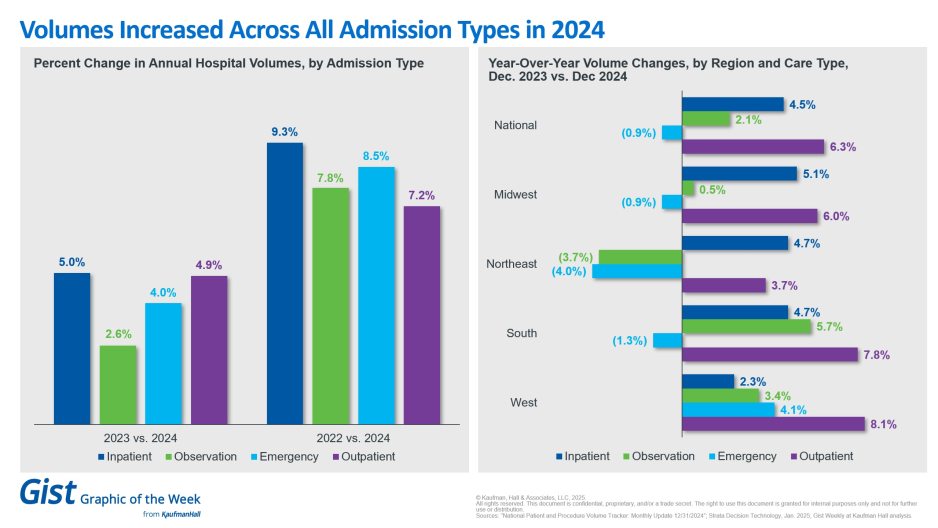
    • After hearing reports from health systems about decreasing revenue capture from Medicare Advantage (MA) plans, this graphic dives into some of the trends driving this costly challenge providers are facing. MA plans’ popularity has swelled in recent years as seniors are drawn to the extra benefits and lower out-of-pocket costs. As a result, MA enrollees as a share of total inpatient days roughly doubled across all area types between 2015 and 2022. This trend has likely continued as MA penetration has only grown since 2022. This shift has been tough for providers because most MA plans require prior authorization for certain kinds of care, a burnout-driving and costly administrative demand for providers. Although the number of prior authorizations per MA enrollee has remained stable over recent years, providers are seeing more MA patients, leading to an increased burden. On top of that, the overall prior authorization denial rate jumped to 7.4% in 2022, after hovering around 5.7% for several years prior. These decisions can be overturned, but patients and providers often don’t file appeals, leading to higher rates of uncompensated care and lost revenues for providers. Unfortunately, these higher costs have brought many providers to a breaking point in contract negotiations with MA plans, leading to care disruptions that ultimately hurt patients the most.
  • Bloomberg Law reports,
    • “CVS Pharmacy Inc. and the former president of Cigna Corp.’s Express Scripts asked a federal judge to amend an injunction prohibiting her from joining CVS so that it expires at the same time as her noncompete agreement with Cigna.
    • “CVS notified Amy Bricker on Nov. 6 that it’s terminating her inactive employment status with the company, according to a motion the two filed Thursday in the US District Court for the Eastern District of Missouri. CVS and Bricker argued that fact materially changes the circumstances of the injunction because she “will not, even in the future, perform any active employment duties or responsibilities for CVS.
    • “Bricker’s termination followed a Nov. 6 quarterly earnings call where CVS publicly announced senior leadership changes.
    • “It “obviates any need” for the injunction, CVS and Bricker said, and “has the practical effect of interfering with Ms. Bricker engaging in gainful employment for longer than” the Cigna noncompete, which is set to expire Feb. 3.”

Friday Factoids

From Washington, DC,

  • The Hill reports
    • “Control of the House has yet to be determined, as a number of critical races remain too close to call, leaving lawmakers — and voters — waiting to see which party will hold the majority next year.
    • “The sprint to 218 seats, however, is nearing the final stretch, after a handful of additional races were called in the days following election night.
    • “Republicans had secured 216 seats in the lower chamber as of Friday morning, with Democrats trailing at 204 seats, according to Decision Desk HQ. A total of 15 races have not yet been called: Democrats are leading in eight of the contests, while GOP candidates are ahead in the other seven.”
  • CMS finally announced the Medicare Part A and B premiums and cost sharing amounts for 2025 today.
    • Medicare Part A cost sharing
      • “The Medicare Part A inpatient hospital deductible that beneficiaries pay if admitted to the hospital will be $1,676 in 2025, an increase of $44 from $1,632 in 2024. The Part A inpatient hospital deductible covers beneficiaries’ share of costs for the first 60 days of Medicare-covered inpatient hospital care in a benefit period. In 2025, beneficiaries must pay a coinsurance amount of $419 per day for the 61st through 90th day of a hospitalization ($408 in 2024) in a benefit period and $838 per day for lifetime reserve days ($816 in 2024). For beneficiaries in skilled nursing facilities, the daily coinsurance for days 21 through 100 of extended care services in a benefit period will be $209.50 in 2025 ($204.00 in 2024).” 
    • Medicare Part B premiums
      • “The standard monthly premium for Medicare Part B enrollees will be $185.00 for 2025, an increase of $10.30 from $174.70 in 2024. The fact sheets also disclose the Medicare Part B Income-Related Monthly Adjustment Amounts (IRMAA).”
    • Medicare Part B annual deductible
      • “The annual deductible for all Medicare Part B beneficiaries will be $257 in 2025, an increase of $17 from the annual deductible of $240 in 2024.  The increase in the 2025 Part B standard premium and deductible is mainly due to projected price changes and assumed utilization increases that are consistent with historical experience.”
  • Modern Healthcare reports,
    • “Many hospitals are not publishing their prices in accordance with the price transparency law, a federal watchdog’s new report found.
    • “More than a third of the 100 hospitals reviewed by the Health and Human Services Department’s Office of Inspector General did not post machine-readable pricing data files correctly, or at all, as required by the 2021 federal law, according to the report released Friday. Most of the violations were related to disclosing the rates hospitals negotiated with insurers, metadata errors and outdated information. Five hospitals did not post any machine-readable files.
    • “The OIG analyzed data from 30 hospitals that were part of the country’s three largest health systems, and the rest were part of a random sample of 5,504 facilities. Researchers reviewed hospital websites between Jan. 17, 2023, and March 14, 2023.”

From the public health and medical research front,

  • The Centers for Disease Control and Prevention announced today.
    • “COVID-19 activity is stable or declining in most areas. Minimal seasonal influenza activity is occurring nationally. Signs of increased RSV activity have been detected in the southern, southeastern, and mid-Atlantic United States, particularly in young children. Respiratory infections caused by the bacterium Mycoplasma pneumoniaehave continued to increase in young children in the United States.”
    • “COVID-19
      • Nationally, COVID-19 activity is stable or declining in most areas. Wastewater levels, laboratory percent positivity, emergency department visits, and hospitalizations are continuing to decrease nationally while deaths remain at low levels. Across the nation, COVID-19 infections are predicted to decline in some states and grow slowly from a low level in others.
      • “CDC expects that the 2024-2025 COVID-19 vaccine to work well for currently circulating variants. For additional information, please see CDC COVID Data Tracker: Variant Proportions. There are many effective tools to prevent spreading COVID-19 or becoming seriously ill.”
    • “Influenza
    • “RSV
      • “Nationally, RSV activity remains low. However, continuing signs of increased RSV activity have been detected in the southern, southeastern, and mid-Atlantic United States, particularly in young children. Emergency department visits and hospitalization rates are increasing in young children in some areas.
    • “Vaccination
      • RSV, influenza, and COVID-19 vaccines are available to provide protection and play a key role in preventing hospitalizations.
  • MedPage Today adds,
    • “If you missed the early fall pushopens in a new tab or window for flu and COVID-19 vaccines, it’s not too late.
    • “Health officials say it’s important to get vaccinated ahead of the holidays, when respiratory bugs tend to spread with travel and indoor celebrations.
    • “Those viruses haven’t caused much trouble so far this fall. But COVID-19 tends to jump in the winter months, a rise that usually starts around Thanksgiving and peaks in January.
    • “And that coincides with flu season, which tends to start in November or December and peak in January or February.
    • “It takes the body about 2 weeks to build up immunity after either shot — meaning vaccination is needed before these viruses start spreading.”
  • Per Health Day,
    • “It doesn’t take much: Adding just five minutes of exercise to your daily routine lowers your blood pressure and might cut your odds for heart disease, new research shows.
    • “The good news is that whatever your physical ability, it doesn’t take long to have a positive effect on blood pressure,” said study lead author Jo Blodgett, from University College London (UCL). “What’s unique about our exercise variable is that it includes all exercise-like activities, from climbing the stairs to a short cycling errand, many of which can be integrated into daily routines.”
    • “Her team published its findings Nov. 6 in the journal Circulation.”
  • and
    • “Women who take vitamin D supplements during a pregnancy may be giving their kids the legacy of stronger bones, new British research suggests.
    • “Children whose moms took vitamin D supplements when pregnant had stronger, denser bones at the age of 7 compared to the kids of women who didn’t, a study from the University of Southampton shows. 
    • It’s a head start on bone health that might last a lifetime, said lead researcher Dr. Rebecca Moon.
    • “This early intervention represents an important public health strategy. It strengthens children’s bones and reduces the risk of conditions like osteoporosis and fractures in later life,” said Moon, a clinical lecturer in child health at the university.”

From the U.S. healthcare business front,

  • Modern Healthcare reports,
    • “Value-based care platform Astrana Health has signed a definitive agreement with private equity firm Prospect Medical Holdings to acquire some of its assets for $745 million. 
    • “Pending regulatory approvals, Astrana would acquire Prospect Health Plan, Prospect Medical Groups, Prospect Medical Systems, RightRx and Foothill Regional Medical Center in Tustin, California. 
    • “In October, Astrana Health finalized its acquisition of management services organization Collaborative Health System from health insurer Centene for an undisclosed price. The company’s latest acquisitions are expected to close in mid-2025, according to a Friday news release from Astrana. 
    • “Astrana and Prospect Medical did not immediately respond to requests for comment.” 
  • Beckers Payer Issues ranks large payers by third quarter medical loss ratio.
  • Per Fierce Healthcare,
    • “Quest Diagnostics and Elevance Health are broadening their partnership into four more states with the goal of making it easier for patients to access in-network laboratory services.
    • “Beginning Jan. 1, Quest’s service will be available in-network in four additional states: Colorado, Georgia, Nevada and Virginia. This includes routine lab testing, advanced diagnostics and Quest’s network of pathologists, according to an announcement.
    • ‘Members who need lab services are able to schedule appointments online at one of Quest’s patient service centers as well as access test results and updates through the free myQuest mobile app.”
  • Per MedTech Dive,
    • “Tandem Diabetes Care and Insulet executives this week touted the strong demand they’ve seen for their insulin pumps among people with Type 2 diabetes, tipping that adoption could be even greater than previously believed.
    • “Tandem CEO John Sheridan said on an earnings call Wednesday that adoption of pumps among the roughly 2 million patients with insulin-intensive Type 2 diabetes in the U.S. is about 5%. Sheridan told investors that Tandem sees that figure growing to more than 25% over the next several years. Just a few quarters ago, the company was projecting a 15% longer-term adoption rate.
    • “Interest in insulin pumps among people with Type 2 diabetes has made up a solid chunk of new users, helping to propel Tandem to a record quarter in sales.
    • “More than 30,000 people living in the U.S. with Type 2 use a Tandem pump,” Sheridan said. “If we look at it on a quarterly basis, approximately 5-10% of new customers each quarter have Type 2, which has been a consistent trend throughout the years.”
  • and
    • “Exact Sciences reported third-quarter results that fell short of analyst expectations and cut its guidance for the fourth quarter. The cut, which William Blair analysts called a “shocking guidance update,” contributed to a 23% drop in the diagnostic company’s stock Wednesday.
    • “TD Cowen analysts said in a note to investors that the third quarter was the third time in five years that Exact Sciences, which sells the Cologuard colorectal cancer screening test, has missed revenue expectations. 
    • “Screening and precision oncology sales were each 1% below Wall Street’s consensus expectations, William Blair analysts wrote in a note to investors Tuesday. Exact Sciences is forecasting a bigger shortfall for the fourth quarter, with the company lowering its total revenue guidance by 11%, or around $85 million, from the prior implied range, according to William Blair.”

Midweek Update

President Grover Cleveland Photo by Library of Congress on Unsplash

From Washington, DC

  • President Donald Trump was reelected following an intervening term by another President in the fashion originated in the late 1800s by President Grover Cleveland, who was a Democrat.
  • NBC News adds this afternoon,
    • “Republicans will win control of the Senate for the next two years, NBC News projects, though control of the House is still up for grabs.
    • “Senate Republicans ousted Democrats in red states to secure the majority, flipping seats in West Virginia, Montana and Ohio, states that have swung heavily to the GOP. And they held their ground in friendly states like Texas and Florida, assuring them at least 51 seats when the new Congress is sworn in next January.” * * *
    • “The GOP senators are expected to elect a new leader next week as longtime Republican leader Mitch McConnell, R-Ky., is stepping down from the role after a record 18 years. His current deputy, Sen. John Thune, R-S.D., and former deputy, Sen. John Cornyn, R-Texas, are battling to take the job when the new Congress begins.”
  • Congress’s lame duck session begins next Tuesday November 12, and it will be a busy time for the legislators. You will recall that on September 26, President Biden signed into law,
    • “H.R. 9747, the “Continuing Appropriations and Extensions Act, 2025,” which provides fiscal year 2025 appropriations to Federal agencies through December 20, 2024, for continuing projects and activities of the Federal Government.” 
  • Govexec discusses FEHB plan fertility benefit offerings for 2025.
  • WTW Consulting shares advice on how to effectively use healthcare and dependent care FSAs.
  • Per MedTech Dive,
    • “Advamed has asked for Medicare to cover supplemental imaging of patients with heterogeneously and extremely dense breast tissue.
    • “In a letter sent to the Centers for Medicare & Medicaid Services Friday, the medtech industry group said many individuals with dense breasts currently have to pay out of pocket or forgo potentially life-saving additional testing.
    • “Advamed made the request two months after the Food and Drug Administration began requiring mammographers to notify patients when they have dense breast tissue. Traditional mammography is less sensitive than other imaging technologies in dense breasts, which increases the risks of imaging to miss cancer.”

From the public health and medical research front,

  • The American Hospital Association News lets us know,
    • “The Centers for Disease Control and Prevention Nov. 6 released its annual progress report on health care-associated infections, which showed continued decreases in hospitalizations last year. There was a 16% decrease in hospital-onset methicillin-resistant Staphylococcus aureus, or MRSA; a 15% decrease in central line-associated bloodstream infections, or CLABSI; a 13% decrease in hospital-onset Clostridioides difficile (C. difficile) infection; an 11% decrease in catheter-associated urinary tract infections; and a 5% decrease in ventilator-associated events. The declines align more closely with progress made prior to the COVID-19 pandemic in 2020, the CDC said. 
    • “For inpatient rehabilitation facilities, there was a 14% decrease in hospital-onset C. difficile infection and an 8% increase in CAUTI in 2023, but no significant changes in CLABSI and hospital-onset MRSA standardized infection ratios compared with 2022. Among long-term care hospitals, there was a 13% decrease in hospital-onset C. difficile infections but no significant changes in 2023 SIRs compared with 2022. 
    • “The report recommends facilities continue reinforcing prevention practices and review HAI surveillance data to identify areas for improvement.”
  • MedPage Today tells us,
    • The FDA announced marketing authorization of a form of light therapy as the first-ever treatment for dry age-related macular degeneration (AMD).
    • LumiThera’s Valeda Light Delivery System generates light at different wavelengths to stimulate and improve the function of retinal mitochondria. The photobiomodulation (PBM) system is the first treatment shown to improve vision loss associated with dry AMD.
    • “Patients will now be able to try a non-invasive treatment that can help improve their vision earlier in the disease process,” said David Boyer, MD, of Retina Vitreous Associates Medical Group in Beverly Hills, California, in a company statement. “This is an exciting option for patients, and something doctors and patients have been waiting for.”
  • The National Cancer Institute informs us,
    • “Every year, almost 90,000 of these adolescents and young adults (AYAs)—generally defined as people between the ages of 15 and 39—receive a cancer diagnosis. And this group of patients often needs extra help navigating the complexities of cancer care.
    • “A new study has shown that a program in place for a decade at the University of North Carolina (UNC) Lineberger Comprehensive Cancer Center substantially increased its assistance to AYAs with cancer being treated at the center. For example, there were large increases in the number of AYAs who underwent fertility counseling, a particularly important consideration for this age group. The program also substantially boosted AYA enrollment in clinical trials and helped more AYAs get other care recommended by national guidelines. 
    • “The UNC team is now working to standardize many components of the program so it can be adapted by other cancer centers, explained Jacob Stein, M.D., M.P.H., who presented the findings from an evaluation of the program in September at the American Society of Clinical Oncology’s Quality Care Symposium.
    • “A lot of [centers] are now reaching out and asking: ‘How do we do this?’” said Dr. Stein. And the timing is right for the wider availability of programs to help AYAs with cancer, he added.
    • “Studies are showing that cancer is on the rise in younger adults,” he said. “That’s a concerning trend, but there are a lot of folks now engaged and talking about cancer in AYAs in a way that we weren’t 5 or 10 years ago.”
  • and
    • “[H]ow well does telehealth perform when it comes to delivering palliative care for people with cancer, which can rely on a deeper level of connection between patients and providers than may be possible with a virtual visit?
    • “A study of 1,250 people with advanced lung cancer has now provided some insights into that question. The study found that virtual and in-person palliative care were similarly effective in improving patients’ quality of life and other important measures of well-being, according to findings published September 11 in JAMA. It also found benefits for caregivers. 
    • “The results show that “we can successfully deliver … high-quality [palliative] care in person and virtually,” said Joseph A. Greer, Ph.D., of Massachusetts General Hospital, who led the study.
    • “The study results also have implications for the accessibility of palliative care, Dr. Greer noted. Telehealth provides a way for people with cancer who live in rural areas where there may not be many palliative care providers or who don’t have reliable transportation to receive palliative care. 
    • “Many of us see the potential that telehealth can have, and studies like this go a long way to help provide the evidence” needed to demonstrate that it can be used effectively as part of something as complex as palliative care, said Roxanne Jensen, Ph.D., of NCI’s Healthcare Delivery Research Program, who was not involved in the study.” 
  • Per Healio,
    • “Respiratory syncytial virus vaccines proved highly effective at preventing hospitalization and ED visits in older adults, even in those with immunocompromising conditions, results from an observational analysis showed.
    • “The findings, published in The Lancet, are consistent with previously reported data on respiratory syncytial virus (RSV) vaccine effectiveness.”
  • Per Medscape,
    • “Nilotinib, a drug approved by the US Food and Drug Administration (FDA) to treat chronic myeloid leukemia, improved biomarkers and cognitive outcomes in patients with dementia with Lewy bodies (DLB) in a phase 2 randomized, double-blind, placebo-controlled trial. 
    • “The findings align with an earlier study that showed possible disease-modifying effects of nilotinib in patients with mild cognitive impairment or Alzheimer’s disease, as previously reported by Medscape Medical News
    • “We’re looking at repositioning or repurposing tyrosine kinase inhibitors for neurodegenerative diseases,” said study investigator Raymond Scott Turner, MD, PhD, of Georgetown University School of Medicine in Washington, DC.”

From the U.S. healthcare business front,

  • Healthcare Dive reports,
    • “CVS reported mixed third-quarter results shadowed by heightened medical costs on Wednesday, in the massive healthcare enterprise’s first earnings report with new CEO David Joyner at the helm.
    • “The Woonsocket, Rhode Island-based company beat Wall Street expectations on revenue of $95.4 billion, up more than 6% year over year. However, CVS’ net income fell to $71 million, down from almost $2.3 billion same time last year, as its Aetna insurance arm continued to struggle with higher spending.
    • “CVS appointed Steve Nelson, previously the CEO of value-based primary care company ChenMed, as president of Aetna. Nelson also ran UnitedHealthcare, the largest private insurer in the U.S., from 2016 to 2019.”
  • Health Affairs Scholar concludes,
    • “The No Surprises Act banned surprise billing and established a final-offer arbitration system, independent dispute resolution (IDR), to resolve disagreements between health plans and providers. One factor that arbiters must consider in the IDR process is the qualifying payment amount (QPA), the median contracted rate for the same or similar service in the same market as computed by health plans. We analyzed public IDR data from 2023 for the most common disputed professional service: evaluation and management of a moderate to severe emergency medicine visit. Providers won 86% of cases, with mean decisions 2.7 times the QPA. Private equity-backed providers won more often and higher monetary awards than other providers. The mean QPA was 2.4 times Medicare payments. Disputes were dominated by a small group of health plans and providers, so payments may not reflect the overall market for emergency services.”
  • Per Fierce Pharma,
    • “As other biopharma giants have divested their generics units to focus on the development and commercialization of innovative drugs, Teva has relied on its copycat business to help trigger its rebound under CEO Richard Francis.
    • “Wednesday, Teva revealed booming third-quarter sales for its generics and biosimilars. In the U.S., revenue from the knockoffs came in at $1.1 billion, which was a 30% increase year over year, or 7% sequentially. Sales of generics and biosimilars also were up 10% year over year in Europe.
    • “The figures contributed heavily to Teva’s overall success in the quarter. Its revenue of $4.3 billion topped analysts’ consensus of $4.14 billion and was a 13% gain year over year. With the result, Teva tweaked its annual guidance up by $100 million at both ends to a window of $16.1 billion to $16.5 billion.”
  • MedCity News notes,
    • “While employers are prioritizing mental and physical wellbeing programs, employees report that what they really want is financial wellbeing support, according to a new survey.
    • “The survey was released last week by WTW, a global advisory, broking and solutions company. It included responses from 535 employees at medium and large private sector employers.
    • “The organization found that 73% of employers prioritize mental wellbeing and 50% prioritize physical wellbeing. However, 66% of employees say that financial wellbeing is their biggest concern. For employers, only 23% of respondents listed this as a priority. This comes as just 41% of employees feel financially secure, according to the survey.”

Weekend Update

From Washington, DC,

  • As we all know, the national election is Tuesday. The current Congress will return to Capitol Hill the following Tuesday November 12, to begin its lame duck session. The new Congress will begin on January 3, 2025.
  • In anticipation of the Federal Employee Benefits Open Season that begins on November 11, OPM has posted 2025 FEHBP and FEDVIP plan comparison tools on its website.
  • Modern Healthcare reports,
    • “Elevance Health is the latest Medicare Advantage insurer to dispute its star ratings quality scores in court.
    • “The health insurance company filed suit against the federal government in the U.S. District Court for the Northern District of Texas on Thursday. According to Elevance Health, the Centers for Medicare and Medicaid Services improperly assessed its quality performance, costing the insurer $375 million in bonus payments. The company won a case regarding its 2024-star ratings on different grounds, which led the agency to recalculate scores across the program.
    • “Elevance Health wants the court to order CMS to redo its ratings and to provide insurers with the data to “validate the 2025-star ratings calculations and future star ratings calculations,” according to its lawsuit. The insurer also seeks reimbursement the court deems appropriate.”

From the public health and medical research front,

  • CBS News asks and answers “Do I have COVID, the flu or something else? 2024 symptoms and testing to know.”
  • The New York Times lets us know,
    • “More than 80 percent of emergency departments in United States hospitals are not fully prepared for pediatric cases, a new study finds, despite the fact that children make up about 20 percent of visits each year.
    • “The new analysis, published Friday in the journal JAMA Network Open, estimated that if every emergency department in the United States had the core features of “pediatric readiness,” more than a quarter of the child deaths that follow E.R. visits could be prevented, a figure that equates to thousands of young lives each year.
    • “Even in the most ill-prepared states, the cost to ready every emergency room would be less than $12 per child living there, the researchers found.
    • “You can now find your state and see: How many children who would otherwise die could we expect to save if we implemented universal pediatric readiness at a high level?” said Dr. Craig Newgard, who was the lead author on the paper, and is the director of the Center for Policy and Research in Emergency Medicine at Oregon Health & Science University.”
  • The Washington Post informs us,
    • “Migraine is a surprisingly common problem, affecting an estimated 15 percent of the global population. Scientists don’t know how triggers lead to attacks but have made some progress in treatment: The latest drugs, inhibitors of a body signaling molecule called CGRP first approved for use in 2018, have been a blessing for many. For others, not so much. And it’s not clear why.”
    • * * * “Despite some failures, CGRP’s successes show that there’s hope for new medicines. CGRP has really paved the way,” says Andrew Russo, a neuroscientist at the University of Iowa in Iowa City who described CGRP as a new migraine target for the Annual Review of Pharmacology and Toxicology in 2015. “It’s a very exciting time for the field.”
  • Fortune Well informs us,
    • “Binge drinking is prevalent across generations, but the dangerous habit is growing among one age group in particular. 
    • “Long associated with college students, binge drinking, defined as having four or more drinks within two hours at least five times per month for women (five drinks for men) is on the rise among older adults. According to The National Survey on Drug Use and Health, 20% of adults aged 60 to 64, reported binge drinking in the last month. For those older than 65, the prevalence of binge drinking is 12%—a rate that has been increasing over the last decade, while binge drinking rates among young adults 18 to 25 have been going down.” * * *
    • “For more education on how to assess your—or a family member’s—drinking habits, visit the NIAAA Healthcare Professional’s Core Resource on Alcohol.”

From the U.S. healthcare business front,

  • Per Legal Dive,
    • “Pennsylvania’s attorney general sued Prospect Medical Holdings and its former parent company, alleging mismanagement by the hospital chain caused two hospital closures and widespread disruptions to patient care.
    • “The lawsuit Tuesday argues Prospect broke the terms of its 2016 purchase agreement of four-hospital system Crozer Health, which required Prospect to keep all acute care hospitals open for at least 10 years.
    • ‘In the suit, Attorney General Michelle Henry asks for a preliminary injunction barring Prospect from closing more hospitals and requests an official receiver step in and manage Crozer Health.”
  • Modern Healthcare tells us,
    • “Zoom, a company that rose to prominence during the COVID-19 pandemic, is looking to expand its presence in healthcare through artificial intelligence. 
    • “The company recently announced plans to incorporate ambient AI documentation technology from digital health company Suki in its clinical platform. Zoom plans to use the ambient AI technology, which turns a recording of a doctor-patient conversation into usable clinical notes in the electronic health record, for virtual and in-person visits. 
    • “It’s the latest move in healthcare from the video teleconferencing company, which has offered telehealth services since 2018.”
  • Per HR Dive,
    • “While the median salary increase stayed at 4% in 2024, average increases dropped from 4.3% to 3.9%, according to survey results collected by Salary.com from more than 1,000 HR professionals in the U.S. and Canada.
    • “The drop is due to fewer companies doling out higher raises, Salary.com found; only 14% of companies gave out raises between 5% and 6.9%, compared with 25% of companies in the previous survey. Additionally, more companies — 38% in 2024, compared to 25% in 2023 — returned to “typical” salary increases in the 3% to 3.9% range.
    • “Last year, we noted that salary increases might be at a peak, even with 4 percent becoming the norm,” Andy Miller, vice president of compensation consulting at Salary.com, said in an Oct. 29 news release. “While 4 percent remained the median in 2024, further analysis suggests a shift is happening.”

Midweek Update

Photo by Manasvita S on Unsplash

From Washington, DC,

  • MedPage Today tells us,
    • “A bipartisan group of House members introduced a bill Tuesday that would reverse a proposed 2.8% Medicare Physician Fee Schedule payment cutopens in a new tab or window and give physicians a raise equivalent to half of the increase in the Medicare Economic Index (MEI), a measure of healthcare inflation.
    • “America’s physicians are at a breaking point and access to high-quality, affordable care is at risk for millions of Medicare patients,” Rep. Greg Murphy, MD (R-N.C.), one of the bill’s co-sponsors, said in a statement. “When a physician sees a Medicare patient, they do so out of the goodness of their heart, not because it makes financial sense … Unfortunately, reimbursements continue to decline, putting immense pressure on doctors to retire, close their practices, forgo seeing new Medicare patients, or seek a less efficient employment position. This bipartisan legislation would stop yet another year of reimbursement cuts, give them a slight inflationary adjustment, and protect Medicare for physicians and patients alike.”
  • Roll Call lets us know,
    • ​”With all eyes on next week’s elections, appropriations battles are simmering on the back burner for Congress. But lawmakers won’t have long to make some tough decisions when they return starting on Nov. 12 for the lame-duck session.
    • “The priorities are twofold: first, passing an emergency relief package after two major hurricanes battered the Southeast, compounding pent-up demands for disaster aid going back to last year. Second, congressional leaders need to figure out what to do about funding the government beyond the stopgap law’s Dec. 20 deadline.
    • ‘The current betting is that there simply won’t be enough time in the five weeks of session remaining to strike the deals needed to put together thousands of pages of text fleshing out a dozen full-year fiscal 2025 spending bills. Top Democrats and appropriators on both sides of the Capitol will push that option, but without GOP leadership buy-in, it’s very unlikely.”
  • Today the U.S. Court of Appeals for the Fifth Circuit handed a loss to the Texas Medical Association (TMA) in the No Surprises Act cases.
    • The Court summarized its holdings as follows
      • “We conclude that the provisions of the Rule related to QPA calculations are lawful and therefore REVERSE the district court’s holdings as to those provisions. We further conclude that the Rule’s deadline provision is unlawful and therefore AFFIRM the district court’s holding as to that provision. Finally, we conclude that the Rule’s disclosure requirements are lawful and therefore AFFIRM the district court’s holding as to those provisions.”
    • The first and third holdings are the TMA loss.  Last December, CMS implemented the district court’s QPA calculation decision in its NSA guidance.  The FEHBlog imagines that CMS may reverse that December 2023 guidance soon.
    • The second holding means that health plans must pay or deny an NSA claim within 30 calendar days after receipt. The clean claim consideration was rejected by the district court and the court of appeals. 

From the public health and medical research front,

  • The Washington Post reports,
    • “The bird flu outbreak in dairy cows has spread to at least one pig on a backyard farm in Oregon, the first detection of the H5N1 virus in swine in the United States, the U.S. Department of Agriculture said Wednesday.
    • “The discovery is particularly concerning to scientists and public health officials because pigs can become coinfected with bird and human viruses, allowing genes to swap to form a new, more dangerous virus that can more easily infect humans.
    • “Bird flu was first detected in poultry on the noncommercial farm, the Oregon agriculture department said Friday. The USDA’s National Veterinary Services Laboratories confirmed that one of the farm’s five pigs was infected with the virus on Tuesday but did not publicize the discovery until Wednesday.” * * *
    • “Once an avian virus like H5N1 gets into a pig, it can mix with other viruses — a process known as reassortment — and pick up the ability to grow better and adapt to make humans sicker, Webby said. At least 31 people have been sickened in the current bird flu outbreak, all with mild symptoms.
    • ‘Animals on the farm are not part of the commercial food supply, the USDA said. The discovery of bird flu in the swine has no impact on the safety of the nation’s pork supply.
    • “The farm’s small size gives the virus less opportunity to spill into humans, experts said.”
  • The New York Times informs us,
    • “The blockbuster drug semaglutide, sold as Ozempic for diabetes and as Wegovy for weight loss, now has a new proven benefit: It markedly soothed knee pain in people who are obese and have moderate to severe osteoarthritis, according to a large study.
    • “The effect was so pronounced that some arthritis experts not involved with the clinical trial were taken aback.
    • “The magnitude of the improvement is of a scope we haven’t seen before with a drug,” said Dr. Bob Carter, deputy director of the National Institute of Arthritis and Musculoskeletal and Skin Diseases. “They had an almost 50 percent reduction in their knee pain. That’s huge.”
    • “Dr. David T. Felson, an arthritis expert and professor of medicine at Boston University School of Medicine, said the study “changes the landscape,” adding that the pain reduction is greater than anything that can be achieved short of knee replacement surgery.”
  • and
    • “For decades, people with failing heart valves who nevertheless felt all right would walk out of the cardiologist’s office with the same “wait and see” treatment plan: Come back in six or 12 months. No reason to go under the knife just yet.
    • “A new clinical trial has overturned that thinking, suggesting that those patients would be much better off having their valves replaced right away with a minimally invasive procedure.
    • The trial, whose results were published this week in The New England Journal of Medicine, could change the way doctors treat severe aortic stenosis, a narrowing of the valve that controls blood flow from the heart. The disease, which has a prognosis worse than that of most cancers, afflicts more than 3 percent of people ages 65 and older. It is expected to become more common as people live longer.
    • “Replacing people’s heart valves, even if they were not yet experiencing any ill effects, appeared to roughly halve their risk of being unexpectedly hospitalized for heart problems over at least two years, the trial found.”
  • The Wall Street Journal adds,
    • “It is hard to mend a broken heart, but in a few years doctors might be able to do essentially that.
    • “Scientists are closing in on ways to help patients grow new heart muscle after a heart attack, as well as new lung tissue to treat fibrosis, corneas to erase eye pain and other body parts to gain a new chance at life.
    • “If the science works, it could represent a new approach to medicine: reversing rather than alleviating chronic illnesses.”
    • “The idea “is really to restore function to the organ such that the quality of life of that person is normalized,” says Peter Schultz, president and chief executive of Scripps Research, a nonprofit scientific institute in La Jolla, Calif., that is testing medicines to regenerate hearts, lungs and other organs.
    • “These treatments eventually might also be used to reverse the effects of aging, Schultz says. If they prove effective in people with disease, he says, they could be tested in healthy people to see if they can, say, “turn a 70-year-old heart into a 40-year-old heart.”
  • STAT News relates,
    • “An experimental Alzheimer’s therapy from Roche successfully cleared a protein that’s a hallmark of the disease from patients’ brains, the company reported Wednesday, adding to evidence that the drug shows promise.
    • “The data are from an early-stage trial and so far, Roche has not yet assessed whether there has been any corresponding change in cognitive function or disease progression. But U.S. regulators have in recent years approved similar medicines that can reduce levels of the protein, called amyloid, in patients’ brains and that in trials modestly slowed the worsening of Alzheimer’s.
    • “What’s more, the early findings of Roche’s treatment, an antibody called trontinemab, suggest it could be safer than some of the other amyloid-clearing treatments, although larger studies would need to confirm that. In particular, there have been comparatively few cases of an issue called ARIA, a type of brain swelling or bleeding, that has been seen with the other antibodies and that has led regulators in some parts of the world to take negative views of the existing drugs.”
  • Beckers Hospital Review alerts us,
    • “A recent study revealed a 17.5% increase in asthma-related hospitalizations in the three months following the announcement that GSK would discontinue the widely used asthma medication Flovent, and 24.1% in the following three to six months, ABC News reported Oct. 30. 
    • “The research, conducted by EPIC Research, analyzed data from over 3 million patients and highlighted the potential risks associated with the switch to alternative medications. 
    • ‘Five-year-old Burton Hayes, whose asthma was previously well managed on Flovent, faced significant health challenges after his mother was forced to switch his medication, ABC News reported. Reports indicated a sharp rise in asthma exacerbations among patients following the discontinuation, leading to an increase in emergency room visits and hospital admissions. 
    • “The decision to halt Flovent’s production came after a Federal Trade Commission warning about its patent. To comply with regulatory changes and avoid potential financial penalties, GSK shifted to an authorized generic, fluticasone propionate. However, many patients are finding that the new generic is not covered by insurance, complicating access, according to the ABC News report.”
  • CIGNA points out “fifteen stats illustrating cancer’s impact on people, employers, and health care costs.”
  • Per an NIH press release,
    • “New insights from multiple studies provide critical information on how cancer tumors develop, spread, and respond to treatments. The 10 studies from the Human Tumor Atlas Network (HTAN), a National Institutes of Health (NIH)-funded Cancer Moonshot initiative to construct three-dimensional maps of human tumors, will be published Oct. 31, 2024, across several Nature journals.
    • “Several studies explore the role of the tumor microenvironment and the immune system in promoting the spread of cancer and its resistance to treatment. Three studies map the trajectory of precancerous colorectal tissues toward cancer by measuring the contributions of multiple molecular and cellular events. Multiple new HTAN papers describe the development of innovative single-cell technology and analysis platforms. An accompanying research briefing by W. Kimryn Rathmell, M.D., Ph.D., director of NIH’s National Cancer Institute (NCI), and Dinah Singer, Ph.D., NCI deputy director for scientific strategy and development, discusses the history, progress, and future of HTAN.
    • “Launched in 2018, HTAN constructs three-dimensional maps of human tumors that capture their molecular features and surrounding microenvironments over time. The work is being done by teams of investigators from research institutions across the country using a variety of technologies and computational approaches to study tumors at the single-cell level. This comprehensive, publicly available resource aims to help researchers better understand the development and progression of cancer to inform its prevention and treatment. The first tumor atlas studies from this initiative were published in 2020 and 2021.” * * *
    • “The collection page is available at https://www.nature.com/collections/fihchcjehc.”

From the U.S. healthcare business front,

  • Healthcare Dive points out,
    • “Actions taken by Humana to weather tumult in the Medicare Advantage program appear to be bearing fruit. On Wednesday, the insurer reported better-than-anticipated third quarter results and modestly increased its 2024 earnings guidance after retaining more MA seniors than expected — and those members having higher risk scores, boosting reimbursement.
    • “Humana now expects to add 265,000 individual MA members this year, representing 5% growth, compared to its previous guidance of 225,000 new MA members.
    • “Despite the stronger membership, Humana doesn’t expect earnings growth in 2025 because of heavy investments the insurer plans to make to boost its MA stars — valuable quality ratings linked to plans’ revenue in the privatized Medicare program.”
  • Per BioPharma Dive,
    • “Eli Lilly’s seemingly inexorable growth hit a speed bump Wednesday, when the Indianapolis drugmaker reported earnings for the third quarter that missed Wall Street expectations and sent shares down sharply.
    • “Overall, revenue reached $11.4 billion between July and September, up 20% from the same period last year but higher by only 1% versus the second quarter and well below the consensus forecast of about $12.1 billion.
    • “Lilly’s sales and stock price have swelled on surging demand for the company’s GLP-1 medicines Mounjaro and Zepbound, which it respectively sells for diabetes and obesity.
    • “The company has had difficulty meeting that demand, though, leading to shortages that have hampered the drugs’ availability. (In October, the Food and Drug Administration officially removed Mounjaro and Zepbound from its shortage list, but is now reconsidering that decision.)
    • “Compared to the third quarter last year, sales of the two drugs are significantly higher, respectively reaching $3.1 billion and $1.26 billion during the period. But both totals were lower than analysts expected and roughly flat compared to the second quarter.”
  • and
    • “All doses of Novo Nordisk’s popular GLP-1 medicines Ozempic and Wegovy are available in the U.S. and being regularly shipped to wholesalers, the drugmaker confirmed Wednesday.
    • “One dose form or another of both drugs, which respectively treat diabetes and obesity, has been in shortage since March 2022, according to a database maintained by the Food and Drug Administration. The database was updated Wednesday to reflect the drugs’ new availability, although both remain listed.
    • “In an emailed statement, Novo cautioned that, “even when a medication is available, patients may not always be able to immediately fill their prescription at a particular pharmacy.” The statement added that people seeking to fill a prescription may experience this “variability” regardless of whether a drug is actively in shortage.”
  • Per Fierce Pharma,
    • “It’s a new era for AbbVie. For the first time in years, the company has a new top sales driver as Skyrizi has overtaken Humira in quarterly sales.
    • “Humira heir Skyrizi has been slowly creeping up on the once-dominant Humira ever since biosimilar competition prompted the immunology king’s decline. With Skyrizi salesskyrocketing 50% to $3.2 billion during the third quarter, the drug took the sales crown from Humira, which has been trending down and generated $2.2 billion during the period.
    • “Skyrizi holds biologic share leadership in approximately 30 countries and boasts a “best-in-class profile” that presents a “very high bar” for rivals, AbbVie’s chief commercial officer Jeffrey Stewart said on the company’s third-quarter earnings conference call.
    • “After Skyrizi’s recent debut in ulcerative colitis, feedback and initial prescription trends have been “overwhelmingly positive,” Stewart added. The crowded ulcerative colitis market recently gained another competitor in Johnson & Johnson’s Tremfya, setting up a fierce fight for dominance between the pharma giants. However, Skyrizi has a leg up with its prior Crohn’s disease nod, which represents the second form of inflammatory bowel disease (IBD).”
  • Fierce Healthcare tells us,
    • “Online therapy company Talkspace grew its revenue 23% in the third quarter, bringing in $47.4 million, and turned last year’s net loss into a profit of $1.9 million.
    • “The company continues to expand its business with payers and employers and now covering 158 million people in-network and through Medicare/Medicare Advantage plans, an increase of 40% year-over-year, Talkspace announced in its third-quarter earnings report released Tuesday. As Talkspace grows, it is increasing access to virtual behavioral health services for seniors, teens and members of the U.S. military, exectives said.
    • “This past quarter marks Talkspace’s third consecutive quarter of adjusted EBITDA profitability. Adjusted EBITDA came in at $2.4 million in Q3, an improvement from a loss of $2.8 million a year ago and beating Wall Street analysts’ consensus estimate of $1.4 million.”
  • Beckers Payer Issues identifies “the investments 18 payer executives are most excited about.” Check it out.

Monday Roundup

Photo by Sven Read on Unsplash

From Washington, DC,

  • Govexec offers a commentary on why federal and postal employees should consider a high deductible plan with a health savings account in the upcoming Open Season.
    • The FEHBP misses his CareFirst HDHP/HSA when Medicare became his primary health insurer at the end of 2019. The FEHBlog likes Medicare. He wonders whether the November 5 election is causing CMS to delay announcing Medicare premiums and cost sharing for 2025. Congress should pass a law requiring CMS to release this information before the beginning of the annual Medicare Open Enrollment on October 15.
  • Beckers Hospital Review lets us know,
    • Baxter has received FDA approval to extend the shelf life of more than 50 intravenous and irrigation products by up to 12 months, now allowing for a 24-month expiry from products made before September 2024, according to an Oct. 28 news release from the company. 
    • Here are four other IV shortage updates: 
      • A completed temporary bridge has already moved more than 825 truckloads of finished products from Baxter’s North Cove, N.C. facility. A second bridge is set to open in early November. 
      • Baxter anticipates restarting its primary IV solutions line the week of Oct. 28, aiming to begin distribution of new products by mid- to late November, the release said. 
      • Nine Baxter plants are supplementing North Cove’s output to stabilize supply levels in the U.S. 
      • Conservation efforts for IV and peritoneal dialysis solutions remain crucial, with Baxter’s supporting healthcare systems on product management strategies, according to the release. 
  • Federal News Network tells us,
    • “Agencies with higher employee satisfaction scores are also getting top marks on their performance.
    • Research from the Partnership for Public Service finds agencies that received the highest internal customer experience scores also ranked high on the Federal Employee Viewpoint Survey.
    • “Brandon Lardy, the Partnership’s senior manager for data science and Strategy, said the study is part of its ongoing work to produce customer experience metrics on par with FEVS data or its Best Places to Work in the Federal Government ranking.”
  • The Wall Street Journal reports,
    • “The Biden administration took steps to alleviate shortages of cancer drugs for children, part of a final push for one of the president’s domestic priorities: reducing the nation’s cancer burden.
    • “The federal government is testing a new way to prevent treatment disruptions for seven pediatric cancer drugs by improving communication between hospitals, nonprofits and wholesalers. Shortages of cancer medicines regularly plague hospitals and patients, sometimes forcing them to delay or change care. 
    • “No one in this country should struggle for access to the treatment they need, but kids and families facing cancer in particular,” said Danielle Carnival, an adviser to Biden who leads his “Cancer Moonshot” effort.” 

From the public health and medical research front,

  • STAT News reports,
    • “If one can point to anything good about the H5N1 bird flu outbreak in dairy cattle — to be honest, there’s nothing good about this situation — it’s the timing. Transmission of the virus through U.S. dairy herds took off when last winter’s flu season was effectively over, making the job of looking for people infected with H5N1 an easier task in theory, though there have been plenty of human hurdles impeding those efforts.
    • “But in the months since the outbreak was first detected, the spread of the virus in cows has not been contained, with infections reported in 380 herds in 14 states so far. Now, with cold and flu season looming, it is likely to become significantly more difficult for the country’s public health departments to track the virus. 
    • “If one can point to anything good about the H5N1 bird flu outbreak in dairy cattle — to be honest, there’s nothing good about this situation — it’s the timing. Transmission of the virus through U.S. dairy herds took off when last winter’s flu season was effectively over, making the job of looking for people infected with H5N1 an easier task in theory, though there have been plenty of human hurdles impeding those efforts.
    • “But in the months since the outbreak was first detected, the spread of the virus in cows has not been contained, with infections reported in 380 herds in 14 states so far. Now, with cold and flu season looming, it is likely to become significantly more difficult for the country’s public health departments to track the virus.”
  • Beckers Hospital Review names the ten most health and the ten least health cities in our country.
    • “Detroit leads the list of cities with the least healthy populations, while San Jose, Calif., has the healthiest residents, according to a new ranking published Oct. 28 by Forbes Advisor, a financial services and personal finance website affiliated with Forbes.
    • “In making its determination, Forbes Advisor compared the 46 most populated U.S. cities with available data across eight metrics. Metrics ranged from the number of heart disease deaths per 100,000 residents to the percentage of adults who report physical inactivity.
    • “Data for the analysis comes from the City Health Dashboard and the Census Bureau. Read more about the methodology here.”
    • Austin, Texas, where the FEHBlog lives, is listed as the city with the second healthiest population, following San Jose, California.
  • Consumer Reports, writing in the Washington Post, discuss “seven winning dietary supplements for sleep, bone health and more. As for which brands, the key is choosing products that have been verified to be free of contaminants and to contain what their labels claim.”
  • Per National Institutes of Health press releases,
    • “A study from researchers at National Institutes of Health (NIH) and their collaborators revealed a significant genetic risk factor for kidney disease in people from Ghana and Nigeria. Their study demonstrated that having just one risk variant in a gene known as APOL1 can significantly increase the risk of developing kidney disease. APOL1 is important for the immune system and variants of the gene are linked to increased risk of chronic kidney disease. The study is published in the New England Journal of Medicine and was conducted by researchers from the Human Heredity and Health in Africa (H3Africa) Kidney Disease Research Network.
    • “Previous research established that genomic variants in APOL1 increase the risk of developing chronic kidney disease among African Americans. However, not much is known about how these genomic variants affect people from West African countries, where many African Americans derive genetic ancestry. Studying how these genomic variants contribute to chronic kidney disease in West Africans and people with West African ancestry can also help inform the risk of kidney disease in many Americans.”
  • and
    • “A highly pathogenic avian influenza (HPAI) H5N1 virus, isolated from the eye of a farm worker who became infected through contact with dairy cows, was lethal in mice and ferrets infected in a high-containment laboratory environment, according to a new study in Nature. The study investigators also found that the virus isolated from the worker, who experienced mild inflammation of the cornea (conjunctivitis), could be transmitted through the air between separated ferrets and might be capable of binding to and replicating in human respiratory tract cells.
    • “The virus isolated from the worker is called huTX37-H5N1 and has a mutation (PB2-E627K) frequently seen in avian influenza viruses that replicate in mammals, typically making virus replication more efficient. These mutations underscore the need for continued monitoring and evaluation of viruses from the current H5N1 outbreak.
    • “The study also showed that a bovine H5N1 virus is susceptible to the antiviral drugs favipiravir and baloxavir marboxil (brand name Xofluza) of the polymerase inhibitor class, as well as the neuraminidase inhibitor zanamivir. The virus is less sensitive to oseltamivir (Tamiflu), another neuraminidase inhibitor.” * * *
    • “In summary, this study characterizes the huTX37-H5N1 isolate, finding that it may be capable of replicating in cells of the respiratory tract in humans, that it is pathogenic in mice and ferrets, and that it is capable of being transmitted by the respiratory route in ferrets. The authors note that “based in these observations, every effort should be made to contain HPAI H5N1 outbreaks in dairy cattle to limit the possibility of further human infections.”
  • From the U.S. healthcare business front,
  • AHIP shows us where our healthcare dollar goes.
  • For experience rated FEHB plans, which serve the vast majority of subscribers, the profit is less than one cent of each dollar. Other FEHB plans can enjoy the 2.4 cents profit.
  • Beckers Hospital Review points out “50 things to know about hospital consolidation and what consolidation means for the future of healthcare.
  • Per Fierce Healthcare
    • “Leaders at UnitedHealth Group and Amedisys are set to meet with the Department of Justice this week in hopes of avoiding a potential attempt to block their $3.3 billion merger deal, according to media reports.
    • “Bloomberg reported that the “last rites” meeting is generally the last step before regulators decide to intervene in a deal or not. It’s possible that the antitrust enforcers will allow the two companies to move forward with the deal with some changes that address competition concerns, according to the article.
    • “People familiar with the matter told Bloomberg there has been no definitive decision to challenge the deal. The DOJ will need to make a choice by the end of the month, based on an arrangement with UHG and Amedisys, according to the article.”
  • and
    • “Elevance Health plans to acquire home health company CareBridge in a deal that’s reportedly worth $2.7 billion.
    • “Elevance CEO Gail Boudreaux told investors on the company’s earnings call earlier this month that the company’s Carelon division “recently” entered into a deal to acquire CareBridge. 
    • “Further details on the transaction have not yet been disclosed. The Nashville Business Journal, where CareBridge is based, reported that Elevance Health would pay $2.7 billion for the home health company. The article called CareBridge the “fastest growing” company in the Tennessee city.
    • “On the call, Boudreaux said that CareBridge will “serve as the foundation for Carelon’s home health business, and we’re excited to continue to serve all its customers and members.” CareBridge provides value-based care in the home and community for people with complex and chronic conditions.”
  • and
    • “Universal Health Services (UHS) beat analysts’ estimates for third-quarter revenue as its top line grew 11% from 3.963 billion to reach $3.96 billion thanks to solid growth by its acute care hospitals and behavioral health care services.
    • “A year ago, UHS brought in $3.56 billion in revenue in the third quarter of 2023.
    • “The King of Prussia, Pennsylvania-based for-profit health system reported that adjusted admissions rose 1.5% from a year ago. Meanwhile, the total number of days patients stayed increased by 2% as compared to the same period in 2023.” * *
    • “The company also saw net revenue per adjusted admission rise by 7% while net revenue per adjusted patient day increased by 6.5% as compared to the third quarter of 2023. Net revenue from hospital services rose by 9.2% during the third quarter of 2024.
    • “UHS has approximately 96,700 employees and, through its subsidiaries, operates 27 inpatient acute care hospitals and 333 inpatient behavioral health facilities as well 40-plus outpatient facilities and ambulatory care access points. UHS also has an insurance offering and a physician network.”
  • Per Healthcare Dive,
    • Providence is expanding its presence in the home care market after the nonprofit health system agreed to launch a joint venture this week with home care provider Compassus.
    • “The JV, which will be called Providence at Home with Compassus, will offer home health, hospice, community-based palliative care and private duty caregiving services. 
    • “Compassus will manage operations, according to a press release. The JV will operate 24 home health locations in Alaska, California, Oregon and Washington, and 17 hospice and palliative care locations in Alaska, California, Oregon, Texas and Washington. There’s no timeline yet on when the parties might finalize the proposed JV, and the deal is still pending regulatory review in Oregon.”
  • The Wall Street Journal reports,
    • AbbVie has agreed to buy Aliada Therapeutics, a biotechnology company backed by Johnson & Johnson, for $1.4 billion in cash in a deal that adds a potential therapy for Alzheimer’s disease to AbbVie’s neuroscience pipeline.
    • “AbbVie on Monday said Aliada’s lead investigational asset, ALIA-1758, is an anti-pyroglutamate amyloid beta antibody that uses a novel blood-brain barrier-crossing technology and is in development for the treatment of the memory-robbing disease.” * * *
    • “The deal is slated to close by the end of the year.”

Weekend Update

From Washington, DC

  • Congress remains on the campaign trail until the lame duck session begins November 12.
  • On October 7, the Supreme Court invited the Solicitor General to file a brief in a Tenth Circuit ERISA preemption case, Mulready v. PCMA, No. 23-1213, expressing the views of the United States. The case bears on FEHB preemption of state PBM laws regulating PBM contracts with FEHB carriers. Because the national election will result in a new President on January 20, 2024, it’s likely that the Solicitor General will not submit a brief in this case until next Spring.
  • Beckers Payer Issues offers a useful perspective on HHS OIG and other investigative reports alleging that Medicare Advantage plans game the Medicare program by arranging for plan nurses to visit plan members to conduct health risk assessments.
    • “In a statement published Oct. 24, Mary Beth Donahue, president and CEO of the Better Medicare Alliance, said the report “paints a misleading picture of in-home health assessments.” 
    • “The Better Medicare Alliance is backed by major insurers. 
    • “Medicare Advantage is designed to achieve a better overall understanding of individuals’ health, and in-home assessments are a crucial part of this model,” Ms. Donahue said. “This information ensures seniors get the resources they need. We have supported codified best practices for these assessments and will continue to do so.” 
    • “In an Oct. 24 statement, AHIP, the trade association representing insurers, said CMS did not concur with key recommendations in the OIG’s report. 
    • “The agency did not concur with recommendations from the OIG to restrict payments for diagnoses found during in-home visits. 
    • “In its statement, AHIP said that health risk assessments are “one of many tools” MA plans use to identify chronic conditions and prevent these conditions from becoming more serious. 
    • “Whether they occur in the patient’s home or in a clinical office setting, the HRA offers an opportunity for the health plan and provider to obtain a complete evaluation of the patient’s physical, behavioral, and mental health needs, medications, health risks, and environmental factors that affect health,” the association said.” 
  • Cardiovascular Business tells us,
    • “Medtronic has received U.S. Food and Drug Administration (FDA) approval for its new Affera mapping and ablation system with the Sphere-9 catheter, an all-in-one electrophysiology offering capable of pulsed field ablation (PFA) and radiofrequency (RF) ablation. The system was approved to treat persistent atrial fibrillation (AFib) and cavotricuspid isthmus-dependent atrial flutter. It previously received CE mark approval in March 2023.
    • “Medtronic is now the first company to offer two FDA-approved PFA systems for the treatment of AFib. The company’s PulseSelect PFA system gained FDA approval in December 2023. 
    • “The Sphere-9 catheter at the heart of this system includes a 9 mm lattice tip designed to deliver wide-area circumferential ablations. It can provide either pulsed field or RF energy, a feature that puts more treatment options at the fingertips of operators than other commercially available PFA offerings. 
    • “The significance of this innovative technology should be underscored; Affera is a game changer for treatment of AFib and atrial flutter,” Vivek Reddy, MD, director of cardiac arrhythmia services for the Mount Sinai Health System in New York City and a known leader in ablation technologies, said in a statement. “The Affera system provides physicians with one safe, effective and efficient solution to this common and increasing problem in heart disease that needs optimized solutions for patients. With a short learning curve for experienced physicians, the possibilities are boundless for the treatment of AFib.”

From the public health and medical research front,

  • The AP reports,
    • “McDonald’s announced Sunday that Quarter Pounders will again be on its menu at hundreds of its restaurants after testing ruled out beef patties as the source of the outbreak of E. coli poisoning tied to the popular burgers that killed one person and sickened at least 75 others across 13 states.
    • “The U.S. Food and Drug Administration continues to believe that slivered onions from a single supplier are the likely source of contamination, McDonald’s said in a statement. It said it will resume selling the Quarter Pounder at affected restaurants —- without slivered onions — in the coming week.
    • “As of Friday, the outbreak had expanded to at least 75 people sick in 13 states, federal health officials said. A total of 22 people had been hospitalized, and two developed a dangerous kidney disease complication, the Centers for Disease Control and Prevention said. One person has died in Colorado.”
  • Fortune Well identifies 17 factors that may play a role in whether a person suffers a stroke.
    • Stroke rates are rising, with over half a million Americans having a first stroke every year. But up to 80% of strokes may be preventable, which is why it’s so important to understand and mitigate your risk factors.
    • That’s according to the American Stroke Association, which this week released its first new clinical guidelines for strokes in a decade. 
  • Fortune Well also shares four lessons about “leadership, parenting, and setbacks” that the UPS Stores president learned from suffering a severe heart attack at age 47.
    • “Sarah Casalan remembers several clear details from the night of her heart attack two years ago: First, she kept thinking she had indigestion from the hamburger she’d made herself for dinner the night before, though it was unusual, considering her “iron stomach.” But then she felt so awful that she lay on the bathroom floor, sweaty and nauseous, for over an hour—and found she could not get up.
    • “That was when the alarm bells went off, though I couldn’t, even at that moment, imagine I was having a heart attack,” says Casalan, president of the UPS Store Inc. and a single mom to two boys who were 6 and 7 at the time. After all, she was just 47, active, and in generally good health. “And why would I think I was having a heart attack without chest pain?” 
    • “Casalan eventually got herself up and to her mom, who happened to be visiting that night, and from there “it was a total of about five minutes between the realization that I could be having a heart attack to unconsciousness.” Turns out she was suffering from full blockage in her left ascending artery—prompting a heart attack known as a “widowmaker”—which has just a 12% survival rate outside of hospitals for women. (Doctors have since theorized that it could’ve been brought on by having had an “overly inflamed” heart after a bout with COVID.)”
  • Per Medscape,
    • “A new study provides real-world evidence to support the potential repurposing of glucagon-like peptide 1 receptor agonists (GLP-1 RAs), used to treat type 2 diabetesand obesity, for prevention of Alzheimer’s disease (AD). 
    • “Adults with type 2 diabetes who were prescribed the GLP-1 RA semaglutide had a significantly lower risk for AD compared with their peers who were prescribed any of seven other antidiabetic medications, including other types of GLP-1 receptor–targeting medications. 
    • “These findings support further clinical trials to assess semaglutide’s potential in delaying or preventing AD,” the investigators, led by Rong Xu, PhD, with Case Western Reserve School of Medicine, Cleveland, Ohio, write. 
    • “The study was published online on October 24 in Alzheimer’s & Dementia.”
  • and
    • “For patients with metabolic dysfunction–associated steatotic liver disease (MASLD) and diabetes, treatment with a glucagon-like peptide 1 receptor agonist (GLP-1 RA) may protect against progression to cirrhosis and mortality; however, the protective benefits do not extend to patients who already have cirrhosis, a new study found.”
  • The Wall Street Journal reports,
    • “Imagine being able to control a computer with your thoughts—even more easily and quickly than using your hands. That is the goal of Precision Neuroscience. Using brain-computer interfaces, it aims to transform the lives of people with physical challenges.
    • “The Wall Street Journal’s Rolfe Winkler spoke with Michael Mager, co-founder and chief executive of Precision Neuroscience, and Benjamin Rapoport, the company’s co-founder and chief science officer. [The article provides] edited excerpts of their discussion at the annual WSJ Tech Live conference.

From the U.S. healthcare business front,

  • Fierce Healthcare lets us know,
    • “HCA Healthcare took a $50 million financial hit in the third quarter due to the impacts of the back-to-back hurricanes Helene and Milton, which slammed facilities in North Carolina, Georgia and Florida.
    • “The for-profit health system told investors on Friday morning that it expects to feel the effects of the two storms in the fourth quarter as well, with additional hurricane-related costs likely to be between $200 million and $300 million, according to a press release.
    • “HCA noted that these projections do not account for insurance recoveries it may receive.” 
  • ‘Beckers Payer Issues tell us,
    • “Eighteen insurers have exited Medicare Advantage markets for 2025, with more than 1.8 million people currently enrolled in plans that will not exist next year, according to OliverWyman.
    • “Market exits by Humana, Aetna, and UnitedHealthcare collectively affect nearly 70% of those 1.8 million individuals.
    • “It’s important to highlight that these plan exits reflect members who will not be automatically moved into other products, even if one was available,” OliverWyman analysts wrote. “While these plan exits may seem alarming, carriers in many of these markets have introduced new products or have other products that members can switch to for 2025.”
  • Per Beckers Hospital Review,
    • ‘U.S. Bankruptcy Court Judge Christopher Lopez approved the sale of seven Dallas-based Steward Health Care hospitals to Healthcare Systems of America, an affiliate of Glendale, Calif.-based American Healthcare Systems during an Oct. 25 court hearing.
    • “Steward sought Chapter 11 protection May 6 and has been working to sell its 31 hospitals.
    • “The Steward hospitals are Houston-based St. Joseph Medical Center, Port Arthur-based Medical Center of Southeast Texas, Coral Gables (Fla.) Hospital, Hialeah (Fla.) Hospital, Miami-based North Shore Medical Center, Lauderdale Lakes, Fla.-based Florida Medical Center and Hialeah, Fla.-based Palmetto General Hospital. 
    • “Healthcare Systems of America has been interim manager of the hospitals and Steward’s West Monroe, La. -based Glenwood Regional Medical Center since Sept. 11.”

Tuesday’s Tidbits

Photo by Patrick Fore on Unsplash

From Washington, DC

  • OMB’s Office of Information and Regulatory Affairs disclosed it has completed its work on OPM’s supplemental Postal Service Health Benefits rule. That rule now should appear in the Federal Register’s public inspection list shortly. The rule by the way is not on today’s list.
  • The International Foundation of Employee Benefit Plans tells us,
    • The Internal Revenue Service (IRS) released annual inflation adjustments for more than 60 tax provisions in Revenue Procedure 2024-40. Many of these adjustments affect employee benefits.
    • For example,
      • Health flexible spending cafeteria plans. For the taxable years beginning in 2025, the dollar limitation for employee salary reductions for contributions to health flexible spending arrangements rises to $3,300, increasing from $3,200 in tax year 2024. For cafeteria plans that permit the carryover of unused amounts, the maximum carryover amount rises to $660, increasing from $640 in tax year 2024.
      • HSA/HDHP changes were announced before the call letter responses were due at the end of May 2024.
  • The Wall Street Journal adds,
    • “The brackets that determine how much Americans pay in taxes each year are moving up by their smallest amount in a few years.
    • “It will take more income to reach each higher tax bracket after the roughly 2.8% inflation adjustment for 2025, the Internal Revenue Service said Tuesday. The annual adjustments are based on formulas tied to inflation.
    • “This year’s adjustments slightly outpace the current inflation rate, which has been cooling. Still, average hourly earnings rose 4% from a year earlier in September, the Labor Department said.”
  • Per an HHS press release,
    • “Today, the Department of Health and Human Services (HHS), through the Office of Assistant Secretary for Planning and Evaluation (ASPE), released new data showing that nearly 1.5 million people with Medicare Part D saved nearly $1 billion in out-of-pocket prescription drugs costs in the first half of 2024 because of the Biden-Harris Administration’s Inflation Reduction Act. Thanks to the Inflation Reduction Act, some people with high drug costs have their out-of-pocket drug costs capped at around $3,500 in 2024. Next year that cap lowers to $2,000 for everyone with Medicare Part D. The report shows that if the $2,000 cap had been in effect this year, 4.6 million enrollees would have hit the cap by June 30 and would not have to pay any more out-of-pocket costs for the rest of the year.”
    • “To view the full ASPE issue brief, “Medicare Part D Enrollees Reaching the Out-of-Pocket Limit by June 2024” visit: https://aspe.hhs.gov/reports/medicare-part-d-oop-cap
  • KFF offers a data note.
    • “Overall, just under half of individuals with job-based health coverage are enrolled as a dependent on a family member’s plan (47%). The likelihood of enrolling as a dependent decreases with age. Nearly all children (ages 0-17) with employer-sponsored coverage are enrolled as dependents, usually on a parent’s plan. Young adults, particularly those ages 18-25, are more likely to be covered as dependents than adults overall (72% vs. 32%).
    • “The Affordable Care Act (ACA) requires most employer plans allow young adults to remain on a parent’s plan until age 26. Before the ACA, employers typically limited dependent eligibility for young adults to an age less than 26 and often imposed additional eligibility requirements. This provision of the ACA maintains considerable popularity and has been credited with reducing the uninsured rate among young adults. In 2024, 56% or 19.3 million young adults aged 18-25 were covered on an employer-sponsored plan (Figure 1).
    • “As young adults age, a greater share of those with employer coverage transitions from dependent coverage to being policyholders. For instance, while a majority of 18 and 19-year-olds with employer-sponsored coverage are still covered as dependents, the proportion decreases among those aged 24 and 25 (93% vs. 50%) (Figure 2).”
  • Seeking Alpha lets us know,
    • “Sen. Dick Durbin (D-Ill.), chairman of the Senate Judiciary Committee, has sent letters to Pfizer and Eli Lilly regarding the two drug giants’ relationships with telehealth platforms.
    • “Durbin is seeking to find out whether the two pharmaceutical companies are violating federal anti-kickback laws, according to the letters.
    • “Both Pfizer and Lilly this year launched websites for consumers to find out about their medications, as well as links to talk to a physician online that can prescribe them and an online pharmacy to get prescriptions filled. Pfizer’s is called PfizerForAll, while Lilly’s is name LillyDirect.
    • “Durbin, along with Sens. Bernie Sanders (I-Vt.), Elizabeth Warren (D-Mass.), and Peter Welch (D-Vt.), argue that these setups are designed to push consumers to particular drugs “and create the potential for inappropriate prescribing that can increase spending for federal health programs.”
    • “Regarding Pfizer’s platform, the senators say the ease of getting meds prescribed “creates the impression that any patient interested in a particular medication can indeed receive it with just a few clicks, and the appearance of Pfizer’s approval that these chosen telehealth providers can ensure a patient receives the given medication.”
  • It strikes the FEHBlog as strange that these legislators are attacking the drug manufacturers for disintermediating the middlemen.
  • Fierce Pharma reports
    • “With Johnson & Johnson sweetening the pot and mustering up the support of 83% of those who claim that the company’s talc products caused their cancer, it had appeared that the sides were speeding toward a resolution of the litigation through J&J’s third bankruptcy attempt.
    • “But the U.S. Department of Justice (DOJ) has called a foul.
    • “In federal bankruptcy court in Houston, Texas, the U.S. Trustee program—the DoJ’s unit that oversees bankruptcy cases—has filed a motion (PDF) to dismiss a Johnson & Johnson subsidiary’s Chapter 11 bid to settle the 60,000-plus talc lawsuits.”
  • MedTech Dive lets us know,
    • “The Food and Drug Administration on Tuesday named Michelle Tarver as the permanent director of the agency’s device center, first reported by Stat and confirmed by MedTech Dive.
    • “Tarver was appointed as acting director of the Center for Devices and Radiological Health in July, when longtime leader Jeff Shuren stepped down. 
    • “FDA Commissioner Robert Califf emphasized Tarver’s “passion about data, science, medicine, and the evidence” and work to build collaboration and transparency at the agency, in an email to staff announcing the new director’s appointment viewed by MedTech Dive.”

From the public health and medical research front,

  • The American Hospital Association News tells us,
    • “Four workers at a commercial egg farm in Washington tested presumptively positive for H5N1 bird flu, the Washington State Department of Health announced Oct. 20. These are the first presumed human cases in the state. The individuals experienced mild symptoms and Benton-Franklin Health District officials have forwarded test samples to the Centers for Disease Control and Prevention for final confirmation and analysis. Washington is the sixth state with human H5N1 infection, which has caused outbreaks in poultry, dairy cattle and wildlife. The CDC considers the risk of H5N1 bird flu to the general public to be low.”
  • The New York Times tells us,
    • “New guidelines for preventing strokes spell out for the first time the risks faced by women, noting that pre-term births and conditions like endometriosis and early menopause can raise the risk.
    • “Prior guidelines tended to be sex-agnostic,” said Dr. Brian Snelling, director of the stroke program at Baptist Health South Florida’s Marcus Neuroscience Institute, who was not involved in writing the guidelines.
    • “Now we have more data about sex-specific subgroups, so you’re able to more appropriately screen those patients.”
    • “The focus of the recommendations by the American Stroke Association, published on Monday in the journal Stroke, is primary prevention — the effort to prevent strokes in individuals who have never had one. It represents the first such update in a decade, and it’s the playbook by which millions of Americans will be cared for.”
  • BioPharma Dive reports about “RNA editing: emerging from CRISPR’s shadow. Early study data from Wave Life Sciences suggests how editing RNA may yield viable medicines. Large and small drugmakers say such results are just the start.”
    • “RNA editing is a fast growing corner of the biotechnology sector. About a dozen companies, from privately held startups to established biotech firms, are pursuing the technology. One already has early, but promising, clinical trial results. Others could follow soon. And large pharmaceutical companies, such as Eli LillyRoche and Novo Nordisk, have taken an interest.
    • “RNA editing’s proponents say it may be safer and more flexible than DNA editing. Those advantages, they contend, will enable RNA editing to address more diseases, including common conditions that are now beyond genetic medicine’s reach.
    • “It has all the features of a technology that could leapfrog other editing technologies,” said Michael Ehlers, a general partner at Apple Tree Partners and the CEO of RNA editing startup Ascidian Therapeutics.”
  • The U.S. Preventive Services Task Force has opened for public comment its Grade B recommendation that doctors “provide or refer pregnant and postpartum persons to interventions that support breastfeeding.” This is a confirmation of a 2016 Grade B recommendation. The public comment period is open until November 18, 2024.
  • Per Food Navigator
  • The Centers for Disease Control and Prevention issued the following alert today.
    • CDC, FDA, USDA FSIS, and public health officials in multiple states are investigating an outbreak of E. coli O157:H7 infections. Most people in this outbreak are reporting eating the Quarter Pounder hamburger at McDonald’s before becoming sick. It is not yet known which specific food ingredient is contaminated.
    • McDonald’s is collaborating with investigation partners to determine what food ingredient in Quarter Pounders is making people sick [mostly in Colorado and Nebraska]. McDonald’s stopped using fresh slivered onions and quarter pound beef patties in several states while the investigation is ongoing to identify the ingredient causing illness.
  • The Washington Post reports,
    • TreeHouse Foods has expanded an earlier recall of frozen waffles to include all its griddle products, including Belgian waffles and pancakes, over possible listeria contamination.
    • Though no illnesses have been reported, TreeHouse Foods has previously said that the breakfast products were widely distributed throughout the United States and Canada, primarily as private-label offerings by Walmart, Target, Tops, Harris Teeter, Publix and other large merchants.
    • The suspected contamination was discovered through routine testing at a manufacturing facility in Ontario, according to the company announcement.
    • “We are working with our retail customers to retrieve and destroy the recalled products, and encourage consumers to check their freezers for any of the products subject to the recall and dispose of them, or return them to the place of purchase for a refund,” the company said in an unsigned email.

From the U.S. healthcare business front,

  • OptumRx discusses its efforts to “automate prior authorization process for prescription drugs to improve the patient and provider experience.”
  • MedTech Dive brings us up to date on what happened at the MedTech Conference held last week in Canada.

Weekend Update

Photo by Tomasz Filipek on Unsplash

From Washington, DC

  • Congress remains on the campaign trail until the lame duck session begins on November 12.
  • Modern Healthcare reports,
    • “Humana Inc. sued U.S. health agencies seeking to reverse a cut to crucial Medicare quality ratings, linked to billions of dollars in revenue, that sent the company’s stock tumbling this month.
    • “The lawsuit argues that the U.S. Medicare program was “arbitrary and capricious” in how it calculated the metrics for Humana’s health plans. The scores, known as star ratings, are linked to billions in bonus payments in future years.
    • “The case was filed Friday in federal court in the Northern District of Texas before Judge Reed O’Connor, who has frequently ruled in favor of plaintiffs challenging government regulations.” 

From the public health and medical research front,

  • The Washington Post reports,
    • “The simple difference in the genetic code — two X chromosomes vs. one X chromosome and one Y chromosome — can lead to major differences in heart disease. It turns out that these genetic differences that usually distinguish women from men influence more than just sex organs and sex assigned at birth — they fundamentally alter the way cardiovascular disease develops and presents. * * *
    • “Women are more likely to die after a first heart attack or stroke than men. Women are also more likely to have additional or different heart attack symptoms that go beyond chest pain, such as nausea, jaw pain, dizziness and fatigue. It is often difficult to fully disentangle the influences of sex on cardiovascular disease outcomes vs. the influences of gender.
    • “While women who haven’t entered menopause have a lower risk of cardiovascular disease than men, their cardiovascular risk accelerates dramatically after menopause.
    • In addition, if a woman has Type 2 diabetes, her risk of heart attack accelerates to be equivalent to that of men, even if the woman with diabetes has not yet gone through menopause. Further data is needed to better understand differences in cardiovascular disease risk among nonbinary and transgender patients.
    • “Despite these differences, one key thing is the same: Heart attack, stroke and other forms of cardiovascular disease are the leading cause of death for all people, regardless of sex or gender.”
  • STAT News lets us know,
    • “Pascal Geldsetzer and his team looked at nearly 300,000 electronic health records gathered randomly from people born between 1925 and 1942, comparing those on either side of the birthday cut-off date. They found that individuals who received the vaccine, called Zostavax, had a 20% lower risk of later developing dementia. The single shot had no impact on a host of other health outcomes common in older people, including heart disease, lung infections, and cancer. When his team began looking at other places with similar vaccine rollouts, including the U.Kand Australia, they kept finding shingles shots were protecting people’s brains. 
    • “Wherever we look, we see this strong signal,” Geldsetzer said. “We’re looking at a causal effect. And it’s specific to dementia. There is something clearly going on here.”
    • “The idea that viral infections can play a role in at least some dementia cases goes back decades. But it’s still controversial in the Alzheimer’s field, where scientists who raised the possibility have faced frustrating, even career-ending obstacles to pursuing their research. In the last decade though, the connections between pathogens and dementia have been slowly strengthening, as more and more researchers and funders begin to take the idea more seriously. 
    • “Like most fields there is an orthodoxy; in Alzheimer’s disease it’s not infectious agents,” said Paul Harrison, a professor of psychiatry at Oxford University. “But I’ve always viewed it as very intriguing.” * * *
    • “For the past few years, a team Harrison leads has been combing through millions of electronic health records to understand how Covid-19 affects the brain. They’ve published several influential studies showing how rates of mood disorders, strokes, and dementia alarmingly increase following infection, risks that stay elevated for years. Harrison realized he could use this same massive medical database to look for a link between a newer version of the shingles vaccine and dementia incidence. 
    • ‘The results of their analysis of health records from 200,000 Americans, published in Nature Medicine in July, showed that Shingrix — the recombinant shingles vaccine approved in the U.S. in 2017 — decreased the risk of developing dementia in the six years following its approval by 17%, compared to people who’d received Zostavax, an older, less effective shingles shot. Compared to people who’d received shots against other infections (like flu and tetanus), Shingrix vaccination cut dementia risks by up to 25%.”
  • Fortune Well discusses the public health implications of food dyes.

From the U.S. healthcare business front,

  • The Wall Street Journal considers why health insurers keep getting slammed with higher costs.
    • “[W]hat seems to have unnerved investors is how, after consecutive quarters of disappointing results, insurers still don’t seem to have a full understanding of what is going on or when it will improve. Many will choose to wait on the sidelines until the fog clears.”
  • Modern Healthcare notes,
    • “The HLTH 2024 conference kicked off Sunday, Oct. 20, in Las Vegas at the Venetian Expo Center, where all sorts of innovative companies from the healthcare industry will connect to share strategies, network and discuss their thoughts on the future. Speakers and presenters this year include leaders from Kaiser Permanente, Nvidia, Oracle, Walgreens and many more plus special appearances by Dr. Jill Biden, Halle Berry and Lenny Kravitz.”
  • Legal Dive tells us,
    • “Expect to spend twice as long preparing a filing under the Hart-Scott-Rodino merger review process under final guidelines released by the Federal Trade Commission and Department of Justice, an analysis says
    • “What typically took about 37 hours to comply with will likely take closer to 70 hours, Freshfields attorneys say in a memo on what in-house counsel can look forward to once the guidelines take effect, slated for mid-January. 
    • “The time, cost, and burden on all filing parties will increase significantly,” the attorneys say in their Oct. 16 analysis. “And [the increased burden] almost certainly underestimates the time required for strategic transactions.”
  • HR Dive informs us,
    • “As the global workforce continues to evolve, talent acquisition and retention will shift toward personalized employee experiences and expectations rather than typical rewards and physical work locations, according to an Oct. 11 report based on EY’s 2024 Work Reimagined Survey.
    • “For instance, 38% of employees said they’re likely to quit in the next year, which will require company flexibility and a plan for talent flow. This means untethered culture, expanded rewards and agile skill building will become more prevalent, the report found.
    • “Previous iterations of this survey showed the lenses through which employers and employees viewed the working world: employers driven mostly by cyclical concerns and employees fueled by structural transformation of how, where and why they work,” EY experts wrote. “Those lenses appear to be fracturing, as old thinking is shown as too rigid to navigate new terrain.”
    • “Instead, organizational success will rely on five dimensions: talent health and flow; work technology and generative AI; total rewards priorities; learning, skills and career pathways; and culture and workplaces. EY calls the combination a “Talent Advantage.”