Thursday Miscellany

Thursday Miscellany

Robert Redfield, MD, the Director of the Centers for Disease Control gave a press conference on the COVID-19 emergency today as discussed in this STAT News article.

“I’m asking people to recognize that we’re in a different situation today than we were in March, in April, where the virus was being disproportionately recognized in older individuals with significant comorbidities and was causing significant hospitalizations and deaths,” he said.

“Today we’re seeing more virus. It’s in younger individuals. Fewer of those individuals are requiring the hospitalizations and having a fatal outcome. But that is not to minimize it.”

But Redfield went on to note that descriptions of the state of the pandemic in the country can be misleading, with maps that show where transmission is high suggesting much of the nation is experiencing high levels of spread. In reality, he said, about 110 or 120 counties in the country currently have significant transmission. There are more than 3,100 counties in the United States.

The CDC also released updated guidance identifying categories of people who are most at risk for severe illness by contracting COVID-19.

The Washington Post reports that drug manufacturers are increasing production of the flu vaccine for the next flu season. “Getting a flu shot does not protect against the coronavirus, but disease experts said reducing episodes of flu could prove pivotal in freeing up space in hospitals and medical offices to deal with covid-19, the disease caused by the coronavirus.”

Healthcare Dive informs us that pediatric visits are lagging in the recent doctors office visit rebound following the great hunkering down. “[O]ver the past week, visits to some specialists have returned to normal, including dermatology and rheumatology. However, pediatric practices are among the hardest hit and have seen the greatest decline in visits when comparing specialties . . .”

Health Payer Intelligence discusses CVS Health’s new service called “Return Ready.” It’s “a COVID-19 testing strategy for employers whose workforces are returning to the workplace and academic populations returning to campus.” Timely. Here’s a link to current Equal Employment Opportunity Commission guidance on employer compliance with the Americans with Disabilities Act and the Rehabilitation Act in COVID-19 related matters. .

The Society for Human Resource Management provides observations about how the the Supreme Court’s recent ruling holding that Title VII’s sex discrimination protections extend to sexual orientation and gender identity situations affects employer sponsored health coverage.

Tuesday Tidbits

At today’s House Energy and Commerce Committee hearing on the COVID-19 emergency, Dr. Fauci, according to the Wall Street Journal, remarked that “he is ‘cautiously optimistic’ that a successful vaccine could be produced around the end of 2020. ‘I believe it will be when and not if,’ he said.” Amen to that. Here’s a link to today’s Senate Health Education Labor and Pension Committee’s hearing on the same topic.

The Labor Department’s Employee Benefit Security Administration issued a wide-ranging set of frequently asked questions on the health plan related provisions of the Families First Coronavirus Response Act and the CARES Act. Check it out.

Reuters reports on a sobering CMS study of the COVID-19 emergency on Medicare beneficiaries. ““The disparities in the data reflect longstanding challenges facing minority communities and low income older adults,” said Seema Verma, administrator of the Centers for Medicare & Medicaid Services (CMS).”

MedCity News informs us that “Clinical development will soon begin for an inhaled version of a [Gilead] antiviral drug {remdesivir} used to treat Covid-19 that is currently available only to hospitalized patients in intravenous form.” That’s a pro move.

Drug Channels offers its annual study of 2019 PBM drug spending reports.

The PBMs’ data highlight key trends about drug spending:
— For 2019, CVS and Express Scripts reported overall changes in drug spending that were in the low single digits. Prime reported mid-single-digit growth in overall drug spending.
— Spending growth on traditional drugs declined by mid-single digits for the third consecutive year. This decline came from deeper commercial rebates on brand-name drugs, ongoing deflation in generic drugs, and a small increase in the generic dispensing rates.
— The results for CVS and Express Scripts were comparable. For CVS Caremark’s commercial clients, net drug prices for traditional drugs declined by -6.3%, while utilization grew by 1.5%. For Express Scripts’ commercial clients, net drug prices for traditional drugs declined by -6.4%, while utilization grew by 1.4%.

In legal news

  • It was no surprise to learn from Politico that LGBTQ advocates already have brought a lawsuit against the Department of Health and Human Services (“HHS”) “over its rollback of LGBTQ patient protections, arguing that last week’s Supreme Court decision extending workplace legal protections to gay and transgender employees invalidates the new rules.” That should be a rollover win for the plaintiffs.
  • It was a pleasant surprise to learn that the U.S. District Court for the District of Columbia today ruled in favor of an HHS rule requiring hospital to disclose real prices, e.g, negotiated prices with health plans, for their services just like retail stores. The FEHBlog expects that this rule will lead to more and better (e.g., quality based) competition among hospitals. But first the decision will need to be affirmed by the Court of Appeals.

Weekend Update

Happy Fathers’ Day.

The House and Senate are holding committee hearings and floor votes this week. On Tuesday the Senate Health Education Labor and Pensions Committee will hold a hearing on applying lessons learned from the current COVID-19 emergency to prepare for the next pandemic emergency.

Speaking of the current pandemic:

  • The FEHBlog was wondering about whether there has been an uptick in COVID-19 related hospitalizations to accompany the uptick in COVID-19 cases over this month. The FEHBlog was delighted to find this handy CDC website on COVID-19 related hospitalizations which shows that new hospitalizations have continued to trend down this month.
  • On Friday, OPM released guidance on the relationship paid leave / other time off and COVID-19 work by Federal employees. According to the guidance, OPM plans to issue “regulations [that ] will deem the COVID-19 national emergency to be an exigency of the public business for the purpose of restoring forfeited annual leave. The regulations [among other things] will provide that employees who would forfeit annual leave in excess of the maximum annual leave allowable carryover because of their essential work during the national emergency will have their excess annual leave deemed to have been scheduled in advance and subject to leave restoration.”

The U.S. Supreme Court has 15 decisions left to issue before its summer break. The Court is expected to issue some of those decisions tomorrow at 10 am. The Court is continuing to hold its Thursday conferences so all of 15 of the decisions may not be ready for issuance.

Georgetown Law Professor Katie Keith provided a welcome Health Affairs blog analysis of a complicated topic — federal regulation of employee wellness programs. The key complicating factor is that there are so many different applicable federal laws in play.

Midweek update

On the COVID front —

  • Forbes reports on a new Centers for Disease Control analysis confirming that the disease has hit racial minority and ethnic groups, the elderly, and people with multiple chronic conditions harder than others. Also “Incidence was highest among people 80 and older (902 cases per 100,000), while it was lowest among children 9 and younger (51), but surprisingly people between the ages of 40 to 59 saw higher incidence (between 541 and 550) than people between 60 and 79 (478 and 464).”
  • The Department of Health and Human Services has posted a fact sheet on its Operation Warp Speed which “aims to deliver 300 million doses of a safe, effective vaccine for COVID-19 by January 2021, as part of a broader strategy to accelerate the development, manufacturing, and distribution of COVID-19 vaccines, therapeutics, and diagnostics (collectively known as countermeasures).”
  • The FEHBlog also ran across the Food and Drug Administration’s COVID-19 resources website. Check it out.

The Senate Health Education Labor and Pensions Committee held a telehealth hearing today. Healthcare IT news reports on the hearing. “HELP Committee Chairman Sen. Lamar Alexander, R-Tenn., advocated for two particular policy changes to be made permanent: the originating site rule, allowing physicians to be reimbursed for telehealth appointments wherever a patient is located, including a patient’s home, and the expansion of Medicare- and Medicaid-reimbursable telehealth services.” Also Health Payer Intelligence identifies three telehealth challenges for payers one of which is on Sen. Alexander’s short list: “Discerning how to provide coverage for many different sites of care and for various types of telehealth technologies as well as complying with state and federal regulatory barriers can put a damper on the telehealth boom.”

Fierce Healthcare reports that two Northeastern Blue Cross licenses Highmark and HealthNow have announced a merger. “[upper New York State’s]”HealthNow will bring nearly 1 million additional members into the [central Pennsylvania based] Highmark fold and boasted $2.8 billion in revenue for 2019. It will join the fourth largest Blues organization in the country, building on Highmark’s 5.6 million members and $18 billion in operating revenue for 2019.” The affiliation agreement is subject to regulatory approval.

Friday Stats and More

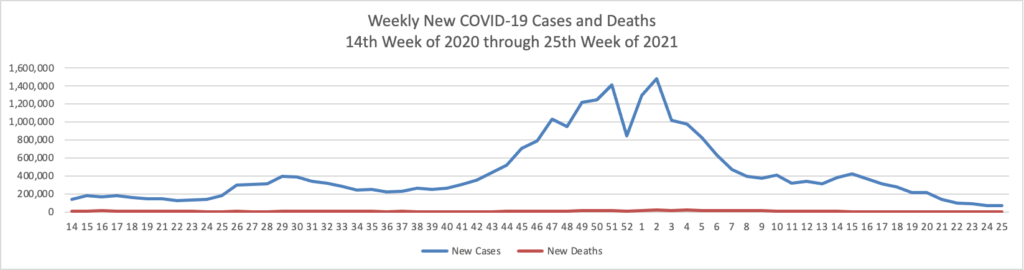
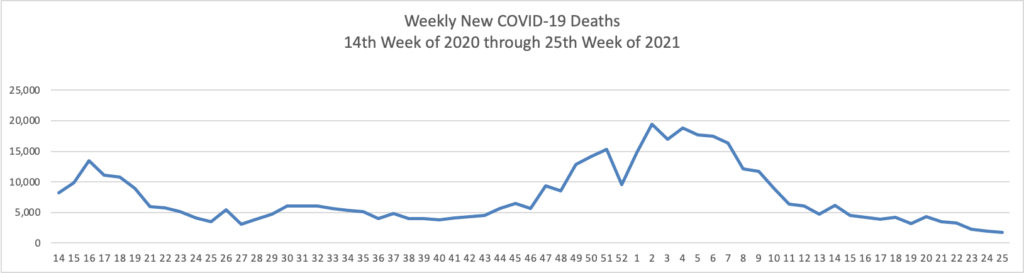
According to the CDC’s COVID-19 cases in the U.S. website, which the FEHBlog tracks, over the past four weeks the numbers of new cases had taken a downward path until this week. New deaths have seen consistent weekly reductions.

Week Ending5/225/296/56/12
New Cases155,596148,210142,829153,371
New Deaths8,1607,5616,5635,850

The Wall Street Journal report discussed in yesterday’s FEHBlog post suggested that we would see an uptick in new cases this week. Today, the Centers for Disease Control released COVID-19 considerations for events and gatherings as we emerge from the great hunkering down.

Today, the Department of Health and Human Services announced its revised final rule on Section 1557 of the Affordable Care Act which concerns individual non-discrimination. Here’s a link to the Department’s fact sheet. The 2016 final rule imposed extensive and expensive non-discrimination notice requirements on insured FEHB plans. The revised final rule scales down those requirements dramatically. What’s more the preamble to the revised final rule (p. 53) states

The Department continues to take the position that FEHB plans are not covered under this rule. Even if FEHB plans were considered “contracts of insurance,” as suggested by some commenters, they still would not fall under the scope of this rule because the contract would be with the Office of Personnel Management (OPM),which operates the FEHB Program, not with the Department. As noted above, this final rule does not extend the Department’s enforcement authority to a covered entity that is not principally engaged in the business of providing healthcare to the extent of its operations that do not receive financial assistance from the Department. The Department agrees that this final rule will accomplish the Department’s goal of reducing regulatory burden.

Being excepted from the HHS Section 1557 enforcement rule does mean that insured FEHB plans would not be subject to an HHS non-discrimination notice requirements. That status does not necessarily lead to the conclusion that FEHB plans are exempt from the statute. In any event, the revised final rule takes effect 60 days from publication in the Federal Register and you can expect federal court litigation over the revised final rule which likely would be reversed if we get a new President in 2021.

In other news —

  • Healthcare Dive reports on a recent study concluding that the air ambulance billing process is dysfunctional and produces big surprise bills. The article suggests that a federal surprise billing law is not in the offing but no one expect the counter productive ACA taxes to be repealed last year. Keep the faith.
  • Govexec.com reports on a GAO study finding that 60% of new hires left federal employment within only two years following hire during the years 2011-2017. Holy guacamole.
  • The Wall Street Journal reports that U.S. blood banks are “critically low.” “Covid-19 shutdowns have emptied community centers, universities, places of worship and other venues where blood drives typically occur.” Here’s a link to the American Red Cross blood donation site. This is a site worth promoting.

Thursday Miscellany

Regrettably, the Wall Street Journal reported today a spike in COVID-19 cases in States, like Texas, Utah, Arizona, and Arkansas, that were not hard hit early on in the COVID-19 emergency.

Experts analyzing states with worrisome trends in serious cases are largely pointing to the onset of summer, when people began to congregate in resort spots. [FEHBlog note: Super-speader events are risky.]

Some also suspect that officials who allowed businesses to reopen after a relatively calm few weeks might have sent an inadvertent message that the problem had largely passed.

As if responding to the suspicious “some,” the Centers for Disease Control has released a social media toolkit to spread COVID-19 related advice on Facebook, Instagram, Twitter etc.

It’s worth noting that the Wall Street Journal editorial page’s observation that “More infections are inevitable as states reopen, and there will be much trial and error. States need to be vigilant for outbreaks and protect high-risk areas and the vulnerable. But the costs of shutting down the economy are so great, in damage to lives and livelihoods, that there is no alternative to opening for the broader public good.”

In other news —

A new study published in the Journal of the American Medical Association found that one-fifth of patients who read ambulatory care notes reported finding a mistake in those notes, and 40% of those regarded the error as serious.

“Among patient-reported very serious errors, the most common characterizations were mistakes in diagnoses, medical history, medications, physical examination, test results, notes on the wrong patient, and sidedness,” the study authors explained.

That’s worrisome for patient healthcare as well as for other doctors and health plans who rely on these reports.

  • Health Payer Intelligence offers a thought provoking article on four data points that illustrate mental health parity. The rub is that “Mental and behavioral healthcare parity is about more than just equal reimbursement with similar medical and surgical services. It includes ensuring access to care by having enough providers in-network and making sure that the right types of specialists are available for members.”

Monday Roundup

Let’s begin with a story that surprised as well as interested the FEHBlog. The Society for Human Resource Management reports that the U.S. Occupational Health and Safety Administration is requiring health plans, insurers, and other low hazard employers to report to OSHA “work-related coronavirus illnesses that result in a fatality or an employee’s in-patient hospitalization, an amputation or the loss of an eye.” Other employers have broader recording and reporting obligations.

A friend of the FEHBlog called to his attention this Newsweek interview with Dr. Anthony Fauci about whether we may encounter a second wave of COVID-19. While Dr. Fauci expects COVID-19 infections to continue at least through 2020, Dr. “Fauci says whether or not these ongoing new cases will become a wave will depend on whether ‘we prepare ourselves from now through June, July, August and September. We have four months to make sure we have in place the system, the test, the capability, the manpower to do the kind of identification, isolation and contact tracing as cases begin to reappear in the fall, because they will reappear.'”

STATNews also also features an interview with Dr. Fauci which focuses on vaccine development.

Today, prescription drug manufacturer Eli Lilly announced

[hospital] patients have been dosed in the world’s first study of a potential antibody treatment designed to fight COVID-19.

This investigational medicine, referred to as LY-CoV555, is the first to emerge from the collaboration between Lilly and AbCellera to create antibody therapies for the prevention and treatment of COVID-19. Lilly scientists rapidly developed the antibody in just three months after AbCellera and the Vaccine Research Center at the National Institute of Allergy and Infectious Diseases (NIAID) identified it from a blood sample taken from one of the first U.S. patients who recovered from COVID-19. LY-CoV555 is the first potential new medicine specifically designed to attack SARS-CoV-2, the virus that causes COVID-19.

The FEHBlog heard a discussion of the investigational new drug on television this morning. The Eli Lilly representative explained that this drug focuses on one antibody while convalescent plasma relies on an array of antibodies. The investigation. The Wall Street Journal explains that

Researchers at AbCellera Biologics Inc., a Canadian company that partnered with Lilly in March, and the U.S. National Institute of Allergy and Infectious Diseases identified an antibody with virus-fighting potential in a blood sample taken from one of the first U.S. patients who recovered from Covid-19.

Lilly’s scientists then essentially cloned the antibody to make the new therapy [which is administered intravenously]. Its goal is to block the virus from attaching to and entering human cells, thus neutralizing it.

This first random study uses hospitalized patients and if successful the next random study will use non-hospitalized patients. “Lilly said it is starting large-scale manufacturing of the therapy, so that if studies prove successful, it will have several hundred thousand doses available by the end of the year.” Let’s go.

Weekend update

The House of Representatives and the Senate both will be in session on Capitol Hill this coming week, Of note from an FEHBP perspective is that Senate Homeland Security and Governmental Affairs Committee has scheduled a confirmation hearing for the President’s nominee for OPM Inspection General, Craig E. Leen, for Tuesday June 2 at 2:30 pm. Mr. Leen currently is Director of the Office of Federal Contract Compliance Programs (OFCCP) at the U.S. Department of Labor. The FEHBlog plans to tune in.

The Supreme Court heads into the home stretch of its October 2019 term tomorrow. The Court has 25 decisions left to issue before adjourning for the summer according to the Scotusblog.

OPM released more COVID-19 guidance last Friday. This guidance concerns preparedness for returning to OPM facilities.

Fierce Healthcare brings us up to date on COVID-19 testing at home options. The latest product receiving FDA approval is offered by Quest Diagnostics a/k/a Quest Labs.

The FEHBlog ran across on Twitter today this May 24 column from Reason senior editor Jacob Sillum.

According to the Centers for Disease Control and Prevention (CDC), the current “best estimate” for the fatality rate among Americans with COVID-19 symptoms is 0.4 percent. The CDC also estimates that 35 percent of people infected by the COVID-19 virus never develop symptoms. Those numbers imply that the virus kills less than 0.3 percent of people infected by it.

The FEHBlog also found this reassuring (at least to the FEHBlog) Science News article on COVID-19 mutations.

[C]oronavirus mutations are guaranteed to pop up over the coming months — and experts will continue to track them. “The data will tell us whether we need to worry, and in what way we need to worry,” [Louise] Moncla[, an evolutionary epidemiologist at the Fred Hutchinson Cancer Research Center in Seattle] says. “Everyone should take a deep breath and realize that this is exactly what we’ve always expected to happen, and we don’t necessarily need to be concerned.”

Thursday Miscellany

Earlier this month, the National Center for Health Statistics released a report on 2019 births in our country. Here are some notable snippets from that report:

  • The provisional number of births for the United States in 2019 was 3,745,540, down 1% from the number in 2018 (3,791,712). This is the fifth year that the number of births has declined after the increase in 2014, down an average of 1% per year, and the lowest number of births since 1985.
  • The birth rate for teenagers in 2019 was 16.6 births per 1,000 females aged 15–19, down 5% from 2018 (17.4), reaching another record low for this age group. The rate has declined by 60% since 2007 (41.5), the most recent period of continued decline, and 73% since 1991, the most recent peak.
  • The low-risk cesarean delivery rate, or cesarean delivery among nulliparous (first birth), term (37 or more completed weeks based on the obstetric estimate), singleton (one fetus), vertex (head-first) births, also decreased to 25.6% of births in 2019 from 25.9% in 2018.
  • The percentage of infants born preterm (births at less than 37 completed weeks of gestation) fell 8% from 2007 (the most recent year for which national data are available based on the obstetric estimate of gestation) to 2014, but has risen 7% from 2014 (9.57%) to 2019.

Healthcare Dive reports that

The number of Medicare beneficiaries using telehealth skyrocketed in the early weeks of the pandemic as the Trump administration relaxed regulations to virtual care.

The looser regulations are only in place for the extent of the national public health emergency, but myriad groups have called on HHS to permanently relax the barriers. Top administration health officials have said they’re exploring the possibility.

Here’s hoping.

Health IT Security informs us about Verizon’s latest data breach investigations report.

For healthcare, there were 798 security incidents and 521 confirmed data breaches in 2019, compared to 304 incidents in the previous year. While miscellaneous insider errors, privilege misuse, and web applications were the leading causes 2018 healthcare data breaches, external threats outpaced insiders in this year’s report.

In fact, 51 percent of healthcare data breaches were caused by external actors, and insider-related breaches fell to 48 percent. Despite the slight increase in external-related breaches, healthcare does remain the leading industry for internal bad actors.

It’s not always a good thing to be in first place.

Let’s wrap it up with a story about responsible corporate citizenship. Becker’s Hospital CFO Report informs us that

CMS automatically sent out the first slice of federal funding under the Coronavirus Aid, Relief and Economic Security Act based on historical Medicare fee-for-service reimbursement. Now, several companies are returning the relief aid.

[Healthcare companies] Cigna, CVS Health, DaVita, Encompass and Walmart are among the companies sending back federal grants they received under the CARES Act, which are meant to reimburse healthcare providers for expenses or lost revenues tied to the COVID-19 pandemic, according to Business Insider. The companies are returning a total of nearly $574 million.

The common reason for returning these large amounts of money was aptly stated by CVS Health:

“We have made the decision to return the funds and forgo participation in subsequent disbursements,” CVS Health President and CEO Larry Merlo wrote in a May 19 letter to HHS Secretary Alex Azar. “In doing so, we hope to help HHS provide additional support to other providers who are facing significant financial challenges as a result of the pandemic.”

Bravo.

Tuesday Tidbits

The Senate Health Education Labor and Pensions Committee held a COVID-19 hearing today featuring a number of federal government healthcare luminaries including Dr. Fauci. Here is a link to the hearing and the submitted testimony. The Wall Street Journal reports

Dr. Fauci said that with some states reopening before seeing a steady decline in cases and deaths, “there is a real risk you could trigger an outbreak…that could set you back rather than going forward.”

Adm. Brett Giroir, who is heading up the administration’s testing efforts, said an increased focus on testing in schools could be used as a means of surveillance to help ensuree students stay healthy.

Other health officials also emphasized the need for widespread testing to get a more accurate picture of how many people have fallen sick and to spot potentially undetected clusters of cases.

Here’s a link to the COVID Tracking Project site which provides a ton of state by state COVID-19 data, including testing data. As previously noted, GoodRx offers a complete, growing list of drive up COVID-19 test sites. Last week, one of the big U.S. lab test companies, LabCorp, began to offer “expanded access to COVID-19 antibody test through LabCorp’s wide network of doctors, healthcare providers, and online. Individuals have the ability to receive the COVID-19 IgG antibody test from their doctor, in person or through a telemedicine program, and now directly using www.LabCorp.com/antibody-testing.

A friend of the FEHBlog pointed out this National Institutes of Health website which is chock-a-block full of COVID-19 research tidbits. For example, the FEHBlog noticed a NIH study finding “nearly everyone who recovers from COVID-19 makes coronavirus antibodies.” Check it out.

The Hill brings us to date on the four leading U.S. and European COVID-19 vaccine development efforts. “There are more than 100 potential vaccine candidates, according to the World Health Organization, but only eight have entered the crucial clinical trials stage. Four are in the United States and Europe, with the rest in China.”

Healthcare Dive reports that the American Hospital Association flipped out over new price transparency rules in the fiscal year 2021 Medicare Part A hospital PPS changes proposed rule released yesterday.