Tuesday Tidbits

Tuesday Tidbits

Photo by Patrick Fore on Unsplash

Happy Mardi Gras!

As the FEHBlog has noted, the FEHB Program has unique demographics compared to other employer sponsored health plans because the federal government offers generous FEHB annuitant coverage to its employees. FEHB enrollment is roughly 52% active employees and 48% annuitants. The average age of federal and postal employees is late forties and the FEHBlog understands that average age of an FEHB enrollee is sixty. (OPM offers detailed demographic statistics on its workforce but not on its retirement system members. No complaints, just stating a fact.)

Today HHS’s Agency of Healthcare Research and Quality issued a fascinating report titled “Concentration of Healthcare Expenditures and Selected Characteristics of High Spenders, U.S. Civilian Noninstitutionalized Population, 2018.” Here are the report’s highlights:

  • In 2018, the top 1 percent of persons ranked by their healthcare expenditures accounted for about 21 percent of total healthcare expenditures, while the bottom 50 percent accounted for only about 3 percent.
  • Persons ages 65 and older and whites were disproportionately represented in the top spending tiers.
  • Inpatient hospital care accounted for 36 percent of spending for persons in the top 5 percent of the spending distribution.
  • About three-quarters of aggregate expenses for persons in the top 5 percent of spenders were paid for by private insurance or Medicare.

In 2018, the top 1 percent of persons ranked by their healthcare expenditures accounted for 21 percent of total healthcare expenditures (100 minus 79 percent; figure 1), with an annual mean expenditure of $127,284 (figure 2). The group within the top 1 percent is defined as persons who spent $72,212 or more during the year. Cut points for additional percentile groups are shown in table 1 [immediately below]. The top 5 percent of the population accounted for 48.3 percent of total expenditures (100 minus 51.7 percent), with an annual mean expenditure of $58,609. The bottom 50 percent accounted for only 3.2 percent of total healthcare expenditures. Every person in this group spent less than $1,317 during the year (table 1), with an average annual expenditure of $384 (figure 2).

Percentile of population2018 Expenditure
Top 1%$72,212 or more
Top 5%$26,355 or more
Top 10%$14,651 or more
Top 30%$3,776 or more
Bottom 50% Less than $1,317

But given the FEHB’s demographics, this figure particularly caught the FEHBlog’s eye:

Figure 4: Percentage of persons by age group and percentile of spending, 2018

Age groupOverall percentageBottom 50%Top 50%Top 10%Top 5%
0–1722.630.614.56.45.8
18–4435.243.227.320.818.9
45–6425.420.130.733.436.3
65+16.86.027.539.439.0

It is a credit to OPM and the FEHB carriers that they are able to hold premiums rather stable.

On the COVID-19 vaccination front —

  • NPR updates us with encouraging COVID-19 vaccination distribution statistics.
  • Federal News Network tells us that “The Biden administration’s Safer Federal Workforce Task Force has new details on how agencies should handle [COVID-19 vaccination] leave, labor unions and mask mandates during the ongoing pandemic.”
  • The Centers for Disease Control now offers guidance on how to arrange COVID-19 vaccinations for home-bound individuals.

Healthcare Dive reports on CVS Health’s fourth quarter 2020 earnings report. The headline is that CVS Health’s payer arm Aetna plans to return to the Affordable Care Act marketplace for 2022.

CVS’ fourth quarter revenue of $69.6 billion, up 4% year over year, was mostly due to growth in the benefits segment. Healthcare benefits reported quarterly revenue of $19.1 billion, up 11% year over year, driven primarily by membership growth in Medicaid and Medicare products and partially offset by a drop in commercial membership and COVID-19 costs.

As of the end of 2020, CVS covered 23.4 million lives. Despite fluctuating membership and utilization due to COVID-19 over the course of last year, overall utilization in the fourth quarter was generally back to normal, executives said. The company’s medical loss ratio, a marker of how much it’s reinvesting in patient care, was 86.7% in the quarter, compared to 85.7% same time last year.

JDSupra includes this employment law article titled “Employees Starting to Receive the COVID-19 Vaccine – Now What?” which is worth a gander in the FEHBlog’s opinion.

Friday Stats and More

Image result for abraham lincoln birthday

Happy Lincoln’s Birthday.

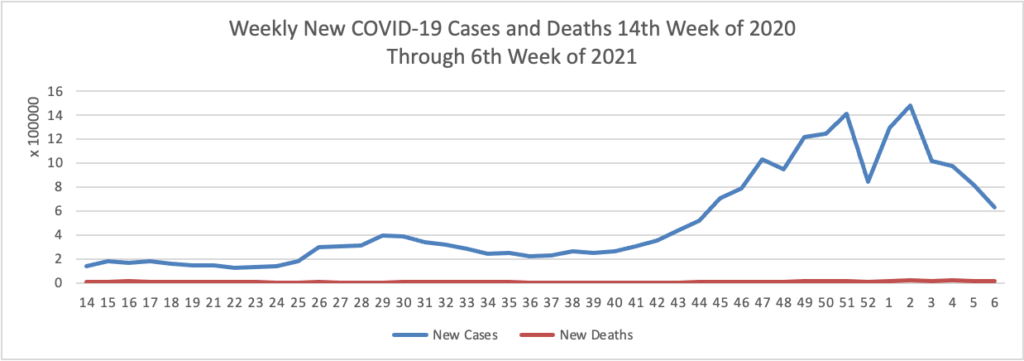
Based on the Centers for Disease Control’s COVID-19 Case Tracker website, here is the FEHBlog’s chart of new weekly COVID-19 cases and deaths over the 14th week of 2020 through the 6th week of this year (beginning April 2, 2021, and ending February 10, 2021; using Thursday as the first day of the week in order to facilitate this weekly update):

and here is the CDC’s latest overall weekly hospitalization rate chart for COVID-19:

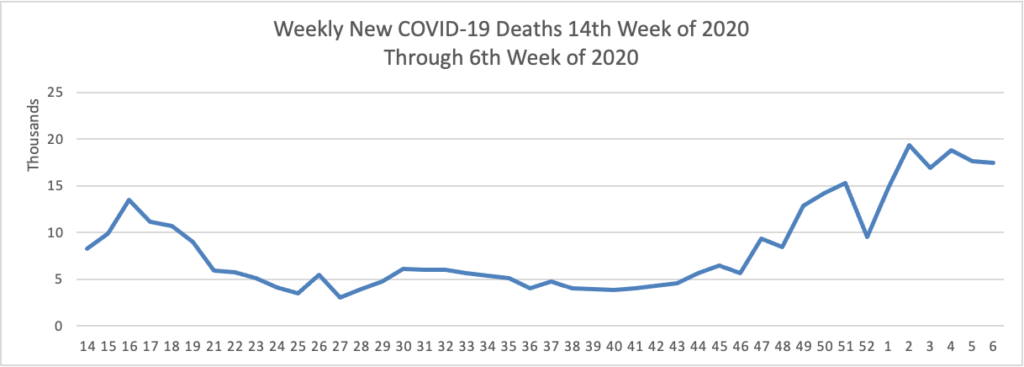
The FEHBlog has noticed that the new cases and deaths chart shows a flat line for new weekly deaths because new cases greatly exceed new deaths. Accordingly here is a chart of new weekly COVID-19 deaths over the period April 2, 2020, through February 10, 2021):

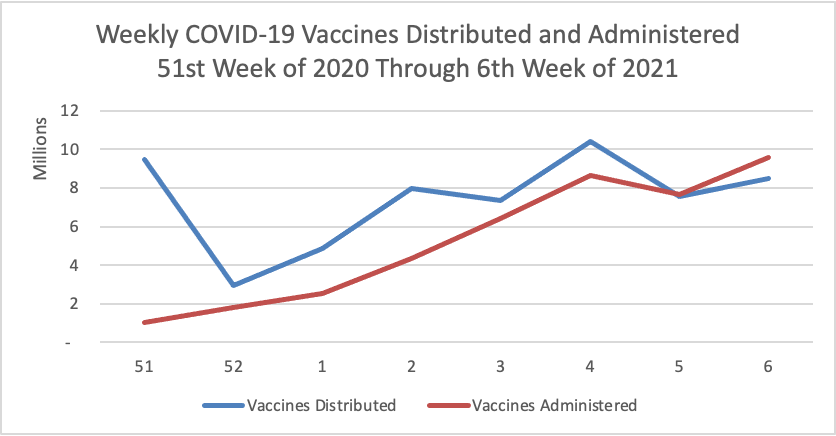
Finally here is a COVID-19 vaccinations chart from December 17, 2020, through February 10, 2021, which also uses Thursday as the first day of the week:

The Wall Street Journal sums it up well for this week :

U.S. Covid-19 deaths [a lagging indicator] appear to finally be slowing, following a broad and steep decline in both newly reported cases and hospitalizations in recent weeks.

While daily deaths remain near record highs, the average number of coronavirus-related fatalities has broadly fallen in recent days, dropping from a seven-day average of 3,172 on Feb. 1 to 2,765 on Wednesday, according to a Wall Street Journal analysis of Johns Hopkins University data.

Vaccinations, meanwhile, appear to be increasing, with about two million shots administered Thursday, according to a Wall Street Journal analysis of data from the Centers for Disease Control and Prevention.

In other vaccination news —

  • Medpage Today informs us about CDC changes to its adult and children vaccination recommendations which were released yesterday.
  • HR Dive reports that

The Society for Human Resource Management and 41 other business groups including the U.S. Chamber of Commerce have asked the U.S. Equal Employment Opportunity Commission (EEOC) to clarify “the extent to which employers may offer employees incentives to vaccinate.”

In a Feb. 1 letter to EEOC Chair Charlotte Burrows HR Dive obtained from the HR Policy Association, a signee, the groups wrote that incentives may aid in coronavirus vaccine distribution. But many employers are concerned about the liability they could create in offering such incentives, the letter said.

The signees asked EEOC to clarify how they might offer vaccination incentives without infringing upon the boundaries established by the Americans with Disabilities Act and other laws enforced by the agency. Specifically, the groups requested that the agency issue guidance that defines “what qualifies as a permissible incentive as broadly as possible.” An EEOC spokesperson said the agency appreciates “input from all stakeholders and will review the letter carefully.”

From the seeking public comment front —

  • The National Committee for Quality Assurance is seeking “feedback on proposed new measures, changes to existing measures and proposed measures for retirement. Public comment is now open for HEDIS® Measurement Year 2022.” The public comment deadline is March 11, 2021.
  • HHS’s Agency for Healthcare Research and Quality “encourage [interested parties] to review the draft report [titled “Strategies to Improve Patient Safety: Draft Report to Congress for Public Comment and Review by the National Academy of Medicine”] and send comments to PSQIA.RC@ahrq.hhs.gov no later than Feb. 16. We’ll review feedback in developing a final report for Congress later this year.” That’s not much time as the notice was posted today.

Midweek Update

FYI this is the 3,001st FEHBlog column since 2006. My how time does fly.

The Wall Street Journal reports tonight that

Democratic leaders signaled Wednesday they were prepared to reduce their demands for the next round of coronavirus relief, fueling hopes that an agreement could be reached with Republicans by year’s end to boost struggling businesses and households.

Congressional leaders have been mired in disagreements for months. In a sign that the partisan standoff was easing, however, House Speaker Nancy Pelosi (D., Calif.) and Senate Minority Leader Chuck Schumer (D., N.Y.) said that a new, bipartisan $908 billion relief proposal released Tuesday should serve as the starting point for talks with GOP leaders and the White House. 

If a compromise is reached, those COVID-19 relief provisions would be included in the omnibus spending bill for the current federal fiscal year which must pass before December 12. The only alternative would be to pass a short term funding bill in order to punt the COVID-19 relief provisions into the next Congress which begins on January 3, 2021.

The Journal explains that “Few lawmakers want to linger in the Capitol beyond what is necessary. House Majority Leader Steny Hoyer (D., Md.) said Wednesday that congressional leaders hoped to finish up by the end of next week to give lawmakers time to quarantine before Christmas.” How 2020 is that?

The Centers for Disease Control released updated guidance today on COVID-19 quarantine periods (approaches to reducing the quarantine period for 14 to 10 days) and domestic holiday travel (don’t do it).

A friend of the FEHBlog shared this interesting Health and Human Services infographic on COVID-19 testing in our country.

This friend also pointed out this news about

A free online course developed by the Johns Hopkins Bloomberg School of Public Health on the basics of contact tracing has enrolled more than one million people over the past six months, teaching hundreds of thousands of individuals around the world how to deploy an epidemiological tool considered critical to slowing the spread of COVID-19.

The six-hour course, COVID-19 Contact Tracing, is hosted by Coursera and is open to anyone. Since its launch in May, it has attracted participants from every U.S. state and territory as well as more than 150 countries around the world. To date, more than 520,000 people have completed the course.

Pretty cool effort.

The Agency for Healthcare Quality and Research informs us about its partnership with Google to develop

a new online tool to help patients plan for medical visits. The new Google visit planning tool is built on the same evidence behind AHRQ’s QuestionBuilder app. It makes it easy for patients and those who care for them to privately list and prioritize their questions in preparation for a medical visit. When people use Google to search for a healthcare provider, they will have the option to create their own private visit plan.

Asking the right questions—and making sure you understand the answers—has always been at the heart of AHRQ’s “Questions Are the Answer” public education initiative. Launched in 2007 through a series of public service announcements with the Ad Council, the Questions Are the Answer message highlights the vital role patients and families play as part of their healthcare team.

That’s a helpful tidbit for health plans to share with their members.

Tuesday Tidbits

Photo by Patrick Fore on Unsplash

The FEHBlog spent two hours this morning listening to the oral argument in the latest Affordable Care Act (“ACA”) constitutionality case to reach the U.S. Supreme Court, California v. Texas (No. 19-840). This activity resulted in the FEHBlog learning a new word hortatory and receiving confirmation that his hunch is correct, to wit, There is no chance that the Supreme Court will disrupt the ACA status quo as a result of this case. Indeed the Supreme Court clearly took the case to preserve, not disrupt, the status quo. If you are interested, Amy Howe from the SCOTUSblog has written a legal analysis of the oral argument.

Following up on yesterday’s good news about Pfizer’s COVID-19 vaccine, the Wall Street Journal informs us that

In Kalamazoo, Mich., Pfizer has turned a stretch of land the size of a football field into a staging ground outfitted with 350 large freezers, ready to take delivery of millions of doses of Covid-19 vaccine before they can be shipped around the world.

To make sure its Covid-19 vaccine doses arrive at hospitals and clinics frozen and potent, Pfizer created its own container to ship them.
The temperature-controlled container can store between 1,000 and 5,000 doses for 10 days at minus 70 degrees Celsius before requiring re-icing.

From that site, and another in Puurs, Belgium, the pharmaceutical giant said it wants to deliver up to 100 million doses this year and another 1.3 billion in 2021.

One person needs two doses of the vaccine in order to be protected, again assuming that the phase III study of the vaccine remains on its currently successful course.

The Journal further reports that

U.S. health officials on Monday authorized use of the first treatment for people with earlier-stage Covid-19 who aren’t hospitalized, filling a gap in treatment.

The U.S. Food and Drug Administration said Eli Lilly LLY 2.97% & Co.’s antibody drug should be used for patients ages 12 and up with mild to moderate Covid-19, based on a study showing it helped improve symptoms and kept many patients out of the hospital.

The drug is named bamlanivimab [and it is infused into the patient]. Lilly said it will begin shipping the drug immediately to AmerisourceBergen Corp. ABC 3.59% , a national drug distributor, to distribute it as directed by a federal allocation program [which is described in this HHS announcement issued today].

The Journal also discusses ongoing U.S. problems with COVID-19 testing

The U.S. is running more Covid-19 tests each day than at any other point during the pandemic, but the increased testing doesn’t fully explain recent case surges across the nation, data show. Altogether, testing data suggest Covid-19 diagnostic tests are still severely underused in the U.S. And inconsistencies in data collection and reporting systems are hampering efforts to understand and contain the virus’s spread as the holidays approach, public health and testing executives say.

Because the FEHBP covers a large cadre of senior citizens, it is worth pointing out this AHRQ funded report finding that

Healthcare costs for seniors who needed emergency services after a fall averaged $26,143 in the year following the event, according to an AHRQ-funded study published in The Journal of the American Geriatrics Society. Those costs significantly exceeded the average $8,642 in healthcare costs in the year prior to the event

In civil service news,

Federal employees would not receive an across-the-board increase in pay next year under provisions outlined in a series of fiscal year 2021 funding bills released by the Senate Appropriations Committee Nov. 10. Unlike FY2021 funding passed in the House earlier this year — which simply did not include any provision addressing federal pay — the Senate bill actively sets 2021 pay levels at the same rate as 2020. That difference would override any planned pay increase out of the White House, which was set at 1 percent in President Donald Trump’s February budget proposal.

The Senate is pushing through these measures in order to create a baseline for negotiating an omnibus continuing resolution with the House, which has completed its appropriations bills work, before the current continuing resolution expires on December 11.

  • Federal News Network reports on the Biden Administration’s transition team. Of note,

Kiran Ahuja, a former chief of staff at the agency, will lead the OPM team. Ahuja served at OPM during the aftermath of the agency’s cybersecurity breaches. Prior to her OPM service, she led the Obama administration’s White House Initiative on Asian Americans and Pacific Islanders. Today, she’s the CEO of Philanthropy Northwest, a non-profit organization. The rest of the team is filled with OPM alums who served at the agency as senior advisors during the Obama administration.

Weekend update

Lincoln Memorial in the Fall

The House of Representatives is on the campaign trail. The Senate will join them tomorrow after a confirmation vote on Judge Amy Coney Barrett’s nomination to the Supreme Court. Her nomination narrowly cleared a cloture vote at the Senate today. If you want to understand why the Supreme Court will not strike down the Affordable Care Act this term even with Judge Barrett on its illustrious bench, click here.

There is only one Congressional hearing this week — a Senate Commerce Committee hearing on Wednesday morning, October 28, about the federal internet liability shield. The witnesses will be the CEOs from Twitter, Alphabet/Google, and Facebook, large companies that currently benefit from this shield. Congress returns to its legislative business on November 16 following the Presidential and Congressional election on November 3.

Today, the Department of Health and Human Services shared news on how States and the District of Columbia will use the rapid COVID-19 BinaxNOW tests that the federal government purchased on their behalves. “HHS also provided all CLIA-certified nursing homes over 11 million rapid, point-of-care tests. The tests include the following FDA-authorized antigen diagnostic tests: Abbott BinaxNOW and either a Quidel Sofia 2 or Becton, Dickinson and Company (BD) Veritor™ Plus System instrument(s).”

The Washington Post’s Lily website offers an interview with a 14 year young lady, Anika Chebrolu, who was awarded a $25,000 prize “for her discovery: a compound that can bind to the coronavirus [COVID-19-, inhibiting its ability to infect people. She beat out nine other finalists — whose own projects ranged from a robotic glove to a device that detects invisible particles in water — to be named America’s top young scientist.” Ms. Chebrolu modestly explains that “my effort to find a spike protein binder isn’t unique in its methodology, and it may appear to be a drop in the ocean, but it adds to all these efforts and therefore is quite substantial.” Congratulations.

It’s also worth pointing out this Healthcare Dive article informing us that

Medical device funding hit a new high in the third quarter, growing 63% year on year to top $5 billion for the first time in CB Insights’ dataset. Investments in robotic surgery startups was a major driver of the increase. The analysts listed the progress of neuromodulation devices and Medtronic’s deals in diabetes and neurosurgery as other medical device highlights of the quarter.

The Mayo Clinic explains that “Robotic surgery, or robot-assisted surgery, allows doctors to perform many types of complex procedures with more precision, flexibility and control than is possible with conventional techniques. Robotic surgery is usually associated with minimally invasive surgery — procedures performed through tiny incisions.”

The International Modulation Society further explains that

Neuromodulation is technology that acts directly upon nerves. It is the alteration—or modulation—of nerve activity by delivering electrical or pharmaceutical agents directly to a target area.

Neuromodulation devices and treatments are life changing. They affect every area of the body and treat nearly every disease or symptom from headaches to tremors to spinal cord damage to urinary incontinence. With such a broad therapeutic scope, and significant ongoing improvements in biotechnology, it is not surprising that neuromodulation is poised as a major growth industry for the next decade.

Most frequently, people think of neuromodulation in the context of chronic pain relief, the most common indication. However, there are a plethora of neuromodulation applications, such as deep brain stimulation (DBS) treatment for Parkinson’s disease, sacral nerve stimulation for pelvic disorders and incontinence, and spinal cord stimulation for ischemic disorders (angina, peripheral vascular disease).

Cochlear implants to treat deafness, for example, are intermodulation devices.

The FEHBlog noticed on Twitter today that the HHS Agency for Healthcare Quality and Research has made available in the Apple Store and Google Play an app to help patients to develop questions for the doctor visits.

On the healthcare survey and report front

The top 12 reasons for using telehealth, according to the 2020 survey, are listed below, with the 2019 ranking and percentages in parentheses:

  1. Convenience, 51 percent (1, 64 percent)
  2. Safety, 46 percent (12, 13 percent)
  3. Speed – ability to receive care quickly, 44 percent (2, 53 percent)
  4. Quality care, 30 percent (6, 25 percent)
  5. Condition covered by telehealth visit, 28 percent (7, 22 percent)
  6. Ease of access to health information, 27 percent (3, 34 percent)
  7. Convenient communication channels, 26 percent (4, 33 percent)
  8. Lower overall cost, 23 percent (5, 30 percent)
  9. Difficult to travel to medical office, 21 percent (7, 20 percent)
  10. Recommendation, 19 percent (7, 20 percent)
  11. Reputation, 19 percent (11, 14 percent)
  12. Past experience, 17 percent (9, 19 percent).
  • Health Payer Intelligence reports that

Around a third of Millennials [ages 24 – 39] have a behavioral health condition, emphasizing a greater need for behavioral healthcare options and coverage as well as a new approach to millennial member engagement, the latest Blue Cross Blue Shield Association (BCBSA) report revealed. * * * Not only do Millennials have a high percentage of behavioral health conditions but their rate of developing a behaioral health condition is rising by double digits. Over five years from 2014 through 2018, the prevalence of major depression rose by 43 percent, ADHD rose by 39 percentage percent, and psychotic disorders rose by 26 percent among Millennials.”

Tuesday Tidbits

The U.S. Office of Personnel Management released its first of four Benefit Administration letters for the upcoming Federal Benefits Open Season which which will run from Monday, November 9, 2020 through Monday, December 14, 2020. Here are links to the BAL, a sample email to employees and a Venn diagram displaying the interlocking aspects of the health, dental, vision, and flexible benefits programs that participate in this Open Season. The FEHBlog expects that COVID-19 public health emergency will tamp down the traditional Open Season health fairs. It will be an interesting experiment to see whether this change impacts the volume of plan changes one way or the other.

In anticipation of FDA approval of COVID-19 vaccine(s), an expert panel formed by the National Academies of Science has issued for public comment draft recommendations for staging an equitable distribution of the vaccines according to a STAT News report. A public hearing on the draft recommendations is scheduled for tomorrow. This report then goes to the Centers for Disease Control which has an Advisory Committee on Immunization Practices. The staging offered in the recommendations makes sense to the FEHBlog, e.g., first responders first etc.

The Wall Street Journal reports that Americans should add strong ventiliation to the Covid-19 prevention toolbox along with mask, social distancing, etc.

After urging steps like handwashing, masking and social distancing, researchers say proper ventilation indoors should join the list of necessary measures. Health scientists and mechanical engineers have started issuing recommendations to schools and businesses that wish to reopen for how often indoor air needs to be replaced, as well as guidelines for the fans, filters and other equipment needed to meet the goals.

There’s a recently renovated office building near the FEHBlog’s offices in downtown DC that has a big outside sign stating that its ventilation services are tops and known to be anti-COVID. The FEHBlog will retry to remember to post a picture of the sign later this week.

Becker’s Health IT discusses a Centers for Medicare and Medicaid Services proposed rule issued yesterday. “The Medicare Coverage of Innovative Technology proposed rule would speed up the FDA approval process for Medicare coverage of new medical technologies. * * * Often referred to as the “valley of death,” for innovative medical tech products, the lag time between the FDA’s approval and Medicare establishing coverage prevents seniors from accessing these new technologies during the coverage determination process.” Ouch.

Speaking of innovation, Econtalk podcast host and economist Russ Roberts speaks this week with author Matt Ridley about his fascinating book titled “How Innovation Works.” Check it out.

In other news

  • EHR Intelligence reports “Following vote in the House of Representatives to remove the bill prohibiting the use of federal funds for the adoption of a national patient identifier (NPI), the Premier Healthcare Alliance and the Patient ID Coalition call on the US Senate to also lift the ban.” Good luck.
  • FYI, here’s a link to Treasury Secretary’s Steven Mnuchin’s testimony before the COVID-19 subcommittee of the House Oversight and Reform Committee. The federal employee press does not suggest that fireworks exploded at the hearing.
  • The Department of Health and Human Services announced today that “The Federal Communications Commission (FCC), HHS, and U.S. Department of Agriculture (USDA) today announced that they have signed a Memorandum of Understanding to work together on the Rural Telehealth Initiative, a joint effort to collaborate and share information to address health disparities, resolve service provider challenges, and promote broadband services and technology to rural areas in America.” Perhaps another silver lining in the COVID-19 cloud.
  • And then another. The HHS Agency for Healthcare Research and Quality explains that

There is evidence that people who receive longer-term treatment with medications for addiction treatment (MAT) have better outcomes. But, keeping people with OUD on MAT is challenging. Now, the COVID-19 pandemic may be making retention of patients in MAT even more difficult.

Fortunately, we can report some good news that should help us fight the opioids epidemic even as we try to maintain safe distance. It appears that people with OUD will stay in treatment when given support remotely as they do in person—a major benefit that appears to be emerging during the COVID pandemic.

Tuesday Tidbits

The FEHBlog noted in the latest Weekend Update that the President had allowed pharmaceutical manufacturers until August 24 to present alternative to the President’s plan to tie American drug pricing to foreign benchmarks via executive order. As of August 22, the President was waiting for such a proposal. and according to STAT News today

The pharmaceutical industry is weighing two drug pricing policies that it could offer as a trade to President Trump, in exchange for his dropping a different proposal that drug makers detest, according to three drug industry lobbyists and a summary of the potential changes obtained by STAT.

In the meantime, the White House has not taken any action to implement this executive order.

On the COVID-19 front —

  • The Boston Globe reports that “An international meeting of Biogen leaders at a Boston hotel in February led to roughly 20,000 cases of COVID-19 in four Massachusetts counties by early May, far more than the 99 previously identified, according to three scientists involved in a new study.” Wow. That was a super spreader event for sure.
  • STAT News discusses “four scenarios on how we might develop immunity to Covid-19.” Interesting read.

Also other news from New England, Healthcare Dive informs us that

Google is investing $100 million in “Amwell, one of the biggest telehealth companies in the country, in a concurrent private placement with Amwell’s initial public offering, the two companies announced Monday. As part of the multiyear partnership, Amwell will become Google Cloud’s preferred telehealth platform and Amwell will migrate its video capabilities over to Google Cloud.”

Amwell is headquartered in Boston, Massachusetts.

Via AHRQ.gov, the FEHBlog ran across this recent study of “National Inpatient Hospital Costs: The Most Expensive Conditions by Payer, 2017.” Here are the highlights:

In 2017, aggregate hospital costs for 35.8 million hospital stays totaled $434.2 billion.

The five most expensive inpatient conditions were septicemia, osteoarthritis, liveborn (newborn) infants, acute myocardial infarction, and heart failure. The 20 most expensive conditions accounted for slightly less than half of aggregate hospital costs.

The share of aggregate inpatient hospital costs by primary expected payer was 66 percent for Medicare and Medicaid combined, 27 percent for private insurance, and 3 percent for self-pay/no charge stays.

Septicemia ranked among the three most costly conditions in the hospital for all four expected payer groups

Conditions related to pregnancy and childbirth accounted for 4 of the top 20 most expensive conditions expected to be paid by Medicaid.

Medicaid was the only expected payer for which 3 of the top 20 most expensive conditions were related to mental and substance use disorders.

Finally, yesterday, the U.S. Supreme Court allocated oral argument time in Texas v. California case (No. 19-840) which raises the constitutionality of the Affordable Care Act for the third time before the Court.

The motions of the Solicitor General for divided argument and of the U.S. House of Representatives for enlargement of time for oral argument and for divided argument are granted, and the time is allotted as follows: 30 minutes for California, et al., 10 minutes for the U.S. House of Representatives, 20 minutes for the Solicitor General, and 20 minutes for Texas, et al. The motion of Ohio and Montana for leave to participate in oral argument as amici curiae, for enlargement of time for oral argument, and for divided argument is denied.

Midweek Update

Yesterday, the Internal Revenue Service created in view of the COVID-19 emergency new flexibilities for flexible spending account (FSA) holders, health savings account (“HSA”holders and cafeteria plan members by

  • extending claims periods for taxpayers to apply unused amounts remaining in a health FSA or dependent care assistance program for expenses incurred for those same qualified benefits through December 31, 2020.
  • expanding the ability of taxpayers to make mid-year elections for health coverage, health FSAs, and dependent care assistance programs, allowing them to respond to changes in needs as a result of the COVID-19 pandemic.
  • applying earlier relief for high deductible health plans to cover expenses related to COVID-19, and a temporary exemption for telehealth services retroactively to The notice increases the limit for unused health FSA carryover amounts from $500, to a maximum of $550, as adjusted annually for inflation.January 1, 2020.

The IRS also increased “the limit for unused health FSA carryover amounts from $500, to a maximum of $550, as adjusted annually for inflation.”

The Board of Directors of America’s Health Insurance Plans issued a statement on “Safely Re-Opening America’s Health Care System and Resuming Needed Procedures and Treatments, Routine Care, and Preventive Services” in the wake of the COVID-19 emergency. The statement encourages continued use of telehealth and sensible applic ation / waivers of health plan prior authorization requirements.

HHS’s Agency for Healthcare Research and Quality has created its own COVID-19 resources webpage. Among other things the site “provides links to research funding opportunities, AHRQ Views blog posts about the Agency’s COVID-19 activities, and examples of new AHRQ-funded research findings.”

Benefits Pro reports that “A Social Security policy analyst for the advocacy group The Senior Citizens League is estimating the cost-of-living adjustment for 2021 will be zero based on consumer price index data through April and the continued impact of COVID-19 on the economy.” A zero COLA, which occurred in 2009, 2010, and 2015, will trigger the protection of Medicare Part B premium hold harmless clause for certain but not all federal annuitants.

Midweek update

On the COVID-19 front —

  • The Senate this afternoon approved H.R. 6021, the Families First Coronavirus Response bill. HR Dive explains the paid leave revisions that the House made to the bill first passed last Saturday before sending the bill to the Senate. Three attempts in the Senate to further amend the bill were rejected. The President has indicated that he will sign the bill.
  • H.R 6021 will mandate all types of health plans, including FEHB plans, cover FDA approved COVID-19 testing without cost sharing or medical management by the health plan. OPM already has required this for FEHB plans. However, the no cost sharing aspect of this coverage does not extend to treatment of the COVID-19 disease. A recent survey “of nearly 600 individual and family health insurance enrollees released today by eHealth, Inc. more than two thirds (69%) feel they lack a basic understanding of how testing and treatment of coronavirus (COVID-19) would be covered by their health insurance plan.” A word to the wise, etc.
  • Federal News Network reports “Federal agencies have 48 hours [until tomorrow] to review, modify and start implementing policies and procedures that will realign critical resources to slow the spread of the coronavirus. This includes offering “maximum telework flexibilities” for the federal workforce and may even include mandatory telework orders, the Office of Management and Budget said Tuesday night.”
  • The Wall Street Journal’s Journal podcast offers an interesting 20 minute long take on the race for a cure to the COVID-19 disease. One of the drugs discussed on the podcast is a Regeneron arthritis drug Kevazara that acts to calm the body’s immune system. Severe cases of COVID-19 cause lung inflammation. The FEHBlog read in the Great Influenza that the flu pandemic caused a spike in the death rate for healthy young adults. This flu struck deep in the lungs where the alveoli tissues transfer oxygen to the blood stream. The body’s immune system took great umbrage with this type of attack and threw everything at the disease. The body’s immune system attack often was the cause of death in young adults who have the strongest immune systems. The modern treatment is to try to calm the immune system and use a ventilator, options that didn’t exist in 1918.
  • Verily Health, the Google / Alphabet affiliate, issued an update on its development of a COVID-19 testing platform for patients. The Washington Post reports on COVID-19 testing sites in the DC metropolitan area.
  • Medicare has expanded the availability of telehealth for traditional Medicare beneficiaries during the COVID-19 emergency. HHS has issued guidance to health care providers on how to maintain HIPAA Privacy and Security rule compliance in the brave new world of telehealth.

In other news–

  • The Labor Department’s Employee Benefits Security Administration has released its latest report to Congress on improving health plan compliance with the federal mental health parity law and its report and an appendix on EBSA enforcement of that law in 2019.
  • Healthcare Dive reports that “The Trump administration is considering pushing back the timeline for payers, providers and health IT vendors to come into compliance with its two sweeping rules to promote interoperability as the healthcare system struggles with the novel coronavirus outbreak.” It would make sense to slow down the effort to ensure that it is done correctly, in the FEHBlog’s opinion.
  • AHRQ wisely points out the need to rethink the role of primary care in reducing hospital readmissions. Check it out.
  • Fierce Healthcare reports that

Aetna is linking Unite Us, a social care coordination platform, with its Guardian Angel program for members who have suffered an opioid overdose. The insurer, owned by CVS Health, will roll out the joint effort first in North Carolina, it announced this week. Using the Unite Us platform, care managers will be able to more effectively link members with social supports and other nonclinical options to aid in recovery, such as housing and healthy food.

Bravo.

TGIF

The President declared COVID-19 to be a national emergency this afternoon. The Wall Street Journal reports that the President announced that efforts are well underway to greatly expand COVID-19 testing, including drive thru testing. Furthermore,

A new, high-speed coronavirus test was earlier granted emergency clearance by the Food and Drug Administration. Developed by Roche Holding AG, the test is designed to run on the company’s automated machines, which are already installed in more than 100 laboratories across the U.S. It will be available immediately.

The FEHBlog understand that these high speed tests can turn around results in 24 hours, rather than a few days.

The FEHBlog compared the Centers for Disease Control’s COVID-19 U.S. case statistics from last Friday compared to today.

CDC COVID-19 stats
6-Mar13-Mar
Travel-related36138
Person-to-person spread18129
Under Investigation1101362
Total cases1641629

That’s quite a jump. CMS and Healthcare Dive also have offered their perspectives on the import of the emergency declaration.

In other news

  • Healthcare Dive reports on a Rand study on the value of out of network cost controls.
  • On this last day of AHRQ’s Patient Safety Week, the agency called public attention to its “Guide to Patient and Family Engagement in Hospital Quality and Safety.” The FEHBlog thinks its important for health plans to help families to support their hospitalized family members.

This Guide reminded me of a related human nature anecdote that I heard on the Econtalk blog which I can share

Russ Roberts: I was talking to this nurse about the challenges of doing a good job because it can be a very boring job, and then all of a sudden it’s unbelievably intense. And at one point he said to me–and at this point, my brother and sister, our mom had all been in the room for hours over a course of three or four days.

He said, he conceded, that–he said, ‘It really helps to have family here with the patient.’

And I thought he was going to say, you know, ‘Because it helps them sustain their morale.’

He said, ‘I think it makes us do a better job.’

And I thought, of course, of Adam Smith’s impartial spectator. It’s like we’re the actual spectator, watching him, and he said–this was a great thing–he said, ‘It shouldn’t be that way.’ And he’s right, of course. It should be that you’re equally motivated whether no one’s watching. But as human beings we sometimes fall short. He said, ‘It shouldn’t be that way, but sometimes it is.’

Russ Roberts is a University of Chicago trained economist who has written on Adam Smith.