FEHBlog

Weekend update

Photo by JOSHUA COLEMAN on Unsplash

Both Houses of Congress are engaged in committee and floor business this coming week. The Senate is focused on confirming the President’s cabinet nominations.

Politico reports

As Senate Majority Leader Chuck Schumer and Senate Minority Leader Mitch McConnell negotiate a power sharing agreement for a 50-50 Senate, committee assignments are still up in the air. That means that Republicans like [Sen. Ron] Johnson [R Wisc] are, for now, holding hearings and markups for President Joe Biden’s Cabinet nominees, even though Democrats are in charge of the Senate floor. 

Johnson, who will eventually hand over the top GOP slot to Sen. Rob Portman (R-Ohio), said that his committee will hold a meeting next week on Biden’s pick to lead the Department of Homeland Security, Alejandro Mayorkas. Mayorkas is facing resistance from Republicans and could be stuck in committee if he doesn’t receive enough GOP support.

The Hill reports that President Biden has released a topical daily schedule for the coming week which is full of new Executive Orders. January 28 will be Healthcare Day:

Biden on Thursday will take the highly anticipated action among pro-choice advocates of rescinding the so-called Mexico City policy, which bans the use of U.S. funding for foreign organizations that provide or promote abortions.

The policy, described as a “global gag rule” by reproductive health advocates, was first instated by then-President Reagan, and has been repeatedly rescinded by Democratic presidents and reinstated by Republican presidents in the years since.

Biden will also order a review of the Trump administration’s controversial changes to the Title X family planning program, which required family planning providers participating in the program to stop providing or promoting abortions to remain eligible for funding. 

The president is also slated to sign an executive order aimed at strengthening Medicaid and initiating an open enrollment period under the Affordable Care Act.

Fierce Healthcare reports that “Micky Tripathi, Ph.D., a recognized name in the health tech world, has been tapped as the new national coordinator for health IT under President Joe Biden’s administration. * * * Tripathi will replace the outgoing Don Rucker, M.D., who held the position since April 2017. The Office of the National Coordinator for Health Information Technology (ONC) provides counsel for the development and implementation of a national health information technology framework. * * * An expert on interoperability, privacy, and technology standards, Tripathi most recently served as chief strategy officer at Arcadia Analytics, a population health management solutions company. 

On the COVID-19 vaccination front:

  • The Wall Street Journal offers a very informative article with advice from doctors about what to expect when you have an appointment to receive the COVID-19 vaccine. This is understandably of the Journal’s top five articles.
  • America’s Health Insurance Plans has created a robust website about the COVID-19 vaccines.
  • According to the CDC’s Vaccinations data website, over 4.3 million doses of COVID-19 vaccines were administered in the U.S. on Friday and Saturday.

On the reports front —

Friday Stats and More

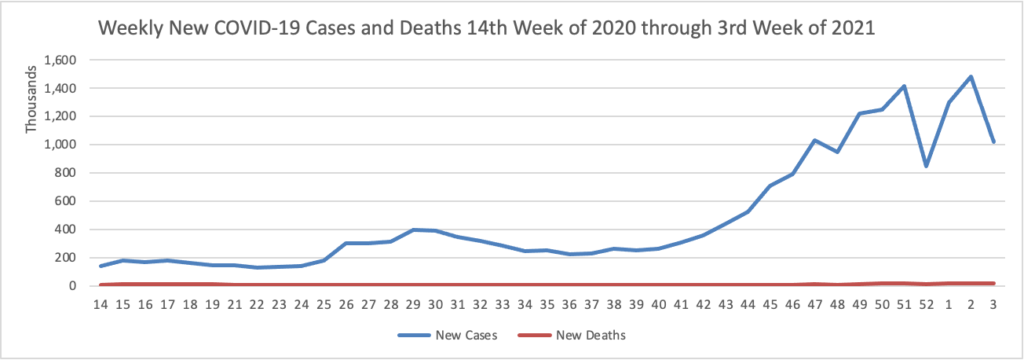
Based on the CDC’s Cases in the U.S. website, here is the FEHBlog’s chart of new weekly COVID-19 cases and deaths over the 14th week of 2020 through third week of this year (beginning April 2, 2020, and ending January 20, 2021; using Thursday as the first day of the week in order to facilitate this weekly update):

and here is the CDC’s latest overall weekly hospitalization rate chart for COVID-19:

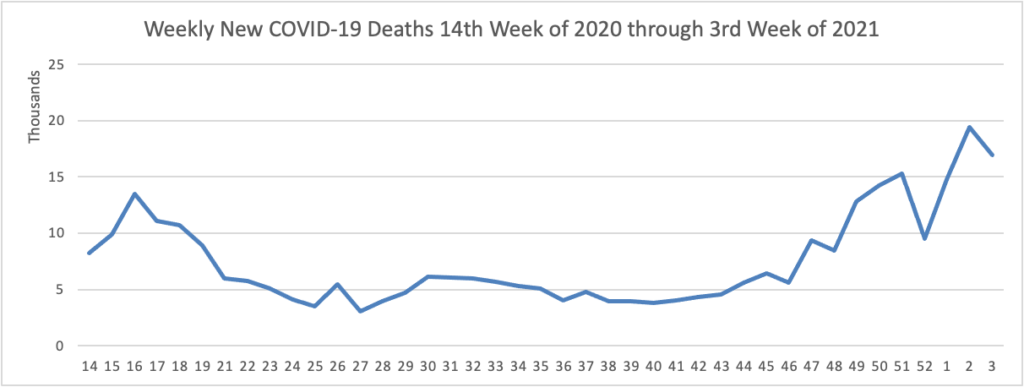
The FEHBlog has noted that the new cases and deaths chart shows a flat line for new weekly deaths  because new cases greatly exceed new deaths. Accordingly here is a chart of new COVID-19 deaths over the period (April 2, 2020, through January 20, 2021):

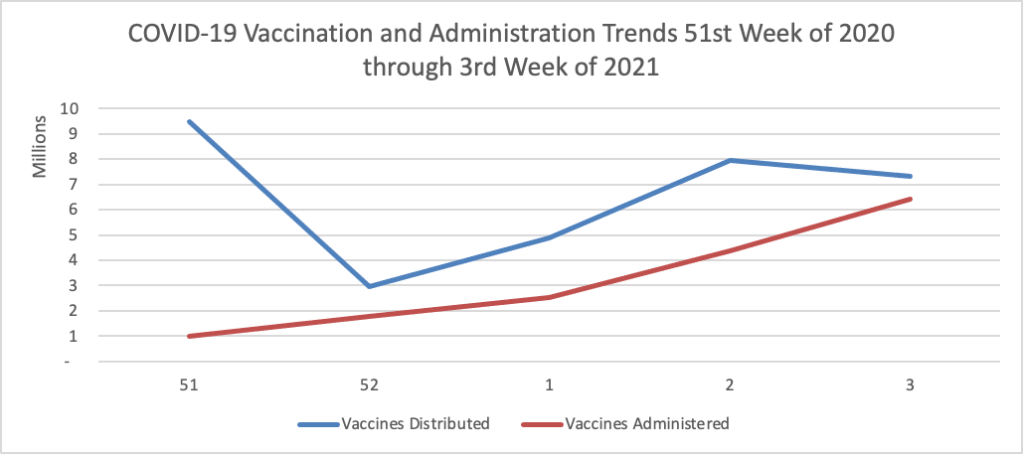
Finally here is a COVID-19 vaccinations chart for the past month which also uses Thursday as the first day of the week:

Here’s more from the COVID-19 vaccine front —

Bloomberg reports

As of Thursday, 940,000 shots a day were administered on average over a seven-day period, according to data from the Bloomberg Vaccine Tracker. The most recent two days topped a million doses.

Anthony Fauci, Biden’s chief medical adviser, said on Thursday that vaccinating 70% to 85% of the country by the end of the summer would enable a return to normalcy. To do so would mean administering 460 million to 560 million doses, since the current vaccines require a first shot followed by a booster. That’s more than double the rate of Biden’s 100-day goal.

The President’s goal cannot be considered a stretch goal and the FEHBlog is not suggesting that he had been doing so. Bloomberg adds

The U.S. spent more than any country in the world to help speed up the development and deployment of [COVID-19] vaccines. It secured more than 1 billion doses from six companies before any of the shots had been approved. For all the criticism that has been directed at the early fumbles of the vaccine rollout, the U.S. still leads the world in shots administered and is fifth in the world on per-capita basis.

The American Hospital Association reports in its daily email about “rare” levels of allergic reactions to the COVID-19 vaccines:

The Centers for Disease Control and Prevention today reported 10 cases of anaphylaxis, a life-threatening allergic reaction, among the more than 4 million people who received a first dose of the Moderna COVID-19 vaccine between Dec. 21, 2020, and Jan. 10, 2021. That’s an estimated 2.5 cases per 1 million doses. Nine cases occurred within 15 minutes of vaccination and one after 30 minutes. All of the individuals received emergency treatment with epinephrine; four were treated in an emergency department and six were hospitalized. All eight for whom follow-up information was available reportedly recovered. On Jan. 6, CDC reported 21 cases of anaphylaxis among the nearly 1.9 million people who received a first dose of the Pfizer COVID-19 vaccine between Dec. 14 and 23. That’s an estimated 11.1 cases per 1 million doses, but still a rare outcome, according to Nancy Messonnier, M.D., director of CDC’s National Center for Immunization and Respiratory Diseases. CDC recommends that locations administering COVID-19 vaccines adhere to its guidance, including screening recipients for contraindications and precautions, implementing recommended post-vaccination observation periods and immediately treating suspected anaphylaxis with intramuscular epinephrine injection.

Bloomberg reports on second dose timing:

People may receive their follow-up doses of the Covid-19 vaccines up to six weeks later if it’s not feasible to get them in the recommended interval, the Centers for Disease Control and Prevention said.

The guidance posted in a Jan. 21 update to the CDC website said a second dose should be administered as close to the recommended schedule as possible, either three weeks for the Pfizer Inc.BioNTech SE vaccine or four weeks for the Moderna Inc. shot.

But if it’s impossible to get the follow-up shot on time, the CDC says people may schedule it as much as six weeks, or 42 days, after their initial dose. There is “limited data on efficacy” of the vaccines beyond that interval, according to the guidance, but if the second dose is administered later “there is no need to restart the series.”

Bloomberg adds

Vaccine supply and the pace of vaccinations could accelerate rapidly when new shots are cleared for use. A vaccine by Johnson & Johnson has enough data to begin analyzing now, and could have results in a week or two, Fauci said this week. The Food and Drug Administration has moved within days to authorize vaccine applications based on early results. 

The U.S. has secured contracts with J&J for enough vaccine to inoculate 100 million people—the same as its agreements with Pfizer and Moderna. Unlike the two vaccines that are currently available in the U.S., J&J’s vaccine requires only one dose — which could accelerate the pace of vaccinations. It also can be stored in standard refrigerators, unlike Pfizer’s vaccine, which requires special freezers to keep temperatures below -94 degrees Fahrenheit.

Two other vaccines, from AstraZeneca Plc and Novavax Inc., have yet to be cleared for use in the U.S. but could add hundreds of millions of additional doses to the effort to stop the pandemic. 

In other encouraging COVID-19 vaccine news, FiercePharma reports that “Americans are back on the COVID-19 vaccine bandwagon. Sixty-nine percent now plan to get a COVID-19 vaccine, close to the previous high of 73% in April, according to the latest data from The Harris Poll.”

Thursday Miscellany

Photo by JOSHUA COLEMAN on Unsplash

President Biden has issued a blizzard of executive orders over the last day and a half. The Hill summarizes them in this article, and for more details you can find the text of each order on Whitehouse.gov.

STAT News reports that

The Biden administration is willing to consider almost anything to boost the nation’s dwindling supply of Covid-19 vaccines.

A new strategy document released Thursday, totaling nearly 200 pages, offers the first clear list of the options President Biden has before him, though it doesn’t specifically say he’ll actually take all of the steps. On the list are some controversial ideas, like cutting the amount of vaccine being administered to each American. He’s also made it clear he wants to utilize the Defense Production Act to ramp up production of key supplies, and some more straightforward options like buying more doses.

Governors and mayors around the country have complained in recent weeks that they do not have enough vaccines to meet current demand. Biden, too, has acknowledged that the supply of physical vaccines is not where it needs to be to vaccinate a majority of Americans. Already, the Trump administration stopped holding vials in reserve, in hopes of releasing more vaccines to the public.

As of today, the CDC reports that nearly 38 million doses of the two dose vaccines have been distributed and around 17.5 million have been administered. 2.1 million of those doses have been administered at long term care facilities.

In that regard, the AP reports that

Drugmaker Eli Lilly said Thursday its antibody drug can prevent COVID-19 illness in residents and staff of nursing homes and other long-term care locations.

It’s the first major study to show such a treatment may prevent illness in a group that has been devastated by the pandemic. 

Residents and staff who got the drug had up to a 57% lower risk of getting COVID-19 compared to others at the same facility who got a placebo, the drugmaker said. Among nursing home residents only, the risk was reduced by up to 80%.

The study involved more than 1,000 residents and staff at nursing homes and other long-term care locations like assisted living homes. The vast majority tested negative at the start of the study. Some were assigned to get the drug, called bamlanivimab and which is given through an IV, and others got placebo infusions.

Also on the prescription drug front, STAT News informs us that

The Food and Drug Administration has approved a monthly injectable medication, a regimen designed to rival pills that must be taken daily.

The newly approved medicine, which is called Cabenuva, represents a significant advance in treating what continues to be a highly infectious disease. In 2018, for instance, there were approximately 36,400 newly infected patients living with HIV in the U.S., according to the Centers for Disease Control and Prevention. About 1.7 million people worldwide became newly infected in 2019, according to UNAIDS.

Although several medicines exist for treating HIV, ViiV Healthcare is banking on the improved convenience of getting a monthly shot, even if it must be administered by a health care provider. The company, which is largely controlled by GlaxoSmithKline (GSK), gathered data showing nine of 10 patients in pivotal studies claimed to prefer the shot over taking pills each day.

The Wall Street Journal reports on a phenomenon that has attracted the FEHBlog’s attention — the low levels of flu infections this winter across the Northern Hemisphere, including the U.S.

The WHO says the measures people and governments are taking to prevent the spread of Covid-19, such as wearing masks and limiting public gatherings, have probably helped keep the flu in check. Increased flu vaccination rates may also be contributing, it says.

Another hypothesis holds that the broad spread of SARS-CoV-2, the virus that causes Covid-19, in countries like the U.S. may play a role in blocking the flu by lifting people’s immunity against other viruses. One study in the spring of 2020 in New York City found that people testing positive for SARS-CoV-2 were far less likely to be carrying other common viruses such as influenza viruses. Still, research into that hypothesis is just beginning.

What is clear is the historically low number of people with the flu.

The FEHBlog also ran across another interesting Cyberscoop article with more of the backstory on the SolarWinds backdoor hack as uncovered by Microsoft.

Attackers behind an espionage campaign that exploited software built by the federal contractor SolarWinds separated their most prized hacking tool from other malicious code on victim networks to avoid detection, Microsoft said Wednesday.

The findings make clear that, while the hackers have relied on a variety of tools in their spying, the tampered SolarWinds software functioned as the cornerstone of an operation that Microsoft described as “one of the most sophisticated and protracted” of the decade. Multiple U.S. federal agencies focused on national security have been breached in the campaign, which U.S. officials have linked to Russia. * * *

After the SolarWinds trojan was delivered to organizations, the attackers spent about a month pinpointing victims, according to Microsoft. As early as May 2020, the hackers were doing the “real hands-on-keyboard activity” of moving through victim networks for valuable data, Microsoft said.

The hackers were meticulous in covering their tracks. They prepared unique malicious code implants for each victim machine, according to Microsoft, and changed timestamps of the digital clues they left behind to complicate the recovery process for organizations. Microsoft called the former technique an “incredible effort normally not seen with other adversaries and done to prevent full identification of all compromised assets.”

Happy Inauguration Day

Mount Rushmore

Joe Biden and Kamala Harris were sworn in as President and Vice President this morning. Good luck to them both on this National Day of Unity.

The President issued fifteen executive orders today. Among the new requirements are the following per the Wall Street Journal

  • The 100-day [COVID-19] mask mandate applies on federal property and on airlines, trains and transit systems traveling between states, though Mr. Biden will direct the government to work with state and local authorities on similar steps.
  • [The establishment of] an office of White House Covid-19 response, headed by Jeffrey Zients, Mr. Biden’s coronavirus czar, which will work with federal agencies and report directly to the president. Goals include securing more protective equipment for workers, increasing testing and vaccinations and reopening schools.
  • Mr. Biden also called for extending the federal eviction moratorium until at least March 31 and the pause on interest and principal payments for direct federal loans until at least Sept. 30.

The President’s chief of staff imposed a regulatory freeze pending review and approval by Biden Administration officials. This order applies, for example, the proposed HIPAA Privacy Rule amendments discussed in yesterday’s post as well as the HHS and CMS rule makings discussed earlier this month. That’s a sensible action.

Govexec.com reports that Kathleen McGettigan is replacing Michael Rigas, who resigned, as acting OPM Director. Ms. McGettigan, who is OPM’s Chief Management Officer, previously served in this position during other transition periods. Govexec.com adds that President “Biden has yet to name a nominee for OPM director.”

In other developments today

  • STAT News reports that “Amazon has reached out to President Joe Biden to offer logistical and technical support for his goal of vaccinating 100 million Americans within his first 100 days in office.”
  • Healthcare Dive informs us that “UnitedHealth Group beat Wall Street expectations for both earnings and revenue in fourth-quarter financial results released Wednesday, as care consumption and prescriptions returned to more normal levels despite fears of renewed deferrals as COVID-19 cases surge.”
  • The Health Affairs Blog identifies five healthcare trends to watch this year.

Tuesday Tidbits

Photo by Patrick Fore on Unsplash

Surprise! The FEHBlog mentioned the other day that he considered the Trump Administration’s proposed HIPAA Privacy Rule amendments to be a dead letter because they had not been scheduled to be published in the Federal Register today, the last day of the Trump Administration’s Federal Register. Well, as it turns out, that proposed rule showed up in the Federal Register public inspection list today with a Federal Register publication date of Thursday January 21. In any event. as the FEHBlog mentioned, the Biden Administration will be decide the fate of this rule making, which for what it’s worth the FEHBlog considers to be a helpful improvement.

Also today, OPM released a preview of the 2020 Federal Employee Viewpoint Survey results. “A preview of the governmentwide results are heartening,” said Acting Director Michael Rigas. “Through the toughest times, employees have been resilient and motivated while supervisors and senior leaders alike have served employees well by embracing their roles to keep employees safe and informed.”  Well done, OPM and federal agency employers and employes.

The FEHBlog is a fan of new health plan designs. Fierce Healthcare reports that

UnitedHealthcare is launching a new, virtual primary care option as part of an effort to expand access to local clinicians in its employer-sponsored plans.

Virtual primary care will be available to members in certain employer plans across 11 states, UnitedHealthcare said in an announcement. The insurer expects to expand the offering to additional states over the course of the year.

The goal, UnitedHealth said, is to make it easier for patients to establish and maintain an ongoing relationship with a primary care provider.

“The UnitedHealthcare Virtual Primary Care service and updated policy help expand the use of virtual care from delivering care to people who are sick, to now also focusing on preventing and detecting disease before it starts and, if needed, helping people more conveniently manage certain chronic conditions,” said Anne Docimo, M.D., chief medical officer at UnitedHealthcare,” in a statement.

Creative.

In another creative move, Fierce Healthcare calls our attention to the following:

As healthcare continues to evolve, legacy players are aiming to be the first to gain access to the latest innovations.

At Anthem, that effort has meant launching its own Digital Incubator, which pairs financial backing with mentorship and opportunities for partnerships with universities and corporations.

“Essentially, we are looking to get access to cutting-edge healthcare products,” said Kate Merton, staff vice president and head of Anthem Digital Incubator, in an interview with Fierce Healthcare. “We work with our entrepreneurs early in the cycle to make sure they’re developed with the mindset of the payer, of the consumer and the provider all in one.”

ADI offers a number of pathways for innovators to take and operates in both digital and physical platforms, with its first incubation space opening in Palo Alto, California.

On the mental healthcare front —

  • IFEBP informs us that the Department of Labor’s Employees Benefit Security Administration, which enforces ERISA, “released the Fiscal Year (FY) 2020 Mental Health Parity and Addiction Equity Act (MHPAEA) fact sheet on investigations.”
  • “The U.S. Department of Health and Human Services (HHS) and the Office of the Surgeon General (OSG)—in collaboration with the National Action Alliance for Suicide Prevention (Action Alliance)—released The Surgeon General’s Call to Action to Implement the National Strategy for Suicide Prevention. This new report outlines the actions that communities and individuals can take to reduce the rates of suicide and help improve resilience.”

Happy Martin Luther King, Jr. Day

The FEHBlog hopes that everyone is having an enjoyable, contemplative holiday.

Both Houses of Congress are back at legislative grindstone this week. Here is a link to the brief Committee schedule. CNN reports

The top two Senate leaders are nearing a power-sharing agreement to hash out how the evenly divided chamber will operate, with Democrats in charge of setting the schedule but both parties likely to hold an equal number of seats on Senate committees, according to sources familiar with the talks.

The negotiations between Democratic Leader Chuck Schumer and Republican Leader Mitch McConnell have been built largely around how the Senate operated the last time the body was split 50-50: When George W. Bush initially became president in 2001. Final details are still being sorted out between the two leaders, sources said.

Similar to those rules, set in January 2001, Schumer and McConnell aides are discussing allowing bills and nominations to advance to the Senate floor even if they are tied during committee votes, something that could become common given that each party is expected to have the same number of seats on committees. Democrats will hold the chairmanships of the committees, giving them power to set the agenda, and Schumer will be granted the title of majority leader since Vice President-elect Kamala Harris will cast tiebreaking votes on the floor.

The Senate ultimately must approve these rules.

The FEHBlog noticed today that on January 13, 2021, the President signed into law the bill (H.R. 1418), now Pub. Law No. 116-327, that exposes health and dental insurers to federal antitrust liability.

On the COVID-19 front, NBC News discusses the new COVID-19 mutations that have cropped up in our country.

Dr. Dan Jones, vice chair of the division of molecular pathology at Ohio State University Wexner Medical Center, told NBC News that vaccination is key to both stop the spread of variants, as well as reduce the odds of new variants emerging.

“The larger your pool of [susceptible] patients, the more possibility for a mutation to survive and emerge,” he said. “It has to pass from person to person, so if you’re not getting a lot of infection in the population [because of vaccination], then even an important mutation may just peter out, because the person who was infected doesn’t transmit the virus to anyone else.”

Even “having an optimally fit, pathogenic change in the virus doesn’t do any good if it keeps meeting a wall of vaccinated people,” Jones added.

Well put, Dr. Jones.

Catchup Sunday

Happy Martin Luther King, Jr. Day weekend.

HHS issued several final rules on Thursday and Friday last week, none of which apply directly to the FEHBP:

  • The Centers for Medicare and Medicaid Services (CMS”) issued a final rule intended to streamline health plan prior authorization request to providers. America’s Health Insurance Plans, the health insurer trade association, was unimpressed. This rule applies to HHS’s own programs, e.g., Medicare, Medicaid, CHIP, the Qualified Health Plans in the ACA marketplace.
  • CMS also a final Calendar Year (CY) 2022 Medicare Advantage and Part D Rate Announcement, finalizing Medicare Advantage (MA) and Part D payment methodologies for CY 2022. Here’s a link to the fact sheet.
  • HHS also issued part of the final CY 2022 Notice of Benefit and Payments Parameters required by the Affordable Care Act. Katie Keith outlines the notice on the Health Affairs blog, noting

On January 14, 2021, the Centers for Medicare and Medicaid Services (CMS) released its final 2022 Notice of Benefit and Payment Parameters rule, joined in part by the Treasury Department. Historically, the “payment notice” adopts major changes for the next plan year in areas such as the exchanges and the risk adjustment program. Here, however, the final 2022 payment notice adopts only a subset of the policies considered in the proposed 2022 payment notice. This subset of policies includes the most controversial changes that had been included in the proposed rule. The final rule was accompanied by a fact sheet and a press release.

  • A friend of the FEHBlog called to his attention the fact that the Trump Administration HHS never published its proposed HIPAA privacy rule changes, announced December 10, 2020, in the Federal Register. (The HIPAA Privacy Rule does apply to the FEHBP.) What’s more the rule making cannot be found on the Federal Register’s latest public inspection list. The Biden Administration HHS will now have the opportunity to reconsider these “final actions” as well as what to do if anything with the proposed privacy rule changes.

The FEHBlog noticed that on January 7, 2021, the HHS Secretary extended the opioid crisis public health emergency another 90 days into April 2021.

Healthcare Dive informs us that

  • The Federal Trade Commission sent orders to six health insurance companies to obtain patient-level claims data for inpatient, outpatient, and physician services from 2015 to 2020, the agency said Thursday.
  • The FTC wants to figure out how hospitals’ acquisitions of physician practices has affected competition.  
  • The agency sent orders to some of the nation’s largest insurance companies, including UnitedHealthcare, Anthem, Aetna, Cigna, Florida Blue and Health Care Service Corporation.

Federal government personnel moves:

  • The Boston Globe reports that “President-elect Joe Biden on Friday nominated Eric Lander, a pioneer in the study of the human genome and the founding director of the Broad Institute of MIT and Harvard, to be his chief science adviser in a newly created Cabinet position. If confirmed by the Senate, Lander will be the first science adviser to serve in a presidential Cabinet * * *.
  • Medical Design and Resourcing reports that Food and Drug Administration (“FDA”) “veteran Dr. Janet Woodcock has been tapped as interim FDA commissioner by the Biden administration, according to published reports.” Dr. Woodcock currently serves as the FDA’s Director of the Center for Drug Evaluation and Research.
  • Bloomberg Law reports that Dr. “Francis S. Collins will stay on as NIH director under the Biden administration, making him one of the few biomedical agency directors to span three presidents.”
  • Govexec.com reports that “President-elect Joe Biden has named Jason Miller as his government management czar, tapping a former Obama administration economic adviser for the key role in setting the president’s management and federal workforce agenda. * * * Should Miller be confirmed by the Senate, he would serve under OMB Director-designate Neera Tanden if she is confirmed and replace Michael Rigas, who is serving in the OMB management role—and that of Office of Personnel Management director—in an acting capacity. The last Senate-confirmed official to hold the management position was Margaret Weichert, a Trump nominee who served concurrently as acting OPM director. Biden has yet to name a head of OPM.”
  • The Washington Post and the Partnership for Public Service offer a Biden Administration political appointee tracker.

As this is the FEHBlog, it is worth noting that Federal News Network has reported on the OPM’s Inspector General’s report on the impact of COVID-19 on the FEHBP. The OIG’s analysis was found in its September 2020 semi-annual report to Congress. Federal News Network queries “What about 2022, or future years for that matter, when FEHB enrollees flock back to their doctor’s offices again for those checkups and preventative procedures they’ve been putting off?”

Bear in mind that all health U.S. plans including FEHB plans experienced a V shaped drop in claims at the height of the great hunkering down last Spring. Many preventive tests are not required annually. The FEHBlog got his routine physical last summer by a combination of a holding a televisit with the doctor and giving blood etc. at the doctor’s office. Furthermore, prescription drug claims have held steady throughout the pandemic and flu cases remain “unusually low” during this winter. We will get through this together. When we reach the new normal, the healthcare sky will not fall in, at least in the FEHBlog’s view.

Friday Stats and More

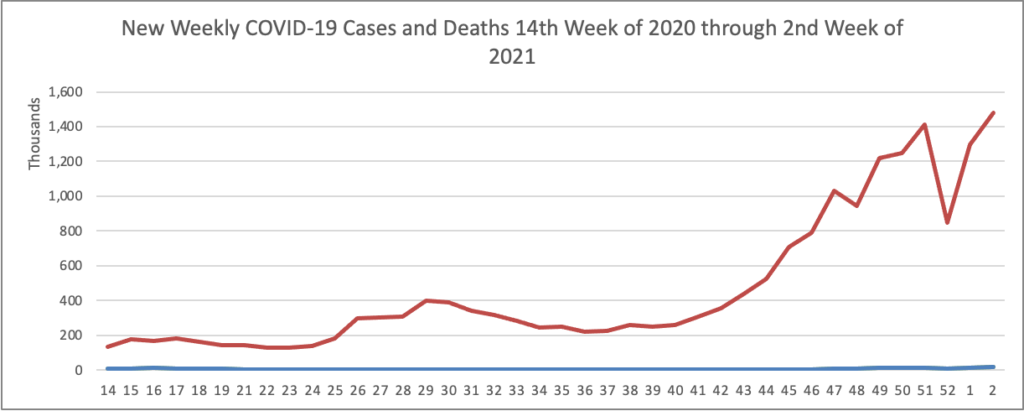
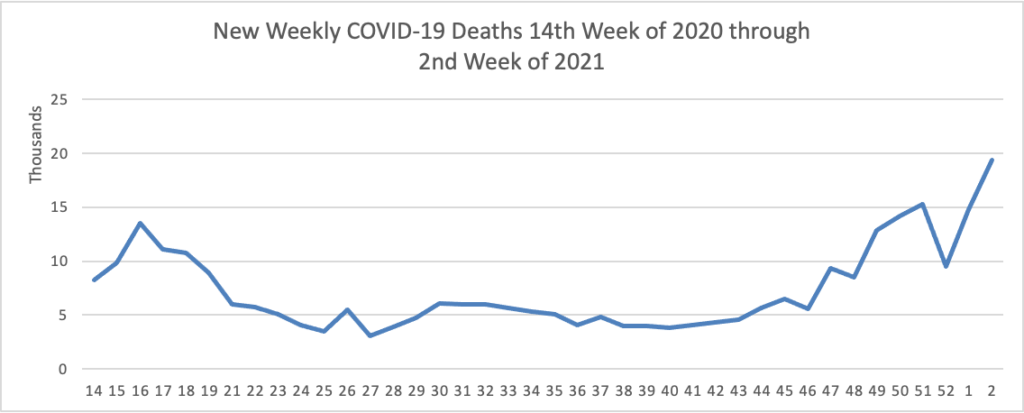
Based on the CDC’s COVID Data Tracker website, here is the FEHBlog’s chart of new weekly COVID-19 cases and deaths over the 14th week of 2020 through the second week of this year (beginning April 2, 2020 and January 13, 2021; using Thursday as the first day of the week in order to facilitate this weekly update):

and here is the CDC’s latest overall weekly hospitalization rate chart for COVID-19:

The FEHBlog has noted that the new cases and deaths chart shows a flat line for new weekly deaths  because new cases greatly exceed new deaths. Accordingly here is a chart of new COVID-19 deaths over the same period April 2, 2020 through January 13, 2021:

Finally here is a COVID-19 vaccinations chart for the past month which also uses Thursday as the first day of the week:

The CDC reports that as of today at 9 am roughly 10.6 million American have received one dose of either the Pfizer or Moderna vaccine and 1.6 million American have received both doses. 1.1 million doses of the vaccines were administered yesterday in total.

President-elect Biden announced additional members of his COVID-19 response team today, including

David Kessler, Chief Science Officer of COVID Response
David A. Kessler, M.D., who serves as a co-chair of the COVID-19 Task Force for President-elect Joe Biden, was the Commissioner of the Food and Drug Administration from 1990 to 1997, under Presidents George H. W. Bush and Bill Clinton. 

Per the American Hospital Association, this role will assume the responsibilities of the current head of Operation Warp Speed.” Beckers Hospital Review informed us on January 13 that “Moncef Slaoui, PhD, chief advisor of Operation Warp Speed, submitted his resignation at the request of President-elect Joe Biden’s team, although he’ll stay on for another month to oversee the transition to the new administration, CNBC reported Jan. 12. To close the loop NPR reports that the Biden Administration plans to retire the Operation Warp Speed moniker.

Also on the COVID-19 vaccine front, the Wall Street Journal reports tonight that

If manufacturing projections previously put forth by companies hold up, Mr. Biden’s pledge to administer 100 million doses of Covid-19 vaccines during the first 100 days of his presidency should be possible, according to manufacturing and supply chain experts. But efforts to significantly ramp up vaccines and curtail spread of the virus will depend on state partnerships and public buy-in for some public health measures. * * *

The success of the vaccination push rests in part on available supplies and the ability of a workforce to provide shots. Mr. Biden’s plan seeks to address both challenges through the expanded use of the Defense Production Act and a call for letting more people, including retired medical professionals, administer vaccines with training. He would also expand the use of pharmacies to provide vaccines.

The federally backed community vaccination centers would involve the Federal Emergency Management Agency, the National Guard and state and local teams. The administration would use federal resources and its emergency contracting authority to help launch the centers.

Thursday Miscellany

Photo by Juliane Liebermann on Unsplash

The National Law Review shares its notes on the third and final day of this week’s virtual JPMorgan healthcare conference. Here’s an interesting tidbit

TalkSpace, a pure-play virtual behavioral health platform that is subscription based and offers text-based asynchronous (i.e., not “live”) therapy, has shown immense growth during 2020 and has demonstrated that increased access and lower costs for behavioral health services can drive better outcomes. You may have seen the company’s advertising recently that features Olympic swimmer Michael Phelps or actress Demi Lovato. The company connects directly with consumers and through health plans and employee benefit plans to over 46,000 members. It has a network of over 2,650 providers and has 39 million commercial covered lives. Perhaps the most critical aspect of its offering is the ease of use. Connecting with a therapist or psychiatrist can take days, weeks or months to set up in a traditional in-person setting.

With TalkSpace, members are typically matched through an algorithm with, and then connected to, a provider on the same day, dramatically reducing the time between the decision to seek care and the provision of actual care. The patient can change therapists as needed within the platform or consult with a psychiatrist, and patient progress is measured through machine learning/artificial intelligence with feedback to the therapists. Therapists also are mentored during the onboarding process and then as they work for TalkSpace. Therapists agree to respond to patients’ texts within a specified time period and post their working and non-working hours. TalkSpace is growing nationally and works with both employers directly, with consumers/patients directly and with insurers. Public reports estimate TalkSpace’s estimated 2021 net revenue at $125 million, up approximately 69% from 2020 estimated net revenue.

STAT News adds another twist —

Buoyed by the pandemic, 2020 was undoubtedly the year that telehealth turned the corner to mainstream. But for savvy investors, the big question isn’t what’s hot now — it’s what’s the future holds. 

“If it’s straight telehealth, we’re not interested,” Lynne Chou O’Keefe, founder and managing partner of Define Ventures, said on a panel Wednesday on digital health business opportunities at the all-virtual Consumer Electronics Show. “To me, telehealth is a pipe… It’s about the use case and what are we trying to solve.” 

She pointed to her firm’s investment in MedArrive as an example of a company with a telehealth component that’s got the right idea. MedArrive, which launched out of stealth mode this fall, plans to send paramedics and EMTs to deliver home-based care under the supervision of remote physicians who are “piped” in. 

“I think we believe in hybrid models.  You know, there are going to be areas where virtual and virtual only will be enough. And I think there are others where we’re going to have a mixed model — to the home as an example.”

The federal government’s Pandemic Response Accountability Committee (“PRAC”) has issued a “report examines COVID-19 testing efforts for six federal health care programs [including the FEHBP] during the first seven months following the declaration of a public health emergency in the United States.” The FEHBP section runs from pages 24 to 28 of the report.

The Centers for Disease Control issued a report yesterday titled “COVID-19 Trends Among Persons Aged 0–24 Years — United States, March 1–December 12, 2020.” Bloomberg sums up the CDC report as follows:

The return to in-person classes in nearly two-thirds of the U.S. hasn’t led to a rash of community outbreaks, federal scientists said in a study of 2.87 million cases among those under age 24.

Disease rates in counties where in-person learning is available for school-aged children and adolescents is similar to areas where classes are entirely online, according to a report by the U.S. Centers for Disease Control and Prevention. It concludes [K-12] schools should be the last to close, and the first to re-open.

Meanwhile, young adults ages 18 to 24, who led the country in infections during the summer and fall, may have contributed more to community transmission, the agency said in its Morbidity and Mortality Weekly Report.

Also the Department of Health and Human Services announced today that “it will publish Practice Guidelines for the Administration of Buprenorphine for Treating Opioid Use Disorder*, to expand access to medication-assisted treatment (MAT) by exempting physicians from certain certification requirements needed to prescribe buprenorphine for opioid use disorder (OUD) treatment.” The HHS news release explains

More than 83,000 drug overdose deaths occurred in the United States in the 12 months ending in June 2020, the highest number of overdose deaths ever recorded in a 12-month period, and an increase of over 21% compared to the previous year, according to recent provisional data from the Centers for Disease Control and Prevention (CDC).

The increase in overdose deaths highlights the need for treatment services to be more accessible for people most at risk of overdose and today’s action will expand access to and availability of treatment for opioid use disorder.

“The medical evidence is clear: access to medication-assisted treatment, including buprenorphine that can be prescribed in office-based settings, is the gold standard for treating individuals suffering from opioid use disorder,” said Adm. Brett P. Giroir, MD, assistant secretary for health. “Removing some of the certification requirements for an  X-waiver for physicians is a step toward providing more people struggling with this chronic disease access to medication assisted treatment.”

Without MAT, the chances of relapse for a person who suffers from OUD are significant; studies have shown that outcomes for people with OUD are much better with MAT.

Midweek Update

Photo by Manasvita S on Unsplash

Bloomberg reports that Johnson & Johnson now expects to receive Food and Drug Administration emergency use authorization for its single dose COVID-19 vaccination in late February or early March 2021 which is later than initially anticipated.

J&J’s vaccine offers advantages in ease of distribution and administration [over the currently authorized Pfizer and Moderna vaccines]. Health systems have been navigating relatively complex two-shot campaigns for vaccines from Pfizer and Moderna. J&J’s shot will likely protect people with a single dose, and can be stored at refrigerator temperatures for three months; the Pfizer and Moderna vaccines must be frozen. Speaking Wednesday at a JPMorgan Healthcare Conference event, [Moncef] Slaoui said he expects the J&J shot to have 80% to 85% efficacy, surpassing the objective the company outlined in its clinical trial design.

Speaking of the virtual annual JPMorgan Healthcare Conference, the National Law Review reports on Day 1 of the conference here and Day 2 of the conference there. Take a gander at this interesting tidbit from Day 1

[Blue Shield of California CEO] Paul Markovich spoke to the need for real-time quality information that can result in real-time feedback and incentivization to physicians and other providers, rather than the costly and slow HEDIS pursuits we see today.  One health plan noted that it spends about $500 million a year going into physician offices looking at medical records for HEDIS pursuits, but the information is totally “in the rearview mirror” as it is too old when finally received and digested to allow for real-time treatment changes, improvement or planning.  Markovich suggested four initiatives (including the above, pay for value and shared decision making through better, more open data access) that he thought could save $100 billion per year for the country.  Markovich stressed that all of these four initiatives required a digital ecosystem and asked for help and partnership in creating one. He also noted that the State of California is close to creating a digital mandate and statewide health information exchange that could be the launching point for this exciting vision of data sharing and a digital ecosystem where the electronic health record is the beginning, but not the end of the healthcare data journey.

Health Payer Intelligence informs us that

The tension between payers and pharmaceutical companies over drug pricing has carried into 2021, as evidenced by a press release from America’s Health Insurance Plans (AHIP) criticizing pharmaceutical companies for January 2021 drug pricing increases.

“Americans are being hurt by out-of-control drug prices, which are set and fully controlled by Big Pharma alone,” Matt Eyles, president and chief executive officer of AHIP, said in a related blog post.

“The incoming Biden-Harris administration should focus on bipartisan, workable solutions to protect patients, taxpayers, and all Americans from higher drug prices, especially in the midst of the ongoing COVID-19 crisis.”

Meanwhile STAT News reports that

In an unexpected move, the high-profile billionaire [Mark Cuban] has launched the Mark Cuban Cost Plus Drug Company, which its website says is “dedicated to producing low-cost versions of high-cost generic drugs” and claims that everyone will get the same low price for every drug it makes.

As part of its mission, the company pledged to provide “radical transparency” about its manufacturing, distribution, and marketing costs. The plan is to add a flat 15% margin to wholesale prices to ensure profitability, but Cuban also promised there will be no hidden costs, no middlemen, and no rebates available only to insurers.

“This is our first step towards taking on the pricing of generic drugs,” Cuban tweeted in announcing the company, which will start by producing a medicine to treat parasites, but plans to introduce more than 100 other medicines by the end of 2021. There are also plans to build a factory in Dallas by next year, according to its web site.

The article reminds us that

[In 2018] several large hospital systems form[ed] Civica Rx, a nonprofit that contracts with manufacturers to ensure sufficient supplies to hospitals across the U.S. The idea is to entice companies, which make injectable and infused medicines but have a minimum amount of sales, to ramp up investment in production. The Civica network, which began with $100 million in capital and loans from three philanthropic organizations, now has more than 50 health systems that represent more than 1,200 hospitals and over 30% of all licensed U.S. hospital beds. The nonprofit is also teaming with the Blue Cross Blue Shield Association and 18 of its health plans to supply copycat medicines and combat rising prices.

Bleeping Computer provides us with an update on the SolarWinds backdoor hack, including an explanation of how the hack was implemented and the hacker’s various malware strains.

A week ago, the FBI, CISA, and the NSA also disclosed in a joint statement that a Russian-backed Advanced Persistent Threat (APT) group is likely behind the SolarWinds hack.

“The U.S. government and many private-sector experts have stated the belief that a foreign nation-state conducted this intrusive operation as part of a widespread attack against America’s cyberinfrastructure,” SolarWinds CEO Sudhakar Ramakrishna said today.

“To date, our investigations have not independently verified the identity of the perpetrators.”