Cybersecurity Dive provides five takeaways from the RSA conference held in San Francisco from June 6 through 9.
From the cyber breach front, MeriTalk provides more details on the settlement of the lawsuit against OPM over the massive 2015 data breach.
The lead counsel in the class action said that individual victims are in line for minimum payments of $700 each under the terms of the settlement, which still needs to be finalized. * * *
The preliminary settlement agreement will be subject to further consideration at a fairness hearing set for Oct. 14.
From the cyber vulnerabilities front,
Here is a link to CISA’s known exploited vulnerabilities catalog. Bookmark that one.
Becker’s Hospital Review explains why “Cybersecurity experts say that the two biggest threats to healthcare cybersecurity are insider threats and ransomware.”
Security Week reports “Microsoft has fixed roughly 50 vulnerabilities with its June 2022 Patch Tuesday updates, including the actively exploited flaw known as Follina and CVE-2022-30190.”
From the ransomware front
Cybersecurity Dive discusses how ransomware groups are shifting tactics and objectives.
Here is a link to Bleeping Computer’s The Week in Ransomware.
From the cyber defense front
HHS’s Healthcare Cybersecurity Coordination Center (HC3) offers a presentation about strengthening cyber posture in the health sector.
Health IT Security discusses the HC3 presentation.
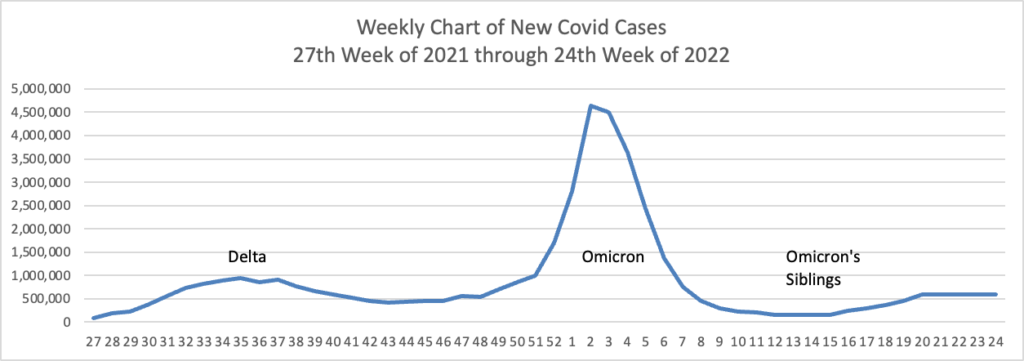
Based on the Centers for Disease Control’s Covid Data Tracker and using Thursday as the first day of the week, here is the FEHBlog’s weekly chart of new Covid cases from the 27th week of 2021 through the 24th week of 2022:
While the CDC did not publish its weekly Covid statistical review this week, the FEHBlog can tell you that the daily new Covid hospitalization average is 4,321 for the week ended June 15, 2022. That average is 4.7% higher than the previous week.
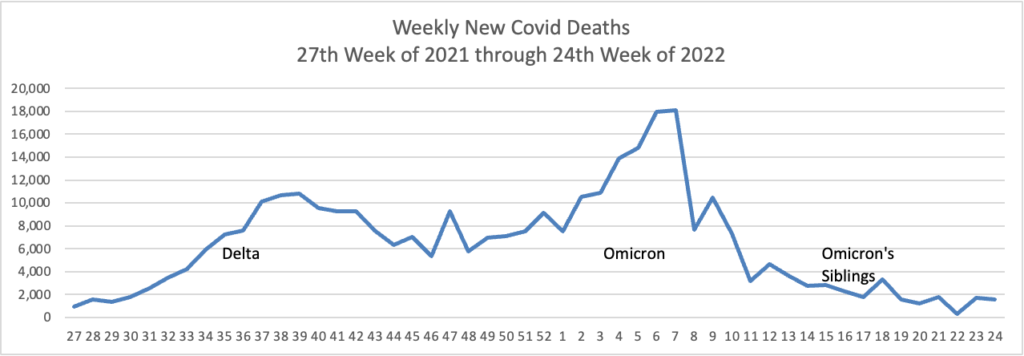
Here’s the FEHBlog’s weekly chart of new Covid deaths for the same period as new cases:
New cases and deaths are both stable. MedPage Today adds
About 4.5% of people who became infected with SARS-CoV-2 when Omicron was the dominant strain experienced long COVID symptoms, compared with 10.8% who became infected during the Delta period, reported Claire Steves, PhD, of King’s College London in England, and co-authors.
Overall odds of long COVID were about 20% to 50% less during the Omicron era — defined as December 2021 to February 2022 in this study — depending on age and time since vaccination, the researchers wrote in a letter to The Lancet.
For more information, Science discusses clues to long Covid.
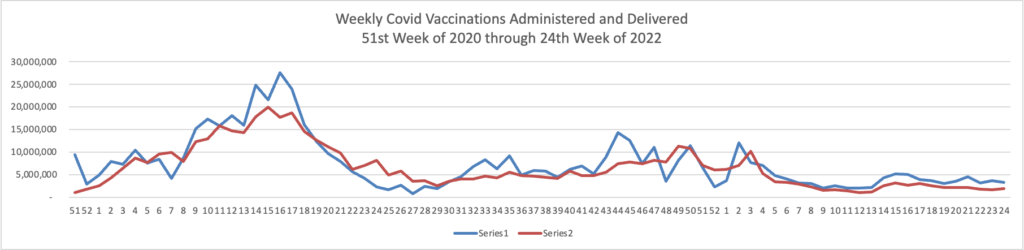
Here’s the FEHBlog’s weekly chart of new Covid vaccinations distributed and administered from the 51st week of 2020, when the Covid vaccination era began and the current 24th week of 2022.
Over 100,000 people aged 12 and older have received at least one booster.
Vaccine advisers to the Centers for Disease Control and Prevention discussed Friday the merits of Covid-19 shots now authorized for children as young as 6 months. * * *
The committee is scheduled to discuss further the case for recommending giving the Pfizer-BioNTech and Moderna shots to young children, and then vote on the matter Saturday.
The Biden administration has said the shots could be made available as soon as Monday, should regulators give their assent.
The federal government has begun shipping millions of doses to doctor’s offices, children’s hospitals and pharmacies, President Biden said after the FDA’s authorizations.
From the Rx coverage front, STAT News and Medical Economics update us on the federal government’s investigation of prescription benefit managers. Notably, STAT News reports
Amid intensifying scrutiny of pharmacy benefit managers, a group of House Republicans is urging the U.S. Government Accountability Office [via a June 17 letter] to investigate the role these controversial middlemen play in the opaque pharmaceutical pricing system.
From the Federal Trade Commission front, Healthcare Dive tells us that the FTC has obtained several victories over the past week in its legal challenges to hospital system mergers in New Jersey, Rhode Island, and Utah.
From the No Surprises Act front, reginfo.gov informs us that on June 15, the Office of Information and Regulatory Affairs received for review the NSA regulators’ final rule on the independent dispute resolution process. OIRA review is the last step before the rule is published in the Federal Register. The healthcare provider associations mounted a successful legal challenge to the interim final rule’s treatment of the qualifying payment amount as a rebuttable presumption at the arbitration stage.
From the HIPAA standard transactions front, a Health and Human Services workgroup has issued guidance on how payers can help providers associate electronic explanations of benefits with electronic payments.
From the U.S. healthcare front, Kaiser Health News and a WTW study delve into the widespread related problems of medical debt and deferred care. On the bright side, the National Institutes of Health reports that flexible work schedules and paid sick leave improves employee access to healthcare.
The Senate on Thursday took a major step toward broadening America’s commitment to take care of sick veterans, passing a bill to offer new health care and tax-free disability benefits to as many as 3.5 million veterans on an 84-14 vote.
Under the legislation written by Veterans’ Affairs Chairman Jon Tester, D-Mont., and ranking member Jerry Moran, R-Kan., the Department of Veterans Affairs would consider a veteran with any of 23 conditions, ranging from brain cancer to hypertension, who was deployed to a combat zone during the wars in Iraq or in Afghanistan automatically eligible for care at government cost, based on the presumption that exposure to toxic chemicals in the war zone caused the ailments.
The House must now pass the revised bill before President Joe Biden can sign it, which seems likely. The legislation largely mirrors, and slightly expands on, a House bill by Veterans’ Affairs Chairman Mark Takano, D-Calif., that passed 256-174 in March. Biden issued a statement at the time saying he supported the measure.
Under current law, veterans who believe toxic exposure during their service caused them to develop a disease can have trouble proving it, even when the linkage is known. So it’s likely that many veterans are denied care and disability benefits they deserve, advocates say. The new law, at a projected cost of $278.5 billion over 10 years, shifts the calculus, meaning the government will now pay for the care of veterans whose sickness is tied to their service, as well as others whose ailments might not be.
Because the federal government employs many veterans, this bill will reduce benefits costs for the FEHB Program once it becomes law.
From the Omicron and siblings front, the Wall Street Journal informs us
Many people are embarking on a summer of vacations, concerts and weddings put off during the height of the pandemic. Covid-19 is still finding ways to disrupt some of those plans.
Covid-19 isn’t causing acute illness and death on the scale it once did, thanks in part to protection built up by vaccines and prior infections. * * *
The U.S. is logging some 100,000 known cases a day, and many more are being detected via at-home tests health departments don’t track. This is a stark difference from a year ago, when U.S. cases sank below 12,000 a day, the lowest level since the first surge, as vaccinations rose and many hoped the virus was in retreat.
The era of 12,000 cases a day was over when Delta and then Omicron arrived and will remain around until Omicron departs.
In a notable move, the Federal Trade Commission put drugmakers and pharmacy benefit managers on notice that the agency will “ramp up enforcement” of any “illegal bribes and rebate schemes” that make it harder for patients to access lower-cost medicines.
The new policy statement noted the FTC plans to scrutinize rebates and assorted fees for signs that these payments are violating antitrust and consumer protection laws. As part of that effort, the agency expects to monitor lawsuits and file its own legal briefs in cases where it can provide assistance in analyzing illegal practices that may raise prescription drug prices.
“Today’s action should put the entire prescription drug industry on notice: when we see illegal rebate practices that foreclose competition and raise prescription drug costs for families, we won’t hesitate to bring our full authorities to bear,” said FTC Chair Lina Khan in a statement. “Protecting Americans from unlawful business practices that are raising drug prices is a top priority for the Commission.”
While the end of Omicron is not in the offing, the end of prescription drug rebates appears to be getting closer. However, the federal government should not put the kibosh on rebates unless the drug manufacturers agree to maintain the economic equities by offering price reductions equivalent to the rebates.
Drugmaker acquisitions of all sizes could receive closer scrutiny in the future if the Federal Trade Commission follows the advice of experts who spoke at a two-day agency meeting on market concentration and anticompetitive conduct.
The experts, mostly economists and other antitrust regulators, warned that some drugmakers have gained unfair market power due to the breadth of their product portfolios, allowing them to negotiate for preferred or even exclusive status on insurers’ coverage lists and thereby squeeze out competitors.
Taken together with the FTC’s plans to investigate the practices of pharmacy benefit managers, the meeting signals the Biden administration may take a tougher line on monopolistic practices in an effort to spark competition and target drug pricing.
From the Food and Drug Administration front, BioPharma Dive notes that
An experimental and closely followed drug for Alzheimer’s disease has failed a key clinical study, dealing yet another blow to the prevailing theory on how to treat a neurodegenerative illness that affects millions of people.
The drug’s developer, Roche, along with Banner Alzheimer’s Institute, the Phoenix-based organization helping lead the study, announced the negative results Thursday. After years following a family believed to be genetically predisposed to the disease, researchers found no significant difference in cognition or the ability to store and retrieve new memories between participants who received the drug and those who got placebo.
The failure is an upset not only to Roche, which hopes to follow its rival Biogen in getting an Alzheimer’s therapy approved for market, but also to the wider Alzheimer’s research field. For years, a protein called beta amyloid has been at the center of efforts to treat the disease. But every drug designed to block this protein, including Biogen’s, has faced setbacks. Roche’s announcement may therefore add to concerns that this protein isn’t the best research target.
In other drug research news, Walgreens announced “the launch of its clinical trial business to redefine the patient experience and increase access and retention in sponsor-led drug development research. Walgreen’s flexible clinical trial model combines the company’s vast foundation of patient insights, partner-enabled health and technology capabilities and in-person and virtual care options to break through barriers to engaging broader and more diverse communities.”
In U.S healthcare news, the American Medical Association completed its annual meeting. The AMA offers highlights from the session here.
Also, the Commonwealth Fund released its 2022 Scorecard on State Health System Performance.
Hawaii and Massachusetts top the 2022 State Scorecard rankings, based on overall performance across 56 measures of health care access and quality, service use and cost, health disparities, and health outcomes during the COVID-19 pandemic in 2020. The lowest-performing states were Mississippi, Oklahoma, and West Virginia.
From 2000-2019 overall life expectancy in the United States increased by 2.3 years, but the increase was not consistent among racial and ethnic groups and by geographic area. In addition, most of these gains were prior to 2010. This is according to a new study funded by the National Institutes of Health that examined trends in life expectancy at the county level. The study was led by researchers at the Institute for Health Metrics and Evaluation at the University of Washington’s School of Medicine, Seattle, in collaboration with researchers from NIH and published on June 16th in The Lancet.
MedCity News reports “Online healthcare marketplace Sesame closed a $27 million Series B funding round on Tuesday, bringing its total funding to $75 million. David Goldhill, CEO of the New York City-based startup, said the company is ‘an Expedia for medical care’ because patients can buy the care they want directly online, without the middleman of an insurance company.”
From the federal employee benefits front, Govexec delves into the impact of cost of living adjustments on federal employee retirement benefits.
The Senate Committee on Health, Education, Labor and Pensions voted Tuesday to send a bill to the Senate that would reauthorize the Food and Drug Administration to collect user fees from device- and drug-makers for the next five years.
A provision would require the FDA to finalize guidance that would create a category of over-the-counter hearing aids within a month of the bill’s passage. The FDA last issued a proposed guidance in October.
Committee Ranking Member Sen. Richard Burr, R-N.C.,questioned on Tuesday whether the FDA should have that expanded authority, despite co-sponsoring legislation that would change how diagnostic tests are regulated, including laboratory-developed tests.
The American Hospital Association (AHA) penned a last-ditch letter to congressional leaders pleading for Medicare sequester cuts slated to take effect July 1 to be halted in light of the financial strain many of the nation’s hospitals are expected to face throughout 2022.
Congress had initially paused the 2% payment cut as part of the CARES Act when the COVID-19 pandemic began to threaten providers’ bottom lines. Sequestration cuts were continually punted downfield until last December, when a bill was signed to resume a 1% cut in April and the full 2% in July.
With half a month to go, AHA Executive Vice President Stacey Hughes warned majority and minority leaders Tuesday that financial relief from the pending cut is necessary for hospitals “to maintain access to care for the patients and communities they serve.”
From the Supreme Court, the American Hospital Association gleefully informs us
The U.S. Supreme Court today ruled unanimously in favor of the AHA and others, reversing a 2020 [U.S.] court of appeals decision upholding the authority of the Department of Health and Human Services to significantly cut payments to certain hospitals that participate in the 340B Drug Pricing Program, and thereby threatening access to care for patients.
The Supreme Court held that “HHS’s 2018 and 2019 reimbursement rates for 340B hospitals were contrary to the statute and unlawful.” Noting that “340B hospitals perform valuable services for low-income and rural communities but have to rely on limited federal funding for support,” the Supreme Court observed that “this case has immense economic consequences, about $1.6 billion annually.”
Despite those serious practical impacts, the Supreme Court concluded that “[u]nder the text and structure of the statute,” the case is “straightforward” as a matter of law: “Because HHS did not conduct a survey of hospitals’ acquisition costs, HHS acted unlawfully by reducing the reimbursement rates for 340B hospitals.”
The panel voted 21 to 0 in a pair of votes on Wednesday in support of expanding access to the vaccines.
The positive recommendations will likely lead soon to expanding the U.S. Covid-19 vaccination campaign to the 19.6 million children from 6 months to under 5 years of age, one of the last groups of people in the U.S. waiting for shots.
The Food and Drug Administration, which doesn’t have to follow the panel’s recommendations but usually does, is expected to authorize the shots within days. Vaccinations could begin as early as June 21, according to the Biden administration.
Moderna Inc. is planning to test its Covid-19 vaccine in babies 3 months to 6 months old, the youngest age group studied to date.
The Cambridge, Mass., company said Wednesday it is in the final stages of planning the study, to be called BabyCove and expected to begin enrolling as many as 700 babies in September.
Pfizer said Tuesday that a much-watched study of its antiviral Paxlovid in patients who have Covid but don’t have risk factors for severe disease failed to show a benefit in speeding alleviation of Covid symptoms, but did seem to prevent doctor’s visits and hospitalizations.
Additionally, because of the small number of hospitalizations overall in the study, it failed to produce a statistically significant finding on whether patients who had previously been vaccinated against Covid were hospitalized less often if they received Paxlovid.
The data in no way invalidate earlier results that show that Paxlovid prevents hospitalizations and saves lives in patients at high risk of severe Covid. But the results, published in a press release, are likely to take time for experts to digest and understand.
From the unusual viruses front, the American Hospital Association explains
The Centers for Disease Control and Prevention yesterday [June 14] updated its guidance to help clinicians evaluate and test patients with relevant history, signs and symptoms for monkeypox. Over 1,800 monkeypox or orthopoxvirus cases have been reported globally this year, including 72 in the United States. According to CDC, the virus does not spread easily between people without close contact, so the risk to the general population remains low.
The World Health Organization plans to change monkeypox’s name next week.
Anthem will officially become Elevance Health on June 28, and, as part of its corporate rebrand, it’s also launching new brands for two of its subsidiaries.
The insurer will consolidate its healthcare services businesses under one umbrella, called Carelon. Carelon is a combination of the word “care” with the suffix “lon,” which means full or complete, representing the company’s ambition to offer an end-to-end care experience.
Carelon will include Anthem’s in-house pharmacy benefit manager Ingenio Rx as well as recent acquisitions such as Beacon Health Options, a behavioral health provider, and myNEXUS, a home healthcare company. Carelon will serve 1 in 3 people in the U.S., according to the announcement.
Humana is moving its pharmacy brands under the CenterWell umbrella.
Humana Pharmacy and Humana Specialty Pharmacy will now operate as CenterWell Pharmacy and CenterWell Specialty Pharmacy, respectively, the insurer announced. Enclara Pharmacia and Humana Pharmacy Solutions, the company’s pharmacy benefit management arm, will maintain their original branding.
“The CenterWell brand symbolizes our ongoing and strong commitment to keeping members, customers and patients at the center of everything we do,” said Scott Greenwell, Humana Pharmacy Solutions president, in a statement.
Morning Consult discusses how CVS Health and Walgreens retained “high customer trust” in 2021.
From the benefit design front, Employee Benefits News offers the case for health savings accounts. The FEHBlog is already sold.
From the Omicron and siblings front, MedPage Today reports
A committee of independent vaccine experts recommended that the FDA grant an emergency use authorization (EUA) for the two-dose Moderna COVID-19 vaccine for kids ages 6 to 17 years.
The Vaccines and Related Biological Products Advisory Committee (VRBPAC) voted 22-0, agreeing unanimously that the benefits of vaccination outweigh the risks in two age groups: kids ages 6 to 11 years and teens ages 12 to 17. They recommended two 50-mcg doses for the younger kids and two 100-mcg doses for teens.
The FDA will consider the vote in making a final decision on whether to clear the vaccine for use in children 6 years and older. * * * An FDA authorization could come within days. It would open the use of Moderna’s vaccine to children for the first time in the U.S., and give anyone still intending to inoculate their children 6 years and older against Covid-19 a second option.
Only a very small number of high-risk patients with COVID-19 experienced “rebound symptoms” after being treated with nirmatrelvir/ritonavir (Paxlovid), a retrospective study found.
Among nearly 500 patients, 93% of whom were fully vaccinated, two patients were hospitalized due to symptoms that were not directly related to “rebounding” within a month and required care in the intensive care unit (ICU), and four experienced rebound symptoms at a median of 9 days (interquartile range [IQR] 7-14.5), reported Nischal Ranganath, MD, PhD, of the Mayo Clinic in Rochester, Minnesota, and colleagues.
All rebound symptoms were resolved with symptom-directed treatment, and no deaths were reported in any patients after 30 days following their initial COVID-19 diagnosis, the group noted in Clinical Infectious Diseases.
“We found that rebound phenomenon was uncommon in this group of patients,” said co-author Aditya Shah, MBBS, also of the Mayo Clinic, in a statement. “The four individuals who experienced rebound represent only 0.8% of the group, and all of them recovered quickly without additional COVID-directed therapy.”
That’s certainly good news to read.
From the Rx coverage front, the Drug Channels blog tears apart a recent JAMA study concluding that the pricing of recently launched drugs has skyrocketed in recent years.
[T]he study’s headline conclusion is highly misleading. The authors obscure the real story with mathematical sleight-of-hand that misrepresents the underlying data and overlooks the true nature of today’s pharmaceutical innovations.
Most notably, the authors discount the fact that the most expensive new drugs treat ultra-rare conditions affecting extraordinarily small patient populations. Their policy recommendations would therefore have a devastating impact on these patients and their hope for treatments and cures.
As Nobel prize winner Ronald Coase observed: “If you torture the data long enough, it will confess to anything.”
And the Dr. Fein can back up his conclusion.
From general healthcare front, Kaiser Health News offers thought provoking articles about
waiving cost sharing on all diagnostic tests for cancer, not just the first one.
The first article draws an important distinction between medical care and SDOH. Unfortunately, the second article reminds us that no good deed goes unpunished. If the government simply had relied on personal responsibility (outside of Medicaid), we would not find ourselves in this pickle.
From the Omicron and siblings front, the Wall Street Journal reports
A Covid-19 vaccine developed by Sanofi SA and GSK PLC to target the Beta strain of the virus produced a stronger antibody response against variants of Omicron when given as a booster compared with certain first-generation shots, two studies have found.
The results are the latest indication that tweaking vaccines can nudge antibody responses in the direction of new variants, possibly helping to shore up immunity as the virus mutates. The study results may also provide an opportunity for Sanofi and GSK, two vaccine giants that were late to develop Covid-19 immunizations, to play a role in providing booster shots.
A panel of advisers to the Food and Drug Administration is set to meet Tuesday [June 14] to consider whether use of Moderna Inc.’s Covid-19 vaccine should be expanded to include children ages 6 through 17.
The advisory committee is expected to vote Tuesday afternoon on whether the benefits of vaccinating children in this age group outweigh the risks. The FDA will consider the vote in making a final decision on whether to clear the vaccine for use in children 6 years and older.
An FDA authorization could come within days. It would open the use of Moderna’s vaccine to children for the first time in the U.S., and give anyone still intending to inoculate their children 6 years and older against Covid-19 a second option.
Moderna’s vaccine has been authorized for use in adults 18 years and older since late 2020, while use of the other leading Covid-19 vaccine, from Pfizer Inc. and BioNTech SE, was expanded to anyone 5 and older last year.
From the FTC investigation front, FierceHealthcare updates us on the recently launched FTC investigation of the six largest PBMs. In other FTC news, Healthcare Dive tells us
** UnitedHealth and LHC Group have been hit by a request for additional information on their acquisition from the Federal Trade Commission, as regulators take an increasingly active role in overseeing healthcare M&A.
** The second request extends the waiting period the FTC has to challenge the deal. UnitedHealth agreed to acquire home health and hospice provider LHC for $5.4 billion in March.
Speaking of home health care, Home Health News discusses Aetna’s interest in the topic.
Aman Gill, Aetna’s director of product strategy and innovation, told Home Health Care News last month that a home health acquisition was “on the table” for the company.
This past week, at HHCN’s VALUE event, Aetna CMO Dr. Kyu Rhee reiterated the company’s commitment to the home as a setting of care. He also explained how care delivery has changed over the course of the last few years.
“We’ve been committed to home health and virtual care during the pandemic,” Rhee said. “And in our Medicare program, we’ve delivered tens of thousands of healthy at-home visits as well. … So my challenge to us as we think about the opportunity we have now and the next stage of this pandemic is: Are we going to persist in those values and make sure that the system delivers on those values, that hopefully we’ve learned over the last couple of years?”
From the Rx coverage front, the Food and Drug Administration announced
the [agency approved Olumiant (baricitinib) oral tablets to treat adult patients with severe alopecia areata, a disorder that often appears as patchy baldness and affects more than 300,000 people in the U.S. each year. Today’s action marks the first FDA approval of a systemic treatment (i.e. treats the entire body rather than a specific location) for alopecia areata.
“Access to safe and effective treatment options is crucial for the significant number of Americans affected by severe alopecia,” said Kendall Marcus, M.D., director of the Division of Dermatology and Dentistry in the FDA’s Center for Drug Evaluation and Research. “Today’s approval will help fulfill a significant unmet need for patients with severe alopecia areata.”
The drug initially was FDA-approved for the treatment of rheumatoid arthritis in 2018.
From the HIPAA Privacy Rule front, the U.S. Department of Health and Human Services (HHS), through its Office for Civil Rights (OCR), announced
issuing guidance on how covered health care providers and health plans can use remote communication technologies to provide audio-only telehealth services when such communications are conducted in a manner that is consistent with the applicable requirements of the Health Insurance Portability and Accountability Act of 1996 (HIPAA) Privacy, Security, and Breach Notification Rules, including when OCR’s Notification of Enforcement Discretion for Telehealth – PDF is no longer in effect. * * *
A bipartisan group of senators announced an agreement Sunday on significant updates to the nation’s gun laws, and the Senate majority leader said it would be put on the floor once legislative text is ready.
The agreement, announced by 10 Republicans and 10 Democratic caucus members, certainly will not go as far as many Democrats would have hoped, but the scale of the GOP support suggests it could get the all-important 60 votes to overcome the filibuster rule that kept derailing the last bipartisan attempt to change gun laws, in 2013.
The agreement, which is not yet in legislative language, is the product of discussions led by Sens. Christopher S. Murphy, D-Conn., and John Cornyn, R-Texas, in the wake of recent mass shootings, including at an elementary school in Uvalde, Texas.
“Our plan increases needed mental health resources, improves school safety and support for students, and helps ensure dangerous criminals and those who are adjudicated as mentally ill can’t purchase weapons,” the 20 senators said in a statement. “Most importantly, our plan saves lives while also protecting the constitutional rights of law-abiding Americans.”
From the Omicron and siblings front —
MedPage Today discusses the latest Omicron siblings — BA.4 and BA.5. “Generally, BA.4 and BA.5 variants cause mild disease but spread in large numbers potentially because, unlike the Wuhan strain, which settles in the lungs, these newer strains seem to attach to the more benign upper nasal passages.”
Bloomberg Prognosis answers a reader’s question about whether to get a fourth Covid booster now.
Moderna said just this week that a new version of its Covid vaccine led to a better antibody response against omicron compared with its current mRNA shot. It plans to submit data to the US Food and Drug Administration in the coming weeks and hopes the shot will be available as soon as late summer. That shot is what’s called a bivalent vaccine, meaning it contains mRNA coding for the spike protein of both the original strain of the virus and omicron.
Pfizer should also have updated mRNA vaccines available as soon as the fall, says Monica Gandhi, an infectious disease expert at the University of California, San Francisco. The FDA will hold an advisory committee meeting later this month to address whether fall shots should be modified, and if so what strains they should include.
But while currently available boosters are less effective against omicron, Gandhi points out, they still do offer some protection. So, she says, that answer to whether to get boosted now depends on a few factors.
”I would advise — depending on case rates in your area and your age— getting the fourth dose now,” she says. “And then deciding what to get in the fall.”
MedPage Today also explains why “the [Novovax Covid] technology is quite innovative and has potential to enhance protection against” the disease.
From the healthcare business front, the Wall Street Journal reports on a
A philanthropic organization founded by the ex-energy trader [John Arnold] and his wife Laura is providing financial backing to three lawsuits against giant hospital systems in Wisconsin, Connecticut and North Carolina, alleging the systems used their market power to squash competition and illegally inflate prices. The systems say the lawsuits from employers and consumers are baseless. * * *
The financing from Arnold Ventures is supporting the work of Fairmark Partners LLP, the law firm behind the lawsuits. Fairmark secured its funding from the philanthropy after filing its first lawsuit, one of the founders said. The firm’s founders say the backing is key to a targeted effort to reshape hospital markets through the courts, and that it received money from other philanthropies it declined to identify.
While the FEHBlog is not a fan of litigation, this strikes him as a worthy effort.
From the medical research front —
Kaiser Health News summarizes recent drug research developments.
NPR Shots reports on efforts to connect human nerve systems to prosthetic devices.
Researchers at CVS studied the relationship between total cost of care and the use of National Comprehensive Cancer Network (NCCN) guidelines to direct care and found savings among both breast cancer and colon cancer patients. The studies, released at the American Society of Clinical Oncology’s meeting earlier this month, build on a similar analysis among lung cancer patients.
In both studies, the researchers found that using NCCN guidelines drove significant declines in total cost of care.
“Evidence-based medicine does result in improvement in quality of life,” Shirisha Reddy, M.D., senior medical director at CVS Health and an author on both studies, told Fierce Healthcare. “There’s a lot of external data that supports that.”
The first study included 937 patients with colon cancer. Among Medicare beneficiaries, concordance with NCCN guidelines was linked to a 33% reduction in total cost per care per member per month. The results were less significant among commercially insured patients.
In the second study, the researchers retrospectively looked at 315 patients with breast cancer. They found total cost of care reductions for patients treated in ways consistent with NCCN across multiple insurance types, including 25% among fully insured commercial patients, 28% among self-insured commercial patients and 43% in Medicare.
This included notable decreases in administered chemotherapy spend as well as outpatient care between Jan. 1, 2019, and Dec. 31, 2020.
From the cyberattack front, Federal News Network reports
A D.C. federal judge this week preliminarily approved a $63 million settlement as part of a class action lawsuit brought by victims of the breach into OPM databases. The breach was uncovered in 2015. By then, hackers had stolen the records of nearly 22 million current and former federal employees. The Chinese government is widely thought to be behind the attack. The proposed settlement would only compensate those who can prove they were financially affected by the breach. The court’s order set a Dec. 23 deadline to submit a claim.
Health IT Security adds “Shields Health Care Group reported a healthcare cyberattackto HHS impacting 2 million individuals. The Massachusetts-based healthcare group provides MRI, PET/CT, and ambulatory surgical services to patients across New England at more than 30 locations.”
From the cybervulnerabilities front, Cyberscoop explains
When the Cybersecurity and Infrastructure Security Agency [CISA] debuted its list of known, exploited vulnerabilities in November, it was nearly 300 flaws long and came attached to an order for federal agencies to fix them quickly.
Now, as of this week, the catalog known as “KEV” or the “Must-Patch” list is well on its way to 800 listings, and it’s the “No. 1 topic” that CISA Executive Director for Cybersecurity Eric Goldstein says comes up in his frequent, daily meetings with businesses.
The reason, said Goldstein, is that the private sector has — without any order from his agency — adopted the KEV list as a guide for the vulnerabilities they focus on, rather than relying on the traditional open-source industry standard Common Vulnerability Scoring System for assessing the severity of software weaknesses.
This week, CISA first added 36 and then three more known, exploited vulnerabilities to its catalog.
The HHS Health Sector Cybersecurity Coordination Center posted its May report about vulnerabilities of interest to the health sector.
It doesn’t pay to pay [ransom]. This advice on ransomware payment is often given, but rarely enumerated. Now it has been. A new study finds that 80% of companies that paid a ransom were hit a second time, with 40% paying again. Seventy percent of these paid a higher amount the second time round.
These figures come from an April 2022 Cybereason study that queried 1,456 cybersecurity professionals from organizations with 700 or more employees. The shocking nature of the statistics, published in Ransomware: The True Cost to Business (PDF) go much deeper.
It’s not a problem that can be ignored with the vague belief, ‘it won’t happen to me’. Seventy-three percent of organizations have suffered at least one ransomware attack in the past 24 months – up 33% from last year.
Sixty percent of companies admitted ransomware gangs had been in their network from one to six months before they were discovered – a key indicator of a double extortion attack. But paying the double extortion fee doesn’t really help; nearly 200,000 companies never received their data back after paying. And the criminals still have the data regardless. Thirty-five percent of companies suffered C-level ‘resignations’ because of a ransomware attack.
Other key findings of the research include the prevalence of the supply chain as a factor in the attack. Sixty-four percent of companies believe the ransomware gang got into their network via one of their suppliers or business partners.
Healthcare ransomware attacks are not slowing down, prompting an increased demand for reliable cyber insurance policies. But as healthcare cyberattacks skyrocket, cyber insurers are pushing up prices or leaving the market altogether, Sophos stated in its “State of Ransomware in Healthcare 2022” report.
Sophos surveyed 5,600 IT professionals, including 381 in healthcare, to garner insights on how healthcare organizations are navigating the cyber threat landscape.
The report found that 66 percent of surveyed healthcare organizations were hit by ransomware in 2021, up from just 34 percent in 2020. About 61 percent of those attacks resulted in data encryption. Survey results also revealed that healthcare was the most likely sector to pay a ransom. Just over 60 percent of respondents who experienced encryption admitted to paying the ransom, compared to a cross-sector average of 46 percent.
Here is a link to Bleeping Computer’s Week in Ransomware.
From the cyber defense front, here are links to a Wall Street Journal report on personal password management and a CISA article on multi-factor authentication.
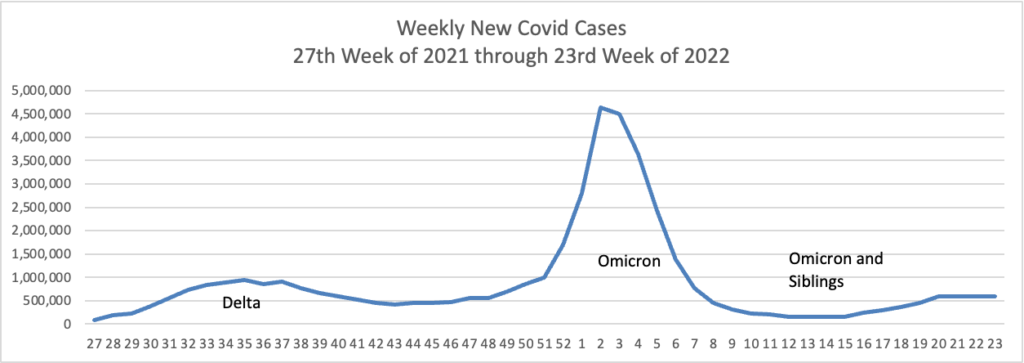
Based on the Centers for Disease Control’s Covid Data Tracker and using Thursday as the first day of the week, here is the FEHBlog’s weekly chart of new Covid cases from the 27th week of 2021 through the 23rd week of 2022.
The CDC’s weekly review of its Covid statistics observes “As of June 8, 2022, the current 7-day moving average of daily new cases (109,032) increased 8.0% compared with the previous 7-day moving average (100,916).”
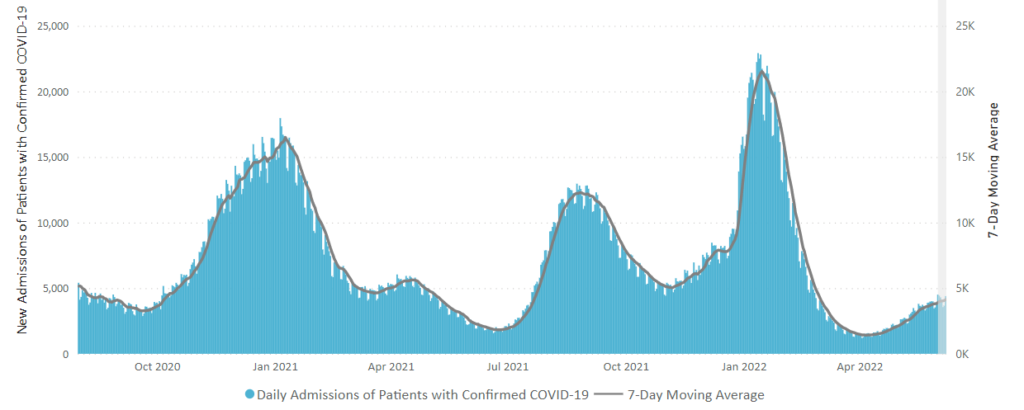
Here’s is the CDC’s latest weekly report of new Covid hospitalizations:
The CDC’s weekly review notes “The current 7-day daily average for June 1–7, 2022, was 4,127. This is an 8.0% increase from the prior 7-day average (3,820) from May 25–31, 2022.”
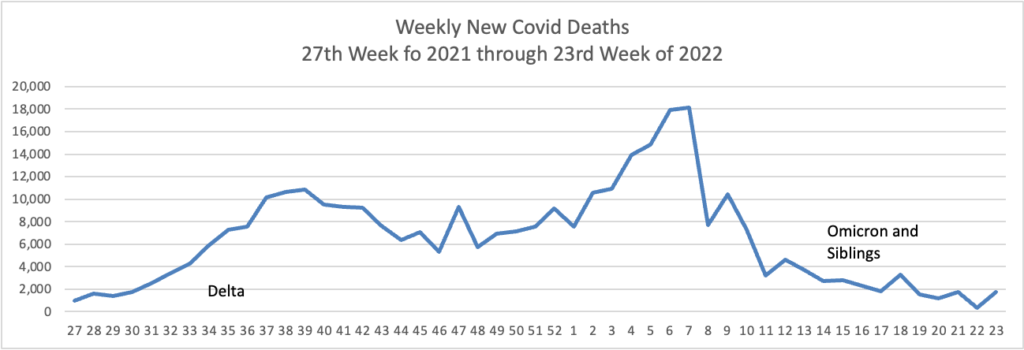
Here’s the FEHBlog’s weekly chart of new Covid deaths over the same period as new cases:
The CDC’s weekly review adds “The current 7-day moving average of new deaths (306) has increased 18.6% compared with the previous 7-day moving average (258).” Over 2/3s of the U.S. population is now fully vaccinated.
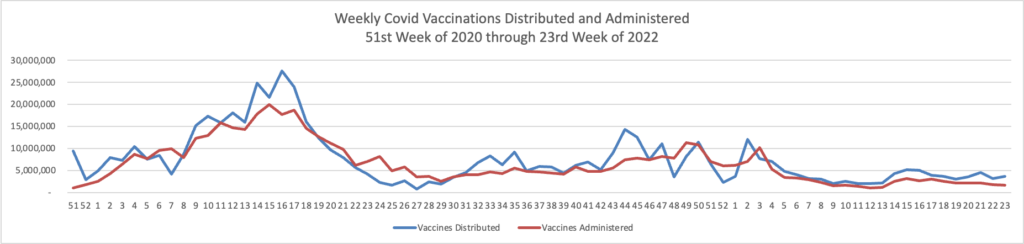
Here’s the FEHBlog weekly chart of Covid vaccinations distributed and administered from the beginning of the vaccination era at the 51st week of 2020 through the 23rd week of 2022:
The CDC’s weekly review states “As of June 8, 2022, the 7-day average number of administered vaccine doses reported (by date of CDC report) to CDC per day was 290,078, a 15.6% decrease from the previous week.”
The American Hospital Administration adds
An initial 10 million doses of COVID-19 vaccine are available for children under age 5 if the Food and Drug Administration authorizes and the Centers for Disease Control and Prevention recommends the Pfizer and Moderna vaccines for children in this age group, Assistant Secretary for Preparedness and Response Dawn O’Connell said yesterday during a White House briefing.
FDA’s vaccine advisory committee will meet June 14-15 and the CDC’s advisory committee June 17-18 to consider whether to authorize and recommend the vaccines for this age group, after which the agencies will issue their respective decisions.
“It will take some time to position these vaccines across the country, and vaccinations can’t begin until CDC has made its decision,” O’Connell said. “But we also know that many parents have been waiting for a long time, so we will be working 24/7 until every dose is shipped and delivered.”
The Administration last week opened pre-ordering of doses for states, tribes, territories and other partners, and estimates that 85% of children under 5 live within 5 miles of a potential vaccination site, she said.
The CDC’s weekly review sums things up as follows:
As of June 9, 2022, there are 314 (9.75%) counties, districts, or territories with a high COVID-19 Community Level, 1,052 (32.67%) counties with a medium Community Level, and 1,854 (57.58%) counties with a low Community Level. This represents a small (+2.20 percentage points) increase in the number of high-level counties, a moderate (+9.57 percentage points) increase in the number of medium-level counties, and a corresponding (−11.77 percentage points) decrease in the number of low-level counties. Fifty-two (100%) of 52 jurisdictions* had high- or medium-level counties this week.
From the unusual viruses front, the American Hospital Association tells us
The Centers for Disease Control and Prevention today reported over 1,300 monkeypox cases globally, including 45 in the United States. While no deaths have been reported and the overall risk to the U.S. public remains low, officials encouraged clinicians to review the CDC’s latest guidance and individuals to talk with their health care provider if they develop symptoms or need to get tested.
According to CDC, monkeypox spreads through direct contact with an infected person’s body fluids, sores or materials that have touched them, such as clothing or linens. It may also spread through respiratory secretions when people have close, face-to-face contact.
Smallpox vaccines are effective at protecting people against monkeypox when given before exposure and may also help prevent the disease or make it less severe. According to CDC, the Strategic National Stockpile currently holds about 72,000 doses of JYNNEOS smallpox vaccine and will soon receive an additional 300,000 doses from the manufacturer. The U.S. also has ordered another 500,000 doses for delivery later this year. In addition, the SNS holds over 100 million doses of an older smallpox vaccine (ACAM2000).
From the electronic health record front, Beckers Hospital News reports
Oracle’s primary mission is improving the complex healthcare system with technology, according to Larry Ellison.
The chair, co-founder and chief technology officer of Oracle said in a June 9 virtual public presentation the company plans to vastly improve care delivery, outcomes and public health policy while also lowering costs. Oracle acquired Cerner in a $28.4 billion transaction earlier this week and has plans to modernize the platform, taking it from a documentation and billing system to a complete source of information about an individual’s healthcare. The EHR would also have virtual care capabilities, be interoperable and expand clinical trial accessibility.
“Together, Cerner and Oracle have all the technology required to build a revolutionary new health management information system in the cloud,” Mr. Ellison said. “That system will deliver much better information to healthcare professionals. Better information will fundamentally transform healthcare.”
Oracle aims to build a unified database for patient information, similar to the unified financial database with credit information, accessible to healthcare providers and public health officials. The database would have anonymized data from hospitals, clinics and providers across the U.S. and provide up-to-the-minute information about patients’ personal health as well as public health statistics, such as the number of people hospitalized with COVID-19 or available hospital beds in a particular state.
“We’re building a system where the health records, all American citizens’ health records, not only exist at the hospital level, but they are all in a unified national healthcare database,” Mr. Ellison said. “The national database solves the data electronic health record fragmentation problem.”
Aim high. Assuming security and privacy challenges can be addressed, such a database could be a public health game changer.
From our Nation’s capital, the New York Times reports,
White House officials said on Wednesday that they would have to repurpose federal Covid-19 funds meant for coronavirus tests and protective equipment in order to supply more antiviral pills and vaccines, after so far failing to persuade Congress to pass a new pandemic relief package.
Roughly $10 billion from Department of Health and Human Services funds will be rerouted, around half of it to purchase vaccines for Americans ahead of a possible fall or winter wave of virus cases, when an updated shot may be needed, according to one White House official. The other half will go mostly to purchasing 10 million courses of Paxlovid, the antiviral treatment made by Pfizer that has been shown to substantially reduce the severity of Covid-19 in high-risk people, the official said. Around $300 million will be spent on another kind of treatment, monoclonal antibodies.
Also from the Omnicron and siblings front, a friend of the FEHBlog, journalist Theresa Defino, points out
Today and tomorrow NIH’s Advisory Committee to the Director is holding its first of two annual meetings. Today Dr. Fauci gave a presentation on Covid and Dr. Walter Koroshetz, director of the National Institute of Neurological Disorders and Stroke, spoke on recovery from Covid.
The most interesting comments Dr. Fauci made begin on page 45. Dr. Koroshetz’s talk was about NIH’s efforts to understand long COVID. Lots of trials are going on. He also mentioned this website on Covid recovery which is worth a look.
From the unusual viruses report, Becker’s Hospital Review brings us up to date on roughly 700 cases of acute hepatitis of unknown etiology infecting young children in 34 countries, including our own. “The U.S. has reported 274 probable hepatitis cases in 39 states and jurisdictions as of June 8, according to the CDC.”
From the maternal health front, the American Hospital Association informs us
The Health Resources and Services Administration has released a report evaluating the Rural Maternity and Obstetrics Management Strategies Program, which completed its first year last August. The program uses a network approach to coordinate and improve maternal health care from preconception to postpartum; telehealth services to increase access to care in rural areas; potential aggregation of low-volume rural obstetric services; and payment structures that promote financial sustainability for access to high-quality maternal care. The cohort includes networks in Missouri, New Mexico and Texas that provided prenatal, delivery and postpartum care to 3,101 rural mothers. Participants said hiring patient navigators emerged as an early success strategy. The networks also laid the groundwork for expanding telehealth.
From the Rx coverage front, STAT News offers an interesting article about the drug pricing reform debate ongoing in Congress using an AMA Journal report showing skyrocketing launch prices for newly approved drugs.
Health Payer Intelligence tells us that “AHIP has subscribed to the Institute for Clinical and Economic Review’s (ICER) cloud-based analytics platform, providing [its] health plan members with access to benchmark reports, cost-effectiveness data, and policy recommendations.” Good idea, AHIP.
From the federal employee benefits front, a financial planner discusses how divorce may affect FEHB and FEGLI benefits at the My Federal Retirement website.
From the HIPAA standard transactions front, the CMS National Standards Group has released an updated Compliance Review Program Findings report identifying the most common violations of those standard and operating rules from compliance reviews.
We use cookies on our website to give you the most relevant experience by remembering your preferences and repeat visits. By clicking “Accept”, you consent to the use of ALL the cookies.
This website uses cookies to improve your experience while you navigate through the website. Out of these, the cookies that are categorized as necessary are stored on your browser as they are essential for the working of basic functionalities of the website. We also use third-party cookies that help us analyze and understand how you use this website. These cookies will be stored in your browser only with your consent. You also have the option to opt-out of these cookies. But opting out of some of these cookies may affect your browsing experience.
Necessary cookies are absolutely essential for the website to function properly. These cookies ensure basic functionalities and security features of the website, anonymously.
Cookie
Duration
Description
cookielawinfo-checbox-analytics
11 months
This cookie is set by GDPR Cookie Consent plugin. The cookie is used to store the user consent for the cookies in the category "Analytics".
cookielawinfo-checbox-functional
11 months
The cookie is set by GDPR cookie consent to record the user consent for the cookies in the category "Functional".
cookielawinfo-checbox-others
11 months
This cookie is set by GDPR Cookie Consent plugin. The cookie is used to store the user consent for the cookies in the category "Other.
cookielawinfo-checkbox-necessary
11 months
This cookie is set by GDPR Cookie Consent plugin. The cookies is used to store the user consent for the cookies in the category "Necessary".
cookielawinfo-checkbox-performance
11 months
This cookie is set by GDPR Cookie Consent plugin. The cookie is used to store the user consent for the cookies in the category "Performance".
viewed_cookie_policy
11 months
The cookie is set by the GDPR Cookie Consent plugin and is used to store whether or not user has consented to the use of cookies. It does not store any personal data.
Functional cookies help to perform certain functionalities like sharing the content of the website on social media platforms, collect feedbacks, and other third-party features.
Performance cookies are used to understand and analyze the key performance indexes of the website which helps in delivering a better user experience for the visitors.
Analytical cookies are used to understand how visitors interact with the website. These cookies help provide information on metrics the number of visitors, bounce rate, traffic source, etc.
Advertisement cookies are used to provide visitors with relevant ads and marketing campaigns. These cookies track visitors across websites and collect information to provide customized ads.