Govexec.com provides an update on COVID-19 vaccine administration by federal agencies to their employees. A friend of the FEHBlog asked him today whether he knew how long it took for a COVID-19 to provide protection following the injection. Good question. The New York Times reported last week that “The protective effects of vaccines are known to take at least a couple of weeks to kick in.” To wit,
Data from Pfizer’s clinical trials suggests the vaccine might start safeguarding its recipients from disease around one or two weeks after the first injection. A second jab of mRNA, delivered three weeks after the first, helps immune cells commit the virus’s most prominent features to memory, clinching the protective process.
Biopharma Dive reports that “AbbVie raised the list prices of many of its drugs on Jan. 1, while Biogen hiked the price tag of its old multiple sclerosis treatment Tysabri, part of broad, sector-wide increases typically taken at the start of a new year. The hikes could feature in calls for drug pricing legislation as a new Congress and new administration begin work.” Timing is everything.
Here a few loose ends that have been tied up.
According to Healthcare Dive, “Haven, the high-profile, secretive venture to lower healthcare costs backed by Amazon, J.P. Morgan and Berkshire Hathaway, is suspending operations in February after three years, the company announced Monday. Haven caused waves when launched in 2018, with a lineup of notable hires from within the healthcare industry. However, the nonprofit, independent company is now closing with little concrete to show, hinting at the difficulty of reforming the complex insurance system and curbing rising costs in the deeply entrenched healthcare industry. Haven said in a statement on its website that Amazon, J.P. Morgan and Berkshire Hathaway would use the information it gained moving forward and continue working to create programs addressing the health needs of their combined 1.2 million employees. Shares of major U.S. insurers got a bump in Monday trading following the news, with UnitedHealthcare and Humana each climbing more than 2% since noon.”
According to Fierce Healthcare, “New York Life completed its acquisition of Cigna’s group life, accident and disability insurance businesses in a deal valued at $6.3 billion.” Cigna like CVS Health / Aetna has decided to focus its attention on healthcare.
Congress.gov reported today that the Senate has returned to the President his nomination of Craig Leen to be OPM Inspector General because the Senate failed to act on the nomination during the 116th Congress. The President may renew the nomination for the 117th Congress.
Thinking about the OPM Inspector General caused the FEHBlog to check to see whether the latest OPM Inspector General semi-annual report to Congress (period ended September 30, 2020) is online and by golly it has been posted right here. The lead article in the report discusses the impact of the COVID-19 public health emergency on the FEHBP. The management response to the Inspector General’s report is available here.
The 117th U.S. Congress convened today, and Rep. Nancy Pelosi (D Calif.) was re-elected Speaker of the House. The Wall Street Journal reports that “Democrats expect to have 222 seats to Republicans’ 211.” Party leadership in the Senate hinges on the two special elections that will be held in Georgia on January 5.
The federal mandate for health plans to cover the Moderna COVID-19 vaccine begins today. According to the CDC as of yesterday at 9 am ET, 13,071,925 doses of the Pfizer-BioNTech and Moderna vaccines have been distributed across the U.S. and 4,225,756 initial doses of those vaccines have been administered.
Turning back to the Affordable Care Act amendments included in Division BB of the Consolidated Appropriations Act, 2021, that require health plan attention in order to implement then for 2022:
Section 107 requires health plan identification cards to include the following information:
‘‘(1) Any deductible applicable to such plan or coverage.
‘‘(2) Any out-of-pocket maximum limitation applicable to such plan or coverage.
‘‘(3) A telephone number and Internet website address through which such individual may seek consumer assistance information, such as information related to hospitals and urgent care facilities that have in effect a contractual relationship with such plan or coverage for furnishing items and services under such plan or coverage’’.
Section 116 creates new requirements on health plan network provider directories and holds health plans and providers liable to consumers/ patients liable for errors in those directories, although the provider may shift certain aspects of that liability to the health plan in the network contract.
There is one requirement in the new law (relating to mental heath parity) that takes effect on February 9, 2021. The section requires specific comparative analyses to demonstrate health plan compliance with the most complicated provision of the federal mental health parity law, non-quantitative treatment limitations, e.g, medical necessity, pre-authorization. Here is a link to the most recent federal government FAQs on NQTLs.
Section 203 of Division B states
In the case of a group health plan or a health insurance issuer offering group or individual health insurance coverage that provides both medical and surgical benefits and mental health or substance use disorder benefits and that imposes nonquantitative treatment limitations (referred to in this section as ‘NQTLs’) on mental health or substance use disorder benefits, such plan or issuer shall perform and document comparative analyses of the design and application of NQTLs and, beginning 45 days after the date of enactment of the Consolidated Appropriations Act, 2021, make available * * * the Secretary of Health and Human Services [FEHBlog note edited for the FEHBP], upon request, the comparative analyses and the following information:
‘‘(i) The specific plan or coverage terms or other relevant terms regarding the NQTLs and a description of all mental health or substance use disorder and medical or surgical benefits to which each such term applies in each respective benefits classification.
‘‘(ii) The factors used to determine that the NQTLs will apply to mental health or substance use disorder benefits and medical or surgical benefits.
‘‘(iii) The evidentiary standards used for the factors identified in clause (ii), when applicable, provided that every factor shall be defined, and any other source or evidence relied upon to design and apply the NQTLs to mental health or substance use disorder benefits and medical or surgical benefits.
‘‘(iv) The comparative analyses demonstrating that the processes, strategies, evidentiary standards, and other factors used to apply the NQTLs to mental health or substance use disorder benefits, as written and in operation, are comparable to, and are applied no more stringently than, the processes, strategies, evidentiary standards, and other factors used to apply the NQTLs to medical or surgical benefits in the benefits classification.
‘‘(v) The specific findings and conclusions reached by the group health plan or health insurance issuer with respect to the health insurance coverage, including any results of the analyses described in this subparagraph that indicate that the plan or coverage is or is not in compliance with this section.
The law permits that Secretary of HHS to use the comparative analyses for investigative purposes when a mental health parity compliance complaint has been made against the health plan.
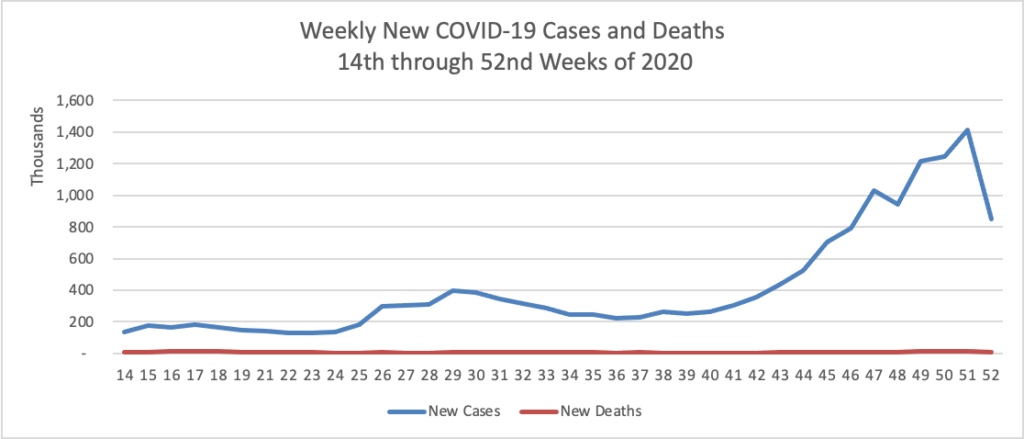
Based on the CDC’s Cases in the U.S. website, here is the FEHBlog’s chart of new weekly COVID-19 cases and deaths over the 14th through 52nd weeks of this year (beginning April 2 and ending December 30; using Thursday as the first day of the week in order to facilitate this weekly update):
and here is the CDC’s latest overall weekly hospitalization rate chart for COVID-19:
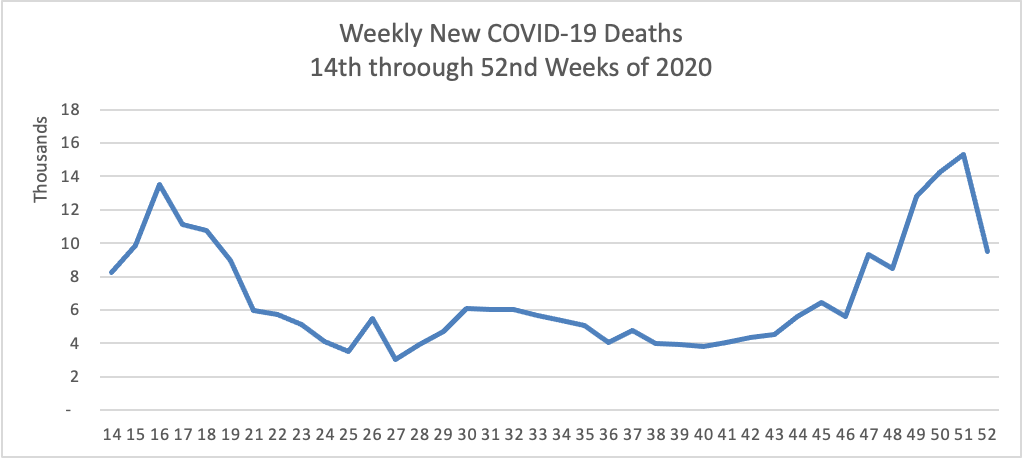
The FEHBlog has noted that the new cases and deaths chart shows a flat line for new weekly deaths because new cases greatly exceed new deaths. Accordingly here is a chart of new COVID-19 deaths over the period (April 2 through December 30):
The CDC’s COVID-19 Vaccine tracker has not been updated since last Wednesday morning At that time roughly 2.8 million initial doses had been administered. The American Hospital Association and the American Medical Association have posted helpful information about the currently available COVID-19 vaccines. The Food and Drug Administration offers a comprehensive year end report.
The CDC’s FluView continues to report that “Seasonal influenza activity in the United States remains lower than usual for this time of year.”
The FEHBlog took a look at a couple of the hospital chain websites and could not find the price information required by the HHS hospital price transparency rule. However, FEP Blue, the largest FEHB plan, announced the availability of their FEP Cost Advisor Tool.
Today is the last day of the 116th Congress. The Wall Street Journal informs us that among the provisions in the Consolidated Appropriations Act, 2021, is the following
Flexible spending accounts. Many workers with FSAs that allow them to use pretax dollars to pay for unreimbursed health expenses (like glasses) or dependent-care expenses (like summer camp) didn’t use all the money in their 2020 accounts because of the pandemic. The IRS had limited ability to ease FSA rules, but Congress has now done so.
Participants in such plans can carry over unused funds from 2020 to 2021 and 2021 to 2022, or for up to 12 months for companies with fiscal years. For dependent-care accounts, the law extends the age limit from 12 to 13 for some carried-over funds. For workers to take advantage of these changes, company plans must often opt into the new rules.
OPM typically does adopt such changes for FSAFeds.
Federal News Network reports that yesterday the Senate joined the House of Representatives in overriding the President’s veto of the FY 2021 National Defense Authorization Act. The Senate did not join the House in approving a $2000 direct stipend COVID relief proposal.
With hours to spare before the new year, President Donald Trump signed an executive order Thursday night implementing a federal pay raise for civilian employees and military members in 2021. Civilian employees will receive a 1% across-the-board federal pay raise in 2021. There are no additional locality pay adjustments this year.
The FEHBlog wishes all of his readers a Happy New Year.
The Wall Street Journal reports that in the wake of the December 29 D.C. Circuit opinion upholding the Trump Administration’s hospital price transparency rule,
The nation’s largest hospital chains, including publicly traded giants HCA Healthcare Inc., Universal Health Services Inc. and Community Health Systems Inc., and national nonprofit chains CommonSpirit Health and Ascension, said they planned to comply with new requirements to post pricing. Tenet Healthcare Corp. declined to comment.
“Ascension supports price transparency of our hospital services for the benefit of consumer choice and access to care for those we serve,” said Nick Ragone, a spokesman for the St. Louis-based chain.
As of Jan. 1, hospitals will be required to publish the prices negotiated privately with each payer for 300 common services for easy use by consumers, and make public the same information for all their procedures in a format that can be read and analyzed by computers.
The FEHBlog will be back on January 2 for Saturday Stats and More. Enjoy.
Per the Office of Personnel Management, “The effective date of the Open Season change is the first day of the first full pay period in January. For annuitants this date will always be January 1.” It turns out that Sunday January 3, 2021, is the first day of the first full pay period in January 2021. How convenient.
The Consolidated Appropriations Act, 2021, does include the three standard FEHBP appropriations provisions — a prohibition on applying full Cost Accounting Standards coverage to FEHB contracts (Sec. 611), an abortion coverage restriction (Secs. 613, 614), and a limited contraceptive coverage mandate (Sec. 726) which the Affordable Care Act has overridden. What’s more this new law extends the option of FEHBP and FEGLI coverage to 120 tribal grant schools thereby filling a coverage gap erroneously created by the Affordable Care Act. This option is exercised by the tribal employers who must make the minimum federal civil servant government contribution toward the benefit coverage.
For the past 20 years or so, the FEHBP has offered plan members transitional care protection pursuant to President Clinton’s Bill of Consumer Rights which states in pertinent part as follows:
Consumers who are undergoing a course of treatment for a chronic or disabling condition (or who are in the second or third trimester of a pregnancy) at the time they involuntarily change health plans or at a time when a provider is terminated by a plan for other than cause should be able to continue seeing their current specialty providers for up to 90 days (or through completion of postpartum care) to allow for transition of care.
FEHB plan carriers intending to terminate a network provider for cause generally could comply with this requirement by giving affected members 90 days advance notice of the change.
It turns out that Section 113 Division BB of the Consolidated Appropriations Act, 2021, includes an Affordable Care Act amendment ensuring continuity of care. The requirements of this new law bear similarities to the FEHBP’s transitional care protections. However, as always, the devil is in the details. For example, the new law’s transitional care provisions apply to any provider contract termination, including passive non-renewals, whether triggered by the provider or the payer, with the limited exception of payer termination for fraud or failure to meet applicable quality standards. FEHB plans and OPM have a year to sort out the details before the new requirements take effect on January 1, 2022.
In other news —
The Senate moved forward today on overriding President’s veto of the FY 2021 National Defense Authorization Act but not on the $2000 COVID-19 relief direct stipend per the Wall Street Journal:
Moving through the procedural steps for overriding Mr. Trump’s veto of the National Defense Authorization Act could take up much of the Senate’s time before Sunday. Sen. Bernie Sanders (I., Vt.), in a push for a stand-alone vote on increasing the size of the direct checks, has stopped Mr. McConnell from fast-tracking votes on the NDAA override. As a result, the final vote on the NDAA may not take place until Saturday due to a series of procedural steps.
The Senate took one of those steps late Wednesday, voting 80-12 to move forward with the bill, in another show of broad, bipartisan support for the legislation Mr. Trump vetoed.
Bleeping Computer updated us on how the federal government is addressing the SolarWinds backdoor hack.
The Cybersecurity and Infrastructure Security Agency (CISA) has ordered all US federal agencies to update the SolarWinds Orion platform to the latest version by the end of business hours on December 31, 2020. CISA’s Supplemental Guidance to Emergency Directive 21-01 demands this from all agencies using Orion versions unaffected in the SolarWinds supply chain attack.
The U.S. Court of Appeals for the District of Columbia Circuit issued an opinion today affirming a district court holding that the Trump Administration’s hospital price transparency rule is lawful. The rule takes effect on Friday January 1. Needless to say the Court also denied the appellant American Hospital Association’s motion for an emergency stay of the rule.
On a similar note, one of the transparency provisions included in the Consolidated Appropriations Act, 2021, amendments to the Affordable Care Act (Section 114 of Division BB) states:
‘‘A group health plan or a health insurance issuer offering group or individual health insurance coverage shall offer price comparison guidance by telephone and make available on the Internet website of the plan or issuer a price comparison tool that (to the extent practicable) allows an individual enrolled under such plan or coverage, with respect to such plan year, such geographic region, and participating providers with respect to such plan or coverage, to compare the amount of cost-sharing that the individual would be responsible for paying under such plan or coverage with respect to the furnishing of a specific item or service by any such provider.’’’
This new requirement, which applies to FEHB plans, takes effect with the first plan year beginning on or after January 1, 2022. The recently finalized Trump Administration’s payer transparency rule kicks in a year later. We will have to see how the Biden Administration handle this.
As the FEHBlog just picked up a couple of delicious Christmas cookies, it is time to consider the joint HHS and Department of Agriculture Dietary Guidelines for Americans 2020-2025 released today. The announcement described the publication as “the nation’s trusted resource for evidence-based nutrition guidance. The guidelines are designed for use by healthcare professionals and policy makers for outreach to the general public and provide the nutritional foundation for federal nutrition programs. The dietary guidelines should not be considered clinical guidelines for the treatment of disease.” The announcement notes that
Steeped in scientific evidence, the key recommendations look similar to those of the past and address two topics that garnered much attention throughout the development of the guidelines – added sugars and alcoholic beverages. Dietary Guidelines for Americans, 2020-2025 carried forward the committee’s emphasis on limiting these dietary components, but did not include changes to quantitative recommendations, as there was not a preponderance of evidence in the material the committee reviewed to support specific changes, as required by law. As in previous editions, limited intake of these two food components is encouraged. In fact, this sentiment remains prominent throughout the policy document and complements
For consumers, USDA’s MyPlate translates and packages these principles of dietary guidance for Americans in a way that is handy and accessible. To share these messages broadly, USDA offers the Start Simple with MyPlate campaign and a new MyPlate websiteto help individuals, families, and communities make healthy food choices that are easy, accessible, and affordable, in addition to helping prevent chronic disease. For more information, please visit www.myplate.gov.
Funny, the FEHBlog no longer sees Christmas cookies on his plate.
P.S. The Senate did not vote on the stipend increase or the NDAA veto today per the Wall Street Journal. This session of Congress ends on Saturday.
Today, the House of Representatives voted 322-87 to override the President’s veto of the Fiscal Year 2021 National Defense Authorization Act. Govexec notes that “The NDAA contains several provisions for federal employees, such as making technical corrections to the paid parental leave policy from last year’s bill and waiving the normal annual cap for unused leave from year to year.” The Senate is expected to complete the veto action in a vote tomorrow. This would be the first time that Congress has overridden one of President Trump’s vetoes.
The House of Representatives also voted in favor of a “clean bill” to amend the latest COVID-19 relief law (H.R. 133) by increasing the direct stipend from $600 to $2000 per person. That bill now goes to the Senate.
The FEHBlog noted earlier this month that the American Hospital Association had asked Congress not to disrupt payer / provider network contracting in the COVID-19 relief bill. Of course, the surprise billing restrictions may encourage in-network providers to make the jump to out-of-network status particularly if the surprise billing arbitration decisions favor the providers. Time will tell on that one, but the following ACA amendment in H.R. 133 reminded the FEHBlog of the AHA’s warning.
Division BB, SEC. 108. IMPLEMENTING PROTECTIONS AGAINST PROVIDER DISCRIMINATION.
Not later than January 1, 2022, the Secretary of Health and Human Services, the Secretary of Labor, and the Secretary of the Treasury shall issue a proposed rule implementing the protections of section 2706(a) of the Public Health Service Act (42 U.S.C. 300gg-5(a)). The Secretaries shall accept and consider public comments on any proposed rule issued pursuant to this subsection for a period of 60 days after the date of such issuance. Not later than 6 months after the date of the conclusion of the comment period, the Secretaries shall issue a final rule implementing the protections of section 2706(a) of the Public Health Service Act
Congress has set the fuse on another one of the Affordable Care Act’s time bombs directed at provider networks. Section 2706(a) reads as follows:
A group health plan and a health insurance issuer offering group or individual health insurance coverage shall not discriminate with respect to participation under the plan or coverage against any health care provider who is acting within the scope of that provider’s license or certification under applicable State law. This section shall not require that a group health plan or health insurance issuer contract with any health care provider willing to abide by the terms and conditions for participation established by the plan or issuer. Nothing in this section shall be construed as preventing a group health plan, a health insurance issuer, or the Secretary from establishing varying reimbursement rates based on quality or performance measures.
The Obama Administration on April 29, 2013, issued the following ACA FAQ on this law:
Q2: Will the Departments be issuing regulations addressing PHS Act section 2706(a) prior to its effective date?
No. The statutory language of PHS Act section 2706(a) is self-implementing and the Departments do not expect to issue regulations in the near future. PHS Act section 2706(a) is applicable to non-grandfathered group health plans and health insurance issuers offering group or individual health insurance coverage for plan years (in the individual market, policy years) beginning on or after January 1, 2014.
Until any further guidance is issued, group health plans and health insurance issuers offering group or individual coverage are expected to implement the requirements of PHS Act section 2706(a) using a good faith, reasonable interpretation of the law. For this purpose, to the extent an item or service is a covered benefit under the plan or coverage, and consistent with reasonable medical management techniques specified under the plan with respect to the frequency, method, treatment or setting for an item or service, a plan or issuer shall not discriminate based on a provider’s license or certification, to the extent the provider is acting within the scope of the provider’s license or certification under applicable state law. This provision does not require plans or issuers to accept all types of providers into a network. This provision also does not govern provider reimbursement rates, which may be subject to quality, performance, or market standards and considerations.
The Departments will work together with employers, plans, issuers, states, providers, and other stakeholders to help them come into compliance with the provider nondiscrimination provision and will work with families and individuals to help them understand the law and benefit from it as intended.
The FEHBlog recalls that ancillary providers such as chiropractors were particularly exercised by, and insurers were relieved by, the Administration’s statement that “This provision does not govern provider reimbursement rates, which may be subject to quality, performance, or market standards and considerations.” While the statute does not expressly mention consideration of “market standards and considerations,” such a fine point has not stopped federal agencies from elaborating on statutory standards in the past. The FEHBlog expects that this mandated rule making will be a tug of war over statutory interpretation that will wind up in the courts If the providers win this tug of war and the surprise billing arbitrations, then healthcare spending will resume its upward curve.
And there’s more to follow tomorrow. If you want to find the text of H.R. 133 visit this Congress.gov website and download the PDF of the enrolled bill. The ACA amendments may be found in Division BB. You can search for Division BB using the Adobe Acrobat find tool.
According to the Wall Street Journal, the House of Representatives will be voting tomorrow to override the President’s veto of the National Defense Authorization Act, 2021 (H.R. 6395). Under the Constitution the voting threshold for an override is 2/3s of the body. If the House votes to override, the Senate will hold its vote on Tuesday.
Tomorrow December 28 is the deadline for the President to sign the Consolidated Appropriations Act 2021 (H.R. 133) without an intervening government shutdown. Congress presented the bill to the President for his signature on Christmas Eve. The President has expressed his preference for a $2,000 direct stipend instead of the bill’s $600 stipend and opposition to certain foreign aid appropriations. The Hill reports that “A bipartisan group of lawmakers from both chambers of Congress on Sunday reissued their call for President Trump to sign a nearly $1 trillion COVID-19 relief package [which is part of H.R. 133]— or to immediately veto it.” The House likely will pass a separate bill with the $2000 stipend tomorrow.
P.S. The Wall Street Journal and the Washington Post report Sunday night that the President has signed the Consolidated Appropriations Act into law, thereby releasing COVID-19 relief and avoiding a government shutdown. Tomorrow the FEHBlog will continue his discussion of the Affordable Care Act changes in this law.
Today December 27 is the effective date for health plan coverage of the Pfizer-BioNTech vaccine to plan members under the CARES Act. Precision Vaccinations reports that the Centers for Disease Control released updated guidance on the Pfizer-BioNTech and Moderna mRNA based vaccines over the weekend. The widely used guidance states that
‘Until experts learn more about the protection that COVID-19 vaccinesprovide under real-life conditions, people who decide to get vaccinated should continue to follow all current guidance to protect themselves against COVID-19 after they are vaccinated.’
As of 9 am on December 26, the CDC reported that nearly 2 million first dose of one these vaccine have been administered to subgroup 1a — front-line healthcare workers and nursing home patients.
Govexec reports that frontline postal workers will receive the COVID-19 vaccine in subgroup 1b which currently is in the on deck circle.
The exact timing of the distributions for postal workers and the logistics of delivering the shots remain in flux and will be subject to availability and state plans. States are still in their initial Phase 1a distribution to frontline health care workers and nursing home residents. Unlike several other federal agencies such as the Veterans Affairs Department and Indian Health Service, USPS was not slated to receive its own distribution of doses to vaccinate employees directly. CDC’s advisory group recommended bringing vaccination sites close to workers such as those at the Postal Service to ensure ease of access.
The FEHBlog mentioned hearing a Doctors on Demand medical director talking about the challenge in retaining mental health practitioners to handle the surge in telehealth requests for those services. The FEHBlog noted that this hub and spoke telehealth approach helpfully expands mental health provider networks for plan members.
Fierce Healthcare informs us about a research study concluding
The growth in telehealth [during the public health emergency] was not fueled by COVID-19 concerns but by visits for behavioral health issues and chronic conditions, according to a new study of Doctor On Demand data.
The largest increases in telemedicine visits during the COVID-19 pandemic were attributable to scheduled behavioral health appointments, such as therapy and psychiatry visits, and chronic illness visits, according to a peer-reviewed study published in the Journal of Medical Internet Research this month.
It is the FEHBlog’s hunch that garden variety med surg telehealth visits were conducted via direct connections between doctor and patient rather than via a hub and spoke service like Doctors on Demand. From a quality standpoint, it likely is better for the hub and spoke service to gap fill rather than serve as a primary care provider.
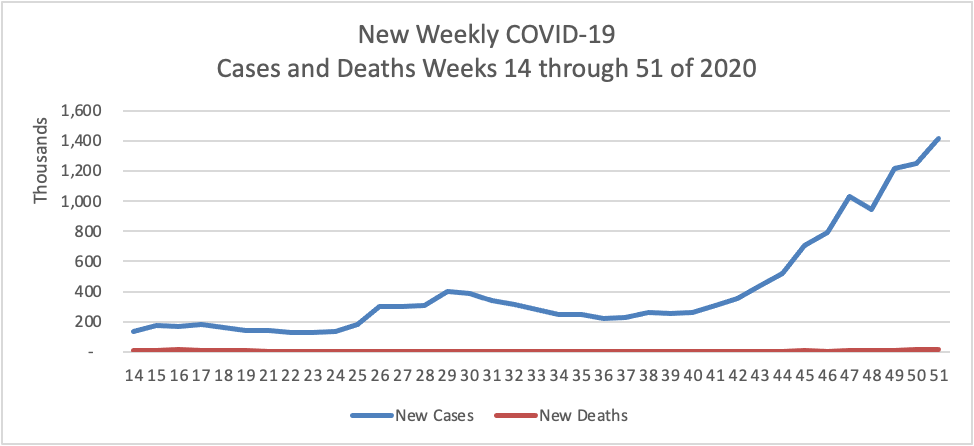
Based on the CDC’s Cases in the U.S. website, here is the FEHBlog’s chart of new weekly COVID-19 cases and deaths over the 14th through 51st weeks of this year (beginning April 2 and ending December 23; using Thursday as the first day of the week in order to facilitate this weekly update):
and here is the CDC’s latest overall weekly hospitalization rate chart for COVID-19:
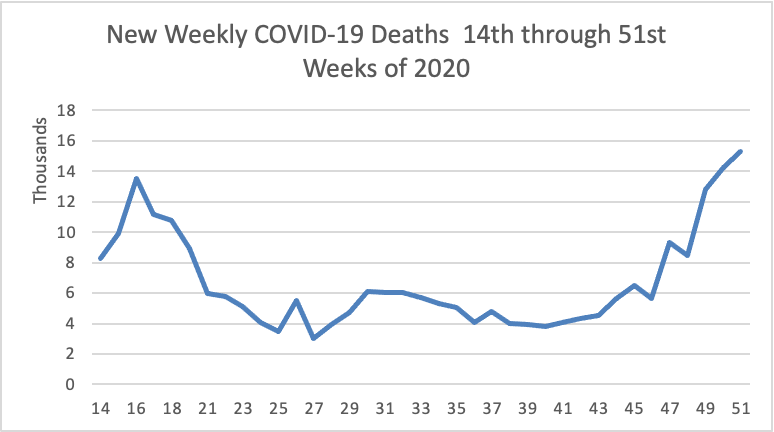
The FEHBlog has noted that the new cases and deaths chart shows a flat line for new weekly deaths because new cases greatly exceed new deaths. Accordingly here is a chart of new COVID-19 deaths over the period (April 2 through December 23):
The latest CDC FluView will be available on Monday December 28. Next week the FEHBlog will begin to include COVID vaccines in these charts.
The FEHBlog had planned to start reviewing the Affordable Care Act changes in the Consolidated Appropriations Act, 2021, but because the status of that bill unfortunately is in limbo, he instead will note two other Congressionally passed bills that are expected to receive the President’s signature:
The McCarran-Ferguson Act of 1945 “limited the application of [federal] antitrust laws to the business of insurance as long as and to the extent state law regulated the business of insurance. However, if states would not regulate insurance, the Sherman and Clayton Acts, as well the Federal Trade Commission Act still applied.” Needless to say the States with the assistance of the National Association of Insurance Commissioners made sure that the States did not unwittingly create such a regulatory gap. In any event. the McCarran- Ferguson Act continued to apply federal anti-trust law, specifically the Sherman Act of 1896, to prohibit “any agreement to boycott, coerce, or intimidate, or act of boycott, coercion, or intimidation” (15 U.S.C. Sec. 1013).
H.R. 1418 adds to the McCarran- Ferguson Act a further exception for health insurance, dental insurance and limited scope dental benefits. In other words health insurers and dental insurers will be subject to both federal and state laws against restraint of trade. The garden variety exceptions to extension of federal anti-trust law appear quite narrow to the FEHBlog.
“(A) to collect, compile, or disseminate historical loss data; (B) to determine a loss development factor applicable to historical loss data; (C) to perform actuarial services if such contract, combination, or conspiracy does not involve a restraint of trade; or (D) to develop or disseminate a standard insurance policy form.”
Matt Eyles, president of America’s Health Insurance Plans (AHIP), said in a statement about passage of H.R. 1418 that implementation of the bill would add layers of bureaucracy to health insurers and destabilize markets.
“Removal of this exemption adds tremendous administrative costs while delivering absolutely no value for patients and consumers,” Eyles said.
Consumer Reports put out a commentary welcoming passage of H.R. 1418.
“The antitrust exemption has essentially allowed health insurers to act as a monopoly, making demands in lockstep on the terms they will offer consumers and health care providers,” the advocacy organization said in a comment on bill passage. “The resulting squeeze puts pressure on providers to cut corners on service in order to increase the profits the health insurers can extract.”
How much can insurers extract when those profits are strictly regulated by the Affordable Care Act?
This bill, which the FEHBlog previously has mentioned, requires HHS’s Office for Civil Rights to consider whether the covered entity or business associate has adequately demonstrated that it had, for not less than the previous 12 months, recognized security practices in place, when imposing penalties or other remedies for HIPAA Security Rule violations.
The bill defines “Recognized security practices” to mean
the standards, guidelines, best practices, methodologies, procedures, and processes developed under section 2(c)(15) of the National Institute of Standards and Technology Act, the approaches promulgated under section 405(d) of the Cybersecurity Act of 2015, and other programs and processes that address cybersecurity and that are developed, recognized, or promulgated through regulations under other statutory authorities. Such practices shall be determined by the covered entity or business associate, consistent with the HIPAA Security rule (part 160 of title 45 Code of Federal Regulations and subparts A and C of part 164 of such title).
The bill expressly does not create liability for HIPAA covered entities and business associates which decide not to adopt such practices. The bill is retroactive to the effective date of the 21st Century Cures Act of 2016.
In other healthcare legal news:
Reuters reports that on December 23, 2020, a federal district judge in Maryland “blocked a last-minute Trump administration rule aimed at lowering drug prices as of next week. The rule, scheduled to take effect on Jan. 1, would have tied reimbursements for 50 drugs by Medicare, a U.S. government insurance program, to the lowest prices paid by certain other countries. U.S. District Judge Catherine Blake in Maryland ruled that the administration had rushed the rule without giving the public a chance to comment, in violation of federal law.” Case No. 1:20-cv-03531 (D. Md). The temporary restraining order is effective for 14 days.
The American Hospital Association, along with several other organizations, filed an emergency stay of enforcement motion to prevent the Department of Health and Human Services’ hospital price transparency rule from going into effect Jan. 1. The rule requires each hospital operating in the U.S. to make public pricing information, including the prices they negotiate with commercial health insurers. Last week, the Centers for Medicare and Medicaid issued a bulletin announcingits plans to audit a sample of hospitals for compliance with the rule starting in January.
The motion was filed with the U.S. Court of Appeals for the D.C. Circuit in its appeal of a lower court order affirming the legality of this rulemaking (Case No. 20-5193). In its opposition to this motion, the Justice Department observed that
This Court granted plaintiffs’ request for an expedited briefing and argument schedule to “allow the Court to hear and decide this case before” January 1, 2021. Pls. Mot. to Expedite, at 5 (July 3, 2020). The Court is likely to rule on the merits of this appeal imminently, thereby resolving plaintiffs’ legal challenge. Should the Court affirm the district court’s rejection of plaintiffs’ claims, plaintiffs would not be entitled to any relief, including a stay of the agency’s rule. Should the Court agree with plaintiffs’ legal challenge, by contrast, plaintiffs would be entitled to appropriate relief.
The FEHBlog will keep an eye out for this opinion next week.
The FEHBlog is taking a brief holiday hiatus until next Sunday December 27. He will leave you with this encouraging CDC news as of 9 am ET this morning:
COVID-19 Vaccinations in the United States Doses Distributed 9,465,725 People Initiating Vaccination (1st dose received) 1,008,025
Total doses distributed are cumulative counts of COVID-19 vaccine doses recorded as shipped in the Centers for Disease Control and Prevention’s (CDC) Vaccine Tracking System (VTrckS) since December 13, 2020. Cumulative totals reflect data available as of 9:00am ET on the day of reporting.
People initiating vaccination (1st dose received) are cumulative counts of individual COVID-19 vaccine first doses administered as reported to the CDC by state, territorial, and local public health agencies and five federal entities (Bureau of Prisons, Veterans Administration, Department of Defense, Department of State, and Indian Health Services) since December 14, 2020. Cumulative doses administered reflect current data available as of 9:00am ET on the day of reporting.
Doses distributed and people initiating vaccination (1st dose received) are for both Moderna and Pfizer BioNTech COVID-19 vaccine.
Not bad for 12 days since the Pfizer-BioNTech vaccine received the FDA’s emergency use authorization.
Have yourself a merry little Christmas.
We use cookies on our website to give you the most relevant experience by remembering your preferences and repeat visits. By clicking “Accept”, you consent to the use of ALL the cookies.
This website uses cookies to improve your experience while you navigate through the website. Out of these, the cookies that are categorized as necessary are stored on your browser as they are essential for the working of basic functionalities of the website. We also use third-party cookies that help us analyze and understand how you use this website. These cookies will be stored in your browser only with your consent. You also have the option to opt-out of these cookies. But opting out of some of these cookies may affect your browsing experience.
Necessary cookies are absolutely essential for the website to function properly. These cookies ensure basic functionalities and security features of the website, anonymously.
Cookie
Duration
Description
cookielawinfo-checbox-analytics
11 months
This cookie is set by GDPR Cookie Consent plugin. The cookie is used to store the user consent for the cookies in the category "Analytics".
cookielawinfo-checbox-functional
11 months
The cookie is set by GDPR cookie consent to record the user consent for the cookies in the category "Functional".
cookielawinfo-checbox-others
11 months
This cookie is set by GDPR Cookie Consent plugin. The cookie is used to store the user consent for the cookies in the category "Other.
cookielawinfo-checkbox-necessary
11 months
This cookie is set by GDPR Cookie Consent plugin. The cookies is used to store the user consent for the cookies in the category "Necessary".
cookielawinfo-checkbox-performance
11 months
This cookie is set by GDPR Cookie Consent plugin. The cookie is used to store the user consent for the cookies in the category "Performance".
viewed_cookie_policy
11 months
The cookie is set by the GDPR Cookie Consent plugin and is used to store whether or not user has consented to the use of cookies. It does not store any personal data.
Functional cookies help to perform certain functionalities like sharing the content of the website on social media platforms, collect feedbacks, and other third-party features.
Performance cookies are used to understand and analyze the key performance indexes of the website which helps in delivering a better user experience for the visitors.
Analytical cookies are used to understand how visitors interact with the website. These cookies help provide information on metrics the number of visitors, bounce rate, traffic source, etc.
Advertisement cookies are used to provide visitors with relevant ads and marketing campaigns. These cookies track visitors across websites and collect information to provide customized ads.