New U.S. Covid-19 cases declined by almost 100,000 last week to the fewest since early October, while an average of 1,326 people died of the disease each day, data compiled by Johns Hopkins University and Bloomberg show. The week’s death toll of 9,284 was the lowest since mid-November. U.S. immunization has expanded amid a growing supply of vaccines and a drive by President Joe Biden’s administration to help roll them out. The U.S. vaccination rate over the last week was about 2.5 million doses per day * * *.
Here’s a link to the CDC’s website on demographic characteristics of Americans who have received the COVID-19 vaccination(s).
HHS’s Agency for Healthcare Research and Quality is holding its annual Patient Safety Awareness Week from March 14 to March 20.
From the FEHB front
FedWeek recently informed us about how getting married affects federal employee benefits.
FedSmith and Govexec each discuss planning for coordination of benefits with FEHB and Medicare in retirement.
The Senate Homeland Security and Governmental Affairs Committee will be holding a hearing on “Understanding and Responding to the SolarWinds Supply Chain Attack: The Federal Perspective” on Thursday March 18.
Speaking of which, Bleeping Computer reports that as of March 11, 2021 “CISA officials said that, so far, there is no evidence of US federal civilian agencies compromised during ongoing attacks targeting Microsoft Exchange servers. This statement is based on information collected by federal agencies following an emergency directive issued by the US Cybersecurity and Infrastructure Security Agency (CISA) one week ago.”
Following up on this story, Cyberscoop reports that
Suspected Chinese government-linked hackers were the first to allegedly exploit the Microsoft vulnerabilities. As soon as the company released a fix for the bugs, though, taking the issue public, a range of other hacking groups also appeared to try leveraging the flaws. At least ten different advanced threat groups are working to exploit the vulnerabilities now, according to ESET research, while other hackers have stolen email data and others have tried to generate financial revenue.
But with such a large list of victims — 30,000 organizations in the U.S. alone, according to some estimates — and so many attackers trying to leverage the flaws, there is little hope for cybersecurity professionals and affected entities to keep up with the sheer volume of exploits and attackers pummeling them, analysts say. In addition to patching the holes in Microsoft technology, organizations should also be working to evict hackers from their networks, and remain on alert for data theft, credential theft and other potentially damaging follow-up attacks. Security analysts also are warning that the flaws could open the pathway for ransomware attacks, meaning that if organizations fail to act now, it could cost them later.
Here is a link to the latest CISA remedial guidance on the Microsoft vulnerabilities.
Over the last several days, Allison Nixon, the chief research officer at cybersecurity consulting firm Unit 221B, rounded up her team to develop a website that would help alert organizations if they’ve been comprised.
The Unit 221B website is designed so users can search to see if they are using compromised Exchange servers with Outlook Web Access (OWA) enabled. Users can go to the site, which launched Tuesday, directly from their Exchange server, which will allow Unit 221B to check their IP address against their victim list. Victims will then be alerted if they are compromised and if the attackers loaded webshells, a malicious tool used to establish a foothold inside targets, Nixon says.
Creating a data backup is one of the most crucial steps that organizations can take right now to protect themselves, Nixon said. Organizations that don’t make a backup of their servers but that do get hit with a ransomware attack, in which hackers lock up their machines and extort them for money, run the risk of losing their businesses entirely, Nixon warned. “It doesn’t matter if they don’t have a regular backup program, or they don’t have a fancy IT team — they just need to take a copy of their servers … put it on a hard drive, put it it in a safe: A one-time thing this week,” Nixon said.
In federal personnel news, Nextgov informs us that the U.S. Office of Personnel Managements chief information officer (CIO) Clare Martorana has been named the federal government’s CIO. Congratulations to her. OPM Principal Deputy CIO Guy Cavallo will serve as acting CIO until a permanent replacement is named, an OPM spokesperson told Nextgov.
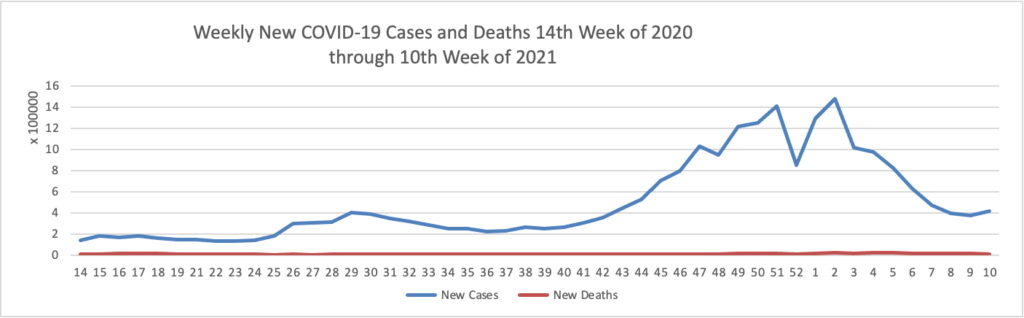
Based on the Centers for Disease Control’s COVID-19 Data Tracker website, here is the FEHBlog’s chart of new weekly COVID-19 cases and deaths over the 14th week of 2020 through 10th week of this year (beginning April 2, 2020, and ending March 10, 2021; using Thursday as the first day of the week in order to facilitate this weekly update:
and here is the CDC’s latest overall weekly hospitalization rate chart for COVID-19:
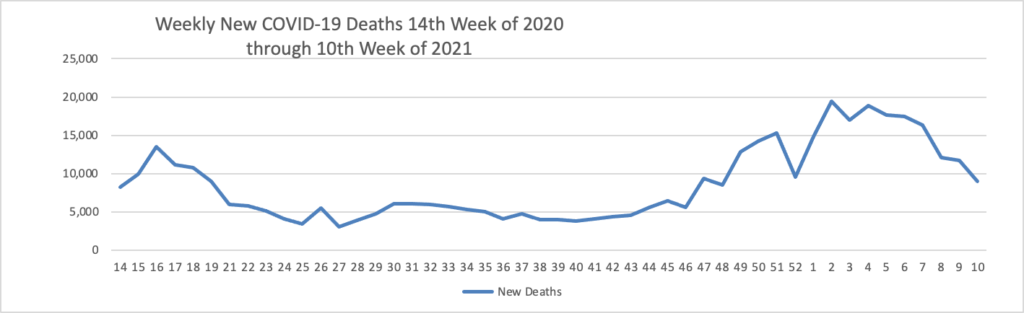
The FEHBlog has noticed that the new cases and deaths chart shows a flat line for new weekly deaths because new cases greatly exceed new deaths. Accordingly here is a chart of new COVID-19 deaths over the period (April 2, 2020, through March 10, 2021):
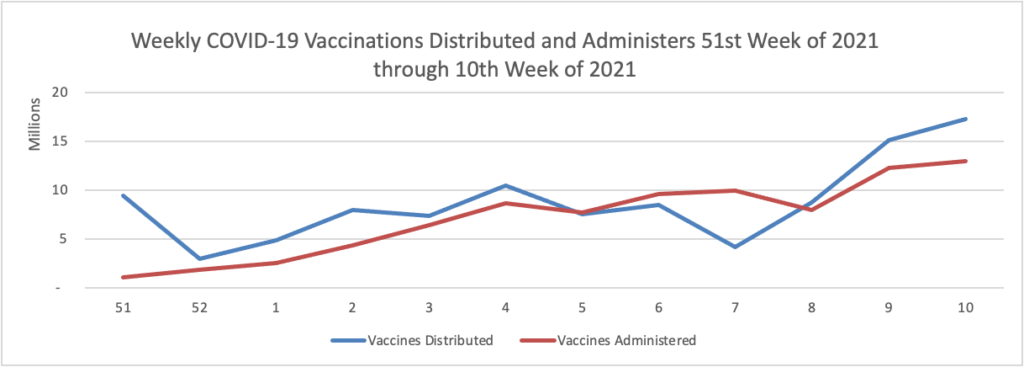
Finally here is a COVID-19 vaccinations chart over the 51st week of 2020 through the 10th week of 2021 (December 24, 2021 through March 10, 2021) which also uses Thursday as the first day of the week:
As of today, over 100 million COVID-19 vaccinations have been administered in the U.S. and just over one quarter of the eligible U.S. population has received at lease one dose of those vaccinations. And that’s before the supply problem is completed resolved. In that regard, the Department of Health and Human Services today expanded the class of medical professionals who can administer the COVID-19 vaccine.
Fortune Magazine’s editor Alan Murray conversed with Pfizer’s CEO Albert Bourla. Here are the highlights of that interview:
I asked Bourla to reflect on the anniversary. His response:
“I think it is very impressive that a year from a major disaster for humanity, we are emerging with a sense of liberation. To see the Israeli ministry of health with their data so revealing of what a vaccine can do for society—that is the best demonstration of the power of science and the power of human ingenuity.”
If you missed it, the Israeli news is here. What it shows is that the vaccine is highly effective in preventing “symptomatic” as well as “asymptomatic” infections—meaning it is highly unlikely a vaccinated person can be infected or spread infection.
I asked Bourla many of the questions people have been asking me:
Can I travel without risk, now that I’ve been vaccinated?
“Our data demonstrate efficacy from the seventh day. Everybody else demonstrated efficacy from 14 days. You are very reduced risk. Nothing is 100% in biology.”
Can I spread the disease to others?
“The Israeli minister said they saw 94% protection from asymptomatic disease. This is extremely, extremely good news.”
Is there evidence suggesting one of the new variants is not susceptible to the vaccine?
“With everything we see and know right now, we believe the current vaccine is effective against all three variants—South African, Brazilian and U.K. With the U.K., we have clinical evidence.”
Will I have to get a booster?
“I think there is a very high chance that everybody will be getting a booster annually…There are scenarios where you might need one sooner.”
People who have recovered from a COVID-19 diagnosis face potentially new diagnoses for neurological, behavioral health and cardiovascular conditions, new data from Cigna show. Cigna researchers analyzed (PDF) claims data on 150,000 commercial plan members and their family members between April and June 2020 and found that 5.8% reported neurological conditions post-COVID. In addition, 5.1% reported heart conditions such as heart failure or coronary artery disease, and 5% reported mental health disorders following a COVID-19 diagnosis, the study found.
The American Medical Association announced that “America’s physicians, pharmacists and nurses are urging their colleagues and other key health care stakeholders to intensify efforts to collect information on race and ethnicity when administering COVID-19 vaccines. “Race and ethnicity data provides critical information to clinicians, health care organizations, public health agencies and policymakers, allowing them to equitably allocate resources across all communities, evaluate health outcomes and improve quality of care and delivery of public health services,” says the open letter, sent by the AMA, American Pharmacists Association (APhA) and the American Nurses Association (ANA).
Agreed but be sure to share the information with health plans too.
The President signed the American Rescue Plan (H.R. 1319) into law today.
Mercer provides a useful overview of the provisions of the law affecting employers. The COBRA subsidy discussed in the article does not apply to the temporary continuation coverage applicable to federal and postal employees. The COBRA subsidy in any event is only available to employees who lost health coverage due to involuntary termination of employment or reduction in hours.
On the bright side, the new law “increases the income exclusion for employer-provided dependent care assistance programs — for example, employee pretax contributions to dependent care FSAs — from $5,000 to $10,500 (and from $2,500 to $5,250 for a married individual filing a separate return) for 2021.” The FEHBlog expects that OPM will adopt this FSA change because the dependent care FSA is fully funded by the employee with no insurance risk to the employer.
Katie Keith in Health Affairs digs into the law’s financial support for the Affordable Care Act marketplace and its beneficiaries.
From the COVID front —
The White House has announced that the Biden administration will seek to “make every adult in the U.S. eligible for vaccination no later than May 1.” This fact sheet explains that steps that will be taken to make good on that plan. The FEHBlog believes that this is an achievable goal.
David Leonhardt in the New York Times offers an interesting take on herd immunity from COVID-19. He explains that
Herd immunity is more like a light dimmer. The more people develop immunity — either from having been infected or from being vaccinated — the less easily the virus will spread.
Nearly 30 percent of Americans have now had the virus, according to Youyang Gu, a data scientist. (That includes many people who have never taken a Covid test.) About 18 percent have received at least one vaccine shot. There is some overlap between these two groups, which means that about 40 percent of Americans now have some protection from Covid.
Had these people been exposed to the virus a year ago, they could have become infected — and then spread Covid to others. Today, many are protected.
What’s more Mr. Leonhardt’s first dose of vaccination figure (18%) reflects the total U.S. population. However the vaccines generally are available only to people over 18 years of age. The Centers for Disease Control reports today that 25.1% of that population has received at least one dose of a COVID-19 vaccine. The FEHBlog nearly fell off his share today when he noticed a new statistic on the CDC site showing that 62.4% of the U.S. population over age 65 has received at least one dose of a COVID-19 vaccine. That’s great news.
In legislative / regulatory news —
Healthcare Dive reports that Xavier Becerra will soon receive a Senate floor vote on his nomination to serve as Secretary of Health and Human Services.
Govexec reports that “Postmaster General Louis DeJoy will soon request a $40 billion investment into the cash-strapped U.S. Postal Service for organizational and workforce improvements, saying the money will help address longstanding challenges the mailing agency faces. The funds would go toward infrastructure updates such as larger facilities and new package sortation equipment, DeJoy told a panel of the House Appropriations Committee on Thursday [March 11], and reducing turnover in the USPS workforce.”
Healthcare Dive also discusses hospital pricing information that has been gleaned from the online reports required by the federal government’s hospital pricing transparency rule. It’s not pretty.
Roll Call reports that the House of Representatives passed the Senate amended version of the $1.9 trillion American Rescue Plan (HR 1319) by a 220 to 211 vote this afternoon. The President plans to sign the bill into law on Friday March 12. Medpage Today recaps the bill’s healthcare provisions, and the Federal Times recaps its federal employment provisions.
From the healthcare front
Medscape informs us that “A one-time injection of the monoclonal antibody cocktail casirivimab with imdevimab (REGEN-COV), taken within 72 hours of a household member’s diagnosis with SARS-CoV-2, prevented 100% of COVID-19 illness, 100% of high SARS-CoV-2 viral loads, and cut length of asymptomatic infection to 1 week. ‘It’s fantastic news,’ said Rajesh Gandhi, MD, an infectious disease physician at Massachusetts General Hospital and Harvard Medical School, who has been treating people seriously ill with COVID-19 since the pandemic began a year ago in Boston. ‘For individuals who, for whatever reason, don’t get the vaccine or decline the vaccine or haven’t yet gotten the vaccine, it’s really proof that antibodies can prevent disease’ in COVID-19.”
MedPage Today reports that “Data on colorectal cancer (CRC) screening gathered over the past decade have prompted the American College of Gastroenterology (ACG) to update its guidelines, last issued in 2009. The new recommendations, published online in the American Journal of Gastroenterology,state that screening should start at age 45 for persons of average risk.”
The Centers for Medicare and Medicaid Services reminds Medicare Part B beneficiaries who are at risk for diabetes type 2 that they can “join the Medicare Diabetes Prevention Program (MDPP)—part of CDC’s National Diabetes Prevention Program—and take steps to lower your risk for type 2 diabetes by more than 70% [with the help of a health coach]. You’ll also learn the skills needed to improve your overall health and build healthy habits that last a lifetime. And if you have Medicare Part B, it’s free!”
From the regulatory front
Govexec reports that two Senate committees have approved a floor vote for President Biden’s nominee for Deputy Director of the Office of Management and Budget, Shalanda Young. As the OMB Director nominee has withdrawn, Ms. Young will take over the reins of OMB when Senate confirms her. What’s more, bipartisan calls have been made in Congress for the President to nominate Ms. Young to be OMB Director.
Modern Healthcare reminds us that the Department of Health and Human Service has a lot of regulatory work to do in order to launch the No Surprise Billing law’s protections on January 1, 2023.
In healthcare industry news, Beckers Payer Issues informs us that “UnitedHealth Group subsidiary Optum signed a definitive agreement to acquire Atrius Health, a 715-physician group based in Newton, Mass., March 1.”
Roll Call reports that “The House [of Representatives] will vote to clear the $1.9 trillion pandemic relief package for President Joe Biden’s signature on Wednesday, Majority Leader Steny H. Hoyer told reporters.”
From the COVID-19 front
Fierce Pharma informs us that “Vaccine doses are fanning out around the globe, but officials worry that surging coronavirus variants could make the immunization push less effective. Thanks to a new lab study, Pfizer and BioNTech have some good news for them. “Pfizer and BioNTech’s mRNA shot [which the FEHBlog has received] appeared to work against three worrisome variants in a lab study, researchers from both companies and the University of Texas Medical Branch wrote in the New England Journal of Medicine. That includes the P.1 variant that arose in Brazil and has raised concerns about re-infections.”
Fierce Healthcare reports ” As the COVID-19 vaccine rollout continues, payers are gearing up to play a key role in easing vaccine fears and hesitancy. At Humana, for example, this has meant connecting with members at multiple touch points over the past year, and ensuring that vaccine education was not their first conversation with their health plan during the pandemic, Chief Medical Officer William Shrank, M.D., said. “I don’t think any of our members see this as our first outreach,” Shrank said.” But bear in mind health plans better late than never.
The Society for Human Resource Management discusses how employers can take steps now to reduce pandemic fatigue in their employees.
From the general healthcare front —
The Wall Street Journal informs us that “A federal medical panel is calling for a significant expansion of CT scanning for smokers to detect lung cancer, citing studies that found the imaging studies can save more lives than previously known. The U.S. Preventive Services Task Force is advising people ages 50 to 80 to get the screening if they have smoked on average a pack of cigarettes daily for 20 years, and who currently smoke or have quit within the past 15 years. The panel’s previous recommendation, in 2013, recommended people get screened between ages 55 and 80, and have smoked the equivalent of a pack of cigarettes a day for 30 years, and currently smoke or have quit within the past 15 years.” The USPSTF recommendation will result in FEHB coverage of the CT scan for FEHBP members in the expanded group without member cost sharing in 2023.
Health Affairs helpfully reports “Bundled payment has shown promise in reducing medical spending while maintaining quality. However, its impact among commercially insured populations has not been well studied. We examined the impacts on episode cost and patient cost sharing of a program that applies bundled payments for orthopedic and surgical procedures in a commercially insured population. The program we studied negotiates preferred prices for selected providers that cover the procedure and all related care within a thirty-day period after the procedure and waives cost sharing for patients who receive care from these providers. After implementation, episode prices for three selected surgical procedures declined by $4,229, a 10.7 percent relative reduction. Employers captured approximately 85 percent of the savings, or $3,582 per episode (a 9.5 percent relative decrease), and patient cost-sharing payments decreased by $498 per episode (a 27.7 percent relative decrease).” Interesting.
Health Payer Intelligence discusses how payers can take action against racial and ethnic healthcare disparities. Because “the payer industry’s core function is to pay for medical care, insurers can play a key role in overturning local care disparities through their payment strategies, offering funds to organizations that reduce disparities, and by spending locally in a way that is conscious of systemic inequities by purchasing from black and minority-owned businesses,” [Kedar] Mate [president and chief executive officer at the Institute for Healthcare Improvement (IHI), president of the IHI Lucian Leape Institute, and a member of the faculty at Weill Cornell Medical College] said.
From the healthcare industry front
Forbes informs us that “In the largest advertising blitz ever undertaken by the health insurance lobby, America’s Health Insurance Plans will spend at least $10 million on a national education campaign to show how health plans are ‘are working together to deliver affordable and accessible care and coverage.’”
Fierce Healthcare explains that “If there was one key word to come out of Cigna’s investor day on Monday [March 8], it would be “growth.” The insurer spotlighted its ambitions to expand across its enterprise, from its insurance plans to pharmacy to digital tools, at the virtual event for investors Monday morning. CEO David Cordani said that its growth plans “fuel our purpose.”
Fierce Healthcare also reports that “COVID-19 accelerated a number of trends already brewing in the healthcare industry, and that’s not likely to change this year, according to a new report from CVS Health. The healthcare giant released its annual Health Trends Report on Tuesday [March 9], and the analysis projects several industry trends that are likely to define 2021 in healthcare, ranging from technology to behavioral health to affordability. “We are facing a challenging time, but also one of great hope and promise,” CVS CEO Karen Lynch said in the report. “As the pandemic eventually passes, its lessons will serve to make our health system more agile and more responsive to the needs of consumers.”
Drug Channels lists that fifteen largest U.S. pharmacy chains in terms of market share and revenue. CVS Health leads the pack.
From the regulatory front, the Department of Health and Human Services’ Office for Civil Rights (“OCR”) announced today “a 45-day extension of the public comment period for the Notice of Proposed Rulemaking (NPRM) to modify the Health Insurance Portability and Accountability Act (HIPAA) Privacy Rule. OCR first released the NPRM to the public on the HHS website on December 10, 2020, and it was published in the Federal Register on January 21, 2021. The 45-day extension moves the current deadline for the public to submit comments from March 22, 2021, to May 6, 2021. The notice of extension of the comment period is available at https://public-inspection.federalregister.gov/2021-05021.pdf – PDF.” The FEHBlog is pleased that the Biden Administration is giving serious consideration to this proposed rule.
The House [of Representatives] looked on track to pass the latest version of the $1.9 trillion coronavirus relief package later this week, as liberal Democrats swallowed their frustration with the Senate’s changes and prepared to approve the bill for a second time.
The House is expected to narrowly pass the bill Tuesday or Wednesday, sending it to the White House for President Biden’s signature. House Majority Leader Steny Hoyer (D., Md.) had initially said the House would take its first procedural vote on the bill Monday, but processing the bill’s Senate paperwork pushed the vote slightly later in the week, aides said.
In COVID-19 news
The Centers for Disease Control today released guidance for those who are fully vaccinated against the disease (meaning two weeks after the final dose).
The Biden Administration announced “an effort to invest $250 million to encourage COVID-19 safety and vaccination among underserved populations. The U.S. Department of Health and Human Services (HHS) Office of Minority Health (OMH) will offer the funding as health literacy grants to localities, who will partner with community-based organizations, to reach racial and ethnic minority, rural and other vulnerable populations. The new initiative – Advancing Health Literacy to Enhance Equitable Community Responses to COVID-19 – is expected to fund approximately 30 projects in urban communities and 43 projects in rural communities for two years. “
The Food and Drug Administration has given emergency use authorization for “the Cue COVID-19 Test for Home and Over The Counter (OTC) Use. The product is a molecular nucleic acid amplification test (NAAT) that is intended to detect genetic material from SARS-CoV-2 virus present in the nostrils. The test is the first molecular test authorized for at-home use without a prescription.” Here’s a link to the Cue Health website.
In other healthcare news —
Healthcare Dive reports that “for the first time since Fair Health started tracking monthly telehealth claims, COVID-19 became one of the top five diagnoses in the U.S. in December as cases surged, the nonprofit said in a report released Thursday. Overall, telehealth claim lines increased 2,817% year over year, rising from just 0.22% of all medical claim lines in December 2019 to 6.51% in December 2020. Mental health conditions continue to be the No. 1 telehealth diagnosis nationwide.” It’s the last sentence that caught the FEHBlog’s attention.
Benefits Pro writes about the important role that employers and their health plans can help in reducing employee obesity issues. “’Overweight and obesity, which require a comprehensive approach, are top health concerns for employers around the world,’ said Ellen Kelsay, president and CEO of Business Group on Health. ‘Employers play a major part in offering quality health care, understanding obesity’s inextricable link to mental health, lessening the stigma surrounding it and addressing some of the social determinants of health.’ By 2025, one in five adults worldwide will be affected by obesity, according to the organization’s new report, ‘The Global Landscape for Overweight and Obesity: A Guide for Employers.’ As overweight and obesity rates surge worldwide, large employers are positioned to address the chronic medical conditions on multiple fronts, the report said.”
The New York Times reports that “When the pandemic struck last year, many Americans rushed to stock up on alcohol, causing retail sales of wine, beer and liquor to surge across the country. But the uptick in sales was a worrying sign for health experts focused on cancer prevention. In recent years, a growing number of medical and public health groups have introduced public awareness campaigns warning people to drink with caution, noting that alcohol is the third leading preventable cause of cancer, behind tobacco and obesity. * * * [Consumer S]urveys continue to show that most people remain unaware of the risks. When the American Institute for Cancer Research surveyed Americans two years ago to gauge their awareness of different cancer risk factors, the results were striking: fewer than half were aware of the alcohol-cancer link.”
The House of Representatives and the Senate will be engaged in committee and floor work this coming week. Fierce Healthcare reports on healthcare provisions found in the Senate passed American Rescue Plan bill.
Under current law, anyone making 400% above the federal poverty level are not eligible for subsidies to pay down the cost of insurance.
However, under the legislation, anyone making 400% above the poverty level won’t have to pay more than 8.5% of their income on health insurance.
The bill would also ensure that low-income customers won’t have to pay anything for their coverage.
Currently, those making 150% above the poverty level pay no more than 4.3% of their income on healthcare. But the legislation would make their coverage fully subsidized.
The legislation would also offer premium assistance to cover up to 100% of COBRA costs for eligible individuals and families through the end of September.
Another change in the Senate version from the House concerns the removal of a cap on the Medicaid drug rebate, changing the removal of the cap to 2024 instead of 2023. The removal of the rebate cap, which kicks in at 100% of a drug’s average manufacturing price, will lead to higher rebates for Medicaid drugs.
The $1.9 trillion Covid-19 relief bill returns to the House of Representatives this week, where lawmakers will gear up for a vote as soon as Tuesday on the package following narrow approval Saturday by the Senate that came only after concessions to moderate Democrats.
The Senate changes to the bill, which first passed the House Feb. 27 with more generous unemployment provisions, mean House Speaker Nancy Pelosi must hold together her slim majority caucus for a second House vote to send President Biden’s top legislative priority to his desk.
The House is expected to hold a procedural vote on the bill Monday night, with final passage slated for Tuesday.
Speaking of the Affordable Care Act marketplace, Katie Keith updates on the successful first two weeks of the ongoing marketplace special enrollment period.
In other healthcare news
Bloomberg reports on developing approaches to overcome COVID-19 hesitancy. “To do that, officials must make the process of getting shots easier, and fight misinformation about the vaccines, concerns about the speed of development and distrust of government and health-care institutions.” As of today, 23% of the eligible U.S population has received at least one dose of the COVID-19 vaccine. The FEHBlog noticed today that the Johnson & Johnson single dose vaccine is now being administered at the Maryland mass vaccination sites in Baltimore and Waldorf. It strikes the FEHBlog that the single dose vaccine will be more attractive to the hesitant.
NPR Shots offers a physician’s take on five types of medical visits that you should stop putting off. “Emerging evidence tells us that the health threats from postponing some tests and exams — including those for cancer and heart disease, but other crucial appointments too — outweigh the risk of running into the coronavirus at a doctor’s visit, even if the virus is prevalent in your community.”
Rep. Michael McCaul (R-Texas) announced that he and Rep. Jim Langevin (D-R.I.), both members of the House Homeland Security Committee are working on a bill that would establish the Cybersecurity and Information Security Agency as a kind of 911 for breach notification. McCaul said his legislation is designed to protect companies from repercussions in the market by removing sources and methods and company names out of reporting. “It would just simply send a threat information itself to CISA so that they could deal both industrywide and federal government wide and state, the threat information they would need to address it on a larger scale,” McCaul said at a joint hearing of the House Committee on Oversight and Reform and the House Homeland Security Committee on Feb. 26.
Speaking of CISA, last Wednesday March 3, CISA issued an emergency directive 21-02 “requiring federal civilian departments and agencies running Microsoft Exchange on-premises products to update or disconnect the products from their networks until updated with the Microsoft patch.” According to the Wall Street Journal this action stems from
A cyberattack on Microsoft Corp.’s MSFT 2.15% Exchange email software is believed to have infected tens of thousands of businesses, government offices and schools in the U.S., according to people briefed on the matter.
Many of those victims of the attack, which Microsoft has said was carried out by a network of suspected Chinese hackers, appear to be small businesses and state and local governments. Estimates of total world-wide victims were approximate and ranged broadly as of Friday. Tens of thousands of customers appear to have been affected, but that number could be larger, the people said. It could be higher than 250,000, one person said.
While many of those affected likely hold little intelligence value due to the targets of the attack, it is likely to have netted high-value espionage targets as well, one of the people said.
The White House is moving forward with an executive order to encourage software developers to build more security into their products as the investigation of a suspected Russian supply chain compromise continues, a top security official said Friday [March 5]. The upcoming directive “will focus on building in standards for software, particularly software that’s used in critical areas,” Anne Neuberger, the deputy national security adviser for cyber and emerging technology, said at the SANS Institute’s ICS Security Summit. “The level of trust we have in our systems has to be directly proportional to the visibility we have. And the level of visibility has to match the consequences of the failure of those systems.”
Microsoft and FireEye on Thursday [March 4] revealed three more malware strains associated with the suspected Russian perpetrators who breached SolarWinds’ Orion software and used its update to infect federal agencies and major companies. FireEye named one strain Sunshuttle in a blog post. In a separate blog post, Microsoft dubbed two more strains GoldFinder and Sibot, and labeled the strain FireEye called Sunshuttle as GoldMax Microsoft said the strains join the previously known SolarWinds hacker tools Sunburst and Teardrop.
Fortune discusses the nascent use of contact tracing in cybersecurity processes.
A concept called Sightings has been gaining traction in the security community, largely at the academic level, for the past few years. The idea is for organizations to be able to share details of how they were attacked and what was targeted—the who, what, and when—as quickly as possible with other organizations.
This concept could help organizations identify breaches sooner and remediate faster and more effectively. Through sharing, attack techniques could be more thoroughly understood, and with the right reporting mechanism, the resulting threat intelligence could be shared to help more organizations avoid a breach in the first place. MITRE, a leading not-for-profit research organization, is working on incorporating Sightings concepts into a security reporting process that would let breach victims share appropriate data in a secure, anonymized way to benefit the wider community.
Beyond this threat intelligence application, organizations could use this sort of contact tracing approach for their own internal investigations. Data contact tracing can dramatically reduce the time it takes to discover how far into their networks an attacker has penetrated, and identify where related systems in their supply chains, customers, and partner networks have also been compromised.
Cyberattacks on healthcare more than doubled in 2020, with ransomware accounting for 28 percent of all attacks. COVID-19 response efforts, including personal protective equipment and the vaccine supply chain were the largest focus of these targeted campaigns, according to the latest IBM X-Force report.
Nearly one out of four of overall cyberattacks last year were ransomware, while the increase in data extortion efforts enabled just one of these ransomware hacking groups to make over $123 million in profits in 2020.
The annual report is generated through insights and observations from monitoring more than 150 billion security events per day in more than 130 countries. Researchers also gathered and analyzed data from multiple sources within IBM, including data from Quad9 and Intezer.
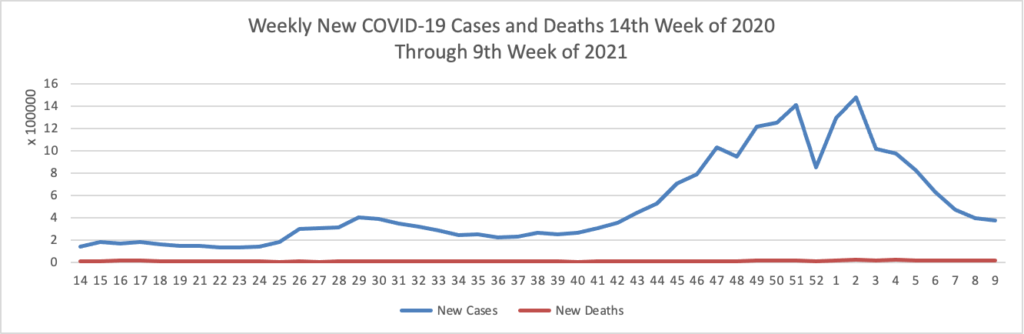
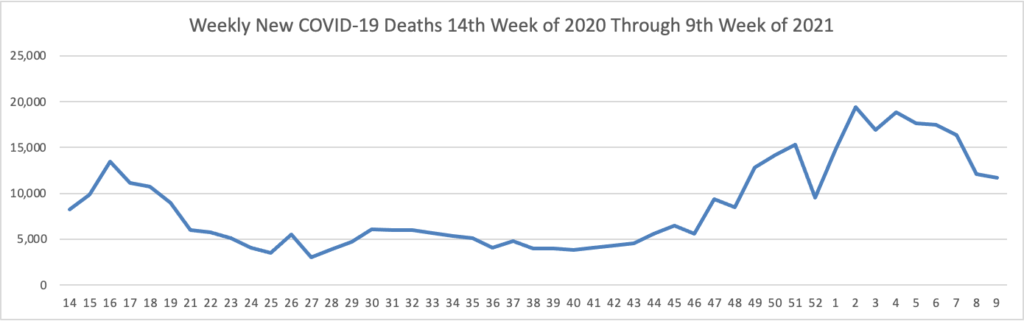
Based on the Centers for Disease Control’s COVID-19 Data Tracker website, here is the FEHBlog’s chart of new weekly COVID-19 cases and deaths over the 14th week of 2020 through 9th week of this year (beginning April 2, 2020, and ending March 3, 2021; using Thursday as the first day of the week in order to facilitate this weekly update):
and here is the CDC’s latest overall weekly hospitalization rate chart for COVID-19:
The FEHBlog has noticed that the new cases and deaths chart shows a flat line for new weekly deaths because new cases greatly exceed new deaths. Accordingly here is a chart of new COVID-19 deaths over the period (April 2, 2020, through March 3, 2021):
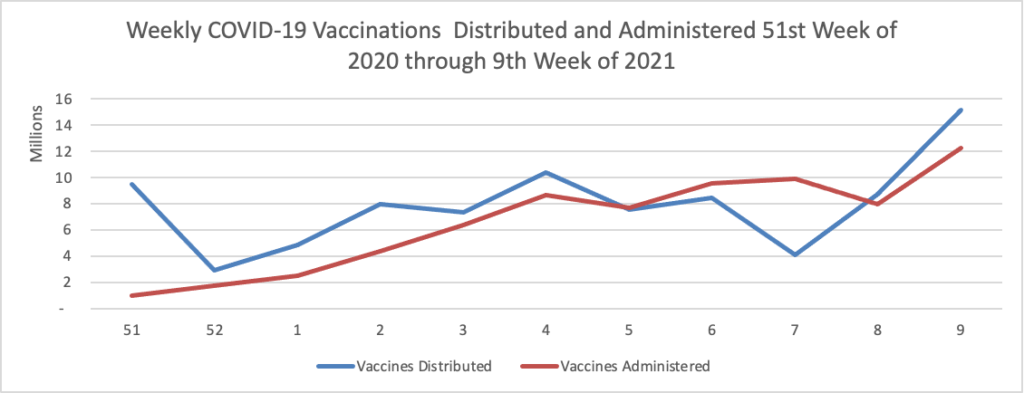
Finally here is a COVID-19 vaccinations chart since mid-December 2020 which also uses Thursday as the first day of the week:
These are all encouraging charts. The CDC reports that as of today 21.7% of eligible Americans (over age 18) have received at least one dose of the COVID-19 vaccine and 11.2% of received two doses.
The CDC’s FluView continues to report that “Seasonal influenza activity in the United States remains lower than usual for this time of year.”
A new study on the topic in JAMA Cardiology is based on the screening of 789 professional athletes who tested positive for Covid-19 between May and October in Major League Baseball, Major League Soccer, the National Hockey League, National Football League, and the men’s and women’s National Basketball Association.
The paper shows that 0.6% of those athletes ultimately had findings suggestive of inflammatory heart disease. Five athletes were held out of competition because of their cardiac results. Three had myocarditis, which is heart inflammation, and two had pericarditis, which is swelling of the tissue that surrounds the heart. All had had moderate cases of Covid.
The findings suggest that long-term heart complications in non-severe Covid cases are unlikely—and that sports leagues are still likely to continue with cardiac screenings during the pandemic.
Govexec offers an interesting interview with National Institutes of Health Director Dr. Francis Collins.
We use cookies on our website to give you the most relevant experience by remembering your preferences and repeat visits. By clicking “Accept”, you consent to the use of ALL the cookies.
This website uses cookies to improve your experience while you navigate through the website. Out of these, the cookies that are categorized as necessary are stored on your browser as they are essential for the working of basic functionalities of the website. We also use third-party cookies that help us analyze and understand how you use this website. These cookies will be stored in your browser only with your consent. You also have the option to opt-out of these cookies. But opting out of some of these cookies may affect your browsing experience.
Necessary cookies are absolutely essential for the website to function properly. These cookies ensure basic functionalities and security features of the website, anonymously.
Cookie
Duration
Description
cookielawinfo-checbox-analytics
11 months
This cookie is set by GDPR Cookie Consent plugin. The cookie is used to store the user consent for the cookies in the category "Analytics".
cookielawinfo-checbox-functional
11 months
The cookie is set by GDPR cookie consent to record the user consent for the cookies in the category "Functional".
cookielawinfo-checbox-others
11 months
This cookie is set by GDPR Cookie Consent plugin. The cookie is used to store the user consent for the cookies in the category "Other.
cookielawinfo-checkbox-necessary
11 months
This cookie is set by GDPR Cookie Consent plugin. The cookies is used to store the user consent for the cookies in the category "Necessary".
cookielawinfo-checkbox-performance
11 months
This cookie is set by GDPR Cookie Consent plugin. The cookie is used to store the user consent for the cookies in the category "Performance".
viewed_cookie_policy
11 months
The cookie is set by the GDPR Cookie Consent plugin and is used to store whether or not user has consented to the use of cookies. It does not store any personal data.
Functional cookies help to perform certain functionalities like sharing the content of the website on social media platforms, collect feedbacks, and other third-party features.
Performance cookies are used to understand and analyze the key performance indexes of the website which helps in delivering a better user experience for the visitors.
Analytical cookies are used to understand how visitors interact with the website. These cookies help provide information on metrics the number of visitors, bounce rate, traffic source, etc.
Advertisement cookies are used to provide visitors with relevant ads and marketing campaigns. These cookies track visitors across websites and collect information to provide customized ads.