Monday Roundup

Monday Roundup

Photo by Sven Read on Unsplash

The Senate’s bipartisan infrastructure bill cleared a cloture vote last night. The Senate is expected to pass it by tomorrow. Roll Call reports on the $3.5 trillion “human infrastructure” related budget reconciliation bill that the Congressional Democrat leadership unveiled today.

In Delta variant news

  • Federal News Network informs us that “The Defense Department is taking actions to make COVID-19 vaccines mandatory for service members by mid-September, or once the vaccines gets licensure from the Food and Drug Administration, whichever comes first.”
  • The New York Times reports that long COVID is now afflicting children. “Studies estimate long Covid may affect between 10 percent and 30 percent of adults infected with the coronavirus. Estimates from the handful of studies of children so far range widely. At an April congressional hearing, Dr. Francis Collins, director of the National Institutes of Health, cited one study suggesting that between 11 percent and 15 percent of infected youths might ‘end up with this long-term consequence, which can be pretty devastating in terms of things like school performance.’” Quite troubling. All the more reason to accelerate vaccinations for children.
  • In this regard, the Wall Street Journal reports that “As the highly contagious Delta strain tears through the country, the trends thus far suggest vaccines can turn Covid-19 into a less dangerous, more manageable disease. “Vaccines definitely make a difference,” said David Dowdy, an epidemiologist at the Johns Hopkins Bloomberg School of Public Health.A Wall Street Journal analysis shows sharp geographic divides in vaccination and hospitalization levels, with every state that has an above-average vaccine rate showing below-average hospitalizations, including in well-vaccinated New England. In the South, meanwhile, fewer people are vaccinated on average and hospitalization rates are climbing faster.” Lesson hopefully learned.

From the second quarter financials report front, Fierce Healthcare tells us that “Kaiser Permanente reported $3 billion in net income for the second quarter of the year as membership in its health plan remains steady. The health system and insurer posted total operating revenues of $23.7 billion against total operating expenses of $23.3 billion. The revenue was slightly above the $22.1 billion it earned in the second quarter of 2020. Kaiser noted in its earnings statement Friday that favorable financial market conditions resulted in $3 billion in net income, compared with $4.5 billion for the second quarter of 2020.”

From the No Surprises Act front, a friend of the FEHBlog pointed out to him that a second NSA rule has been pending at the Office of Information and Regulatory Affairs (“OIRA”) for the past month:

AGENCY: HHS-CMS          RIN: 0938-AU61   Status: Pending Review
TITLE: Reporting Requirements Related To Air Ambulance and Agent and Broker Services and HHS Enforcement Provisions (CMS-9907)
STAGE: Proposed Rule   ECONOMICALLY SIGNIFICANT: Yes
RECEIVED DATE: 07/07/2021        LEGAL DEADLINE: Statutory

In other news —

  • Health Day tells about a severe blood shortage that is adversely affecting U.S. hospitals. “‘A blood shortage is when we have demand outpacing our supply,’ noted Paul Sullivan, senior vice president of donor services for the American Red Cross. ‘Usually it’s around some challenging period of the year. The beginning of summer, end-of-year holidays. And obviously we work hard to try to plan for those times.’ But this time is different, Sullivan said, with the COVID-19 pandemic and its fallout triggering a huge spike in hospital demands for blood. The result is a critical blood shortage that’s now seven weeks long and counting.” The article concludes “There’s more on the blood shortage and blood donations at the American Red Cross.”
  • In good news, Health Leaders Media reports that “The years-long effort to reduce unnecessary Cesarean section births in the United States is coming to fruition, an obstetrics expert says. Complications from C-sections such as hemorrhaging are widely considered to be a contributing factor to the country’s high maternal mortality rate. The federal Centers for Disease Control and Prevention have been monitoring maternal mortality since 1986. The number of pregnancy-related deaths has risen steadily since the monitoring effort began, from 7.2 deaths per 100,000 live births in 1987 to 18.0 deaths per 100,000 live births in 2014. “We are finally at the point where most hospitals are sharing their data and having conversations on an individual basis about C-section rates. We are having conversations about quality at labor and delivery units as well as about the quality of individual providers. It has taken more than a decade to get to this point,” says Amy VanBlaricom, MD, vice president of clinical operations for western states at Greenville, South Carolina-based Ob Hospitalist Group.”


Weekend update

Photo by Dane Deaner on Unsplash

The Senate remains in session for Committee and floor business while the House of Representatives remains on its District work break. Politico reports from the Senate floor that

The bipartisan infrastructure deal embraced by President Joe Biden and shaped by a gang of 10 senators is inching closer to clearing the chamber, with one more filibuster to clear on Sunday before the bill can pass later this week and land in the the House. * * *

[House Speaker] Pelosi and Senate Majority Leader] Schumer have devised a two-track process to enact as much of Biden’s domestic agenda as possible, pledging that the bipartisan infrastructure bill will only advance if it is married to the party-line legislation that will spend as much as $3.5 trillion on climate change action, paid leave policies and health care expansion. 

The Senate will immediately proceed to a budget setting up that massive bill on filibuster-proof ground after it completes its work on the bipartisan infrastructure bill. Schumer is also considering forcing votes on more elections legislation after Democrats’ sweeping overhaul plan failed in June.

From the Delta variant front

  • The CDC’s COVID Data Tracker informs us today that just over two thirds of Americans over age 12 and 90% of Americans over 65 have received at least one dose of a COVID-19 vaccine. The data tracker consistently has shown a 10% difference between one dose and fully vaccinated Americans which indicates to the FEHBlog that people follow through a get the second dose.
  • However, the Wall Street Journal reports about how neighbor deaths from unvaccinated neighbors has caused an Arkansas town to reconsider their reluctance to receive the COVID-19 vaccine. Another Journal article adds that “Top U.S. public-health officials on Sunday [August 8] voiced support for Covid-19 vaccination mandates imposed at the local level, while the head of a national teachers union also backed such a move in schools.”
  • Speaking of mandates, the FEHBlog found a link to the Safer Federal Workers Task Force FAQs on the Biden Administration’s vaccine screening program for federal employees, federal office visitors and on-site contractors that were released last Friday August 6. Interestingly, an FAQ indicates that

Q: Do agencies need to ask employees on maximum telework or remote workers about their vaccination status?

A: Yes, agencies should provide the Certification of Vaccination form to all employees, including employees on maximum telework and remote workers.

Healthcare Dive informs us about

  • Five intriguing panels at this week’s in-person HIMSS conference in Las Vegas.
  • A new survey conducted by Social Sciences Research Solutions for the Bipartisan Policy Center [that] concludes that telehealth is likely an ongoing viable option for consumers even after the COVID-19 pandemic winds down.
  • An overview of second quarter financial reports from health insurers.

The Biden Administration to its credit has proposed a rule rescinding the Trump Administration’s rule to establish a most favored nation pricing approach for Medicare Part B covered drugs.

Govexec reports on a recent Postal Service Board of Governors meeting attended by the three recently confirmed members whom President Biden had nominated. “The tenure of the U.S. Postal Service’s newest board members got off to a tense start on Friday as President Biden’s appointees voiced their displeasure with the agency’s direction and USPS’ leader stated he will still move forward with reforms.”

Cybersecurity Saturday

Security Week informs us that the infrastructure spending bill currently under U.S. Senate consideration includes

approximately $2 billion to “modernize and secure federal, state, and local IT and networks; protect critical infrastructure and utilities; and support public or private entities as they respond to and recover from significant cyberattacks and breaches.”

The bill, which contains more than 300 occurrences of the words “cyber” and “cybersecurity,” includes the Cyber Response and Recovery Fund, which provides $20 million per year until 2028 for assisting government and private sector organizations respond to cyber incidents.

A total of $550 million has been allocated to enhancing the security of the power grid. Some of the money is for developing solutions to identify and mitigate vulnerabilities, improve the security of field devices and control systems, as well as addressing issues related to workforce and supply chains.

The Washington Post adds that the “Senate Democrats and Republicans cleared another key procedural hurdle Saturday [August 7] on a roughly $1 trillion bill to improve the country’s infrastructure, though disagreements continue to plague lawmakers and prevent the measure’s swift passage.”

Nextgov informs us that

The Cybersecurity and Infrastructure Security Agency will work with agency stakeholders and new private-sector partners to minimize the risk of cyber incidents and better coordinate defensive actions if successful attacks occur under a new effort announced Thursday [August 5].

The Joint Cyber Defense Collaborative, or JCDC, will aim to take a proactive approach to cyber defense in the wake of several high-profile breaches that affected the federal government and public, according to CISA Director Jen Easterly. * * *

Initial industry partners include Amazon Web Services, AT&T, CrowdStrike, FireEye Mandiant, Google Cloud, Lumen, Microsoft, Palo Alto Networks and Verizon. * * *

Current government partners in the effort thus far include the Department of Defense, U.S. Cyber Command, the National Security Agency, the Department of Justice, the Federal Bureau of Investigation and the Office of the Director of National Intelligence. 

Here is a link to the JCDC’s website. The NextGov article indicates that the JCDC’s initial focus will be on ransomware.

According to Bleeping Computer’s The Week in Ransomware

If there is one thing we learned this week, it’s that not only are corporations vulnerable to insider threats but so are ransomware operations.

The LockBit 2.0 ransomware is now trying to recruit corporate insiders to help them breach networks. In return, the insider is promised millions of dollars.

On the flip side, ransomware operations are vulnerable too. Yesterday, after being banned from the Conti ransomware operation, a Conti affiliate leaked the training material for the ransomware operation on the XSS hacking forum, giving security researchers and defenders an inside look at the tools being used by the group.

ZDNet advocates “Constant review of third-party security critical as ransomware threat climbs.”

Cyberscoop reports

The Biden administration backed away from the idea of banning ransomware payments after meetings with the private sector and cybersecurity experts, a top cybersecurity official said Wednesday [August 4].

“Initially, I thought that was a good approach,” Anne Neuberger, deputy national security adviser for cyber and emerging technology, said at an Aspen Security Forum event. “We know that ransom payments are driving this ecosystem.”

Experts, including former government officials serving on a non-profit ransomware task force, helped shift that view, following high-profile hacks against Colonial Pipeline, the food production company JBS and Kaseya, a Florida-based IT firm. Payments from the Colonial Pipeline and JBS attacks totaled more than $15 million, a number that likely represents a fraction of the funds sent to extortionists.

“We heard loud and clear from many that the state of resilience is inadequate, and as such, if we banned ransom payments we would essentially drive even more of that activity underground and lose insight into it that will enable us to disrupt it,” she said.

The FEHBlog has registered for a free Public Contract Institute webinar on Data Abduction: Combatting and Limiting Ransomware Risks. Here is a link to the registration page.

Finally this past week the National Institute of Standards and Technology released for public comments draft revisions to existing relevant Standard Publications:

The public comment deadline is October 1, 2021, for SP 800-53 and September 20, 2021 for SP 800-160.

Friday Stats and More

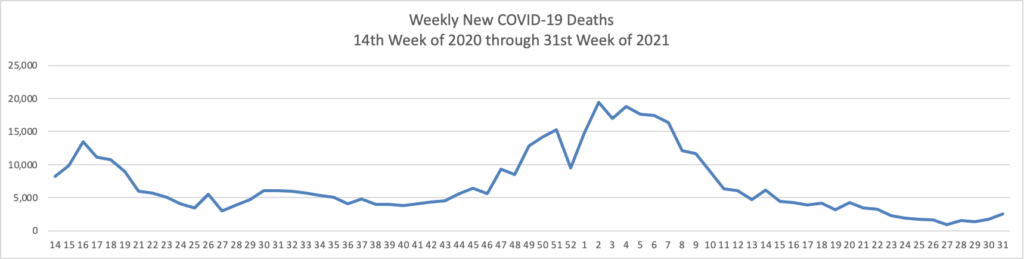
Based on the Centers for Disease Control’s COVID-19 Data Tracker website, here is the FEHBlog’s chart of new weekly COVID-19 cases and deaths over the 14th week of 2020 through 31st week of this year (beginning April 2, 2020, and ending August 4, 2021; using Thursday as the first day of the week in order to facilitate this weekly update):

and here is the CDC’s latest overall weekly hospitalization rate chart for COVID-19:

The FEHBlog has noticed that the new cases and deaths chart shows a flat line for new weekly deaths  because new cases significantly exceed new deaths. Accordingly here is a chart of new COVID-19 deaths over the period (April 2, 2020, through August 4, 2021):

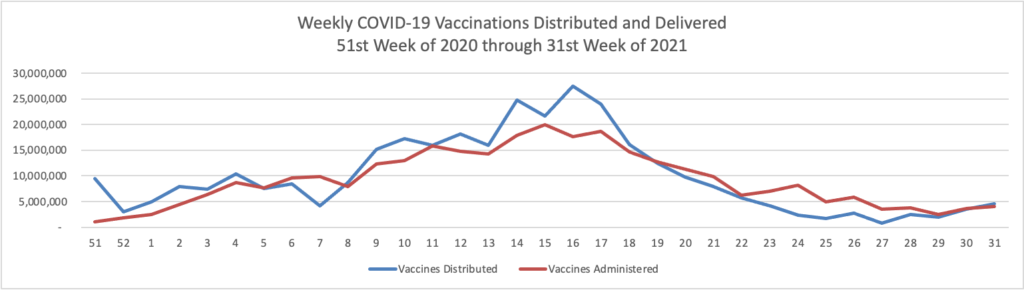
Finally here is a COVID-19 vaccinations chart over the period December 17, 2020, through August 24, 2021, which also uses Thursday as the first day of the week:

While COVID-19 cases are soaring, the number of deaths remains stable thanks to the high vaccination rates for Americans over age 65. It is also encouraging that the number of administered vaccinations also is increasing.

In other Delta variant news:

  • Surprisingly, according to STAT News, “with nearly 20% of all U.S. Covid cases last week recorded in children, the American Academy of Pediatrics and 11 other organizations put out a consensus statement this week calling on providers conducting sports physicals to ask about children’s Covid vaccination status and to use it as an opportunity to administer a vaccine, if possible.”
  • Fierce Pharma tells us that “In a trial of nearly 480,000 healthcare workers in South Africa, Johnson & Johnson‘s one-dose vaccine helped prevent severe disease from the Delta variant, Bloomberg reports. The trial is the first piece of large-scale evidence that shows the shot works against the variant, the news service stated. In fact, Glenda Gray, one of the leaders of the work, said the vaccine may provide better protection against Delta than the Beta variant.”
  • MedPage Today reports that “Unvaccinated adults who were previously infected with COVID-19 were twice as likely to be reinfected as those previously infected but also fully vaccinated, researchers found. A case-control study in Kentucky found a more than two times higher risk of COVID-19 cases among unvaccinated adults with prior infection compared with their fully vaccinated counterparts (OR 2.34, 95% CI 1.58-3.47), reported Alyson Cavanaugh, PhD, of the CDC, and colleagues, writing in an early edition of the Morbidity and Mortality Weekly Report.
  • In related news Precision Vaccines tells us that “The World Health Organization (WHO) issued Influenza Update N° 399 on August 2, 2021, saying, ‘Globally, despite continued or even increased testing for influenza in some countries, influenza activity remained at lower levels than expected for this time of the year.'”

From the No Surprises Act (“NSA”) front, the FEHBlog discovered today that last Tuesday the tri-agencies and OPM submitted their second NSA interim final rule, which concerns the independent dispute resolution process, to OMB’s Office of Information and Regulatory Affairs for final review. OIRA already has two listening sessions concerning this rule making on its calendar. This indicates that the second interim final rule will be made public in early September, rather than on its October 1, 2021, due date.

From the federal employee front

  • Govexec brings us up to date on the development of the President’s mandatory vaccination program for federal employees. “The Safer Federal Workforce Task Force—a group President Biden created by executive order that is led by the White House, General Services Administration and Office of Management and Budget—confirmed in new guidance agencies would not initially ask for proof of vaccination, but they could follow up for documentation if they receive “a good faith allegation that strongly suggests” an employee lied on their attestation form. Those “certification of vaccination” forms will soon go out via email to all federal employees, with an Office of Management and Budget official saying that process will begin next week.  While agencies will initially rely on the honor system as it begins asking employees for their vaccination status, the administration made clear there could be consequences for lying.”
  • Govexec also discusses how Medicare Advantage plans are being integrated into FEHB plans. The trend started with HMOs and the APWU Health Plan picked it up for this year. Expect more plans to follow suit for 2022.  

In more news

  • Earlier this week, the FEHBlog noted a Reuters report that the Justice Department is preparing to file suit to block Optum’s acquisition of Change Healthcare. Fierce Healthcare reports today au contraire that “Change Healthcare President and CEO Neil de Crescenzo said Thursday he’s pleased with the company’s progress on regulatory review of its pending deal with Optum and is moving forward with plans for a successful integration. ‘We look forward to continuing to work diligently in coordination with UHG (UnitedHealth Group) to provide the necessary information requested by the DOJ (Department of Justice) and completing the transaction.'” Time will tell.
  • Medcity News informs us that “GoodRx struck a partnership with medication data giant Surescripts that would let healthcare providers access cash price information on medications. Arlington, Virginia-based Surescripts dominates the e-prescribing market, offering technology that routes clinicians’ electronic prescriptions directly to pharmacies. It’s owned by CVS Health and Express Scripts, and nearly 2 billion prescriptions were delivered through its software last year.”
  • mHealth Intelligence tells us that “While the pandemic prompted an unprecedented surge in telehealth to address healthcare needs, it also highlighted the gap between those who can access care and those who can’t. Now health systems, community health organizations, non-profits and philanthropic groups are moving to address those gaps with programs that use telehealth to extend care to those who can’t access or afford it. They’re fueling a surge in connected health charities and projects targeting the social determinants of health. Among those groups is Beam Up, an organization launched by telehealth company Beam Healthcare to address gaps in access to health food, quality education and healthcare services. Executives see a need for these services not only in other countries – a partnership with Tyto Care is equipping a handful of orphanages in Mexico with telemedicine technology – but in cities and rural regions across the United States.

Thursday Miscellany

Photo by Michele Orallo on Unsplash

The Wall Street Journal reports tonight that the Senate remains poised to pass the bipartisan infrastructure funding bill before the end of this week, notwithstanding an cautious Congressional Budget Report issued this afternoon.

From the Delta variant front

  • The Journal also informs us that “Covid-19 vaccination rates are ticking upward across the U.S., federal officials said, particularly in areas where the Delta variant is hitting hardest. Worries about the virus, growing confidence in the safety of vaccines and the influence of family and friends are all likely contributing to the increase in vaccine uptake, health authorities and residents say. More employers are also starting to institute vaccine mandates. The U.S. has administered more than 864,000 doses of Covid-19 vaccines in the past 24 hours, including 585,000 first shots, White House Covid-19 Response Coordinator Jeff Zients said Thursday during a media briefing. “Clearly, Americans are seeing the impact of being unvaccinated and unprotected,” said Mr. Zients.”
  • The New York Times tells us that “The powerful protection offered by Moderna’s Covid vaccine does not wane in the first six months after the second dose, according to a statement released by the company on Thursday morning in advance of its earnings call. But during the call, Moderna executives said they anticipated that boosters would be necessary this fall to contend with the Delta variant, which became common in the United States after the results were collected.
  • In that regard, according to the Journal, “The Food and Drug Administration expects to have a strategy on Covid-19 vaccine boosters by early September that would lay out when and which vaccinated individuals should get the follow-up shots, according to people familiar with discussions within the agency.”

On the No Surprises Act front, advocates are writing to the trig-agencies who are shaping the independent dispute resolution regulation for that law which is due on October 1. Fierce Healthcare reports that “A major hospital group is imploring the Biden administration to not tilt a dispute resolution process for handling surprise medical bills in favor of insurers. The Federation of American Hospitals (FAH) wrote to three cabinet members Thursday outlining its requests for an independent dispute resolution (IDR) to fairly resolve payment disputes for out-of-network charges. Congress called for the independent arbitration process in a law passed late last year that bans surprise medical bills.” Among other things FAH wants the tri-agencies to extend the dispute resolution deadlines set in the law. Also

FAH also wants more flexibility for batching medical claims together related to the treatment of a similar condition.“The statutory reference to ‘treatment of a similar condition’ should be broadly construed to allow batching of a wide range of clinical scenarios and payment methodologies,” FAH said. “The statutory language does not indicate that Congress intends to restrict bundling based on the diagnosis code or similar distinctions.”

The FEHBlog does not see an issue with batching emergency care but batching non-emergency care can only lead to confusion because the plan needs to know that the care was related to a confinement at an inpatient facility.

From the second quarter financial results front, Healthcare Dive reports

  • Cigna executives said Thursday that COVID-19-related costs were higher than expected in the second quarter, as was the amount of care not directly related to the virus as patients returned for services.
  • Still, the payer reported a 10% year-over-year increase in revenue to $43.1 billion, beating Wall Street expectations. The growth was driven primarily by its health services segment, Evernorth, which CEO David Cordani said was “clearly a standout” on a Thursday morning call with investors.
  • Use of behavioral health services among customers was up 40% in the quarter. Executives said on the call that they viewed this as a growth opportunity going forward as well, particularly for virtual visits considering Cigna’s acquisition of MDLive in February.

In miscellaneous news

  • Health Payer Intelligence interviews Angie Meoli, senior vice president of network strategy and provider experience at Aetna, about how the pandemic has impacted the value based care movement.
  • The federal government’s Get Smart about Drugs” site offers guidance on using over the counter medications safely.
  • Allysia Finley, a Wall Street Journal columnists, calls attention to growing evidence that that “inoculation confers significant protective benefits” beyond the targeted illness. “Growing evidence indicates that seniors who get vaccinated against illnesses such as tetanus and even the flu are much less likely to develop Alzheimer’s, the leading cause of dementia, characterized by a buildup of amyloid plaque and tau tangles in the brain. Scientists don’t completely understand why, but many hypothesize that vaccines generate a systemic immune response that can reduce inflammation in the brain, which results in neuron loss and cognitive decline.”

Midweek Update

It turns out that OPM Director Kiran Ahuja held her first virtual press conference this morning.

  • The Federal Times discusses her conversation with reporters about implementing the President’s vaccination mandate and piloting an online retirement application for federal employees.
  • Federal News Network and FCW paint with broader brushes about Ms. Ahuja’s goals and challenges.

The FEHBlog noticed today that the OPM senior staff bios on its website provide a good picture of Director Ahuja’s team.

On the Delta variant front

  • Kaiser Health News makes a convincing economic agreement for receiving a COVID-19 vaccination.
  • The New York Times reports that “With a new surge of coronavirus infections ripping through much of the United States, the Food and Drug Administration has accelerated its timetable to fully approve Pfizer-BioNTech’s coronavirus vaccine, aiming to complete the process by the start of next month, people familiar with the effort said. President Biden said last week that he expected a fully approved vaccine in early fall. But the F.D.A.’s unofficial deadline is Labor Day or sooner, according to multiple people familiar with the plan. The agency said in a statement that its leaders recognized that approval might inspire more public confidence and had “taken an all-hands-on-deck approach” to the work.”

On the 2nd quarter financial reports front, Healthcare Dive reports that

Returning utilization of health services and higher-than-expected COVID-19 care costs drove CVS Health’s net income in the second quarter down 7% year over year to $2.8 billion, the healthcare behemoth reported Wednesday.

The payer business, which includes Aetna, reported a medical loss ratio of 84.1%, up significantly from 70.3% the same time last year. The hike in MLR, which was higher than both internal and analyst forecasts, is especially acute compared to the second quarter of 2020, which saw a severe dip in utilization as COVID-19 lockdowns and elective procedure restrictions kicked into gear.

However, CVS beat Wall Street expectations for both earnings and revenue, with topline of $72.6 billion, up 11% year over year, driven mostly by growth in government products. The Woonsocket, Rhode Island-based company raised its full-year guidance following the results.

In legal news, Business Insurance informs us that “The U.S. Department of Justice is weighing a possible lawsuit to block UnitedHealth Group’s (UNH.N) nearly $8 billion deal to acquire health care analytics and technology vendor Change Healthcare (CHNG.O), the Information reported on Tuesday.”

From the federal employee benefits front, Reg Jones tells us in FedWeek that “One valuable feature of the Federal Long Term Care Insurance Program is its more generous rules regarding coverage in retirement, as compared with the FEHB health insurance and FEGLI life insurance programs.” Of course, the greater flexibility may be explained by the facts that FEHB and FEGLI coverage are government funded while FLTCIP is fully member funded. Still it’s useful information.

In other mid-week news

  • The Center for Medicare and Medicaid Innovation released its 2020 report to Congress today.
  • STAT News tells us that “For all the explosive controversy over the approval of the first treatment for Alzheimer’s disease in nearly 20 years, hardly any patients have actually gotten it yet. The drug’s eye-popping, $56,000 annual price and questionable benefit to patients have been a shock to the bureaucracy that makes the health care system run — and that’s having a clear effect on uptake. Some analysts estimated last month that fewer than 100 patients were dosed in the first weeks after the therapy was approved, though availability will likely ramp up over the coming months.”
  • Health Payer Intelligence discusses “five ways payers have tackled mental, hehavioral Healthcare in 2021. As the coronavirus pandemic becomes more manageable and vaccination rates increase nationwide, payers are channeling funds into mental and behavioral healthcare programs.” That’s a sound focus of attention.

Tuesday’s Tidbits

Photo by Patrick Fore on Unsplash

From the Delta variant front

  • Govexec and FedWeek provide their respective updates on implementation of the Administration’s vaccine mandate. It’s not moving quickly.
  • Federal News Network informs us that “The Postal Service, as an independent agency, is setting its own rules on masks and vaccines apart from the rest of the federal workforce, but is seeing an uptick in employees who need to quarantine as the delta variant of COVID-19 presents new challenges for the agency.”
  • The Society for Human Resource Management offers advice on topics that should be covered in an employer’s COVID-19 vaccination policy.
  • Medscape gives us a report on a Delta variant “media briefing today sponsored by the Infectious Diseases Society of America.” “Because the Delta variant of SARS-CoV-2 spreads more easily than the original virus, the proportion of the population that needs to be vaccinated to reach herd immunity could be upwards of 80% or more, experts say. Also, it could be time to consider wearing an N95 mask in public indoor spaces regardless of vaccination status * * *. Furthermore, giving booster shots to the fully vaccinated is not the top public health priority now. Instead, third vaccinations should be reserved for more vulnerable populations — and efforts should focus on getting first vaccinations to unvaccinated people in the United States and around the world.”

In the tidbits department

  • Healthcare Dive reports that “In what appears to be a break from the gloom physicians have felt over the past year due to the COVID-19 pandemic, independent medical practices “feel stronger, resilient, and positive about the future of their practice and the industry,” according to a new survey by Kareo.”
  • The Patient Centered Outcomes Research Institute tells us that “As the nation’s primary funder of patient-centered comparative clinical effectiveness research, PCORI examines the important questions that patients face and helps create an informed healthcare system. Congressional reauthorization in 2019 broadened this scope, giving PCORI the opportunity to chart a bold new direction as it looks at today’s health and healthcare challenges, including many exacerbated by the COVID 19 pandemic. To realize this opportunity fully, PCORI is crafting an ambitious strategic roadmap to guide future research funding and related initiatives.”
  • Fierce Healthcare informs us that “Consumer out-of-pocket spending on healthcare is set to hit an estimated $491.6 billion, or about $1,650 per person, in the U.S., according to a recent report. The number is a roughly 10% increase over last year’s total and is expected to maintain a continual annual growth rate of 9.9% for the next five years, according to healthcare market research group Kalorama Information. * * * Kalorama highlighted a handful of government, business and demographic trends that are expected to drive consumers’ out-of-pocket spending outward in a release summarizing the full report.”

Monday Roundup

Photo by Sven Read on Unsplash

The American Hospital Association (“AHA”) reports that “Lawmakers in the U.S. Senate this weekend unveiled the text of a bipartisan infrastructure package that has been under negotiation for several months. The package does not rescind any Provider Relief Funds as an offset for the package, though it does extend the Medicare sequester for one additional year, through fiscal year 2031.” Fierce Healthcare points out two other healthcare provisions in the bill. Fierce Healthcare adds that

The Senate is expected to vote this week on the package. It will then consider a $3.5 trillion package that could clear the chamber via a procedural move called reconciliation that ensures budget bills can pass via a simple majority and bypass the 60 votes needed to break a filibuster.

Democrats have sought to add more healthcare related provisions in the $3.5 trillion package, including adding dental, vision and hearing benefits to Medicare.

Sen. Ron Wyden, D-Oregon, told Fierce Healthcare last week that he is working to add drug pricing provisions into the package, including giving Medicare the authority to negotiate for lower prices.

From the Delta variant front

  • Federal News Network discusses federal employee reaction to the President’s COVID-19 vaccination mandate.
  • The Society for Human Resource Management offers solid advice to employers on how businesses should respond to the Delta variant.
  • The American Medical Association discusses how providers can address high blood pressure problems worsened by the pandemic.

From the employee perspective front, Health Payer Intelligence tells us that “Employees are looking for employers to bolster preventive care services, mental healthcare, and access to employees’ providers in their employer-sponsored health benefits, a Marathon Health survey revealed. The researchers surveyed over 1,100 employees—all of whom were working full-time—and 430 human resource leaders in June 2021. “While Americans prize healthcare above every other benefit, our survey also indicates employees and employers see major shortcomings in their healthcare plans. This is especially true when it comes to cost, preventive care, and mental health,” Jeff Wells, co-founder and chief executive officer of Marathon Health, summarized in the press release.”

From the regulatory front today the Centers for Medicare and Medicaid Services finalized the fiscal year 2022 Medicare Part A payment policies for inpatient hospital care.

Before taking into account Medicare disproportionate share hospital (DSH) payments and Medicare uncompensated care payments, the increase in operating payment rates, increases in capital payments, increases in payments for new medical technologies, increases in payments due to implementation of the imputed floor, and other changes will increase hospital payments in FY 2022 by $3.7 billion, or 3.1 percent. CMS projects Medicare DSH payments and Medicare uncompensated care payments to decrease in FY 2022 compared to FY 2021 by approximately $1.4 billion. Overall, CMS estimates hospitals payments will increase by $2.3 billion.

Here is a link to the AHA’s generally favorable reaction to the final rule.

Weekend update

The House of Representatives is on a long District work break this month while the Senate has one more week of Committee business and floor voting before that body begins its State work break.

The Wall Street Journal reports from the Delta variant front

While the number of cases in the U.S. had climbed, the number of Americans getting vaccinated also surged, particularly in states like Louisiana, Arkansas and Mississippi, where the rates of vaccination were lower, the officials said. Roughly 60% of eligible Americans are fully vaccinated.

The Journal adds that

One recent vaccine recipient was Manny Cid, the 37-year-old mayor of Miami Lakes[, Florida]. He held off on getting a vaccine earlier in the pandemic because the virus seemed to affect mostly older people and he worked out daily and felt healthy, he said. Over time, his thinking changed as he saw young athletes and acquaintances suffer severe bouts of Covid-19. Then the Delta variant emerged, along with research showing people infected with it carry 1,000 times the viral material of people with the original strain. He decided to get a shot Monday.

“Seeing the impact of the Delta variant, attending funerals of people I highly respect, seeing more and more young people in bad shape…that’s really scary,” Mr. Cid said. “We’ve got to protect ourselves.”

In an interesting development, Health Payer Intelligence informs us that “Based on 75 individual [Affordable Care Act] marketplace rate filings, the coronavirus pandemic is not expected to meaningfully affect healthcare spending in 2022, a Peterson-Kaiser Family Foundation (KFF) Health System Tracker brief explained.”

The Centers for Disease Control reminds us that August is National Immunization Awareness Month. Hey health plans, “National Immunization Awareness Month (NIAM) is an annual observance held in August to highlight the importance of vaccination for people of all ages. Use these resources to assist you in communicating to healthcare professionals, parents, and patients about immunization during August and throughout the year.

Cybersecurity Saturday

The Federal Bureau of Investigation announced that on July 28, 2021, “The Cybersecurity and Infrastructure Security Agency (CISA), Australian Cyber Security Centre (ACSC), United Kingdom’s National Cyber Security Centre (NCSC) and Federal Bureau of Investigation (FBI) released a joint cybersecurity advisory today, highlighting the top Common Vulnerabilities and Exposures (CVEs) routinely exploited by cyber actors in 2020 and those vulnerabilities being widely exploited thus far in 2021. Cyber actors continue to exploit publicly known—and often dated—software vulnerabilities against broad target sets, including public and private sector organizations worldwide. It’s recommended that organizations apply the available patches for the 30 vulnerabilities listed in the joint cybersecurity advisory and implement a centralized patch management system.” Check it out because as the FBI explains “One of the most effective best practices to mitigate many vulnerabilities is to update software once patches are available and as soon as is practicable. Focusing cyber defense resources on patching those vulnerabilities that malicious cyber actors most often use should be ingrained in the culture of every organization. This approach offers the potential of not only bolstering network security, but also impeding the disruptive, destructive operations of our adversaries.”

To help reduce such vulnerabilities, the federal government’s Cybersecurity and Infrastructure Security Agency (“CISA”) announced yesterday July 30

the launch of its VDP Platform for the federal civilian enterprise, the latest shared service offered by CISA’s Cyber Quality Services Management Office (QSMO) and provided by BugCrowd and EnDyna. The VDP Platform provides a single, centrally managed online website for agencies to list systems in scope for their vulnerability disclosure policies, enabling security researchers and members of the general public to find vulnerabilities in agency websites and submit reports for analysis. The Department of Homeland Security (DHS), the Department of Labor (DoL), and the Department of Interior (DoI) are among the agencies planning to leverage this platform at the onset. * * *

Through this crowdsourcing platform, Federal Civilian Executive Branch (FCEB) agencies will now be able to coordinate with the security research community in a streamlined fashion and those reporting incidents enjoy a single, usable website to facilitate submission of findings. The platform encourages collaboration and information sharing between the public and private sectors by allowing uniquely skilled researchers to submit vulnerability reports, which agencies will use to understand and address vulnerabilities that were previously unidentified. BugCrowd and EnDyna, the service providers, will conduct an initial assessment of the vulnerability reports submitted. This initial assessment will free up agencies’ time and resources and allow agencies to focus on those reports that have real impact. * * *

For more information about QSMO and CISA’s new VDP platform, visit Cyber QSMO MarketplaceVDP Fact Sheet, or contact us at QSMO@cisa.dhs.gov.

On a related note, per CISA,

The National Security Agency (NSA) has released an information sheet with guidance on securing wireless devices while in public for National Security System, Department of Defense, and Defense Industrial Base teleworkers, as well as the general public. This information sheet provides information on malicious techniques used by cyber actors to target wireless devices and ways to protect against it. CISA encourages organization leaders, administrators, and users to review NSA’s guidance on Securing Wireless Devices in Public Settings and CISA’s Security Tip on Privacy and Mobile Device Apps for information on protecting devices and data.

These preventive measures are timely because according to Security Weekly, “A global study commissioned by IBM Security shows that the average cost of a data breach exceeded $4.2 million during the coronavirus pandemic, which the company pointed out is the highest in the 17-year history of its “Cost of a Data Breach” report.”

Last but not least, here is a link to Bleeping Computer’s The Week in Ransomware.

Ransomware continues to be active this week, with new threat actors releasing new features, No More Ransom turning five, and a veteran group rebrands.

This week marked the fifth anniversary of No More Ransomware, where they announced that they had saved €1 billion in ransom payments through the decryptors on their platform.

We also saw ransomware groups continue to innovate with LockBit 2.0 now using group policiesto automate the deployment of their ransomware over a Windows domain.

I shared what I know about the inner conflict of the Babuk ransomware gang that led to the Admin starting a new RAMP cybercrime forum and the rest of the team launching Babuk version 2.0.

Finally, DoppelPaymber has rebranded as a new ransomware operation known as Grief, which began operating in May.

Also Bleeping Computer informs us that “A new ransomware gang named BlackMatter is purchasing access to corporate networks while claiming to include the best features from the notorious and now-defunct REvil and DarkSide operations.” Oh joy.